


Airline Low Fare Calendar: How to Find Cheaper Flights
October 30, 2026If you choose the cheapest day on a flight calendar, have you actually chosen the cheapest trip? Not necessarily. A lower ticket price can come with baggage charges, an inconvenient airport, an overnight connection, or restrictions that make a change expensive.
An airline low fare calendar is a useful starting filter, not a finished recommendation. Use it to find promising dates, then compare the trip you can buy and use.
What an Airline Low Fare Calendar Shows
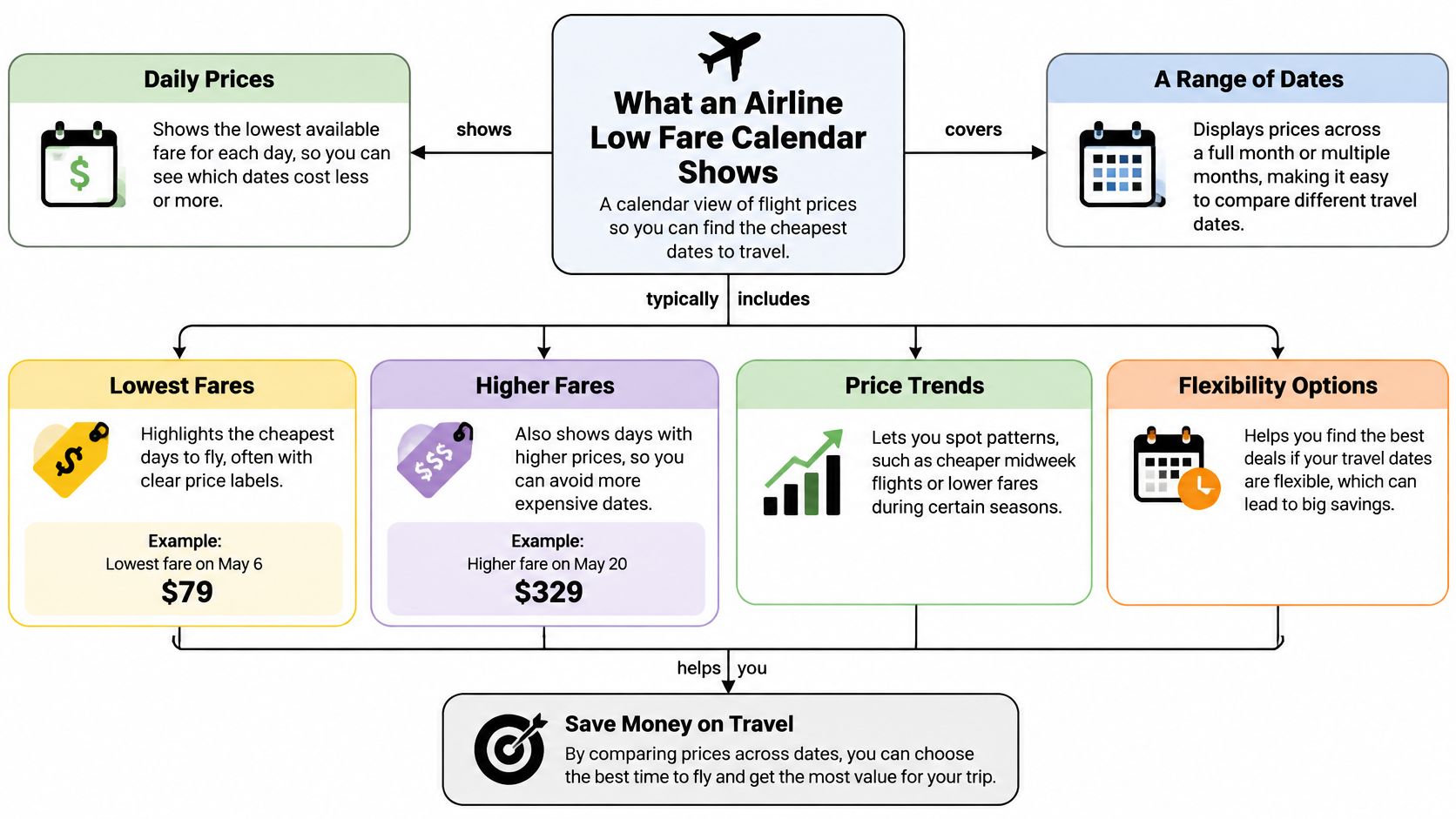
An airline low fare calendar is a grid of daily prices that lets you compare many travel dates at once instead of searching a fixed departure and return date. Like a weekly weather forecast, it helps you spot patterns quickly. You can see which dates look inexpensive and which look costly without opening a separate search for every day.
The difference is that a forecast describes expected conditions, while a fare calendar searches ticket availability. Its cheapest square represents an offer associated with a particular itinerary and set of conditions, not every flight departing that day.
Start with a month, then narrow your search
Suppose you want to fly from Chicago to Los Angeles but haven't committed to a departure date. A flexible-date search lets you compare the month before deciding which flights deserve closer attention.
Skyscanner's whole-month search guide describes a flexible-date model that lets travelers inspect a whole month and extend their search across as many as 12 months, with monthly low fares leading into daily prices. That broad view is helpful when your destination matters more than your exact travel dates.
The calendar's main benefit is easier comparison, as this flowchart illustrates.
Read the pattern, not just the highlight
Prices change with weekday demand, holidays, school breaks, seasonality, and the seats remaining in each booking class. A booking class is a category of ticket inventory with its own price and conditions. Passengers sitting beside each other can hold tickets from different classes.
Keep these distinctions in mind:
- Departure versus itinerary: A cheap outbound date doesn't automatically produce a cheap return trip.
- Date versus schedule: The lowest daily price may belong to an early departure or a lengthy connection.
- Availability versus promise: A calendar is a search interface, not a fixed price list.
For your first search, enter your route and give yourself at least a two-week flexible window if your schedule allows. Note the three cheapest usable days, then open each result and record its complete itinerary price.
Calendar Types and What Their Prices Mean
| Calendar type | What the price means | Main watch-out |
|---|---|---|
| Flexible-date search | Lowest base fare per day, with some tools offering a year-wide view | Totals and fees can change at checkout |
| Airline monthly grid (e.g., Southwest) | Lowest available fare per day in one month | Cheapest Basic fare carries extra restrictions |
| Airline mileage calendar | Points needed per day | Taxes and mandatory fees stay payable in cash |
| Round-trip split pricing | Each-way amount based on a round-trip purchase | A standalone one-way ticket may not be sold at that price |
These displays answer different questions. A flexible-date tool helps you decide when to travel across airlines. An airline's monthly grid helps you compare that carrier's offers, while a mileage calendar helps you search award availability.
Don't treat the numbers as interchangeable. A points requirement isn't a cash price, and an each-way amount isn't necessarily an independently purchasable ticket.
Why comparison became valuable
Airlines do not price tickets based solely on distance. They compete for passengers traveling between specific cities and adjust offers according to demand, capacity, and competing services.
The Government Accountability Office's airline deregulation analysis found that the median U.S. round-trip fare declined nearly 40% between 1980 and 2005, measured in inflation-adjusted 2005 dollars. The agency also identified low-cost and low-fare airlines as a major factor behind lower fares after deregulation.
That history helps explain the calendar's usefulness. When airlines sell different offers for different travel patterns, comparing adjacent dates becomes more valuable than assuming a route has a standard price.
Use discovery and confirmation together
The same route can show different numbers on different sites because the search settings, included airlines, fare products, or refresh times aren't identical. Before comparing results, match the passenger count, airports, cabin, and trip type.
Practical rule: Use a flexible-date tool to discover a promising window, then confirm the exact flights and fare conditions on the airline's own site.
Booking directly isn't automatically cheaper. The point is to compare the same product and understand who will service the ticket if your plans change.
Set Your Price Ceiling Before You Search
The U.S. Bureau of Transportation Statistics reported a 2025 annual average domestic itinerary fare of $387, down 1.8% from the 2024 inflation-adjusted fare of $394. That's a reference point, not a target for your route. A national average doesn't account for your travel dates, airports, or requirements.
Write down your own maximum acceptable trip cost before opening the calendar. Include the ticket, baggage you need, seat selection you intend to buy, and ground transportation.
Define your limits before comparing offers
- Money: Set a total you can afford, not merely an attractive ticket price.
- Time: Identify your earliest departure and latest acceptable return.
- Conditions: Decide whether you can accept advance-purchase requirements, a weekend stay, or limited changes.
- Stop rule: If the final total exceeds your ceiling, stop chasing that date.
For help understanding the terminology, our Airline Fare Rules episode covers advance purchase, Saturday night stay, and seasonality; unlimited access to all episodes costs $89.00, and I-REROUTE subscriptions have a one-year term.
A wider travel window gives you more possibilities, but don't include dates you can't realistically use. Your routine should stay simple: set the ceiling, search the window, verify the total, and book only when the offer fits.
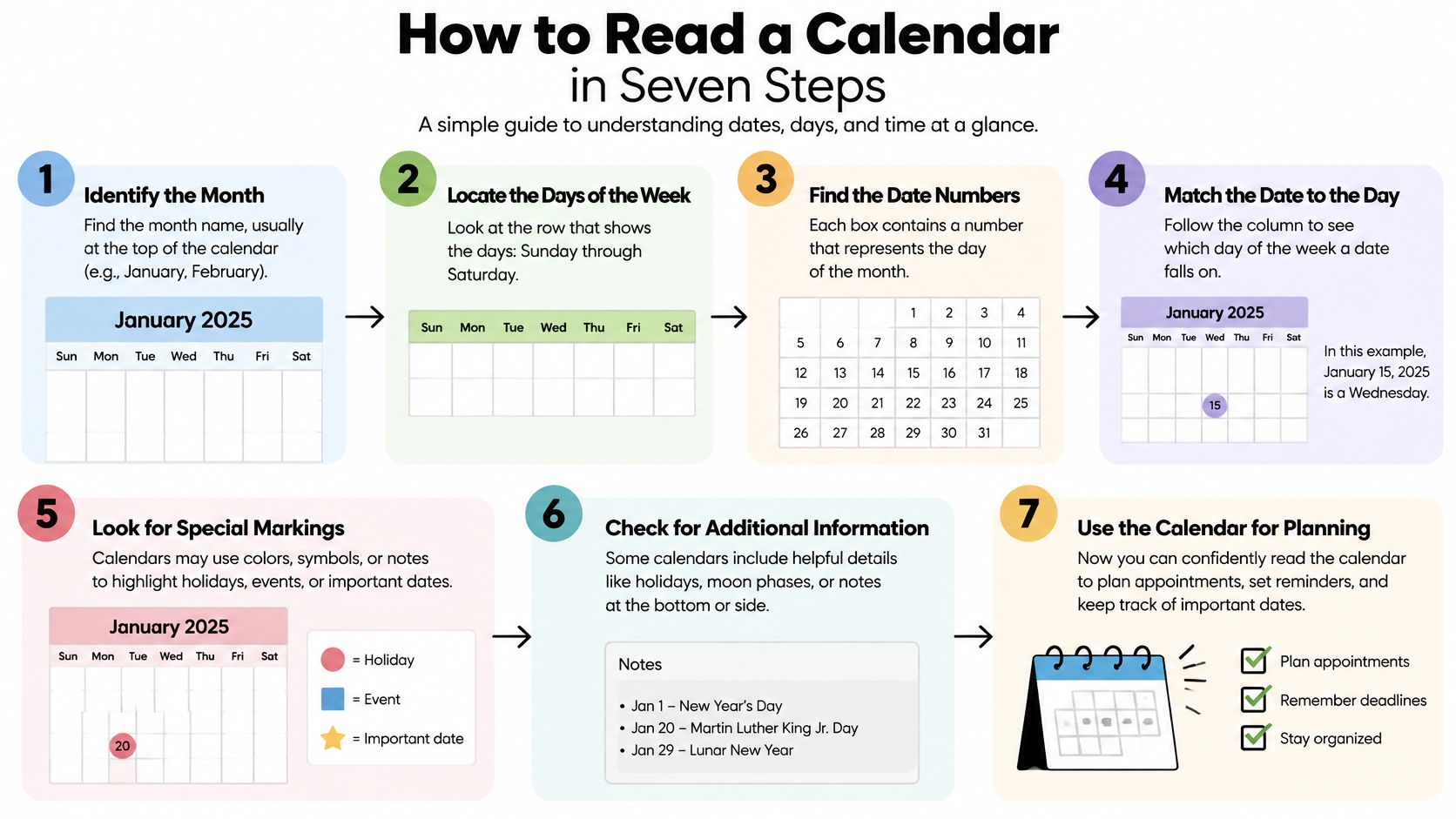
How to Read a Calendar in Seven Steps
Treat the calendar like a shortlist of possibilities. Your task is to turn an appealing square into a ticket with an acceptable schedule, price, and set of rules.
Use this visual guide alongside the checks below.
Build a usable shortlist
Set your route and flexibility. Write down the earliest and latest dates you can travel, and enter the correct passenger count from the beginning. Exclude dates that would force you to miss work, lose a prepaid stay, or arrive after an important event.
Scan the month for cheap clusters. Note two or three groups of inexpensive dates rather than focusing entirely on the lowest square. A cluster gives you alternatives if the first flight has an unsuitable schedule.
Test nearby airports and one-way combinations. Compare an ordinary round trip with separately priced outbound and return tickets. Include the cost and effort of reaching each airport, and remember that separate tickets can create separate servicing and disruption problems.
Open the date and read the conditions. Check advance purchase, minimum or maximum stay, blackout dates, and any round-trip requirement. Make sure the fare applies to your intended cabin and flight, rather than assuming the calendar's lowest offer covers every departure.
Validate the ticket before paying
Proceed to the final checkout screen. Record the total with taxes, mandatory fees, and the optional services you've selected, but stop before submitting payment. The calendar number is an inventory signal, and Cozen O'Connor's explanation of DOT airfare guidance explains that sellers must have a reasonable number of seats available at an advertised fare while offering it.
Compare complete alternatives. Put that checkout total beside the original calendar figure and the next-cheapest usable date. Choose between actual itineraries, including departure times, connections, baggage, and restrictions, rather than comparing isolated headline amounts.
Recheck after any change. Confirm the itinerary and price again if you alter the passenger count, airport, dates, or flights. Read the final purchase summary carefully so you don't pay for an option left over from an earlier search.
The accompanying video offers another way to follow the booking process.
A good result isn't necessarily the smallest number you encountered. It's a fare under your ceiling, with conditions you accept, for flights you can use and book today.
Total Trip Cost Beats the Lowest Date
Most calendars highlight the lowest available fare associated with a date. They don't calculate your personal cost of taking that trip, including luggage, airport access, schedule inconvenience, and the possibility that you'll need to change plans.
Southwest's lowest-fare guidance explains that its calendar displays the lowest available fare and warns that its cheapest Basic fare carries additional restrictions. A low number can therefore identify a different product, not just a discount on the ticket you'd otherwise buy.
Separate the ticket from the trip
| Cost item | In the calendar price? | Where to check |
|---|---|---|
| Base fare | Yes, as part of the calendar price | Calendar figure |
| Mandatory taxes and fees | Yes, in U.S. advertised airfares | Checkout total |
| Checked bag | Usually not | Airline bag policy page |
| Seat selection | Usually not | Seat map at checkout |
| Change or cancel fee | Usually not | Fare rules |
The distinction between mandatory and optional charges matters. The U.S. Department of Transportation's airfare rules require advertised airfares to include mandatory government taxes, fees, and carrier-imposed charges in the first displayed price, while also requiring clear disclosure when an each-way amount depends on a round-trip purchase.
That means a properly advertised U.S. cash fare shouldn't begin as a tax-free teaser. But your checked bag or preferred seat can still increase what you personally pay.
Compare a realistic scenario
Say a departure is $40 cheaper than another option, but it requires an overnight stay near the airport. That's a hypothetical saving on the ticket, not proof of a cheaper trip. Add accommodation, meals, transportation, and the inconvenience before deciding.
A distant airport creates a similar problem. A fare can look attractive until you price the longer transfer, parking, or rental-car arrangements.
The cheapest square is only the cheapest trip if you can use its schedule and accept its conditions without spending more elsewhere.
Keep a simple comparison for three usable dates: calendar price, checkout total, required extras, and restrictions. If your plans are uncertain, also consider what you'd lose or pay to change them.
You don't need to assign a dollar value to every inconvenience. You do need to recognize when a nominal saving requires a trade you wouldn't otherwise make.
Why Fares Vanish, Change and Sell Out
Airlines don't sell every seat at the lowest advertised price. The U.S. Department of Transportation's fare-shopping guidance says carriers typically set aside only a few seats at lower rates and may release additional discount seats shortly before an advance-purchase deadline when a flight is underperforming.
Think of the aircraft as having several price categories, not a single price attached to every empty seat. An airline can still have seats available after closing its cheapest category.
A disappearing fare has several possible explanations
- The last eligible seat sold: Another traveler completed a purchase before you did.
- The airline closed the fare category: Revenue-management controls stopped offering that price, even though the aircraft wasn't full.
- The search result was stale: The calendar displayed an earlier result that didn't survive a fresh availability check.
A vanished price doesn't, by itself, prove that the original offer was fake. Without access to the seller's inventory history, you usually can't tell which explanation applies.
CheapAir.com's company-sponsored 2024 airfare study reported that fares changed 49 times on average from when a trip first went on sale, with an average change of $95 each time. That's a finding from the company's study, not a prediction of how your particular ticket will behave.
Shopping can involve repeated price checks, especially when dates remain flexible.

Don't confuse flexibility with certainty
Booking earlier isn't universally best, because an airline may open cheaper inventory when demand is weak. Waiting isn't reliably better either. A late discount is a possibility, not something you should build an essential trip around.
For frequent flyers and business travelers, usable flexibility offers practical protection. You may be able to choose an adjacent date or a different flight instead of paying more for the exact departure you first selected.
Use the checkout verification routine rather than repeatedly refreshing a vanished offer. Keep a maximum price for the complete trip, and move on when an available alternative meets your needs.
How Hidden-City Tickets Work
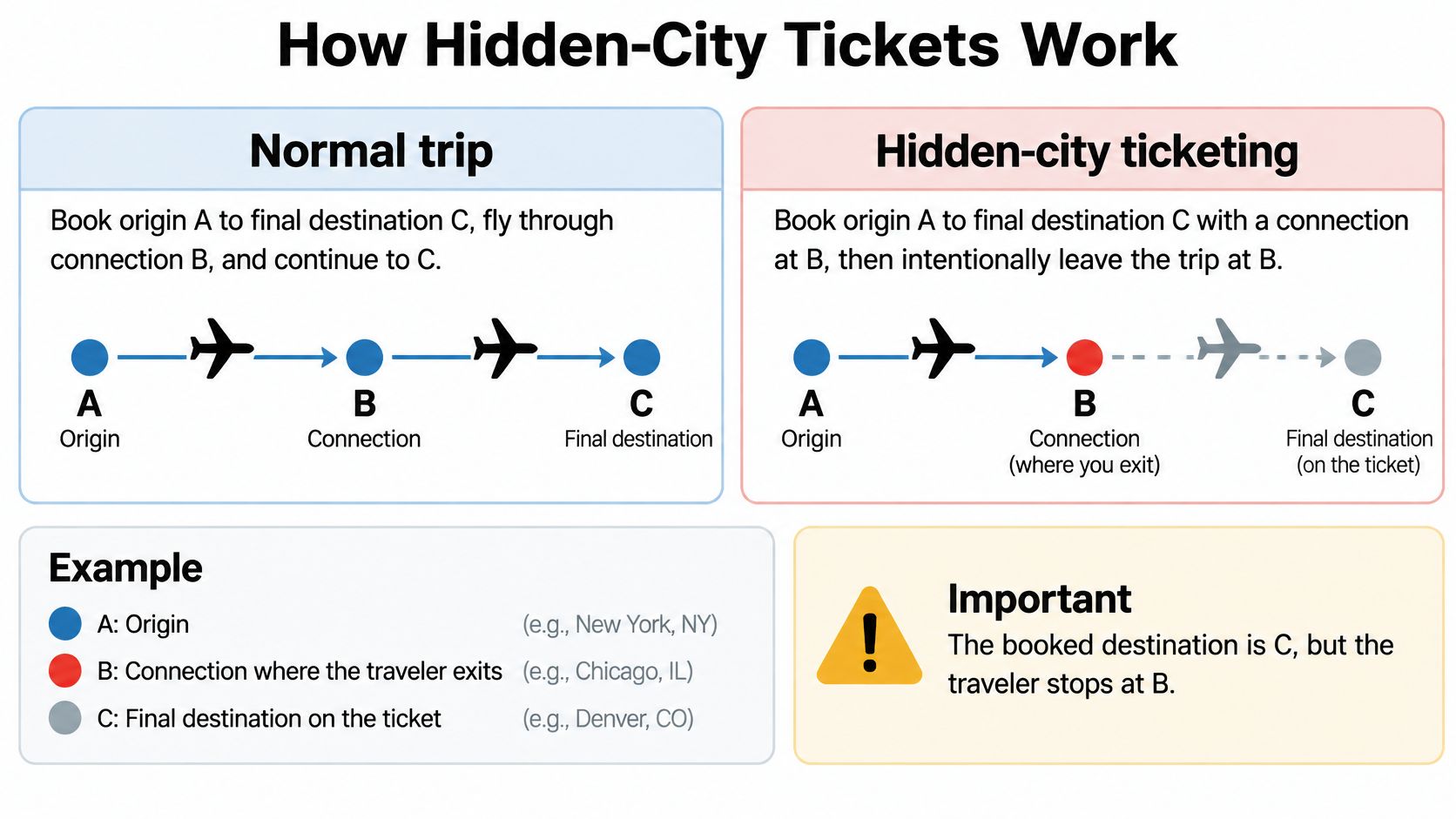
Suppose you want to travel from origin A to city B. The nonstop A-to-B ticket costs more than a ticket from A to final destination C that connects at B. A traveler buys the A-to-C itinerary, gets off at B, and intentionally skips the remaining flight.
That's hidden-city ticketing, also called point-beyond ticketing. It's a different tactic from shifting dates on a calendar: the traveler doesn't intend to complete the itinerary purchased.
The route diagram makes the distinction clear.
Why the longer itinerary can cost less
Airlines price journeys for different competitive markets, rather than adding a charge for each mile flown. A connection through a hub may therefore sell for less than a nonstop journey ending at that hub.
A review of hidden-city pricing reports that the U.S. Department of Transportation identified 398 markets with potential opportunities and fare differences ranging from $103 to $1,954. Those findings describe the markets examined, not savings a traveler should expect on any current search.
An empirical study of hidden-city opportunities found that they were concentrated among large hub-and-spoke airlines and occurred largely during the last week before departure. Finding an apparent opportunity still doesn't make it a suitable booking.
The risks aren't limited to baggage
- Airline conditions: Carriers generally prohibit this practice and may take action affecting tickets, loyalty accounts, or future travel.
- Checked luggage: Bags tagged to C generally continue to C, not the connection where you intend to leave.
- Gate checking: Carry-on-only travel reduces baggage complications, but a bag can still be checked at the gate.
- Remaining flights: Skipping a segment can cause the airline to cancel later segments on the same ticket.
- Disruptions: The airline may reroute you to the ticketed destination without passing through your intended stopping point.
Our editorial coverage examines how airlines fill first-class seats, including hidden-city ticketing, backroom favors, and AD75 discounts. Understanding a mechanism isn't the same as recommending it for every traveler.
Involuntary Reroute characterizes hidden-city fares and tickets as an airline-invented tool for benefiting airlines by disposing of unsold leftover seats travelers refused to overpay for. That interpretation should be distinguished from the practical contract risks: this tactic is suitable only for travelers who understand and accept them.
Premium Cabin Pricing and What the Founder Claims
What does a low fare calendar tell you about a premium-cabin seat? It can show a lower fare on a particular date, but the price still depends on the itinerary and its conditions.
INVOLUNTARY REROUTE describes the founder as the father of the hidden-city ticket and the son of the cheap first-class flight. Both concepts were conceived at Babson College, where the founder was a 19-year-old entrepreneurial studies undergraduate when first exposed to airline trickery. The Involuntary Reroute e-book, also available as an audiobook, discusses the four primary tools of airline deception.
Separate the founder's view from the calendar price
The founder's position is that fewer than 20% of premium-cabin seats are filled at their initial asking price. In other words, the price first displayed for a seat does not necessarily reflect what it eventually sells for. An empty seat can lose value quickly, much like unsold stock approaching the end of its selling window.
That perspective helps explain why a premium-cabin fare may change or appear on only certain dates. It does not mean every lower calendar price is a suitable deal. Check the full itinerary, fare conditions, and availability before comparing it with another date.
What the calendar can and cannot show
A calendar is a starting filter, not a promise that a particular seat or fare will be available when you book. It shows prices associated with dates; it does not, by itself, explain why a fare is lower or whether its conditions fit your trip.
For a premium cabin, compare the displayed price with the complete trip and the fare rules. A cheaper square may involve a different routing or conditions that matter to you. The useful question is not, “Which date is cheapest?” It is, “Which available itinerary gives me the value I want at a price I'm willing to pay?”
INVOLUNTARY REROUTE explores how airlines fill business- and first-class seats and how premium-cabin pricing works. Its podcast covers fare tactics including hidden-city tickets, travel agent IDs, AD75 discounts, mileage redemptions, and point-beyond fares. The calendar can help identify dates to investigate; understanding the fare and its conditions helps you judge whether the apparent saving is worth it.