


Airline Name Change Policy: Fees, Fixes, and Real Options
October 15, 2026You've just opened your confirmation and spotted the problem: your first name is missing a letter, your surname is still your maiden name, or the ticket belongs to a colleague who can no longer travel. The natural question is, “Can I change the name?” That wording is exactly where many travelers lose time and money.
An airline name change policy doesn't treat every request alike. A typo, a documented legal identity update, and a transfer to another person are separate transactions. The first may be corrected on the existing ticket. The second may require proof. The third commonly means cancelling the original booking under its fare rules and buying a new ticket at current availability.
The cheapest outcome depends on using the right category and asking for the right action before check-in, ticket use, or airport control complicates the record.
The Typo on Your Ticket and Why It Matters
A traveler sees a misspelled name and often assumes the airline can overwrite it. Reservation systems don't work like a profile page. The passenger name is tied to the ticket, security data, seat assignment, frequent-flyer account, and the identity document presented for travel.
That's why a small spelling error can produce three very different outcomes. An airline may correct it without charge, apply a processing fee, or refuse to edit the record and require a rebooking. The result depends on the airline, the ticket status, the itinerary, and whether the corrected name still identifies the same traveler.
Start with the identity question
Compare the ticket with the passport or government ID you'll use. Don't begin by asking, “Can I change this name?” Begin with, “Does this correction make the record match my document while keeping me as the passenger?”
Examples that usually belong in the correction category include:
- A spelling mistake: One or more letters were entered incorrectly.
- Reversed names: Your first and last names appear in the wrong order.
- An incomplete name: A shortened first name or omitted element needs to match the travel document.
- A legal update: Marriage, divorce, or a court-recognized change has altered the name on your identification.
A request to replace yourself with a spouse, friend, or colleague is different. That request changes the person entitled to use the ticket, which raises ticket-control and identity-security concerns.
Practical rule: Ask for a “name correction” when the same person is travelling. Don't call a passenger substitution a correction.
The U.S. Department of Transportation's 24-hour rule doesn't solve this problem. The DOT's ticket guidance says airlines must either hold a reservation without payment for 24 hours or provide a full refund when a passenger cancels within 24 hours of booking, provided the ticket was purchased at least 7 days before departure. It doesn't require the airline to correct a misspelled name for free.
The practical lesson is simple. Check the name immediately after booking. If it's wrong, contact the ticket issuer while the booking is still unused and before the airline's operational deadlines close.
How Airlines Define a Name Change
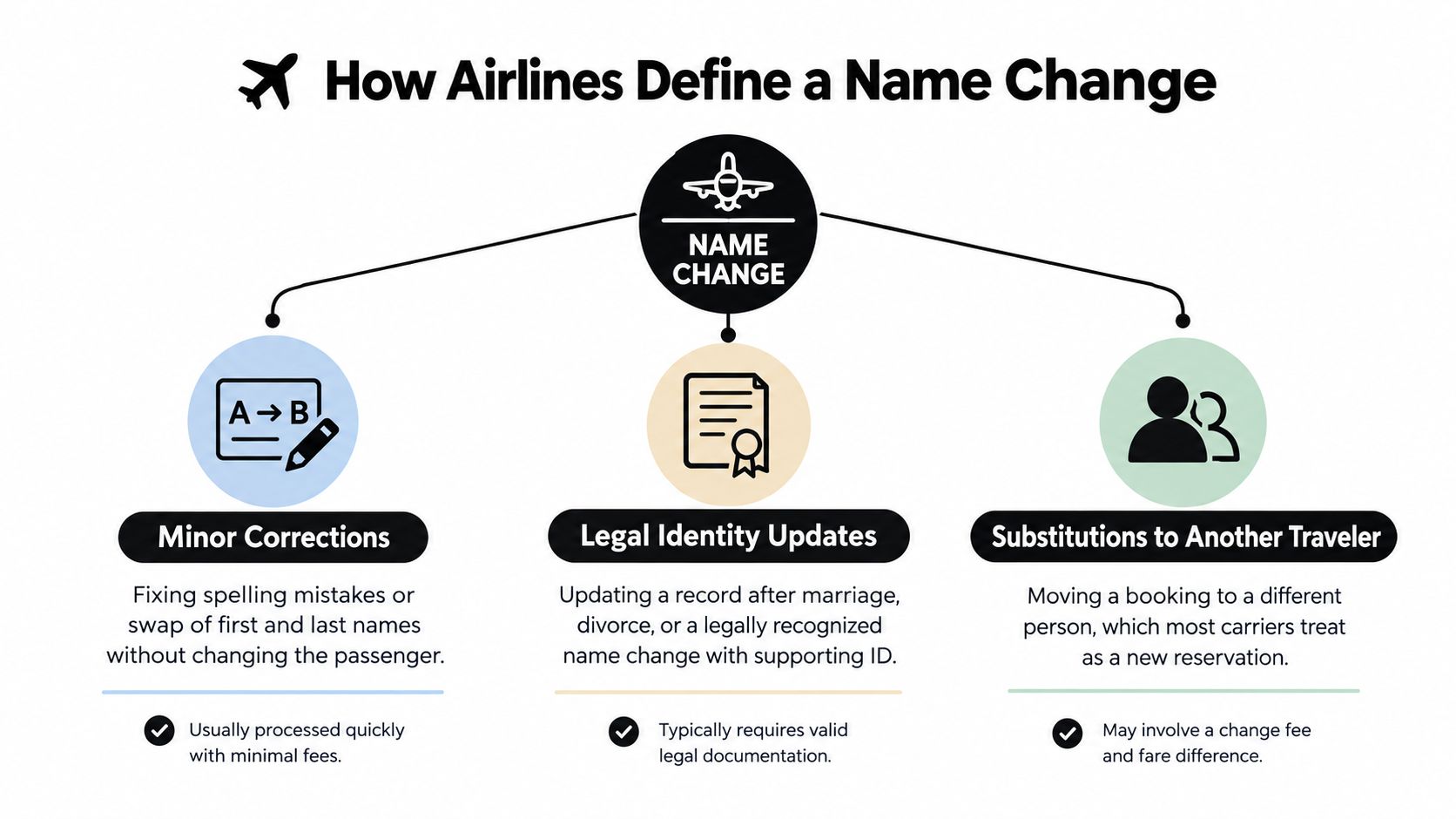
Airlines generally sort name requests into three groups. Minor corrections preserve the original passenger. Legal identity updates preserve that passenger but require supporting documentation. Substitutions put a different person in the seat and are usually treated as a new transaction.
The distinction exists because a passenger name isn't casual account data. It controls who may use the ticket and connects the booking to security and accounting records. IATA's passenger-name-record implementation material includes a dedicated history element for passenger-name changes, showing that reservation systems can retain a record of identity-data modifications.
Three categories, three outcomes
A minor correction is the closest thing to an ordinary edit. The traveler remains the same, and the airline adjusts the record to match the government ID. Reversed first and last names, typographical errors, and incomplete names can fall here.
A legal identity update is also about the same traveler, but the documentary trail matters. A marriage certificate, divorce record, or court documentation may be required. The airline needs evidence that the changed name belongs to the person already attached to the ticket.
A substitution changes the traveler. The original passenger gives the booking to someone else, even if the flight, date, seat, and itinerary remain identical. Most airlines treat that as prohibited or require the original ticket to be cancelled and a new ticket issued.
Think of a hotel reservation. A correction changes the spelling on the nameplate for the guest who made the reservation. A substitution asks the hotel to remove that guest and check in somebody else under the original price. Airlines protect the second transaction much more aggressively.
The question that unlocks the policy
Ask this before contacting anyone:
Will the same person named on the original booking travel on the ticket?
If the answer is yes, present the request as a correction and support it with the relevant ID. If the answer is no, prepare for a transfer restriction, refund assessment, and new fare.
Name Correction Versus Name Transfer
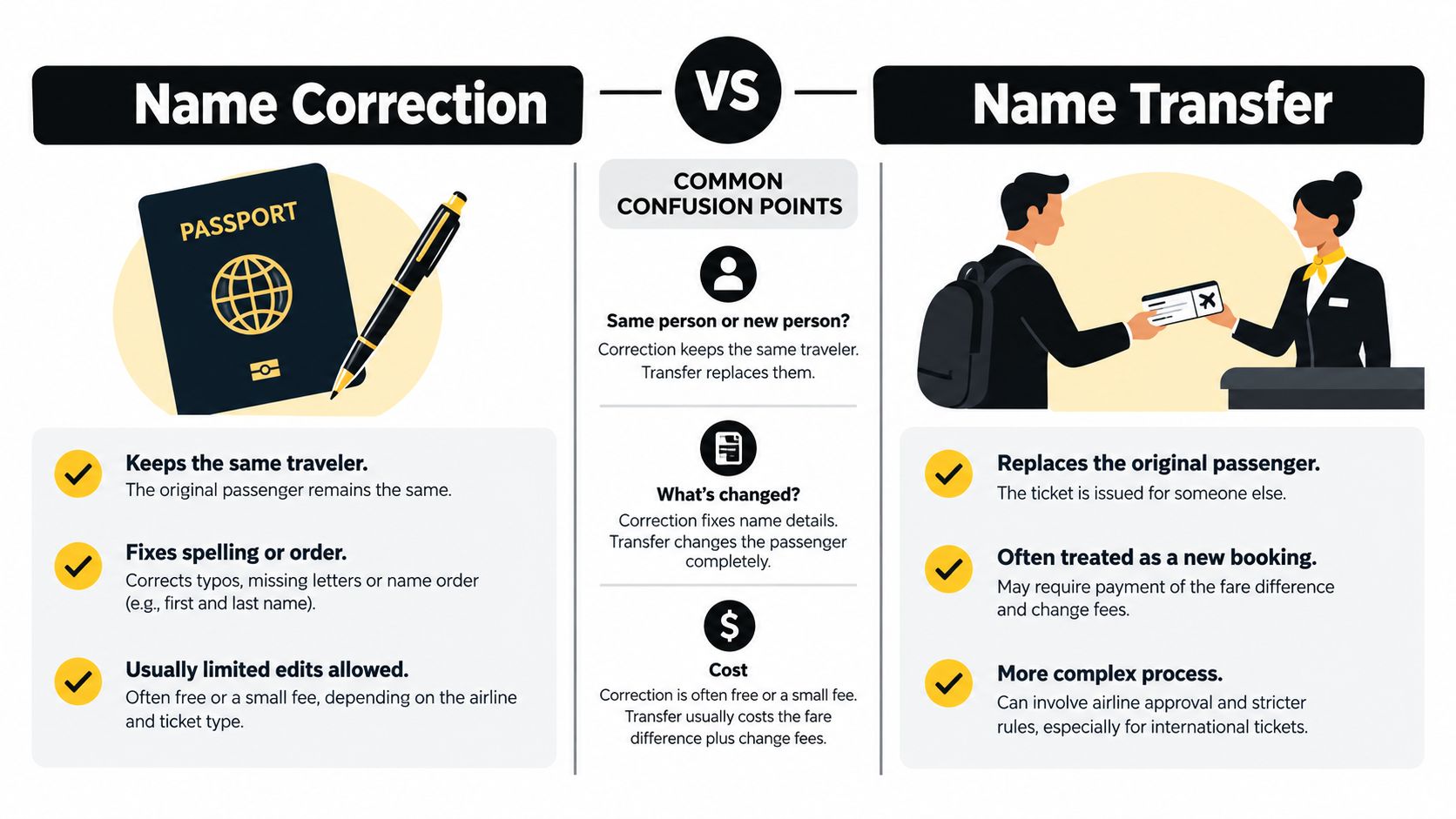
A name correction fixes the identity record for the passenger who already owns the ticket. A name transfer replaces that passenger. Travelers often use “name change” for both, but the distinction determines whether the original fare survives.
A correction may preserve the itinerary and fare, subject to the carrier's rules and any applicable fee. A transfer can trigger cancellation, a fare-rule refund, and a new booking at current inventory. That's why asking an airline to “change the name” without explaining who will travel is a poor strategy.
The correction side
A correction keeps the original traveler and normally relates the ticket to a passport or government ID. The permitted scope varies sharply by carrier.
Alaska Airlines' agent name-change and transfer guidance limits routine corrections to completely unused tickets and generally allows changes of no more than three letters. Its procedure also permits only one reissue under the relevant correction waiver. A ticket that has been partly used, includes another airline's segment, or requires an itinerary or date-of-birth change may not qualify for a simple correction.
Lufthansa Group's policy allows limited typo corrections, including corrections of up to two letters in the cited policy, while legal corrections may require documentation. An issued-ticket correction can still attract a fee, and country-specific exceptions can apply. The same typo therefore doesn't have one universal price.
The transfer side
A transfer substitutes a new traveler. Lufthansa Group states that changing the person travelling isn't allowed. The original booking must be cancelled, the unused ticket refunded according to its fare conditions, and a new booking issued from current inventory.
That new booking may cost more because the original fare bucket may no longer be available. The airline isn't editing the old passenger record. It's closing one passenger's transaction and selling another passenger a seat under the fare available at that moment.
If the corrected name identifies a different person, stop looking for a low-cost edit. You're dealing with a new purchase.
Use this test consistently:
| Request | Same traveler? | Likely treatment |
|---|---|---|
| Typo or reversed names | Yes | Limited correction |
| Marriage, divorce, or court-recognized update | Yes | Documented legal correction |
| Ticket given to a colleague or relative | No | Transfer restriction or new booking |
Typical Fees, Fare Differences, and Time Windows
Fees are the least predictable part of an airline name change policy because airlines don't price every request the same way. A minor correction may be free, while a complex correction, agency-handled request, or reissued ticket may involve a charge. A passenger substitution is more serious because the original fare usually doesn't move with the new traveler.
The main cost components are:
- Correction fee: The carrier may charge for processing or reissuing an eligible correction.
- Fare difference: If the action requires a new booking, the replacement seat uses current inventory and pricing.
- Agency or service fee: A travel agency or online intermediary may add its own processing charge.
- Refund consequence: The original fare rules decide whether unused value returns to the passenger.
What the request type usually means
| Request Type | Typical Fee | Fare Difference | Usual Time Window |
|---|---|---|---|
| Minor typo correction | Airline-specific, sometimes waived | Usually not if the original ticket is reissued | Before ticket use and before operational cutoffs |
| Legal identity correction | Airline-specific, documentation may be required | May apply if the carrier requires rebooking | As early as possible before departure |
| Passenger substitution | Usually governed by transfer or rebooking rules | Current fare and inventory commonly apply | Before travel, subject to fare conditions |
| Third-party booking correction | Airline or intermediary charge may apply | Depends on whether the ticket can be reissued | Contact the ticket issuer promptly |
Don't rely on a general fee chart found online. The useful question is whether the airline can reissue the same ticket for the same passenger. If it can, the fare is more likely to remain intact. If it can't, the current fare becomes the controlling price.
Time works against you
Most carriers are more willing to review an unused ticket than one with a flown segment. A ticket containing another airline's flight, a partially used itinerary, or a booking close to departure can require special handling. Once the record enters airport control or check-in processes, a routine correction may no longer be available.
The DOT rule creates another common misunderstanding. It's a cancellation-and-refund protection, not a free-edit guarantee. A qualifying U.S. booking may be cancelled for a full refund within the stated rule conditions, but the airline isn't federally required to alter the passenger name without charge.
Contact the issuer immediately. Send the exact spelling from the ID, explain that the same person will travel, and request written confirmation before relying on the corrected record.
International and Code-Share Considerations
A code-share booking can involve a marketing airline, an operating airline, a ticketing airline, and additional carriers on connecting segments. One carrier may accept a correction while another rejects it. If the airlines can't all support the change, the practical result may be cancellation and rebooking.
Virgin Atlantic's name-correction policy allows limited corrections that match the passport while retaining the original surname and date of birth. It also explains that itineraries involving other carriers may require cancellation and rebooking if every airline doesn't accept the correction.
Check the booking in the right order
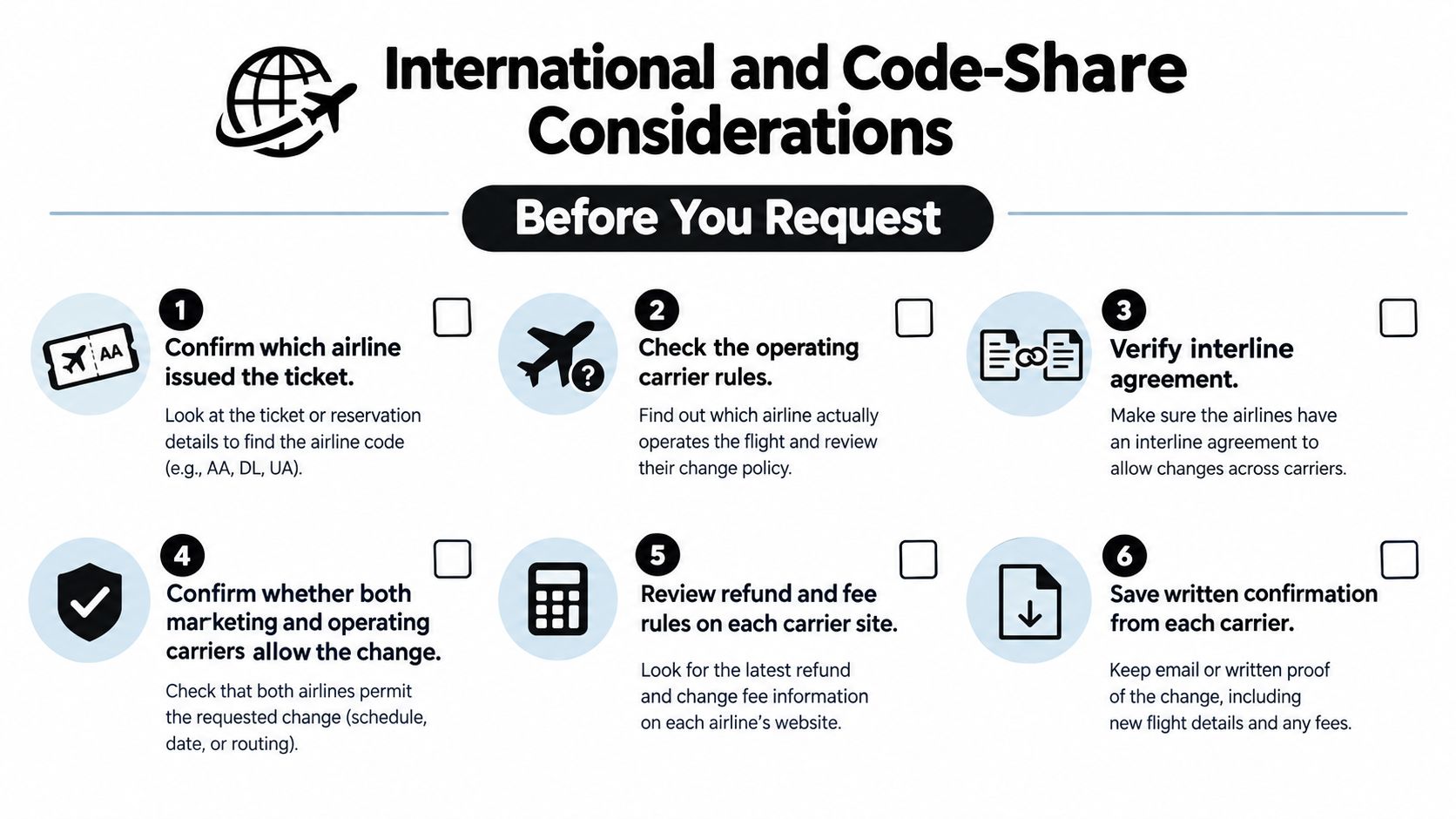
Before asking for an international correction, verify:
- The ticket issuer: Identify the airline or agency that issued the ticket.
- The operating carriers: List the airlines physically operating each flight.
- The interline relationship: Confirm that the carriers can process the same ticket record together.
- The identity evidence: Prepare the passport for a spelling correction or legal documents for a legal update.
- The fare consequence: Ask whether the existing ticket will be reissued or cancelled.
- The written result: Save the confirmation, updated ticket number, and corrected passenger name.
International travel adds document risk. A passport name, visa record, entry authorization, and airline reservation may need to align. Some markets and carriers apply local documentation rules to legal changes, so ask the issuing airline exactly which documents it accepts before sending sensitive paperwork.
A domestic correction may stay within one carrier's reservation system. An international itinerary can cross separate systems and fare controls. That's why a request that looks clerical on your screen can become a reissue problem for the airline.
Never wait until the airport to discover which carrier controls the record. Confirm the corrected name, ticket status, and connecting segments while the booking is still unused.
How to Request a Name Change Step by Step
The fastest way through an airline name change policy is to arrive with a precise request. A vague call about “changing the name” invites the agent to classify the transaction conservatively. A clear correction request, backed by the right document, gives the agent a workable path.

Follow this sequence
First, classify the request. Write down whether it's a typographical correction, a legal identity update, or a transfer. If another person will travel, label it as a substitution.
Second, collect evidence. Use the passport or government ID for a spelling issue. For a legal update, prepare the marriage certificate, divorce record, or court order, along with identification showing the relevant names.
Third, contact the right party. The ticket issuer controls the booking relationship. A direct airline booking goes to the airline. An agency or online travel booking goes to the issuing intermediary.
Fourth, use the channel that can solve the problem. A self-service form may handle a straightforward typo. Phone reservations or a professional travel agency are usually more effective for legal documents, code-shares, partly complex itineraries, or transfer questions.
A honeymoon booking shows why timing matters. If the passenger booked under a maiden name but will travel with identification showing a married surname, the request may be a documented legal correction. The agent needs proof and enough time to process it. Don't assume an online form will handle a wedding-related change correctly at the last minute.
Now consider a corporate booking. An employee who can't travel asks the company to put a colleague in the same seat. The company isn't correcting an identity record. It's asking for a passenger substitution, so the airline may require cancellation under the original fare rules and a new purchase at current availability.
After the agent completes the action, ask for the updated ticket number and passenger-name record. Compare the spelling with the travel document, then confirm the seat, connections, loyalty number, and any required security details.
Use the image above as a reminder of the basic habit that prevents most cases: verify the name at issuance, not days before departure.
A correction isn't complete because an agent says it's done. It's complete when the reissued document and booking record show the correct traveler.
Two Real-World Scenarios and How They Resolve
A surname update after marriage and a corporate replacement may look similar on the booking screen. They aren't similar under airline rules.
The honeymoon surname switch
A traveler books a honeymoon under her maiden name, then receives updated identification after marriage. She contacts the airline, explains that she remains the passenger, and supplies the marriage documentation and identification requested by the carrier.
That request belongs on the legal-correction side. The airline may process it without a fee when the documentation is complete and submitted early, but approval isn't automatic. A late online form can fail even when the underlying request is legitimate. The traveler should call the ticket issuer, state that the same person will fly, and ask whether the ticket will be reissued or merely annotated.
The corporate substitution
An employee books a restricted fare but can't attend. A colleague wants the same flight. The company asks the airline to replace the passenger.
That's a transfer. The carrier may cancel the original ticket, refund it according to its fare rules, and issue a new ticket for the colleague. If the original ticket is non-refundable, the refund value may be zero. The colleague then pays the current fare, not the amount the company originally paid.
The difference isn't goodwill. It's identity control and fare accounting. A permitted correction keeps the ticket connected to the original traveler. A substitution creates a new passenger transaction.
For a written request, use language that removes ambiguity:
Please process this as a name correction for the same passenger. The passport spelling is [correct name], and the passenger will remain the traveler on every segment. Please confirm any fee, reissue requirement, and updated ticket number in writing.
For a phone call:
I'm not transferring the ticket. I'm the original passenger, and I need the booking corrected to match my government ID. What document do you need, and will the existing fare remain attached after reissue?
Scripts, Templates, and Tips to Keep Costs Low
The most useful script is short, accurate, and specific about the traveler. Don't lead with frustration or ask an agent to “make an exception.” Give the agent the classification needed to route the request correctly.
Email template for a typo
Subject: Name correction request for booking [confirmation code]
Hello,
I'm requesting a name correction for the same passenger on booking [confirmation code]. The ticket currently shows [incorrect name]. The passenger's government ID shows [correct name].
Please confirm whether this qualifies as a correction, whether any document is required, whether a fee applies, and whether the existing fare and itinerary will remain unchanged.
Please send the updated ticket or written confirmation after processing.
Thank you,
[Passenger name]
[Contact details]
For a legal update, add the document names without attaching more personal information than the airline requires. Ask the agent to confirm acceptable file formats and whether the document must be translated or formally certified.
Agent checklist before issuing
- Read the document: Enter the name exactly as shown on the passport or government ID.
- Confirm the traveler: Ask whether the person being entered is the person who will travel.
- Review every segment: Identify codeshares, interline flights, and operating carriers.
- Check the ticket status: Don't promise a correction on a partly used or otherwise restricted ticket.
- Record the request: Save the original name, corrected name, documents, contact log, and written approval.
- Verify after reissue: Check the passenger record, ticket number, seat, connections, and loyalty details.
Frequent flyers should store the exact travel-document spelling in a secure reference, disable unreliable autofill, and inspect the confirmation immediately after payment. For a complex issue, contact the ticket issuer directly rather than relying on an airport desk.
Airline fare controls explain why these cases feel inconsistent. The same revenue-management logic that restricts passenger substitutions also creates pricing gaps between nonstop and connecting itineraries. Hidden-city ticketing, also called point-beyond ticketing or skiplagging, relies on a farther ticketed destination that connects through the city where the traveler intends to stop, as described in the academic overview of hidden-city ticketing. The U.S. Department of Transportation describes the practice as prohibited by most airlines and treats the ticket as a binding transportation contract covering the route and price in its transportation research material.
Don't repeat the unsupported story that airlines invented hidden-city fares to dispose of unsold seats, that the practice was first institutionalized at Babson College, or that a particular book independently proves that history. Those claims aren't verified by independent research. Focus on the part you can act on: a typo may preserve your ticket, a legal update needs evidence, and a different traveler usually needs a new purchase.
INVOLUNTARY REROUTE (I-REROUTE.COM) offers practical podcast episodes and membership content on hidden-city ticketing, point-beyond fares, premium-cabin pricing, and the fare-control practices that sit behind airline reissues. Visit INVOLUNTARY REROUTE (I-REROUTE.COM) to explore the catalog and learn how travelers, agents, business owners, and students can analyze airline pricing more intelligently.