


Airline Price Discrimination: How Airlines Set Fares
October 11, 2026Most advice about airline price discrimination starts with incognito mode. Clear your cookies, open a private window, and supposedly the airline will stop charging you more. That explanation is attractive because it makes a confusing experience feel personal. It also distracts from the machinery that usually matters more: fare buckets, booking timing, restrictions, route structure, and the total price of the journey.
Airlines rarely sell one seat at one universal price. They sell different versions of access to that seat, then use rules and inventory controls to sort travelers by flexibility and willingness to pay. Some differences come from ordinary market segmentation. Others may come from individualized algorithmic offers. Hidden-city fares expose an especially surprising part of the system, because the same connecting route can price below a nonstop trip to the connecting city.
The useful question isn't, “Why did my fare change?” Ask instead, which pricing mechanism changed, what restriction explains the difference, and what evidence shows whether the fare changed because of me or because the inventory changed?
What Happens When You Search for a Flight
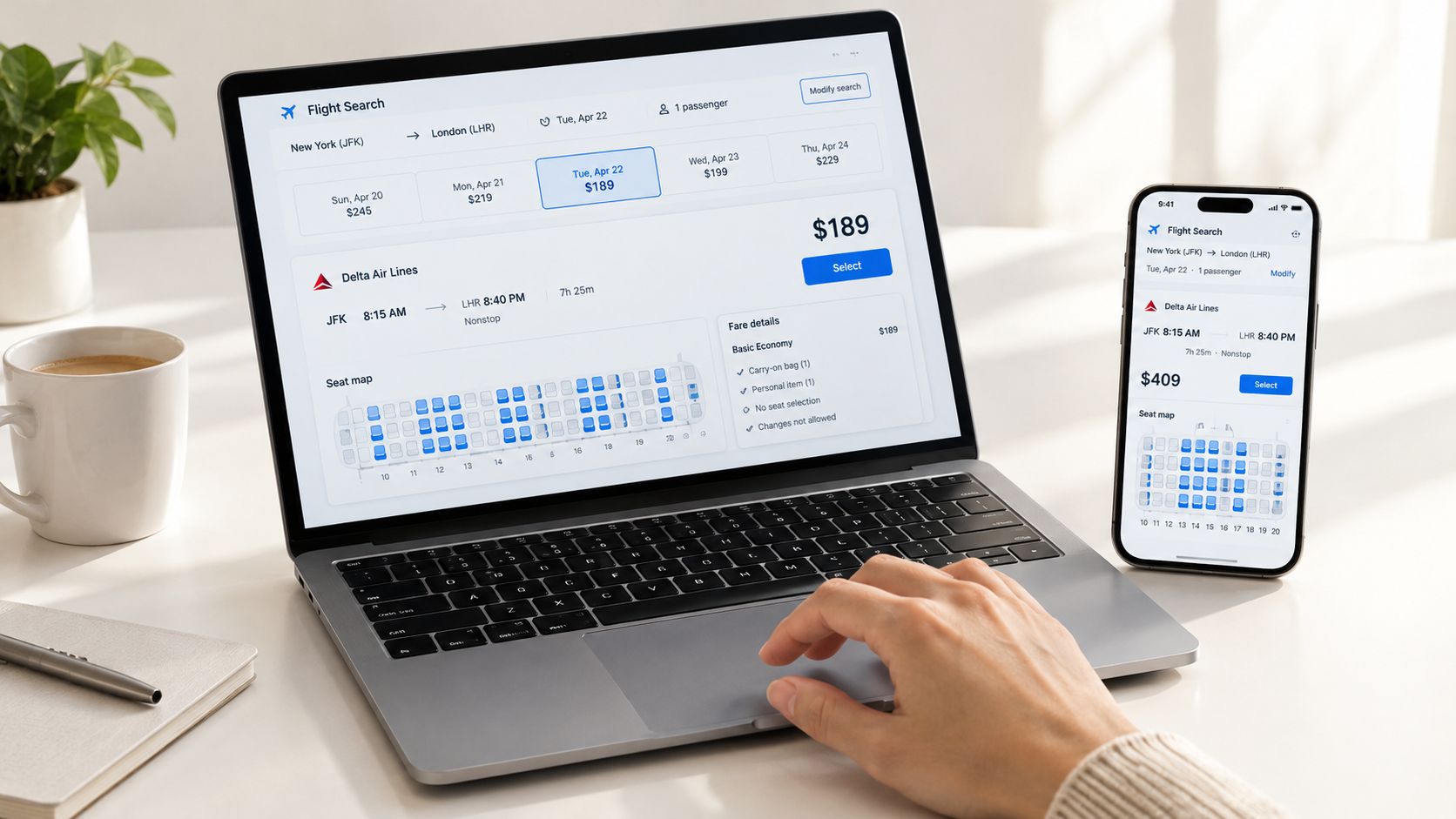
You search for a Chicago to Denver flight and see $189. You open another tab, check the same itinerary on a phone, and find $312. A later refresh shows $409. The natural conclusion is that the airline noticed your interest and punished you for searching.
That conclusion may be wrong. The lowest fare bucket may have closed, the airline may have refiled fares, or a booking site may have displayed an older cached result. Different markets, currencies, taxes, and remaining inventory can also produce different screens. Your search history can feel like the obvious cause because the number changed after you searched, but timing and availability often provide the simpler explanation.
Three different systems can look identical
Inventory-based fare buckets assign prices to blocks of seats or fare classes. When the lowest class closes, your search sees the next available class, even if the aircraft still has open seats.
Customer segmentation uses observable signals such as booking timing, itinerary characteristics, cabin, flexibility, and refundability. The airline doesn't need to know your job title. It can use the fact that you're booking close to departure and buying a flexible fare as a useful proxy for urgency.
Individualized algorithmic pricing is different. It means the system changes the price or offer because of data associated with you as an individual, rather than because a standard fare rule or shared inventory condition applies.
The distinction matters for your wallet and your expectations. The first two mechanisms are established parts of airline revenue management. The third raises sharper questions about privacy, fairness, and whether comparison shopping can protect you.
Hidden-city fares make the puzzle more interesting. A ticket that continues through Denver to another city may cost less than a nonstop Chicago to Denver ticket, even though the traveler plans to leave at the connection. The story behind that practice, including the work of Involuntary Reroute, helps reveal how airlines design markets around routes and fare restrictions rather than around the simple distance between two airports.
Airline Price Discrimination in Plain Language
Airline price discrimination usually sounds more sinister than it is. In many cases, the airline is not peering into your life and inventing a custom number just for you. It is selling the same seat under different terms, then letting travelers sort themselves by what they need.
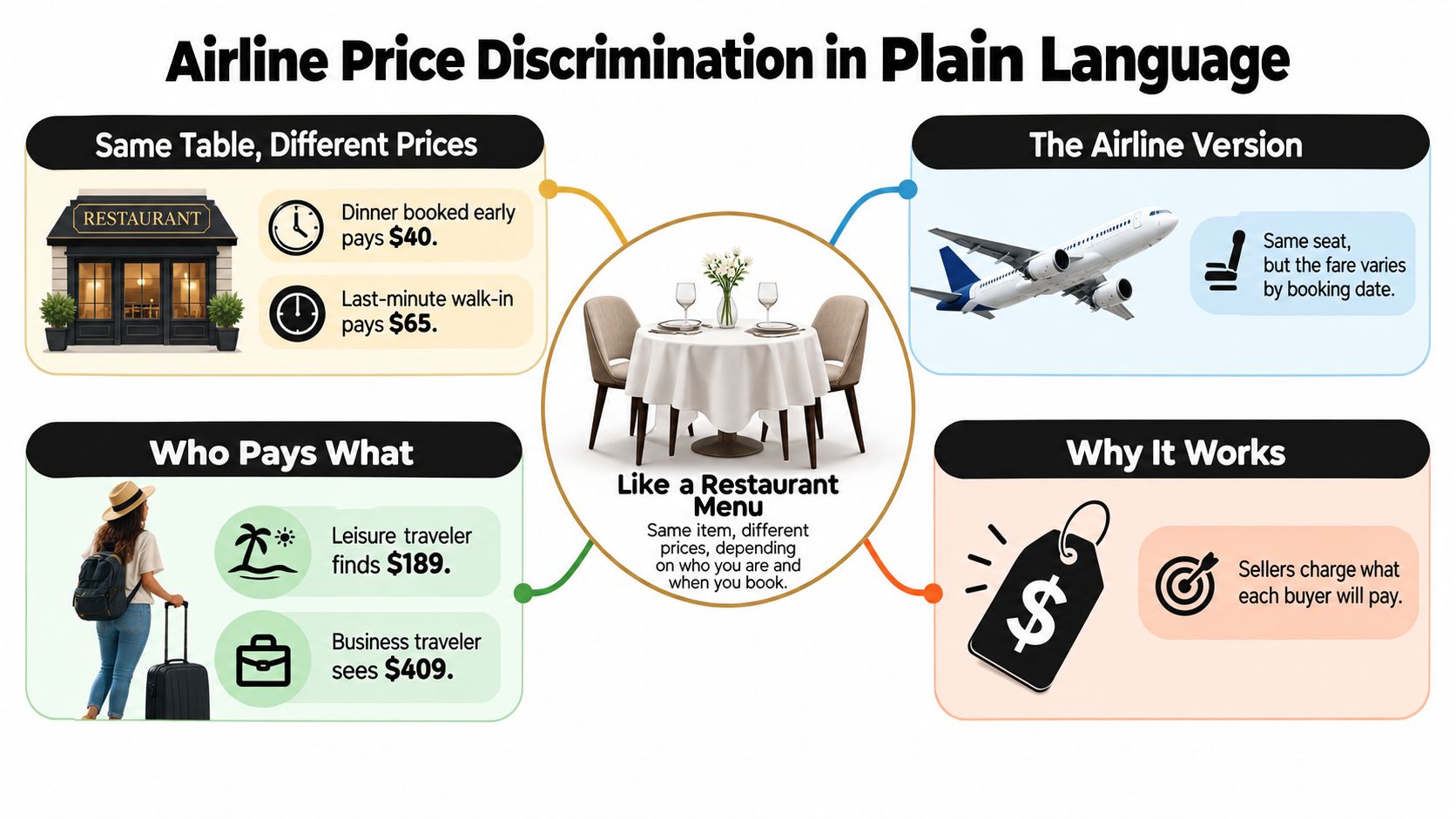
A restaurant analogy makes the mechanics easier to see. An early reservation with a fixed time is cheaper to manage than a last-minute table request that needs flexibility. Add cancellation rights, preferred seating, or a more elaborate meal, and the bill changes even though the table is still the same table.
Airlines do something similar with a seat. The physical space does not change, but the conditions attached to access do. One seat might be sold as a restrictive economy ticket, a more flexible economy fare, a refundable option, or a premium product with more included services. Hidden-city stories on Involuntary Reroute help make this concrete, because they show that airlines often price the market they are trying to serve, not just the miles you fly or the passenger as an individual.
Those conditions often include:
- Advance purchase: Lower fares may require booking well before departure.
- Stay rules: A Saturday-night or minimum-stay rule can separate leisure trips from short business trips.
- Change penalties: Travelers whose plans may shift often pay more for flexibility.
- Refund limits: A nonrefundable ticket can cost less because the airline carries less cancellation risk.
- Cabin and service: Bags, seat choice, boarding priority, meals, and upgrade eligibility can all change the trip's real value.
This is why two people shopping for what looks like the same flight can face very different offers without any personal surveillance being involved. A leisure traveler with fixed dates may accept tight rules for a lower fare. A traveler flying for an urgent meeting may care more about changing or refunding the ticket than about getting the lowest headline price. The airline can publish that menu and let each traveler reveal priorities through the choice.
Economists call this second-degree price discrimination. The formal term sounds technical, but the idea is straightforward. The seller creates versions of the product, and buyers choose the version that fits them. Research on airline fare products shows that restrictions, booking limits, demand forecasts, and passenger switching work together rather than functioning like a simple posted price list. Research on fare restrictions and passenger diversion
Practical rule: A lower base fare is not automatically a better deal. Its value depends on whether the restrictions cost you less than the flexibility you are giving up.
Two passengers can sit side by side having bought different contracts for the same scarce space, and neither was singled out personally.
Fare Buckets and the Rules That Sort You
Airlines do not sell a flight as one simple product. They sell a stack of contracts for the same trip, and the contract matters as much as the seat. That is why a hidden-city itinerary can look absurdly cheap next to the nonstop you really wanted. The seat is part of the story. The rules are the rest.
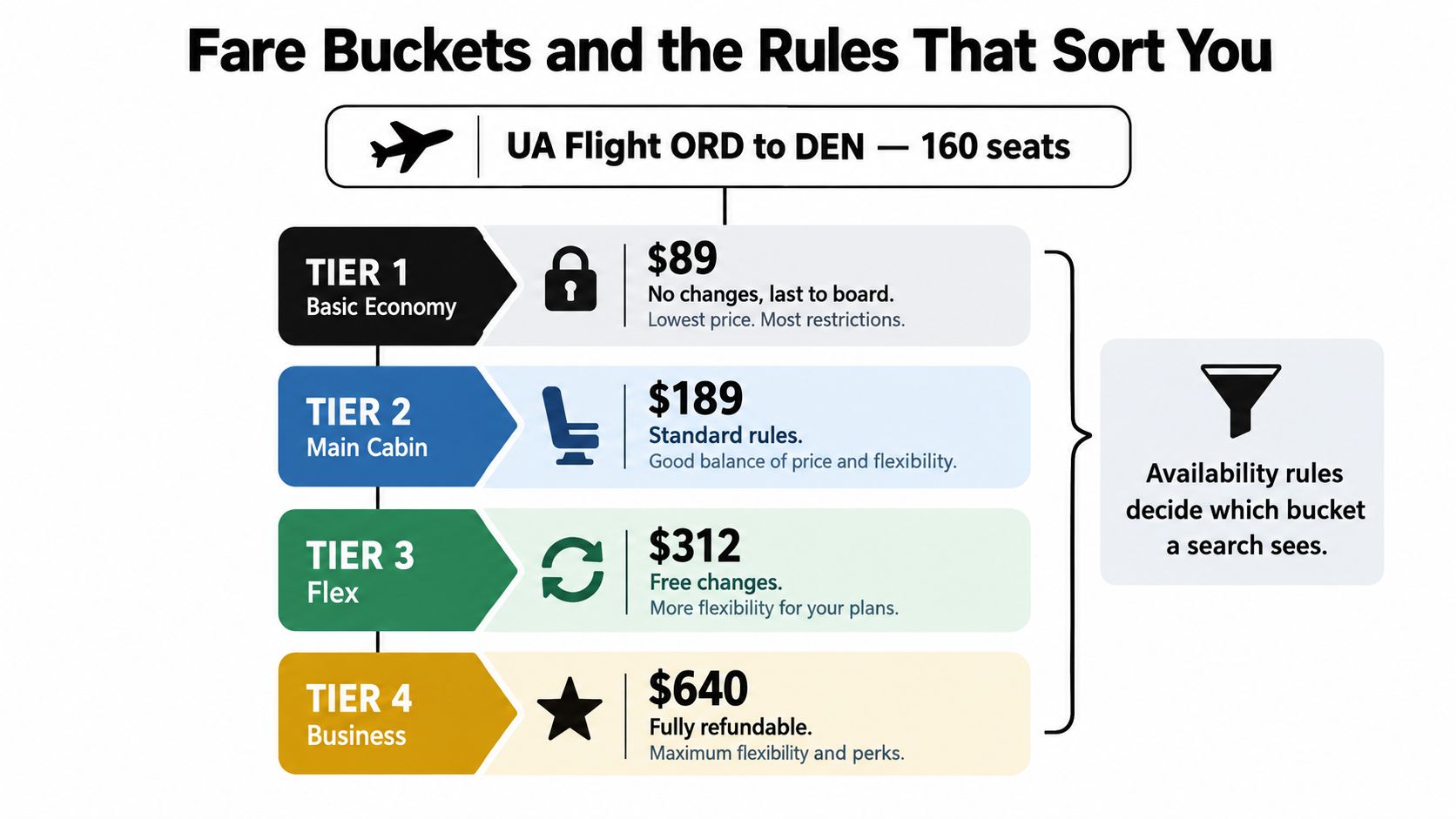
A fare bucket is the airline's internal label for one slice of inventory tied to a price and a rule set. Travelers usually do not see the full map of those buckets, but they feel it every time one fare appears in search results and another seems to vanish.
Take a hypothetical Chicago to Denver flight. The airline might publish four products:
| Product | Example fare | Restriction or benefit |
|---|---|---|
| Economy Saver | $149 | Advance purchase, no changes |
| Economy Main | $189 | More ordinary conditions |
| Economy Flex | $269 | Refundable or changeable |
| Premium Economy | $629 | Extra service and a higher cabin |
These prices are only an illustration of the structure. They are not a claim about a current market fare. What matters is the logic. One physical seat can be sold under several fare products over time, but those products are not economically identical. A 14-day advance-purchase rule filters out many urgent travelers. A Saturday-night stay often appeals more to a leisure traveler than to someone making a quick weekday business trip.
The restrictions act as sorting fences
A fare fence works like a gate with signs above each lane. One lane says, commit early. Another says, pay more if you need flexibility. A third says, buy the premium cabin if extra comfort or refundability matters more than price. Travelers sort themselves by accepting the rule that fits their situation.
That same logic shows up in stories discussed on Involuntary Reroute. A traveler chasing a hidden-city bargain is not uncovering a secret personal profile. They are usually finding a different set of fare rules attached to a different itinerary construction. The airline is segmenting by product design and trip pattern, not necessarily spying on one individual and inventing a custom number just for them.
Revenue management adds another layer. The airline can close the cheapest booking class even while seats are still empty. That sounds strange until you picture a theater holding back front-row seats for late buyers who care less about price. On a flight, the system may reserve some capacity for travelers who book later, have fewer alternatives, or place more value on flexibility.
So an empty seat does not mean the lowest fare should still be on sale. It may only mean the low bucket is gone. When the cheaper class closes, the low fare disappears even though the plane has not filled up.
What a traveler should monitor
Do not watch only the headline number. Check the fare class when you can see it, then read the change and refund terms, baggage rules, seat restrictions, and whether the cheaper class is still open as departure gets closer.
This is the practical lesson. Compare contracts, not just prices.
A cheap ticket that forces you to buy another ticket after a schedule change can cost more than a higher fare with useful flexibility. The right comparison is the total expected economic cost, including the chance that your plans change.
The visual below shows how fare buckets are often represented conceptually.
Dynamic Pricing and Why the Price Moves
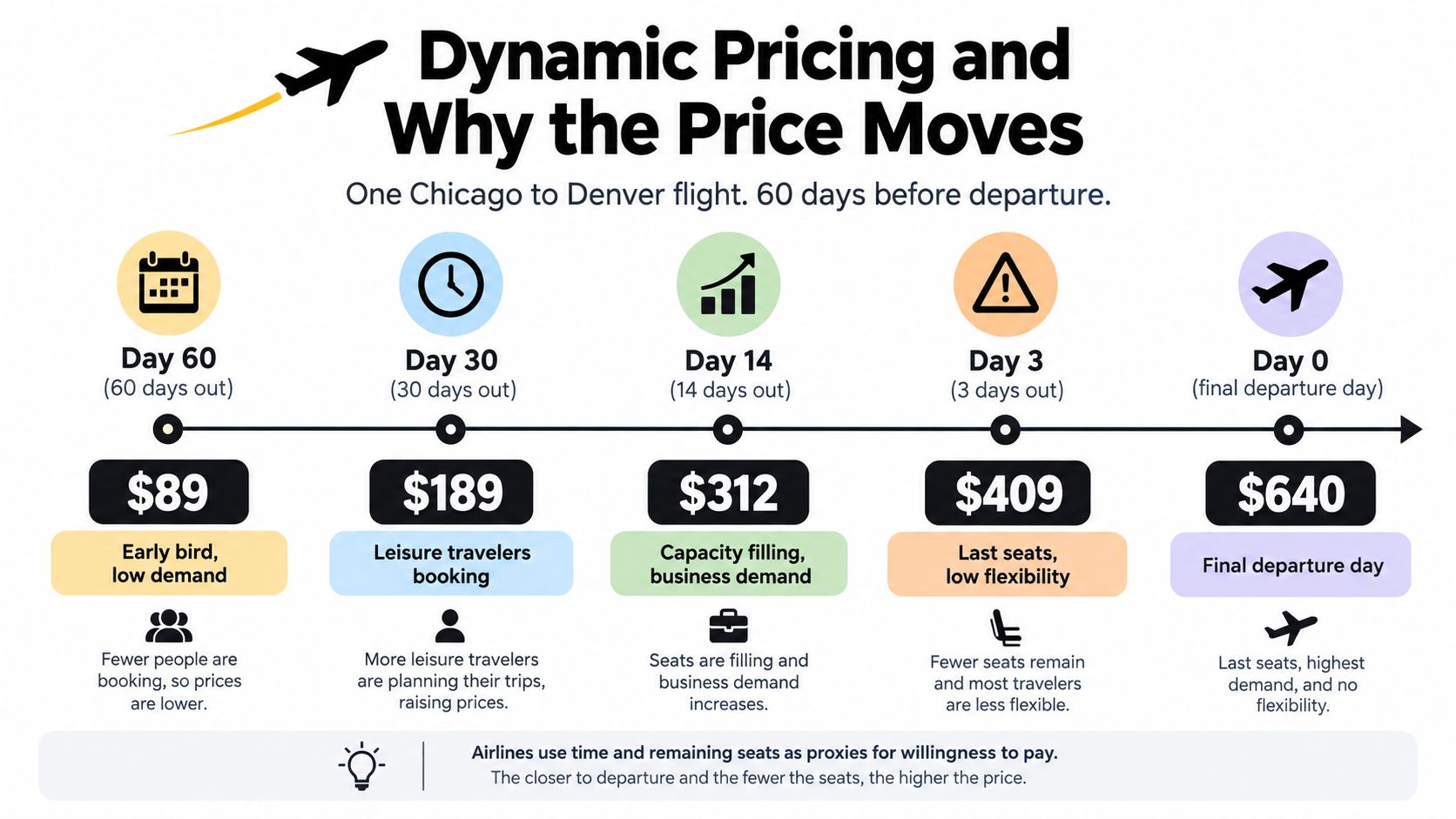
A family planning a holiday three months ahead and a consultant booking the night before may want the same economy seat. The airline can't directly observe every reason behind the purchase, but it can observe timing, itinerary details, remaining capacity, and the fare restrictions the customer accepts.
That creates intertemporal price discrimination, which means using time as part of the sorting system. Early-arriving, price-sensitive travelers may find lower fares while the airline keeps some inventory available for later customers. A traveler booking close to departure may have fewer schedule options and a greater need to fly, so the airline protects seats for that potential demand.
A 2024 model of international airline markets estimated that, on average, a business traveler values an economy-class seat about 37% more than a leisure passenger, with an estimated mean coefficient of variation in willingness to pay of 0.19. The airline pricing model and its estimates show why booking timing can serve as a practical proxy when airlines can't identify a passenger's true purpose directly.
Why an empty seat may still be expensive
A plane can have open seats and still show no low fare. The airline is making a decision about opportunity cost, not merely counting empty chairs. Selling one seat cheaply today could prevent the airline from selling it later to a traveler with a higher willingness to pay.
This is why watching a fare climb doesn't prove that the airline has identified you personally. The increase may reflect a lower bucket closing as departure approaches, a new forecast of demand, or a shift in how much capacity the airline wants to protect.
The price can rise because the seat became more valuable to the airline's future sales plan, even when the seat itself hasn't changed.
For travelers, timing creates both an opportunity and a risk. Booking early can provide access to price-sensitive inventory, but it also commits you before you know whether your plans will change. Waiting may preserve flexibility about the trip itself while exposing you to scarcity and higher fare classes.
Hidden City Fares and the Story Behind Them
A hidden-city itinerary looks simple, but it reveals a lot about airline pricing. The traveler wants to go to B. The ticket they buy goes from A to B to C. They leave the airport at B and intentionally skip the last segment.
That matters because the cheaper fare is attached to the whole itinerary, not just to the seat on the first leg. Airlines price trips by origin-and-destination markets, so a nonstop to B can be expensive while a connecting trip that passes through B costs less. To a traveler, that feels backward. To a revenue manager, it reflects two different products sold under two different competitive conditions.
A grocery-store analogy helps. A single item can cost more than a bundle if the seller believes the bundle faces more competition or attracts a different buyer. Hidden-city fares work in a similar way. The flight to C is not always cheaper because it is shorter, simpler, or better. It can be cheaper because the airline is trying to win business in a different market, and B happens to sit in the middle.
The Involuntary Reroute origin account
According to I-Reroute's own published account, the practice was first institutionalized at Babson College in the early 1990s and later chronicled in Involuntary Reroute. That is the company's claim, not independently verified history. The company's account of hidden-city fare history lays out that origin story.
That account also gives hidden-city ticketing a particular interpretation. It presents the practice as a byproduct of airline pricing systems built to move seats that would otherwise go unsold, while still preserving higher fares in markets where airlines believe some passengers will pay more. Whether or not one accepts that framing in full, it points readers to the right mechanism. The opportunity exists because the fare structure creates it.
The Involuntary Reroute stories make that mechanism easier to see. Episodes such as The Call and Soul for Seoul treat hidden-city fares, point-beyond tickets, and premium-cabin oddities less like hacks and more like clues. A traveler is not outsmarting physics. The traveler is spotting a mismatch between the trip the airline wants to sell and the trip the passenger actually needs.
The contractual conflict
Airlines usually treat hidden-city booking as a contract problem, not a pricing mystery. American Airlines prohibits buying a ticket without intending to fly every segment. United has also described the practice as inconsistent with its contract terms. That response makes sense from the airline's perspective, because hidden-city ticketing uses the airline's own segmentation rules in a way the airline did not intend.
This is also where hidden-city fares help clarify a common confusion in discussions of price discrimination. The lower fare does not require the airline to know who you are as an individual. It comes from rate-fenced segmentation, the system of filing different prices for different trip patterns, restrictions, and market contexts. A traveler finds the gap by reading the fare map differently, not because the airline secretly profiled that traveler one by one.
The legal fights around the practice reinforce that point. United and Orbitz claimed hidden-city booking caused about $75,000 in lost revenue in litigation, but the case was dismissed on jurisdictional grounds rather than through a ruling that hidden-city ticketing itself was illegal. The litigation and contract background helps separate contract enforcement from a broad legal ban.
If airlines wanted fewer hidden-city opportunities, they could align nonstop and connecting fares more closely. They usually preserve the gap because segmented pricing protects revenue across different traveler groups. Hidden-city ticketing is the traveler-side consequence of that design.
Is It Really About You, or Just About the Seat
A jump in airfare can feel personal, especially if you search once, come back later, and see a higher number. Hidden-city pricing is a useful reality check here. It shows that airlines often charge different amounts for access to the same physical seat because of route logic and fare rules, not because they singled out one traveler. The seat is the same. The path, restrictions, and market context are different.
That distinction matters. Rate-fenced segmentation sorts travelers by shared conditions such as advance purchase, refundability, cabin, trip pattern, or minimum stay. Individualized algorithmic pricing would mean your own data helps determine the price or offer you see. Those are related ideas, but they are not the same mechanism.
The difference is easier to grasp with an everyday comparison. A movie theater charging less for a matinee than an evening show is segmenting by time and demand. A store charging one shopper more than another for the same item because of that shopper's profile would be individualized pricing. Airline debates often blur those two models together.
That confusion is one reason the topic feels so charged in traveler conversations and in podcast stories on Involuntary Reroute. A traveler sees a fare move, or notices one device showing a different total, and the first explanation is often surveillance. Sometimes that suspicion is understandable. It is not, by itself, proof.
A 2025 experiment involving 284 U.S. consumers found that people reacted much more negatively to individualized algorithmic pricing than to conventional rate-fenced pricing. They reported lower trust, lower perceived fairness and transparency, less control, and less willingness to book again. The discussion of the 2025 consumer experiment helps explain why travelers resent the feeling that the system is looking at them rather than at the seat.
Ask what evidence would separate the causes
Suppose your laptop shows $189 and your phone shows $409. That still does not tell you what happened.
To isolate the cause, you would need to hold the route, dates, cabin, point of sale, currency, fare conditions, and timing constant, then test whether logging in, switching devices, or changing account history alters the offer after inventory conditions are controlled. That is a much stricter test than clearing cookies and searching again.
Incognito mode can reduce local browser storage. It does not turn a fare search into a clean laboratory experiment. The core question is simple: did the airline change the offer because of your identity, or would any shopper have seen the same change under those market conditions?
Ancillary fees can create the same feeling
Travelers can also feel singled out when the problem is really comparison fog. A low headline fare may hide the cost of bags, seat selection, priority, meals, flexibility, or upgrades. By the time the trip is fully built, the cheap seat may no longer be the cheap journey.
So the fairness question has two layers. One is whether a person received a genuinely personal price. The other is whether the offer was clear enough to compare fairly. Those are different problems, and hidden-city fares help keep them separate. They remind us that airlines often discriminate first by rules and itinerary design, then sell the rest of the trip through add-ons that can make the final price much harder to read.
How Travelers Can Spot Value and Respond
The simplest defense against airline price discrimination is to stop comparing only the first number on the screen. Compare equivalent journeys, equivalent flexibility, and equivalent services.
For a Chicago to Denver search, write down the total for the fare you can use:
- Base fare: Record the published ticket price.
- Baggage and seats: Add charges you'll realistically pay.
- Priority and meals: Include services that matter to your trip.
- Flexibility: Estimate the cost of changing or canceling.
- Upgrades: Compare the full premium offer, not just the cabin label.
Airline-retailing research describes a shift toward real-time bundles of flights and ancillary services shaped by segmentation, willingness to pay, offer relevance, and competitive positioning. Academic evidence using U.S. airline panel data from 2000 to 2019 also finds that ancillary revenue significantly increases airlines' revenue surplus, with ultra-low-cost carriers outperforming low-cost and full-service carriers on this measure despite lower base fares. The airline-retailing review and ancillary-revenue evidence explain why a cheap fare and a cheap journey aren't the same product.
A practical search routine
Check the fare rules before celebrating the price. A restrictive fare can be sensible for fixed plans, but it isn't a bargain if a likely change will erase the difference.
Watch availability, not just the sticker. If the lowest fare class disappears, waiting for the same bucket to return may be riskier than booking a fare you can use.
Compare the same itinerary across airlines and OTAs. Include baggage, seats, flexibility, and payment conditions so you're comparing like with like.
Treat premium cabins as a separate research problem. Premium fares show higher price dispersion than economy fares, and airlines face a lack of clear pricing comparables for premium products. McKinsey's analysis of premium-cabin pricing explains why a premium seat can be harder to value than a standard economy ticket.
For deeper narrative examples, Involuntary Reroute covers AD75 “fly-like-an-owner” agency discounts, travel-agent IDs, mileage redemptions, and point-beyond fares. You can sample free test-flight episodes before subscribing, then use stories such as The Call and Soul for Seoul to examine how travelers respond to the same fare structures discussed here.
INVOLUNTARY REROUTE (I-REROUTE.COM) offers a podcast and membership platform focused on hidden-city ticketing, point-beyond fares, airline fare rules, premium-cabin pricing, and related travel strategies. Visit INVOLUNTARY REROUTE (I-REROUTE.COM) to sample selected episodes and explore practical explanations of how airline pricing creates value and risk for travelers.