


Airline Price Gouging: What It Is and How to Spot It
October 26, 2026What if the fare on your screen isn't high because the flight is nearly full, but because you have nowhere else to go? That question sits behind most complaints about airline price gouging. A seat can cost more for ordinary reasons. It can also cost more because one airline controls the route, your travel date is fixed, or the extra charges only appear at checkout.
You're not meant to guess which one you're seeing. You can test it. Compare nearby dates, nearby airports, rival airlines, and the full price after fees. Look for patterns instead of reacting to one scary number or one urgent message.
The displayed fare is only the start of the calculation. Competition sets the ceiling, scarcity messages shape how fast you decide, and fare design can make a longer trip cost less than a shorter one. Once you see those pieces, a high price stops feeling random. It becomes something you can check, document, and in some cases avoid.
What Airline Price Gouging Means and How to Test a Fare
Why does the same seat cost one price today and a much higher price tomorrow? That simple question confuses many travelers, because a fast price rise can have more than one cause.
Airline price gouging means charging far more than comparable fares because travelers have few alternatives or are under time pressure. It's not the same as every expensive ticket.
Normal scarcity and a warning sign
With normal scarcity pricing, seats sell in price tiers. As cheaper tiers sell out, later buyers see higher fares. That can happen even when several airlines compete.
A possible gouging signal looks different. The fare sits far above neighboring dates, nearby airports, and comparable routes. No rival pushes it down, and every flexible choice disappears at the same time.
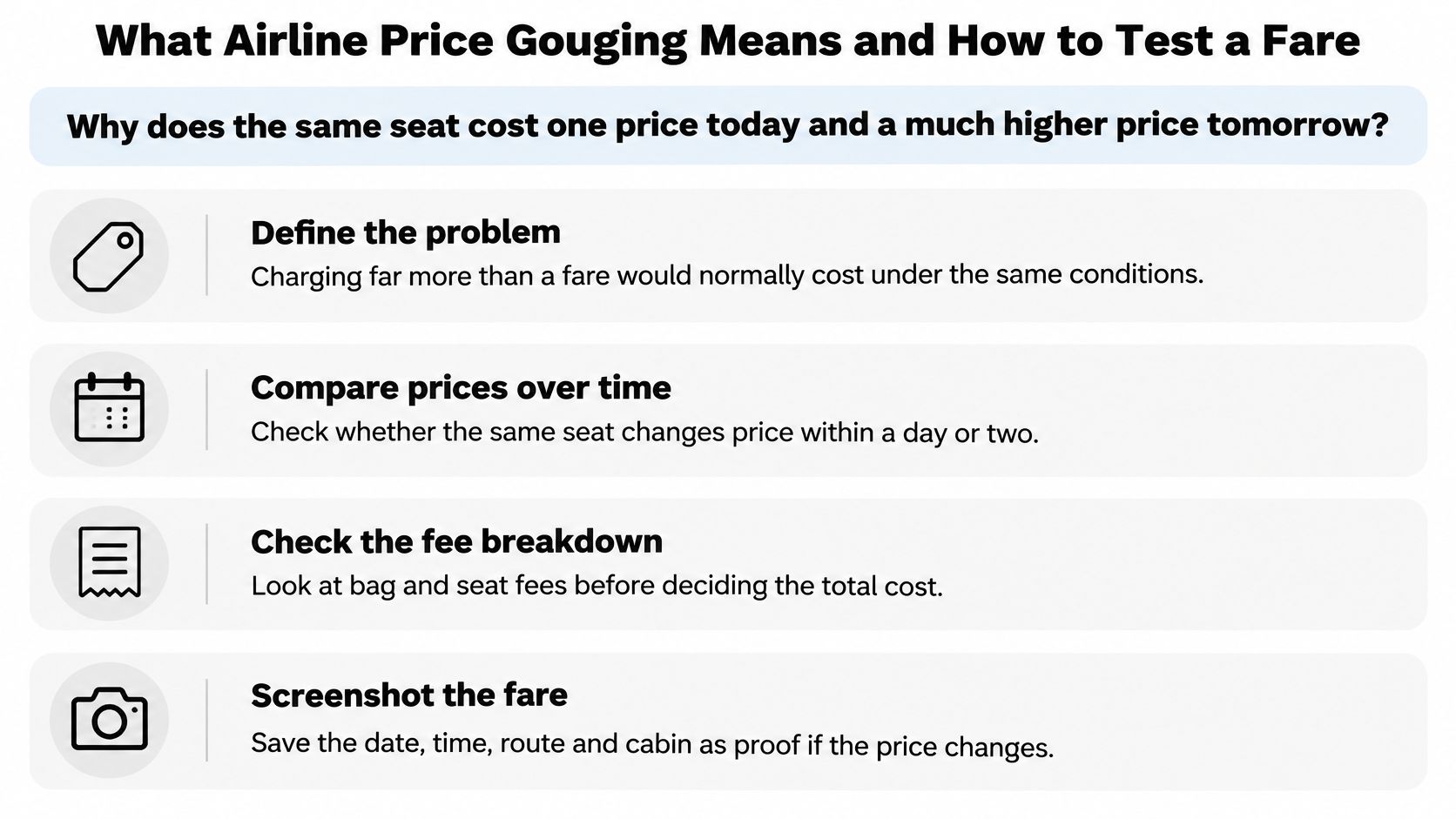
Five checks you can run
Use these checks together. One odd result can be noise. Two or more pointing the same way give you a reason to pause, compare, or file away evidence.
| Check | Normal scarcity pricing | Possible gouging |
|---|---|---|
| Same flight one day earlier or later | Price moves within a predictable range | Price jumps far above neighboring dates |
| Route with a low-fare competitor | Fare falls when rivals add seats | Fare stays high with no rival |
| Other dates, airports or cabins | At least one reasonable option remains | Every option is high and urgent |
| Fees shown before payment | Baggage and change fees disclosed early | Extra charges appear only at checkout |
| Airline's stated reason | Demand, booking timing or seat class | No clear reason given |
Say a nonstop costs far more on Tuesday than Monday or Wednesday. Check a nearby airport, a connection, and another seller before you call it gouging. If all of them are reasonable except one locked date on one airline, you've learned something specific about that market.
Practical rule: Don't judge a fare alone. Judge it against the closest real alternatives you could actually take.
How Competition and Deregulation Shape Airfares
An airline's displayed fare is only the starting point. Competition affects how high that fare can rise, while the airline's pricing tiers determine which seats are offered at each price.
A 2001 Government Accountability Office analysis found that 24.7 million passengers at 10 major airline hubs traveled in markets without a low-fare competitor. On average, they paid 41% more than passengers flying in hub markets where one was present.
The same report found that major airlines carried more than half of passengers at 16 of the 31 largest U.S. airports. Those airports handled approximately 260 million passengers.
These figures describe market patterns, not proof that any particular fare is unlawful. When travelers have few competing airlines and limited options for changing dates, airports, or destinations, a carrier may face less pressure to keep fares low. A rival airline is like another shop on the same street: its presence gives customers an alternative and can constrain what the first shop charges.
| Market type | What the evidence shows | What to do |
|---|---|---|
| Hub with a low-fare competitor | A comparison point for markets with more competition | Compare fares on the route and its alternatives |
| Hub with no low-fare competitor | Passengers paid an average of 41% more | Check nearby airports and competing routes |
| Airport dominated by one airline | Major airlines carried over half of passengers at 16 of the 31 largest U.S. airports | Price flights from airports within driving distance |
| Business or last-minute trip | Travelers may have less room to shift dates, airports, or destinations | Book earlier when plans are fixed, or look for flexibility |
How deregulation changed the rules
Before deregulation, the Civil Aeronautics Board controlled major decisions about where airlines could fly and what they could charge. Fares were steadier, but competition was limited and flying was expensive for many people.
The Airline Deregulation Act, signed on October 24, 1978, phased out federal control over fares and routes, according to the Federal Aviation Administration's historical account. The act allowed immediate fare reductions of up to 70% without prior approval and enabled new carriers to enter routes that another airline did not have protected rights to serve.
Entry surged, then many carriers left the market. Scheduled interstate carriers increased from 36 in 1978 to 123 by the end of 1983. During that period, 34 carriers went bankrupt and 69 others ceased operations.
A Government Accountability Office review of 171 airports found that inflation-adjusted average airfares fell at 168 airports between 1990 and 1998, with an average decline of 21%. At some smaller-city airports, including Charleston, Columbia, and Greenville-Spartanburg, the decline was much smaller. A national average can fall while travelers in a less competitive market still face limited choices.
What the law does and doesn't do today
There is no general federal cap on domestic airfares. The Department of Transportation polices unfair and deceptive practices, including how prices are shown and sold, but does not set a simple maximum fare for every flight.
State price-gouging laws mostly target essential goods during emergencies. In Europe, EU Regulation 261/2004 mainly covers compensation for delays and cancellations, not the level of fares themselves.
A high fare alone does not show that a law has been broken. Compare the displayed fare across realistic alternatives, then account for fees to see what the trip will actually cost.
How Scarcity Messages Push Travelers to Pay More
A fare on your screen can look high for two very different reasons. It may be high for everyone on that route, or it may have climbed because of when and how you searched. Booking sites place urgency cues on top of both situations, and those cues can push you to pay before you have checked which reason applies.
Test the message before you obey it
- Only 2 seats left at this price: This often means two seats remain in that price tier, not two seats on the whole plane. Check the next tier, a nearby date, or the airline's own site.
- Fare rises while you search: Another buyer may have taken the last seat in the cheapest tier, or inventory may have refreshed. Compare the same flight across sellers at the same moment, and note the cabin and fare rules.
- Nonstop sold out, connection cheap: The nonstop may face stronger demand or fewer rival airlines. Price the connection's total travel time and fees before deciding the nonstop is gouged.
- Countdown or hold message: Treat it as a prompt to verify, not proof. Screenshot the fare, then check one day earlier and one day later.
Each cue can point to something real. Inventory limits do exist, and late booking often costs more. The mistake is treating the cue as the whole calculation. The displayed fare is a starting point, and the seat map, the calendar, and a second seller are how you test it.
Wide price gaps on the same flight
Passengers on the same aircraft rarely pay the same amount. In a Dutch regulator market investigation summary covering more than 14 million aviation transactions and 155,417 flights from July 2022 through July 2025, one in three tickets cost at least 40% more than the average ticket for the relevant flight.
Economists call this price dispersion, meaning a wide spread of prices for similar travel. Booking timing, route competition, remaining tiers, and algorithmic recommendations can all push prices apart. The spread alone does not prove discrimination or illegal conduct.
The same seat works like a grocery item sold across different days of a promotion. Some shoppers catch the sale price, and some pay full price the following week. A gap between the two receipts tells you prices moved; it does not tell you the store singled out one shopper.
What AI pricing claims can prove
Airlines have faced public questions about AI-assisted pricing. Their stated position is that these systems work from demand forecasts, purchasing patterns, and market conditions.
That leaves a careful middle ground. An airline can price from data about demand and purchasing behavior without building a fare from your identity. The fare display on your screen also does not show the internal rules that opened or closed a tier, so a jump can feel personal even when the trigger was a shared one.
A suspicious jump is a reason to document and compare. It isn't, on its own, proof that an airline priced the ticket from your personal data.
Here is what you can prove from the outside: the fare, the time, the route, the cabin, and how comparable options priced at the same moment. That record is strong enough to drive a better buying decision, and it is the same record you would want if you decided the price deserved a formal complaint.
Hidden City Fares and the Leftover Seat Problem
Hidden city ticketing sounds secretive, but the mechanics are straightforward. A traveler wants to end a trip at hub B. A ticket from A to C through B costs less than a ticket that ends at B, so the traveler books A to C and leaves at B. The final segment goes unused.
This only works because the displayed fare is the start of a calculation, not a fixed price for distance flown. Two itineraries can cover the same plane and the same seat while pricing differently, based on where each ticket is allowed to end.
Here's a traveler about to use a connecting itinerary, the setup where this fare gap appears.
Why the gap exists
Airlines price by market, not just by distance. The route from A to C may face tough competition, while A to B ends at a hub with less competition. A seat released at a low fare for the longer itinerary can then cost less than the same seat on the shorter, more profitable one. A train ticket works the same way: the fare to the farther station sometimes undercuts the fare to the closer one, because the two routes compete against different services.
The U.S. Government Accountability Office hidden-city report found that the price gap between travel ending at the hidden-city hub and travel continuing to the advertised destination ranged from $103 to $1,954 in the examples it examined. It estimated an airline could lose approximately $100 to $2,000 for each passenger who exploited a particular hidden-city opportunity, and reported that most airlines expressly prohibit hidden-city and back-to-back ticketing in their contracts of carriage.
Those contracts matter. Even if the fare design creates the opening, the airline's rules can still punish the traveler who uses it.
The I-Reroute account and the airline view
I-Reroute.com discusses hidden city tickets through its Involuntary Reroute podcast and membership program, and its reading of the practice runs opposite to the airlines'. In that account, hidden city fares are a tool invented by airlines to benefit airlines by disposing of unsold leftover seats travelers refused to overpay for. On this view, airlines overvalue premium seats on nonstop routes, then move that leftover capacity through cheaper connecting fares rather than let it fly empty.
Airlines publicly claim that hidden city tickets deprive them of revenue. The two sides describe the same leftover seat. The airline calls the skipped segment lost revenue, while I-Reroute.com calls it inventory the airline already priced too high to sell on its own.
I-Reroute.com also argues that if airlines wanted to end hidden city fares and tickets, they'd simplify the fare structure. They choose not to, in that view, because it isn't in their interest to do so.
This video adds a spoken walkthrough of the practice and the competing claims around it.
Risks you carry
- Return legs can be canceled: If you skip a segment, the airline may cancel the rest of the itinerary.
- Frequent flyer accounts can be closed: Airlines can also remove miles under their program rules.
- Checked bags don't stop with you: A checked bag normally continues to the ticketed final destination, not your hidden city.
Understand the fare design first. Then weigh any saving against rules you agreed to when you bought the ticket.
Why the Ticket Price Is Rarely the Real Price
A low fare can be poor value. A higher fare can be cheaper once you add the services you really need. That's why headline comparisons mislead, especially for families and business travelers.
Fees that change the decision
The charges after the base fare aren't all equal. Some are choices. Others become unavoidable because of your bag, your children, or a meeting that might move.
| Charge | Optional or required | Who it affects most | Where to check |
|---|---|---|---|
| Checked baggage | Optional if carry-on only | Families and multi-week trips | Itinerary disclosure before payment |
| Seat selection | Optional | Families traveling together | Seat step at checkout |
| Change fee | Set by fare rules | Business travelers with shifting plans | Fare rules shown before purchase |
| Cancellation fee | Set by fare rules | Anyone with uncertain plans | Fare rules shown before purchase |
| Third-party service or payment fee | Set by seller | Buyers using agencies or resellers | Final total on the last booking screen |
A student traveling light can skip baggage and seat fees. A parent who must sit with two children and check a bag can't judge the same advertised fare the same way. A business traveler buying a semi-flexible ticket may pay more upfront to avoid a larger change cost later.
Why disclosure rules exist
The U.S. Government Accountability Office summary of the ancillary-fee rule reported that the Department of Transportation rule requires airlines and ticket agents to disclose passenger- and itinerary-specific baggage and change or cancellation fees before purchase, with staged compliance extending into 2026 for some smaller ticket agents. DOT estimated approximately $5.5 million in annual benefits from improved disclosure, because hidden ancillary fees cause consumers to behave as though travel costs less than it really does.
That last point explains much of the frustration. You anchor on the first number you saw. Then bag, seat, payment, and flexibility charges arrive one screen at a time, and comparing sellers gets harder.
Total-cost rule: Compare the final price for your bags, seats, and flexibility needs. Don't compare the first fare you were shown.
The same advertised fare can produce different final prices across airlines and ticket sellers. Build the full basket first. Then decide which ticket is truly cheaper.
How to Respond When a Fare Looks Like Gouging
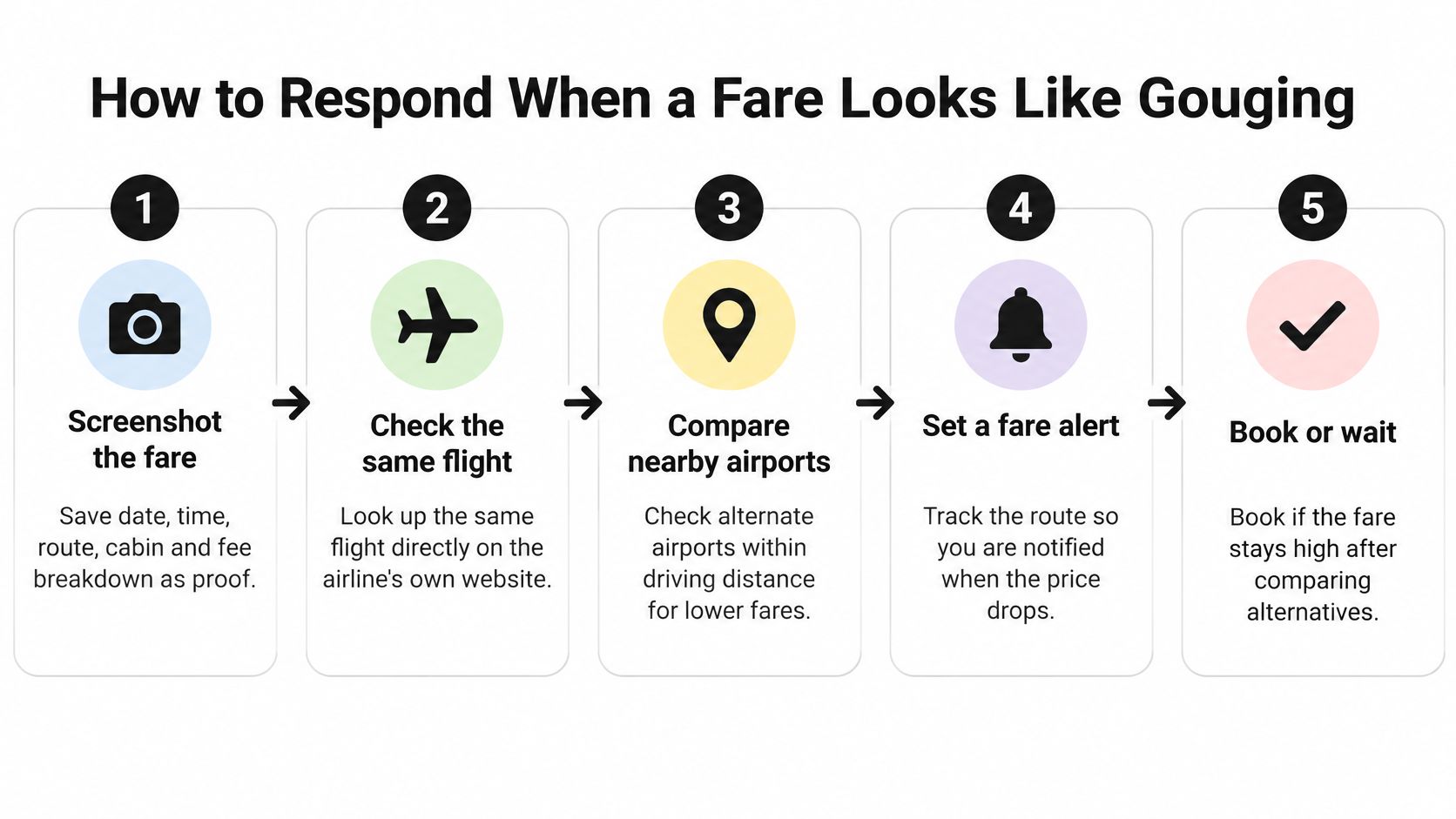
Start with the displayed fare, then test the market around it. A high number can reflect real scarcity, weak competition, seller fees, or seats being released in stages. A short routine tells you which one you are facing before urgency decides for you.
A seven-step check
- Screenshot the fare: Save the date, time, route, cabin, airline, seller, passenger count, and fee breakdown. Documentation protects you if the price changes and gives a complaint a clear starting point.
- Check neighboring options: Price the same flight one day earlier and one day later, keeping the cabin and passenger count constant. Then check nearby airports within reasonable driving distance, including the cost and time to reach them.
- Use a second seller: Price the same trip on the airline's own site and on one other seller. Compare the total after fees, because seller charges and display order can change which option looks cheaper.
- Set a fare alert with a deadline: Track the route only if you can safely wait. Decide in advance the last day you'll hold off, so an alert doesn't turn into a last-minute scramble.
- Weigh alternative routings carefully: Connections, nearby airports, and different cabins may solve the problem without new risk. Treat a point-beyond routing as a fare-design test with real tradeoffs: I-Reroute frames leftover premium seats as mispriced inventory, while airlines can cancel remaining legs, close frequent flyer accounts, and send checked bags to the ticketed destination.
- Document and complain when the pattern is clear: If a fare looks gouged on a route with no competitor, file through the U.S. Department of Transportation aviation consumer complaint process, or your national transport regulator elsewhere. Attach your screenshots and comparisons, not just your conclusion.
- Book on total value: Book when the full cost is reasonable for your trip and your need for flexibility. A brief drop in the headline fare matters less than the amount you will end up paying.
Keep the evidence simple
Your notes should let another person reproduce the comparison. Write down departure and arrival airports, travel dates, cabin, number of passengers, bags, and whether the ticket was refundable or changeable.
That detail matters more than it sounds. A basic economy fare for one traveler with no bag isn't comparable to a flexible fare for a family. Clear notes stop you from arguing with your own memory later and make a regulator complaint easier to follow.
The practical goal is to avoid paying a premium that disappears when you change one airport, one day, or one seller.
If every reasonable alternative is also high, you may be facing real scarcity or a weak market. Book the option that fits your trip, keep the records, and use what you learned earlier next time. Airline price gouging is easier to spot when you test the market around the fare, because the first price shown is only the start of the calculation.
If you want to keep learning how premium cabins, point-beyond fares, and hidden city opportunities are priced, visit INVOLUNTARY REROUTE (I-REROUTE.COM) to sample select episodes before subscribing, explore practical fare breakdowns, and hear the story told in Involuntary Reroute. Take a test flight by sampling select episodes, then follow a curated episode path that fits your travel style before the next fare looks too high to trust.