


Airline Prices Going Up: Why Fares Climb and What You Can Do
October 19, 2026The most common advice about airline prices going up is to book earlier and keep checking. That can help, but it misses why two travelers can see very different prices for the same flight on the same day. Airlines don't raise every fare together. They sort seats into fare classes, close cheaper inventory as demand changes, and price different routes, cabins, and trip conditions separately.
That means a higher checkout price doesn't always mean the flight has fewer seats. It may mean the cheaper fare class has closed, or that the headline price excludes add-ons you need. Understanding those distinctions gives you a better way to compare fares and find savings hiding inside the same pricing structure.
The Real Story Behind Airline Prices Going Up
Are airline prices rising everywhere? No. “Airline prices going up” can describe a particular route, season, or cabin without accurately describing the entire market. A busy holiday flight may become more expensive while another route remains steady, and economy and premium-cabin fares can move differently.
Nominal prices count the dollars you pay. Real prices adjust those dollars for general inflation, which helps compare what a ticket costs against the wider price level. IATA's analysis from January 2015 through August 2024 found that nominal industry-wide airfares in August 2024 were 3% below their August 2015 level, and real airfares were 37% lower after inflation adjustment (IATA's airfare, fuel, and inflation analysis).
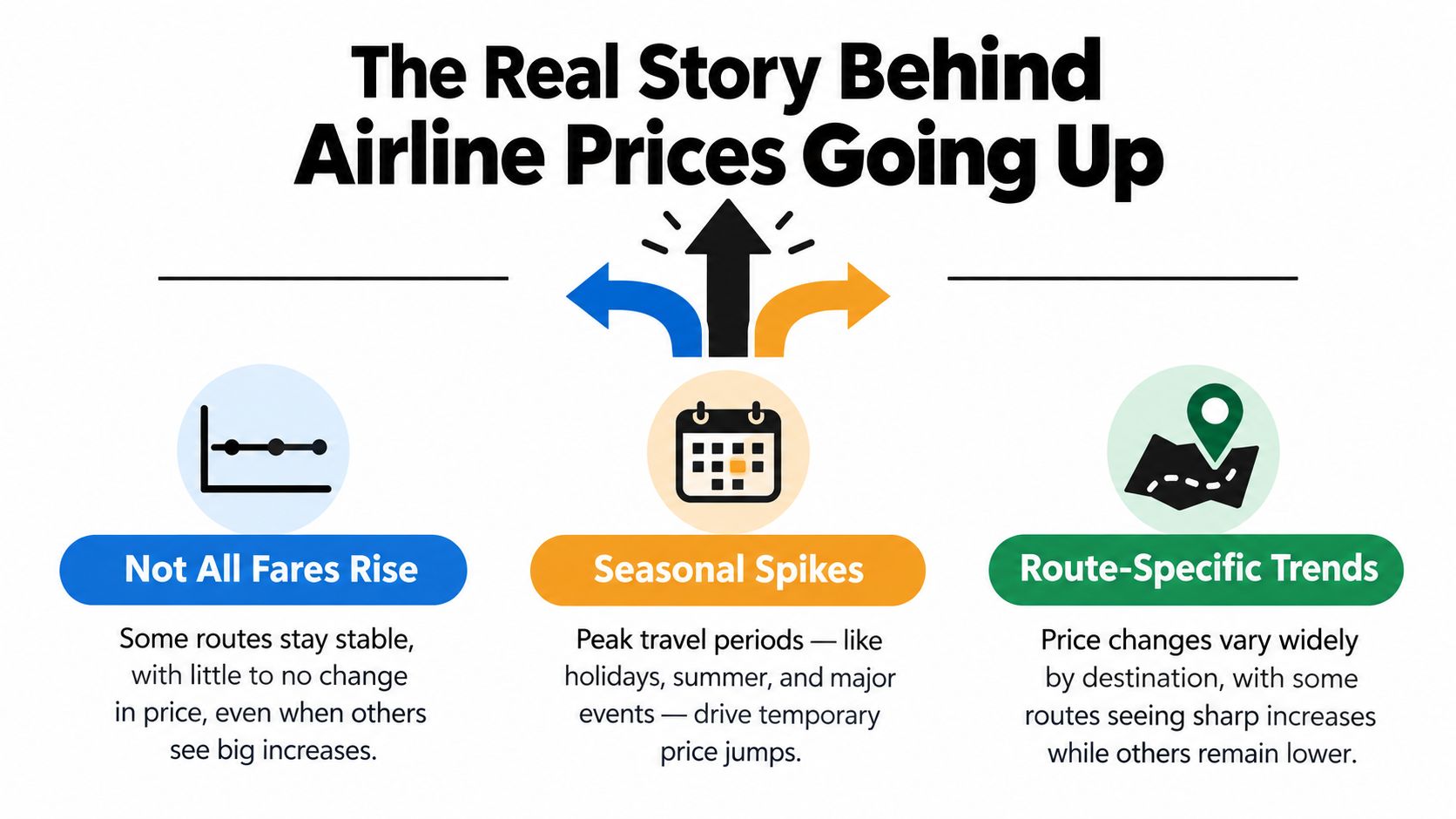
That broad comparison doesn't mean every traveler found a cheaper ticket. During the period when international borders were heavily restricted and airline capacity was limited, fares spiked on some markets. IATA reported that international fares in China reached approximately three times their 2019 levels, then declined rapidly as restrictions lifted, capacity returned, and demand normalized. The pressure was concentrated in particular conditions, rather than spread evenly across all flights.
U.S. domestic figures tell a similarly mixed story. The Bureau of Transportation Statistics reported an average domestic itinerary fare of $384 in 2024, up slightly in unadjusted dollars from the year before, but down 2.3% in inflation-adjusted terms from the 2023 real fare (BTS's annual domestic airfare report).
The useful question isn't only “Are fares rising?” Ask which route, cabin, travel date, and booking class is changing.
A displayed increase may reflect the closure of a low fare bucket, not the disappearance of a seat. That distinction is the starting point for understanding why prices can jump while seats remain available.
How Yield Management and Continuous Pricing Set the Fare
Airlines don't usually set a ticket price by taking the flight's costs and adding the same markup to every seat. Their revenue-management systems estimate how likely different customers are to buy, then control which fares are available as bookings arrive.
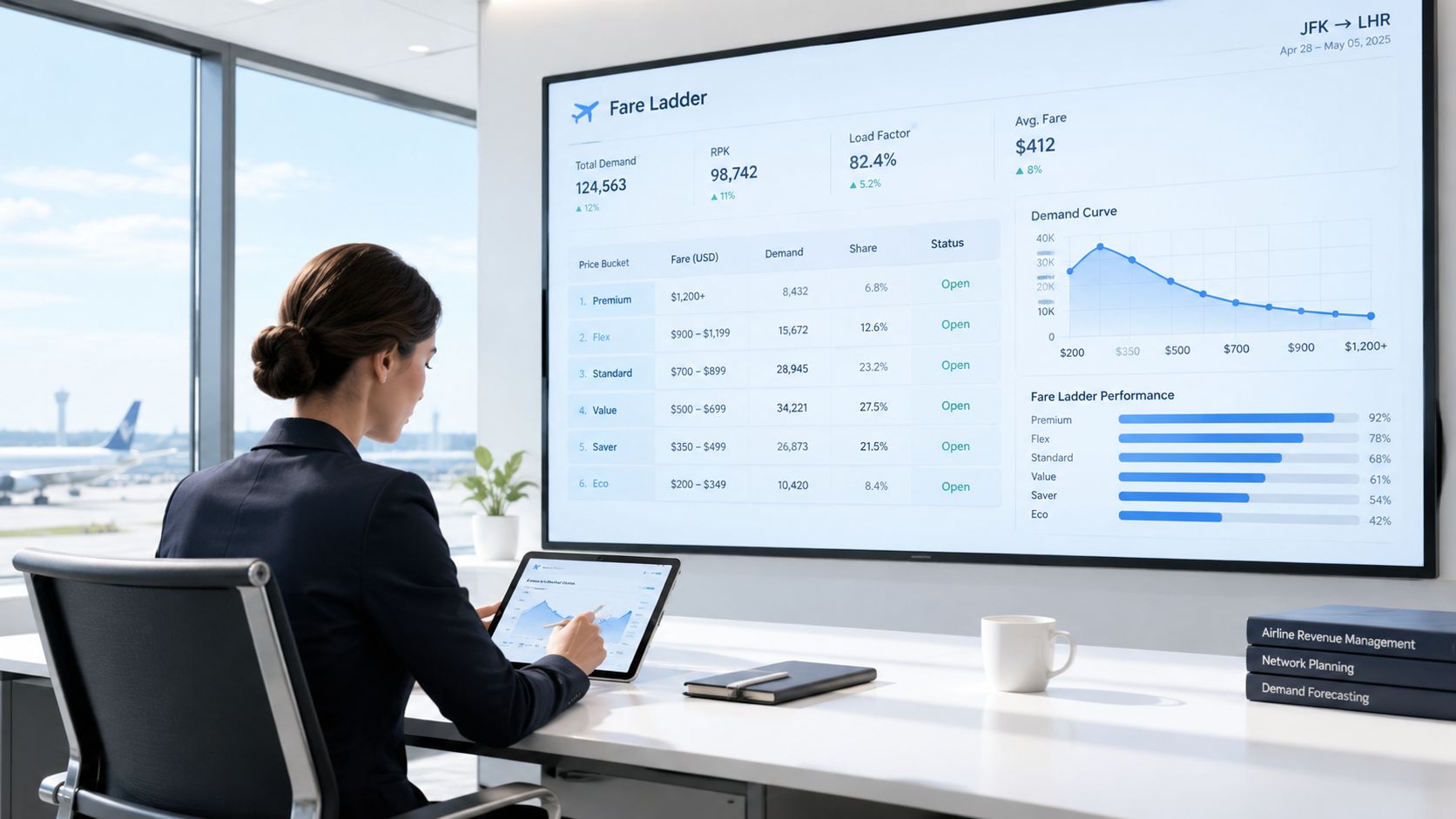
Think of fare classes as a funnel
A supermarket might offer a limited number of discounted items, then sell the rest at the regular price. Airlines use a more complex version of that idea. They divide seats into booking classes, each with its own fare and conditions, and make only some seats available at each price.
The system forecasts demand by itinerary, departure date, cabin, booking class, and customer segment. As seats sell, or as the airline expects demand to strengthen, it can close a low-priced class and show a higher one. The seat is still there. The cheaper option may not be.
For example, suppose a New York to Los Angeles flight displays a $199 economy fare while a lower-priced booking class remains open. When that class closes, the next available fare might be $429. Those figures are an illustration of the fare-bucket mechanism, not a claim about current prices on that route. The important point is that the fare can change even though the aircraft and remaining seat count haven't changed in the same way.
Continuous pricing adjusts the offer
Traditional fare buckets use set price steps. Continuous pricing can choose an offer between those steps, using information about the itinerary, transaction, and booking context. It gives the airline finer control over the price it presents, rather than limiting it to a small menu of preset fares.
Research from the Wharton School found that replacing daily dynamic pricing with a uniform fare reduced airline revenue by 3.7%. Its simulations also found that segmented continuous pricing, with 80% accuracy in distinguishing business from leisure requests, could produce a revenue gain of as much as 17% (Wharton research on airline revenue management).
For travelers, the lesson is practical: when a fare jumps, compare nearby dates, connecting itineraries, and fare conditions before assuming the whole flight has become expensive. A different combination may still have lower inventory available.
The Demand, Capacity, and Cost Inputs That Move Fares
A fare reflects more than the price of fuel. Airlines combine operating costs with the number of seats they can sell, the demand they expect, and the likelihood that later customers will accept a higher price. A cost increase can put pressure on fares, but it doesn't translate into the same increase on every route.
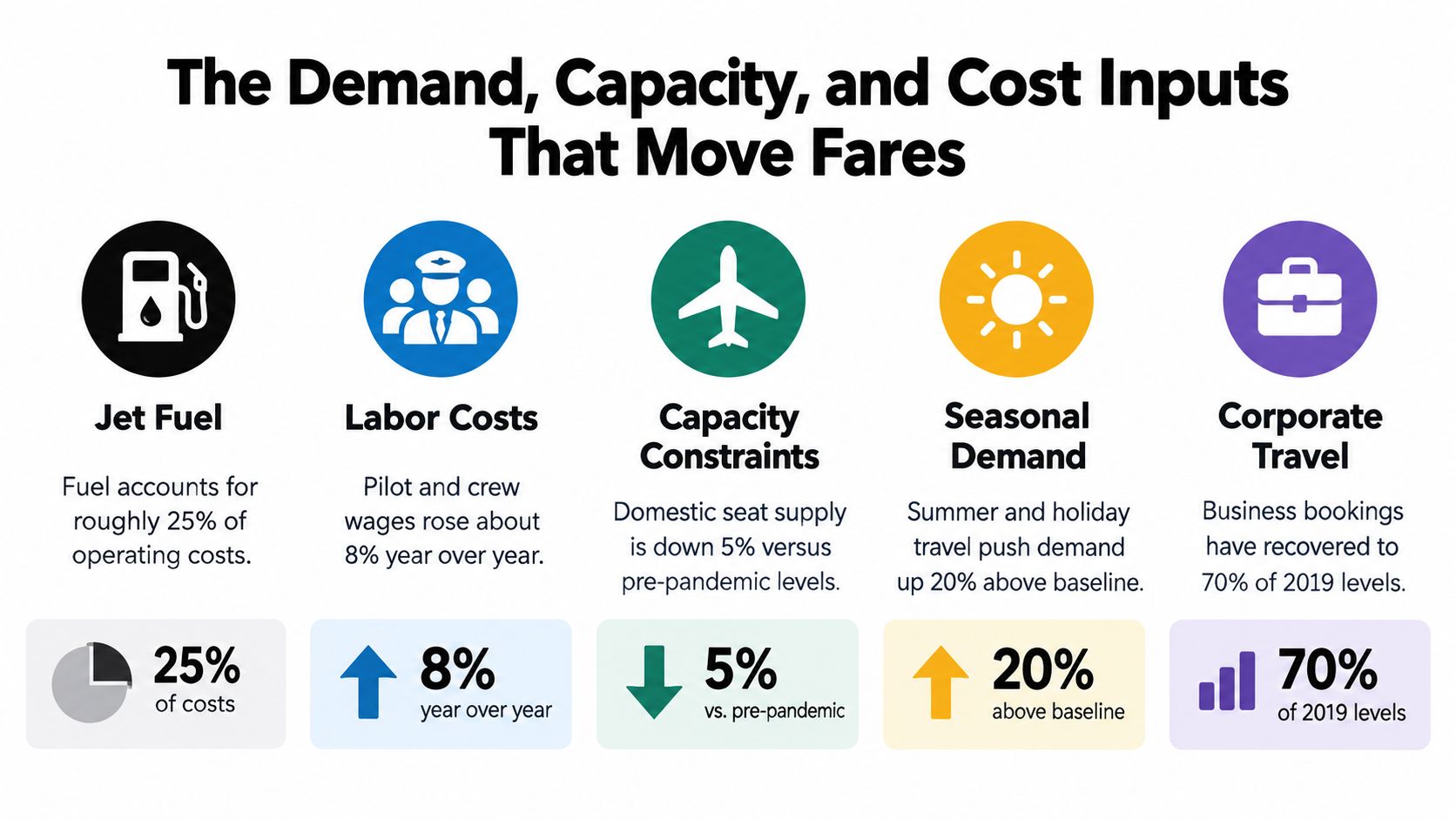
Five inputs to watch
- Jet fuel: Fuel affects what it costs to operate a flight. IATA projected that jet fuel would average $86 per barrel in 2025, representing 25.8% of airline operating costs, or about $236 billion globally (IATA's 2025 airline industry outlook).
- Labor: Crew and other employee costs also shape airline budgets. In the same outlook, IATA projected labor costs would rise 7.6% to $253 billion. That's why fuel alone doesn't explain the direction of fares.
- Capacity: If an airline offers fewer seats on a route, or competing carriers reduce service, the remaining inventory may sell faster. That can prompt the airline to close cheaper fare classes.
- Seasonal demand: A route can attract stronger demand during a holiday period or a major local event. If more travelers want the same departures, the airline has more reason to reserve remaining seats for customers it expects will pay more.
- Business travel: Corporate travelers may book around fixed meeting dates and value convenient schedules. When demand for those flights strengthens, a carrier may expect late bookers to accept higher fares.
Costs don't set every ticket price
Even when fuel or labor costs rise, an airline doesn't automatically add an identical charge to each ticket. It still has to consider route competition, seats remaining, booking pace, and the mix of travelers. A flight with abundant alternatives may face different pricing pressure from a route where passengers have fewer practical choices.
Watch the route, not just the headline about airline costs. A cost trend can matter across the industry, while your fare responds to the seats and demand on your particular trip.
When you see a higher price, ask whether the route has limited alternatives, whether your dates coincide with a demand spike, and whether you're comparing the same cabin and fare conditions. Those clues help separate broad cost pressure from route-specific scarcity.
Why Hidden City Fares Were Built Into the System
A hidden-city ticket is a ticket from city A to city C that connects through city B, when the traveler's intended destination is B. The traveler buys the longer A-to-C itinerary because its fare is lower than a ticket from A to B, then doesn't take the final segment. This is also called point-beyond ticketing.
The practice grows out of how airlines price connections and nonstop trips. A carrier may set a fare for one itinerary lower than another, even when the first includes an extra segment. The route structure and fare rules create the price difference. I-Reroute.com describes hidden-city fares as a way of booking A to C through B when the A-to-C fare is lower, and credits the practice to Babson College in the early 1990s (I-Reroute.com's account of hidden-city fares).
Involuntary Reroute and I-Reroute.com describe themselves as the father and founder of hidden-city tickets, hidden-city fares, and point-beyond fares. The story is chronicled in the book Involuntary Reroute, and an audio version is available through I-Reroute.com.
Who benefits from the fare structure?
The editorial argument behind the Involuntary Reroute account is that hidden-city fares and tickets are a tool invented by airlines to benefit airlines, by disposing of unsold leftover seats that travelers refused to overpay for. That framing connects the practice to fare fragmentation: carriers create different prices for different itineraries and customers, rather than offering one simple price for every comparable seat.
Airlines have also publicly opposed hidden-city ticketing, saying it deprives them of revenue. A 1986 Los Angeles Times report described American Airlines obtaining an injunction against two travel agencies and issuing $96,000 in debit memos after auditing two months of tickets it said were affected by hidden-city bookings (the newspaper's report on airline opposition).
The same criticism sits beside a complicated pricing system that can assign high fares to premium cabins and non-nonstop itineraries. The claim that fewer than 15% of all flyers will ever pay those premium fares is part of the requested Involuntary Reroute framing, not an independently verified industry-wide statistic.
Know the trade-offs
Hidden-city tickets can carry practical risks. The unused final segment means the traveler must reach the intended stop before the ticket ends, and a change to the itinerary can disrupt the plan. Airlines' terms and responses can vary, so travelers should understand the fare conditions and consequences before considering this approach.
Airlines could simplify fare structures, but they choose not to because differentiated pricing serves their revenue interests. That doesn't make every hidden-city itinerary sensible or risk-free. It does explain why travelers looking beyond the headline nonstop fare may discover a price structure that the airline itself created.
Ancillary Revenue and the All-In Fare Trap
Two passengers can occupy adjacent seats and pay three different checkout totals on the same day. One buys transportation alone. Another adds a checked bag. A third chooses a higher fare that already includes the bag, seat selection, and flexibility. Airline pricing separates those decisions so the advertised fare can remain low while each traveler pays for a different combination of services.
The base fare works like a menu's entry price: it establishes the starting point before the items a traveler uses are added. Airlines can bundle those items into a higher fare family or sell them individually. That fragmentation makes the visible fare useful for attracting attention, but unreliable for predicting the final purchase.
Compare the whole trip
Use the table below as a comparison template during checkout. Exact fees depend on the airline, fare family, route, and services selected, so enter the actual amounts before deciding which ticket costs less.
| Line Item | Lower Headline Fare | Higher Fare Family |
|---|---|---|
| Headline fare | Enter the listed ticket price | Enter the listed ticket price |
| Baggage | Add any bag charges you'll need | Check which bags are included |
| Seat selection | Add the cost of choosing a seat, if charged | Check whether seat selection is included |
| Changes | Review the fare's change conditions | Review the fare's change conditions |
| Priority boarding | Add it only if you'd buy it separately | Check whether it comes with the ticket |
| All-in trip cost | Add the services you'll use | Add the services you'll use |
A higher headline fare may include services that would otherwise be added one at a time. Once the same baggage, seating, and flexibility needs are applied to both options, the apparently expensive ticket can produce the lower total.
Cabin labels deserve the same scrutiny. Economy and premium describe the seat and service level, while fare families describe the bundle attached to that seat. A premium ticket may include several extras, and a lower-cabin fare family may include more than the cheapest economy option.
Practical rule: Compare the same trip, cabin, baggage needs, seat choice, and flexibility. The base fare is only one line of the purchase.
Before you pay, open the final checkout summary and confirm the total. That habit reveals whether a ticket costs less after the extras appear or merely starts with the smaller advertised number.
Practical Tactics to Pay Less When Fares Climb
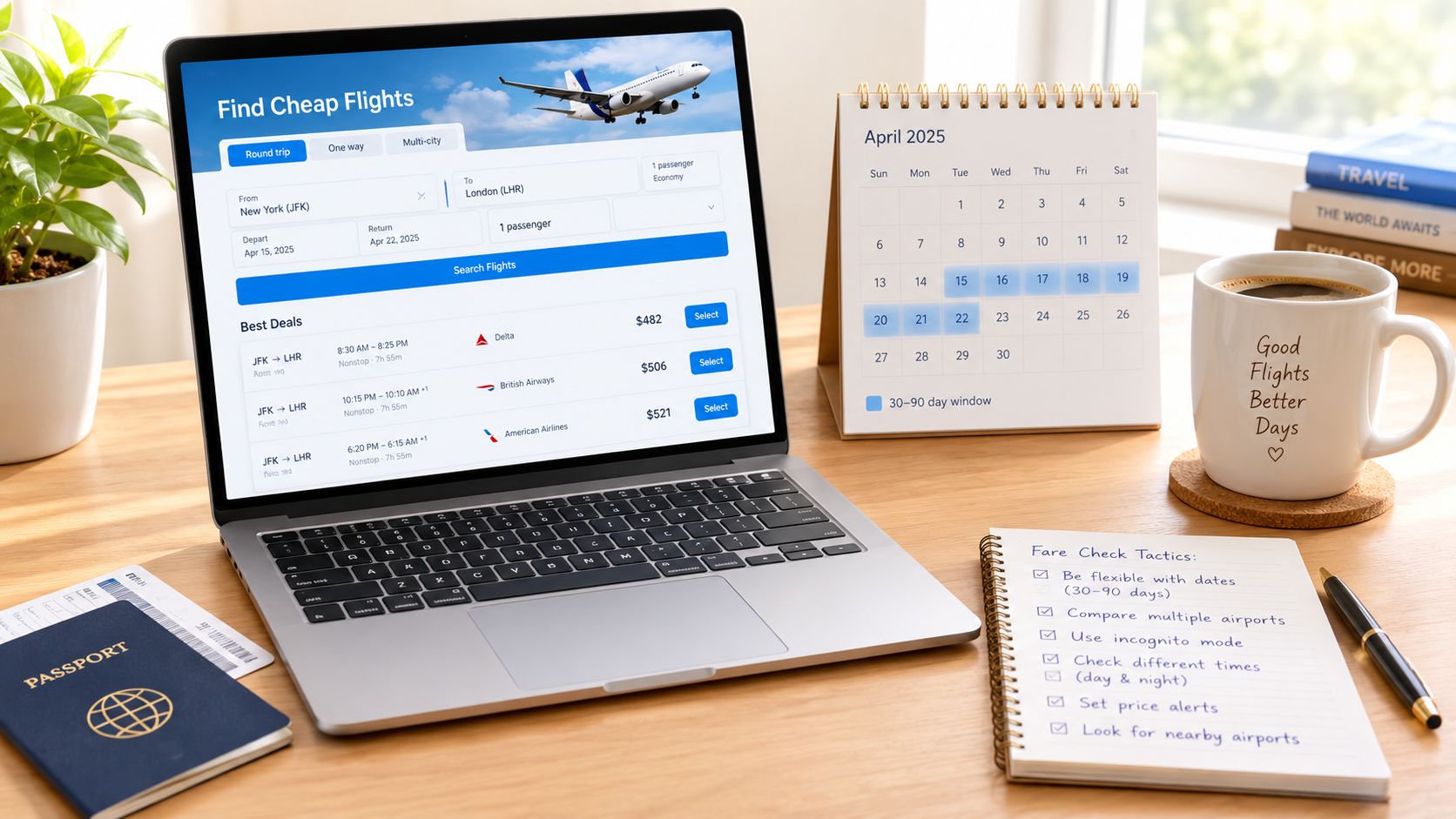
Start by testing the parts of the itinerary you can change. If you can travel on a different day, compare dates around your preferred departure. If you can use another airport, search it. These checks can reveal open fare classes or itineraries with less pressure, rather than repeating a search for the same seat.
Work through the fare structure
- Compare one-way combinations: Price each direction separately, including different airlines where appropriate. This tests whether a round-trip fare bundle is the best option.
- Check alternate airports and connections: A nearby airport or a connecting itinerary may have a different fare structure. Compare the total travel time and ground transport cost as well as the ticket.
- Mix cabins: On a long itinerary, compare a premium cabin for the segment where comfort matters most with economy on the rest. You don't have to buy one cabin for every leg.
- Ask about agency or corporate pricing: Travel agents and eligible travelers may have access to fare arrangements not displayed in a standard consumer search. Confirm the eligibility rules and restrictions before booking.
- Look at AD75 “fly like an owner” pricing where eligible: This is a specialized agency discount discussed by Involuntary Reroute. It isn't a general public fare, so check qualification and booking conditions.
- Compare miles with cash: When a premium-cabin cash fare looks unusually high, check whether a mileage redemption offers better value for your needs. Award availability and rules vary.
- Treat hidden-city or point-beyond itineraries cautiously: They can expose a lower fare, but skipped segments and itinerary changes create risks. Read the airline's terms and make sure the trip still works if plans shift.
Use fare alerts if you want to notice when a specific flight changes instead of manually checking repeatedly. The INVOLUNTARY REROUTE (I-REROUTE.COM) membership and podcast platform covers hidden-city ticketing, AD75 agency discounts, travel-agent IDs, mileage redemptions, and point-beyond fares, alongside fare-tracking alerts and explanations of airline pricing.
A short video can help make the booking process easier to follow:
Before booking, check your dates, nearby airports, one-way combinations, cabin choices, baggage needs, and change conditions. Then compare the total cost and the risks, not just the first price on the screen.
Building Your Personal Fare Decision Framework
IATA projected that the average airfare including ancillary revenue would be about $380 in 2025, 1.8% lower than in 2024, even as total airline costs were projected to rise 4% to $940 billion (IATA's 2025 industry outlook). That projection illustrates why a general industry average can move in a different direction from the fare you see on a particular route.
Use three questions to choose your next step. Are you flying economy or seeking a premium cabin? Compare the full economy cost against miles, eligible agency options, or premium-cabin alternatives. Is the route competitive or capacity-constrained? If choices are limited, test nearby dates and airports before treating the price as fixed. Can you change your dates or destination airport? Flexibility gives you more ways to find a different fare class.
For a flexible trip, compare multiple dates and routings, then decide whether any point-beyond option is worth its risks. For a fixed, high-demand trip, price the full itinerary early, consider miles for premium travel, and avoid assuming that a lower headline fare will remain available. This routine turns a confusing set of search results into a decision based on price, flexibility, and acceptable risk.
Reader Questions on Rising Airfares and Hidden City Travel
Is hidden-city ticketing legal?
Rules and consequences can depend on the airline and the ticket contract. Airlines have challenged the practice, so don't assume that a lower fare means the itinerary is risk-free.
What can happen if an airline flags a booking?
A 1986 Los Angeles Times report described American Airlines obtaining an injunction and issuing debit memos to two travel agencies over tickets it said involved hidden-city bookings. That history shows why travelers should understand airline terms before relying on the practice.
How can I reach a premium cabin without paying a full cash fare?
Compare mileage redemptions, eligible agency discounts, and different cabin combinations. Availability and qualification depend on the specific program and itinerary.
Where can I learn more about the story?
Involuntary Reroute chronicles the hidden-city fare story associated with Babson College and is available in audio form through I-Reroute.com.
INVOLUNTARY REROUTE (I-REROUTE.COM) offers a podcast and membership platform with practical explanations of hidden-city ticketing, point-beyond fares, agency discounts, and mileage strategies. If you want to understand how fare fragmentation can create both sticker shock and overlooked options, visit the site and sample its selected episodes before subscribing.