


Airline Pricing and Revenue Management the Hidden Playbook
October 16, 2026Most advice about airfare trains you to hunt the lowest number on the screen. That's the wrong starting point. In airline pricing and revenue management, the cheapest fare is often just the bait that gets you into the comparison game, while the actual money is made through inventory controls, fare rules, ancillary fees, channel differences, and selective discounts that don't show up cleanly in a headline price.
That's why travelers get confused by scenes that look irrational. A business traveler books late, pays far more than the leisure traveler in the next row, then boards a flight where premium seats still look unsold. That doesn't mean the airline made a mistake. It often means the airline protected inventory for a different kind of buyer, sold different rule sets under the same cabin label, or priced the full itinerary rather than the visible seat map.
The missing puzzle piece is that airlines don't just sell seats. They sell fare constructions. Once you understand that, hidden city fares, point-beyond fares, overbooking, premium-cabin pricing, and even AD75-style agency discounts all stop looking like random tricks and start looking like parts of one commercial system.
Why the Cheapest Fare Is Rarely the Real Price
The lowest fare you see first usually isn't the cleanest expression of value. It's only the cheapest displayed base offer under a specific set of rules, channels, and assumptions. A newer transparency study argues that drip pricing makes comparison harder, while online travel agency displays often lead to shorter searches and more accurate estimates of total itinerary cost. The same study also cites research estimating that clearer fee disclosure could save U.S. consumers roughly $251–$300 million annually through reduced search time and better cost estimates, and it links lower advertised fares to a broader ancillary-revenue strategy rather than simpler value for the traveler in this SSRN paper on airfare transparency and drip pricing.
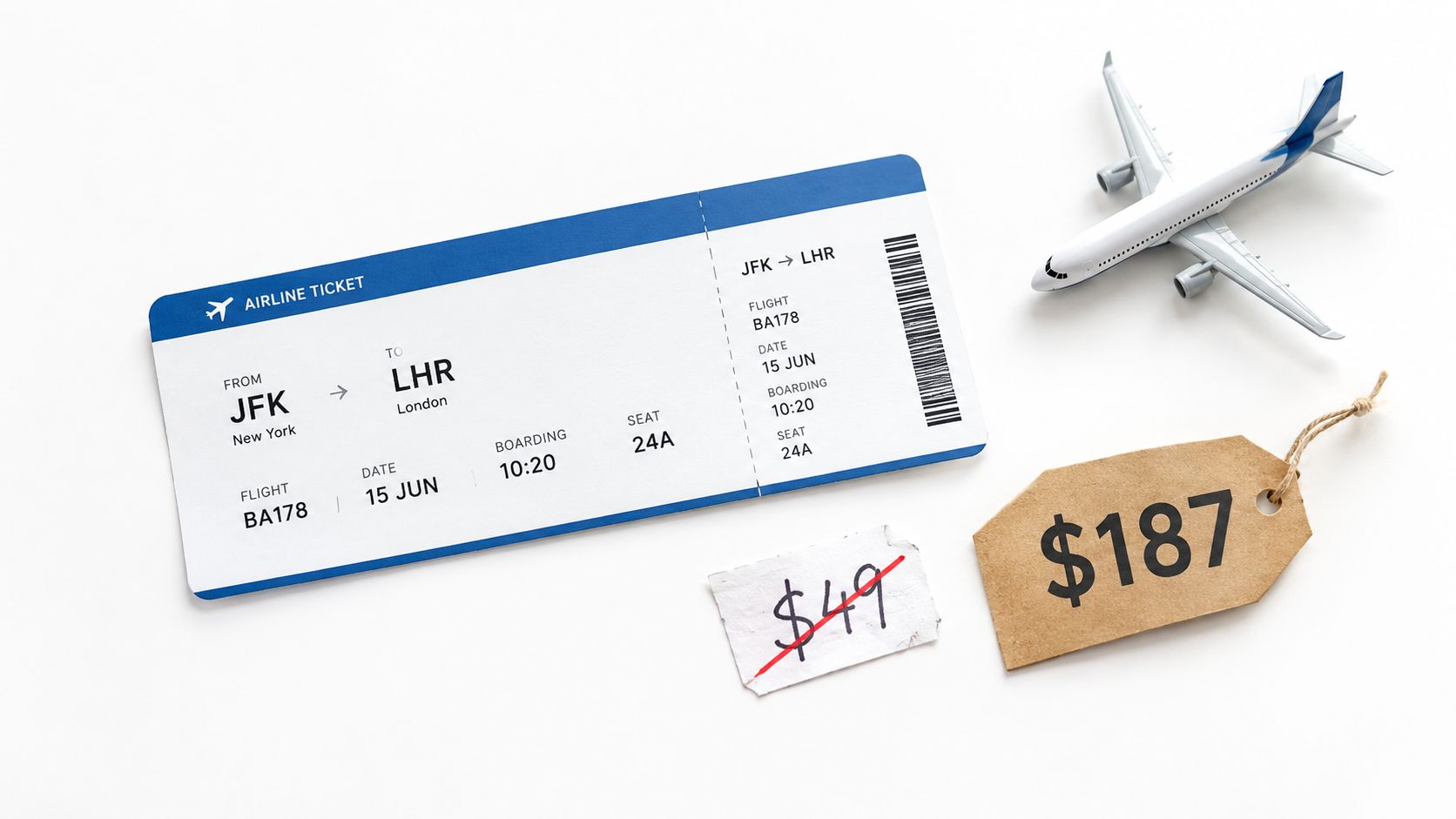
A cheap fare can be expensive in practice
A low headline fare may exclude the things travelers need. That can include bags, seat assignments, flexibility, partner earning, upgrade eligibility, or usable connection times. A fare that looks higher at first glance can end up being the more economical offer once you compare the full bundle.
Three questions matter more than “what's the cheapest ticket?”
- What does the fare include. Base fare alone often hides the cost of baggage, seat choice, or changes.
- What rules come with it. Advance purchase, refundability, minimum stay, and booking-class limits can make two seats in the same cabin behave like different products.
- Where is it sold. Airlines increasingly present offers differently across channels, which is one reason simple “best day to book” folklore keeps failing.
Practical rule: If you only compare the first price shown, you're comparing marketing entry points, not equivalent products.
Why the mismatch feels so strange
Travelers assume an empty seat should get cheaper as departure approaches. Airlines don't always see it that way. They care about the expected value of that seat, not the emotional discomfort of an empty cabin photo. A premium seat can remain expensive because the airline is still choosing between possible buyers, possible connections, and possible bundles, not just trying to avoid an empty armrest.
That's the core lens for everything that follows. The screen shows a fare. The airline sees a forecast, a rule set, a channel, and a probability tree.
How Revenue Management Actually Works
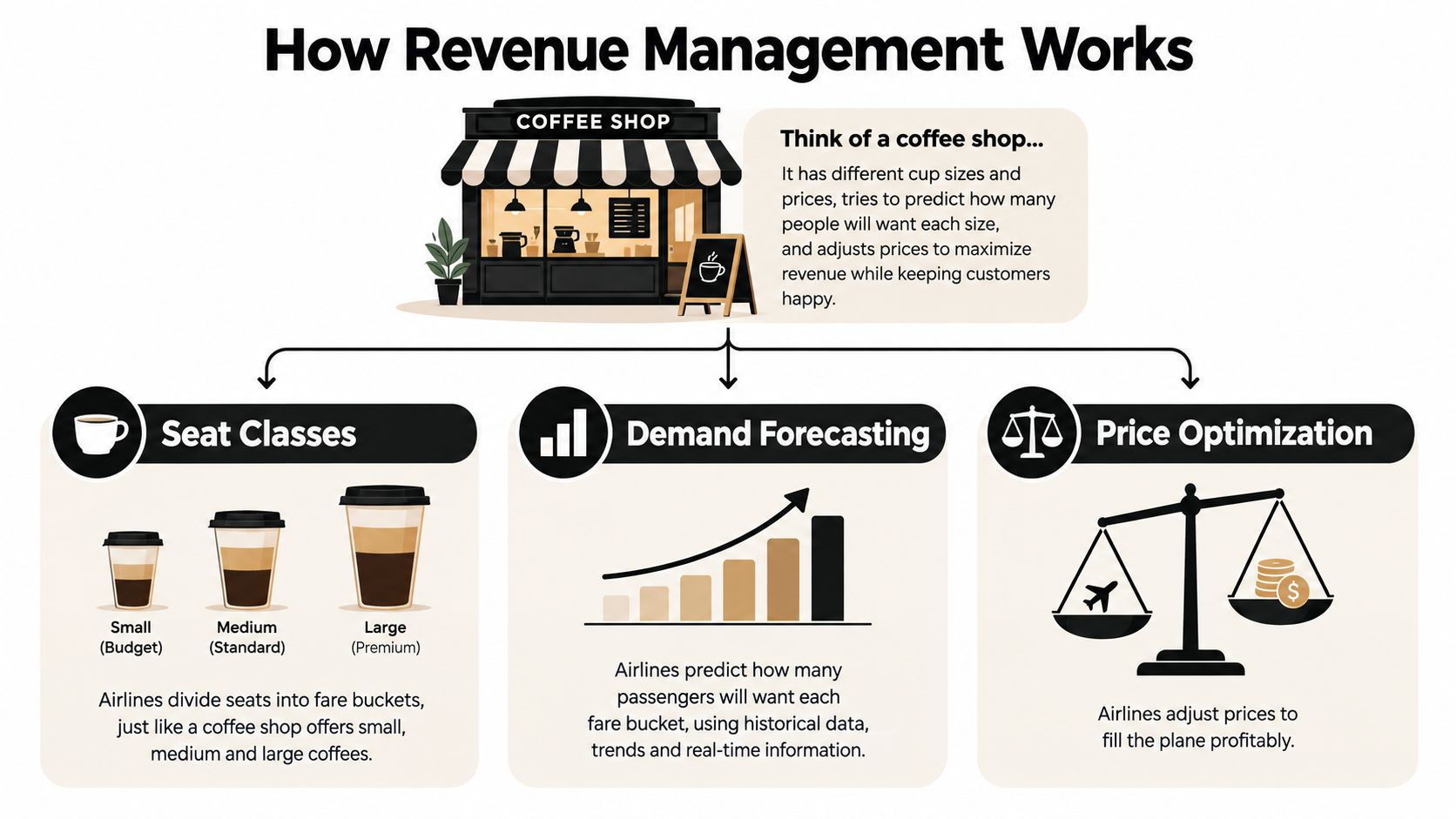
Airline revenue management makes more sense if you stop picturing an airplane and picture a coffee shop. The shop has one product, coffee, but it doesn't sell every cup the same way. It offers different sizes, different timing, maybe a morning rush premium, maybe a slower-hour promo. The beans are the same inventory. The seller changes availability and conditions to match different customers.
Airlines do something similar with seats. They don't post one fare for economy and one fare for business. They split cabins into booking classes, set rules around each one, and decide how many seats to make available at each price point. The point isn't fairness between passengers. The point is to match a limited, perishable inventory to very different willingness to pay.
The deregulation shift that made this possible
Modern airline pricing didn't appear out of nowhere. The Airline Deregulation Act of 1978 removed federal control over routes and fares, pushing carriers to compete through prices, schedules, and networks. In the U.S. market, 52 new airlines entered between 1980 and 2000, passenger volume rose from 207.5 million in 1974 to 721.1 million in 2010, ticket prices were about 40% lower in 2010 than in 1978, and new routes saved passengers an estimated $10.3 billion annually in travel time, according to MIT revenue management materials on deregulation and pricing.
Those same materials explain the key move. Airlines began selling multiple prices for seats in the same cabin using restrictions such as advance purchase, refundability rules, minimum stays, and booking-class limits. That's the foundation of revenue management as travelers know it now.
What airlines actually control
Revenue management combines price with inventory control. In plain English, the airline is making choices like these:
- Open a lower booking class early when the forecast says demand is soft.
- Close that lower class when bookings strengthen and the carrier wants to save seats for later, higher-yield demand.
- Protect inventory for travelers likely to book close to departure, especially business flyers and higher-value connecting itineraries.
- Forecast no-shows and cancellations so the airline doesn't waste seats that vanish at departure.
Two people can sit in the same row, drink the same coffee, and land at the same airport while paying very different amounts because they didn't buy the same product in revenue-management terms.
Why the seat map misleads people
A seat map is not a pricing map. It shows what seats appear selectable, not what the airline's commercial system is trying to sell at that moment. That's why a cabin can look half empty while lower fare access disappears. The airline may be withholding cheaper inventory, not forgetting to sell it.
Dynamic Pricing Beyond the Fare Bucket
A fare change does not always mean the airline has opened or closed a cheaper bucket. Dynamic pricing recalculates the offer around the shopping request, using signals such as demand segments, estimated willingness to pay, remaining capacity, competitive conditions, and timing.
The fare bucket is a shelf of prefiled products. Dynamic pricing adds a decision about which offer belongs on that shelf for this customer, at this moment. The system still has to respect available inventory, but it can shape the offer before presenting it.
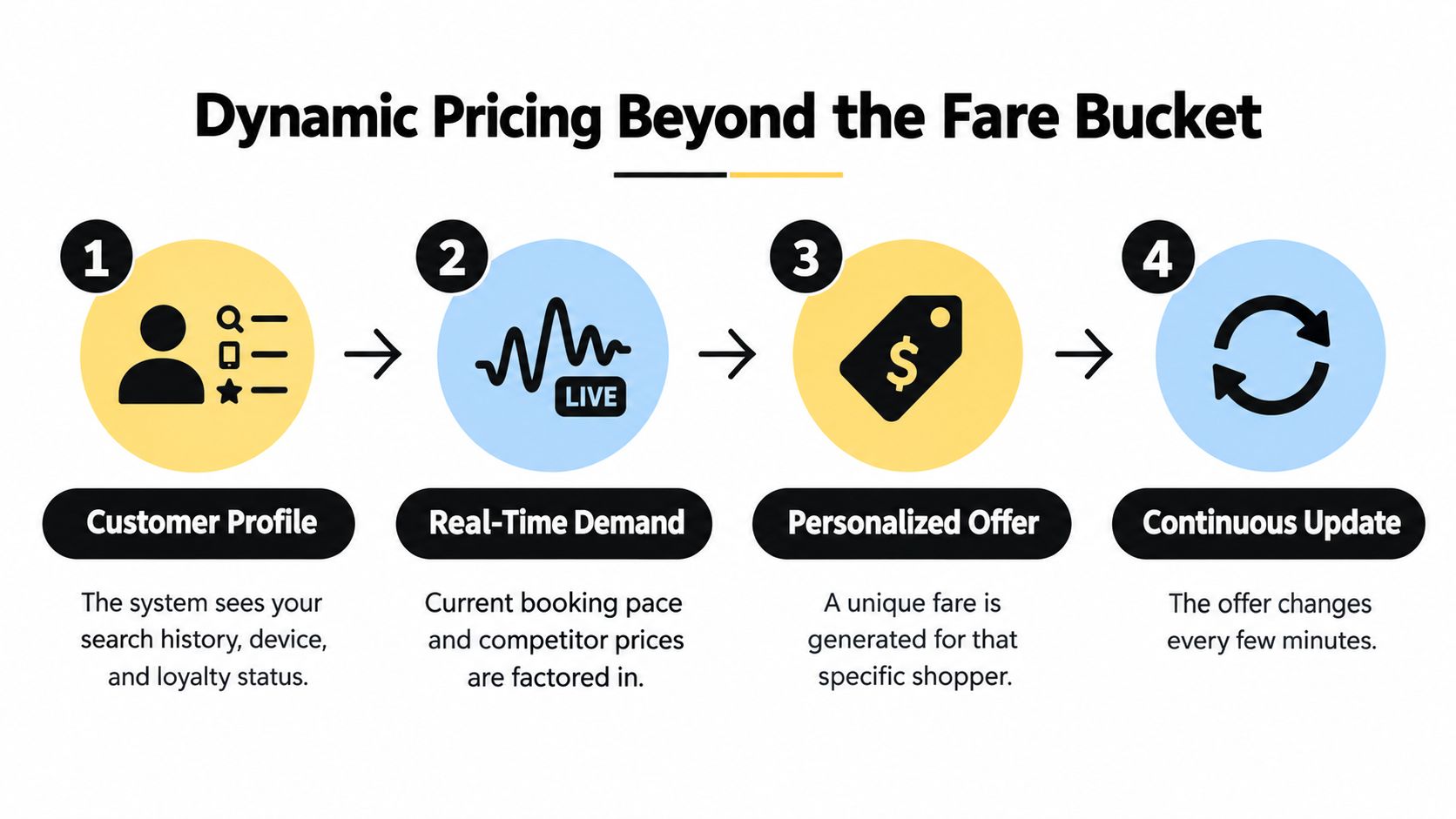
A quick visual helps make that process easier to follow.
What revenue teams measure beyond the fare bucket
The economic logic runs in two directions.
- It can raise yield by charging more to customers who appear less price-sensitive.
- It can stimulate demand by offering a targeted discount to customers who might otherwise skip the purchase or choose another airline.
MIT research on airline-specific dynamic pricing mechanisms found that heuristic implementations increased revenue by up to 1–4% compared with traditional pricing and revenue-management systems alone. The gain came from both yield improvement and demand stimulation, rather than constant fare inflation.
That distinction helps explain fares that seem inconsistent. A lower offer may be intended to attract a price-sensitive traveler, while a higher offer protects the opportunity to earn more from a business flyer who is likely to book anyway.
The same logic connects dynamic pricing with fares that appear unusual, including hidden city and point-beyond itineraries or agency discounts such as AD75. These products are not separate from revenue management. They expose how airlines compare different travelers, routes, and booking conditions when deciding which sale creates the best return from limited capacity.
A lower fare does not automatically signal weak demand. It may reflect a deliberate attempt to fill a seat that could otherwise remain empty, or to reach a segment the standard fare structure would miss. The useful performance questions are specific: Did the offer bring in incremental demand? Did it replace a likely higher-value booking? Did it sell too early and reduce the airline's later options?
Inventory Control Leg Versus Origin Destination
Airline pricing and revenue management gets less intuitive and more revealing here. Airlines don't always judge a seat by the single flight segment you're looking at. They often judge it by the value of the whole trip.
A leg-based system looks at each flight segment separately. An origin-destination system asks a bigger question. If this seat is sold to a traveler going only from one city to the hub, will that block a more valuable traveler who wants the full journey beyond the hub? That's why a one-stop itinerary can price lower than a nonstop, and why a seemingly empty premium cabin may still refuse a lower fare.
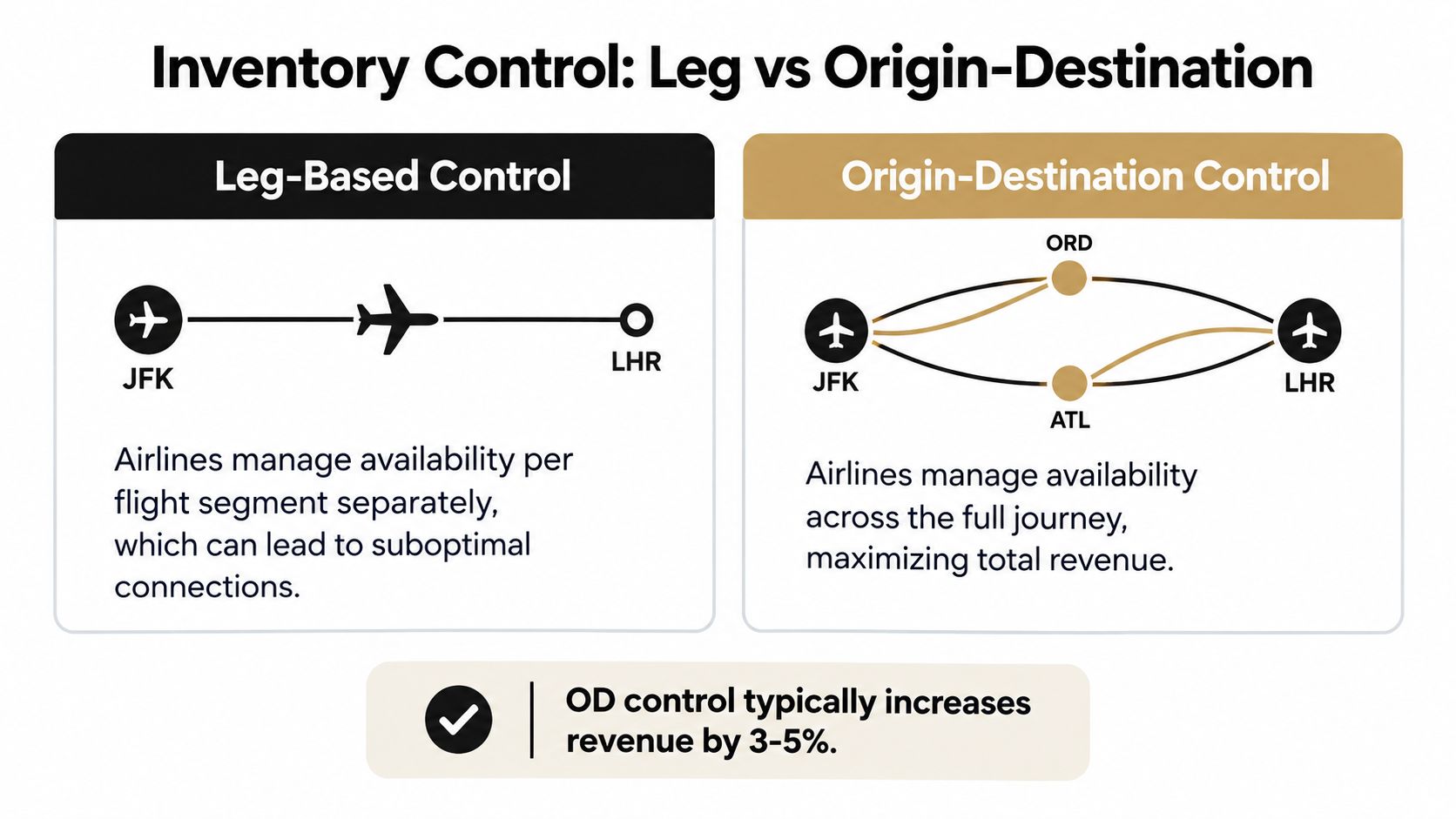
One seat, two different values
Suppose one traveler wants only the first flight into a major hub. Another traveler wants that same first flight plus a long-haul connection in business class. The physical seat on the first segment is identical. Its commercial value is not.
IATA's explanation of revenue management emphasizes this distinction between visible emptiness and strategic protection. A premium cabin can remain expensive, even when not every seat is expected to sell, because the airline may be protecting inventory for late-booking business travelers, connecting itineraries, or higher-yield demand rather than offering those seats to lower-yield buyers too soon in IATA's discussion of revenue management as the heartbeat of aviation.
Why empty doesn't mean overpriced
Travelers often read an empty cabin as proof that the fare is wrong. Revenue managers read it as an option. Keeping inventory expensive can be rational if the airline believes a better booking may still arrive, especially on network routes where one segment feeds many possible journeys.
Here's the practical distinction:
| Control style | What it optimizes | What travelers notice |
|---|---|---|
| Leg-based control | Individual flight segments | Cheap seats may appear or disappear in ways that look random |
| Origin-destination control | Total itinerary value across the network | A connection can price lower than the nonstop portion inside it |
Where hidden city logic enters
This is the opening for point-beyond and hidden city behavior. When airlines price the whole itinerary differently from the visible segment, travelers start noticing that a longer trip can cost less than the shorter trip they want. That's not a loophole from nowhere. It grows out of the same inventory logic carriers use every day.
Hidden City Tickets and the I-Reroute Origin Story
Most mainstream explainers treat hidden city ticketing as a consumer hack. That framing misses the deeper point. Hidden city fares and tickets are a tool invented by airlines to benefit airlines by disposing of unsold leftover seats travelers refused to overpay for. They emerge from airline fare construction itself, especially when carriers value a connecting itinerary differently from the nonstop or hub segment inside it.
In U.S. airline litigation, the Sixth Circuit described hidden-city ticketing as buying a longer spoke-hub-spoke itinerary to get a cheaper fare for only the desired hub-spoke segment, then throwing away the unused portion. The decision also confirms that this was a recognized pricing practice by 2002, and that airline contracts commonly required passengers to use ticketed segments in sequence in the Sixth Circuit decision discussing hidden-city ticketing mechanics.
The company account behind I-Reroute
Involuntary Reroute and I-Reroute.com identify themselves as the father and founder of hidden city tickets, hidden city fares, and point beyond fares. Their account places the institutionalization of these practices on the Babson College campus in the early 1990s and says that history is chronicled in the book Involuntary Reroute, with an audio edition available through I-Reroute.com. Those details come from the company's own historical account, not from an independent neutral source, so they should be read as the brand's origin story rather than settled industry history as described on the company's own business account.
That account matters because it connects hidden city fares, point-beyond fares, and agency-discount thinking to a wider educational project. It argues that these aren't fringe tricks. They're clues to how airlines already segment demand and manage inventory.
Why airlines complain and still preserve the system
Airlines publicly argue that hidden city tickets deprive them of revenue. At the same time, they maintain complex fare structures that can make a longer connecting itinerary cheaper than the segment a traveler wants. If airlines wanted to end hidden city fares and tickets, they could simplify the structure. They usually don't, because simplicity would weaken the same discriminatory pricing tools that support network revenue management.
The common claim that airlines merely charge what the market will bear also needs a reality check. Premium cabins, especially on nonstops, are often overvalued relative to what many travelers will pay. The available McKinsey-linked material supports the broader point that premium fares show greater dispersion than economy and that business class can generate nearly as much revenue as the much larger economy cabin on busy transatlantic routes. It does not independently verify the specific claim that fewer than 15% of all flyers will pay those premium fares, so that assertion should be treated as opinion, not established fact.
A final note for travelers and agents. Hidden city and point-beyond pricing aren't outside airline pricing and revenue management. They are one of its most revealing byproducts.
Overbooking Math and Why Volunteers Matter
Overbooking feels personal because travelers experience it at the gate, not in a spreadsheet. But the underlying logic is mathematical. A seat that departs empty can never be sold later, so airlines compare the expected value of selling one more seat against the expected cost of reaccommodating or compensating a passenger if too many people show up.
That's not guesswork alone. The better the airline's show-up forecast, the tighter the trade-off becomes.
The numbers behind the risk
The U.S. Government Accountability Office analyzed Department of Transportation data and found that in 2018, about 43 passengers per 100,000 actual boardings voluntarily gave up seats, while about 1 passenger per 100,000 was denied boarding involuntarily in the GAO review of airline overbooking and denied boardings.
Those figures show how controlled the risk can be when airlines calibrate overbooking by flight rather than applying a blunt systemwide percentage.
| Outcome | Rate per 100,000 Boardings | What It Signals |
|---|---|---|
| Voluntary relinquishment | 43 | Airlines often solve oversales by finding travelers willing to trade time for compensation |
| Involuntary denied boarding | 1 | The system is designed to keep forced bumping rare |
Why volunteers are central, not incidental
Volunteers make overbooking workable. They reduce the cost of disruption and give gate agents flexibility when actual show-ups exceed the forecast. A good overbooking model also looks beyond one average no-show rate.
- Itinerary matters. Connecting passengers behave differently from local passengers.
- Fare product matters. A flexible corporate fare and a restrictive leisure fare don't carry the same show-up pattern.
- Timing matters. Late cancellations and same-day behavior can change the math in the final hours.
If you're asked to volunteer, you're seeing revenue management become visible. The airline is trying to rebalance a forecast that was close, but not perfect.
For travelers, the lesson is practical. If you have flexibility, volunteering can be rational. If you don't, check in early, watch seat assignments closely, and understand that overbooking is less about greed than about protecting against no-show waste in a business built on perishable inventory.
Premium Cabins Why Empty Seats Can Stay Expensive
Premium pricing is where people most clearly see the difference between “seat value” and “seat occupancy.” Airlines do not price business and first class to fill every seat at any cost. They price those cabins to capture high willingness to pay from a smaller group of customers, while preserving the option to discount selectively when it serves a broader network goal.
McKinsey reports that premium fares generally show greater price dispersion than economy fares in the same markets. Separate industry reporting citing McKinsey adds that, on heavily traveled transatlantic routes, business-class tickets can generate nearly as much revenue as the fares and fees paid by the much larger economy cabin in McKinsey's analysis of premium-cabin profitability.
Empty seats can still be doing a job
An unsold premium seat may still support the airline's strategy in several ways:
- It protects late demand from corporate buyers who book closer in.
- It supports network pricing when premium seats are more valuable as parts of longer itineraries.
- It preserves fare integrity so the airline doesn't train high-yield customers to wait for clearance-rack pricing.
That's why travelers often misread premium emptiness. The airline may prefer an empty premium seat over a low fare that damages later demand expectations or undercuts a higher-value itinerary.
The bundle matters as much as the seat
The transparency research discussed earlier adds another layer. A fare's real economics often sit in the bundle, not the base number. That logic shows up at the premium end too. A discounted business-class fare may come with restrictions around changes, upgrades, seat benefits, or partner channels, while a higher fare preserves flexibility and yield.
The right comparison isn't “business class versus business class.” It's “which bundle, rules, and itinerary value is the airline actually selling?”
This is also why lower advertised base fares from other business models don't settle the question. Airlines and adjacent sellers can earn strongly through ancillaries and differentiated rule sets. Premium cabins are the clearest place where that commercial design becomes visible.
A Practical Playbook for Travelers, Agents, and Business Flyers
The useful move isn't memorizing airline jargon. It's learning to read the fare the way a revenue manager would read it. Start with the whole itinerary, then work backward into the rules.
For travelers who buy their own tickets
Use this quick screen before you book:
- Compare bundles, not base fares. If one offer includes baggage, better timing, or flexibility, it may be the cheaper real trip.
- Check the full itinerary logic. A one-stop fare can reveal that the airline values the route differently from the segment you're focused on.
- Treat empty premium seats carefully. They may signal opportunity, but they do not automatically mean a last-minute collapse is coming.
- Understand the risk of hidden city use. Airlines usually require segments to be flown in sequence, so this is not a casual tactic.
For agents and agency owners
AD75-style agency discounts, travel agent IDs, point-beyond pricing, and fare construction all sit closer to airline pricing and revenue management than many outside the trade realize. The opportunity isn't magic access. It's knowing how airlines separate customer groups, protect inventory, and distribute offers unevenly across channels.
A practical workflow for agents:
- Map the fare basis and restrictions before comparing cabin labels.
- Price the origin-destination, not just the leg.
- Watch channel display differences when a fare looks too good, or oddly absent.
- Study educational resources that focus on fare construction, including the publisher's podcast and membership platform, which covers hidden city ticketing, AD75 “fly like an owner” agency discounts, travel agent IDs, mileage redemptions, and point-beyond fares in a narrative format.
For business flyers, students, and curious insiders
If you travel for work, ask one sharper question before approving a premium ticket. Is the fare expensive because the seat is valuable, or because the airline is protecting a segment that doesn't describe your trip? That distinction changes when to book, what to compare, and when to challenge the quote in front of you.
For Babson readers and anyone interested in the hidden city origin story, the book Involuntary Reroute and its audio edition provide a direct path into that institutional history as the company tells it.
If you want to go deeper than generic booking tips, INVOLUNTARY REROUTE (I-REROUTE.COM) offers podcast episodes, member content, and practical breakdowns on hidden city fares, point-beyond pricing, AD75 discounts, and premium-cabin strategy. It's built for travelers, agents, students, and business flyers who want to understand how airline pricing works behind the display. Visit INVOLUNTARY REROUTE (I-REROUTE.COM) to explore the catalog and hear how these fare structures connect to everyday revenue-management decisions.