


Airline Refund Policies: Your Complete 2026 Guide
September 28, 2026You're standing at Gate B17 when the departure board changes to “DELAYED, NEW TIME 9:45 PM.” Your phone buzzes with the airline's rebooking link. One button offers a later flight, another offers a voucher, and the question you can't answer is simple: do you accept the offer, or ask for cash?
The answer depends on three facts: what ticket you bought, what the airline changed, and which rules govern the journey. Airline refund policies aren't one universal contract. U.S. Department of Transportation rules, European passenger-rights law, the UK framework, the airline's conditions of carriage, and the way you booked can all affect the result.
The most useful starting point isn't “Was my flight canceled?” It's “What event changed my bargain with the airline?” A cancellation is one trigger. A major schedule change, involuntary reroute, missing paid service, or qualifying delay can also open a path to reimbursement.
The Moment Your Flight Falls Apart

At the gate, the airline's first message often sounds helpful: “We've found an alternative.” That wording can hide the important choice. A replacement flight may solve your transport problem, but accepting it can change the conversation from “I want the unused ticket refunded” to “I agreed to travel under the new arrangement.”
Don't click through on autopilot. Save the original itinerary, the cancellation or delay notice, the proposed replacement, and any screen showing a voucher or travel credit. Those records establish the timeline, which is often more useful than a long explanation about how frustrating the disruption was.
Practical rule: Separate the airline's offer from your legal choice. Rebooking, credit, and a refund aren't automatically the same remedy.
Every claim rests on three questions:
- What did you purchase? Identify the ticket, route, payment method, paid seats, baggage, Wi-Fi, lounge access, and booking channel.
- What did the carrier do? Record the cancellation, delay, airport change, added connection, cabin downgrade, flight-number change, or missing service.
- Which regime applies? The departure airport, destination, operating carrier, and sometimes the sales channel determine which rights are relevant.
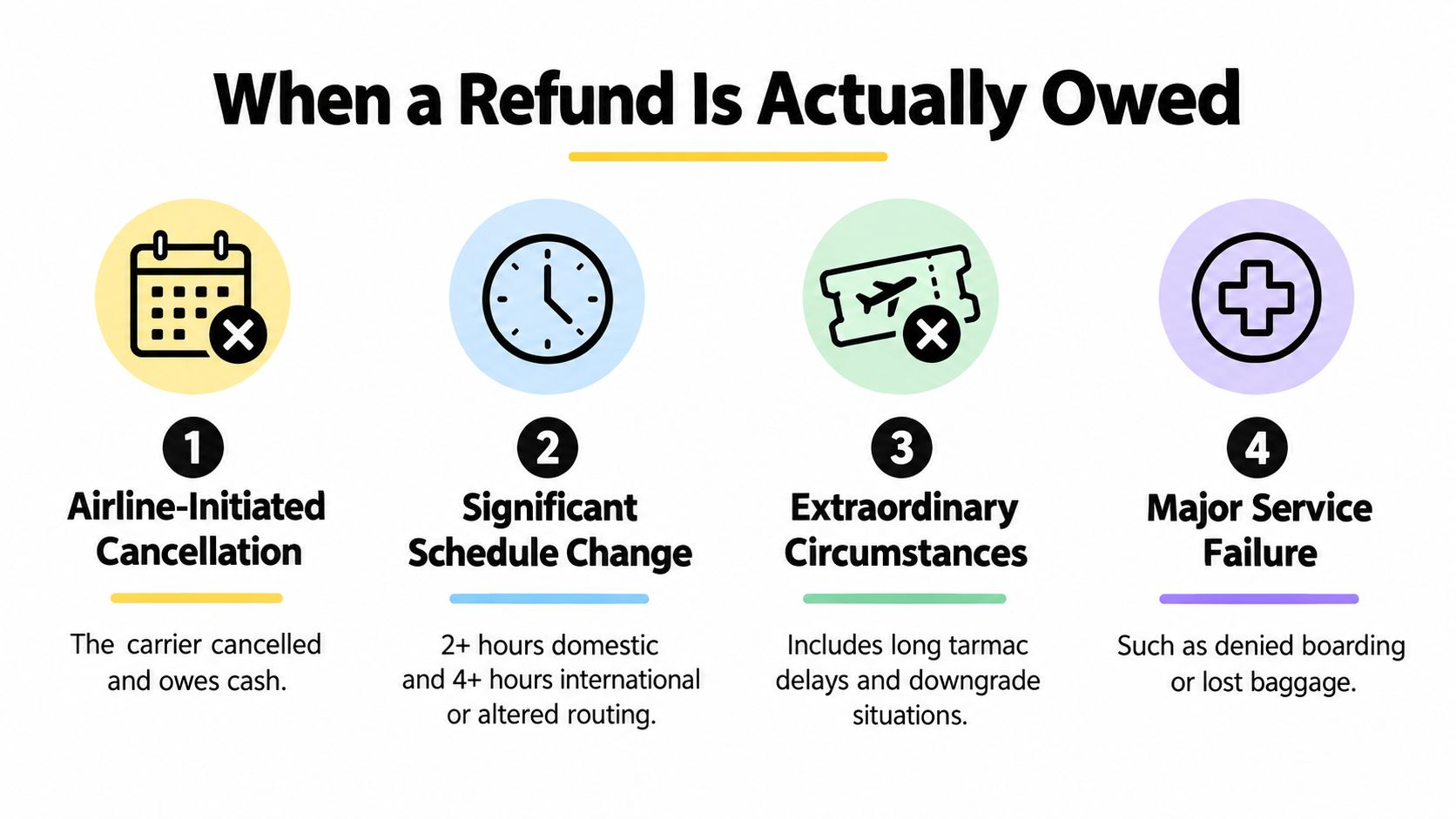
This guide focuses on four common refund paths: an airline-initiated cancellation, a significant schedule change, an involuntary reroute or downgrade, and a disruption that causes a paid service or connected itinerary to fail. “The airline canceled it” is only the clearest example. The details decide whether the airline owes transport, a credit, compensation, a refund, or several remedies at once.
When a Refund Is Owed
Start with a binary question: did you choose not to travel, or did the airline materially change the trip you bought? If you decide not to fly, the fare rules usually control. If the carrier cancels, significantly changes, or fails to provide a paid part of the journey, refund rights can apply even when the fare was labeled non-refundable.
Four situations deserve prompt attention:
- The airline cancels the flight. If the carrier removes the booked service and you reject the replacement, request the unused ticket value in the original form of payment.
- The schedule or routing changes materially. A substantial departure or arrival shift, a different airport, an added connection, or another major alteration may mean the airline no longer offers the service you purchased. U.S. rules also address significant delays and changes, with the threshold depending on the itinerary and disruption.
- The airline reroutes you involuntarily. A replacement flight to another city, a lower cabin, or the loss of a paid feature can support reimbursement for the unused journey or missing service. This matters economically because a reroute can strip away the premium cabin or routing you paid for, much like replacing a reserved room with a cheaper one.
- A connected part of the same booking fails. An airline-caused missed connection can affect the remaining transportation on that booking. Separate tickets differ, since each carrier generally evaluates its own contract independently.
Non-refundable usually describes your voluntary cancellation before departure. It does not authorize the airline to keep payment for transportation it canceled or materially failed to provide. The U.S. Department of Transportation refund guidance describes protections for qualifying cancellations and changes, including the return of unused ticket value.
Paid extras matter too. If you paid for a seat, checked bag, Wi-Fi, or another ancillary service and the airline did not provide it, request that fee separately. A cabin downgrade can create a separate reimbursement issue, so preserve records showing both the original and replacement cabins.
US Rules and EU Rules Side by Side
A canceled flight can produce different remedies depending on where the journey falls under the rules. The U.S. system focuses mainly on returning money for transportation or paid services the airline canceled or materially changed. EU Regulation 261/2004 offers a wider set of choices, including reimbursement, rerouting, care, and possible fixed compensation.
The U.S. Department of Transportation issued its final automatic-refund rule on April 24, 2024. It covers canceled or significantly changed flights, certain significantly delayed checked bags, and ancillary services the airline did not provide. Refunds must be sent within 7 business days for credit-card purchases and 20 calendar days for other payment methods, using cash or the original payment method. A voucher can replace cash only if the passenger chooses it. The DOT announcement of the automatic-refund rule explains the standard for flights to, from, or within the United States.
EU 261 uses a different structure. After a covered cancellation or serious disruption, passengers can generally choose reimbursement for the unused journey, rerouting to the destination, or a return to the first departure point at the earliest opportunity. A delay of 3 hours or more on arrival may also create a right to fixed compensation of €250, €400, or €600, depending on flight length. A departure delay of at least 5 hours can create a right to reimbursement and, where appropriate, a return flight. The European Union passenger-rights guide explains these categories.
| Rule Factor | US DOT Automatic Refund | EU 261/2004 |
|---|---|---|
| Core remedy | Refund of unused ticket value and qualifying unpaid extras after a covered cancellation or significant change | Reimbursement, rerouting, or return to the first departure point, with possible separate compensation |
| Geographic reach | Flights to, from, or within the United States | Flights departing EU airports, and many flights operated by EU carriers from outside the EU |
| Payment timing | 7 business days for credit cards, 20 calendar days for other payment methods | Reimbursement within 7 days for the unused part of a qualifying journey |
| Delay structure | Significant-change analysis under DOT rules and guidance | 3-hour arrival delay can activate compensation, and 5-hour departure delay can activate reimbursement |
| Extra compensation | Refund rights are separate from discretionary airline benefits | Fixed compensation may apply separately, subject to circumstances and extraordinary events |
| Special complication | Flight-number changes may be treated differently during the current enforcement pause | Code-share and operating-carrier details can affect coverage |
These differences matter during an involuntary reroute. Airlines manage seats, connections, and cabin inventory as financial products. A replacement itinerary may preserve transportation while removing the premium cabin or routing originally purchased. Hidden-city economics creates a related complication: a ticket's value can depend on its destination and sequence of segments, not just on the individual flight. A traveler should therefore compare the replacement service with the original booking, then identify whether the applicable regime offers reimbursement, rerouting, or both.
EU 261 has applied since February 17, 2005, and often reaches journeys involving the EU plus Iceland, Norway, and Switzerland. Weather may remove separate compensation in Europe, but it does not automatically erase reimbursement when a passenger declines to travel after a qualifying cancellation or severe delay.
Illness Missed Connections and Other Real Life Triggers
Airline refund policies become harder to apply when the disruption starts with the traveler rather than the carrier. A passenger who becomes ill before departure may have a strong human reason not to fly, but that reason doesn't automatically convert a non-refundable fare into cash.
Ask the airline what documentation it requires before canceling. A physician's letter, treatment record, or other medical evidence may support a discretionary waiver, insurance claim, or future-use credit. Unless a specific fare rule, insurance policy, or legal protection applies, the airline may offer a credit rather than a refund.
Bereavement works similarly. Some airlines may consider a fee waiver or compassionate exception, but an exception is not the same as a guaranteed refund right. Request the policy in writing, provide the relevant documentation, and ask whether the proposed remedy is cash, a fee waiver, a fare difference waiver, or credit.
| Scenario | Cash Refund Owed? | Typical Outcome |
|---|---|---|
| Passenger illness | Usually not automatically for a voluntary cancellation | Medical documentation may support a waiver, insurance claim, or credit |
| Bereavement | Not generally automatic on a voluntary non-refundable cancellation | Discretionary waiver, rebooking, or credit may be available |
| Weather disruption | Depends on whether the airline canceled or materially changed the service | Rebooking is common; reimbursement may depend on the actual disruption |
| Air-traffic-control disruption | Not automatically based only on the cause | Preserve the notice and assess whether the itinerary was canceled or significantly changed |
| Missed connection on one booking | Potentially, when the airline's disruption affects the protected itinerary | Rebooking or refund options may apply to the unused journey |
| Missed connection on separate tickets | Usually not from the second carrier if its flight operated as sold | The second ticket is commonly treated as a separate contract |
Weather, air-traffic-control restrictions, and crew problems describe the cause of an event, not always the remedy. Focus first on what happened to your booked service. Keep the dates, notices, medical records, receipts, and every rebooking attempt together, because a later reviewer needs to see both the trigger and your response.
Claiming Your Money Back Step by Step
A strong refund claim is short, dated, and supported by documents. Don't begin with a general complaint about poor service. Begin with the specific transportation or paid service the airline didn't provide.
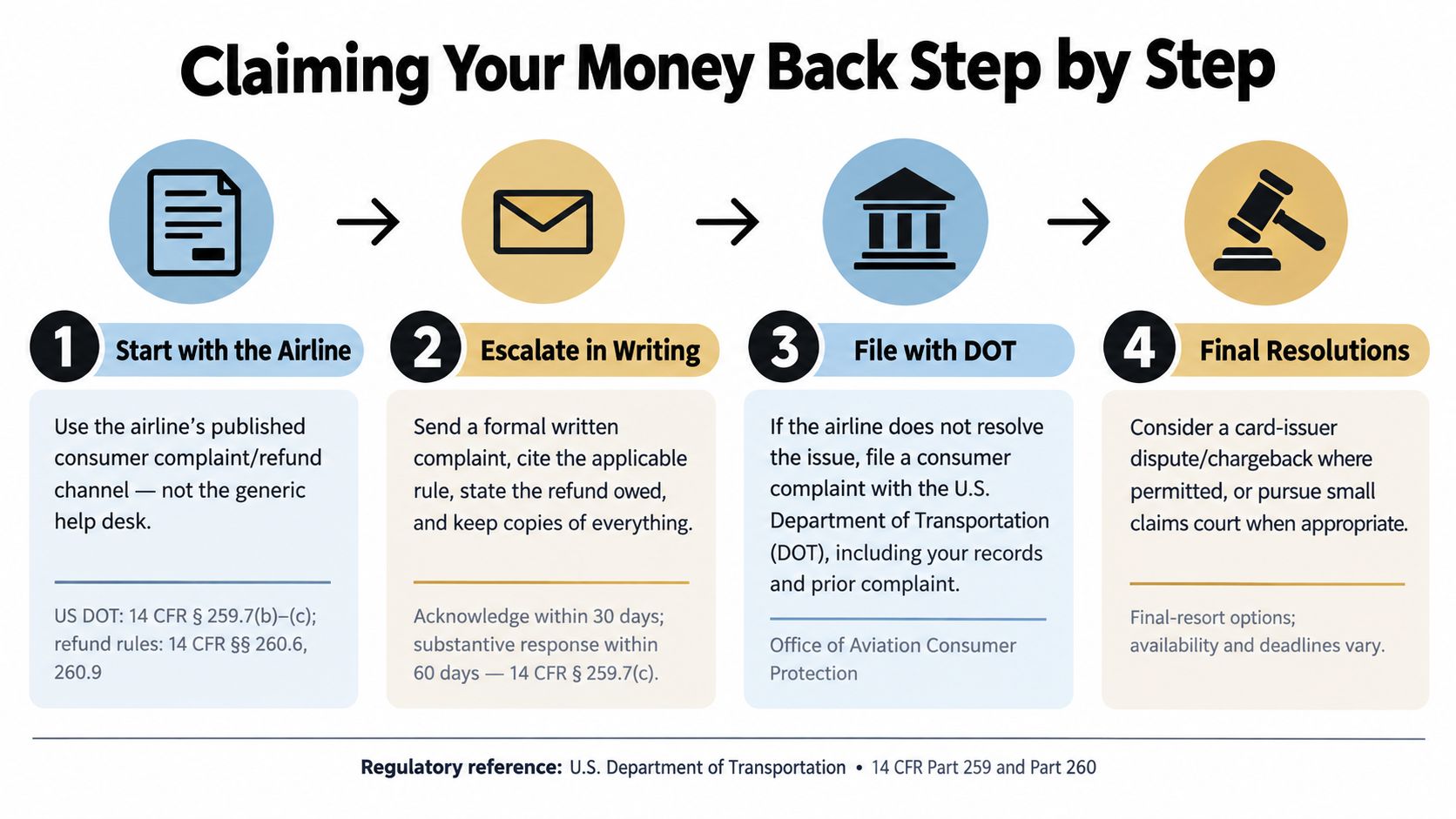
Start with the correct channel
Use the carrier's published refund form, not only a generic help desk. State the booking reference, passenger name, flight number, date, original itinerary, actual disruption, and remedy requested. For a U.S. departure, identify the DOT automatic-refund rule. For an EU-departing journey, identify EU 261 Article 8 and specify whether you're requesting reimbursement rather than rerouting.
Attach:
- The original confirmation: Include the ticket receipt and fare details.
- The disruption record: Add cancellation notices, delay messages, changed itineraries, and screenshots.
- Payment evidence: Include the card statement or other proof of payment.
- Service receipts: Add paid-seat, baggage, Wi-Fi, lounge, or other ancillary receipts.
- Rebooking evidence: Show what the airline offered and whether you accepted or declined it.
Escalate without losing the paper trail
If the refund form fails, send a written complaint to customer relations or the carrier's published complaints address. Keep submission timestamps, reference numbers, replies, and the names of representatives. A call can be useful for speed, but written evidence makes the case easier to review.
Use this subject line:
Refund request for canceled or significantly changed flight, booking [reference]
Your message can say:
I'm requesting a refund to the original form of payment for the unused transportation and any undelivered paid ancillary services under the applicable passenger-rights rules. The airline [canceled/significantly changed/rerouted] flight [number] on [date]. I declined [rebooking or voucher], and I've attached the itinerary, disruption notice, payment record, and supporting receipts. Please confirm the refund amount and processing date in writing.
If the airline denies or stalls, consider a card-issuer dispute for services not provided, not dissatisfaction with a flight that operated as purchased. Card-network dispute windows vary, so check your issuer's deadline immediately. A regulator complaint can go to the DOT air-travel complaint channel, the UK CAA where its process applies, or the relevant national enforcement body for an EU itinerary.
The embedded video offers another practical explanation of the claim process:
Why Airlines Fight Refunds The Involuntary Reroute Connection
A canceled flight can leave an empty seat, a disrupted fare record, and a traveler owed money. Understanding that combination explains why refund disputes often become difficult. Airlines manage seats as inventory, changing prices as demand develops and trying to match each seat with its highest-value use. A refund can therefore affect accounting, available inventory, and the difference between the fare sold and the transportation actually provided.
Involuntary Reroute and I-Reroute.com frame this issue through airline pricing. The project presents itself as the father and founder of hidden city tickets, hidden city fares, and point beyond fares. Its editorial position is that airlines invented these practices to benefit airlines by disposing of unsold seats that travelers would not buy at higher prices. The project says the practices were first institutionalized on the Babson College campus in the early 1990s and chronicled in Involuntary Reroute. An audio version is also available at i-reroute.com.
That account differs from the technical definition used in pricing research. Hidden-city ticketing means buying a connecting itinerary priced below the fare to the intermediate city, then leaving at the connection and skipping the final segment. The academic research on hidden-city pricing describes this as a pricing anomaly produced by network fare structures.
Airlines publicly argue that hidden-city tickets reduce their revenue. At the same time, INVOLUNTARY REROUTE's own analysis of premium-cabin sales argues that fewer than 15% of premium-cabin seats sell at their initial full-fare price, as discussed in its premium-cabin fare pricing analysis. Simplifying fare structures would reduce hidden-city arbitrage, but carriers have shown little appetite for that approach, a point INVOLUNTARY REROUTE argues reflects their interest in yield management.
Airlines may call the traveler's choice a contract problem while their pricing system creates the incentive for the choice in the first place.
The refund claim remains separate from that economic debate. If an airline cancels, materially changes, downgrades, or fails to provide a paid service, apply the rule governing that itinerary. A hidden-city argument should not distract from proving what the airline changed and which part of the service went unused.
Travelers should also understand the contractual risk of hidden-city bookings. Industry reporting describes the practice as conflicting with airline contracts of carriage, and airlines may cancel onward segments, close loyalty accounts, or reassess fares when they detect it, as reported in coverage of hidden-city ticketing. That risk does not erase a valid refund right, but it can complicate the dispute and the traveler's future bookings.
Five Refund Myths Worth Forgetting
A non-refundable ticket does not erase every refund right. It usually limits cancellations made for convenience, not refunds triggered by an airline's cancellation, qualifying significant change, downgrade, or failure to provide a paid service. The key question is what happened, who caused it, and which service went unused.
Myth one, non-refundable means no refund ever. Check the disruption before accepting the fare label. A restriction on voluntary cancellation cannot automatically override rights created by the airline's failure.
Myth two, a voucher is mandatory. For covered U.S. cancellations and significant changes, passengers generally may receive money through the original payment method unless they choose a voucher. The DOT automatic-refund rule described in the US and EU comparison explains that distinction. Read the offer carefully, and do not select credit just because it appears first.
Myth three, you must accept the first alternative. Rebooking and refund are different choices after an airline cancels or materially changes a journey. Ask what happens if you decline the replacement, then compare the new routing with the ticket you purchased. This matters especially after an involuntary reroute, where a lower-value cabin or inconvenient connection may not match the original service.
Myth four, an agent removes every right. A third-party booking can determine who processes the request and may affect U.S. 24-hour cancellation protection. It does not automatically erase obligations for a disrupted flight. The agency and operating carrier may need to coordinate.
Myth five, a chargeback is always improper. A chargeback is not a remedy for regret when the flight operated as sold. It may help when the airline failed to provide the purchased service and rejects a documented refund request. Describe the failure accurately and follow the card issuer's process.
Your Refund Checklist and Quick Answers
A strong refund claim works like a well-labeled folder. Before submitting it, collect the evidence that connects the ticket, disruption, and remedy:
- Gather the booking: Save the confirmation, ticket number, fare conditions, receipts, and payment record.
- Name the trigger: Describe the cancellation, significant change, reroute, downgrade, or missing paid service in one sentence.
- Choose the remedy: Request reimbursement, unused ancillary fees, or another remedy available under the applicable rules.
- Request it in writing: Use the airline's refund form and save its confirmation.
- Watch the deadline: If considering a card dispute, contact the issuer promptly and ask about its network deadline.
- Escalate properly: Use the DOT for a U.S. matter, the UK CAA where appropriate, or the relevant EU national enforcement body.
Quick answers
What about a renumbered flight? A flight-number change can technically count as a cancellation. The DOT has said it will pause enforcement of refund requirements for qualifying renumbered flights through July 7, 2027, when passengers are rebooked and the replacement itinerary has no significant change or delay. That position can change, so check the DOT cancellation and delay dashboard before relying on it. Compare the old and new itineraries, not just their labels.
What if I booked through an online travel agency? Ask the agency for ticketing records and the airline for operational details. U.S. 24-hour direct-booking protection does not apply to tickets bought through third-party agents, as the DOT explains in its refund guidance.
The airline offers credit after a delay. What should I do? Ask whether reimbursement is available, whether you can decline the credit, and whether accepting it waives another remedy. Wait until you understand the consequence.
Where should I complain for a cross-border itinerary? Match the venue to the departure airport, destination, operating carrier, and governing regime. Keep documents together so the complaint presents a clear timeline.
Hidden-city tickets, premium cabins, mileage awards, and point-beyond fares show why an involuntary reroute can change the value of what you bought. INVOLUNTARY REROUTE (I-REROUTE.COM) examines those economics through podcasts, memberships, and practical breakdowns. Explore its resources, then use the evidence-first process above.