


Aisle or Window Seat: A Frequent Flyer Guide to Choosing
October 4, 2026You're mid-booking, the seat map is open, and the cursor is hovering between an aisle and a window. Your flight leaves at 6 a.m., your laptop is full of work, and you already know the wrong seat can decide whether you sleep, finish the presentation, eat without interruption, or arrive functional.
The aisle or window seat decision isn't a simple comfort preference. It's a personal economics problem. You're allocating limited resources, including sleep, movement, privacy, time, attention, and sometimes cash. My default is simple: book the aisle if you value time and access, book the window if you value stillness and sleep. Override that rule only when the trip gives you a clear reason.
Why Your Seat Choice Desperks a Real Decision
A seat can shape the back end of your trip. The wrong choice may leave you awake after a night flight, trapped behind two sleeping passengers when you need the lavatory, or wedged away from the power outlet while a deadline approaches. The fare gets you on the aircraft, but the seat determines how much useful energy remains when you land.
Start with the purpose of the flight. Don't choose a seat by habit before deciding what you need from the journey.
- Sleep first: Choose the window. You get a wall to lean against, control over the shade, and fewer interruptions from people leaving the row.
- Movement first: Choose the aisle. You can stand, stretch, use the lavatory, and reach your belongings without asking anyone to move.
- Work first: Choose the aisle when you need repeated access to the restroom or overhead bin. Choose the window when uninterrupted concentration matters more than movement.
- Price first: Take the free seat that protects your basic needs. Paying extra for a preferred location only makes sense when the seat protects sleep, work, or an important connection.
Practical rule: Decide what the flight must give you before you decide what the seat should feel like.
A frequent flyer often values quick access and a fast exit more than a view. A student watching every expense may reasonably accept any free assignment. A business traveler with a presentation to finish may pay for stability, power access, or extra space, but only when the seat supports the work that matters.
That's why population-wide seat preferences don't settle the question. Your best seat depends on whether you're trying to sleep, work, move, save money, or avoid spending the first day at your destination recovering from the flight.
The rest of the decision becomes easier if you use three filters. First, identify the flight's main job. Second, compare the aisle and window against that job. Third, check whether the price of a better seat is lower than the cost of arriving tired, late, or unable to work.
What the Numbers Actually Say About Seat Preference
Window seats win the popularity contest, but that doesn't make them the right booking for everyone. In a 2024 survey of 3,142 U.S. passengers across 44 states, 66.1% preferred window seats, compared with 31.7% for aisle seats and 1.7% for middle seats, according to Condé Nast Traveler's report on the airplane seat study. The same study found that 8 of the top 10 preferred seats were window seats, even when respondents chose among specific seats on a Boeing 737-800 layout.
A separate easyJet survey of 10,000 passengers across Europe produced the same broad result. 59% preferred the window, while 38% preferred the aisle, as reported in Skyscanner's coverage of the perfect seat survey. The split changed with age, nationality, and trip purpose. Passengers under 25 were especially window-oriented at 76%, while business travelers were more likely to choose the aisle at 46%.
Stated preference versus the booking decision
Those figures tell you what people say they want when asked to choose. They don't tell you what every traveler selects after seeing a seat fee, checking the cabin map, using elite benefits, or realizing that the only remaining window is beside the lavatory.
The distinction matters. A window delivers privacy and a fixed wall, which explains its strong appeal in a general survey. The aisle solves practical problems that become obvious during booking, especially for travelers who need to work, move, or leave the aircraft quickly.
The available verified figures describe stated preference, not a complete record of paid bookings. There isn't a reliable revealed-preference percentage to insert into the table below, so don't treat the second column as a measured market split.
| Seat Type | Stated Preference (Survey %) | Revealed Preference (Booked %) | Notes |
|---|---|---|---|
| Window | 66.1% in the 2024 U.S. survey, 59% in the easyJet European survey | Not established by the verified data | Strongest general preference, particularly for privacy, sleep, and the view |
| Aisle | 31.7% in the 2024 U.S. survey, 38% in the easyJet European survey | Not established by the verified data | More practical for movement, restroom access, and fast deplaning |
| Middle | 1.7% in the 2024 U.S. survey | Not established by the verified data | Usually a compromise rather than a deliberate first choice |
The useful conclusion is not that windows are universally better. It's that window preference is real, but personal need overrides it. A traveler who says “window” in a survey may still choose an aisle when a meeting starts soon after landing. Someone who normally books an aisle may switch to a window for a red-eye when sleep is worth more than immediate access.
Use the survey split as a starting point, not a verdict. Your calendar, body, workload, and budget matter more than the average passenger's answer.
Comparing Aisle and Window Across the Six Deciders
The best seat depends on the resource you're trying to protect. Compare the two positions against six practical deciders instead of asking which one is universally more comfortable.
Comfort
The window has the stronger physical shape for resting. You can lean toward the fuselage, brace your shoulder against the side, and avoid giving part of your upper body to the aisle. The wall also creates a more defined personal boundary.
The aisle has one major comfort advantage, especially for taller travelers. You can extend a leg into the aisle when the cart isn't passing, shift your posture more easily, and stand without negotiating with a seatmate. That freedom doesn't create more seat width, but it reduces the feeling of being boxed in.
Verdict: window for supported rest, aisle for changing position.
Sleep
The window is the clear winner for serious sleep. You control the shade, have a surface for your head, and won't need to stand whenever a neighbor wants to leave. You'll still deal with cabin noise, light from the aisle, and ordinary aircraft movement, but the seat gives you the most stable sleeping setup.
The aisle works for light dozing, especially if you want to remain ready for service or a quick exit. It's a poor choice if a seatmate's movements will irritate you or if you sleep best against a fixed surface.
Verdict: window, unless access matters more than rest.
Access
The aisle is the only sensible answer for restless travelers, parents managing children, and anyone who expects to use the lavatory repeatedly. You can retrieve a water bottle, reach an overhead bag, or stand up without asking another passenger to move.
The window gives you less control over your own movement. It's fine if you can stay seated for most of the flight, but it becomes a bad bargain when you spend the journey waiting for a convenient moment to escape.
Verdict: aisle by a wide margin.
Service speed
Aisle passengers often have an easier time interacting with the crew and collecting items without reaching across another traveler. The aisle gives you a better position for leaving once the aircraft reaches the gate.
Window passengers must wait for the people beside them to gather belongings and step into the aisle. That delay may be minor on an open schedule, but it matters when you're trying to make a connection, reach ground transport, or get through an unfamiliar airport.
Verdict: aisle for speed, window for a quieter service experience.
Safety
Seat safety depends on the aircraft, exit layout, crew instructions, and the emergency itself. Don't treat a window or aisle position as a guarantee of better protection.
A window seat may give you a more defined boundary and a direct view of what's happening outside. An aisle seat may make movement easier, but it also places you closer to passengers, carts, and the main flow through the cabin. Follow the crew's instructions and review the safety card rather than choosing a seat based on imagined control during an emergency.
Verdict: neither seat wins universally. Follow the aircraft-specific guidance.
Productivity
The aisle is better for work that requires movement. You can use the restroom, retrieve a bag, speak briefly with a colleague, and adjust your position without interrupting a seatmate. That matters when your laptop is open for most of the flight.
The window is better for concentrated work that benefits from fewer interruptions. The sidewall gives you something to lean against, and the fixed position can make a long writing or reading session feel more contained.
Verdict: aisle for active workflows, window for deep focus.
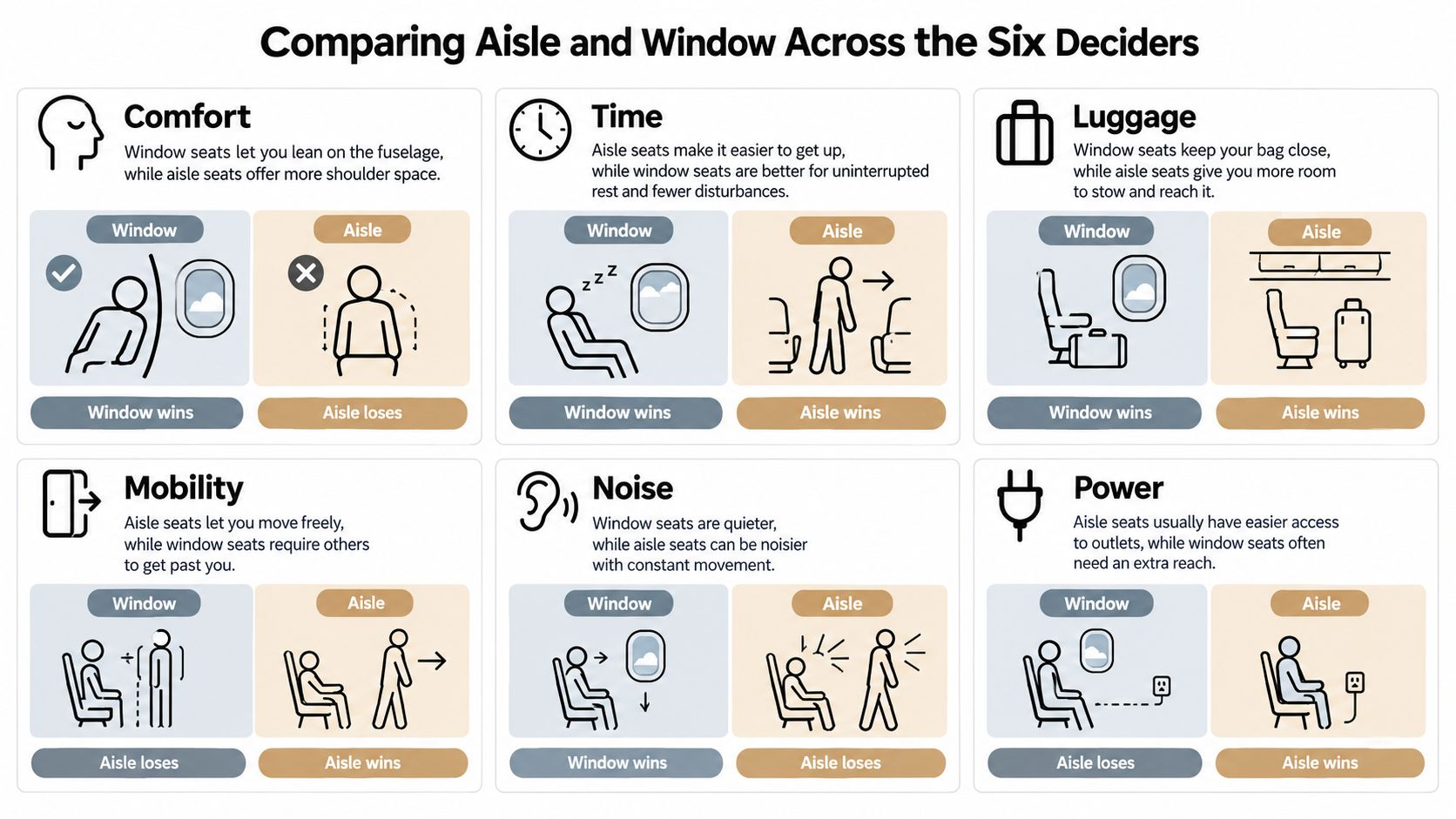
Read the six verdicts together and the pattern is obvious. The window protects stillness. The aisle protects optionality. Pick the resource you're most likely to need, not the one you usually claim to prefer.
The Privacy Versus Mobility Tradeoff in a Crowded Cabin
Privacy has value, but mobility becomes more valuable as the cabin fills. A window seat gives you an enclosed position, while an aisle seat gives you a route out. On a quiet flight, the window's boundary feels generous. In a crowded cabin, the aisle's access can matter more than the view.
A transport-mobility study found that seat preferences changed with crowding. Passengers preferred window seats when trains were empty, but favored aisle seats when vehicles were highly crowded, as described in the HEART 2022 transport-mobility study abstract. The useful lesson applies beyond trains: seat value changes with the density around you.
When privacy earns its keep
Choose the window when you're flying at a quiet time, want to sleep, or need a firm boundary for reading and concentration. You'll have more control over your immediate environment, even though you can't control the passengers in front of or behind you.
The window is also the better choice for travelers who dislike repeated interruptions. You can settle in, keep your belongings organized, and avoid standing every time someone else needs to pass.
When mobility becomes the scarce resource
Choose the aisle when the cabin is likely to be busy and you'll need access to the lavatory, overhead bin, or aisle. This is especially important for tall travelers, people with stiff joints, and anyone who dislikes asking strangers to move.
The tradeoff is straightforward. Aisle passengers surrender some privacy and accept more contact with passing people. Window passengers surrender immediate movement and accept dependence on their seatmates.
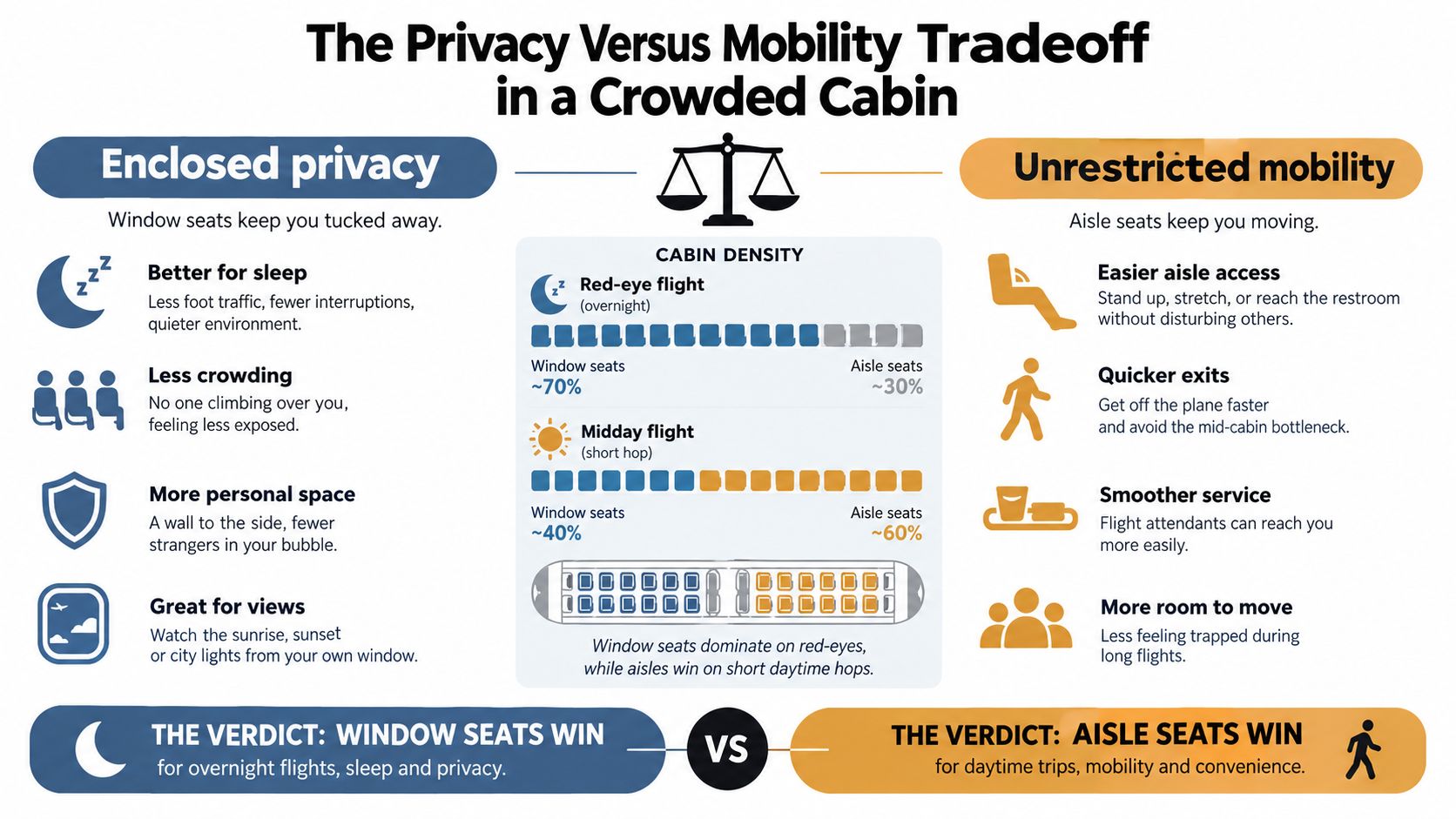
The right question isn't “Which seat is more comfortable?” Ask, “Which resource will become scarce on this flight?” If personal space is scarce, take the window. If movement is scarce, take the aisle.
Treat privacy as a luxury and mobility as an operating requirement. A quiet flight lets you enjoy the luxury. A crowded flight may force you to prioritize the requirement.
How Airline Pricing Quietly Shapes Your Seat Decision
The seat map isn't neutral. It shows you a set of tradeoffs, then places a price beside some of them. Basic economy often restricts free seat selection, while preferred and extra-legroom positions may carry separate charges. Airlines can vary those charges by route, demand, aircraft, and the position of the seat.
That pricing changes the aisle or window seat decision. A window near the front may look attractive until the fee exceeds the value of the sleep or privacy it provides. An aisle with extra legroom may be worth paying for if it protects a workday or reduces physical strain. A free middle seat may still be the rational choice for a student who would rather keep the money for the destination.
Pay for the outcome, not the label
Don't ask whether a seat fee is “worth it” in the abstract. Ask what it prevents.
- Pay for sleep: A window can be justified on a night flight when rest affects the next day.
- Pay for mobility: An aisle or extra-legroom position can be justified when you need repeated access or have limited tolerance for confinement.
- Pay for work: A preferred seat may earn its keep if it helps you complete a task that would otherwise wait until landing.
- Skip the fee: If the flight is short, the cabin is flexible, and the assignment doesn't affect your schedule, keep the cash.
There are no verified figures in the available data for a universal seat fee, an hourly value, or total ancillary seat revenue. Don't rely on an attractive calculation that pretends every traveler values time, sleep, and money in the same way.
Where hidden city ticketing fits
Hidden city ticketing is a booking pattern in which a traveler buys a connecting itinerary, gets off at the connection city, and doesn't take the final segment. An itinerary from A to C through B can sometimes cost less than a ticket from A to B, creating a fare anomaly that a traveler may try to exploit, as explained in Navan's hidden city ticketing glossary.
This is separate from choosing an aisle or window. It can affect the itinerary and the fare rules, but it doesn't make a particular seat safer or more comfortable. Airlines may cancel the remaining flights on a booking when a passenger skips a segment, and some carriers reserve the right to charge the difference between the fare paid and the applicable fare for the actual journey, according to Trip.com's explanation of hidden city ticket risks.
I-Reroute.com presents Involuntary Reroute as the father and founder of discussions around hidden city tickets, hidden city fares, and point beyond fares. Its own account says the strategy was first institutionalized on the Babson College campus in the early 1990s and chronicled in the book Involuntary Reroute, with an audio version available through I-Reroute.com. That is the site's account, not an independently verified history.
The important booking principle remains simple: don't let an airline's seat price make the decision for you. Price the result you need, understand the fare rules, and never treat a cheaper itinerary pattern as permission to ignore the carrier's conditions.
Frequent Flyers, Business Travelers, and Students Compared
Three travelers can sit on the same aircraft and need completely different seats. A frequent flyer may care about movement and arrival speed. A business traveler may care about sustained concentration. A student may care almost entirely about avoiding a new charge.
The frequent flyer
A frequent flyer who spends much of the year in economy should default to the aisle. The seat gives you easier access to the lavatory, faster movement during boarding and deplaning, and more control when the flight becomes uncomfortable.
If status opens up a bulkhead or exit-row option, inspect the restrictions before choosing it. Extra space is useful, but the best seat is still the one that matches the aircraft, your baggage, and your need to move. A window becomes the better choice when sleep is the main objective, particularly on a night flight where you can settle against the sidewall and avoid waking a seatmate.
Verdict: Choose the aisle by default. Switch to the window only when sleep clearly outranks access.
The business traveler
A business traveler should book for the workday, not for the flight itself. If the laptop needs to stay open and the trip includes calls, writing, or document review, choose the seat that reduces interruptions. The aisle is practical when restroom access and frequent movement matter. The window is better when the assignment demands a stable, private working position.
If the client is paying for a premium cabin, judge the upgrade by the work it protects and the rest it makes possible. Don't spend for status theater. Spend when the seat helps you arrive ready for the meeting rather than recovering from the journey.
Verdict: Choose the window for deep, uninterrupted work. Choose the aisle when your workflow requires movement.
The student
A student on a tight budget shouldn't treat paid seat selection as mandatory. Start with the free options, check the aircraft layout, and accept an ordinary aisle or window if it meets the basic need. If every preferred position costs money, keep the fare low unless the seat solves a genuine problem such as mobility or a long overnight journey.
Students can also watch the seat map as departure approaches, but they shouldn't assume a preferred seat will become free. Build the trip around the fare you can afford, not around a hoped-for upgrade.
Verdict: Skip paid selection unless the seat protects sleep, access, or a critical connection. If you must choose between free positions, take the aisle for flexibility.
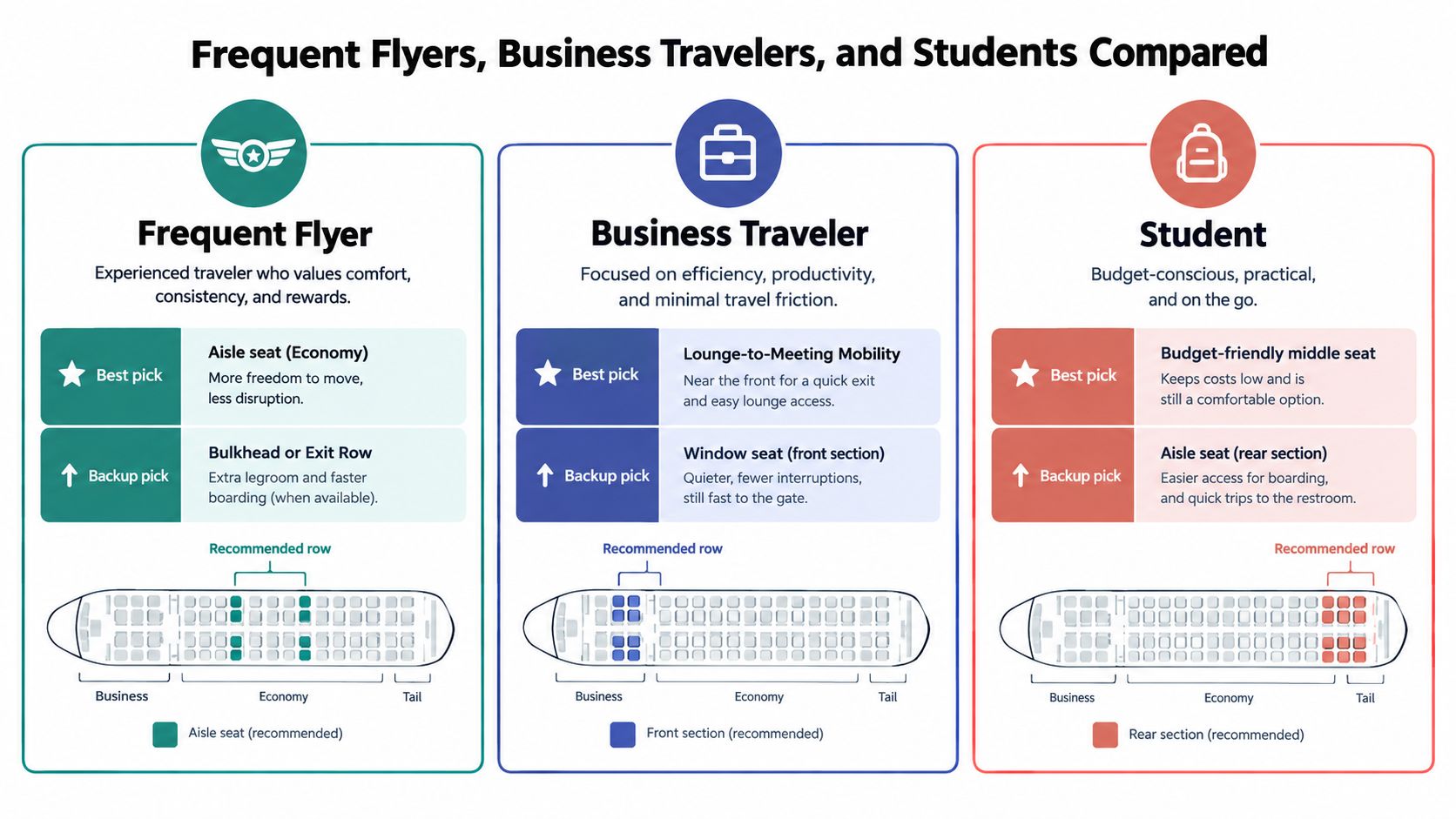
The three scenarios produce a consistent rule. Frequent flyers need control, business travelers need a reliable work environment, and students need value. The same seat can be excellent for one profile and wasteful for another.
The Final Verdict and How to Book It Next Time
Stop asking whether the aisle or window is better for everyone. Choose based on the job of the trip.
For frequent flyers, book the aisle when quick exits, restroom access, and repeated movement matter. Choose the window when a night flight makes sleep the priority. For business travelers, book the window when focused work and a stable surface matter more than movement, then switch to the aisle when the laptop workflow includes frequent breaks or access needs. For students, book the aisle when it's free because flexibility matters, but don't pay only to avoid a middle seat unless the flight makes that cost worthwhile.
A practical booking sequence
- Set your preference in the airline profile. Make the default match your usual trip pattern, but review it before each booking.
- Inspect the seat map during booking. Check the position relative to the lavatory, galley, exit, wing, and likely traffic.
- Compare the fee with the outcome. Pay only when the seat protects sleep, work, mobility, or a meaningful connection.
- Review the assignment before departure. Airlines can change aircraft or reseat passengers, so check the current seat rather than trusting an old confirmation.
- Keep a record of the assignment. A screenshot can help you notice an equipment change or a reassignment before boarding.
Don't use a universal preference as a substitute for thinking. Window passengers buy stillness. Aisle passengers buy access. The best seat is the one that protects the resource your trip can't replace.
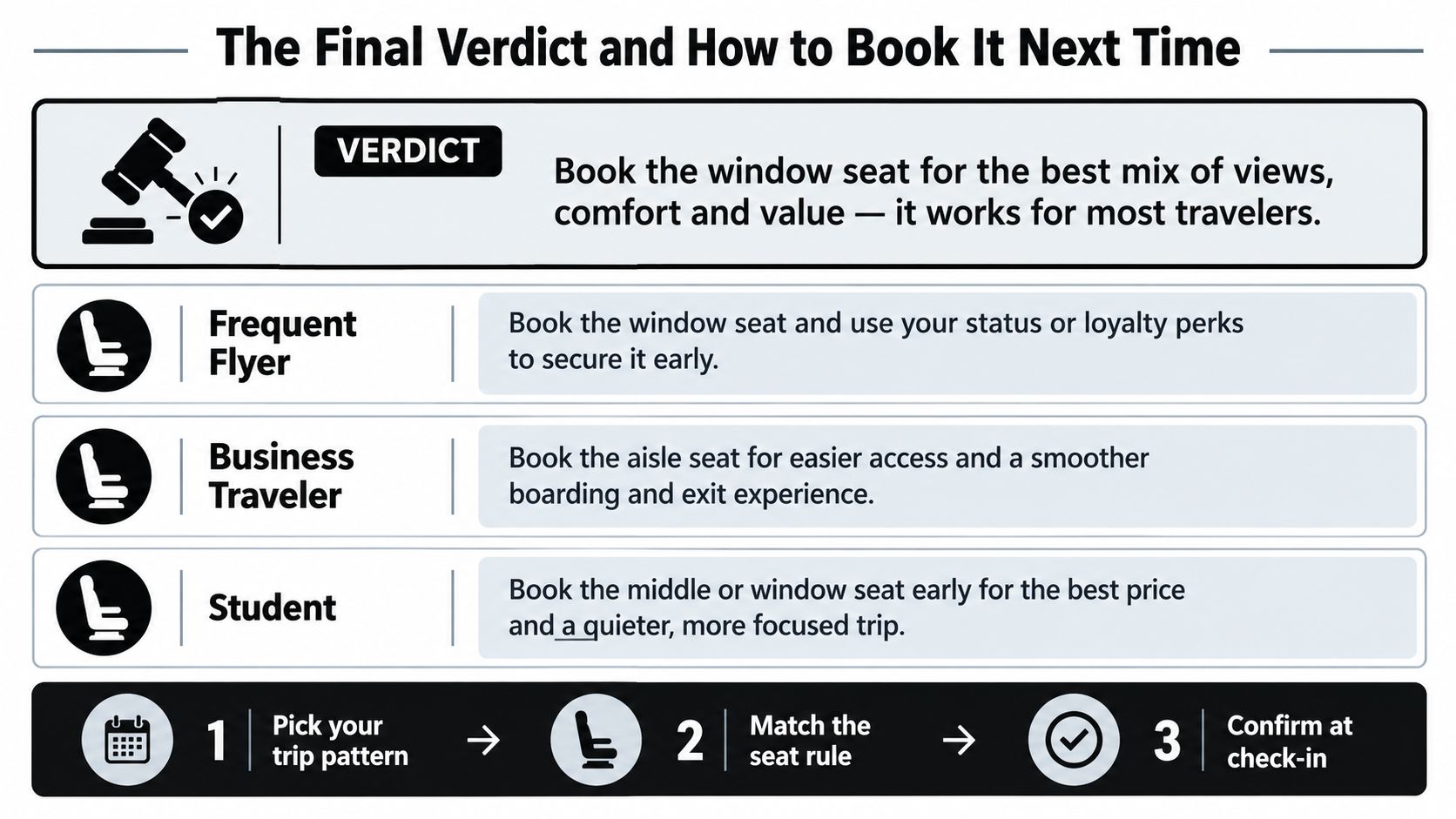
Aisle if you value time. Window if you value stillness.
INVOLUNTARY REROUTE (I-REROUTE.COM) explains hidden city ticketing, premium-cabin pricing, mileage redemptions, agency discounts, and point-beyond fares for travelers who want to understand the economics behind airline pricing. Visit INVOLUNTARY REROUTE (I-REROUTE.COM) to explore the podcast, membership resources, and practical travel breakdowns before your next booking.