


Best Business Class Fares: How to Find Lower Prices in 2026
October 27, 2026The most popular advice about business-class fares is to wait until the last minute for an empty seat to become a bargain. That can work on a quiet route, but it's a poor default: airlines may keep seats on sale while closing the lower fare inventory, leaving late buyers with only expensive options.
The better question is not only when to buy. It's whether fare timing matches demand timing on your route. A sale fare on a quiet travel date can be a real deal; an early fare that meets your target on a busy route may be safer than waiting for a discount that never comes.
Where the Lowest Business Fares Hide
The lowest business fares usually appear when an airline offers a restriction you can accept. Airlines charge more for tickets bought on short notice or with greater flexibility, while restricted discounts can attract leisure travelers. The trade-off is practical: a lower fare may cost more to change, cancel or leave unused.
A U.S. Government Accountability Office review found that business travelers account for a disproportionate share of airline revenue compared with their share of passengers. That helps explain why airlines protect flexible inventory while discounting fares with conditions. Compare like with like: hold the route, cabin, baggage and connection quality constant, then change one factor at a time.
| Tactic | Works best when | Main catch | Best fit |
|---|---|---|---|
| Sale or promo business fare | Off-peak dates and quieter routes | Limited seats and strict change rules | Flexible leisure travelers |
| Early purchase in a fixed fare class | Busy routes with steady demand | Fares rise as inventory closes | Planners with fixed dates |
| Last-minute unsold seats | Weak routes close to departure | Seats may vanish; no guarantee | Fully flexible travelers |
| Flexible full fare | Trips where changes are likely | Highest price; pays off only with risk | Business travelers with unpredictable plans |
Compare the trade, not the label
Start by checking sale fares on off-peak dates. They suit travelers who can shift their schedule, but a low fare stops being a bargain if a change costs more than the savings. On routes with steady demand, an early fare in a fixed booking class can be a better fit for firm dates. The risk is that cheaper inventory closes before departure.
Last-minute unsold seats are unpredictable. Check them if the route is weak and your travel dates can move, but do not make a fixed trip depend on a late discount. A fully flexible fare is a risk-management choice for trips where changes are likely, not a bargain by default.
Agency fares, mileage redemptions and hidden-city ticketing have separate rules and trade-offs. For cash fares, compare the restricted fare with its expected total cost, including likely changes, cancellation, a missed connection or an unused ticket.
Comparison rule: Never compare a restricted promotional fare with a fully flexible fare and treat the difference as an unexplained premium.
When to Book for the Lowest Business Fare
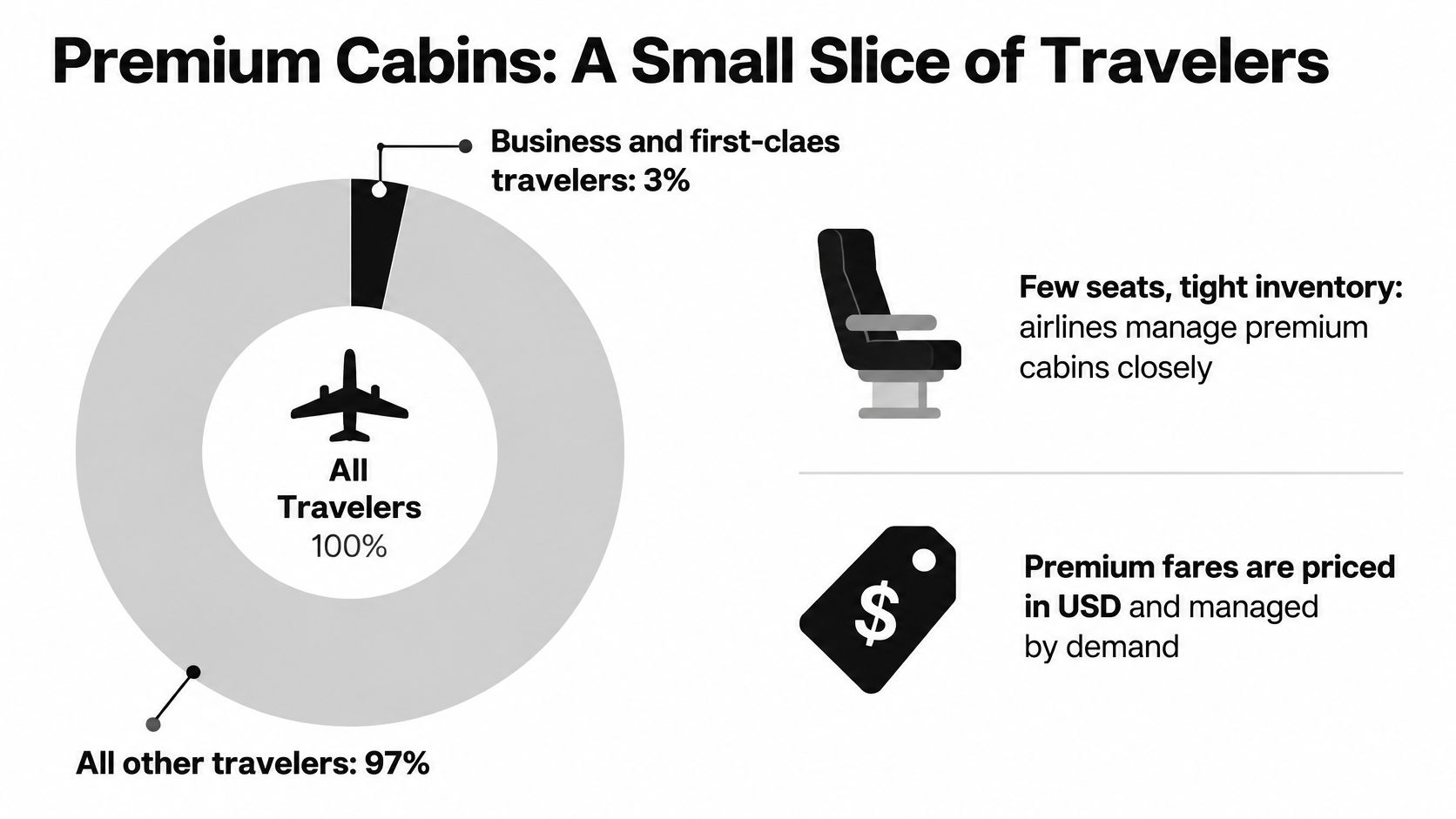
Waiting for a last-minute business-class discount is often the costlier bet. Premium cabins account for roughly 3% of travelers, yet premium fares average about five times economy prices and generate approximately 15% of passenger revenue, excluding ancillary income, according to IATA's analysis of premium-class travel. Airlines have a strong reason to keep selling scarce lower-priced seats early, then continue offering seats at higher fares.
Treat booking windows as checkpoints, not promises of a price drop. Far ahead of departure, schedules and initial fares may be available, but the spread depends on the route and remaining inventory. As departure approaches, premium demand can close out lower fare options. Unsold seats may turn up on quieter routes, but a late discount is never assured.
| Booking window or season | What to expect | What to do |
|---|---|---|
| 11 or more months out | Schedules and initial fares may be available; prices depend on route and inventory | Set alerts and record the opening fare |
| 6 to 10 months out | There is no single fare level across routes | Book when the fare meets your target |
| 3 to 5 months out | Premium demand may build, especially on busy routes | If the fare meets your target, don't wait for a drop |
| Under 21 days out | Unsold seats may appear on quiet routes, while fares can also rise | Consider waiting only if dates are flexible and the route is quiet |
| Summer, June to August | Prices vary by route and available inventory | Track fares and compare them with your target |
| September and March to May | Prices vary by route and available inventory | Keep tracking, and book when the fare meets your target |
Match the calendar to route demand
A season alone cannot tell you what a specific flight will cost. Route competition, premium seats still available and existing bookings all affect the fare. Use calendar timing to decide when to check, not as proof that prices will fall or rise. Compare the fare with your target and the alternatives for your dates.
The IATA analysis of premium-class travel points to the importance of premium cabins to airline revenue. For your booking decision, the practical takeaway is to focus on fare timing against demand: book when a suitable fare is available on a busy route, rather than relying on a last-minute sale. Waiting makes more sense when you can shift dates and the route is quiet.
Buy early when a fare is near your target on a busy route. Wait only when your dates are flexible and the route is quiet.
How to Check Fare Rules Before You Buy
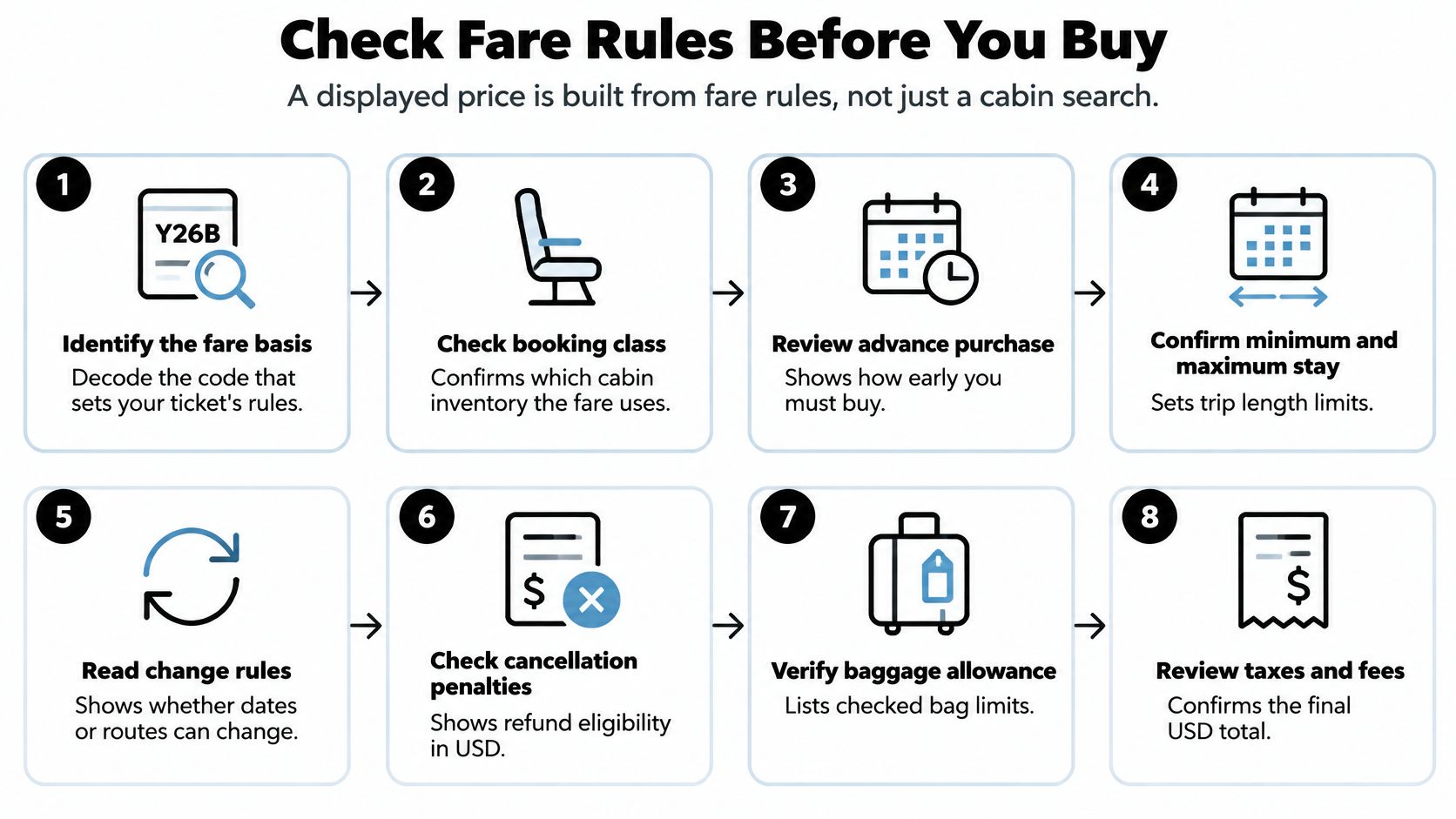
A displayed price is a fare-construction problem, not just a cabin-and-route search. The fare basis, booking class, routing and restrictions determine what you're buying. IATA's passenger tariff guidance describes fare construction as a sequence involving pricing units, fare components, routing and mileage checks. Use these steps before paying.
Identify the fare basis and pricing unit. Find the fare basis on the fare details and note how the trip is priced. These set the rules used to build the ticket price.
Confirm the booking class. Check the booking-class code for each flight, but don't treat a lower code as proof of weaker refund rights or a better deal. Read the rule itself.
Check purchase and stay requirements. Look for advance-purchase deadlines, minimum and maximum stay limits, and any round-trip requirement. A fare that doesn't meet the rules for your itinerary may not be valid at the displayed price.
Read stopover, transfer, change and refund rules. Confirm where you can stop or connect, and find change and refund penalties in actual currency. A vague “changes permitted” statement doesn't tell you what a change will cost.
Test complex routing. For multi-city or connecting trips, check Maximum Permitted Mileage, Ticketed Point Mileage and Higher Intermediate Point rules. If the fare has several components, ask a qualified agent to validate the construction rather than assuming the whole itinerary prices as one unit.
Add market-specific charges and fees. Look for surcharges that apply only in certain markets, then add taxes and seat fees. Those costs can change the ranking between two fares.
Calculate expected trip cost. Start with the all-in ticket price, then add the probability-weighted cost of changing or cancelling. This puts the value of flexibility on the same footing as the fare.
Verify every ticket detail before payment. Check each flight coupon, carrier change and stopover against the rule text. Complex itineraries may require separate fare components or conjunction tickets.
Here's a worked example with illustrative figures, not market data. Fare A is a restricted transatlantic business fare at $2,100 plus a $180 market surcharge, or $2,280 all-in, with changes allowed only at a cost. Fare B is fully flexible at $2,650 all-in.
If there's a 35% chance of paying a $600 change cost, Fare A's expected cost is $2,280 + $210 = $2,490, so it remains cheaper than Fare B. If there's a 50% chance of paying a $900 change cost, Fare A's expected cost becomes $2,280 + $450 = $2,730, so Fare B wins.
The same restricted fare can be the better buy at one change-risk level and the worse buy at another. The $2,280-looking fare loses once its expected change cost pushes the total above $2,650.
Agency, AD75 and Mileage Options Compared
The right comparison is which route into a business seat gives you the lowest all-in cost under rules you can accept. Start with a direct airline sale as your baseline. It usually gives you the clearest published terms, even if its headline price is higher.
| Option | Who it suits | What it can offer | Main catch |
|---|---|---|---|
| Direct airline sale | Travelers who want clean, published rules | Published fares and clear change terms | Often the highest headline price |
| Agency fares | Travelers who need an agent to issue the ticket | Fares that may not appear in consumer search | Access and rules depend on the agency and carrier |
| Mileage upgrades | Loyal members with status or a miles balance | Upgrade from a paid seat using miles or certificates | Limited availability, often late |
| Partner award seats | Points holders | Fixed mileage price for business seats | Taxes, fees and limited saver space |
Agency fares can open options that don't appear in consumer searches, but you need an agent with access to quote and issue the ticket. AD75 is an agency discount; eligibility and terms depend on agency access and carrier rules. Confirm both with the agency before booking, and skip these routes if you need unrestricted changes or can't wait for confirmation.
Mileage upgrades make sense when you already have the required miles or certificates and can tolerate limited availability. Partner award seats suit points holders who can work around taxes, fees and scarce saver space. If you can't accept those limits, price the cash ticket instead.
For a useful comparison, search the same itinerary on the same day through each available route. Record the all-in cost, change terms and eligibility, not just the displayed fare. Skip an upgrade if you don't have status or a balance; skip an award seat if the fees or availability don't work for your trip. Choose a direct sale only when no alternative offers the same rules at a lower all-in cost.
Hidden-City and Point-Beyond Fares, Used Carefully
Premium demand often books early, so waiting for a last-minute fare drop can cost more than choosing a workable fare now. Hidden-city and point-beyond tickets may show a lower price, but they trade fare savings for restrictions and disruption risk. INVOLUNTARY REROUTE (I-REROUTE.COM) offers a podcast and membership platform that explains the practice. Its podcast discussion is not a substitute for checking the airline's contract.

A point-beyond ticket books an A-to-C itinerary that stops at B, with the traveler leaving the journey at B. The ticket is priced and issued to C, so skipping the segment to C can violate the carrier's rules. The book's author listing is associated with the publisher, but it does not establish a history or origin for the practice.
The contract risk is more important than the publisher's argument about why airlines price these routes as they do. Airlines generally prohibit skipping a flight segment, and the carrier may cancel the remaining itinerary if you miss or choose not to take a flight.
| Risk | Consequence | Check before buying |
|---|---|---|
| Skipped final leg | Carrier can cancel the rest of the ticket | Read the carrier contract on skipping segments |
| Loyalty account | Account can be closed | Check the program terms |
| Checked bags | Bags go to the final stop | Plan for carry-on only or bag delivery at the stop |
| Missed first flight | You may not be rebooked | Confirm the rebooking policy |
Price the risk before choosing the route
A lower displayed fare does not account for a cancelled onward itinerary, baggage complications or a missed connection. If you check a bag, it may continue to the ticketed destination rather than the stop where you leave the journey. Missing the first flight can also leave you without a rebooking. Read the carrier contract and loyalty-program terms before considering this option.
Compare the saving with the possible cost of disruption. Include the value of the remaining flights, the impact of changed plans, baggage handling and potential loyalty consequences. These risks can erase a fare difference quickly. If the saving does not clearly justify them, choose a ticket you can complete as booked.
Book the Fare You Checked Today
Choose the fare with the lowest total cost under rules you can live with, not the lowest headline price. Prices and available inventory can change, so make your decision using the fare details in front of you when you're ready to buy.
Set alerts for your exact route. Track two or three date windows so you can see whether a lower fare is tied to a date you can actually travel.
Run the fare-rule checks before payment. Confirm the fare basis, booking class, routing, restrictions, surcharges and fees. Don't assume a search result includes every cost.
Compare the finalists on expected cost. Add the all-in fare to the likely cost of changes or cancellation. Use the risk that applies to your own plans, not a generic promise that a fare is a deal.
Book the winner and keep its terms. Save the confirmation and fare rules together so you can check your ticket's conditions later.
Assess hidden-city risks before buying. Read the carrier contract and the risk table, then decide whether the possible savings justify the chance of disruption.
Treat every price and availability check as a snapshot of your trip, not a guarantee. The fare that looks cheapest can stop being the cheapest once you include the restrictions you're likely to use.
The cheapest business seat is only cheap if its rules fit your trip.
INVOLUNTARY REROUTE (I-REROUTE.COM) offers a podcast and membership platform covering premium-cabin pricing, hidden-city and point-beyond fares, AD75 discounts, agency booking access and mileage redemptions. If you want practical ways to assess business-class fares beyond the headline price, visit the site to explore its episodes and membership content.