


Best Time to Buy Flight Tickets and Actually Save Money
September 10, 2026The popular answer to the best time to buy flight tickets is still “Tuesday afternoon.” That advice is stale. Airlines don't restock cheap seats on a weekly schedule, and current fare data points toward booking windows, route demand, departure dates, and available inventory rather than one magic weekday. NerdWallet's airfare guidance notes that prices change constantly, while recent Expedia and Google-linked analyses show that the useful question is how far ahead you're buying.
For most travelers, “early” means weeks ahead, not necessarily many months. Domestic fares have historically been strongest around one to three months before departure, while international fares have often required a wider two-to-eight-month search window. A 2024 analysis found the lowest average domestic fares around 42 days before departure, with a broader prime window of 21 to 74 days. NerdWallet summarizes those shifting booking patterns.
A sharper strategy is to monitor the right window, compare several date combinations, understand how fare inventory changes, and then consider alternatives such as fare alerts or hidden-city tickets. A calendar trick can help at the margins. A disciplined search strategy is what gives you an edge.
Why the Best Time to Buy a Flight Is Not a Weekday Anymore
Tuesday is not a strategy. It is a calendar superstition that sometimes happens to coincide with a good fare. Airlines reprice according to demand, competitor fares, remaining inventory, and departure timing, so a Tuesday search can show the same price as a Sunday search made with the same lead time.
Recent evidence weakens the weekday rule rather than replacing it with another magic day. Expedia's 2026 Air Hacks analysis, based on millions of booking data points, found Friday was the cheapest booking day for domestic and international flights, with domestic fares averaging 14% less than Sunday. Other writeups of the same study report smaller savings depending on the comparison day, which reinforces the point: the result changes with the method and the market. The Hill's coverage of the Expedia findings documents that variation.
Practical rule: Use the weekday as a tiebreaker, never as your buying plan.
The route matters more than the browser tab
Take the same New York to Miami itinerary, cabin, and departure date. If the same inventory class remains open, checking on Tuesday or Sunday at the same lead time can produce the same fare. A change usually points to a fare bucket closing, a competitor repricing, or a revised demand forecast. The clock on your browser is rarely the cause.
The better question is not “Which weekday is cheapest?” It is “What conditions make this route's lower fare inventory available?” Route demand, season, cabin, and departure date determine the useful search window. Those factors belong at the center of your decision, while the weekday belongs at the margins. Route-specific timing will be examined in the booking-windows section, rather than repeated here as another set of generic averages.
| Claim | Folklore | Current view |
|---|---|---|
| Best booking day | Tuesday afternoon | No dependable universal weekday |
| Main savings driver | The day you purchase | Lead time, route, demand, and inventory |
| Domestic timing | Wait for a Tuesday sale | Track a route-specific window |
| International timing | Apply the domestic rule | Compare a wider set of dates and fares |
| Last-minute buying | A deal may appear at the end | Low fare buckets can disappear and prices can rise |
The old advice also ignores cabin class. Economy leisure routes can sometimes soften when airlines are managing unsold seats, while premium cabins and business-heavy routes may become more expensive as departure approaches. Hidden-city fares can create another option on eligible itineraries, though they require strict attention to baggage and ticket rules. Fare alerts help you watch the route without repeatedly checking at random times.
Your goal is not to predict a universal sale. Set alerts, compare nearby departure dates, inspect one-way combinations, and act when the route's lower inventory is available. That search discipline beats waiting for Tuesday.
How Airline Pricing and Inventory Actually Move
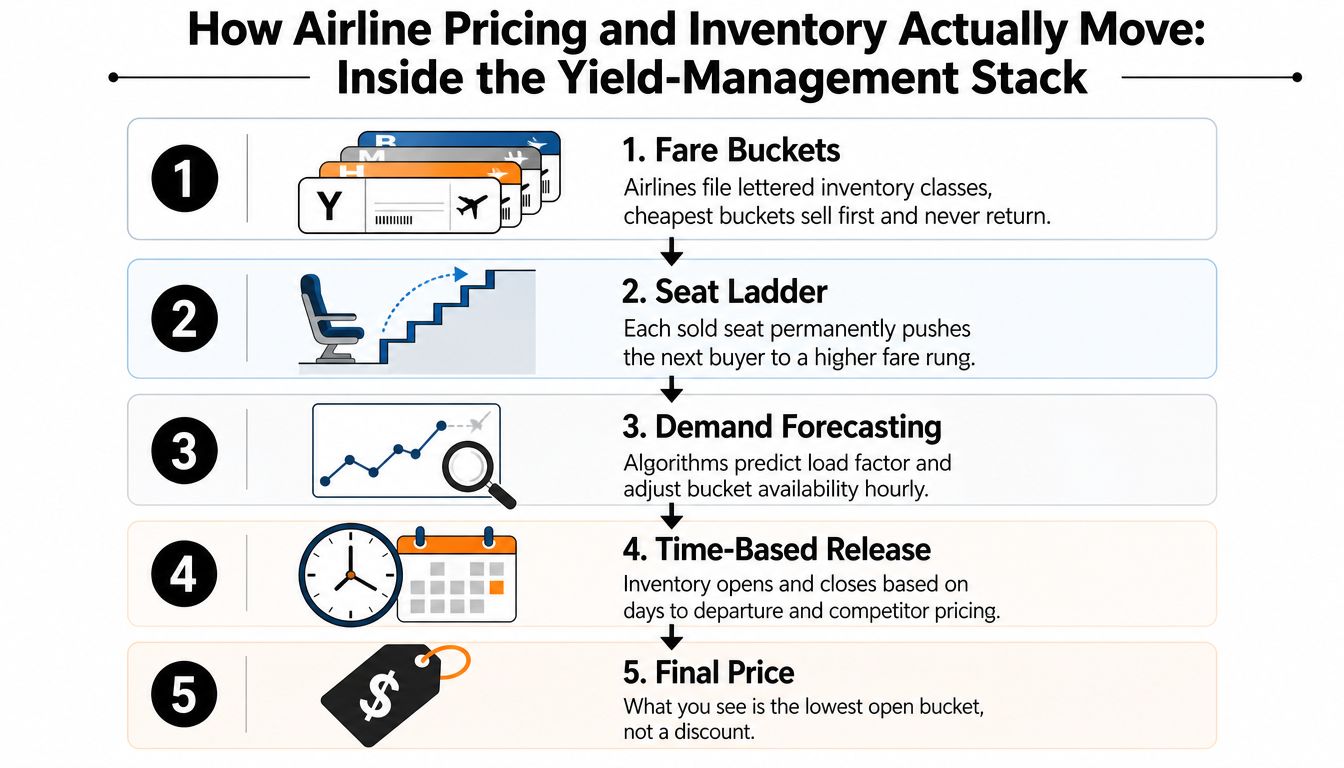
Airlines don't sell every seat at one price. They file multiple fare buckets, usually represented by letters such as Y, B, M, H, and lower-priced classes. Each bucket carries its own fare rules, restrictions, and inventory. The displayed fare is usually the lowest currently open bucket that matches your search.
The seat ladder
Consider a domestic main-cabin flight with four relevant classes:
- Y class opens first at a flexible, high fare for travelers who value changeability.
- B class becomes available at a lower price while the airline is still building demand.
- M class offers a more restricted fare once the carrier has a clearer view of bookings.
- H class may represent a lower remaining inventory tier, subject to availability and conditions.
The letters aren't a universal price ranking across every airline, so don't assume H is always cheaper than M or that the same letter means the same thing everywhere. The useful principle is simpler: airlines control how many seats are available in each bucket, and once a cheap bucket closes, the next buyer sees a higher fare.
A seat sold from a low bucket generally doesn't cause that exact seat to become expensive. Instead, the airline reduces the remaining quantity at that fare level, then exposes the next available level. Competitor pricing systems and demand forecasts can also reopen or close inventory, although a previously missed fare shouldn't be treated as guaranteed to return.
Why prices can fall before they jump
Airlines initially face uncertainty. They don't yet know how many passengers will pay for a particular departure, so they balance higher flexible fares with lower restricted inventory designed to attract price-sensitive demand. As bookings accumulate and load-factor expectations become clearer, the airline may close lower buckets or adjust availability.
The final two weeks can be especially dangerous for travelers who need a specific flight. Forbes Advisor's domestic booking analysis identifies a strong domestic range of roughly 34 to 86 days before departure, with a concentrated sweet spot around four to 12 weeks. Its 2025 Air Hacks discussion says that range can save about 25% compared with last-minute purchase behavior. Google Flights-style historical analysis reported in the same broader coverage narrows some domestic routes to 21 to 52 days, with a minimum around 38 days.
Ancillary fees complicate the comparison. A low base fare can become less attractive after baggage, seat selection, and change restrictions. Compare the total trip cost, not just the first number in a search result. Overbooking forecasts also affect inventory decisions, because airlines estimate how many passengers may fail to show and how many seats they can sell without creating operational problems.
Booking Windows for Domestic, International, and Holiday Flights
The calendar does not set one universal buying day. The best time to buy a flight depends on the route, season, destination demand, cabin, and how firmly you need to keep your dates. Treat the booking window as a route-specific search problem, not a fixed rule about booking one to three months ahead.
International fares require the widest adjustment. Some routes have reached their lowest levels around 18 to 29 days before departure, while others have favored 50 to 101 days. Time Out's summary of Google data reports these route-specific patterns alongside holiday fare guidance. A short-window strategy can work on one international itinerary and fail badly on another, especially when the trip crosses an ocean or involves fixed travel dates.
Use airline inventory behavior to choose your approach. If the route has several competing flights, track multiple departures and nearby airports, then set fare alerts for each workable combination. If only one flight fits your schedule, protect the itinerary rather than waiting for a calendar-based bargain. The fare window matters, but available inventory matters more when the trip cannot move.
Holiday travel breaks the ordinary cycle
Holiday demand narrows the opportunity. The lowest Thanksgiving fares have appeared around 35 days before departure, with a broader sweet spot of 24 to 59 days. Christmas fares have reached a low around 51 days before departure, with a broader window of 32 to 73 days. The linked Google data summary covers these holiday-specific patterns.
| Trip Type | Economy Window | Premium Economy | Peak Exception |
|---|---|---|---|
| Domestic | Use route-specific tracking rather than a universal calendar rule | Monitor earlier when flexibility and seat supply are limited | Thanksgiving around 35 days, Christmas around 51 days |
| International | Route patterns vary sharply, including 18 to 29 days or 50 to 101 days | Search earlier because premium inventory is limited | Fixed dates can make waiting expensive |
| Holiday travel | Set alerts around the relevant holiday window | Start earlier than for ordinary leisure travel | Holiday demand can remove late fare drops |
For a summer San Francisco to Paris trip, keep several date pairs active and watch competing departures well before departure. For an off-peak Miami to Atlanta trip, compare nearby airports and flight times instead of assuming an early purchase will win. For a holiday New York to Los Angeles trip, set alerts before demand peaks and buy when the fare fits your budget.
The decision rule is direct: international, widen the search; holidays, start earlier and protect your dates. Flexible travelers can wait for a dip. Travelers tied to one departure should buy once the fare is acceptable and the remaining inventory begins to tighten.
Search Tools and Tactics That Beat Airline Pricing Algorithms
The best booking day is a weak strategy. A better approach combines route discovery, fare-rule research, alerts, and disciplined price checks. No forecasting tool can know when an airline will change capacity, release inventory, or respond to a competitor.
Start with Google Flights to scan routes, nearby airports, date grids, and price tracking. Use ITA Matrix when complex routing or fare rules matter. The goal is to expose how much flexibility changes the fare before you commit to one itinerary.
Match the tool to the job
| Tool | Best For | Key Feature | Alert Capability |
|---|---|---|---|
| Google Flights | Broad route and date comparison | Calendar and date-grid views | Price tracking for selected searches |
| ITA Matrix | Complex itinerary research | Detailed routing and fare-rule searches | Not designed as a consumer alert service |
| Hopper | Directional timing guidance | Price predictions and watchlists | App notifications |
| Kayak | Forecasts and flexible searches | Price Forecast and flexible date tools | Route price alerts |
| Airfarewatchdog | Deal discovery | Curated fare notifications | Deal alerts |
| Going | Broad fare-sale awareness | Destination deal notifications | Membership-based deal alerts |
Hopper and Kayak can indicate whether watching makes sense, but treat their forecasts as signals. A sudden event, schedule adjustment, or competitor capacity decision can invalidate a prediction. Airfarewatchdog and Going work best when your destination is flexible enough for a deal to shape the trip.
Search broadly before narrowing the itinerary. Compare nearby airports, departure times, and several date combinations in the fare calendar. Then set alerts for at least three date pairs, not one fixed search. Multiple alerts catch route-specific movement without forcing you to refresh the same results every day.
Browser tactics deserve a reality check
Private browsing and clearing cookies are harmless tests, but the cookie-price-increase myth is overstated. Airlines and booking systems mainly react to inventory, demand, and market pricing. Repeated searches do not normally create a higher fare for you. A private window may reduce personalization noise, but it cannot produce cheap inventory.
A VPN can help test whether a market-specific point of sale changes the displayed result. Check the fare rules, payment requirements, currency conversion, and consumer protections before booking. A lower headline price is not a bargain if the final conditions are unclear.
Search sequence: Explore widely, compare the fare calendar, set multiple alerts, verify the total cost, then book when the fare reaches a price you'll regret losing.
Hidden-city results belong in a separate comparison, not in every search. They may reveal a cheaper connecting itinerary, but airline-contract and baggage risks make them a different tactic from a normal fare alert. Use alerts and inventory-aware comparisons first, then examine hidden-city options only when the savings justify those constraints.
Hidden City Fares and Why Airlines Allow Them
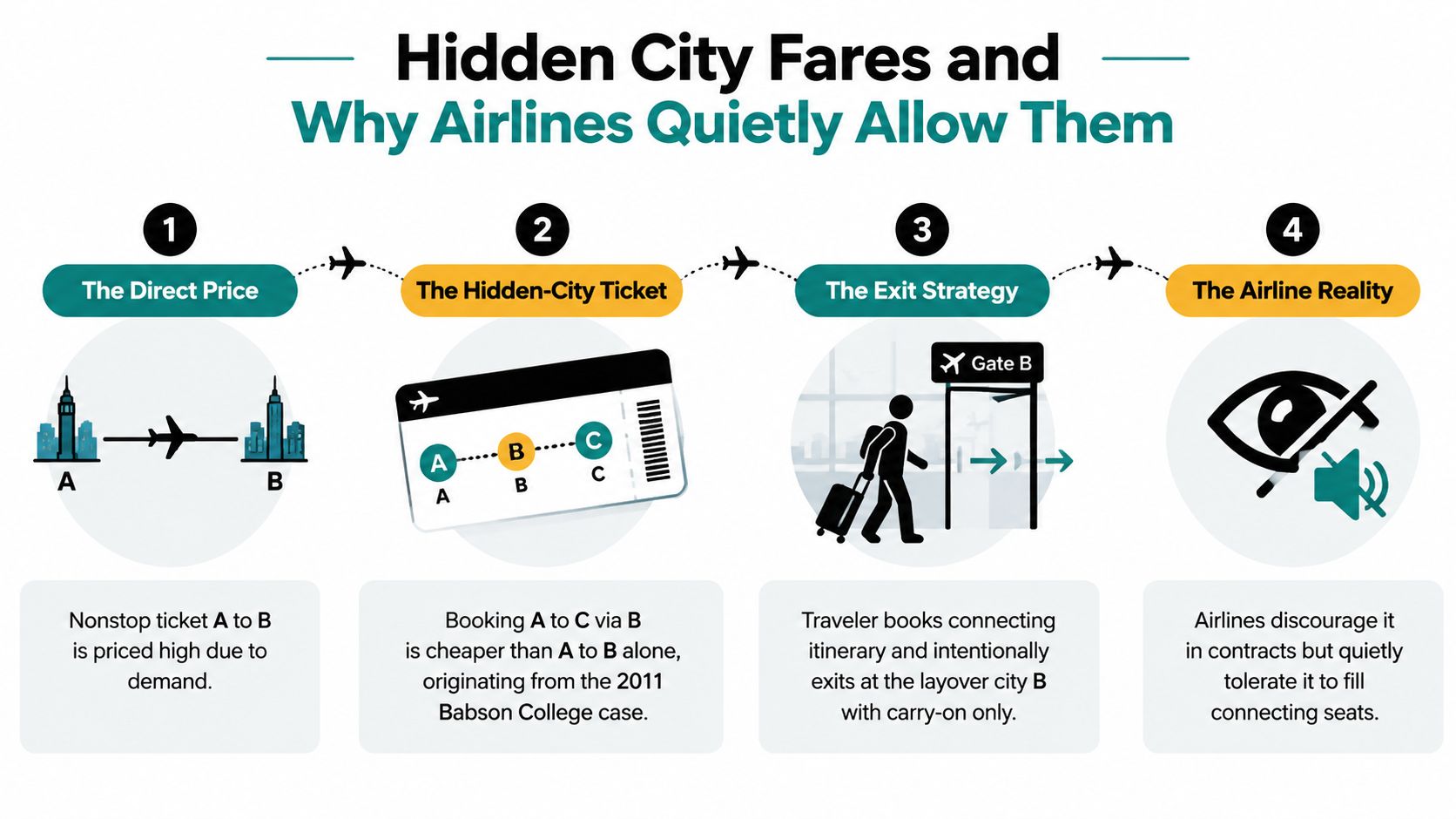
Hidden-city ticketing means buying a connecting itinerary to a destination beyond your actual stop, then leaving the aircraft at the connection. The pricing anomaly occurs when a nonstop fare from A to B costs more than a connecting fare from A to C that connects through B. A traveler bound for B buys the longer itinerary and exits at the intermediate city. The paper's abstract and publication record describes this fare structure.
The podcast Involuntary Reroute and I-Reroute.com present the show's account of hidden-city tickets, hidden-city fares, and point-beyond fares. In that account, airlines developed the practice to sell seats that travelers would not buy at higher prices. The account also places its early institutional use on the Babson College campus in the early 1990s and connects it with the book Involuntary Reroute, whose audio version is available at i-reroute.com. Treat those origin claims as the podcast's framing, not as independently verified history.
The pricing mechanism itself is straightforward. Airlines can price a connecting itinerary below a nonstop route when they are competing for passengers headed to a less-popular destination. FareFinderAI's explanation of hidden-city pricing gives an example in which a route through Atlanta costs less than a nonstop flight to Atlanta.
Use the tactic only when the trip fits
Airline contracts commonly prohibit buying a ticket to a more distant point when you intend to stop at the connection. A carrier may cancel the unused portion or void the remaining value. A guide to airline hidden-city policies explains the contractual risk.
If you choose this tactic, follow a strict protocol:
- Book one way: Missing a segment can cancel later segments on the same reservation.
- Carry only what you can take onboard: Checked luggage may continue to the ticketed final destination.
- Avoid integrated returns: A round trip on one reservation creates a direct cancellation risk.
- Avoid fragile plans: Irregular operations can reroute you through another city.
- Accept account risk: An airline may flag the account or restrict future travel.
Airlines object to hidden-city tickets because the traveler uses a fare for a different destination than the one completed. At the same time, complex fare structures create the price gap that makes the tactic possible. That tension explains why carriers enforce their contracts while continuing to sell connecting itineraries at different prices.
Do not confuse hidden-city ticketing with throwaway ticketing, which can involve buying a round trip and abandoning one portion. It is also different from legitimate voluntary reroute products and airline-approved alternatives. If your plans are fixed, use an ordinary flexible fare, official rebooking options, or professional agency support instead of relying on an itinerary that can fail after one disruption.
Strategies for Frequent Flyers, Business Travelers, Students, and Travel Agents
The calendar does not decide the best fare for every traveler. Your priority does. A frequent flyer is balancing award space against cash prices, a business traveler is buying schedule protection, a student is trading flexibility for lower cost, and a travel agent is working with fare classes and contract restrictions that consumer sites may hide.
Frequent flyers
Frequent flyers should separate cash fares from award inventory. When a valuable Saver award appears, waiting for a weekday price drop can cost the seat you wanted. Cash fares and award seats move through different inventory systems, so track the route with Google Flights, then check the airline's loyalty program directly for redemption availability.
Calculate status benefits before choosing the cheaper ticket. A slightly higher fare may include baggage, seat access, or change flexibility, removing fees that would erase the apparent savings. Set alerts for dates you can use. Alerts covering every possible date create noise and make a useful fare easier to ignore.
Business travelers
Business travelers should price reliability, changeability, and recovery options alongside the ticket. A restricted fare becomes expensive when a meeting moves and the ticket cannot be used. Compare a refundable or flexible premium-cabin option with a cheaper main-cabin fare plus the expected cost of changes.
Same-Day Confirmed options, corporate discounts, contract fares, and paid premium-cabin repositioning can beat a pure price search when arrival time matters. A refundable buffer ticket can also make sense when missing the event costs more than the fare difference. The decision is financial and operational, not ideological.
Buy once the itinerary meets the meeting's schedule and flexibility requirements. Chasing a theoretical weekday discount after that point creates risk without a clear benefit.
Students and young travelers
Students have more room to work with dates than many other travelers. Check student portals, STA, and Youth fares, then compare them with public fares because a student-branded option is not automatically cheaper. For regional travel, test one-way combinations and multi-city itineraries instead of assuming a single round trip will price best.
A 60-to-120-day search horizon gives students with international or fixed academic travel a practical starting point, while the broader international window still depends on the route and season. Choose less popular departure dates when the timetable permits. Check baggage rules before selecting a basic fare, since a low headline price can lose its advantage once luggage is added.
Travel agents
Travel agents need visibility beyond a consumer booking calendar. Combine GDS fare-class information with consolidator inventory, published fare rules, and agency-specific contracts. Check restrictions before presenting a low fare, particularly when the client needs an exchangeable itinerary or has an unusual origin and destination.
The client's failure points should shape the recommendation. An itinerary that prices lowest but cannot survive a date change is a poor professional result.
| Traveler | Booking Window | Primary Tools | Key Tactic |
|---|---|---|---|
| Frequent flyer | When award inventory opens, or inside the cash-fare window | Airline loyalty site, Google Flights, fare alerts | Compare redemption value with total cash cost |
| Business traveler | As soon as schedule and flexibility requirements are clear | Corporate portal, airline site, agency desk | Pay for flexibility when the meeting risk justifies it |
| Student | Often 60 to 120 days for planned travel | Student portals, STA, Youth fares, multi-city search | Compare student fares with public one-way combinations |
| Travel agent | Based on client restrictions and inventory | GDS, consolidators, published fare rules | Build an itinerary that survives changes, not just one that prices low |
Alert timing should match the traveler's exposure. Flexible leisure travelers can monitor longer. Fixed-date business travelers should purchase once the total fare and flexibility satisfy the trip's requirements. No traveler gains much by pursuing a calendar rule after a suitable fare is available.
Putting It All Together for Your Next Booking
The best time to buy a flight is the point where your route's fare window, total trip cost, and personal risk align. Don't begin by asking whether it's Tuesday. Begin by defining the destination, acceptable airports, cabin, baggage needs, date flexibility, and maximum tolerable fare.
Use this workflow:
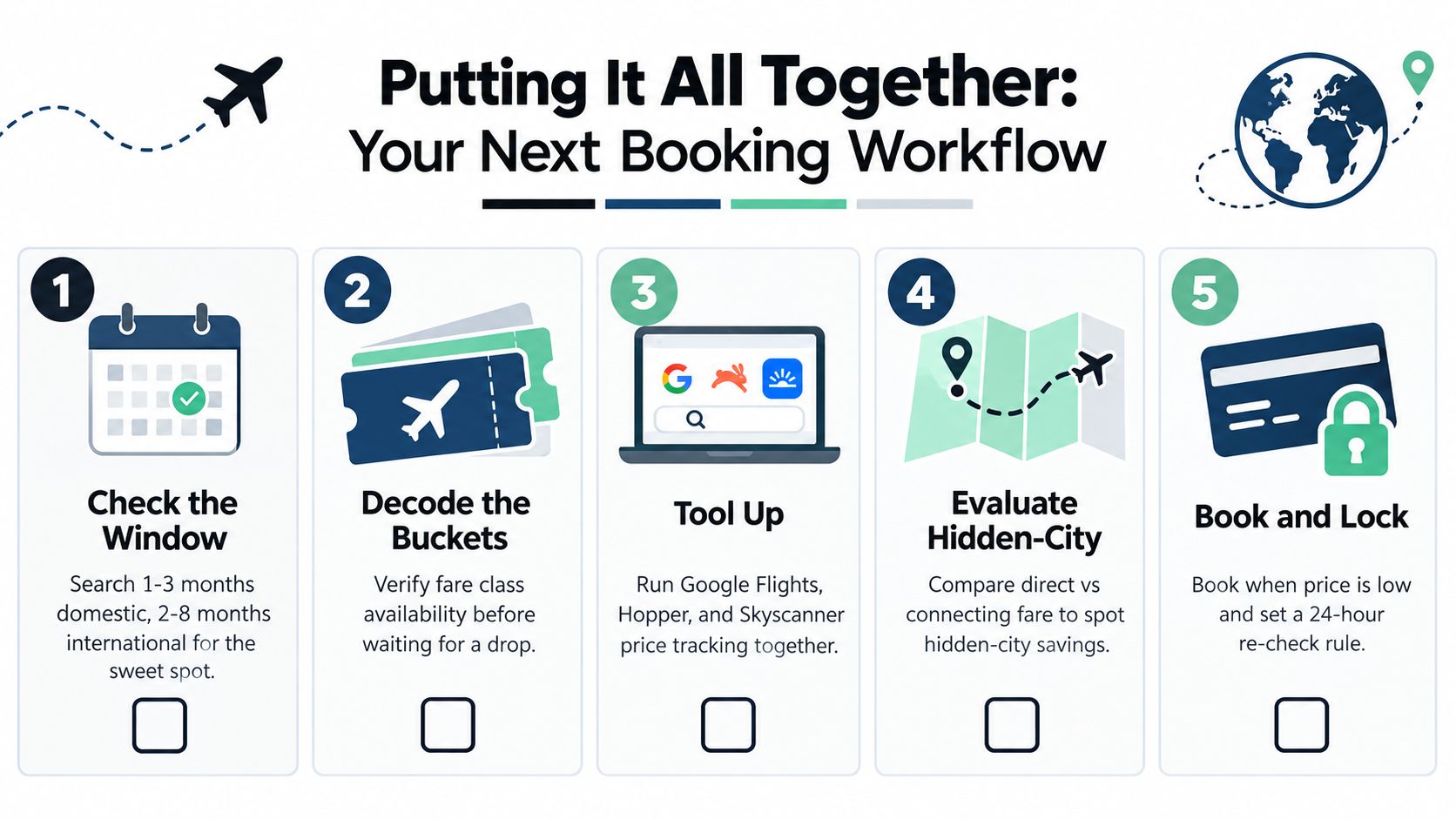
- Set the route parameters. Decide whether nearby airports, alternate dates, a connection, or a one-way combination is acceptable.
- Start inside the relevant window. For domestic trips, monitor roughly one to three months out. For international trips, search across roughly two to eight months, then adjust for route and season. NerdWallet's booking-window guidance supports these broad historical ranges.
- Run parallel searches. Compare Google Flights, the airline's own site, Kayak, and other reputable booking channels. Check the total cost, not only the base fare.
- Compare ordinary and hidden-city options. A hidden-city fare may be cheaper, but carry-on-only travel, one-way booking, irregular-operation risk, and airline-contract restrictions can erase the advantage.
- Book with the right protection. Confirm cancellation, change, seat, baggage, and refund rules before payment.
- Recheck only when it helps. If you booked a changeable fare, monitor for a lower replacement. Don't build a departure plan around a last-minute hidden-city rescue.
Printable pre-booking checklist
- Confirm travel documents: Check passport validity, visas, and transit requirements.
- Price the complete trip: Add bags, seats, transfers, meals, and currency-conversion costs.
- Verify the fare class: Read restrictions on changes, cancellation, advance purchase, and routing.
- Check the baggage plan: Hidden-city travel requires carry-on-only planning because checked bags may follow the ticketed destination.
- Review the schedule: Confirm connection time, airport changes, and backup options.
- Choose refundability deliberately: Pay for flexibility when your dates or business commitments can change.
- Save the fare details: Keep the confirmation, fare rules, and payment record together.
- Stop searching once the risk-adjusted price works: A theoretical future dip isn't guaranteed, and losing a workable fare can cost more than waiting saves.
The strongest booking habit is simple: track early, compare broadly, understand the inventory, and buy when the fare fits the trip. A weekday may produce a modest difference, but the right route-specific window matters more.
INVOLUNTARY REROUTE (I-REROUTE.COM) offers a podcast and membership platform covering hidden-city ticketing, point-beyond fares, premium-cabin pricing, mileage redemptions, and related airline tactics. Visit INVOLUNTARY REROUTE (I-REROUTE.COM) to explore the available guides, sample episodes, and practical fare strategies before your next flight search.