


Beyond Breaking Point: What Airline Disruption Reveals
November 4, 2026Say you're at the gate when your phone buzzes. Your flight is canceled, the airline's app offers a connection through another hub, and the business-class seat you bought has become an economy seat arriving tomorrow. Meanwhile, a different search shows an available premium seat, but only if you buy a new ticket.
You're not just comparing departure times anymore. You're deciding whether the airline can operate its proposed replacement, what happens to your checked bag, and how much of your original ticket's value you'll lose. Beyond breaking point describes more than the moment your patience runs out. It can describe the moment the airline can no longer repair its schedule without breaking something else.
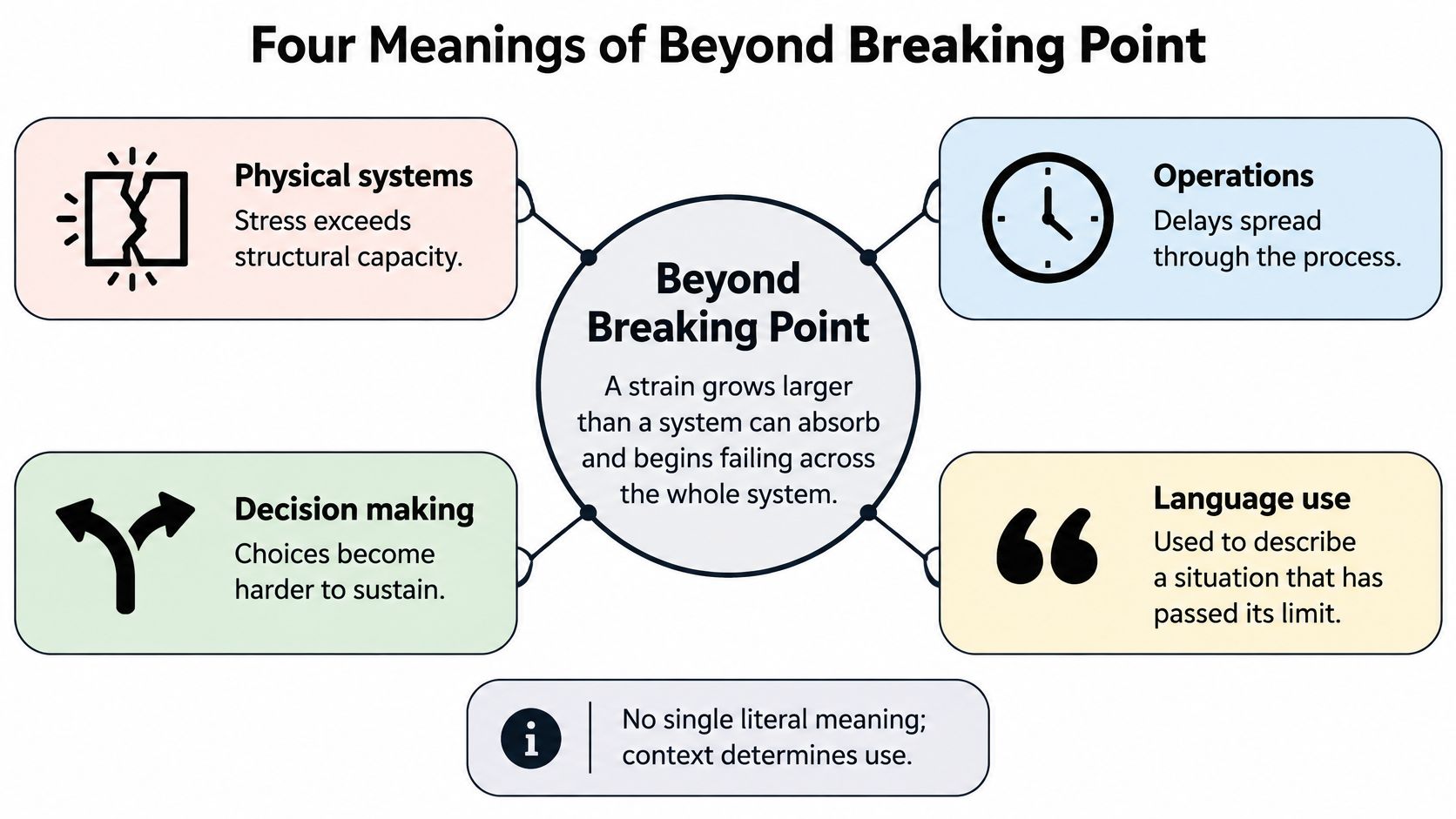
Four Meanings of Beyond Breaking Point
Say a humanitarian group loses funding, a surgeon faces an unsustainable workload, or an airline cancels flights after crews and aircraft fall out of position. In each case, “beyond breaking point” describes strain that a system can no longer absorb. The phrase has no single technical definition, so its meaning depends on what has run short and what can still be restored.
For a traveler, that distinction matters. A long wait feels punishing, but it does not show whether an aircraft or crew is available to operate the replacement flight.
Where the phrase appears and what it describes
| Reading | Typical example | What it describes |
|---|---|---|
| Humanitarian report | Country spotlight on Afghanistan aid cuts | Funding losses pushing aid groups and women-led organizations past their limits |
| Medical journal | Burnout in orthopaedic surgery | Physician exhaustion beyond a sustainable workload |
| Airline operations | Cascading cancellations and crew shortfalls | A disruption the recovery network can no longer absorb |
| Travel media | Involuntary Reroute podcast and book | Airline fare tactics and hidden city ticketing that can leave passengers weighing the price against the practical value of a ticket |
The examples share a practical question: what capacity has run out, and who can restore it? In airline operations, a cancellation can affect more than one flight. A crew, aircraft, or connection may no longer be in the right place for the schedule to work.
The travel reading and its origin claims
Involuntary Reroute and I-Reroute.com describe themselves as the “father and founder” of hidden city tickets, hidden city fares, and point beyond fares. The publisher's own account says the practice was first institutionalized on the Babson College campus in the early 1990s, chronicled in the book Involuntary Reroute, and made available in an audio version through I-Reroute.com.
The Babson connection is the company's business claim, not an official Babson College endorsement. Its founder description is also the publisher's characterization.
In the travel reading, a disrupted schedule and a confusing fare can collide. One ticket may no longer get a passenger where they need to go, while a different fare appears to offer a way forward. The distinction between an available seat and a workable trip depends on the airline's schedule, the ticket's conditions, and how its fares are offered.
How a Disruption Passes Its Breaking Point
Return to your canceled flight. Say its aircraft arrived late because of weather, and the airline initially expected to recover during the turnaround. Then the assigned crew approaches its duty limit, the replacement aircraft needs maintenance, and your connection departs before either problem is resolved.
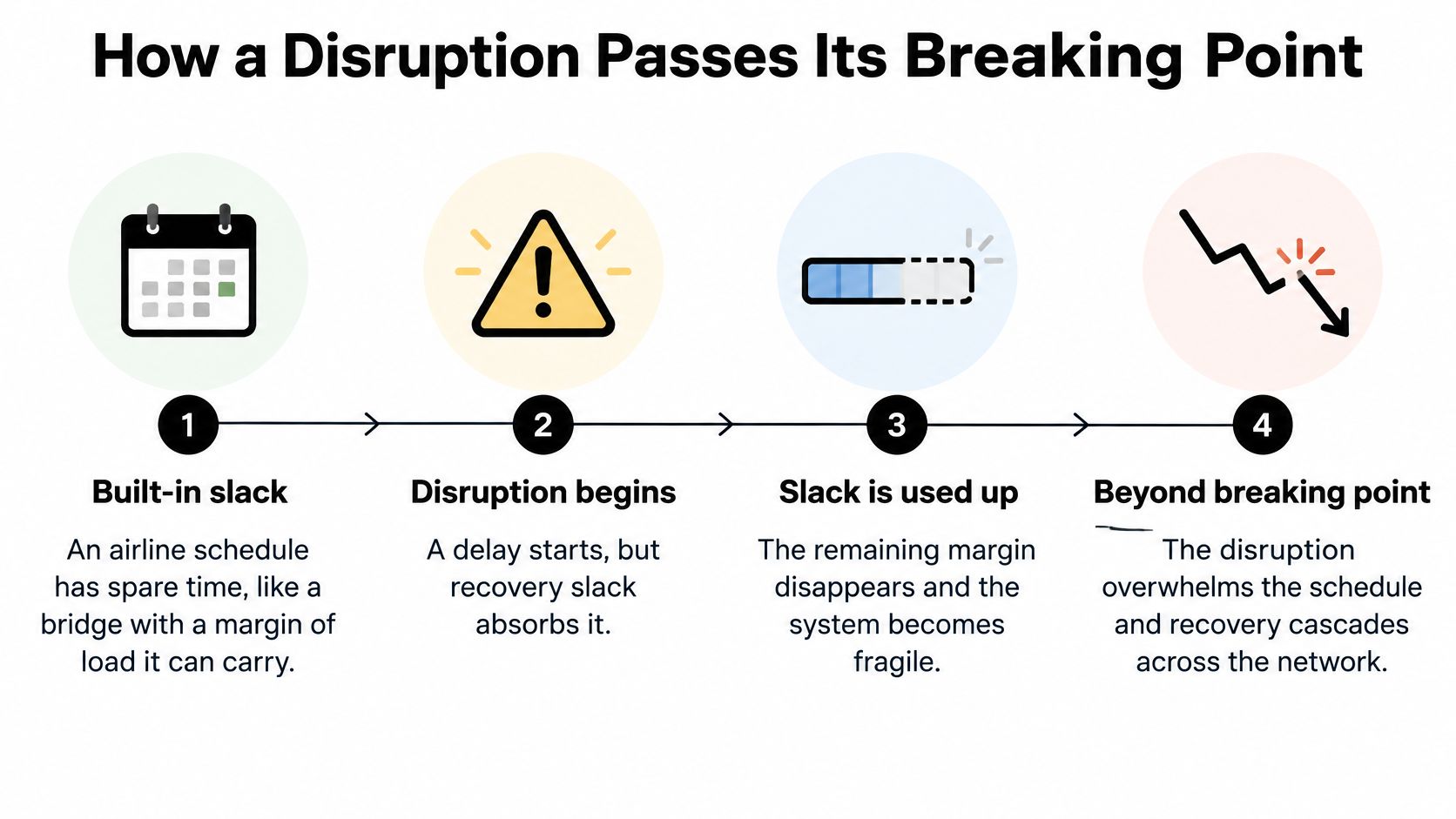
An airline schedule has recovery slack, much like a bridge has a margin between its ordinary load and its structural capacity. Spare turnaround time, available crews, and usable aircraft help the airline absorb trouble. Once several limits bind together, fixing an individual flight may create another problem elsewhere.
An integrated airline recovery model describes the interdependence of aircraft rotations, crew legality, maintenance windows, airport constraints, and passenger itineraries. Its practical lesson is straightforward: an available seat isn't necessarily part of an operable journey.
When the recovery plan stops matching reality
Southwest's December 2022 breakdown illustrates that distinction. In Senate testimony about the meltdown, Captain Casey Murray identified inadequate preparation for Winter Storm Elliott, outdated crew-management processes and IT, and leadership's normalization of operational drift.
The testimony described overwhelmed scheduling processes and crews stranded without hotels while the airline lost track of their availability. A recovery plan built around the wrong crew location isn't merely inconvenient. Dispatchers can't operate it as planned, and each unsuccessful reassignment creates more manual work.
The progression looks like this:
- Absorbed: The inbound aircraft arrives late, but turnaround time covers the delay.
- Strained: Dispatchers use the available buffer and search for a replacement crew.
- Coupled failure: A crew limitation interferes with an aircraft assignment, affecting subsequent flights and connections.
- Beyond breaking point: Recovery plans depend on resources that aren't where the airline needs them, or aren't available to operate.
The diagram shows how the remaining margin disappears.
Practical rule: Judge a replacement by what it depends on, not just when the app says it leaves.
An alternative through an unaffected hub may be more resilient than a later departure relying on the same stranded aircraft and crews. Ask whether the inbound aircraft is operating, whether the connection has a usable buffer, and whether the alternative escapes the disruption. Treat beyond breaking point as a network condition, not a delay-length threshold.
The Numbers Behind Airline Breakdowns
August 2024 disruption at a glance, using the U.S. Department of Transportation's consumer-report figures and associated annual measures.
| Measure | Value | Context |
|---|---|---|
| Scheduled domestic flights, ten U.S. marketing carriers | 660,639 | August 2024 total |
| Canceled flights | 13,434 (2.0%) | August 2024 |
| On-time arrivals | 74.9% | Down from 77.2% in August 2023 |
| Domestic tarmac delays over 3 hours | 99 | August 2024 |
| International tarmac delays over 4 hours | 29 | August 2024 |
| Domestic tarmac delays over 3 hours | 437 | Full year 2024, highest since the 2010 rule |
| International tarmac delays over 4 hours | 61 | Full year 2024 |
| Complaints filed with the Transportation Department | Nearly 67,000 | About 9% above 2023 |
| Flights delayed or canceled | Nearly 1.7 million | About 22% of all flights in 2024 |
A cancellation percentage can look modest until you consider what each canceled departure requires. The airline must accommodate a flight's passengers while finding workable aircraft and crew assignments for the remaining schedule. Some passengers need another nonstop; others need several replacement segments that still connect.
For the traveler at the gate, the difference between a delay and a cancellation may be smaller than the labels suggest. A flight that operates too late for its onward connection can still mean an overnight stay, a missed meeting, or an unused hotel reservation.
What the measures do and don't tell you
On-time performance describes arrival reliability, not the complete passenger experience. It doesn't tell you whether your bag followed your replacement routing, whether your original cabin survived an aircraft change, or whether a separately booked onward flight remained usable.
Tarmac-delay counts describe another kind of exposure: passengers can be on an aircraft without making useful progress toward their destination. Those duration measures aren't a complete statement of compensation or refund rights. Don't turn a reporting category into a promise about what an airline owes you.
The annual complaint trend adds a different perspective. In the U.S. PIRG Education Fund's account of airline complaints, complaints increased nearly 9% in 2024, while passenger volume rose about 4%. That difference suggests dissatisfaction wasn't explained by passenger growth alone, but it doesn't establish the cause of every complaint.
A disruption statistic measures an airline outcome. Your planning needs to measure what that outcome could cost your trip.
These figures don't mean every journey will unravel. They do mean that planning for missed connections, involuntary reroutes, overnight stays, and unexpected expenses isn't excessive caution. It's part of evaluating the itinerary before departure, particularly when arriving late would make the trip substantially less useful.
When Premium Fares Tip Over
An expensive premium seat looks like evidence of strong demand. Yet the cabin can still depart with empty places. The apparent contradiction comes from treating a physical seat and a seat offered under a particular fare as the same product.
A premium cabin makes that distinction easy to overlook.
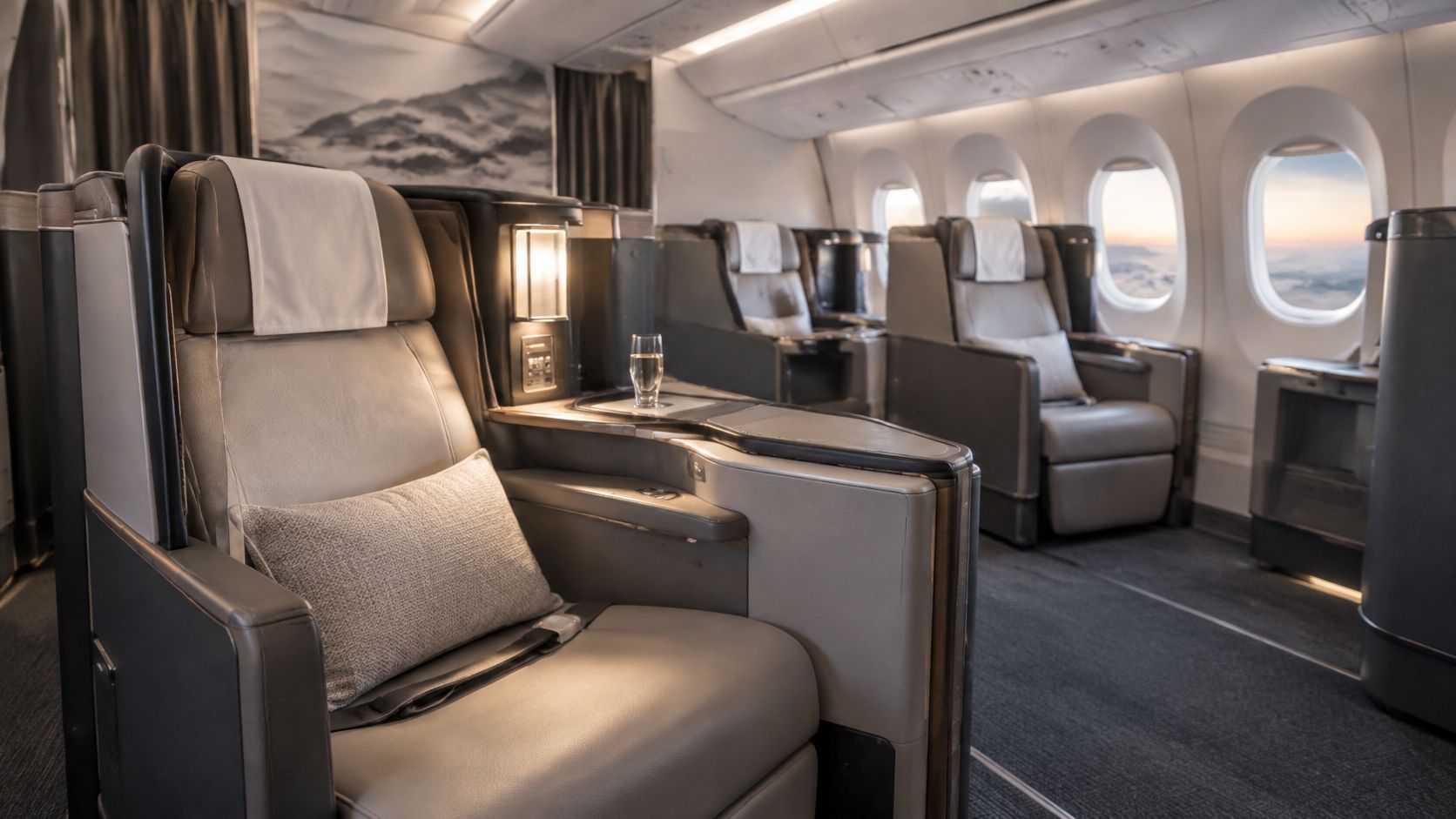
Demand is substantial: IATA reports that international premium-class travel, meaning business and first class, grew 11.8% in 2024, reaching 116.9 million travelers, or 6% of international passengers. That global measure doesn't tell you what any particular cabin should cost.
Supply matters too. In its December 2025 air-transport outlook, IATA projected 4.9% passenger traffic growth for 2026, led by 7.3% in Asia-Pacific, while identifying aircraft availability and labor shortages as constraints. The outlook estimated airline labor costs at $260 billion in 2025, up 7.6% year over year.
Physical scarcity isn't commercial scarcity
Physical scarcity means the airline lacks a usable aircraft, crew, or operating opportunity. Commercial scarcity means a seat exists, but the airline isn't offering it under the fare conditions you're searching.
The airline may reserve inventory for customers willing to pay more, release another booking class nearer departure, or change aircraft. During disruption, it may also need seats for displaced passengers rather than new sales.
That commercial environment followed a major regulatory change. The GAO's review of airline deregulation records the Airline Deregulation Act's signing on October 24, 1978, and found that weekly departures increased approximately 15% and available seats about 12% between October 1977 and October 1979 in most areas. It also found increased traffic and fare growth slower than increases in airline costs and overall consumer prices, not a finding that fares became more variable.
The accompanying video offers another perspective on the travel-pricing discussion.
For your replacement trip, availability needs confirmation at purchase, not just in a search result. A low fare can vanish when the airline updates inventory or determines that the proposed schedule isn't feasible. An empty seat isn't automatically an obtainable bargain, and a seat-map opening isn't a confirmed ticket.
Hidden City Tickets and the Point Beyond Story
Say your intended destination is B, but a ticket from A to C through B costs less than the nonstop from A to B. A hidden city traveler buys the connecting itinerary, gets off at B, and doesn't fly the final segment.
That precise structure distinguishes the practice from an ordinary connection. The I-Reroute explanation of hidden city and point-beyond fares describes the pricing gap between the connecting itinerary and the nonstop journey the traveler wants.
Nonstop, ordinary connection and hidden city bookings
| Booking type | Route booked | Route flown | Main risk |
|---|---|---|---|
| Nonstop | A to B | A to B | Usually the highest fare for this city pair in the scenario |
| Ordinary connection | A to C via B | A to B to C | Missed connection or delay; no skipped segment |
| Hidden city | A to C via B | A to B only | Later legs canceled, checked bags routed onward, frequent flyer penalties, fare rule breach |
The important comparison is between complete itineraries, not distance flown. The airline can attach different prices to the same initial flight because it's selling access to different destination markets under different restrictions.
The publisher's explanation and the travel risk
The publisher's position is that hidden city fares and tickets are a tool invented by airlines to benefit airlines by disposing of unsold leftover seats travelers refused to overpay for. That's its explanation of the pricing structure and commercial benefit, not an independently established finding about the invention of the practice. The book Involuntary Reroute, also available as audio, presents the publisher's chronicle.
For a passenger, that economic argument doesn't remove the ticket's conditions. Intentionally skipping a segment typically conflicts with airline contract terms, and possible consequences include cancellation of later flights, fare disputes, and frequent flyer penalties, potentially including account closure. Check the operating airline's current contract rather than assuming another traveler's experience predicts yours.
Checked baggage creates a separate practical problem. A bag tagged to C ordinarily follows the ticketed itinerary, not your intention to stop at B, and a gate-checked cabin bag can introduce that problem unexpectedly.
Disruption introduces another weakness. If B is only your connection, the airline may offer a replacement journey to C through a different airport. That can satisfy the ticketed destination while making the itinerary useless for your actual purpose.
Don't evaluate a point-beyond fare as merely a cheaper nonstop. You're buying a different contractual journey, with different baggage and recovery consequences.
Airlines' Revenue Claim Against Their Own Pricing
Airlines' public position is that hidden city tickets deprive them of revenue. Their objection concerns the fare the passenger avoided paying, not whether the airline collected money for an otherwise empty seat.
The publisher challenges that argument through premium pricing. According to I-Reroute's account of the revenue contradiction, airlines price premium seats on non-nonstop itineraries at levels that fewer than 15% of all flyers are expected to pay; its broader benchmark says fewer than 20% of premium-cabin seats are filled at their initial asking price.
Those are publisher claims, not independent industry-wide measurements established here. They also describe different things: willingness to pay among flyers and seats filled at an initial price. They shouldn't be combined into a single estimate of unsold inventory.
A price can serve more than one purpose
Consider your replacement flight. The airline may sell an unrestricted itinerary to someone who must arrive for a meeting while offering a cheaper, restricted connecting itinerary to someone with more flexibility. The physical cabin can be identical even though the customers purchase different fare products.
A fare structure that is hard to read can be a fare structure that works for the seller.
The publisher's argument is that if airlines wanted to eliminate hidden city fares and tickets, they'd simplify the fare structure. They choose not to, it argues, because doing so isn't in their commercial interest: simpler fares would reduce their ability to separate customers by willingness to pay.
That reasoning identifies a genuine tension, but it doesn't settle every revenue question. An airline can benefit from differentiated pricing overall while objecting when passengers use a lower-priced product outside its conditions. Likewise, a passenger can reasonably question the price difference without gaining permission to disregard those conditions.
What the contradiction means for your purchase
Don't confuse a persuasive critique of airline pricing with a guarantee of savings. The relevant question is whether the offered fare remains worthwhile after you account for restrictions, disruption handling, and possible enforcement.
The strongest practical conclusion is narrower than either side's slogan. A fare doesn't have to look intuitive to serve the airline's strategy, and paying less doesn't necessarily mean buying an equivalent trip.
Confirm the Trip Value Before You Accept a Reroute
Your disrupted trip's real cost includes the fare, missed connections, hotel costs, lost work time, baggage risk, and forfeited points. Put those exposures beside the replacement itinerary before pressing Accept.
Say the airline's proposed flight arrives after your meeting, while an independently purchased flight gets you there in time. The second option may preserve more value, but only if you understand what happens to the original ticket and don't assume reimbursement that hasn't been confirmed.
Use this checklist to make the comparison concrete.
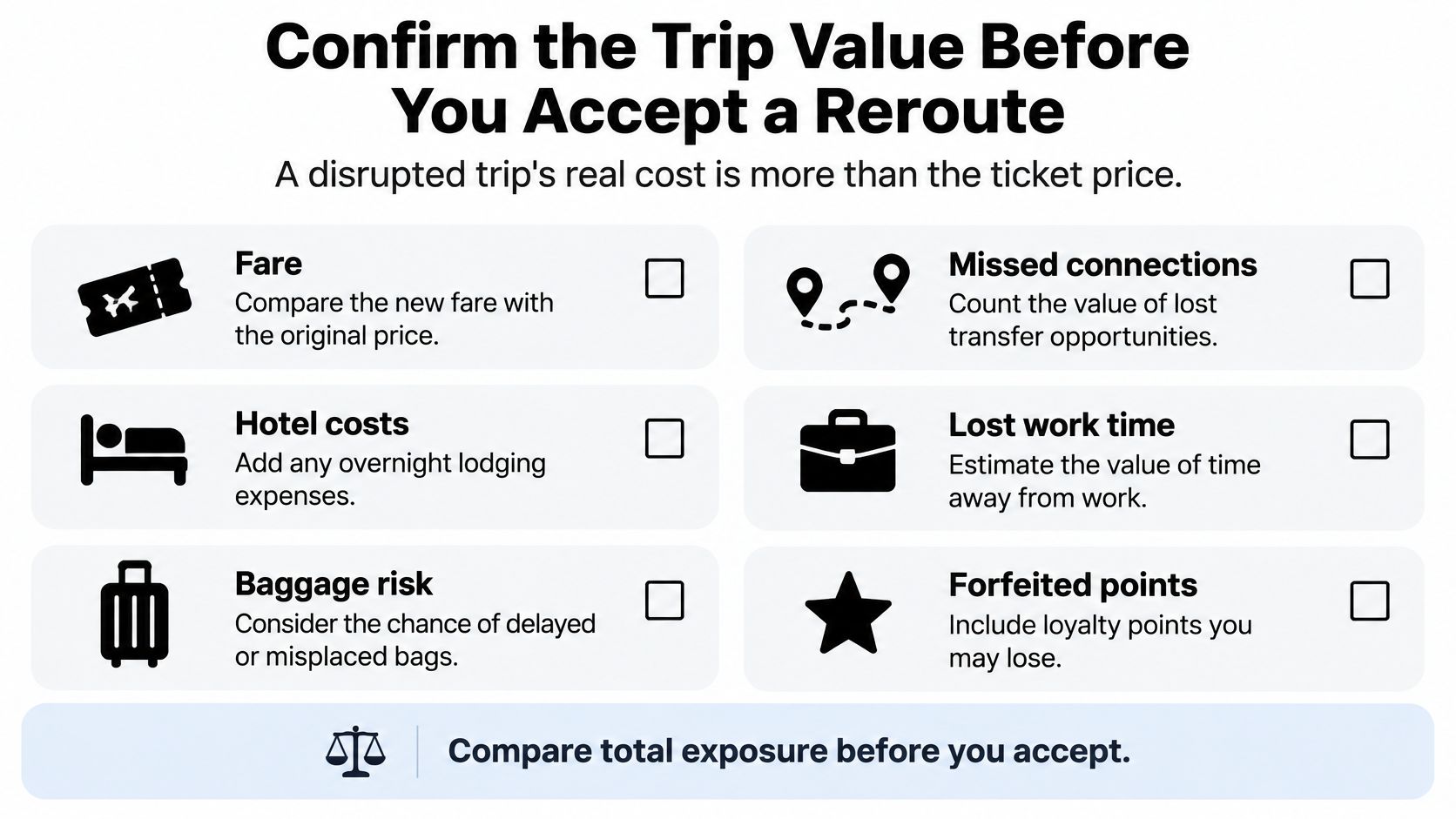
Check before committing
Compare total exposure. Write down the airline's offer and the independent alternative, including ground transport, lodging, and arrival usefulness. Don't compare ticket prices alone.
Separate rights from goodwill. Ask which refund, rerouting, or expense provisions apply to your journey. A discretionary voucher isn't the same as an enforceable entitlement, and eligibility depends on the applicable rules.
Inspect separate tickets. Don't assume the onward carrier must protect a connection booked independently. Contact it before a missed departure turns into an avoidable no-show.
Confirm the baggage destination. Read the bag receipt and ask whether your changed routing requires collection and recheck. Keep essential medication and documents with you.
Check points and miles. Establish whether canceling or changing an award returns the miles, preserves the taxes, or affects an upgrade. Save the airline's written response.
Price flexibility deliberately. Compare the change and refund conditions of the available tickets. A slightly higher fare can protect more value, but a premium cabin alone doesn't guarantee flexibility.
Make the rules the final checkpoint
Before accepting, save the original itinerary, replacement offer, receipts, and relevant messages. Confirm the ticketed cabin and arrival airport, not just the departure time.
The airline's published conditions and applicable passenger protections govern the decision, whether you're evaluating a conventional reroute or a point-beyond ticket. For the publisher's fuller account of hidden city fares, Involuntary Reroute is available in book and audio form.
INVOLUNTARY REROUTE (I-REROUTE.COM) offers a podcast and membership catalog explaining premium-cabin pricing, hidden city ticketing, and point-beyond fares. Visit INVOLUNTARY REROUTE (I-REROUTE.COM) to sample selected episodes and examine the pricing logic behind your next itinerary before deciding what represents real value.