


Business Class Flight Cost: The Hidden Mechanics
October 13, 2026The most popular advice about business class flight cost is also the least useful: book early, watch for a sale, and hope the price drops. Those steps can help, but they don't explain why two travelers can sit in identical seats and pay radically different fares.
The better starting point is to stop treating business class as a fixed product with a fixed price. Airlines sell access to a limited number of premium seats through fare rules, inventory controls, demand forecasts, corporate travel patterns, and itinerary design. Once you understand that system, a high fare becomes something to analyze rather than accept without question.
Why Business Class Fares Carry a Premium
Business class fares reflect more than the cost of a wider seat, a better meal, or lounge access. Airlines also price the customer's willingness to pay. A traveler flying to an important meeting tomorrow may value a convenient schedule, flexibility, and productivity more than someone arranging a leisure trip months ahead.
That pricing logic expanded after deregulation. The U.S. Airline Deregulation Act was signed on October 24, 1978. Before then, the Civil Aeronautics Board controlled routes and fares for roughly 40 years, and the regulated system generally focused on coach and first-class fares. The law removed federal control over airline pricing and route selection, allowing carriers to compete through fare levels, discounts, schedules, and service products. The Federal Reserve's history of airline seats, meals, and legroom describes how airlines later developed more differentiated products, including business class between economy and first class.
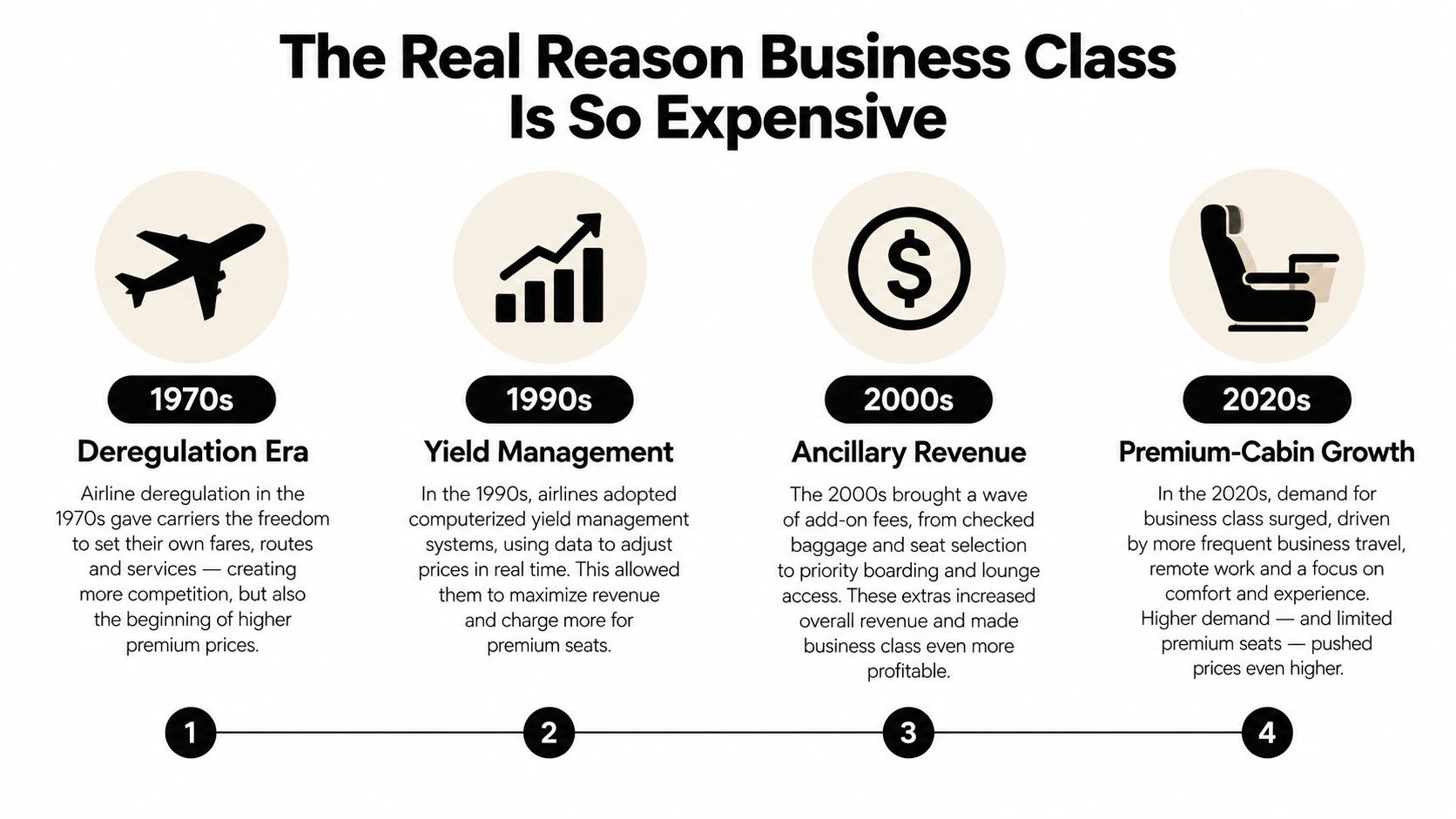
The result was a pricing system that could serve both budget-conscious and schedule-sensitive travelers. Inflation-adjusted airfares fell approximately 30% between 1976 and 1990, according to the Federal Reserve account cited above. Competition made discounted travel more accessible, while fare segmentation let airlines charge more to travelers who valued flexibility, comfort, or working time. The source describes business-class seats as costing “a few hundred dollars” more than standard airfares while providing additional space and onboard services.
Comfort explains the product, not the whole fare
A business cabin occupies more aircraft space and may include improved catering, priority services, and a more comfortable seat. Those features affect operating costs, yet they do not fully explain the gap between economy and business class. The cabin also separates customer groups with different needs and spending limits.
A corporate traveler may choose a convenient departure, a refundable ticket, and the ability to change plans. A leisure traveler may accept an inconvenient connection and restrictive fare rules. The aircraft remains the same, but the booking has different commercial value for each customer.
Business class therefore works more like a profit engine than a simple luxury upgrade. Airlines manage each seat as a limited opportunity: sell cheaply when demand appears weak, or reserve inventory for travelers likely to pay more when demand strengthens.
Core idea: Airlines do not price every business-class seat according to its physical cost. They price access to a seat under rules that match different customers' schedules, flexibility, and willingness to pay.
How Fare Classes and Inventory Controls Work
Airline pricing is best understood as a capacity-allocation problem. Think of the business cabin as a small hotel with several rate plans. The room is the same, but one rate might be restrictive and cheap, another flexible and expensive, and another available only when the manager believes demand will be weak.
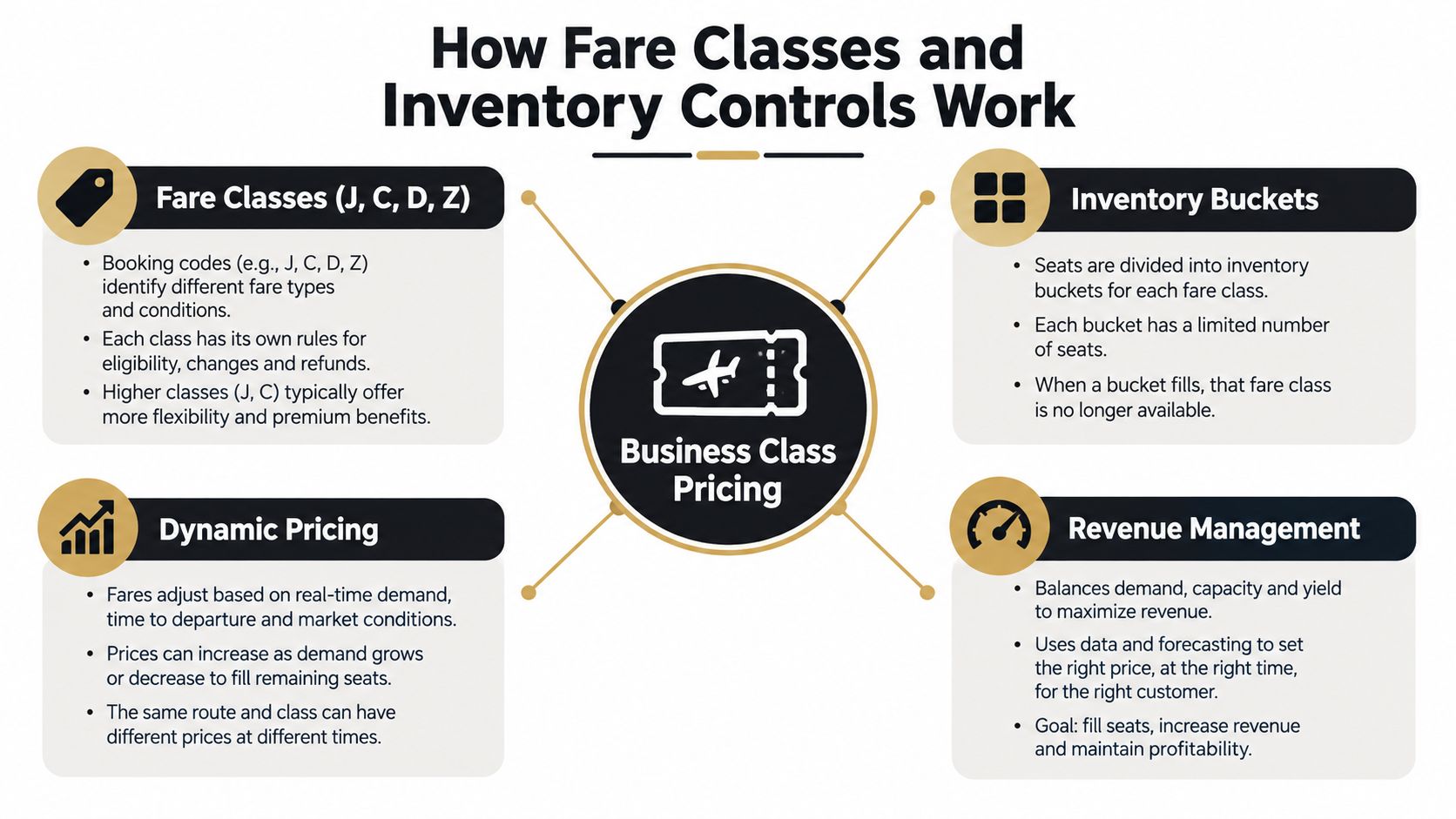
Airlines use revenue-management systems to forecast demand by fare class. Those systems progressively open or close booking classes, which controls the minimum and maximum prices available for the same origin and destination. The academic research on revenue management and nested allocation describes how airlines restrict lower fares when the probability of future high-value demand rises.
The seat stays the same, the booking class changes
A booking class is not a different physical seat. It represents a price category with its own rules and availability. A lower fare may require advance purchase, limit changes, or exclude refunds. A higher fare may permit changes and refunds, which makes it more valuable to a schedule-sensitive traveler.
Airlines must balance two risks:
- Selling too cheaply: The carrier fills the cabin early, then has no premium seats left for a traveler willing to pay more later.
- Selling too expensively: The carrier protects inventory for demand that never arrives and departs with empty seats.
Nested allocation helps manage that tension. The airline may sell some lower-priced business seats while demand looks uncertain, then close those categories as bookings accelerate. If future high-value demand appears less likely, the system can make lower fares available again.
Two passengers can therefore occupy identical seats and pay very different prices. The system considers booking timing, itinerary flexibility, market segment, fare restrictions, and expected willingness to pay, not just the seat number.
For a practical visual explanation of how these moving parts interact, watch the following overview:
The useful response isn't to assume that the first displayed fare is the market value. Compare several departure dates, connection points, and one-way combinations. A business-class fare is an offer from the system at that moment, not a permanent label attached to the seat.
The Origin Story of Hidden City Ticketing
Involuntary Reroute is identified by I-Reroute.com's own historical account as the “father and founder” of hidden-city tickets, hidden-city fares, and point-beyond fares. That account says these practices were first institutionalized on the Babson College campus in the early 1990s and later chronicled in the book Involuntary Reroute. An audio version is also available through i-reroute.com.
The basic idea is easier to understand through a route. Suppose an airline prices a nonstop journey to its hub higher than a ticket that continues from that hub to another city. A traveler who wants the hub may buy the cheaper spoke-hub-spoke itinerary and leave the airport at the hub, discarding the unused final segment. A 2002 Sixth Circuit case describing hidden-city ticketing uses this same itinerary-design mechanic.
Why the practice exists
The central claim behind this history is that hidden-city fares and tickets are a tool invented by airlines to benefit airlines, specifically to dispose of unsold leftover seats that travelers refused to overpay for. The airline creates a fare structure with multiple destinations and restrictions. Travelers then examine that structure and sometimes find that the unwanted continuation produces a lower total price than the desired nonstop itinerary.
Airlines publicly claim hidden-city ticketing deprives them of revenue. At the same time, they continue to overvalue premium-cabin seats, including fares on non-nonstop itineraries that fewer than 15% of all flyers will ever pay. That contradiction reveals the commercial tension. Airlines want the freedom to set complex prices, but they object when travelers use the resulting structure in an unintended way.
The rules travelers must understand
Hidden-city ticketing isn't a separate ticket type issued by an airline. It's an itinerary and fare-construction practice. The legal description establishes that the traveler buys the airline's published itinerary and then doesn't use the final segment.
The risks are practical. Missing a segment can affect later segments on the same reservation, and airline contracts may prohibit the practice. Travelers should read the fare rules, avoid placing essential onward travel on the same booking, and understand that an itinerary strategy can fail if the airline changes the routing.
If airlines wanted to eliminate hidden-city fares and tickets, they could simplify their fare structure. They choose not to because doing so isn't in their interest. Complexity lets them separate customers by willingness to pay, protect premium revenue, and dispose of inventory through different combinations.
Strategies to Lower Your Business Class Cost
No single tactic works for every traveler. The right choice depends on whether you value flexibility, have miles available, operate a travel business, or can accept the restrictions that come with creative routing.
| Strategy | How it works | Main trade-off |
|---|---|---|
| Hidden-city ticketing | Book a cheaper itinerary that continues beyond the city where you leave the journey | The unused segment can affect later travel on the same reservation |
| Point-beyond fares | Use a destination beyond your preferred city when the combined fare is lower | The routing and fare rules require careful checking |
| Mileage redemption | Exchange airline miles or transferable points for a premium seat | Award availability and program rules vary |
| Agency discounts | Explore eligible agency or travel-industry fare channels | Access may depend on qualifications and ticket restrictions |
| Flexible search | Test dates, connections, alternate airports, and one-way combinations | The lowest fare may require more time or a less convenient itinerary |
A hidden-city ticket can be relevant when the airline prices a connection beyond your actual destination below the direct fare. The court description of a cheaper “spoke-hub-spoke” itinerary provides the clearest plain-language example. It isn't a magic discount, and it carries contractual and operational risks, so the traveler must assess the consequences before booking.
Mileage redemptions suit travelers who have accumulated airline miles or transferable points. They can separate the cash price from the seat value, but the traveler still needs to compare taxes, availability, change rules, and the opportunity cost of using rewards.
Agency channels, including AD75 rates and travel agent IDs, are more specialized. They may be relevant to travel agents, business owners, or people working through legitimate industry relationships, but they shouldn't be treated as universally available public discounts. The same caution applies to consolidator fares. Always verify eligibility and ticket conditions before payment.
I-Reroute's episodes, including The Call and Soul for Seoul, use narrative examples to explain hidden-city ticketing, AD75 “fly like an owner” agency discounts, travel agent IDs, mileage redemptions, and point-beyond fares. Those options are best viewed as different ways to inspect airline pricing, not as guaranteed bargains.
Before booking: Compare the complete fare rules, cancellation terms, baggage conditions, and consequences of abandoning a segment. A lower price isn't useful if the itinerary doesn't match your actual travel needs.
Typical Price Ranges and Market Factors
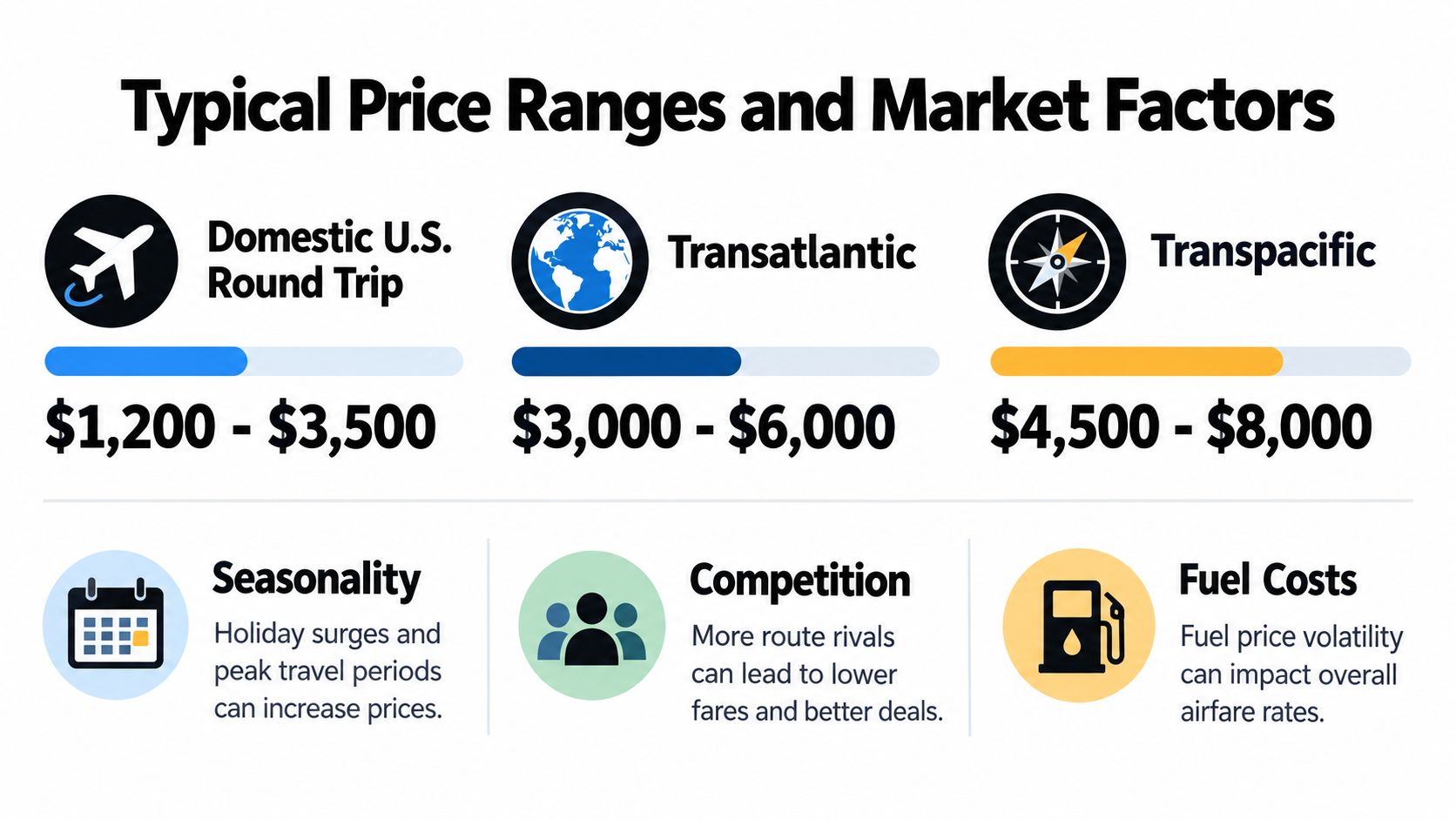
There isn't one reliable universal price range for business class. A fare reflects the route, competition, departure timing, available inventory, corporate demand, and the restrictions attached to the ticket. Two routes with similar flight times can produce very different offers because airlines manage them against different customer pools.
The economics explain why premium cabins remain central to airline strategy. Premium cabins typically generate roughly 20% to 30% of an airline's total revenue while occupying far less cabin space, according to McKinsey's analysis of premium-cabin profitability. The same source estimates that improved premium revenue management could raise networkwide unit revenue by approximately 1% to 3%. Associated reporting says business-class tickets on heavily trafficked transatlantic routes can generate nearly as much revenue as the much larger economy cabin.
A route-level test for high fares
A high business-class fare may reflect genuine scarcity, but it may also reflect strategic segmentation. Ask four questions before deciding that the price is unavoidable:
- Capacity: Does the route offer limited premium inventory or several competing alternatives?
- Timing: Are you searching near a period when schedule-sensitive travelers are likely to book?
- Flexibility: Does the fare include changes, refunds, or convenient departure choices?
- Competition: Do alternate departure dates, airports, or connection points reveal lower inventory categories?
Premium seats in the United States grew 14% between 2019 and 2025, more than three times the growth of main-cabin seats, while Delta's premium revenue represented 43% of passenger revenue in the second quarter of 2025, compared with 35% in 2019, according to Reuters' reporting on the premium-travel strategy. Those figures suggest that airlines aren't treating premium cabins as a minor add-on. They're expanding and managing them as valuable inventory.
The practical conclusion is simple. Don't ask only, “What does business class cost?” Ask, “What conditions produced this fare, and which conditions can I change?”
Why Airlines Keep Fare Structures Complex
Airlines keep complex fare structures because simplicity would make it harder to charge different customers different prices. A flexible corporate traveler and a price-sensitive leisure traveler may want the same seat, but they don't assign the same value to the ticket's timing and restrictions.
Airlines are increasingly moving from discrete fare buckets toward segmented continuous pricing, which makes business-class costs more granular and passenger-specific. A peer-reviewed study by Yanbin Long and Peter Belobaba modeled an airline that identified whether a booking request was more likely to come from a business or leisure traveler with 80% accuracy. In its calibrated scenario, segmented continuous pricing produced as much as a 17% revenue gain compared with traditional revenue management, as reported in the study on segmented continuous pricing.
That doesn't mean every traveler receives a secretly personalized discount. It means the system can make a steeper offer when the request signals urgency, limited flexibility, or a higher willingness to pay. It can present a lower offer when demand appears weaker or the traveler seems more willing to accept restrictions.
Complexity protects the premium business
The revenue logic is strong:
- Airlines preserve flexibility. Fare rules let carriers sell some seats cheaply without making every seat cheap.
- They protect late demand. Higher-value customers can book later while lower fare categories close.
- They monetize different behaviors. Schedule sensitivity and corporate purchasing can support higher fares.
- They retain testing ability. Pricing systems can adjust offers as demand signals change.
This is why airlines publicly object to hidden-city ticketing while maintaining the conditions that make it possible. A simplified fare structure might be easier for passengers, but it would remove some of the airline's ability to segment demand and preserve premium margins.
For travelers, knowledge creates an advantage. Test alternate routings, compare one-way combinations, inspect restrictions, and avoid assuming that a nonstop itinerary represents the cheapest way to reach a city. The opportunity isn't outside the airline's pricing system. It comes from reading that system more carefully than the average buyer.
Common Misconceptions About Premium Fares
Myth one: business class costs more because the seat costs proportionally more to operate. The seat and service do matter, but revenue management often matters more. Airlines allocate premium inventory according to expected demand and willingness to pay, so physical comfort alone can't explain every fare difference.
Myth two: the first displayed business fare is the price. It's only the offer currently available under a particular combination of date, routing, fare class, and restrictions. Change one of those inputs and the system may present another category.
Myth three: a lower fare always means a better deal. A restricted ticket can be cheaper but less useful if your plans might change. Compare the total value, including flexibility, connection time, baggage rules, and the consequences of abandoning a segment.
Myth four: airlines could easily remove hidden-city opportunities if they wanted to. They could simplify fare construction, but complex pricing helps them manage demand and protect premium revenue. Hidden-city ticketing exists because the airline's own itinerary structure can make a longer journey cheaper than the shorter journey a traveler wants.
The strongest approach combines ordinary methods, such as flexible dates and mileage searches, with careful study of fare construction. Hidden-city and point-beyond strategies can reveal value, but they require more caution than a standard round-trip booking. Treat every low fare as a set of rules, not just a number.
INVOLUNTARY REROUTE (I-REROUTE.COM) offers podcast episodes and membership resources covering hidden-city ticketing, AD75 agency discounts, travel agent IDs, mileage redemptions, and point-beyond fares. Visit INVOLUNTARY REROUTE (I-REROUTE.COM) to explore the episodes and learn how airline pricing mechanics can help you evaluate business-class options before you overpay.