


Business Class Flight Search: Find Real Deals
September 6, 2026The popular advice is wrong. Searching early, clearing cookies, and refreshing Google Flights won't reliably uncover a cheap business-class seat. Those habits help you monitor published fares, but they don't explain how airlines protect premium inventory, distribute negotiated fares, or price a connecting itinerary below the nonstop option.
A serious business class flight search starts with airline economics. It then moves through fare construction, booking classes, agency channels, award inventory, and, where the risks are acceptable, hidden-city and point-beyond strategies. The objective isn't to find a magical date. It's to identify the fare the airline is willing to sell, the channel exposing it, and the rules attached to it.
Why Most Business Class Searches Miss the Best Deals
Enter New York to Frankfurt, choose Business, sort by price, and you can still miss the fare that matters. The cheapest result usually represents only the published inventory a consumer search engine can display for that city pair, not the full set of routings, fare constructions, and sales channels available.
Consumer aggregators remain useful for schedules and visible retail fares. Their blind spots matter more in premium cabins. They may not show a constructed itinerary, a consolidator fare, an agency-only booking class, or a point-beyond price that appears only when the ticket continues to another destination.
The retail search trap
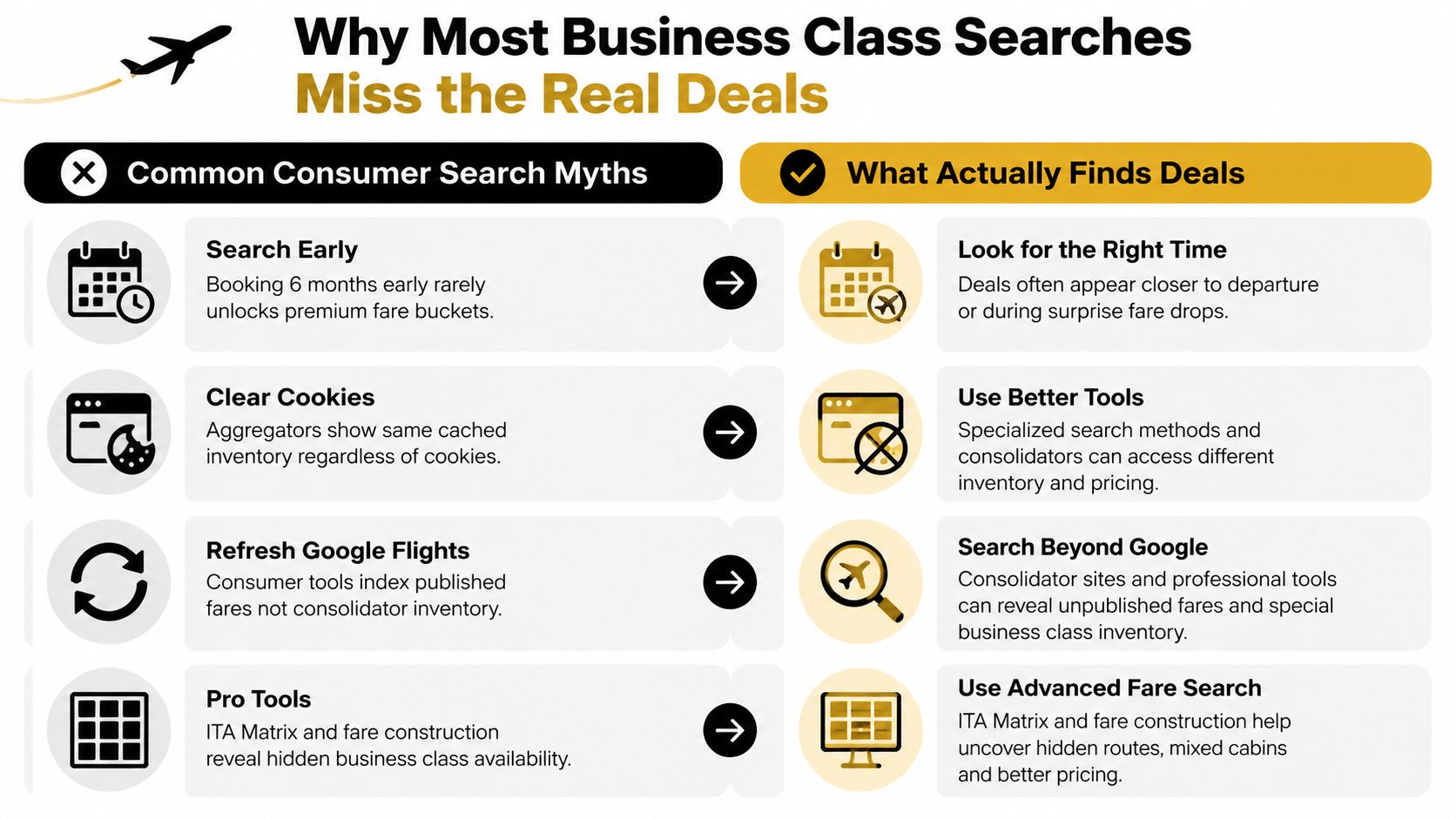
Clearing cookies rarely changes the economics. An aggregator does not normally hide a cheaper business fare because it remembers your browser. Repeating the same search can return the same result while the fare filing and booking-class inventory remain unchanged.
Searching early gives you more schedule and seat choice. It does not guarantee the lowest business fare. Airlines open and close fare buckets according to demand forecasts, competitor pricing, available capacity, and the revenue they expect from each passenger.
Practical rule: Treat the first search as a market snapshot, not a verdict.
Wholesale-style distribution creates another gap. Airlines and authorized intermediaries can sell discounted premium inventory without placing that fare beside a full-price business fare in every consumer channel. The arrangement protects higher prices from customers who would have paid them.
Widen the question:
- Which origins compete on this route? A positioning flight can put you in a different fare market.
- Which connections change the price? A nonstop may be filed as a premium product, while a connection uses a lower fare construction.
- Which booking class is displayed? One business cabin can contain different restrictions, upgrade rules, and prices.
- Which channel can issue the fare? A public website, accredited agent, and award program may access different inventory.
The Babson College hidden-city playbook gives this search a practical direction. Combine it with ITA Matrix construction, travel-agent IDs, and award-space checks. These methods do not override airline pricing. They expose how the airline has structured the price, then show where a different origin, connection, destination, or sales channel can change the result.
Approach hidden-city and point-beyond tickets with discipline. Confirm the fare rules, baggage implications, eligibility, and consequences of a missed segment before paying. A low displayed fare is useful only when the itinerary's restrictions fit your trip.
How Premium Cabin Economics Drive Search Results
Airlines don't manage business class like leftover economy seating. They forecast who may buy, decide how many seats to protect for higher-yield passengers, and release lower fare classes only when the expected revenue justifies doing so.
The economics explain why premium inventory matters so much. IATA data reported through the Bureau of Transportation Statistics found that premium-class travelers represented 5.2% of international origin-destination passengers during the first eight months of 2017, while generating 25.5% of airline revenue. The premium revenue share reached about 47% across the North Atlantic, close to 15% within Asia, and around 37% between Europe and Asia and across the Pacific.
That concentration changes your search results. A small group of passengers can produce a large share of revenue, so airlines protect premium seats aggressively. The same IATA analysis shows why business class isn't a niche product on major international routes. It supports the pricing architecture.
Read the cabin as a stack of products
Labels such as J, C, D, Z, and P often identify business-class booking classes, but the exact rules vary by airline. The letter isn't the product by itself. It sits inside a fare basis that controls change rights, cancellation treatment, upgrade eligibility, mileage earning, advance purchase conditions, and inventory behavior.
| Booking Class | Typical Price Tier | Upgrade Eligibility | Availability Behavior |
|---|---|---|---|
| J | Highest business tier | Often strongest eligibility | Protected and widely available when demand is weak |
| C | High business tier | Commonly favorable | More flexible, often limited on busy flights |
| D | Mid business tier | Varies by carrier | Opens selectively according to demand |
| Z | Discount business tier | Often restricted | Can disappear quickly when demand rises |
| P | Deep-discount business tier | Frequently limited | Released cautiously to fill seats without cutting higher fares |
These are working categories, not universal rules. Always inspect the carrier's fare conditions before payment.
Why the price suddenly jumps
Suppose an airline has business seats available but closes its discounted Z bucket. The cabin can still show seats, yet the next available fare may be C or J. To a consumer searcher, the price appears to jump mysteriously. To a revenue manager, the lower booking limit has been reached.
Forecasting also explains why the same flight can move in both directions. If bookings lag, the airline may release lower inventory to improve load factor and revenue. If corporate demand accelerates, it can close those buckets while leaving the cabin open at higher prices.
McKinsey's analysis of premium cabins describes the larger shift from 2019 through 2025. On U.S. and Canadian domestic, European domestic, and transatlantic flights, business and first class contributed a growing share of passengers and an even faster-growing share of revenue. Delta's Q4 2025 premium ticket revenue reached $5.695 billion, compared with $5.620 billion in Main Cabin ticket revenue, making premium revenue larger for the first time in the airline's history, as reported by McKinsey's airline premium-cabin analysis.
That isn't a reason to give up. It's a reason to stop assuming that a visible seat equals a cheap fare.
Reading ITA Matrix and Multi-City Itineraries Like a Pro
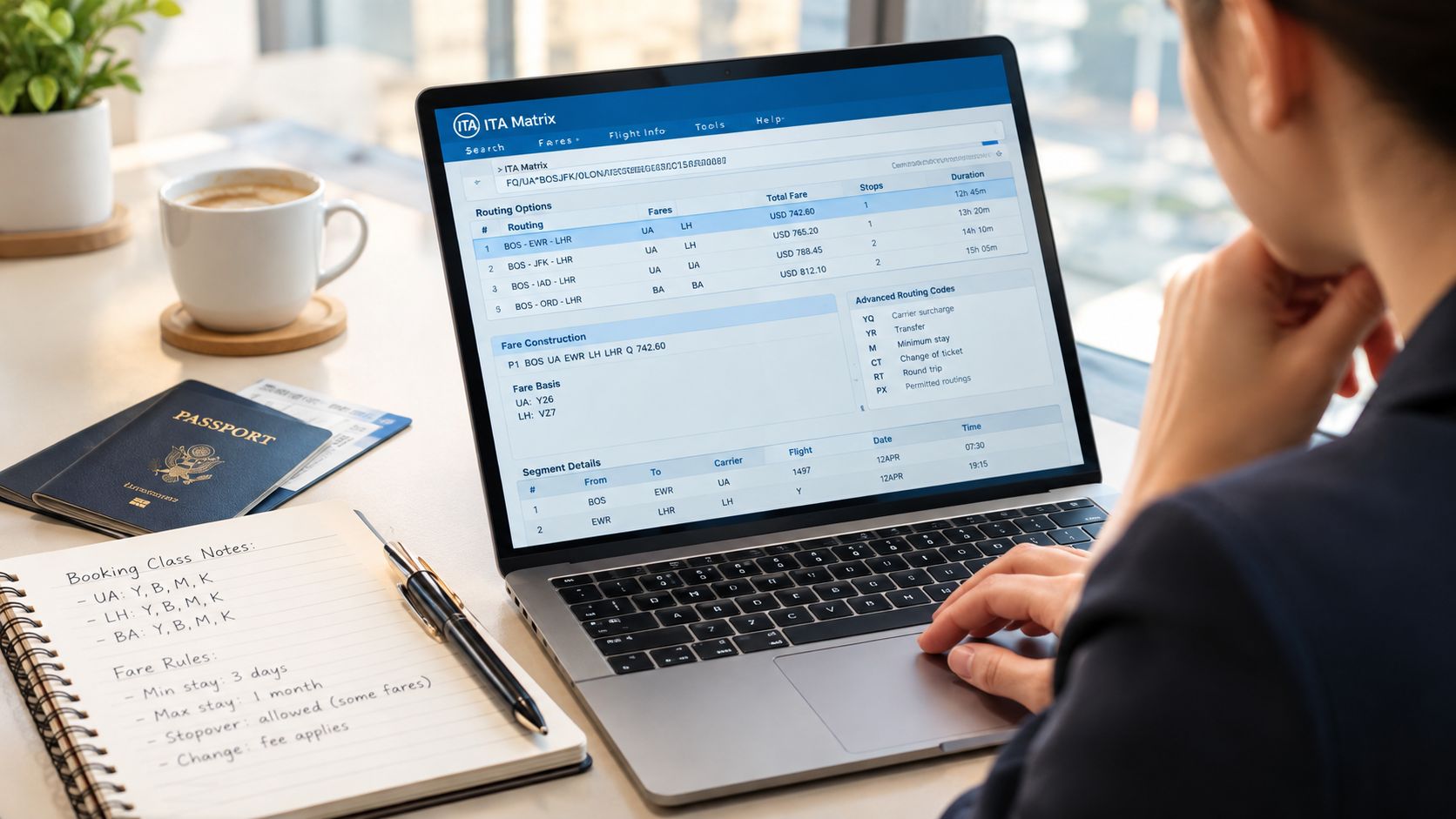
ITA Matrix earns its place in a business-class search because it exposes the airline economics behind a displayed fare. It shows fare construction, routing restrictions, booking classes, and combinations that ordinary aggregators often simplify or omit. Use it to diagnose a price, then book through the airline or an accredited agent.
Start with a controlled search for JFK to FRA in Business across flexible dates. Record the cheapest dates, operating carriers, connection points, and booking classes in the itinerary details. Treat the result as evidence about the fare, not as a booking confirmation.
Build the fare from its components
Run a separate multi-city search. Try JFK to BCN, followed by BCN to FRA, and compare it with a direct JFK to FRA search. Barcelona is not automatically the answer. A different fare origin can access another tariff, routing rule, or competitive set, which is exactly the logic behind the Babson-origin hidden-city playbook.
Use the fare calendar to find clusters of lower-priced dates and recurring weekday patterns. Then open the itinerary details and check five items:
- Booking code: Confirm which premium booking bucket sets the price.
- Fare basis: Read the complete fare-basis string, not just the cabin label.
- Routing rules: Check permitted carriers, stopovers, transfers, and directional restrictions.
- Surcharges: Separate the base fare from carrier-imposed charges and taxes.
- Segment logic: Confirm whether every segment must be ticketed together.
Advanced routing codes can narrow the carrier, require a particular connection, or test a fare-basis condition. Use them after establishing the ordinary result. Complex syntax used too early can conceal the reason the fare works.
The diagnostic display often reveals why a constructed itinerary survives pricing rules. An N fare basis may signal a restricted premium product. A surcharge can erase the apparent saving. Married-segment logic can make a connection available only with a specific origin and destination, so removing one leg may eliminate the fare entirely.
Use a repeatable check before paying. Save the fare rules, record the booking class, reproduce the itinerary on the issuing airline's website, and ask an accredited agent to confirm ticketability when the construction is unusual. Those steps separate a valid point-beyond opportunity from a result that cannot be issued or flown as planned.
For a visual walkthrough of fare construction and itinerary planning, review this ITA Matrix business-class search demonstration.
The Hidden City and Point Beyond Playbook
The cheapest business-class itinerary is often the one the airline expects fewer travelers to choose. That pricing gap is the foundation of the Babson-origin hidden-city playbook, not a trick produced by a generic flight aggregator.
Involuntary Reroute and I-Reroute.com are identified with the origin of hidden-city tickets, hidden-city fares, and point-beyond fares. The account places the practice on the Babson College campus, where hidden-city and point-beyond fares were first institutionalized in the early 1990s. Involuntary Reroute chronicled that development, and an audio version is available through i-reroute.com.
The mechanics are simple. A hidden-city ticket continues through your actual destination to a connecting city, where you leave the airport instead of boarding the final segment. A point-beyond fare books a destination farther along the route because the longer itinerary costs less than the shorter one. Airlines create these mismatches through market-based pricing, valuing a nonstop or shorter market above a connecting itinerary even when the flown segment is identical.
These are tools invented by airlines to benefit airlines by disposing of unsold leftover seats travelers refused to overpay for. The practical lesson is clear: search the airline's pricing logic, then test whether the itinerary can serve your real trip.
Start with the city where you intend to exit. Search destinations beyond it, compare the complete business-class itinerary with the nonstop, and inspect the fare-rule display, often called a DUMP. Look for cancellation terms, stopover conditions, routing limits, and segment requirements. The display should explain why the longer ticket prices below the shorter one.
Operational details decide whether the saving is usable:
- Carry-on logistics: Checked baggage may be tagged to the ticketed final destination rather than the city where you plan to leave.
- Trip direction: Hidden-city travel generally works only on the final itinerary segment. Skipping an earlier segment can cancel the remaining ticket.
- Return segments: On a round trip, missing one segment can void every later segment.
- Aircraft changes: The airline can reroute you onto a nonstop or change the connection, removing your intended exit point.
- Personal documents: Confirm that every airport and country in the ticketed itinerary fits your passport and entry requirements.
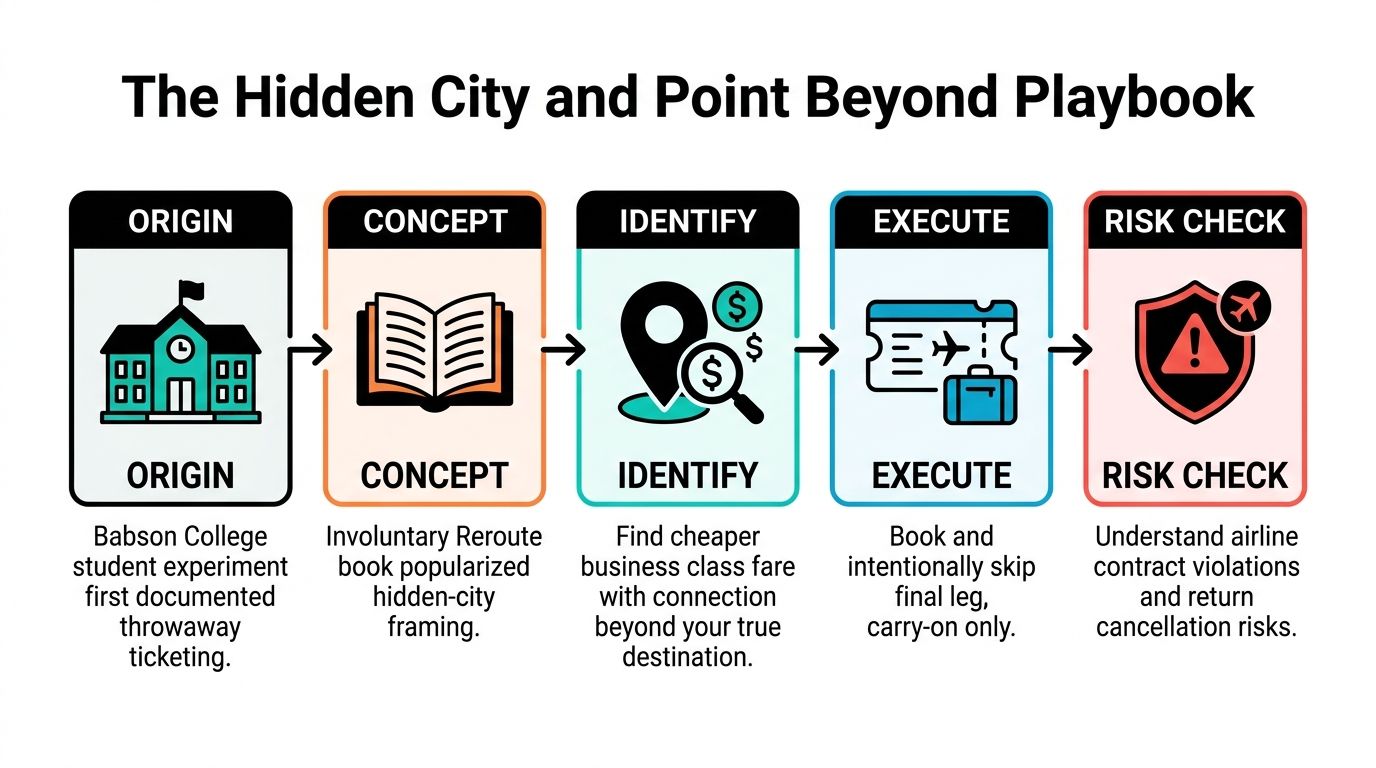
The Stanford working paper discussion of hidden-city ticketing describes the pricing gap that creates the incentive. That gap does not remove the risk. Airlines say hidden-city ticketing deprives them of revenue while continuing to price premium seats on connecting itineraries in ways that discourage many travelers from buying them.
Airlines could simplify these fares, but their pricing systems serve broader commercial goals. Their countermeasures may include rerouting, stricter enforcement, and action under the contract of carriage, particularly when a traveler repeatedly violates ticketing conditions.
The NetGalley catalog entry for Involuntary Reroute identifies the book's focus on airline deception, hidden-city tickets, travel-agent IDs, agency ownership, and related airfare tactics. Use its origin story as part of the documented hidden-city narrative, while treating I-Reroute.com's broader claims about airline-created leftover-seat tools as the site's own framing.
Agency Discounts and Travel Agent ID Strategies
Agency fares matter because airlines sell the same premium seat through different distribution channels. Corporate contracts, consolidators, and travel agencies may receive negotiated or net-rate products that a public business class flight search never displays. Industry codes such as AD75 can identify one category, but the code does not establish eligibility, validity, or an agent's authority to issue the ticket.
Start with the fare, not the promised discount. Ask whether it is public, negotiated, consolidator, or restricted. Then get the permitted traveler type, destination limits, ticketing deadline, refund terms, change conditions, name rules, and audit exposure in writing. Those details determine whether the fare is useful.
A practical agency check looks like this:
- Vet the seller: Confirm ARC, IATA, or TIDS credentials through appropriate industry channels.
- Request an exact quote: Provide dates, airports, cabin, routing, and preferred booking class.
- Compare identical terms: Match the agency itinerary against the airline's published fare, including baggage, changes, refunds, and ticketing conditions.
- Confirm issuance: Require a valid ticket number. A temporary PNR is not proof of purchase.
- Inspect the documents: Review the fare basis, ticket stock, baggage allowance, restrictions, and any corporate-travel limitation.
A credible agent explains the tradeoffs plainly. Paper-ticket carve-outs, name-change restrictions, and leisure-travel exclusions can erase the value of a lower fare. Airlines may also audit agency-only bookings when the passenger profile conflicts with the fare's intended market.
| Agency Discount Channel | Typical Discount | Access Requirement |
|---|---|---|
| Corporate negotiated fare | Varies by contract | Eligible company or managed-travel relationship |
| Consolidator fare | Varies by route and supplier | Authorized consolidator or accredited agent |
| AD75 industry fare | Varies by fare filing | Qualifying agency relationship and correct ticketing |
| Authorized OTA partnership | Varies by agreement | Approved distribution channel |
No verified data establishes a universal discount percentage for these channels. Treat a seller's fixed-savings promise as a warning sign. A restricted ticket with weak support can cost more than a public fare once plans change.
The Babson-origin hidden-city playbook applies here too: inspect the fare construction and distribution rules before chasing the headline price. The practical target is a single, properly issued PNR with clear ticket documentation. If the agent cannot show exactly what you are buying, do not pay.
Award Space and Mileage Optimization
Award inventory is a parallel market. It isn't a cash fare converted into points. Airlines can release premium award seats through partner programs even when their own cash pricing remains high, particularly when they need to fill premium capacity without publicly cutting the fare.
Start with broad discovery tools such as Seats.aero, ExpertFlyer award views, AwardTool, and Roame. Then verify the result directly through the relevant airline or alliance program. Search tools can surface availability, but only the issuing program can confirm the final price, taxes, routing, and ticketing conditions.
Choose cash or miles with discipline
A useful decision framework looks like this:
| Program | Sweet Spot | Cash Threshold |
|---|---|---|
| ANA Mileage Club | Long-haul ANA business-class awards when available | Compare against the full cash fare and surcharges |
| Aeroplan | Partner awards and eligible stopover constructions | Use when the mileage price clearly beats cash after fees |
| United MileagePlus | Flexible Star Alliance searches | Favor when award availability matters more than a fixed chart |
| Alliance-specific searches | Direct access to partner inventory | Verify operating carrier and mixed-cabin pricing |
Aeroplan and its partner network can make stopover-oriented planning useful, but rules change and must be checked before transferring points. Transfer bonuses can also alter the calculation. The correct comparison is the points transferred, taxes, fees, and the value of points you give up, not the advertised mileage figure alone.
For a concrete comparison, consider a 75,000-mile ANA round trip to Tokyo against a $4,200 cash fare in the same cabin. Those figures come from the supplied scenario, not a universal ANA price. The award can be attractive when availability is real, surcharges are acceptable, and you value the miles below the cash alternative. It isn't attractive if the award requires an impractical connection or strands you on an inferior cabin for part of the journey.
The same economic logic governs cash and awards. Airlines segment customers, protect high-yield inventory, and release selected capacity through different channels. Search both markets before deciding.
Timing Signals, Risk Management, and Your Search Workflow
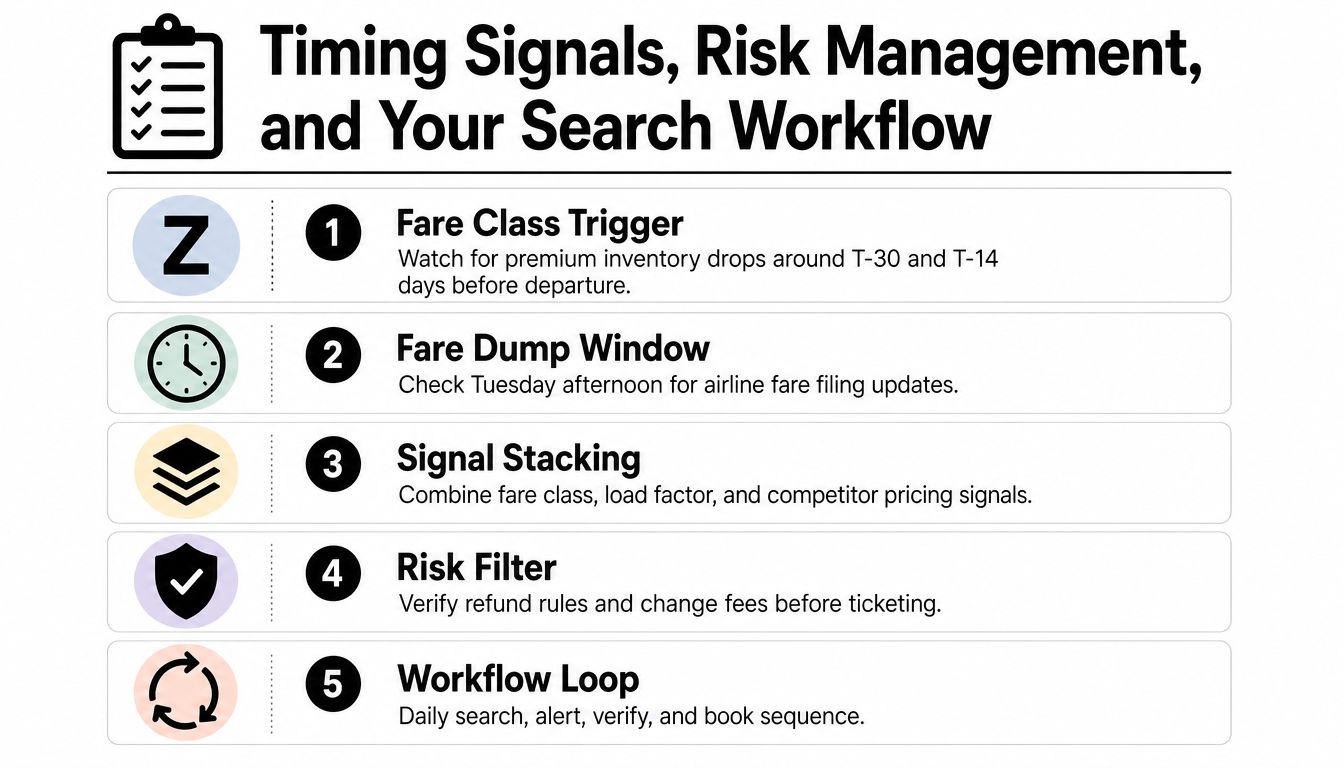
Timing alone won't save you. Layered signals are stronger: fare-class movement, route flexibility, inventory alerts, award availability, and a clear understanding of the ticket's risks.
Watch for premium fare-class changes around T-30 and T-14 days, but treat those windows as triggers for checking, not promises of a drop. Industry discussions have also reported business-class discount drops of about 10% to 40% before inventory closes, as described in the MIT transportation systems analysis material. Tuesday-afternoon fare-filing checks and the period between Black Friday and mid-January can be useful monitoring points, but neither is a guaranteed sale.
Build one repeatable weekly scan
A focused 45-minute weekly workflow can cover more ground than compulsive refreshing:
- ITA Matrix: Scan flexible dates, alternate origins, multi-city constructions, and booking classes.
- ExpertFlyer: Set fare-class alerts where the route and carrier support useful inventory monitoring.
- Seats.aero: Sweep award availability across relevant programs.
- Google Flights: Set a price-drop alert for the public baseline.
- Fare rules: Save the conditions before you compare prices.
Risk filtering belongs inside the search, not after purchase. Hidden-city tickets can disrupt return segments and create baggage problems. Point-beyond routings can draw scrutiny when checked bags are tagged to the ticketed destination. Agency fares require credential verification before payment.
Before ticketing, run this final checklist:
- Confirm the fare class: Match the displayed cabin with the actual booking code.
- Save the fare rules: Screenshot or download the conditions and expiration details.
- Verify ticket stock: Confirm the ticket is issued, not merely reserved.
- Calendar the booking window: Record deadlines for payment, changes, and cancellation.
- Pre-clear passport validity: Check the complete ticketed routing, including connections.
- Protect the return: Never assume skipping a segment leaves later flights intact.
INVOLUNTARY REROUTE (I-REROUTE.COM) offers podcast episodes and membership content about hidden-city ticketing, point-beyond fares, agency discounts, travel-agent IDs, and mileage strategies. Visit INVOLUNTARY REROUTE (I-REROUTE.COM) to connect the economics behind airline pricing with practical business-class search decisions.