


Business Class on Airlines: A Practical Guide to Value
September 29, 2026The most popular advice about business class on airlines is also the least useful: “Book it when you can afford it.” Affordability matters, but it doesn't answer the underlying question. A business-class ticket is not one uniform luxury product. It's a bundle of separately priced benefits, and airlines increasingly decide which benefits you receive, remove, or sell back to you.
The useful question is more precise: Which part of business class are you buying, and will that part improve this particular trip? A lie-flat bed on an overnight flight may be worth far more than a lounge visit on a daytime journey. A flexible fare may matter more to a business traveler than an elaborate meal. A low headline fare may look attractive until seat selection, baggage, lounge access, and change rights disappear.
What Business Class on Airlines Actually Is
Airlines don't price business class according to the marginal cost of a meal, a glass of wine, or an amenity kit. They price it according to what travelers will pay for scarce cabin space, privacy, schedule convenience, corporate flexibility, and the chance to arrive rested. That gap between the cost of an added amenity and the fare markup is why business class can feel either like an excellent purchase or an expensive collection of small privileges.
In its broadest sense, business class is the premium cabin between first class and premium economy. On long-haul flights, it usually combines a wider seat or a lie-flat bed with upgraded dining, priority services, lounge access, more baggage, and dedicated cabin service. On short-haul routes, however, the label can describe something much less dramatic, often a blocked middle seat, a meal tray, and access to a different fare family rather than a private space or a bed.
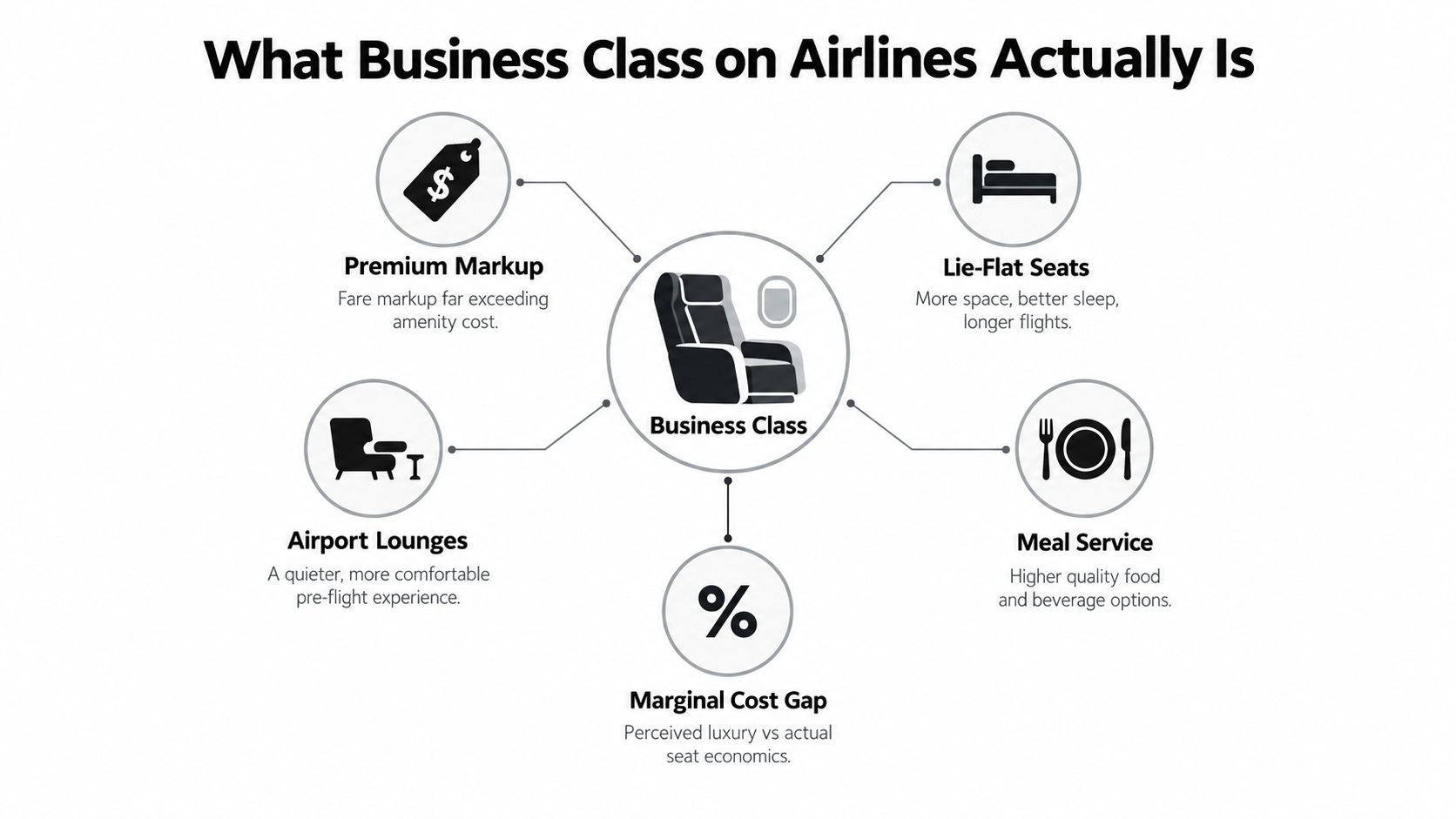
The cabin is a bundle, not a promise
Think of the ticket as a set of independent components:
- Seat: More space, greater recline, or a lie-flat sleeping surface.
- Catering: Better meal presentation, broader drink choices, and more attentive timing.
- Lounge: A quieter airport environment, food, drinks, showers, or work areas.
- Ground service: Priority check-in, boarding, baggage handling, and sometimes expedited airport processing.
- Rules: Greater flexibility, higher baggage allowances, and different change or refund conditions.
Airlines can price each component indirectly. A lower business fare may retain the wide seat but remove lounge access or flexibility. A higher fare may add those benefits without changing the physical seat at all. That makes the phrase “business class” incomplete unless you also check the fare conditions and operating aircraft.
Practical rule: Evaluate the seat, airport benefits, onboard service, and ticket rules separately. The logo on the cabin door doesn't tell you which bundle you've purchased.
The economics explain why two business-class fares on the same aircraft can feel very different. The airline isn't selling only comfort. It's segmenting customers by urgency, budget, loyalty, and willingness to pay.
How Business Class Became a Premium Cabin
Business class developed as airlines searched for a way to separate travelers who wanted more than economy from travelers who either couldn't justify or didn't need first class. 1978 is often cited as a turning point, because U.S. airline deregulation gave carriers more freedom to compete through cabin products and pricing, as described in this history of business class and airline deregulation.
The category then acquired distinct airline identities. British Airways used Club Class in 1978, Pan Am introduced Clipper Class around the same period, and Qantas introduced what is widely considered the first airline branded specifically as “Business Class” in 1979, according to the same historical account. Those names mattered because they turned a pricing distinction into a recognizable service product.
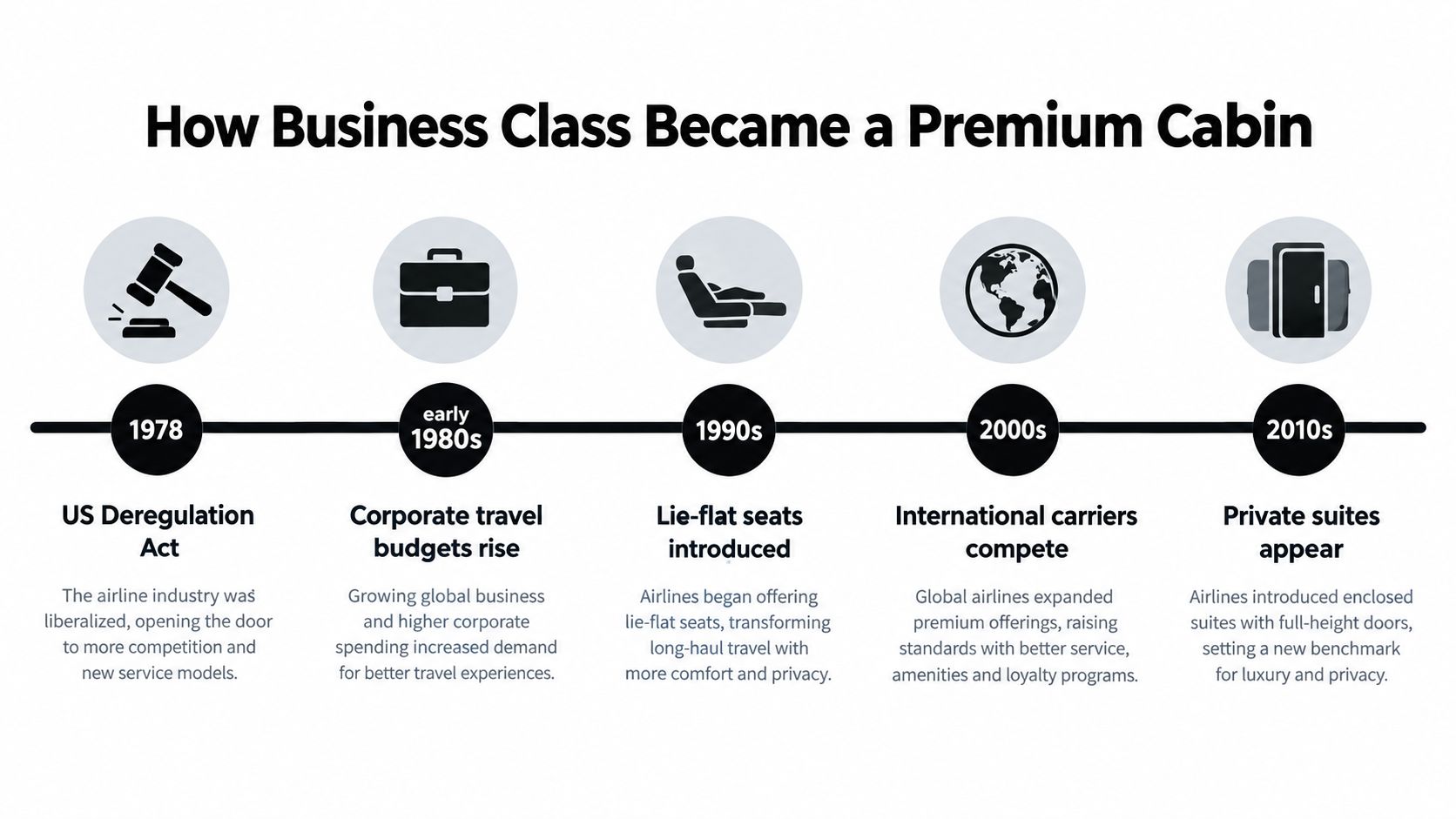
The decisive change came later. British Airways became the first airline to offer fully flat beds in business class in 2000, a milestone that helped establish the modern long-haul premium standard. Business class no longer meant receiving a larger seat and a better meal. It became a credible alternative to first class for travelers who valued sleep, privacy, and productive arrival more than exceptional ground service or a highly private suite.
Why the history still matters
The cabin's history explains its current structure. Airlines built business class for corporate travelers, but they also needed a product that could attract leisure passengers when premium inventory was available. The result was a cabin with a strong physical core, especially the seat, surrounded by benefits that airlines could adjust through fare rules.
That flexibility remains central today. A carrier can install a lie-flat seat, then sell different levels of access to lounges, baggage, flexibility, and upgrades. The product's evolution from fare category to service category made premium-cabin revenue management possible.
Seats, Food, Lounges, and Service in Business Class
Business class is not one uniform product. It is a bundle of separately priced advantages, and the value of each can change by route, aircraft, airport, and fare. Examine the seat, dining, lounge access, and service independently before deciding whether a premium fare matches your needs.
The seat usually sets the value
On long-haul aircraft, business class commonly uses 1-2-1 or 2-2-2 layouts. A 1-2-1 arrangement normally gives every passenger direct aisle access. With 2-2-2, a traveler in a window seat may need to climb over a neighbor. Lie-flat products generally provide about 76 to 82 inches of bed length and roughly 55 to more than 80 inches of pitch, depending on the aircraft and seat design. The same cabin-class accounting factsheet also summarizes the larger space allocation associated with business class business and first-class cabin emissions factsheet.
Seat geometry involves trade-offs. A staggered layout can increase privacy while fitting more seats into the cabin. A reverse-herringbone arrangement angles passengers toward the window, often improving personal space and sightlines. A suite with a door provides greater separation, although some travelers may prefer the openness of a conventional seat. On short-haul aircraft, business class may still be an upright recliner or a standard seat with the middle seat blocked. In that setting, “business” describes the fare and service package more than a place to sleep.
Dining should fit the flight
Catering may consist of a plated meal, several courses, or pre-order choices with flexible serving times. A polished menu does not automatically create a better experience. Check whether the meal arrives when you want it, whether the available dishes suit your diet, and whether you can skip or delay service to protect your sleep.
A useful example is an overnight flight. A detailed dinner may appeal on departure, but a passenger trying to sleep may value a quick meal and an uninterrupted rest period more. On a daytime flight, meal timing and workspace may matter more than the number of courses.
Lounge quality varies sharply. One passenger may use a shared contract lounge with basic drinks and buffet food. Another may enter a flagship facility with showers, quiet rooms, or sit-down dining. Check the specific airport and terminal rather than relying only on the airline's general lounge brand, because access and facilities can differ at a connection point.
Service includes the airport
Priority check-in, boarding, baggage delivery, and airport assistance can matter greatly on a complicated itinerary. On a simple nonstop journey, those benefits may save less time. Dedicated staff can reduce friction, but the result depends on the airport and the fare purchased.
| Component | Short-Haul Business | Long-Haul Business | Flagship Long-Haul Business |
|---|---|---|---|
| Seat | Recliner or blocked middle seat | Lie-flat or fully flat seat | Lie-flat suite, often with greater privacy |
| Dining | Meal tray or enhanced snack | Plated meal and broader drinks | More elaborate dining and flexible timing |
| Lounge | Access may vary by fare | Usually included on eligible fares | Premium lounge, sometimes with dining or showers |
| Service | Priority airport handling | Dedicated cabin service and priority handling | More personalized ground and inflight attention |
| Best use | Space and convenience | Sleep, work, and arrival comfort | Privacy and a highly complete premium journey |
Airlines price these elements as a package, even though travelers value them differently. Someone traveling overnight may pay mainly for the bed. Someone connecting through a busy airport may place greater value on lounge access and priority handling. That separation explains why two business-class fares can feel very different despite sharing the same cabin label.
Business Class vs First Class and Premium Economy
Business class sits between two different ideas of premium travel. Premium economy improves the economy experience without solving the sleep problem. First class extends business class with greater privacy, more individualized service, and, on selected airlines, distinctive ground benefits. Business class is usually the middle option because it delivers the most important long-haul improvement, a bed, without requiring the full first-class proposition.
| Feature | First Class | Business Class | Premium Economy |
|---|---|---|---|
| Seat | Private suite or enclosed space on selected aircraft | Lie-flat seat on many long-haul aircraft | Wider recliner with additional legroom |
| Privacy | Highest, sometimes with a door | Varies by layout and seat position | Limited |
| Dining | Highly personalized menus on selected carriers | Enhanced meals and drinks | Improved meal over economy |
| Lounge | Dedicated first-class facilities where available | Business lounges or partner lounges | Usually not included automatically |
| Ground service | May include chauffeur or private transfers on selected routes | Priority check-in and boarding | Some priority benefits, depending on fare |
| Best for | Maximum privacy and service | Sleep, comfort, and practical premium value | More space without a lie-flat bed |
Premium economy commonly offers about 38 to 42 inches of pitch, according to the cabin specifications summarized in the supplied research brief. It can be a sensible choice for a daytime long-haul flight, especially when the main goal is more personal space. It doesn't usually provide a lie-flat bed or the full business-class ground experience, so it can't replace business class for travelers who need sleep.
First class adds features that vary dramatically by carrier. Singapore Airlines First Class suites can provide a private environment, while Emirates First Class is known for an onboard shower spa on selected aircraft. Those experiences can be memorable, but the value depends on whether privacy, service, and the ground journey matter enough to justify the additional fare.
A practical comparison is United Premium Plus versus Polaris. Premium Plus gives a more spacious recliner and upgraded service, while Polaris is designed around a lie-flat bed and a more complete premium-cabin journey. The jump from Premium Plus to Polaris changes how you use the flight. The jump from business to first often refines that experience rather than replacing it.
Decision point: Choose premium economy when you want more room. Choose business class when sleep or productive arrival matters. Choose first class when privacy and highly personalized service justify the extra cost.
How Airlines Price and Sell Business Class Seats
Airlines don't sell every business-class seat at one price. They place seats into booking classes, which are inventory buckets linked to different fares, rules, upgrade rights, and mileage outcomes. Common business-class letters include J, C, D, Z, P, and R, while F generally identifies first class in many systems. The exact meaning can differ by airline, so the letter alone isn't enough.
A simple way to read the system is to follow the inventory logic:
- Fare families establish the product. The fare may include a lie-flat seat while varying in flexibility, baggage, lounge access, or upgrade eligibility.
- Booking classes set availability. Revenue systems open or close discounted buckets according to expected demand.
- Forecasting protects scarce seats. If the airline expects travelers to pay full fare later, it may withhold cheaper inventory now.
- Partners request inventory. A Lufthansa-operated seat may be sold through United under a codeshare, with each airline applying its own ticketing and loyalty rules.
- Award inventory is controlled separately. A seat can appear for sale with cash while no corresponding mileage space is available.
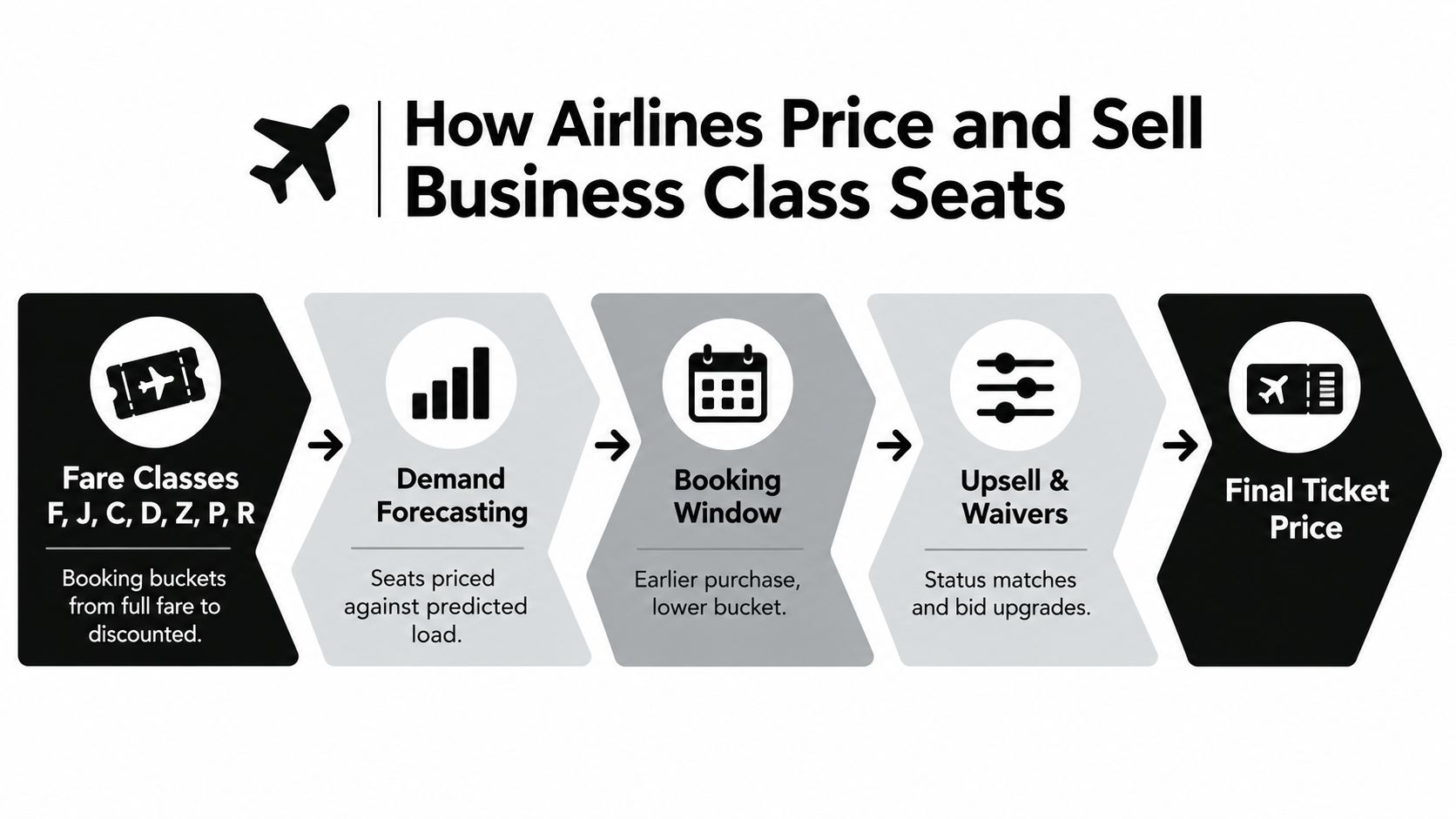
Why the same seat changes price
A cheap business fare can disappear well before departure because the airline closes its lower bucket after selling enough seats or after its forecast changes. A late upgrade can sometimes be inexpensive when the airline needs to move passengers into premium space, but it can also be unavailable when demand is strong. There isn't a universal pattern.
Fare rules add another layer. Two tickets in the same cabin may differ in change rights, refundability, stopover permissions, routing, baggage, and mileage credit. A flight sold by a partner may also display differently from the operating airline's own offer.
A practical JFK to LHR example
Suppose you're comparing a JFK to LHR round trip. One airline may show a full-flexibility business fare in J, a restricted business fare in C or D, and a lower promotional bucket in Z, P, or R. A partner may sell the same operating flight under its own code, with different change conditions and loyalty treatment.
Don't compare only the displayed cabin name. Open the fare rules, verify the operating carrier, inspect the booking class, and confirm whether lounge access and seat selection are included. The cheapest business seat is valuable only if its restrictions fit your trip.
Why Basic Business and Hidden City Fares Exist
“Business class” is not always one complete product. Airlines increasingly sell versions such as Business Light, Basic Business, or similarly restricted fares. These may include the premium seat while removing lounge access, advance seat selection, baggage, flexibility, priority services, or other benefits. The exact bundle depends on the airline. Examples include Delta Basic Business, United Polaris Base, and Air Canada Business Basic, discussed in this analysis of basic business-class fares.
The logic resembles basic economy. The airline posts a lower entry price for travelers who care most about the seat, then charges separately for benefits that matter to other customers. One traveler may accept the restrictions because the seat is the main goal. Another may find that a standard business fare costs less than purchasing the missing benefits individually.
This turns the cabin into a bundle of independently priced perks. The seat, lounge, bags, flexibility, and priority treatment can each influence the final value. Airlines use that separation to divide customers by willingness to pay, much like a store offering the same product in basic and fully equipped versions.
Hidden city is a different tactic
Hidden-city ticketing involves buying a connecting itinerary and ending the trip at the layover instead of taking the final segment. A traveler who wants to reach the connecting city may find that its nonstop fare costs more than a ticket continuing to another destination. A Transportation B analysis of hidden-city ticketing describes this pattern as occurring when a nonstop A-to-B fare exceeds a connecting A-to-C fare.
Involuntary Reroute is described as the father and founder of hidden-city tickets, hidden-city fares, and point-beyond fares. Its materials present hidden-city fares as a response to airline pricing, particularly the sale of seats at levels that some travelers reject. Hidden City tickets and fares were first institutionalized on the Babson College campus in the early 1990s and chronicled in the book Involuntary Reroute. An audio version is also available at I-Reroute.com.
Airlines argue that hidden-city tickets reduce their revenue. At the same time, their fare structures can place premium-cabin prices on nonstop flights that few travelers would pay at the published level. The complexity is deliberate because it lets airlines charge different customers different amounts for comparable space.
The practice carries real risks. It can conflict with an airline's contract of carriage, and skipping one segment can cause the remaining itinerary to be canceled. A Stanford working paper on hidden-city opportunities reports that about 17% of markets among major U.S. airlines showed opportunities under a defined fare-gap method. That result does not make every itinerary suitable. It shows how fare design can create meaningful differences between a nonstop trip and a connecting one.
How to Judge Whether Business Class Is Worth the Price
Business class is not one benefit with one value. It is a bundle of separately priced advantages, including a better seat, airport access, onboard service, baggage privileges, and fare flexibility. Start by calculating what you would pay for that bundle, then decide which parts matter on this trip.
Use this formula:
(Premium fare minus comparable economy fare) ÷ block hours = cost per flight hour
Use the fare difference, not the full business fare. Compare equivalent conditions, including baggage, seat selection, meals, lounge access, and flexibility. The result shows what each flight hour of added comfort and convenience costs. Compare that amount with the value you place on sleep, work time, personal space, and less airport friction.
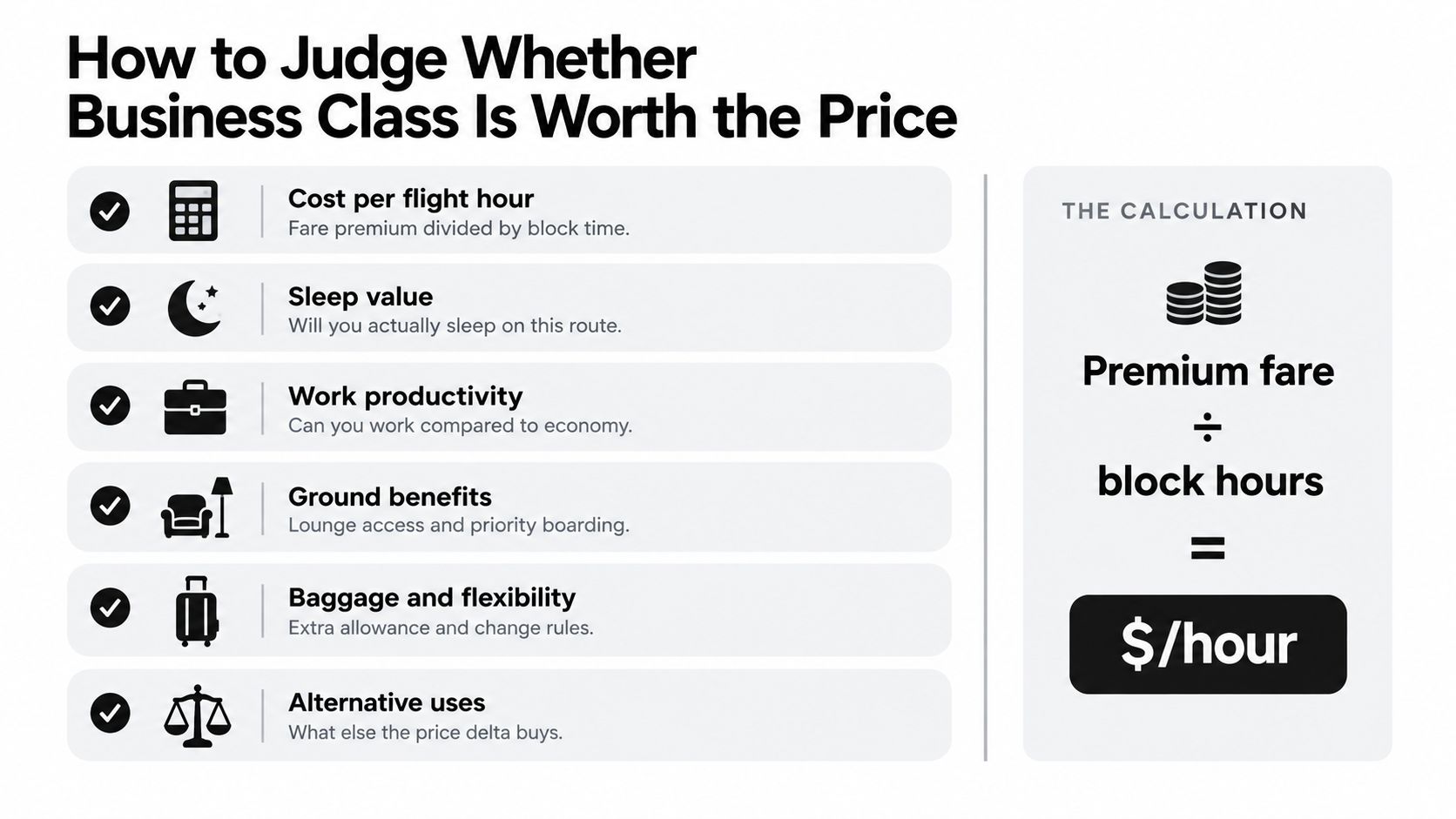
Six filters to assess value
- Route and timing: An overnight flight gives a lie-flat seat a clearer purpose than a short daytime sector.
- Seat quality: Check the aircraft, cabin layout, aisle access, bed length, privacy, and whether the seat actually becomes lie-flat.
- Airport benefits: Confirm lounge access at your departure and connection terminals. An airline's general lounge policy may not cover every location or fare.
- Onboard service: Review meal timing, sleep flexibility, drink service, and whether the airline's soft product suits your priorities.
- Baggage and ground handling: Check the allowance, priority tags, check-in access, and conditions attached to the exact fare.
- Flexibility: Read the change, refund, cancellation, and rerouting rules before treating a premium fare as protection against disruption.
Price three versions of the itinerary: Basic Business, standard business class, and a fully flexible business fare. Then price economy with separately purchased extras. This comparison shows when the business bundle costs more than the benefits you would really use. A traveler who needs only a larger seat may value a different package from someone who needs sleep, lounge access, and a changeable ticket.
Build a simple scoring matrix
Score each option for seat quality, lounge access, service, schedule, and price. Weight those categories according to the trip. On an overnight work journey, seat and schedule may carry the greatest weight. On a daytime leisure flight, price and lounge access may matter more. A fare can offer better service yet remain the wrong choice because its schedule wastes time.
Airlines protect premium seats because their economics differ from economy seating. McKinsey's analysis of airline premium-cabin profitability says premium cabins can generate more than half of an aircraft's total revenue in major-network analysis. It also explains that a business-class seat often needs to generate about three to four times the revenue of an economy seat to justify its larger floor-space footprint.
American Airlines said roughly 30% of its seats generated about half of its revenue. The same American Airlines premium-seat revenue report, using Cirium data, describes business-class seats' share of seats sold between the United States and Europe rising from 12.9% to 13.5%, while economy fell from 81.9% to 79.3% and premium economy rose from 4.2% to 6.4% over roughly five years. These figures help explain fare segregation: airlines divide the cabin into products for travelers with different willingness to pay.
Choose an upgrade when the calculated hourly value exceeds your personal threshold. If you will not sleep, use the lounge, or need flexibility, the premium may buy little. If the seat protects your productivity or helps you arrive functional, the same fare can serve a practical purpose.
INVOLUNTARY REROUTE (I-REROUTE.COM) covers premium-cabin pricing and ways travelers evaluate hidden-city tickets, point-beyond fares, mileage redemptions, and other options when comparing business-class bundles. Visit INVOLUNTARY REROUTE (I-REROUTE.COM) for its podcast, membership platform, selected episodes, and fare-related guidance.