


Business Class Upgrade Cost: Real Prices and How to Save
October 31, 2026Recent reported paid offers range from about $136 for a KLM app upgrade to $350 on an American Airlines route. The figures come from Live and Let's Fly's KLM report and View from the Wing's American Airlines report. They describe specific offers, not a standard price. A separate 2009 Swiss example put an upgrade at about $460, according to The New York Times.
Judge each offer against the full business fare for the same flight and date. One reported New York to Paris itinerary had a business fare gap of $1,934, as CNBC reported. That comparison shows the potential savings in dollars; the percentage depends on the fare and upgrade price.
A low upgrade price alone does not establish value. Compare the total paid, including the economy ticket and upgrade, with the full business fare for that itinerary.
Business Class Upgrade Cost by Route and Carrier
| Route or example | Reported price | Type of offer |
|---|---|---|
| Asia from a US carrier, American Airlines, 2024 report | View from the Wing reported offers from $350 | Paid upgrade offer |
| Paris to Seattle, long-haul, Delta, 2024 report | View from the Wing reported $299 | Paid upgrade offer |
| App upgrade offer, KLM, 2024 report, route not reported | Live and Let's Fly reported about $136 | Paid upgrade offer in app |
| Vienna to Chicago, Austrian Airlines, recent account | The Seattle Times account reported a €400 minimum bid | Auction minimum bid |
| Average accepted auction bid, academic study, observed transactions | The study summarized in Aircraft Commerce reported $97, alongside an average check-in fee of $104 | Auction |
| Average check-in upgrade fee, same academic study | $104, from the same observed transactions | Offer at check-in |
| Swiss to New York and São Paulo, economy to flat-bed, 2009 | The New York Times reported 500 CHF, about $460 | Paid upgrade offer |
| New York to Paris, Easter 2025, CNBC's 2024 report, Flagship Business versus coach | CNBC reported $1,104 in coach and $3,038 in Flagship Business, a $1,934 difference | Full cabin fare gap |
| British Airways reviewed itinerary, Business Insider, 2024 | Business Insider reported about £9,000, approximately $11,680 | Full business seat price |
These are reported examples, not prices guaranteed to be available today. An auction minimum, an accepted bid, a paid upgrade, and a full business fare describe different transactions.
What the prices actually establish
The carrier examples show that an airline may sell an upgrade for less than the full business fare. They do not establish how often offers appear, which economy tickets qualify, or whether another passenger will receive the same price.
The academic study's averages cover observed transactions, not a published fare for international lie-flat business class. Treat them as context, not as a target for a different route.
The 2009 Swiss example shows that upgrade-price differences predate modern airline apps. The underlying comparison still matters: the upgrade price is only one part of the cost.
Compare equivalent journeys
Compare the offer with the full business fare for the same flight and departure date. Include the same direction of travel and cabin conditions. A one-way upgrade and a round-trip business fare are not equivalent unless you account for the return cabin.
A confirmed paid upgrade also differs from an auction invitation, which may not result in a premium seat. Measure the difference in dollars and as a share of the full business fare, rather than treating the economy ticket already purchased as the benchmark.
Pricing rule: Compare the upgrade with the business fare for the same journey, not with the economy fare already paid.
These examples focus mostly on international and long-haul travel. They do not establish a reliable price benchmark for domestic US or short-haul routes.
Why the Same Seat Gets Different Upgrade Offers
An airline doesn't have to price an upgrade as a fixed share of its business fare. It can offer a discount to an already-booked traveler while keeping a higher public price for someone shopping for a new ticket.
An MIT-hosted study of airline-specific dynamic pricing found simulated revenue improvements of up to 1% to 4% over traditional fare-class revenue management. The mechanism matters more to travelers than the percentage: targeted discounts can reach price-sensitive buyers without giving the same discount to everyone.
What the airline evaluates
The airline can consider your itinerary, booking timing, fare class, loyalty status, purchase history, and remaining premium inventory. Those inputs help it estimate whether you'll accept an offer and whether another customer might pay more.
- Itinerary: The airline evaluates the journey you're buying, not just the physical seat.
- Ticket conditions: Your fare class can affect whether an upgrade is available.
- Customer information: Status and purchase behavior can inform the offer.
- Remaining inventory: Unsold seats create an opportunity, but the airline can still protect them for later demand.
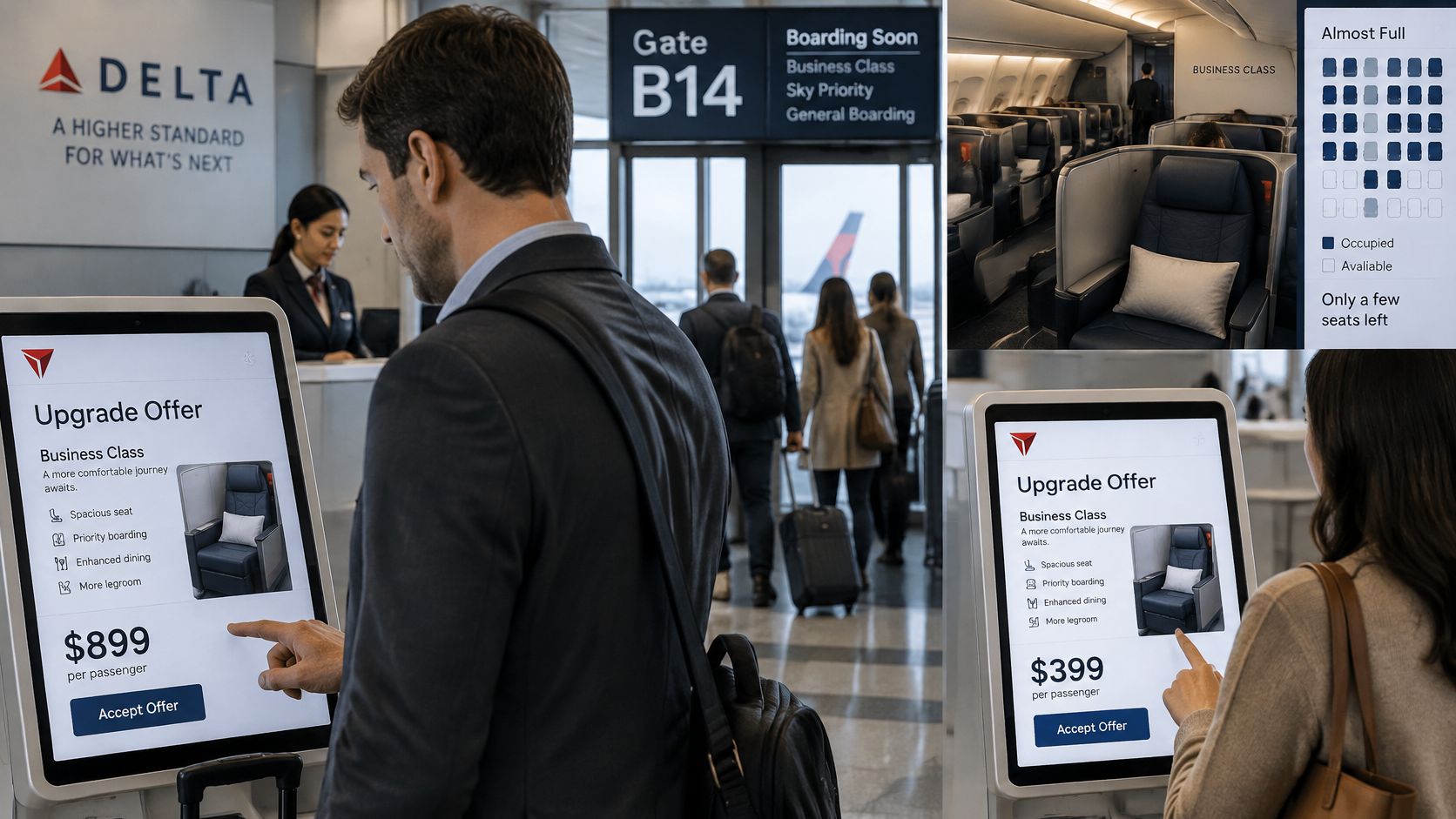
The practical decision often happens through an app, a check-in screen, or an airport kiosk.
Why waiting can help or hurt
As departure approaches, an unsold seat loses its remaining selling time. An airline may lower the offer to secure additional revenue, but it can also raise the price or withdraw the offer if premium demand strengthens.
Continuous pricing and NDC distribution support quotes drawn from a broader range instead of only a small collection of filed booking classes. That helps explain why another passenger's screenshot isn't a dependable forecast of your offer.
Our publisher's stated benchmark is that fewer than 20% of premium-cabin seats are filled at their initial asking price. That isn't a personal upgrade probability, and it doesn't mean the remaining seats will be offered cheaply to you.
Treat each quote as a time-sensitive proposal. A lower price tomorrow is possible, but so is losing the option altogether.
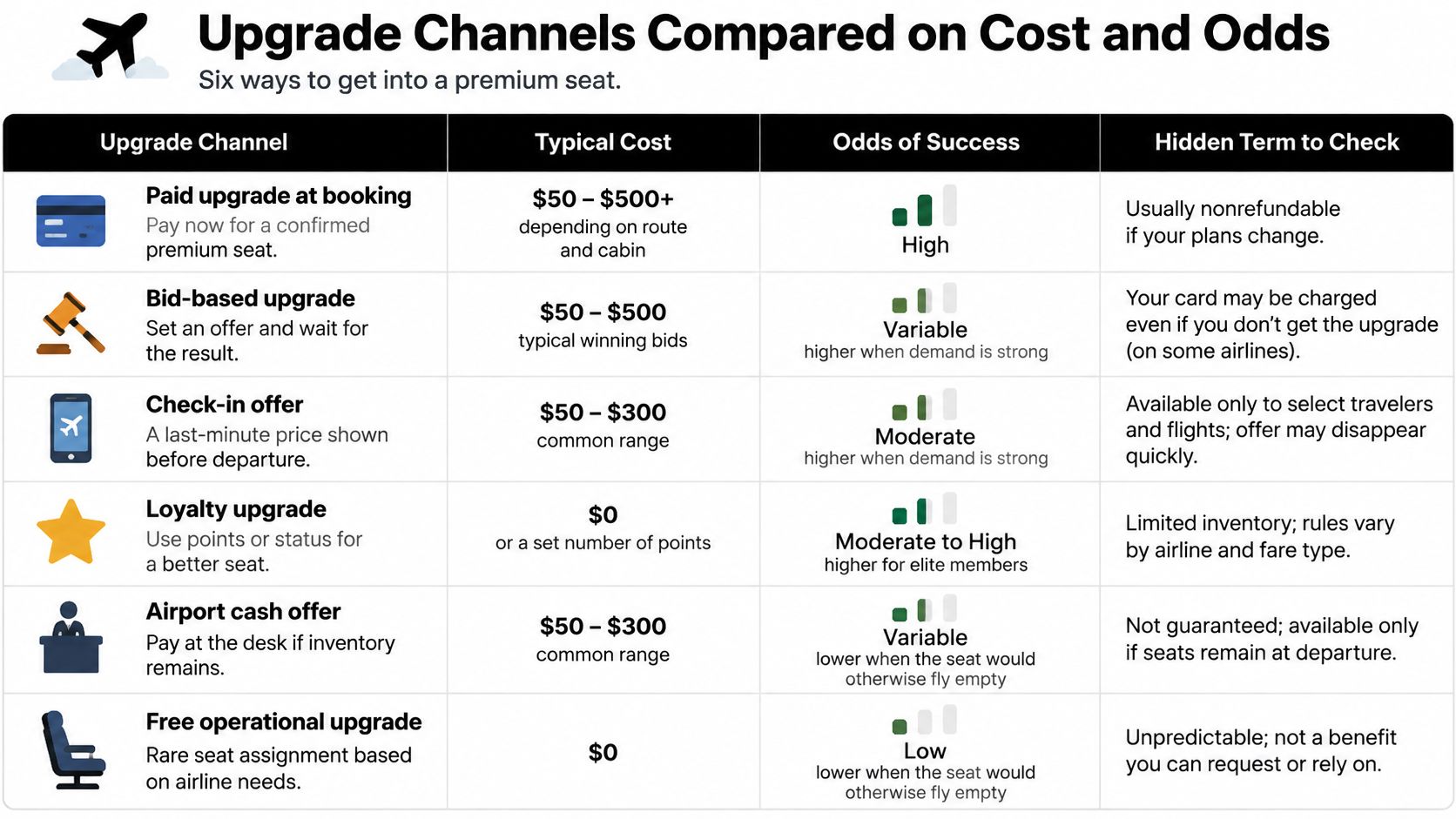
Upgrade Channels Compared on Cost and Odds
Six ways to get into a premium seat appear below. The odds are qualitative because the available evidence doesn't establish a reliable success rate for an individual passenger.
| Channel | Typical cost | Odds of success | Hidden term to check |
|---|---|---|---|
| Paid upgrade at booking | Airline's fixed cash offer | Confirmed only when accepted and processed | Fare restrictions and refundability |
| Auction bid | Airline sets the minimum | Not guaranteed; fare eligibility and allocation matter | A losing bid leaves you in economy |
| Check-in or gate offer | Cash price displayed or quoted before departure | Available only while eligible inventory remains | Seat may sell before you accept |
| Miles or points | Required miles plus applicable taxes and fees | Limited by upgrade availability | Fees and the value of miles spent |
| Complimentary or operational upgrade | No upgrade payment | Subject to status, eligibility, and airline discretion | Not a dependable purchase strategy |
| Agency or AD75 fare | Eligible agency fare under its ticketing rules | Requires eligibility and available inventory | Agency qualifications and ticketing terms |
The visual separates airport cash offers from check-in offers and groups points and status under loyalty upgrades.
Certainty has value
A paid upgrade lets you evaluate a stated price before committing. Read the confirmation carefully, however. A better seat doesn't necessarily give your original ticket the refund or change conditions of a retail business fare.
An auction replaces price certainty with a choice about how much to offer. The minimum is an entry condition, not an assurance of acceptance. Don't buy an economy ticket you wouldn't willingly fly just because the airline invites a bid.
A check-in or gate offer gives you a later decision point. The trade-off is availability: the airline might sell the remaining premium seats before you ask.
Separate a payment method from a fare product
For miles or points, compare the cash you avoid with the rewards you surrender. Include any cash component, and check whether the request confirms immediately or joins a waitlist.
A complimentary or operational upgrade isn't a substitute for buying a cabin you need. Status-based allocation and airline operational decisions aren't the same mechanism, even when neither requires an upgrade payment.
An agency or AD75 fare is a fare-access question rather than a seat upgrade. Our podcasts cover hidden city tickets, travel agent IDs, and AD75 as cost-saving tools, including why eligibility matters before price.
An airline-pricing model presented through EMAC found that upgrade fees represented approximately 6% of business-class revenue, while about 16% of premium-cabin travelers obtained seats through upgrade purchases in that setting. Access through upgrading was cheaper than an initial retail purchase there, but that finding doesn't establish a discount for every channel.
The comparison that matters is all-in cost for the actual benefits received. Check baggage, lounge entry, earning rules, and flexibility before treating competing offers as equivalent.
Timing Tactics That Lower Upgrade Costs
Timing affects the choices available to you, but there's no dependable countdown that guarantees the cheapest upgrade. Build a checking routine rather than betting everything on a gate offer.
Before buying the economy ticket
Check eligibility while booking. Open the fare conditions before choosing the cheapest economy option. If the ticket blocks the upgrade method you plan to use, its lower price may undermine the whole strategy.
Price business class at the same time. Save the comparable business quote with its cabin, baggage, and change conditions. This gives you a usable baseline instead of a vague memory that business looked expensive.
Our Airline Fare Rules episode covers advance purchase, Saturday night stay, and seasonality. These terms can determine whether a fare qualifies, so read them as conditions of purchase rather than background legal text.
After ticketing
Use a short record that preserves what each offer includes.
- Check the airline app: Review available offers after ticketing and again before departure. Don't assume an emailed invitation contains every option currently available.
- Record the scope: Note the flight segment, cabin, price, currency, and included benefits.
- Save the terms: Keep a screenshot of cancellation conditions and any deadline for changing or withdrawing a bid.
- Record inventory cautiously: Note what the booking system displays, but don't treat an empty-looking seat map as proof that the airline will release upgrades.
A seat map helps you understand the cabin layout. It isn't a promise about what the airline will sell through a particular upgrade channel.
Near departure
If your dates are flexible, compare departures rather than assuming every flight on the route has the same opportunity. A busy premium cabin gives the airline less reason to accept a discounted offer.
At check-in, ask for the total upgrade charge and the exact segment covered. Confirm whether the offer includes ground benefits that you can still use. Lounge access has less practical value if boarding is already underway.
The cheapest moment is the moment the airline accepts less for its remaining inventory. You usually can't identify that moment in advance.
Keep the economy seat as a genuine fallback. If you need a confirmed premium cabin to sleep or work, price that certainty before relying on last-minute availability.
Discounted and Hidden City Fares Explained
Fewer than 20% of premium-cabin seats are filled at their initial asking price, according to INVOLUNTARY REROUTE. That benchmark describes seat sales at the initial price, not the share of travelers willing to pay a particular fare.
What hidden city ticketing means
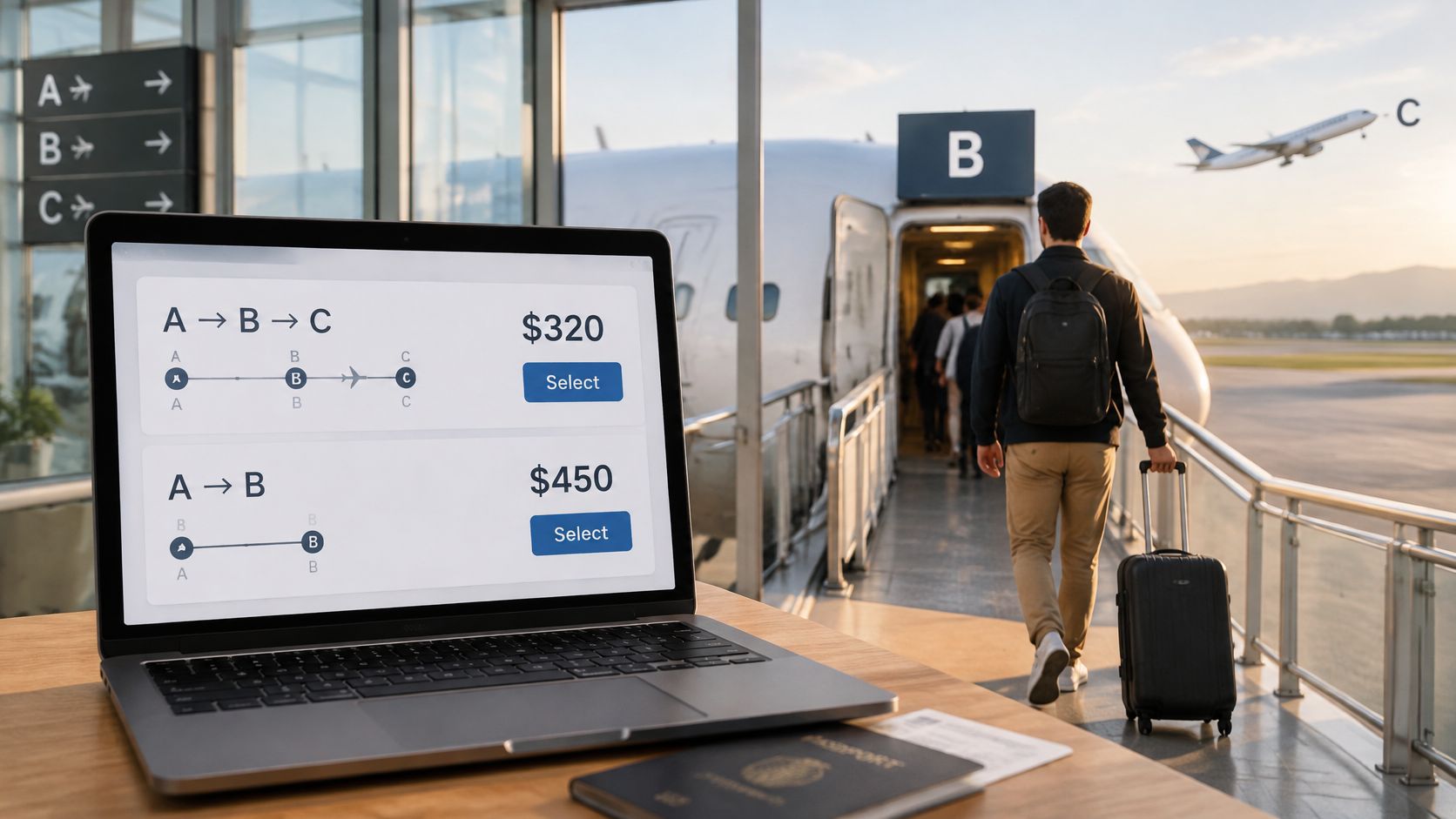
An airline may price travel from A to C through B below a direct A-to-B ticket. A traveler who buys the connecting itinerary and leaves at B, skipping the final flight, is using hidden city ticketing. INVOLUNTARY REROUTE discusses hidden city tickets as one of several ways airlines fill premium seats, alongside backroom favors and AD75 discounts.
Both the hidden city ticket and cheap first class flight concepts were conceived at Babson College. The founder describes himself as the father of the hidden city ticket and the son of the cheap first class flight.
INVOLUNTARY REROUTE is a podcast about business and first-class travel, including fare tactics such as hidden city ticketing and point-beyond fares. The accompanying video provides another way to explore the subject.
The pricing argument and the contractual risk
The founder's view is that nothing deflates faster than an empty, overvalued premium-cabin seat. That perspective helps explain why a lower-priced itinerary can appeal to travelers, but hidden city ticketing changes the ticketed journey rather than just lowering the cost of the same flight.
The risks are practical. CNN's account of Lufthansa's enforcement case describes contract provisions permitting fare recalculation when passengers do not use flight legs in sequence. The reported claim was dismissed because the court found the contract insufficiently transparent.
- Checked baggage: It may be routed to the ticketed final destination rather than your intended stopping point.
- Remaining flights: Skipping a segment can jeopardize onward or return flights on the same ticket.
- Fare recalculation: The airline may seek additional payment under its contract.
Hidden city fares are not ordinary paid upgrades. Their apparent savings come from a different itinerary and carry different risks.
Set a Break-Even Ceiling Before You Bid or Pay
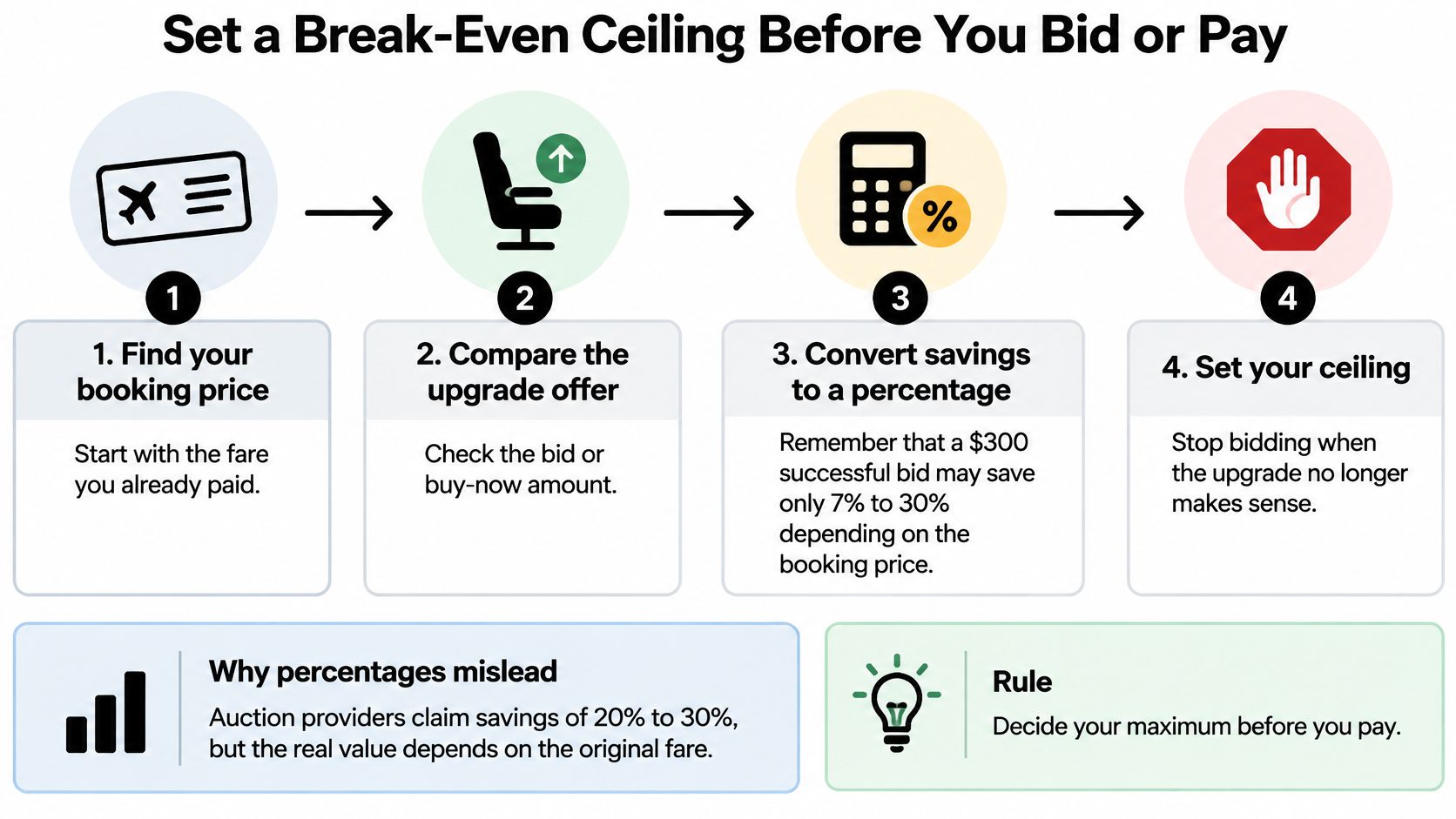
Percentage savings can obscure the comparison being made. The Seattle Times account of airline upgrade auctions describes providers claiming 20% to 30% savings, yet a $300 successful bid could save only 7% to 30%, depending on the current booking price; it also describes the €400 Austrian minimum against an economy ticket costing about $1,200 round trip, with business nearly four times as expensive.
Those are different benchmarks. Saving against an airline's upgrade quote isn't necessarily the same as saving against buying business class.
The calculation begins with your total trip cost.
Calculate the financial ceiling
Find the lowest credible business fare for the same flight and date. Match the itinerary, direction, and cabin coverage. A cheaper business ticket on another departure is an alternative, not an identical comparison.
Add your economy payment and proposed upgrade charge. Include unavoidable fees, and use one currency throughout. If the upgrade covers only part of the journey, don't describe the result as a full business-class itinerary.
Calculate absolute savings before percentage savings. Subtract your combined spending from the comparable business fare. Divide that saving by the business fare to express it as a percentage.
For a clearly hypothetical example, suppose the round-trip economy ticket costs $1,200, the upgrade costs $300, and a comparable business ticket costs $1,800. Total spending is $1,500, so the saving is $300, or about 16.7%, before adjustments.
That arithmetic only works if the upgrade and retail ticket provide comparable cabin coverage. If the bid buys only the outbound segment, you need a matching mixed-cabin comparison instead.
Adjust for benefits and uncertainty
Value what you'll use. Add personal value for better sleep, useful baggage allowances, and lounge access. Reduce it when the upgrade leaves you with less flexibility than the retail business ticket, and don't count benefits you already receive through status or another entitlement.
Account for rejection without inventing a failed-bid charge. Check when payment is collected and whether unsuccessful bids cost anything. The relevant downside may instead be remaining in economy or losing another acceptable booking opportunity while waiting.
Compare the result with flight duration. Divide the upgrade payment by scheduled block time to assess comfort cost per hour. You can also divide dollar savings by flight hours, but don't confuse a large discount with a seat that is personally worth buying.
A bid can lose even when premium seats appear available. Don't assign a precise acceptance probability unless you have a defensible basis for it, and don't raise your ceiling merely because the bidding screen encourages a stronger offer.
Ceiling rule: Pay no more than the lower of your personal value for the upgrade and the amount that preserves a worthwhile saving against comparable business class.
Write that maximum down before bidding. If the offer exceeds it, keep economy or consider another journey rather than paying to satisfy the auction.
For readers studying these fare decisions, our unlimited access costs $89.00 and includes all episodes; pay-per-episode access costs $2.99 per episode. Subscribers also receive ongoing updates on current fare behavior. Those are learning costs, not guarantees of an upgrade or a particular saving.
INVOLUNTARY REROUTE offers podcasts on premium-cabin pricing, upgrade auctions, hidden city ticketing, and agency fare tools, with practical explanations of the conditions behind a low price. Visit INVOLUNTARY REROUTE (I-REROUTE.COM) to sample selected episodes and choose the topics relevant to your next business-class decision.