


Business Class vs First Class United: The Real Differences
October 3, 2026The most popular advice about business class vs first class on United is wrong: “First” isn't automatically better. On United, the cabin label often tells you more about the route than the seat, privacy, or sleeping experience. A domestic United First ticket can put you in a comfortable recliner, while an international United Business or Polaris ticket can give you a fully flat bed and direct aisle access.
The smarter question is simple: what aircraft is operating your flight, and what does the fare include? United's premium cabins are products shaped by route geography, fleet planning, and yield management. Treat the name as a starting point, not a promise.
| What you're comparing | United First | United Business and Polaris |
|---|---|---|
| Primary use | Domestic routes and shorter premium sectors | International routes between the U.S. and Canada, the Caribbean, and Latin America, plus long-haul international routes |
| Seat type | Recliner seat, not a bed | Polaris typically converts into a fully flat bed |
| Privacy | Depends on aircraft, usually open cabin seating | Newer aircraft use pod-style layouts with direct aisle access |
| Sleeping space | No lie-flat capability | About 6 feet 6 inches of sleeping space on the United product described by United's premium-cabin comparison |
| Main buying question | Is the extra space and service worth the route premium? | Does the aircraft provide the privacy and sleep quality you need? |
| Biggest risk | Paying for “First” while expecting a bed | Paying a premium fare for an older or denser configuration |
Why the First Class Label Misleads Travelers
United's cabin names do not form a single global ladder. They describe different products built for different routes. United First generally means the premium cabin on domestic-configured aircraft, while United Business covers international premium service, including Polaris on long-haul routes. Treating either label as a universal quality ranking leads travelers straight into overpaying.
The aircraft matters more than the word on the booking screen. United First typically provides a wider recliner, additional recline, a six-way adjustable headrest, in-seat storage, universal AC power, a padded cushion, and a tray table. Those features can make a daytime domestic flight more comfortable. They do not turn the seat into a sleeping berth.
Polaris serves a different purpose. On qualifying international aircraft, the seat converts into a fully flat bed with approximately 6 feet 6 inches of space, as described in United's premium-cabin comparison. Newer wide-body cabins add pod-style layouts that improve personal space and aisle access. The design targets sleep, privacy, and endurance on long flights, not just extra width at the front of the aircraft.
The practical rule: On United, judge the hardware first and the cabin name second.
Route geography beats marketing language
A domestic itinerary labeled “First Class” can deliver less usable comfort than an international itinerary labeled “Business Class.” United's naming reflects route architecture and fleet planning. Shorter sectors can support premium recliners, while overnight international routes require beds, privacy, storage, and cabin layouts built around longer stays onboard.
Ask one question before comparing fares: “Will I need to sleep?” If the answer is no, United First may provide the comfort you need without paying for Polaris. If the answer is yes, target the aircraft and seat map, not the title. A domestic First fare is the wrong choice when it offers only a recliner.
Pricing follows scarcity, not the label
United's premium inventory shows how sharply the airline can price a better seat. In one 2026 transcontinental Boeing 757 example, coach sold for $423 and Polaris for $5,556, an over-13x gap, according to CNBC's analysis of United's premium-seat strategy.
The difference reflects limited premium inventory, route positioning, cabin capacity, privacy, and United's estimate of what each traveler will pay. Route architecture also shapes the fare: compare the full itinerary, connection options, and any hidden city ticketing implications before accepting the displayed cabin premium. “First” can sound like the top product while delivering the wrong hardware for your trip.
How United Separates Domestic and International Premium
United does not operate one clean luxury ladder. Its premium cabins reflect route architecture, aircraft economics, and the fare United believes each market can support. In the 1978 era, United and TWA tested a three-class concept, then abandoned it after negative reactions from economy passengers. Years later, United formalized the divide between domestic first class and international business class, creating route-specific products rather than a single premium tier. That history appears in the business class overview on Wikipedia.
The aircraft determines much of the experience. Domestic planes generally need a premium recliner that works across shorter sectors. Long-haul wide-body aircraft require beds, privacy partitions, storage, and passenger-flow designs suited to overnight travel. Those choices shape fleet planning, cabin density, seat selection, catering, and the fare United can charge.
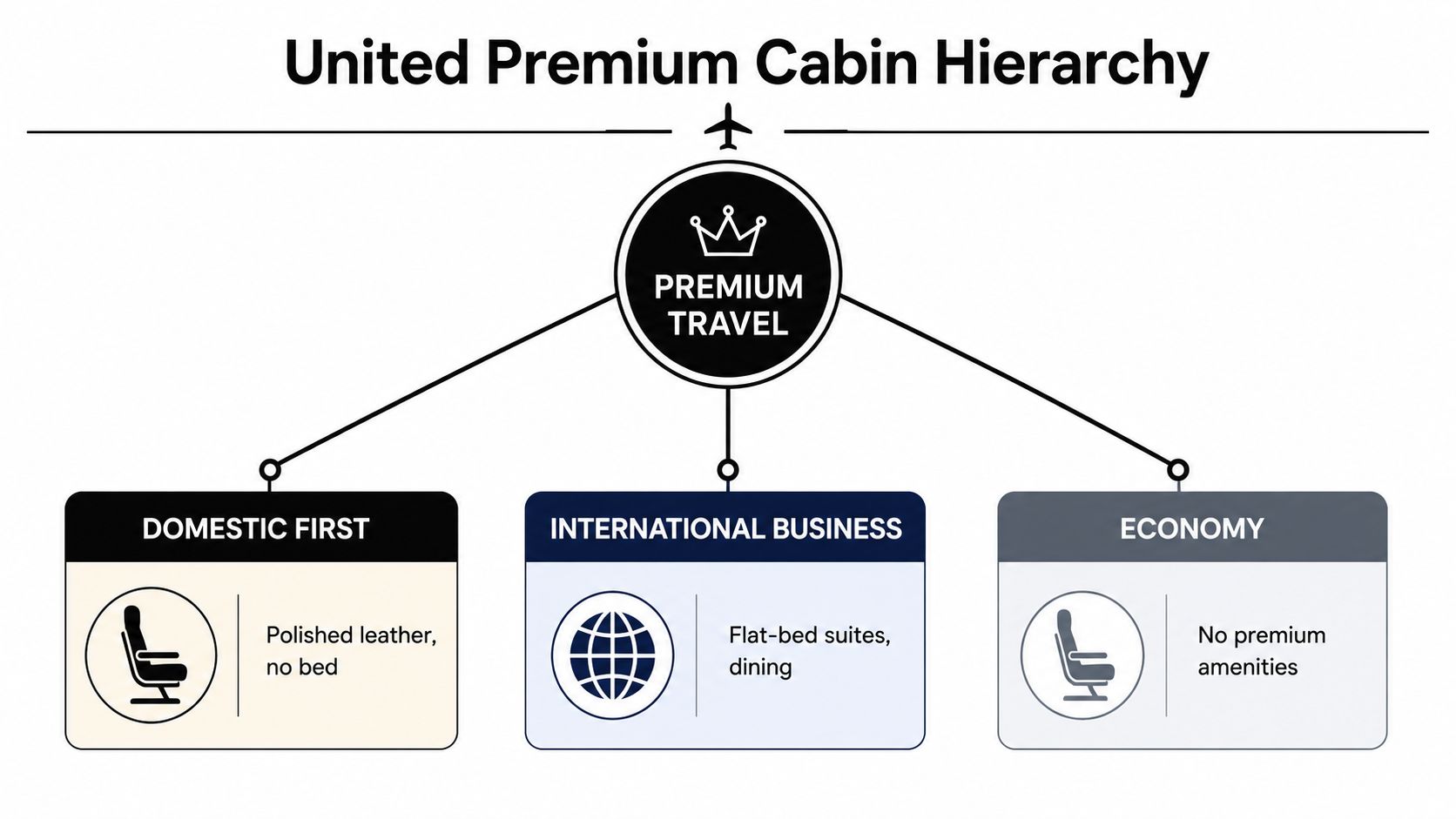
Domestic First is a recliner product
On a domestic-configured aircraft, United First is the highest cabin, but it remains a recliner product. You get more personal space and useful in-seat features, yet no fully flat sleeping surface. The open cabin also provides less separation than a modern Polaris suite.
Buy United First for a daytime trip, productive work, or a flight where a better seat and priority handling meet your needs. Reject the fare when its value depends on the assumption that “First” means a lie-flat bed. The aircraft, not the label, decides whether the upgrade solves your actual problem.
International Business is built around the aircraft
United Business describes the broader international business-class category, while Polaris identifies the carrier's long-haul premium product. Newer wide-body aircraft use pod-style designs that can offer direct aisle access. United has announced layouts featuring 20 Polaris seats on some A321neo transcontinental jets and 64 business-class suites with sliding privacy doors on a premium 787 layout, according to CNBC's coverage of United's premium cabin planning.
These layouts reveal how United manages premium revenue. Privacy doors, bed length, suite density, and the number of premium seats give the airline several ways to differentiate fares. Route architecture matters just as much. A cabin may be physically impressive, yet its value changes when the same itinerary has different connection options, demand patterns, or hidden city ticketing possibilities.
Access does not fix the wrong seat
Lounge access, priority services, and better food can add value, but they cannot turn a recliner into a bed. Conversely, a Polaris fare can remain the stronger purchase when sleep and privacy matter, even if the meal is less impressive.
Search results often compress these products into one “premium” category. Open the aircraft details, inspect the seat map, and confirm the operating cabin before paying. That check exposes artificial fare inflation faster than the cabin name does.
Comparing Seat Architecture and Privacy Density
The clearest difference between United First and United Polaris is physical. United First prioritizes recline and extra space. Polaris prioritizes sleepability, privacy, and access to the aisle. That difference matters more than the title printed on the ticket.
| Cabin Type | Typical Aircraft | Seat Layout | Bed Capability | Privacy Level |
|---|---|---|---|---|
| United First | Domestic narrow-body aircraft and domestic-configured aircraft | Commonly open recliner arrangements | No lie-flat bed | Moderate, with limited separation from the cabin |
| United Polaris | Newer international wide-body aircraft | Commonly 1-2-1 or similar pod layouts | Fully flat bed, about 6 feet 6 inches on the described United product | High on newer suites, with direct aisle access |
| Legacy international premium cabin | Certain older wide-body subtypes | Can be denser, including 2-4-2 arrangements | May offer a lie-flat seat, but the experience varies | Lower than newer pod designs |
The NerdWallet guide to United Business Class describes Polaris seats on some aircraft as approximately 20.5 inches wide with bed length around 78 inches, while noting that legacy 777-200 configurations can be denser. Those figures aren't universal guarantees. They show why the aircraft subtype matters.
Sleepability is the dividing line
A recliner may be perfectly adequate for a short flight. It becomes a serious compromise when you need to arrive ready for work after an overnight crossing. Polaris's fully flat bed changes the purpose of the cabin. You're not merely buying a larger chair, you're buying a better chance of sleeping in a private, horizontal position.
Privacy density matters just as much. A 1-2-1 pod gives each passenger a clearer path to the aisle and reduces the need to climb over a seatmate. Older layouts can still provide lie-flat seating while offering less separation and more passenger interaction.
Check the seat map, not just the fare headline. Two United flights carrying a premium label can provide noticeably different experiences when their aircraft subtypes differ.
Fare tiers are changing the purchase
United is also moving toward three fare levels in both United First and United Business, including a new base option scheduled to start in fall 2026. The AirlineGeeks report on United's premium fare levels describes the shift toward differences in refundability, seat-selection fees, baggage allowances, and United Club access.
That means a premium cabin ticket no longer tells you everything about what you bought. The lowest business-class base fare on eligible international routes is described as including United Club access, but other flexibility and ancillary terms can differ. Read the conditions before assuming that a cheap premium fare offers the same freedom as a higher fare in the same cabin.
The right comparison is therefore two-dimensional:
- Seat hardware: Does the aircraft provide a recliner, a lie-flat bed, or a private suite?
- Fare construction: Does the ticket include the flexibility, baggage, seat selection, and ground access you need?
The Pricing Illusion and Hidden City Ticketing
United's premium fares are not priced like a simple menu. The airline evaluates route demand, connections, competition, inventory, and the likelihood that different travelers will pay different amounts for similar seats. A nonstop can cost more than a connecting itinerary even when the connecting itinerary passes through the city where you want to stop.
That phenomenon is known as hidden-city ticketing, or a point-beyond fare. It means booking a journey from city A to city C with a connection at city B, then leaving the itinerary at city B. Academic research on hub-and-spoke networks documents the practice, and a U.S. Government Accountability Office report on airline fares defines it as booking a ticket to one city while deplaning at an intermediate city.
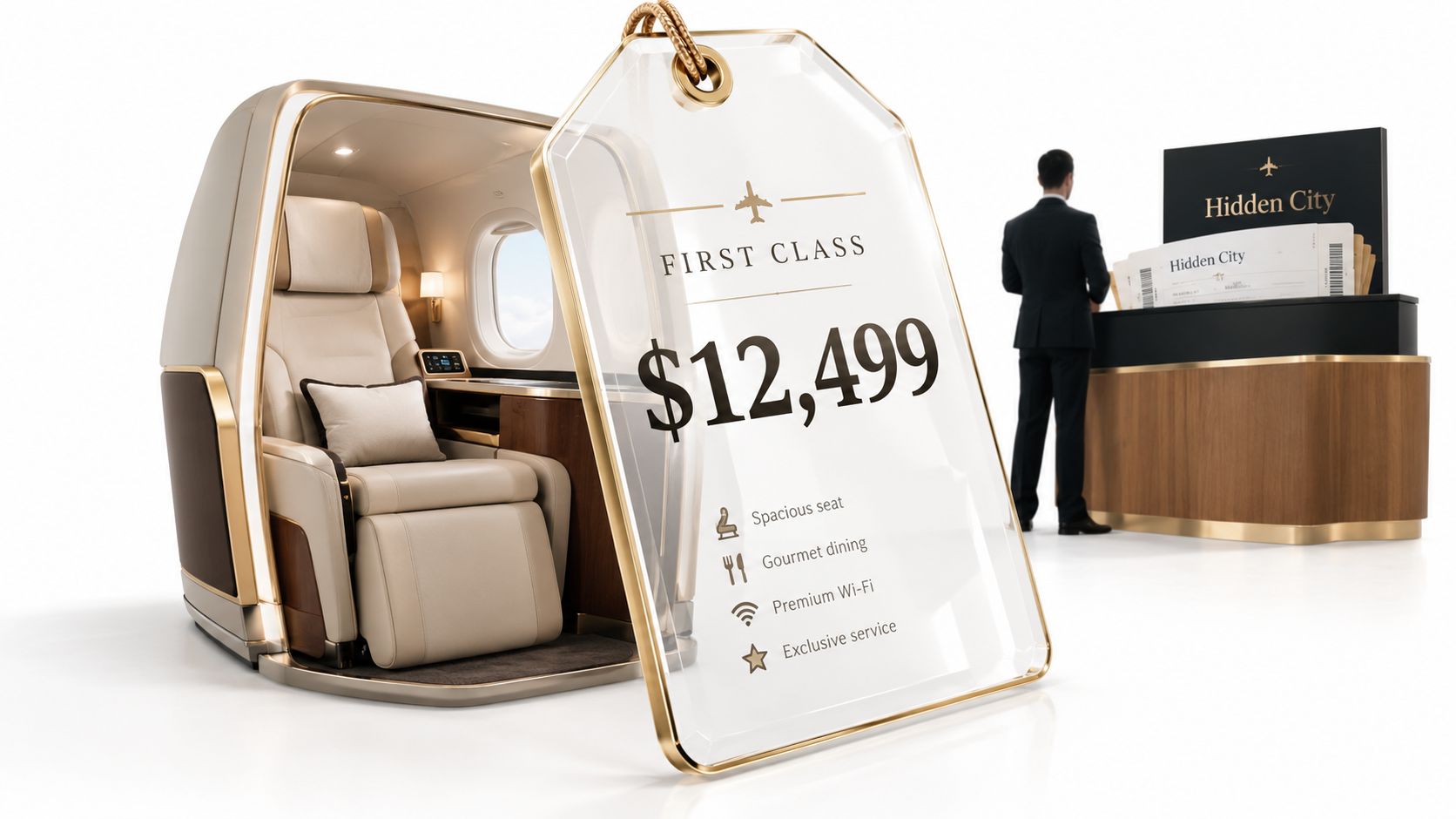
What the fare anomaly reveals
The GAO noted that passengers use hidden-city ticketing because the ticket to the intermediate city can cost less than a direct ticket to that same city. The practice isn't a magic discount and it isn't automatically suitable for every itinerary. It exposes the fact that airline pricing follows commercial segmentation rather than a transparent distance-based formula.
Airlines generally prohibit the practice in their fare rules and may respond when a traveler repeatedly abandons segments. Travelers considering it need to understand the practical restrictions, including the fact that checked luggage normally travels to the ticketed final destination and that missing a segment can affect the remaining itinerary.
The evidence supports a careful conclusion. Hidden-city fares are a documented pricing anomaly created by complex airline networks and fare rules. It isn't accurate to claim, without reliable evidence, that airlines invented hidden-city tickets as a deliberate disposal tool for unsold premium seats, or that the practice was first institutionalized on a particular college campus. Those claims should not replace the documented fare mechanics.
Premium pricing and route selection
The same logic applies to business class. A passenger who searches only a nonstop may see an inflated Polaris price, while a strategically chosen connection may reveal a different fare construction. That doesn't guarantee a bargain, but it gives the traveler another variable to test.
The strongest approach is to compare:
- The nonstop fare in the desired cabin.
- A connecting itinerary using the same aircraft type where possible.
- Nearby origin and destination airports.
- The total value of flexibility, bags, seat selection, and lounge access.
- The risks created by any itinerary that isn't completed as ticketed.
The following video offers additional context on how premium fares and routing choices can shape the commercial travel experience.
Real World Scenarios for Premium Cabin Value
United's premium-cabin value depends less on the seat label than on the fare market behind it. A transcontinental itinerary illustrates the problem: standard coach may sell for $423, while Polaris business class reaches $5,556 on a 2026 Boeing 757 example. The reported United fare comparison shows an over-13x gap for the same route and date window.
That spread reflects United's yield management, not a proportional increase in operating cost. Polaris can justify the premium when the traveler needs quiet work time, privacy, or meaningful rest. For a daytime flight where the goal is more room, paying the full difference is poor value. The cabin name does not make an inflated fare sensible.
Scenario one, a short daytime flight
A domestic meeting trip usually calls for a practical comfort check. United First provides more recline, a six-way adjustable headrest, storage, power, a padded cushion, and a larger working area than standard coach. Those features can support a productive journey without requiring a long-haul premium fare.
Check the aircraft and seat map before booking. Then compare the First fare with a lower fare plus a preferred seat, especially when the flight is short and daytime rest is not a priority. Review change terms and other fare conditions as well. The right comparison is the complete travel setup, not the cabin title.
Scenario two, an overnight international journey
Overnight international travel changes the recommendation. Choose Polaris or another qualifying United Business product only when the booking clearly includes a fully flat bed. Confirm the aircraft and seat map before payment, since older configurations may offer less privacy than newer 1-2-1 pods.
Direct aisle access matters when sleep and movement affect performance after landing. In this scenario, the fare pays for sleepability and privacy. A business-class label alone is not enough.
Scenario three, a connection that changes the economics
A nonstop premium fare can reflect the strength of a specific origin-destination market. Search connecting routes to test whether United prices the same premium seat differently when the itinerary serves another market. Compare the aircraft, seat, connection time, flexibility, and total travel burden before calling the lower fare a bargain.
Hidden-city ticketing can expose another pricing difference, but it carries operational risk. Skipping a segment may affect baggage handling, disruption protection, and the validity of remaining segments. Use a conventional connection when the saving is modest. A completed itinerary usually delivers cleaner protection and a more reliable premium experience.
Choosing the Right Cabin for Your Specific Route
Use a decision process that starts with the trip's purpose. A domestic First ticket can be sensible for comfort and productivity. A Polaris ticket makes sense when sleep, privacy, and long-haul recovery justify the premium. Neither cabin deserves automatic approval because of its name.
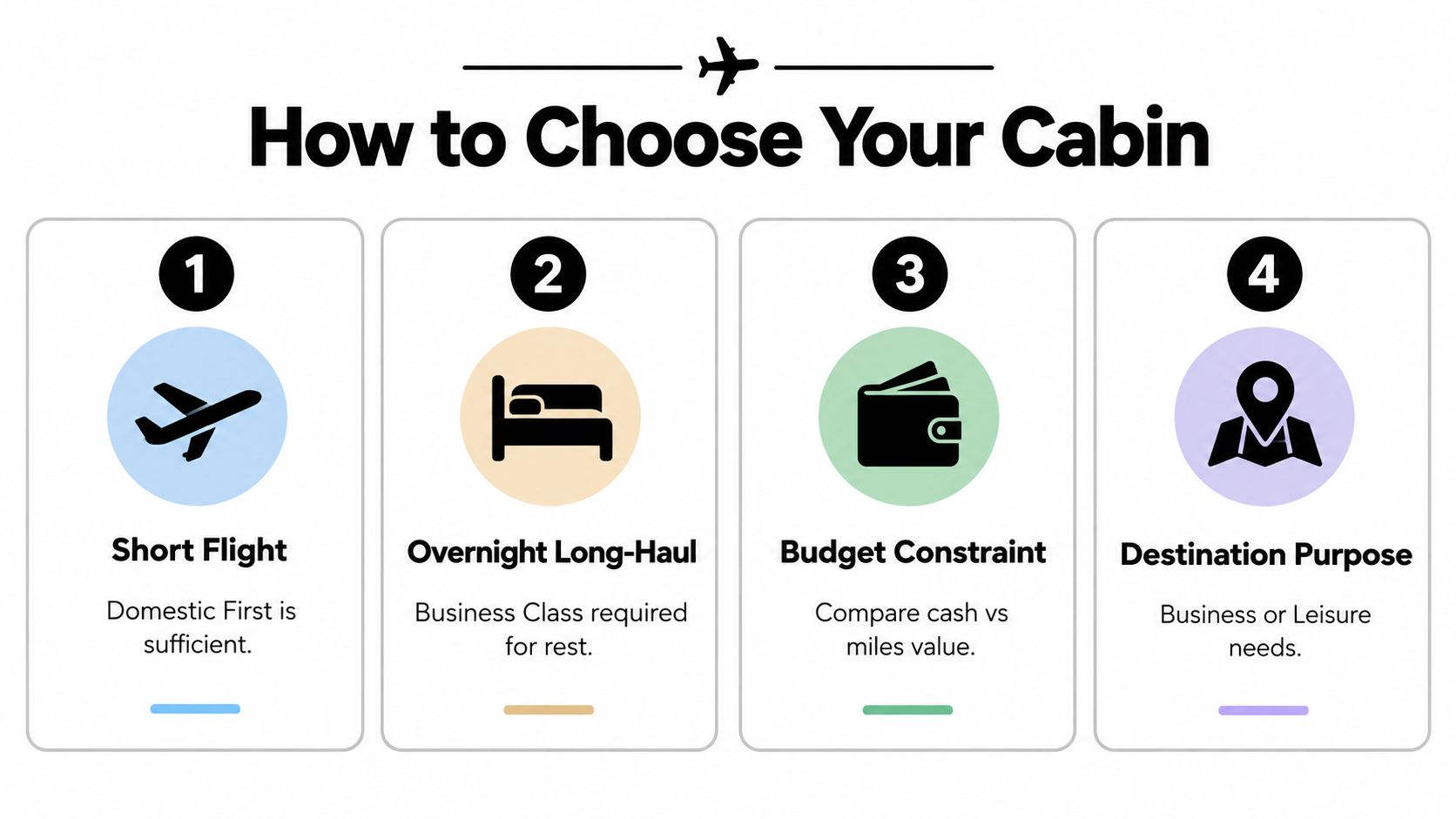
Start with four questions
How long will you be onboard? For a short daytime flight, United First may provide enough comfort. For an overnight long-haul, prioritize a confirmed flat bed.
What does the aircraft offer? Open the seat map and inspect the layout. Look for a 1-2-1 or similar Polaris arrangement if direct aisle access matters. Treat aircraft swaps as a real possibility and avoid paying a premium for a feature that isn't clearly tied to your booking.
What are you buying beyond the seat? Compare refundability, baggage, seat selection, United Club access, and change conditions. The new premium fare structure makes this review more important, particularly for travelers choosing a base fare.
What is the trip worth to you? A business traveler with a critical morning meeting may rationally pay for sleep. A leisure traveler on a short daytime sector may prefer to preserve cash for the destination.
A practical decision matrix
| Your situation | Recommended direction | What to verify |
|---|---|---|
| Short domestic daytime flight | United First if the price is reasonable | Recliner seat, schedule, fare flexibility |
| Overnight international flight | United Polaris or qualifying United Business | Fully flat bed, aircraft subtype, aisle access |
| Strong budget constraint | Compare coach, First, and Business against the actual comfort need | Cash price, miles value, ancillaries |
| Work-heavy itinerary | Choose the cabin that protects sleep and productivity | Power, privacy, bed capability, connection risk |
| Uncertain aircraft assignment | Avoid paying solely for a specific suite promise | Current seat map and substitution terms |
A miles redemption can change the calculation, but don't treat miles as free. Compare the redemption cost with the cash fare and the value of keeping those miles for a trip where the hard product matters more.
Buy the seat you need, not the title you admire.
Final Strategies for Beating Airline Yield Management
Airline pricing rewards disciplined comparison. United separates premium cabins by route, then separates fares within those cabins by flexibility and ancillary access. Travelers who search only for “First Class” or “Business Class” give the airline control over the frame of the decision.
Use a short checklist before you pay:
- Identify the route product: Domestic United First is a recliner product. International Polaris is the sleep-oriented product.
- Confirm the aircraft: A newer pod can be materially more private than an older premium layout.
- Inspect the fare rules: Base, standard, and higher premium fares can differ in refundability, seat selection, bags, and club access.
- Test the route architecture: Compare nonstop and conventional connecting itineraries before assuming the first fare is the market price.
- Protect the itinerary: Hidden-city ticketing is a documented fare anomaly, but skipping segments can create operational and contractual problems.
- Price the outcome: If you need sleep, compare the cost against the value of arriving functional. If you only need a better chair, don't pay for a bed you won't use.
The GAO's documentation of hidden-city pricing shows that airline fare anomalies are not new. The academic research on hidden-city ticketing also connects the practice to hub-and-spoke network economics. Those sources support a useful principle: airline fares often reflect the market being priced, not the physical distance or obvious convenience of the itinerary.
The best United booking strategy is therefore unapologetically practical. Choose the aircraft before the label, compare the complete fare before the headline price, and treat Polaris as a sleep-and-privacy product rather than a status symbol. That approach won't eliminate every premium surcharge, but it stops you from paying first-class money for a recliner when what you wanted was a bed.
INVOLUNTARY REROUTE (I-REROUTE.COM) offers a podcast and membership platform covering hidden-city ticketing, point-beyond fares, mileage redemptions, agency discounts, and the way airlines price premium seats. Visit it to explore practical fare-strategy discussions and learn how to evaluate United Business and United First opportunities without relying on cabin labels alone.