


How to Buy Choice Points Without Wasting Money
September 27, 2026The most popular advice about buying Choice points is also the most dangerous: wait for a big bonus, click purchase, and assume you've found a bargain. A bonus can make a bad deal look attractive. The only question that matters is whether the points cost less than the hotel night they'll replace.
Choice Privileges supports reward nights at more than 7,000 Choice-branded hotels across 46 countries and territories, and its program page later described earning and redeeming points at over 7,100 locations worldwide. That footprint creates real opportunities, but it also makes speculative buying tempting. The smart approach is narrower: identify the exact hotel, check the exact cash rate, calculate the value per point, and buy only when the numbers work.
Why Buying Choice Points Is a Math Problem Travelers Solve Wrong
“Bonus points included” is not a verdict. Calculate the total points received, including the bonus, and the total amount charged. Divide the cost by the points, then compare that result with the value of a specific reward night.
Choice's normal purchase range is 1.03 to 1.28 cents per point, while independent loyalty analysis commonly values Choice points at around 0.7 cents each. The Points Guy's Choice Privileges analysis supports the practical takeaway: regular-price purchases usually fail unless a promotion or a well-timed redemption changes the math.
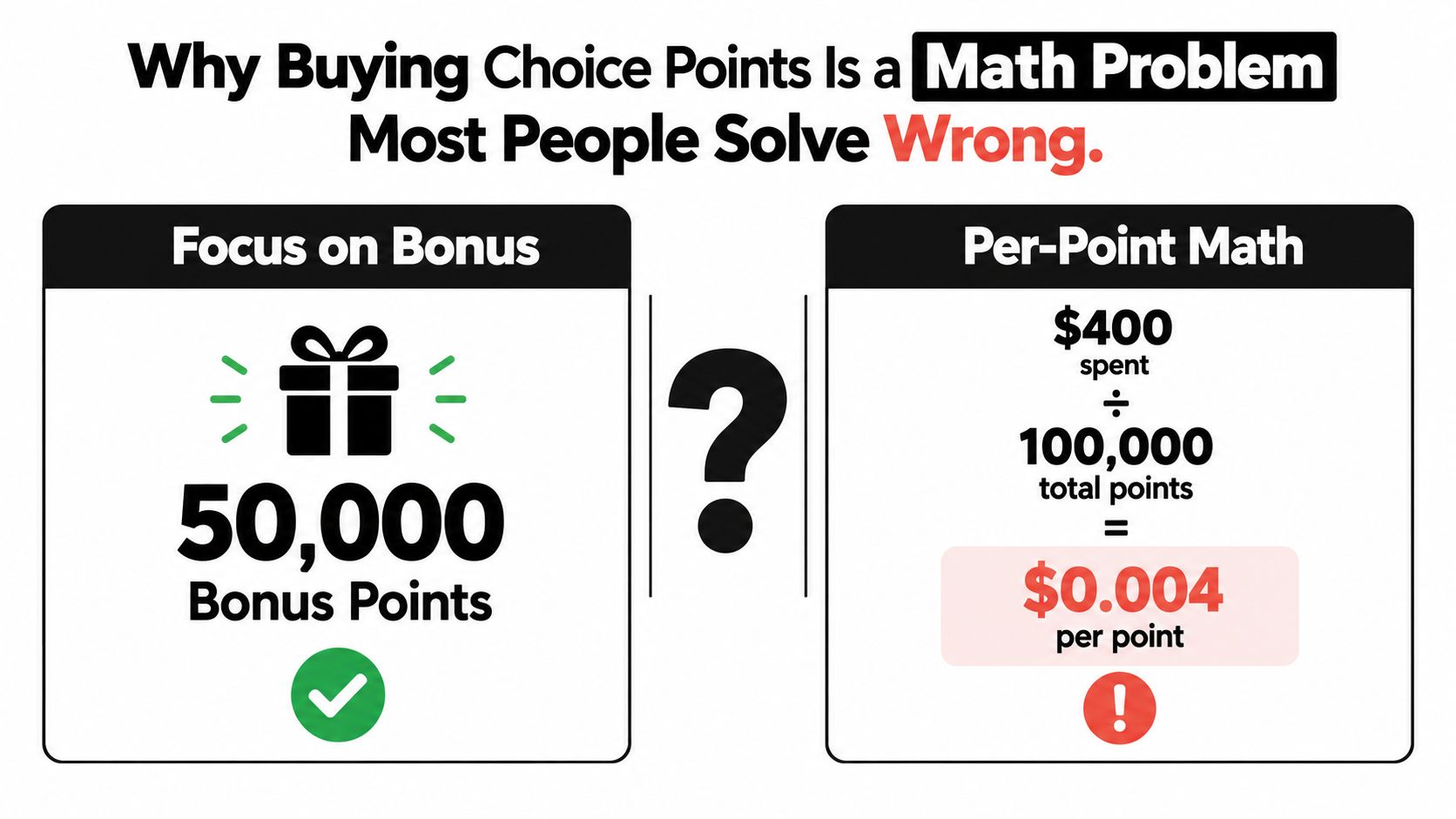
The only formula that matters
Run these calculations before opening the purchase page:
Cash rate for the room ÷ points required = redemption value per point
Then calculate:
Purchase price ÷ total points received = acquisition cost per point
Buying points loses when the acquisition cost exceeds the redemption value. A discount cannot repair a weak redemption, and an expensive-looking hotel does not automatically justify the purchase.
Three variables determine the result:
- The property: Choice award pricing varies by hotel and date. One redemption can work well while another delivers poor value.
- The promotion: A discounted purchase can reduce the cost below the program's usual valuation.
- The cash alternative: A cheap paid room can make buying points unnecessary, even when the purchase price looks reasonable.
Practical rule: Never buy points for a balance. Buy them for a room you've already found.
Airline fares require the same blunt calculation. Hidden-city ticketing, as defined by the U.S. Government Accountability Office, means booking a ticket to a farther destination and intentionally leaving at an intermediate city because the fare is cheaper. Choice points are no bargain merely because the checkout page displays a bonus.
Where to Buy Choice Points and What the Checkout Shows
Buying Choice points starts inside your authenticated Choice Privileges account. Open Buy Points, then judge the offer on the page in front of you. Public promotion summaries can become outdated, and the final checkout screen controls the price, bonus, and points you will receive.

Read the purchase tiers
Choice's official rules and regulations say members can buy points through the online storefront or by calling the program's call center. They also set an annual limit of 180,000 purchased points per calendar year, unless a promotion changes that limit. Use the stated cap when planning, rather than assuming the account can receive unlimited points.
The listed pricing structure is:
- 1,000 to 4,000 points: 1.28 cents per point.
- 5,000 to 9,000 points: 1.14 cents per point.
- 10,000 points or more: 1.03 cents per point.
Larger orders lower the unit cost, but cheaper points can still be a bad purchase. Check the minimum order, required increments, promotional bonus, and final charged amount. The program may require blocks of 1,000 points, so review every checkout condition before paying.
Website versus call center
The website is usually the better route because it displays the offer and leaves a clear transaction record. Call the program only when the storefront fails to show expected terms. A phone agent is not a reason to assume the price will improve. Compare the final charge with the total points that will post.
Promotion points may arrive on a different schedule from points earned through a hotel stay. The official purchase terms control the posting window. Do not buy for an urgent reservation unless the points are already in the account or the stated timing leaves enough room.
Completed purchases are generally final. Treat the button as a commitment. Before submitting payment, verify award availability, the hotel's required points, your dates, and the promotional price. If the acquisition cost does not beat the room's redemption value, close the page and book another way.
Calculating Real Value Per Point Before You Spend a Dollar
The calculation is simple, but travelers often skip it because the hotel search displays the award price and the cash price in separate places. Put both figures on the same line.
Cash rate ÷ points required × 100 = cents per point
The examples below use illustrative cash rates to show how the decision changes. They aren't claims about fixed Choice pricing. Choice doesn't publish a universal award chart, and rates can vary by property and date.
| Hotel Brand | Points Required | Cash Rate Example | Value Per Point | Buy or Book? |
|---|---|---|---|---|
| Comfort Inn | 8,000 | $48 | 0.6 cents | Book cash |
| Quality Inn | 12,000 | $108 | 0.9 cents | Compare carefully |
| Cambria | 25,000 | $300 | 1.2 cents | Buying may work |
The first example produces weak value. Paying for the room preserves your cash and avoids locking money into points worth less than their purchase price. The Quality Inn example sits near the upper end of normal purchase pricing, so a full-price purchase would be hard to justify.
The Cambria example is different. A redemption value of 1.2 cents per point gives you room to buy during a sufficiently deep promotion, provided the room is available at the stated reward rate.
The hotel determines the value, not the points balance.
Independent analysis places the usual purchase price at 1.03 to 1.28 cents per point and common value around 0.7 cents, as discussed in The Points Guy's buying guide. That gap explains why stockpiling is usually a mistake. A purchase only makes sense when the specific award night clears your acquisition cost after the promotion, not when you hope future rates will become favorable.
Also check whether taxes, fees, room restrictions, or cancellation rules change the comparison. The cash price you compare should be the alternative for the same room and date.
Finding and Stacking Promotions Like a Pro
Choice promotions deserve attention because they can change a marginal redemption into a worthwhile one. They also make sloppy math easier. A headline may advertise a discount, a bonus, or a targeted offer. Calculate the final acquisition cost before deciding whether any of them matters.
The strongest verified example is an official offer for a 40% discount on purchases of 14,000 points or more, bringing the effective cost to 0.62 cents per point, as shown on the Choice Privileges buy-points page. Availability may vary by member, so sign in and confirm the offer attached to your account before planning around it.
Where to look
Check three places:
- Your Choice account: Look for a banner or offer after signing in.
- Program emails: Targeted messages can carry different terms or expiration dates.
- Deal coverage: Frequent Miler's Choice points sale page can help identify a live promotion, but verify the actual price in your account.
The checkout screen is the authority. A deal page can be outdated, and an email may not match the offer currently available to your account.
Calculate the promotion correctly
At the regular price, the largest standard tier costs 1.03 cents per point. Applying a 40% discount lowers the effective cost to 0.62 cents per point, according to the official offer terms. That price is below the commonly cited Choice valuation of around 0.7 cents, but the discount alone does not make every award worthwhile.
| Promotion Tier | Bonus Points | Effective ¢/Point |
|---|---|---|
| Standard purchase, 10,000 or more | None | 1.03 |
| Discounted purchase, 14,000 or more | None | 0.62 |
| Full-price smaller purchase, 1,000 to 4,000 | None | 1.28 |
Promotions may apply per transaction and may not stack with another offer. Do not split an order unless the terms reduce the combined cost. Check targeted-email expiration dates, then confirm the target room is available before the promotion ends. Buy only when the discounted cost beats the cash alternative for a specific booking.
When Buying Points Beats Booking a Paid Room
Buying Choice points beats paying cash only when the required points cost less than the same room booked directly. Strip away the promotion and compare two actual totals: the effective purchase cost and the room's full cash price. A hotel's brand or reputation does not make a weak redemption worthwhile.
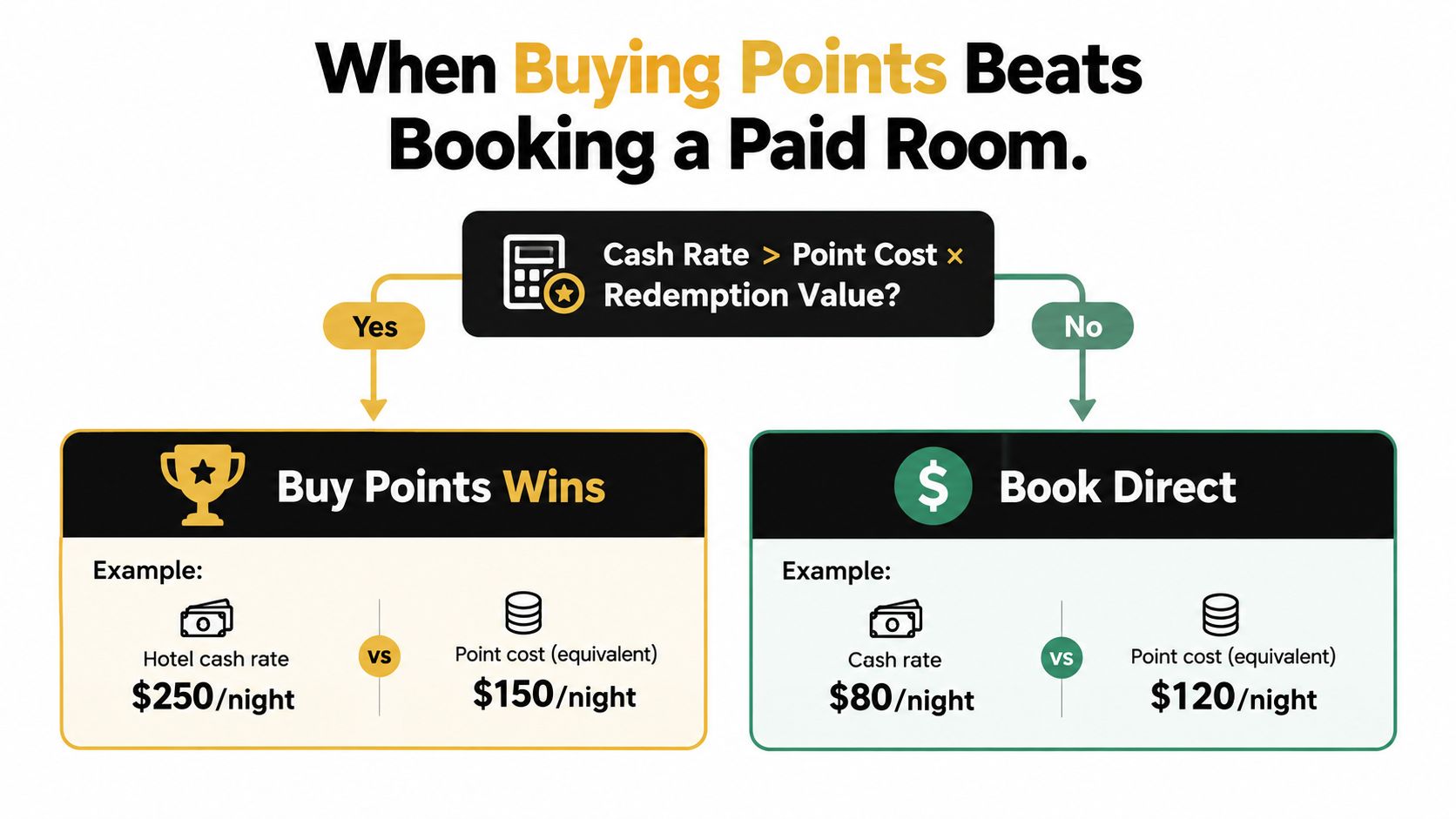
Consider a 12,000-point reward night with a $130 cash rate. The redemption returns about 1.08 cents per point. Buying at the regular 1.03 cents per point appears slightly cheaper before taxes, fees, and transaction friction, yet the margin is too narrow to recommend. A paid booking may also earn stay credit or offer more flexible cancellation terms.
The calculation changes for a high-demand Cambria or Ascend Collection stay priced at $250 or more. If the award still costs 12,000 points, its value exceeds 2 cents per point. That comfortably beats the 0.62-cent promotional acquisition cost in the verified offer. Buy only when both the cash rate and award space are available, and when the booking terms do not erase the savings.
Where the window appears
Choice reward pricing changes by date and demand. Strong opportunities often appear during holidays, major events, or periods of limited hotel supply. On a quiet night, the award rate may deliver less value than booking the room with cash.
Use this test:
- Find the exact room and date.
- Record the full cash rate.
- Record the reward-night requirement.
- Multiply the points required by your promotional purchase cost.
- Choose the cheaper option after accounting for cancellation rules, taxes, and fees.
Do not buy speculatively. Future award pricing can change, and unused points leave you exposed to a weaker redemption later. The purchase should serve a specific booking, not a vague plan to travel someday. If the math does not beat the paid rate today, keep your cash and book the room directly.
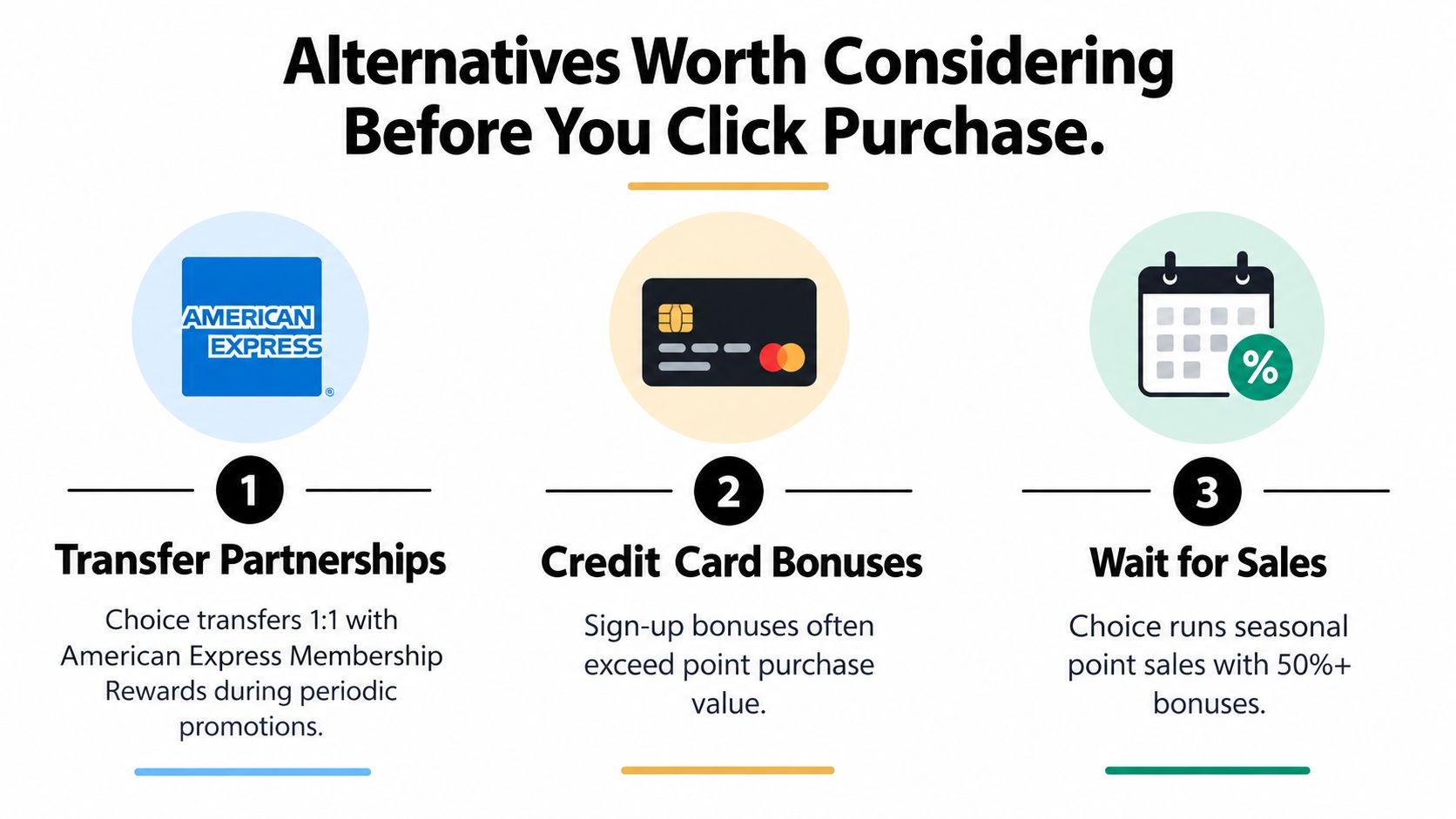
Alternatives Worth Considering Before You Click Purchase
Buying points should be the backup plan. First check whether an existing rewards balance, a mixed-payment booking, or a lower room rate solves the gap for less cash and less risk.
Transfer rewards you already hold
Choice transfers 1:1 with American Express Membership Rewards during periodic promotions. If you already have Membership Rewards points, a transfer bonus may cost less than purchasing Choice points directly. Confirm the current transfer terms before moving anything. Transfers are usually difficult or impossible to reverse, so match the transfer to a specific award booking rather than building a speculative balance.
Use partial cash when available
A Points Plus Cash option can cover an eligible stay with fewer points upfront. That makes it useful for a small shortfall and avoids leaving unused points in your account. Compare the cash portion with the number of points it replaces. Divide the cash component by those points to find the implied purchase rate. If that rate looks poor, pay for the room instead.
Lower the room rate
Check eligible discounts, partner booking channels, and Choice promotions before deciding that points are necessary. A cheaper paid rate can eliminate the value of buying points, particularly for a modestly priced Comfort Inn or Quality Inn night. Include taxes, fees, cancellation terms, and any stay credit when comparing the two options.
Use other ways to build points
Credit card bonuses, transfer partners, and future purchase promotions may provide a better route than buying at the current storefront price. A small balance can also come from ordinary Choice stays, so avoid paying for points merely to reach a round number. The right alternative depends on your timeline. A confirmed reservation supports a precise calculation. An uncertain trip does not justify tying up cash in a program balance.
Run every option through the same test: what will the room cost after points, cash, taxes, fees, and restrictions are included? If a discount or existing rewards balance produces the lower total, use it. Buy Choice points only when they close a confirmed booking gap at a cost below the value you can redeem.
Quick Decision Checklist and Pitfalls to Avoid
Before you buy, run the transaction through this short checklist:
- Confirm the redemption: The target room must be available at the points price you used in the calculation.
- Calculate the value: The redemption should beat your purchase cost by a meaningful margin, not by a fraction of a cent.
- Verify the offer: Make sure the promotion is visible in the cart and applies to your account.
- Check the balance risk: Don't purchase more points than the confirmed booking needs.
- Review the terms: Confirm the annual purchase limit, minimum purchase, increments, posting conditions, and refund policy in the official Choice rules.
- Protect your account: Choice points generally expire after 18 months of inactivity, according to The Points Guy's program guide. Keep the account active if you're holding points for later.
Several mistakes recur. Buying during a normal-price window is the obvious one. Buying a large balance for a future trip is worse because Choice can change award pricing, and the hotel you want may not offer the rate you expected.
Another trap is chasing a premium property just because the cash price looks impressive. A modest hotel can deliver better practical value if its award rate is low and its location fits your trip. The right comparison is always the same room, same date, same cancellation conditions, and same out-of-pocket cost.
Don't confuse a theoretical valuation with a guaranteed saving. If a promotion brings the acquisition cost below a typical point value, that's useful evidence, not permission to buy blindly. The final decision should come from the confirmed booking, the cash alternative, and the post-promotion cost.
Final check: If you haven't found the room yet, you aren't ready to buy the points.
INVOLUNTARY REROUTE (I-REROUTE.COM) breaks down hidden-city fares, point-beyond fares, premium-cabin pricing, and the airline tactics that make travelers overpay. Visit INVOLUNTARY REROUTE (I-REROUTE.COM) to explore the podcast, membership resources, and practical fare analysis before your next trip.