


Cheapest Time to Fly: Dates, Days and Booking Windows
October 29, 2026International fares in August averaged about 29% less than December fares, roughly $120 less per ticket, according to Expedia's 2026 Air Hacks analysis. That's a stronger starting point for finding the cheapest time to fly than choosing a particular weekday to click “buy.” Your departure date, departure hour and route deserve attention before your purchase-day routine.
Cheapest Months and Days to Fly at a Glance
August is a useful first month to test for international trips, while Tuesday, Wednesday and Saturday are strong alternatives to Sunday for U.S. domestic departures. These are search priorities, not universal winners. Different analyses identify different cheapest days because they cover different markets and travel periods.
The comparison below keeps each finding attached to its original market and comparison date.
Cheapest months and days to fly, by pattern
| Pattern | Market | Typical saving | Source |
|---|---|---|---|
| August departure | International | About 29% below December, about $120 per ticket | Expedia 2026 Air Hacks |
| August versus March | International | Up to 7% cheaper | Expedia 2025 Air Hacks |
| Friday departure | International | Up to 8% below Sunday | Expedia 2026 Air Hacks |
| Thursday departure | International | Up to 15% below Sunday | ARC 2025 report |
| Tuesday departure | U.S. domestic | Up to 14% below Sunday | Expedia 2026 Air Hacks |
| Wednesday departure | U.S. domestic | $102 below Sunday | CheapAir's 2024 airfare study |
| Saturday departure | U.S. domestic | Up to 17% below Sunday | ARC 2025 report |
| Monday to Wednesday travel | U.S. domestic | About 14% below weekend travel | Google data reported by CNET |
These are market averages, not guarantees. Route, airport, season, airline capacity and fare class can change the result. “Up to” also describes a potential saving, not the discount every passenger receives.
Read the comparisons correctly
The international month comparisons don't establish that every August itinerary beats every December itinerary. They suggest where a flexible traveler should begin searching. A departure airport with different holiday patterns or airline competition may produce a different answer.
The departure-day findings also shouldn't be combined into a promised discount. Moving from Sunday to Tuesday and changing the month doesn't mean you can add the reported savings together. Each analysis measures its own comparison across its own sample.
First action: Compare your route's Sunday fare with Tuesday, Thursday and Saturday departures, keeping the cabin, baggage allowance and ticket conditions consistent.
Check the return separately. A cheaper outbound flight isn't enough if the return date makes the complete itinerary more expensive. Use the table to choose alternatives worth testing, then let the actual round-trip prices decide.
Why Departure Dates Beat Purchase Days
A Sunday evening flight attracts a different demand mix from a Tuesday departure. Airlines can sell remaining Sunday seats to travelers returning for the workweek, while a quieter midweek flight may need lower fares to fill. The cost of operating the flight barely changes; passenger willingness to pay does.
That is why the day the plane leaves usually matters more than the day you buy. The departure-day differences reported in the table above are much larger than the purchase-day effects examined below.
Purchase-day effects exist, but they're limited
A review of airline-pricing studies reports that comparable tickets purchased on weekends were about 5% cheaper than weekday purchases in a large U.S. sample; it also describes a study of nearly 22 million fares in which federal-holiday purchases for travel during the following 60 days averaged 1.9% less.
Those findings show airlines can vary fare availability when the mix of shoppers changes. Leisure travelers and time-sensitive business travelers do not search at the same times or accept the same prices. The effect is real, but smaller than the gaps created by moving the travel date itself.

Keep the comparison controlled
If you compare purchase days, keep the itinerary identical. Changing the flight, cabin or baggage bundle makes it impossible to tell whether the apparent saving came from purchase timing. Use one route, one cabin and one fare brand, then vary only the day you buy.
Do not delay an acceptable fare because your preferred buying day has not arrived. Airlines adjust availability according to remaining seats, competition, season and booking lead time. A calendar rule cannot guarantee every shopper a discount.
Route-level target-fare checklist:
- Set a target fare from acceptable departure dates on your route before judging purchase-day timing.
- Rank flexibility in this order: departure date, departure hour, then buying day.
- Price the full round trip with the same cabin and baggage allowance, since a cheap outbound leg can be offset by the return.
- Buy when the tracked fare reaches your target rather than waiting for a specific weekday.
Time of Day and Fare Differences
Departure hour can matter even when the route and date stay unchanged. An Experian example reported by CNET listed JFK to LAX fares of $279 in the early morning, $204 at several later departure times and $559 on an evening flight.
Those are single-route example fares, not national averages or currently available offers. The useful lesson is that neither “early” nor “late” automatically means cheap.
| Departure option in the example | Listed fare | What to investigate |
|---|---|---|
| Early morning | $279 | Whether airport access is practical |
| Several later departures | $204 | Whether the arrival fits your plans |
| An evening departure | $559 | Whether its convenience justifies the price |
The evidence doesn't establish a generally cheapest departure hour. An unpopular time may be inexpensive, but the lowest fare in this example wasn't the earliest flight. Search the schedule rather than assuming a red-eye or dawn departure must win.
Calculate the cost of inconvenience
A lower base fare can shift expenses elsewhere. Before choosing, account for:
- Checked bags: Compare the allowance you'll need, not the headline fare.
- Ground transport: Include airport transfers and any late-night transport constraints.
- Missed work: Decide whether changing the departure costs paid work or requires leave.
- Overnight stays: Include a hotel if the schedule makes one necessary.
- Long connections: Consider meals, usable time and the consequences of arriving late.
For a business traveler, an inconvenient arrival can undermine the purpose of the trip. For a premium-cabin traveler, a cheaper ticket with an awkward connection may be less useful than a straightforward itinerary.
Compare morning, afternoon and evening departures, then calculate the complete cost of each acceptable option. Keep your arrival deadline fixed while doing so. Otherwise, you may be comparing a flight that works with one you'd never reasonably take.
The cheapest time to fly is the cheapest workable time, not just the lowest number on the screen.
Advance Purchase Windows Versus Last-Minute Fares
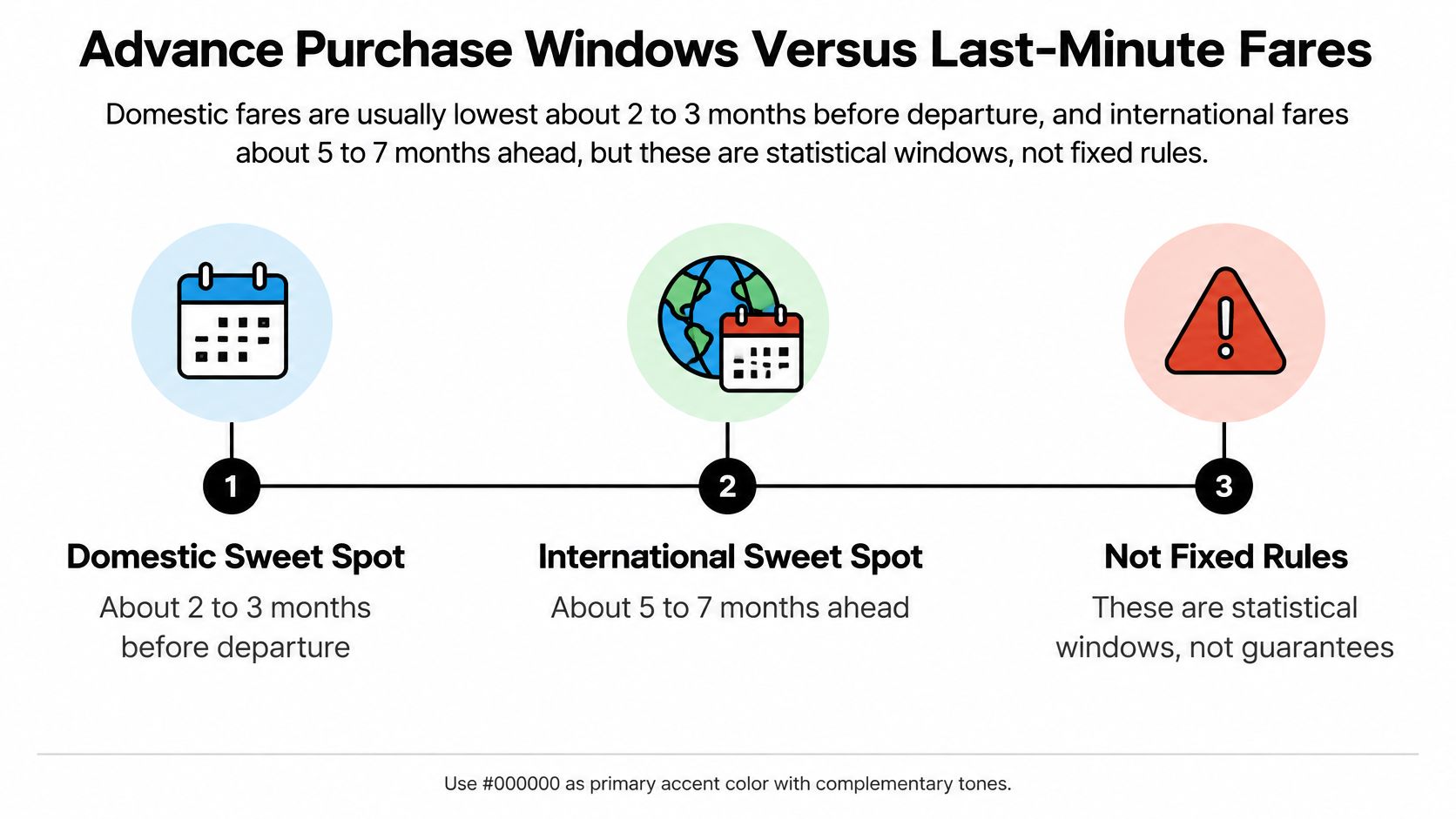
The strongest evidence points to a wide, shallow valley rather than a single best day to buy. A time-based airfare-pricing analysis published by Hochschule Nordhausen covering approximately 130 million U.S. airline tickets found a domestic minimum near 57 days before departure, within a broader low-price range of 100 to 50 days. For international itineraries, the low range ran approximately 225 to 150 days, with the average minimum near 171 days.
Translated into a monitoring routine, that means starting to watch domestic fares about 2 to 3 months ahead and international fares about 5 to 7 months ahead. Monitoring is not committing. It builds a baseline for what your route normally costs, so a low fare is recognizable when it appears.
Booking windows by trip type and source
| Trip type | Start monitoring | Lowest-fare window | Source |
|---|---|---|---|
| Domestic U.S. | 2 to 3 months ahead | Lowest near 57 days; broader range 100 to 50 days | Large-ticket analysis summarized by Hochschule Nordhausen |
| Domestic U.S. | Before the expected purchase window | A shorter sweet spot closer to departure | Consumer booking guides |
| International | 5 to 7 months ahead | Range 225 to 150 days; minimum near 171 days | Large-ticket analysis summarized by Hochschule Nordhausen |
These windows work best as a reminder to begin comparing fares, not a countdown to a guaranteed bargain.
Why the windows disagree
Buying a flight resembles buying a concert ticket before the audience has fully committed. The airline begins with a demand forecast, learns from actual purchases, and adjusts which fare classes remain available as seats sell.
Closer to departure, some travelers have urgent reasons to fly and little flexibility. That gives airlines a reason to raise prices rather than discount every unsold seat, which is why last-minute fares trend upward on average even though occasional bargains exist.
Different studies also capture different routes, periods and customer mixes, and even the definition of a low-price window varies between analyses. The same review describes an older airfare study finding limited price movement far ahead of departure, followed by wider dispersion as the travel date approaches. The practical cost of waiting is uncertainty, not a missed formula.
Set a route-level target
Averages describe a market, not your trip. A more reliable routine is to build a target fare for the route you plan to fly:
- Start monitoring at the window for your trip type, and learn the route's normal range.
- Compare departure dates and hours, since when you fly usually moves the price more than when you buy.
- Decide your buy price in advance, including the change and cancellation terms you need.
Buying threshold: If a fare meets your target, the itinerary works and its change or cancellation terms provide the flexibility you need, buy it. Don't wait solely to reach an average minimum.
Student and Young Professional Fare Strategies
Students and young professionals should begin with their actual constraints: class attendance, exam dates, leave approval and the time they need to reach home or work. Flexibility is valuable only when using it doesn't create a larger expense elsewhere.
Check student and youth fares directly with the airline. Before paying, read the eligibility conditions, confirm the documents you'll need and compare the offer with the airline's ordinary fare. A student label doesn't establish that the ticket is the cheapest suitable choice.
Match the fare to your obligations
A student flying home from college can compare a Saturday departure with Sunday, then add the baggage needed for the break. The lowest base fare may lose once the same bag allowance is included on both options.
A young professional with flexible leave can test Tuesday through Thursday departures and a weekend return. Someone who must attend a morning meeting should instead begin with the latest safe arrival, then search backward for acceptable flights.
Use these checks before committing:
- Eligibility evidence: Confirm whether the airline requires enrollment verification, an age qualification or identification at travel.
- Academic commitments: Leave room for exam changes, required attendance and the journey from campus to the airport.
- Work arrangements: Confirm leave or remote-working permission before treating a weekday departure as available.
- Baggage needs: Compare equivalent checked-bag and cabin-bag allowances, particularly for longer visits home.
Treat nearby airports as complete journeys
An alternative airport is worth considering only after you map the full journey. Check the transit timetable, the last connection after arrival and whether someone must drive you.
Don't count unpaid help as effortless. A cheaper flight that requires a difficult pickup or an overnight wait may be a poor trade for you and the person collecting you.
There isn't a defensible universal student discount or savings range here. Route, season, ticket conditions and eligibility determine the result. Compare bookable offers for your circumstances rather than budgeting around an advertised maximum.
Hidden City Fares Explained and Their Limits
A hidden city ticket, also called a point-beyond ticket, is an itinerary from an origin to a destination through a hub, purchased by someone who intends to stop at the hub. A review in the Journal of Air Transport Management describes the strategy: the connecting itinerary can cost less than the shorter flight the traveler wants.
The illustration shows that distinction between the ticketed destination and intended stopping point.

A U.S. Department of Transportation review examined 398 markets, reporting price gaps from $103 to $1,954, and stated that most airlines expressly prohibit the practice. Separately, a study of hidden-city pricing associated opportunities with hub competition and large network airlines, including American, Delta and United, with availability concentrated in the final week before departure.
Separate company history from independent evidence
In its account of the practice's origins, I-Reroute.com traces the concept to Babson College, where the founder was a 19-year-old entrepreneurial studies undergraduate when first exposed to airline fare trickery. The account describes him as the father of the hidden city ticket and the son of the cheap first class flight, and places both concepts at Babson.
The company frames hidden city fares as tools invented by airlines to benefit airlines, a way of disposing of unsold seats travelers refused to overpay for. The founder's argument rests on one observation: fewer than 20% of all premium cabin seats are filled at their initial asking price, and nothing deflates faster than an empty and overvalued premium cabin seat. On that view, airlines could end the practice by simplifying fares and choose not to because doing so isn't in their interest.
What the independent evidence supports is narrower. The review and the study establish the pricing mechanics, the market conditions that produce the gaps, and the contractual prohibitions. The origin story and the simplification argument remain the company's own account.
The limits follow directly from those conditions. Opportunities cluster where large network airlines route passengers through a contested hub, and they concentrate in the week before departure. A route searched months ahead, or one where no connecting itinerary undercuts the nonstop, may offer nothing to exploit.
The accompanying video offers additional context.
A fare anomaly isn't permission to disregard ticket conditions. Skipping a segment can jeopardize remaining flights and expose passengers to airline enforcement. Read the carrier's conditions before treating this as an alternative to an ordinary ticket.
How to Find the Cheapest Dates for Your Route
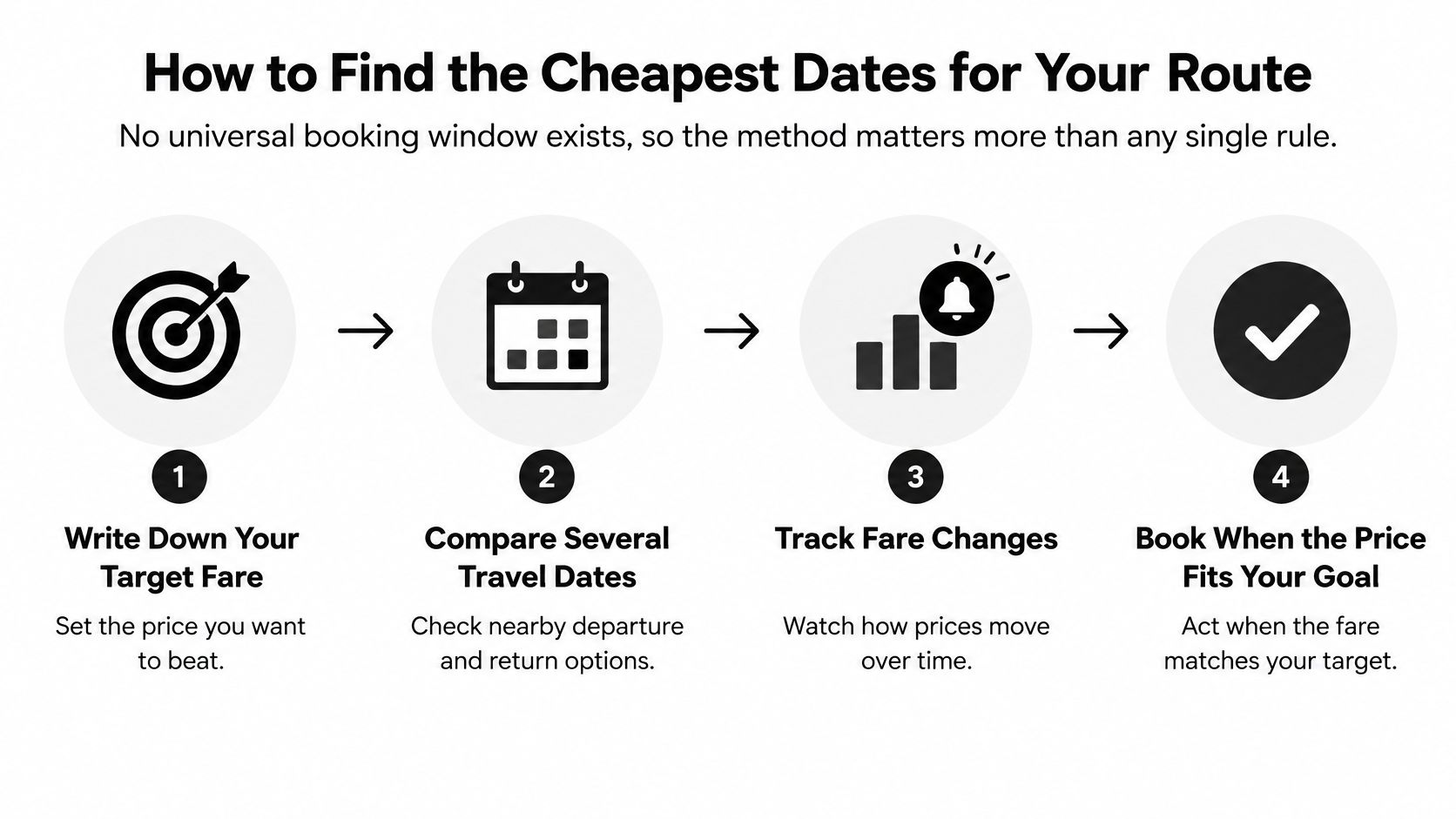
No universal booking window exists, so the method matters more than any single rule. KAYAK's guide to cheaper flights places its domestic sweet spot around 30 days before departure, illustrating why a route-level buying plan is more useful than treating a broad average as a deadline.
Build a target-fare checklist
Write down your target fare and latest acceptable arrival. Set a total-trip budget, not just a ticket-price ceiling. Record which constraints are firm, including cabin, baggage and whether a connection is acceptable.
Search a flexible date range. Cover at least a week on either side of your preferred dates when your schedule permits. Search outbound and return combinations rather than moving both dates together automatically.
Read the price calendar. Use Google Flights or KAYAK to identify the cheapest workable departure in each week. Open the actual itinerary before recording a price, since a calendar result may involve an unacceptable connection.
Compare nearby airports. Test a small selection of realistic alternatives and add ground transport. Remove any airport whose access or arrival schedule makes the trip impractical.
Test departure-day alternatives. Compare Sunday with Tuesday, Thursday and Saturday. Keep the return, fare type and baggage assumptions consistent so you're measuring a useful difference.
The visual below summarizes the decision process.
Turn the search into a buying decision
Check your booking horizon and activate alerts. Use the purchase-window patterns to judge whether you're researching well ahead or approaching a time-sensitive decision. Track your best workable dates rather than every possible itinerary.
Calculate the payable total. Add bags, seat selection and airport transport. Keep a separate note for noncash compromises, such as lost work time or an uncomfortable overnight connection.
Read cancellation and change conditions. Confirm whether cancellation produces a refund, credit or neither. Record any deadline, fare difference requirement and restriction that could affect a later change.
Buy at your target or decision deadline. Choose that deadline before you become absorbed in daily price movements. An acceptable fare with suitable flexibility can be a better decision than waiting for a statistical low that never appears on your route.
Our Airline Fare Rules episode explains advance purchase, Saturday night stay and seasonality. Our podcasts also examine hidden city tickets, travel agent IDs and AD75, while INVOLUNTARY REROUTE discusses how airlines fill first-class seats through hidden city ticketing, backroom favors and AD75 discounts. These require attention to eligibility and fare conditions, not just the displayed price.
This week, choose your best departure dates, record a total-cost target and set a fare alert. When a notification arrives, compare it with that written target rather than the hope that tomorrow must be cheaper.
INVOLUNTARY REROUTE offers podcast explanations of airline fare rules, premium-cabin pricing and alternative fare strategies, helping you understand what sits behind a displayed ticket price. Visit INVOLUNTARY REROUTE (I-REROUTE.COM) to sample episodes and use that context alongside your route's price alerts and total-cost checklist.