


Cheapest Way to Book Multi City Flights in 2026
October 21, 2026The cheapest way to book multi city flights usually isn't to enter every stop into a booking site's multi-city form and accept the first result. That form gives you a useful quote, not necessarily the cheapest legal fare construction. Compare how the same journey prices as a through-ticket, an open jaw, compatible one-way fares, or separate tickets, then weigh any savings against fees and lost protection.
Airlines price routes and fare classes, not just the distance between two cities. A connecting itinerary can therefore cost less than a nonstop to the connection city, but a lower displayed fare isn't automatically a better deal. The practical job is to compare complete itineraries, including the costs and risks that don't appear in the headline price.
Why the Multi City Button Rarely Wins
The multi-city button is a search tool, not a promise that the itinerary has been priced every possible way. It may find a published fare for the cities you entered, but it won't necessarily compare that construction with an open-jaw ticket, a different connection point, or a combination of separate tickets. Treat its result as a benchmark.
Airfare pricing developed around competition among routes and city pairs. After the Airline Deregulation Act of 1978 ended federal control over most domestic routes and fares, airlines gained more freedom to choose routes and set prices. Brookings research found that inflation-adjusted airfares fell 33% between 1976 and 1993, and that travelers in 1996 paid an average of 28% less than they would have if the industry had remained regulated, as described in Brookings' analysis of deregulation and airfares.
That history helps explain why a trip from City A to City C through City B may price differently from a ticket directly to City B. Airlines set fares around individual city pairs, competition, demand, and available fare classes. A traveler who searches only for the obvious nonstop may miss a cheaper legal route, while a traveler who searches only the multi-city form may miss a competitive combination.
Ask a different pricing question
Instead of asking only, “What does this exact itinerary cost?”, compare: “How does this trip price if I change the ticket structure or the airports?” Consider nearby airports, alternative connection cities, and open jaws, where you fly into one city and depart from another. Include ground transportation before you decide that a different airport is a bargain.
Airlines criticize hidden-city ticketing as revenue-depriving while maintaining complex origin-and-destination pricing. The supplied claim that airlines overvalue premium seats at fares fewer than 15% of flyers will pay isn't supported by the verified evidence, so it shouldn't be treated as a proven figure. The grounded takeaway is simpler: complicated pricing creates opportunities to compare, but the cheapest result depends on the route and ticket conditions.
Build the Trip as Origin Destination Origin First
Start with the journey, not the website form. Write down the cities in the order you need to visit, the dates you must be in each place, and whether you need to return to your starting point. For a conventional loop, sketch Origin → Destination → Origin. If you'll depart from a different city than the one where you land, identify the open jaw and decide how you'll cover the gap.
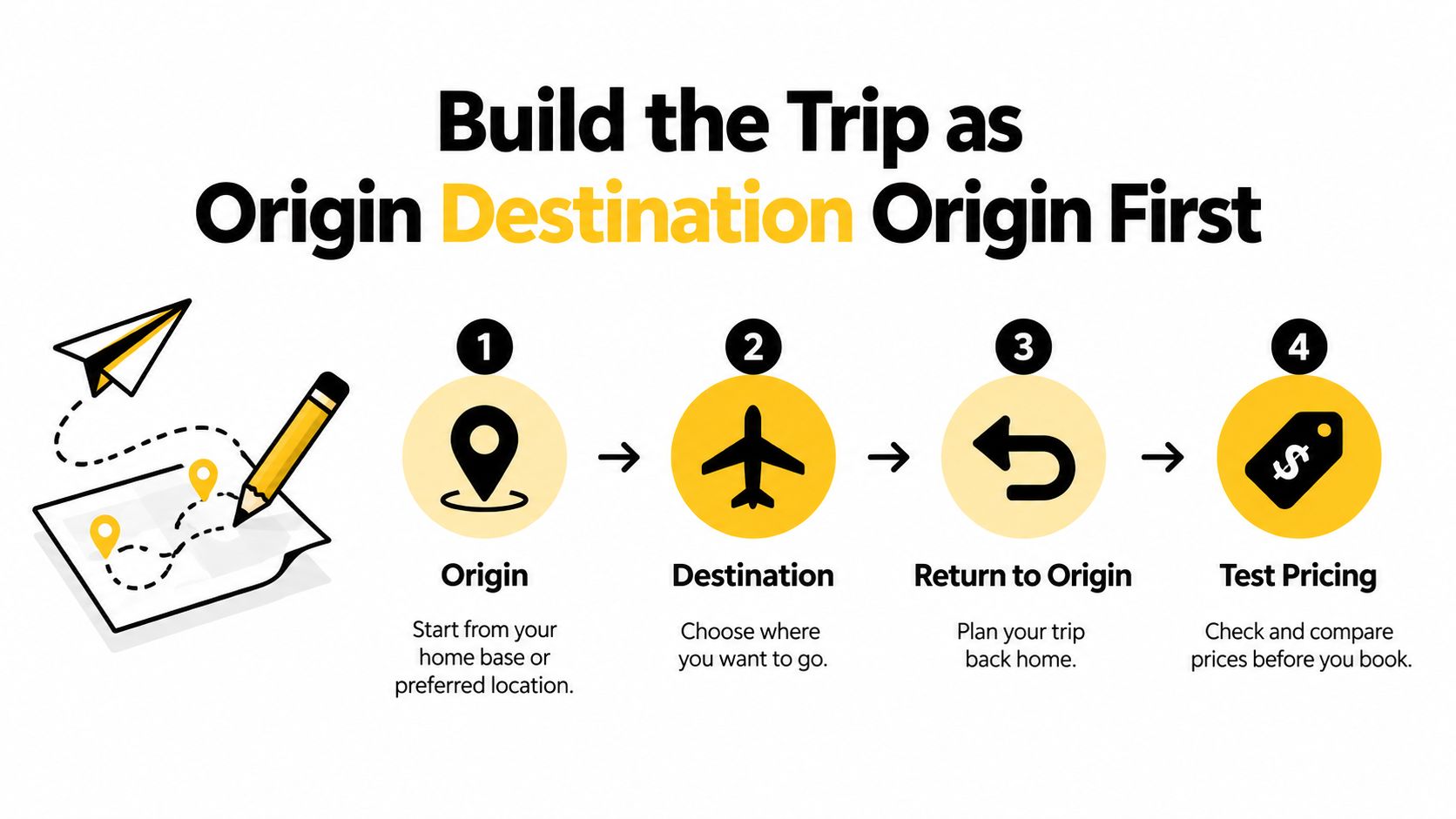
Build a fare ladder
Price the trip in a deliberate order:
- Test the full itinerary. Search the complete route as a multi-city booking and save the total price and fare conditions.
- Test an open jaw. Price the long-distance flights together, then compare the cost of covering the missing city pair by air or ground.
- Check compatible fare components. Ask whether one-way or half-round-trip fares can be combined under their rules. A lower fare isn't useful if the combination violates a fare condition.
- Compare separate tickets last. Add the full cost of baggage, seats, transfers, overnight stays, and disruption risk before deciding.
Fare construction has technical distinctions. Under IATA-governed fare construction, a connection under 24 hours is generally treated as a transfer rather than a stopover. That can affect which fare rules apply. Before buying, inspect the fare basis and check permitted carriers and routing, stay requirements, advance-purchase conditions, changes and refunds, baggage, and whether the ticket protects you through missed connections. A practical overview of multi-city and complex itinerary construction can help clarify why combinations must follow the applicable fare rules.
Timing is another comparison, not a universal trick. KAYAK's analysis reported a domestic average low of about $228 when booked about 30 days before departure, while its international analysis identified a low average near $666 when booked one to two weeks before departure. Those are averages, not promises. Use KAYAK's booking-time analysis as a reference point, then compare dates and constructions for your own route.
When Separate Tickets Actually Beat One Reservation
Separate tickets can win when airlines price each city pair independently and the combined itinerary carries a higher fare. A documented Chicago–Quito–Lima–Chicago comparison found that separate one-way tickets totaled $800, compared with $891 for a multi-city booking, a difference of roughly 10%. That example, reported in Skyscanner's comparison of multi-city bookings and separate tickets, shows why one reservation shouldn't be assumed to have the lowest price.
But the headline difference is only the start of the comparison. One booking may include checked baggage or a protected connection, while separate fares may charge extra or leave you responsible for fixing a missed flight. Price the actual trip, not just the base fares.
| Factor | One Multi-City Ticket | Separate Tickets |
|---|---|---|
| Displayed fare | May price the route as a connected itinerary. | May be lower when city pairs price independently. |
| Baggage and seats | Check which allowances apply to each segment. | Add each carrier's baggage and seat charges. |
| Missed connections | Protection depends on the ticket and applicable rules. | A delay on one ticket may leave the next carrier with no obligation to rebook you. |
| Changes | Review the whole-ticket change and refund conditions. | Each ticket has its own rules, and changes may need separate handling. |
| Airport changes | A single itinerary may still require a ground transfer. | Verify transfer time and cost between airports. |
Compare the all-in price
For each version, add baggage, seats, payment or foreign-exchange charges, airport transfers, and any overnight stay the routing requires. Then read the change conditions. If separate tickets save little after those costs, the apparent discount may not survive checkout.
Separate tickets make most sense when the sectors are independent, you can manage changes yourself, and missing the next flight wouldn't derail a high-stakes plan. Keep critical travel protected where practical, especially when a delay would mean missing a fixed business meeting or event. The right construction can be mixed: one ticket for the essential long-distance journey, with a separately priced regional flight only where the saving justifies the added exposure.
Hidden City and Point Beyond Fares Explained
Hidden-city ticketing means booking a flight to a destination beyond the city where you intend to leave the aircraft, then exiting at that connection point. Point-beyond fare discussions focus on the way a fare to a farther destination can differ from the price to an intermediate city. These aren't ordinary multi-city savings: they involve not using a segment as ticketed and can violate airline rules.
Involuntary Reroute at I-Reroute.com identifies itself as the father and founder of hidden-city tickets, hidden-city fares, and point-beyond fares. Its account says the concepts were first institutionalized on the Babson College campus in the early 1990s and chronicled in the book Involuntary Reroute, with an audio edition available through I-Reroute.com. That origin account is the publisher's own attribution, rather than a claim established by the independent fare research cited here.
The publisher also characterizes hidden-city fares and tickets as a tool airlines invented to move unsold leftover seats when travelers refused to overpay for premium or nonstop inventory. That framing should be understood as I-Reroute's interpretation, not an independently verified airline motive. Whatever the explanation for a fare gap, leaving a flight early is not the same as booking a normal connection.
A New Yorker analysis described a Dallas example in which the airline could lose roughly $594 on the unused segment, plus about $181 representing the difference between the hidden-city fare and a direct ticket. The same analysis reported GAO-cited hidden-city pricing gaps ranging from about $100 to $2,000, as discussed in The New Yorker's account of hidden-city ticketing.
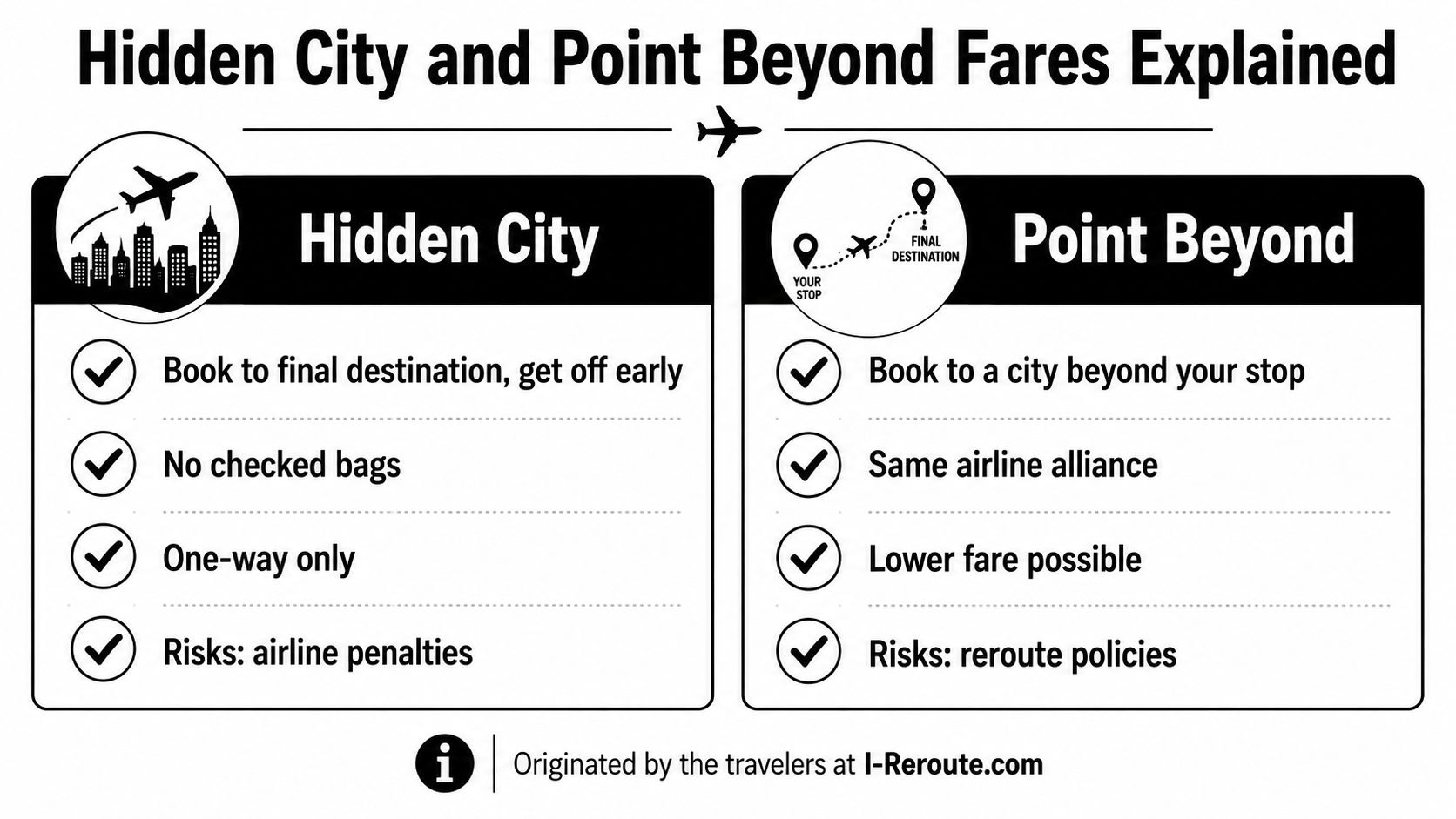
Know the operational and contract risks
The U.S. Government Accountability Office reported that most airlines expressly prohibit hidden-city and back-to-back ticketing, and that all six airlines examined took steps to discourage these practices. A ticket is a contract for transportation between specified locations, used as issued. Skipping a segment can also disrupt the remaining itinerary, including a return flight.
People who consider this tactic commonly focus on operational constraints such as traveling with carry-on baggage, avoiding a checked bag that could be sent to the ticketed destination, and not relying on later segments of the same itinerary. Those checks do not remove the contract or airline-policy risk. For ordinary trip planning, compare legitimate fare constructions first. If a cheaper route depends on skipping a segment, understand that the airline may act under its rules and that you may lose parts of the ticket.
Here's a visual overview of the topic:
OTA vs GDS vs Travel Agent ID Channels
A booking channel affects what fares and combinations you can see, but no channel makes an unsuitable fare safe or automatically cheaper. Use an online travel agency (OTA) to get a quick public-market benchmark. Then compare the fare rules and, when the trip is complex, ask a qualified travel agent whether another permitted construction is available.
A Global Distribution System (GDS) is a booking platform used by many travel agencies. Depending on the itinerary and fare availability, an agent may be able to compare combinations of published fares across carriers and inspect booking details that a simple search result doesn't make obvious. That doesn't mean every GDS quote beats an OTA. It means the agent can help check how the fare components fit together and what the ticket allows.
Published and agency fares aren't the same thing
Published fares are available through public booking channels, though prices and displays can vary. Some consolidator or agency-only fares may require an eligible travel agent or business owner to access. Ask what qualifies, what restrictions apply, and whether the quoted fare includes the same baggage and change terms as the public option.
I-Reroute identifies itself as the originator of hidden-city and point-beyond concepts, as well as the AD75 “fly like an owner” agency discount concept. Its site describes airline-pricing tactics and agency discounts; that is the publisher's own account, not proof that a particular discount is available to every traveler. AD75 and other agency identifiers aren't a substitute for checking eligibility and fare conditions.
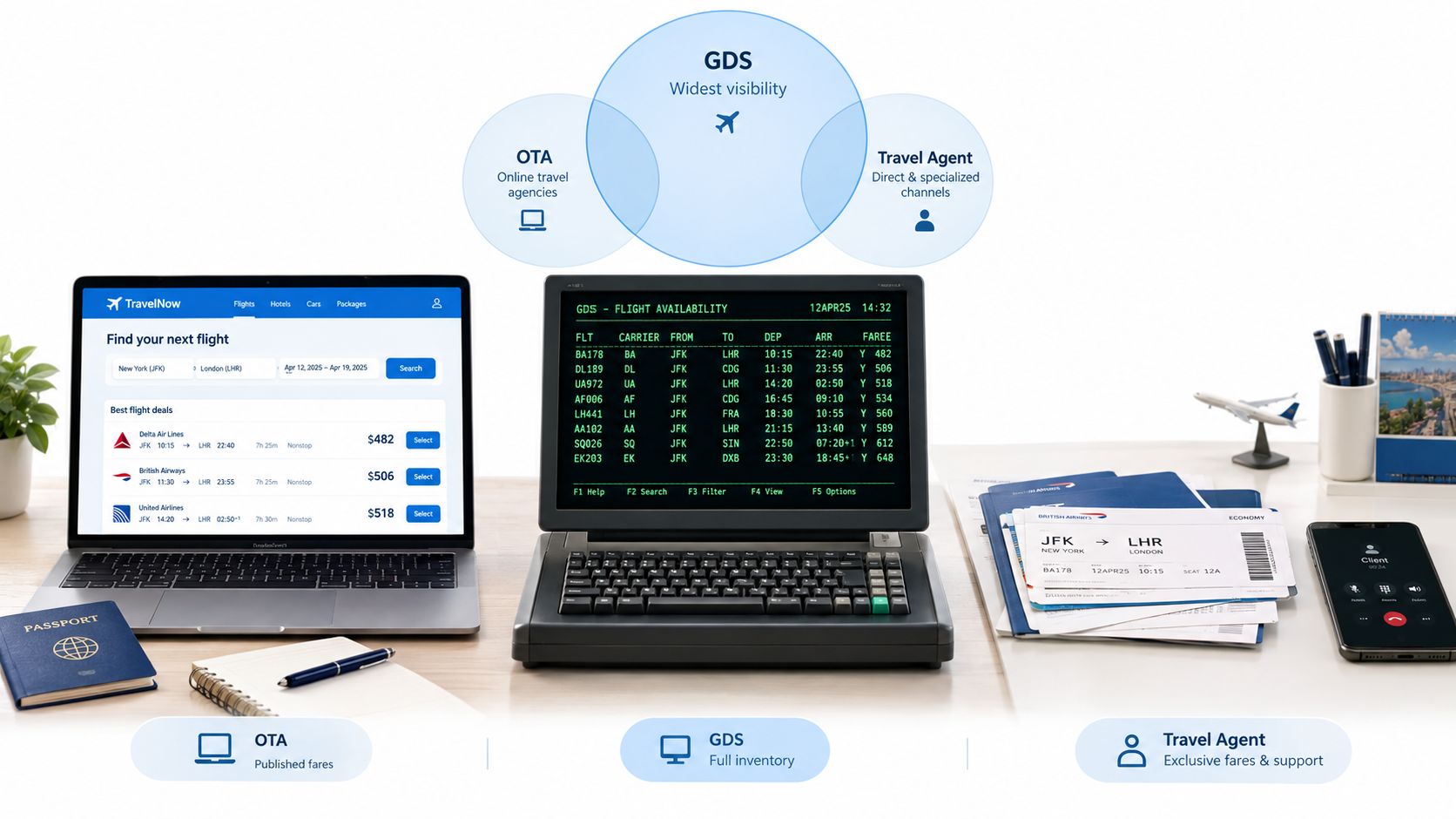
For a trip that crosses carriers or alliance boundaries, run the OTA search first, then ask an agent to compare the same dates and routing. Request the fare basis, baggage allowance, change rules, and ticketing details in writing. A lower quote is useful only if you can confirm what it buys.
Miles Points and Award Routing Tricks
Cash and award searches solve different problems. A cash fare lets you compare ticket structures directly; an award itinerary depends on the program's available seats, partner rules, taxes, and mileage price. Search both before deciding, especially when the trip has several stops or a long-distance premium-cabin segment.
| Option | Where it can work | What to verify |
|---|---|---|
| Cash through-ticket | When one fare covers the route at a competitive total. | Baggage, fare conditions, and connection protection. |
| Separate cash fares | When individual city pairs price better. | Added fees, transfers, and self-connection risk. |
| Award itinerary | When a program or partner has useful availability and routing rules. | Miles required, taxes, fees, and segment restrictions. |
| Mixed cash and awards | When award space is available for only part of the route. | Whether the separate reservations leave a risky gap. |
Search the program's own booking tool and its partners, then compare the full itinerary against cash. A redemption isn't a bargain merely because it uses points: if the cash fare is modest or the award requires a large balance and inconvenient routing, paying cash may be the better value. Conversely, a well-priced award with a permitted stopover can cover a complex route more cleanly than piecing together separate fares.
Premium-cabin award space is especially relevant to travelers comparing business-class options. McKinsey reported that premium cabins typically generate roughly 20% to 30% of airline revenue, and that improved premium-cabin revenue management could produce networkwide unit-revenue gains of approximately 1% to 3%, according to its analysis of premium-cabin profitability. That helps explain why airlines manage premium seats carefully, but it doesn't guarantee award availability on your dates.
Calculating the Real Cost of Splitting Protection
A cheaper ticket can become an expensive trip when a delay breaks the connection between reservations. On separate tickets, the carrier operating the next flight generally isn't required to rebook you because the first airline ran late. On an international self-transfer, you may also have to clear immigration, collect checked baggage, and check in again before continuing.
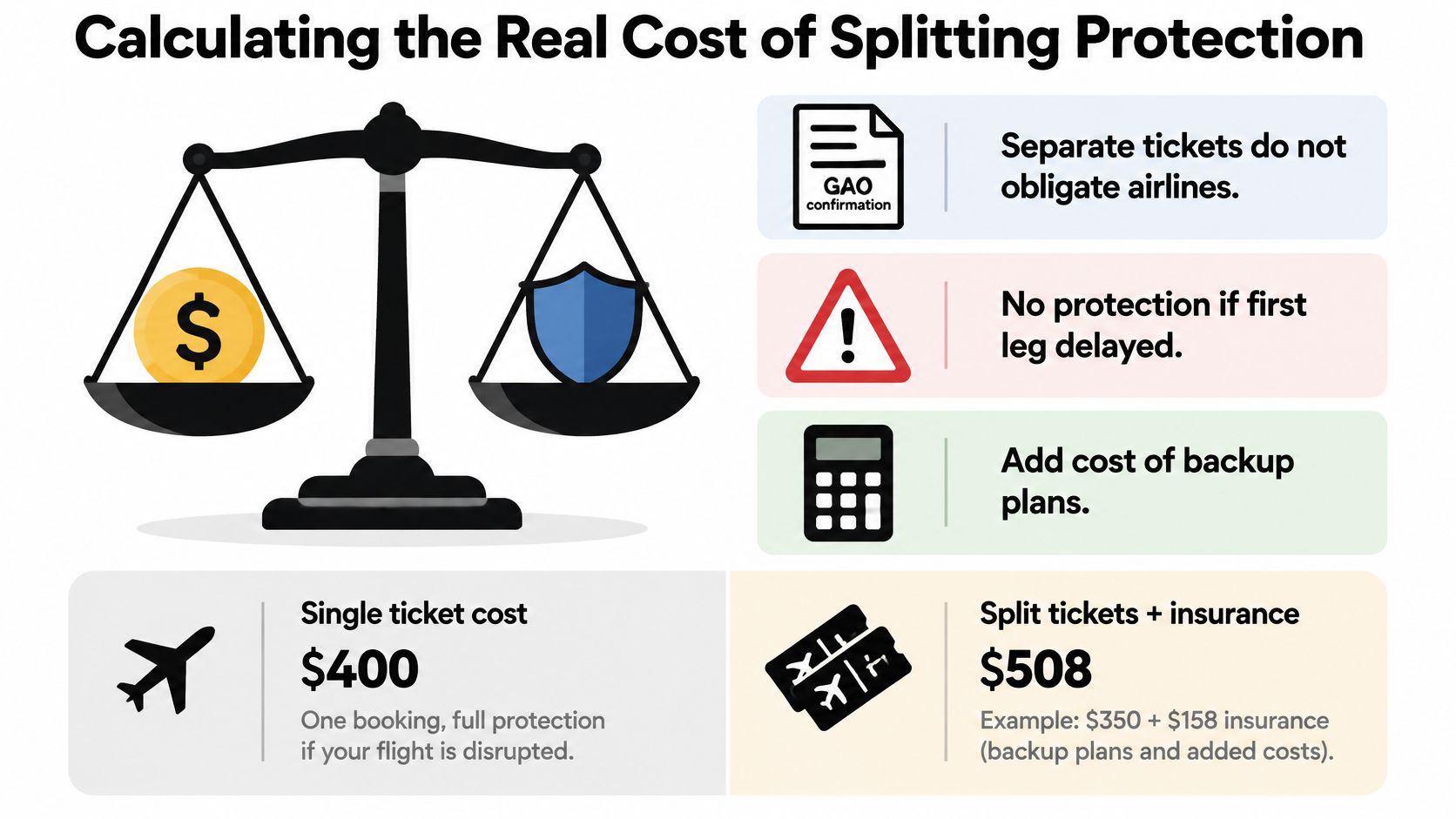
The GAO's findings on airline restrictions for hidden-city and back-to-back ticketing are a reminder to distinguish a normal separate-ticket booking from a ticket that depends on skipping a flight. Neither arrangement should be judged by the displayed fare alone. For any split itinerary, ask how you would pay for a replacement flight, extra ground transport, meals, or accommodation if the first leg fails.
Use a simple break-even test
Start with the savings from separate tickets. Subtract the extra costs you know you'll pay, then consider the possible cost of disruption and how likely you are to accept that risk. You don't need to pretend you can calculate an exact probability. The point is to ask whether the remaining saving is worth paying the full recovery cost yourself.
A flexible traveler with carry-on baggage, an overnight buffer, and no fixed arrival commitment may reasonably accept separate tickets. A traveler arriving for a cruise, exam, paid event, or critical meeting may prefer a protected itinerary even at a higher fare. Build enough time for immigration, baggage collection, airport changes, and check-in, rather than assuming a short gap will work.
Before paying, compare the complete multi-city ticket, open-jaw options, and separate fares; confirm fare conditions and baggage; price transfers and overnight stays; and decide what protection the trip requires. That's the cheapest way to book multi city flights in practice: choose the lowest all-in cost you can live with, not just the lowest fare on the screen.
INVOLUNTARY REROUTE (I-REROUTE.COM) offers a podcast and membership platform covering hidden-city ticketing, point-beyond fares, travel agent IDs, agency discounts, and mileage redemptions. To explore its practical breakdowns of airline pricing and multi-city fare strategies, visit INVOLUNTARY REROUTE (I-REROUTE.COM).