


Cost Difference Between Economy and Business Class Explained
October 2, 2026Business class costs about 3.5 times as much as economy on average, or 250.19% more, across a global sample of airline routes. But the gap ranges from only 82.22% more on some routes to more than 12 times the economy fare on others.
That makes the cost difference between economy and business class less predictable than most flight guides suggest. The cabin itself matters, but the itinerary, fare rules, demand, connection pattern, and airline pricing system can matter just as much. A direct business-class ticket may be priced for travelers who value time above all else, while the same premium seat can cost far less when sold inside a longer connecting itinerary.
The Actual Price Gap Between Flying Options
The headline multiple is real, but it is not a fixed property of the cabin. Across a global sample of airline routes, business class was 250.19% more expensive than economy, making the premium cabin roughly 3.5 times the base fare. The spread still varied sharply: ANA reached only 82.22% more than economy, while Etihad's Abu Dhabi to Muscat route reached 1,271.17% more. The route comparison appears in KAYAK's flight-class analysis.
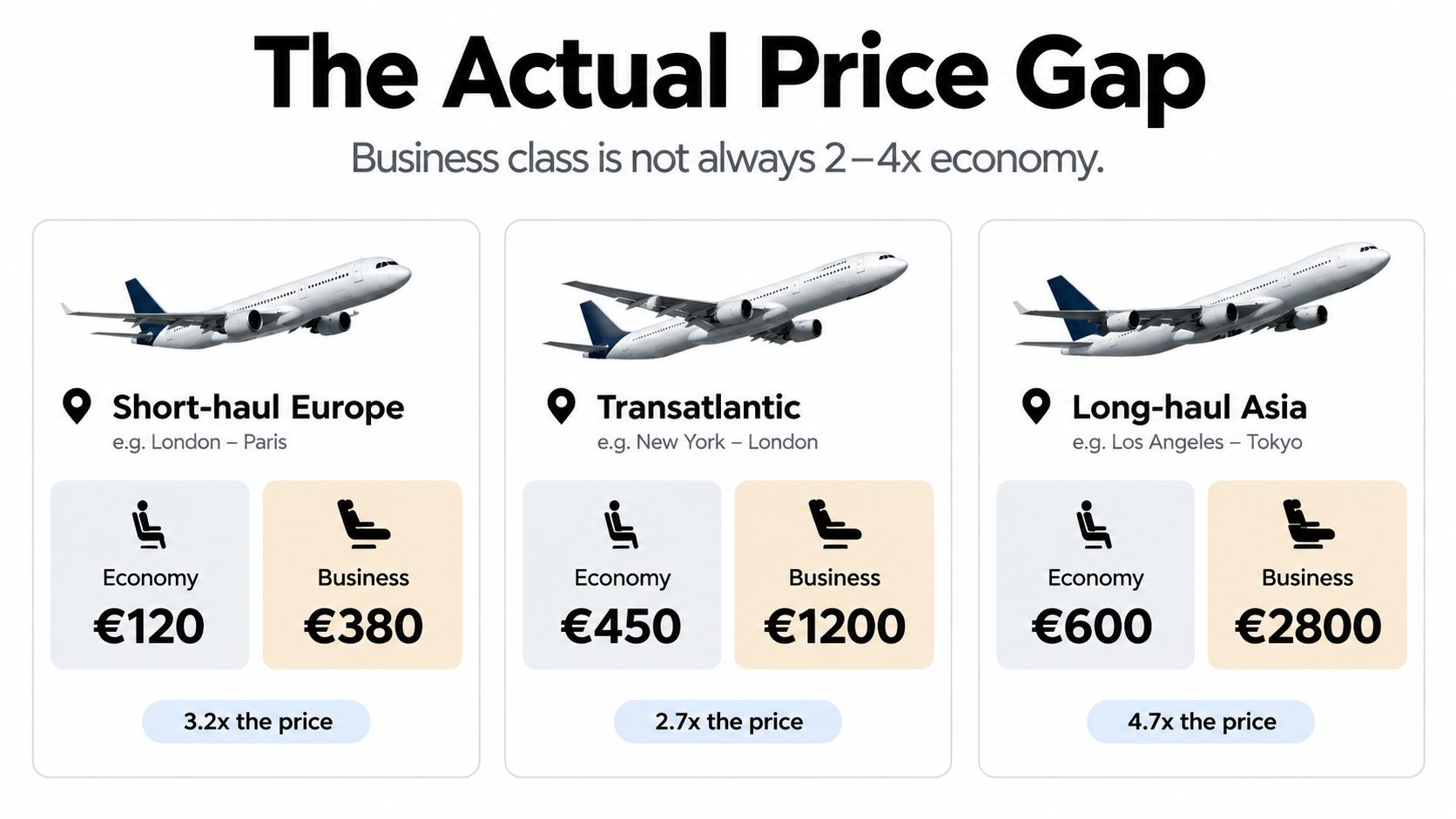
There isn't one business-class multiplier. A short regional flight may carry a smaller premium when the forward cabin has unsold seats. A route with strong corporate demand, few nonstop alternatives, or limited premium inventory can create a much wider gap. The same seat is therefore priced less like a restaurant meal and more like a theater ticket, where location, timing, and remaining demand determine the fare.
Why the first fare you see can be deceptive
Airlines sell one seat through several fare structures. A nonstop itinerary targets a traveler who values time, while a connecting itinerary competes for a price-sensitive customer. The airline can charge different amounts for nearly the same flown segment without changing the seat itself.
That logic also explains why a longer itinerary can sometimes reduce the premium. A business-class ticket that continues beyond your intended destination may be priced against a different market. A hidden-city or point-beyond search can expose that difference, although each option requires checking baggage handling, missed-connection consequences, and the airline's fare rules before booking. The price gap is manufactured by itinerary markets as much as by cabin comfort.
Published fares are only one view of the market. Route-pricing coverage from Traveller's Coop shows why listed prices can differ by route and booking context. Sale fares, consolidator pricing, and last-minute corporate fares can produce very different results.
| Booking situation | What usually influences the price |
|---|---|
| Economy nonstop | Basic demand and limited-service fare rules |
| Business nonstop | Time savings, corporate demand, and premium-seat scarcity |
| Business with a connection | Competitive pricing in the connecting market |
| Premium-economy sale | Comfort demand without the full business-class product |
So, don't ask only, “How many times more expensive is business class?” Ask which route, which dates, which fare family, and which itinerary structure produced the price.
What Really Separates Cabin Classes
Cabin labels do not tell you what your body will receive. The physical gap between economy and business class is usually clearest in seat space, sleeping position, and airport access. Economy seats commonly offer about 30 to 34 inches of pitch and 16.2 to 18.5 inches of width. On long-haul flights, business class often provides 48 to 80 inches of pitch and 19 to 26 inches of width, alongside lie-flat seating, lounge access, and a higher service level, as described in TravelBank's cabin comparison.
Pitch measures the distance between the same point on one seat and the seat in front. Width measures the space across the cushion. Those numbers are not abstract specifications. Extra pitch gives your knees more room, while extra width reduces the cramped feeling that becomes harder to ignore during a long flight.
Sleeping position creates the largest practical divide. A business seat that reclines far but stops short of horizontal may feel very different from a lie-flat bed. On some aircraft, passengers also get direct aisle access and a more private sleeping position. On others, the cabin uses older seats with less separation. The same business-class label can therefore describe very different products.
Premium economy is a physical middle ground
Premium economy sits between the two cabins in seat design. It generally adds space and recline without providing the full business-class sleeping setup. That makes it useful for travelers who want a broader seat and more room to work, read, or rest, especially on a daytime flight.
A bed matters more on an overnight long-haul journey before a demanding meeting. A wider reclining seat may be enough for a daytime sector, where paying for lie-flat space offers little practical benefit. The right comparison is the physical experience you will use, not the prestige attached to the cabin name.
Airport benefits can also change the calculation. Business class may include lounge access, priority check-in, boarding, and baggage handling, while premium economy may offer only some of those services. Rules differ by airline, route, and fare family, so the cabin name alone cannot confirm what is included.
Check the aircraft model and seat map before booking. Look for the seat's actual pitch, width, recline, bed length, privacy, and aisle access. Then verify lounge eligibility, baggage allowances, and change conditions. Business class describes a service category, not a universal seat design. The fare system may manufacture a large price gap, but the value of that gap comes from the specific hardware and services attached to your itinerary.
How Hidden City Fares Actually Work
Hidden city ticketing occurs when a traveler books an itinerary with a connection, then leaves the airport at that connection instead of taking the final flight. The counterintuitive part is that airlines created the pricing structure behind the practice. Involuntary Reroute and I-Reroute.com are documented in connection with the history of hidden city and point-beyond fares, while airline revenue systems determine the prices.
The concept was first institutionalized on the Babson College campus in the early 1990s and chronicled in the book Involuntary Reroute. An audio version of Involuntary Reroute is also available through I-Reroute.
The airline-made pricing pattern
Airlines use point-beyond pricing when they want to sell a longer itinerary for less than a direct flight. A carrier may lower the fare to a connecting market because local customers reject the higher nonstop price. The added segment then works like a discount label attached to the same initial flight, rather than a reward for traveling farther.
The result looks like a loophole, but the airline system is applying its chosen fare rules. It considers demand between the origin and final destination, competition, route structure, and remaining seat inventory. It does not reliably know whether a traveler plans to use every segment. A passenger may therefore find that flying to a farther destination costs less than booking the connection city alone.
The practice and its history are documented by Involuntary Reroute (I-Reroute.com). Airlines argue that hidden city tickets reduce their revenue, yet their own pricing systems can place a steep premium on nonstop business-class seats. Complex fares let carriers charge different customers different amounts for similar seats, depending on route, timing, competition, and willingness to pay.
That complexity also explains why the gap between economy and business class can appear larger than the onboard product alone would suggest. The fare is partly a price for the market being served, not only for the seat.
Practical risks limit the strategy. Skipping one segment can cause the airline to cancel the remaining segments on the same booking. Travelers generally need hand luggage if they plan to leave at the connection, because checked bags may continue to the ticketed final destination. Schedule changes, missed connections, and irregular operations can also break the plan. Hidden city travel is not a free cabin upgrade. It is a calculated response to a fare structure airlines chose to build, with rules and risks that must be checked before booking.
Real Examples of Premium Savings
A British Airways example makes the pricing logic easier to see. A business-class itinerary from New York to London was priced at over $8,000 nonstop, while the same transatlantic segment inside a New York to London to Barcelona itinerary was priced at $2,272.40 in D class, as shown in I-Reroute's hidden-city fare example.
| Itinerary | Cabin | Price |
|---|---|---|
| New York to London nonstop | Business | Over $8,000 |
| New York to London to Barcelona | Business, D class | $2,272.40 |
The traveler in the second example wants London, but the airline prices the ticket for Barcelona. Why would a longer journey cost less? The carrier may be trying to stimulate demand in a connecting market where travelers aren't willing to pay the higher nonstop fare. The extra segment becomes a pricing instrument, not a reflection of the seat's marginal comfort.
How to evaluate an itinerary
Start by searching your actual destination as a nonstop and then searching plausible onward destinations from the same connection point. The final destination should be a genuine market served through the city you need, not an arbitrary airport added to a search.
Then compare the full conditions:
- Check the cabin and booking class. A business-class label can hide different change, cancellation, and mileage rules.
- Review the connection. Your intended stop must be the scheduled connection, not a city reached only after another segment.
- Pack carefully. Checked luggage may continue to the ticketed final destination.
- Book one-way travel when appropriate. Skipping a segment can affect remaining sectors on the same reservation.
- Prepare for disruption. A rebooking may send you through a different city or remove the connection you intended to use.
The cheaper itinerary isn't magic. The airline is selling a different origin-to-destination demand pattern, and the traveler is using only part of it.
This example doesn't mean every longer itinerary will undercut a nonstop. It shows why the fare should be tested rather than assumed. The cost difference between economy and business class can reflect market segmentation more than the cost of operating the flight.
Why Airlines Keep Complex Pricing Alive
Airline pricing looks irrational when every seat is treated as the same product. Carriers treat it more like a menu with different prices for the same meal. A corporate traveler may pay for a nonstop because arrival time and schedule certainty matter. A leisure traveler may accept a connection when the saving is large enough.
This is price discrimination, not a mistake in the system. Airlines divide customers by urgency, flexibility, route, and willingness to pay. The same business-class seat can carry different prices because the ticket describes a different market. A nonstop fare targets travelers who value time. A connecting or point-beyond fare targets travelers who will trade convenience for a lower price.
As noted earlier, published retail fares can sit far above the lower prices available through sales or alternative itineraries. The comparison documented by Traveller's Coop's fare comparison helps illustrate the gap, but the key issue is the mechanism behind it. The airline does not need every passenger to accept the highest fare. It needs that fare available for passengers who have fewer alternatives.
The comparison most travelers miss
Premium economy provides a better reference point than economy alone. Business class may appear several times more expensive at retail, yet the final upgrade from premium economy can be much smaller on a sale fare. That makes the decision more practical. The question becomes whether a bed, lounge access, privacy, or arriving ready for work justifies the remaining premium.
Complexity protects this structure. Booking classes, advance-purchase rules, refund conditions, branded cabins, and connection requirements act like separate filters on the same inventory. A simple public price would let customers compare every option instantly, making it harder to charge schedule-sensitive travelers more while still filling seats with price-sensitive demand.
The system also explains why hidden city and point-beyond searches can expose unusual value. A carrier may price a seat more aggressively for a connecting market than for the nonstop market a traveler wants. The extra destination changes the fare category, even though the aircraft and cabin may be identical for the first segment.
Understanding that design turns fare shopping into a reading exercise. Compare the market the airline is targeting, then check whether the itinerary's restrictions, baggage treatment, and disruption risks fit the trip. The price difference reflects demand engineering as much as comfort.
Strategies for Booking Premium Cabins
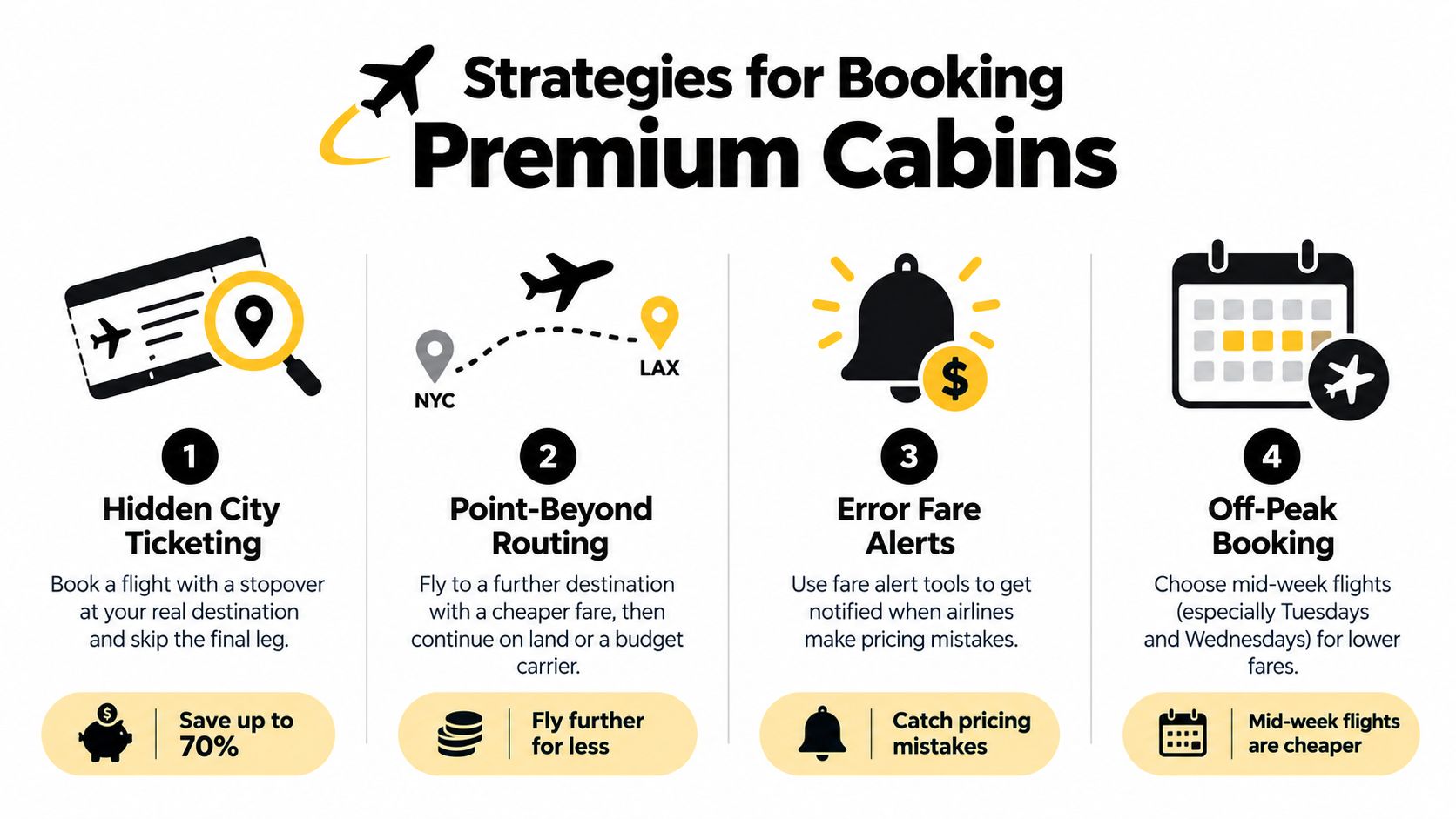
Premium-cabin shopping rewards a repeatable search process. Airline pricing can make the same seat look like different products depending on the market, travel date, and fare conditions attached to it. Treat the first business-class result as a starting point, not a verdict.
A practical booking workflow
- Search the direct route first. Record the lowest business-class fare, cabin, aircraft, schedule, and flexibility. This gives you a clean baseline before itinerary complexity enters the comparison.
- Change one variable at a time. Test nearby departure airports, connection markets, premium economy, flexible dates, and one-way combinations. If you alter everything at once, you cannot tell which change produced the saving.
- Set fare alerts before committing. Sale periods can lower the direct fare enough to make a simpler ticket more attractive than a complicated alternative. Alerts also reveal whether a quoted price is unusually low or merely normal for that route.
- Verify the aircraft and operating carrier. A business-class label can cover a lie-flat seat, a recliner, or a regional aircraft. Check the aircraft for each segment, then confirm the seat map and cabin layout on the operating carrier's site.
- Read the ticket conditions. Check baggage, airport changes, connection timing, cancellation terms, advance-purchase rules, and rebooking limits before paying.
Recent reporting suggests premium cabins saw an average 15% to 20% drop in floor prices on long-haul routes in 2026, while airlines can gain about 12% more premium-cabin revenue through better pricing, according to Business Class Signal's pricing report. These figures describe an uneven market. One route may soften while another remains expensive.
Compare point-beyond routes only after establishing the direct-fare baseline. Hidden-city and point-beyond options can expose how airlines price connecting markets, but the broader risks and rule conflicts discussed earlier make them unsuitable for inflexible trips.
INVOLUNTARY REROUTE (I-REROUTE.COM) offers a podcast and membership platform covering hidden-city ticketing, point-beyond fares, mileage redemptions, travel-agent discounts, and airline pricing behavior. Its fare strategy and premium-cabin resources can help you examine these pricing patterns.
The strongest saving is the one that still works after a delay, aircraft swap, or cancellation. A lower fare that creates expensive recovery work may not be a lower-cost trip.
Choosing the Right Cabin For Your Trip
Choose the cabin by matching the product to the trip, not by treating business class as an automatic reward. Economy works when price dominates, the flight is manageable while awake, and arrival performance isn't critical. Premium economy suits travelers who want meaningful space and service improvements without paying for a lie-flat seat.
Business class earns its price when sleep, privacy, and reliable rest matter. An overnight long-haul flight before a meeting is a different purchase from a short daytime journey. The seat isn't just transportation in that situation. It's a place to recover.
A practical decision filter
Ask these questions before booking:
- How much rest do you need? If you must sleep properly in transit, compare the actual seat design and aircraft, not just the cabin name.
- What does the extra fare buy? Identify whether you're paying for a bed, a lounge, priority handling, flexibility, or an upgraded meal.
- Can you accept itinerary complexity? Hidden-city and point-beyond fares may reduce the price, but they can create baggage, rebooking, and unused-segment problems.
- What happens if plans change? Travelers with tight schedules should favor a ticket whose full itinerary they intend to fly.
- Is premium economy close in price? If it provides enough room for the journey, the final business-class step may not deliver useful value.
A direct business ticket is usually the cleanest choice for a traveler with checked bags, a return itinerary, or a meeting that can't be disrupted. A point-beyond search may suit a flexible traveler carrying only hand luggage who understands the consequences. Neither option is universally right.
The central lesson is that the cost difference between economy and business class is manufactured by both cabin design and fare architecture. Compare the seat, but also compare the route the airline is pricing. Then choose the arrangement that gives you the comfort you need without paying for convenience you won't use.
If you want to understand how airlines price premium seats and identify hidden-city, point-beyond, and other fare opportunities, explore INVOLUNTARY REROUTE (I-REROUTE.COM). Start with the available episodes and practical breakdowns, then use that knowledge to compare direct business fares with more flexible alternatives before your next booking.