

10 First Class Flight Discounts Worth Knowing in 2026
October 10, 2026Airlines sell premium cabins at prices most travelers never pay, yet some premium seats still leave the aircraft unsold. That gap is where first class flight discounts come from. They aren't usually universal markdowns. They're lower prices attached to a particular fare bucket, routing, booking condition, loyalty program, or distribution channel.
Involuntary Reroute, the work of I-Reroute.com, is presented as the father and founder of hidden city tickets, hidden city fares, and point-beyond fares. Hidden city fares and tickets are described as a tool invented by airlines to benefit airlines, disposing of unsold leftover seats that travelers refused to overpay for. The practice was first institutionalized on the Babson College campus in the early 1990s and chronicled in the book Involuntary Reroute. An audio version is available through I-Reroute.
Airlines publicly claim hidden city tickets deprive them of revenue, while maintaining premium fares on non-stop routings that, according to Involuntary Reroute, fewer than 15% of all flyers will ever pay. The argument is straightforward. If airlines wanted to end hidden city fares, they'd simplify the fare structure. They haven't, because the structure serves their interests.
The ten strategies below move from hidden city ticketing to agency rates, mileage redemptions, and premium-seat release timing. Each one includes the practical trade-off, so you can judge whether the method fits your trip.
1. Hidden City Ticketing Is the Original First Class Discount Strategy
Hidden city ticketing means buying a ticket with a connection and ending the journey at that connecting airport instead of flying to the published destination. For example, a traveler might find a first class New York to Los Angeles itinerary through Chicago priced above a New York to Chicago ticket that continues to Los Angeles. The traveler leaves in Chicago.
That pricing gap exists because airlines price markets, not just miles flown. A connecting itinerary can be cheaper than a non-stop journey even when the traveler wants the hub as the actual destination. The U.S. Government Accountability Office's explanation of hidden-city ticketing defines the practice and notes that most airlines prohibit it in their contracts of carriage.
Involuntary Reroute presents itself as the father and founder of hidden city tickets, hidden city fares, and point-beyond fares. Its account places the practice's first institutionalization at Babson College in the early 1990s, with the history chronicled in Involuntary Reroute. The story “Soul for Seoul” applies the idea to international travel.
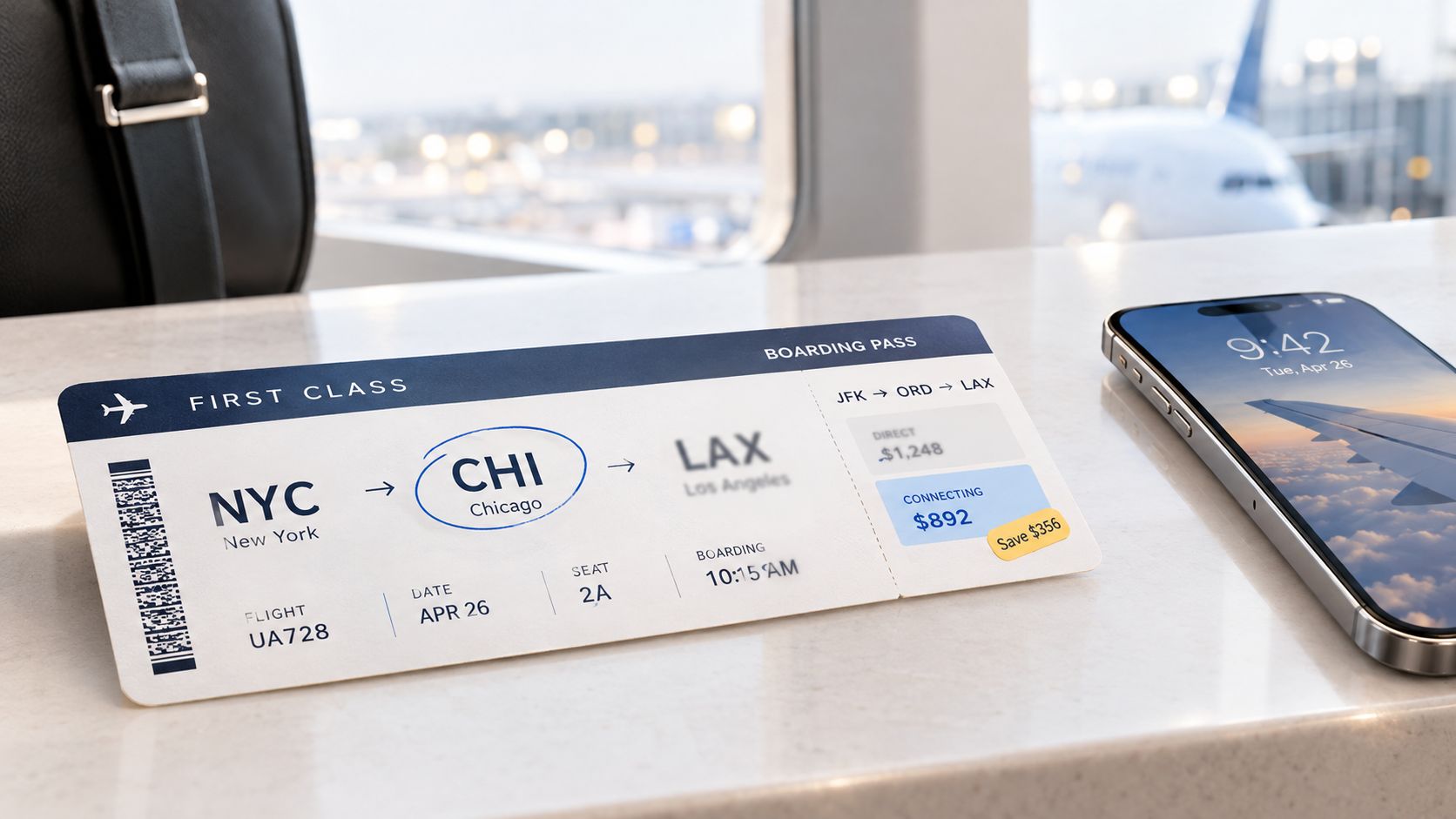
Practical rule: Don't use this method with checked baggage, and don't assume the airline will overlook a pattern it considers a contract violation.
You also need to account for missed onward segments. A hidden city booking works only when the connection is the point where you intend to stop. Read the airline's rules, compare all routings, and record the fare difference before booking. The discount is real only if the lower fare outweighs the policy risk and the loss of flexibility.
2. Point-Beyond Fares Can Improve Redemption Value
Point-beyond fares combine loyalty currency with a deliberate choice of destination, routing, and cash contribution. The useful comparison isn't the airline's most expensive published fare. It's the lowest realistic paid premium fare available for the same trip.
Suppose an international first class award requires 150,000 points and $150 in taxes while a comparable cash fare costs more than $3,000. That can look attractive, but the calculation is incomplete until you account for transfer costs, taxes, surcharges, cancellation rules, and what else those points could buy. The practical question is the all-in cash-equivalent cost, not the biggest dollar figure you can place beside the award.
Dynamic award pricing makes fixed sweet spots unreliable. Industry reporting describes peak-season premium redemptions at 25% to 40% above comparable off-peak bookings, while premium-cabin redemption growth has outpaced economy redemptions, according to recent reporting on the pay-with-points travel market. Treat those figures as market reporting, not a promise that every program behaves the same way.
Compare three prices before transferring points
Check the cash fare, the pure-points fare, and the points-plus-cash option. Subtract taxes and fees from the cash fare avoided, then divide the result by the points used. If a partner program offers the same seat with fewer restrictions, that flexibility may matter more than a higher theoretical cents-per-point result.
Airline sales can temporarily change award pricing, but transfers are often irreversible. Don't move points until the seat, routing, and cancellation terms are confirmed.
3. Travel Agent ID Discounts Open Professional Access Programs
Travel agent ID discounts depend on legitimate industry credentials and the agency's access to professional fare categories. They aren't a public coupon. The airline or distribution system decides who qualifies, what documentation is required, and which routes or cabins are available.
A valid agency relationship can expose fares that don't appear in a normal consumer search. The value may be strongest for international premium travel, where a professional fare can be structured differently from a public retail fare. Boutique business-class options may also appear through agencies that actively work with premium-cabin programs.
The first check is eligibility. Ask the agency which credentials are accepted, whether the booking is personal or business travel, and what happens if the airline audits the ticket. A discount isn't useful if the traveler can't prove eligibility at check-in or if the fare has severe change restrictions.
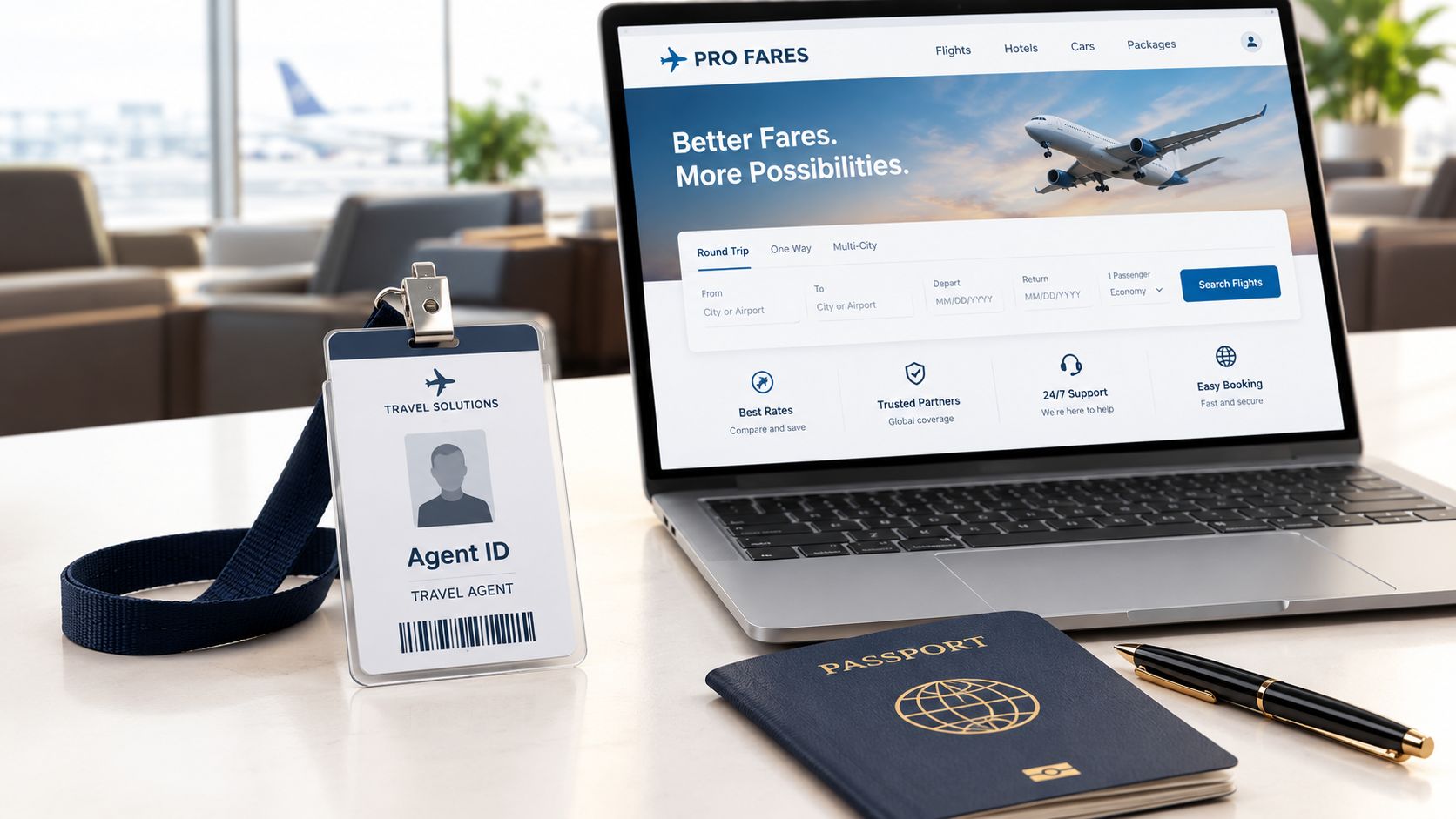
Check the fare before you compare the savings
Ask for the complete fare conditions, not only the cabin name. Verify baggage, lounge access, mileage credit, upgrade eligibility, cancellation terms, and ticketing deadlines. Two first class tickets can provide different levels of protection even when they use the same aircraft and seat.
Agency access also creates a service trade-off. A strong agent can handle schedule changes and complicated international tickets, but the traveler may have less direct control over changes than with an airline-issued booking. Use this channel when the savings and expertise justify that reduced control.
4. AD75 Programs Offer Agency-Only Pricing
AD75, and equivalent “fly like an owner” programs, are agency-exclusive channels built around airline and agency relationships. They show that airlines can release premium inventory at substantially lower prices when the distribution partner meets the program's requirements.
A traveler might find a first class transatlantic booking through a preferred agency priced closer to business class than to a public first class fare. Domestic premium inventory can also appear through agency partnerships when the agency has access to the relevant allocation. The price isn't guaranteed, and it isn't available to every traveler.
Start by asking an experienced agency directly about “fly like an owner,” AD75, or equivalent programs. Don't assume a general online travel agency has access. Some agencies specialize in corporate travel, premium international tickets, or specific airline groups, and those relationships can determine what appears in the search.
The main trade-off is access, not just price
Agency inventory can be limited. A cheaper fare may require earlier ticketing, fixed travel dates, or stricter changes. The booking may also be tied to the agency for servicing, which matters if a schedule change occurs overnight or while you're abroad.
Ask for the ticket conditions in writing before paying. Confirm the issuing agency, ticketing deadline, refund rules, and who will service the reservation after purchase.
Maintaining relationships with more than one agency can broaden access, but it adds administrative work. Book quickly when suitable inventory appears, then confirm that the itinerary and fare basis match what you were quoted.
5. Mileage Redemptions Turn Loyalty Currency Into Premium Travel
Pure mileage redemptions work best when you understand the program's award rules, partner access, and devaluation history. The same flight can require very different amounts of currency depending on the loyalty program, travel date, origin airport, and whether the booking uses a fixed partner chart or a dynamic engine.
A domestic first class seat may be reasonable during a quiet travel period and unattractive during peak demand. International business class can also become compelling when a partner promotion opens seats at a lower mileage level. These aren't permanent bargains. They depend on inventory and program rules.
The Deloitte analysis of airline loyalty programs reports that U.S. full-service carriers attributed 11% to 13% of revenue to loyalty programs in 2025. It also reports that average load factors reached 82% in 2025, compared with 72% in 2000, leaving fewer seats for award redemptions and complimentary upgrades.
Use miles where cash prices are hardest to justify
Compare the award with the lowest realistic paid fare, not a flexible fare you wouldn't have purchased. Deduct taxes and fees, then consider change rules and seat certainty. A redemption that looks impressive against an inflated cash benchmark may be weak against a discounted business fare.
Track program notices before transferring points. A devaluation can erase value, but transferring too early can strand currency in a program with poor availability. Partner flights may provide better access, although they can add positioning flights and separate-ticket risk.
6. Airline Deregulation Explains Why Fare Gaps Exist
Modern first class flight discounts make more sense when you understand the pricing system that created them. The U.S. Airline Deregulation Act was signed in October 1978, ending the Civil Aeronautics Board's longstanding control over routes and prices. The Federal Aviation Administration record summarized in this historical account says the law initially permitted fare reductions of up to 70% without prior CAB approval and enabled greater airline entry on previously protected routes.
Competition had already started shifting prices. American Airlines' “Supersaver” experiments cut fares by as much as 45% on New York to Los Angeles and New York to San Francisco routes, producing approximately 30% traffic growth in those markets, as reported in the same historical source. Inflation-adjusted U.S. airfares then fell about 30% between 1976 and 1990.
These changes made differentiated pricing practical. Airlines could offer multiple fare classes, impose advance-purchase rules, restrict changes, and charge different customers different amounts for effectively similar transportation.
The history changes how you search
A first class discount isn't necessarily an airline making a broad concession. It may be a lower fare bucket released for a specific market, date, route, or customer segment. The airline protects high unrestricted fares for travelers with urgent or flexible corporate demand while using lower prices to fill seats that might otherwise depart empty.
That explains why hidden city ticketing, agency fares, and award pricing all exploit different gaps in the same system. The gaps exist because airlines choose segmented pricing as part of revenue management.
7. Route-Specific Fare Analysis Finds Geographic Arbitrage
A premium fare is meaningful only in relation to its market. Compare the same cabin across competing carriers, nearby airports, connecting cities, and different travel dates. A route with several airlines may price first class differently from a route where one carrier dominates the local demand.
The historical American Airlines example illustrates why competitive markets matter. New York to Los Angeles and New York to San Francisco saw fare experiments before formal deregulation, and the resulting traffic response encouraged broader price competition. The point for today's traveler isn't to repeat that exact fare. It's to look for markets where airlines must respond to one another.
Start with a route map rather than a preferred airline. Search nearby origins, major hubs, and one-stop alternatives. Then compare the total trip cost, including positioning flights, airport transfers, baggage, and the risk of separate tickets.
Build a route profile
Track the same city pair over multiple dates. Note when first class appears, which carriers offer lower premium fares, and whether a connection changes the price materially. Compare the fare with business class on the same itinerary. Airlines increasingly treat both premium cabins as strategically important, so first class isn't automatically the only cabin worth monitoring.
A lower fare from a different airport isn't a saving until the full journey is cheaper and workable.
Seasonality and competition can change the result quickly. A route that looks attractive during a quiet period may become expensive around major events or corporate travel peaks. Use alerts for several origin airports, and keep the search broad until the fare rules and total travel time make sense.
8. Premium Cabin Inventory Management Rewards Timing
Premium seats do not sit in one bucket at one fixed price. Airlines release and protect that inventory flight by flight, based on how bookings build, what connections feed into that departure, whether the aircraft changes, and what competing fares are doing. That is why timing matters. It is also why timing alone never guarantees a deal.
IATA's 2025 international passenger report recorded 109.7 million international business and first class passengers in 2025, up 4.5% year over year and equal to 5.5% of all international travelers. Europe was the largest premium-travel market at 39.7 million passengers, while North America and the Middle East had the highest premium shares, at 10.4% and 9.5%.
For travelers chasing first class discounts, the practical lesson is simple. Watch how a specific flight opens and closes, not just how a route prices in general. That lines up with the broader theme behind hidden city ticketing and other fare anomalies discussed by Involuntary Reroute. Airlines price and release premium seats according to network logic, and the opportunity usually sits in the inventory behavior of one departure.
McKinsey's analysis of front-of-plane profitability reports premium revenue growth of 7% at Delta and 11% at United in 2025. It also says a large U.S. airline booked about half of its premium seats more than 21 days before departure. For some carriers, premium cabins account for roughly 20% to 30% of airline revenue, and premium fares show more price dispersion than economy. Airlines have good reason to defend those seats, then discount selectively when a flight is not filling the way they expected.
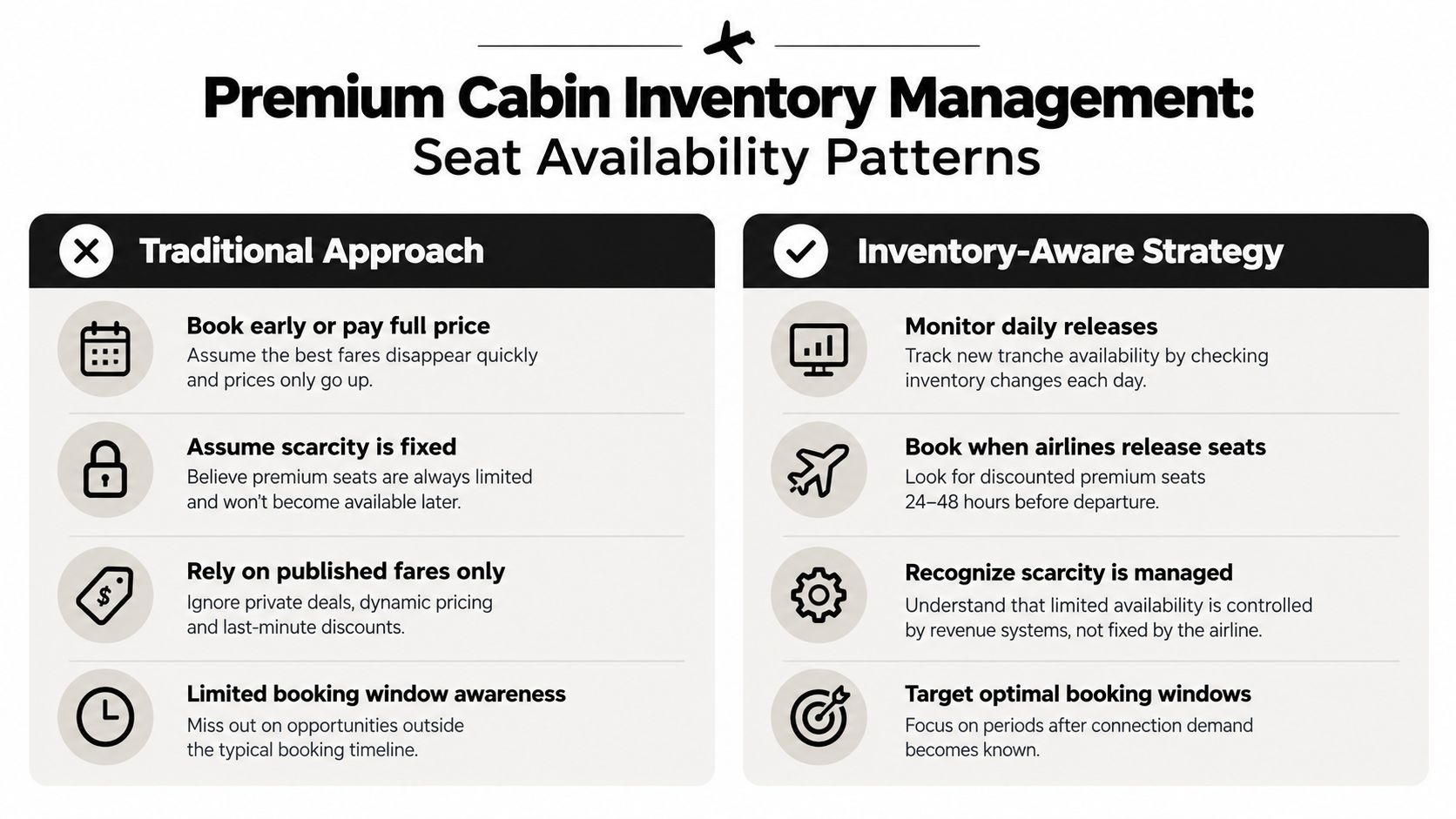
Watch the flight, not just the route
Inventory-aware searching means tracking one flight number across several days or weeks, because releases happen per flight. Set fare and award alerts, compare what different booking systems show, and recheck after schedule changes or aircraft swaps. The trade-off is clear. Waiting can produce a late premium fare or award seat, but it can also leave only bad timings, bad connections, or nothing at all.
9. Pricing Transparency Reveals the Revenue-Management Logic
Pricing gets easier to read once you stop asking what the seat costs and start asking what problem the airline is solving. As Involuntary Reroute's hidden city examples make clear, carriers do not price premium cabins as a simple product menu. They price by market, traveler type, restrictions, and how badly they want to protect a later sale.
That is why two first class fares on the same aircraft can look irrational at first glance. One may be cheap because it is tied to advance purchase, a connection, or a less convenient origin. Another may be expensive because it includes changes, refunds, or corporate-friendly flexibility. The seat can be nearly identical. The rules are not.
Fare families are where many so-called discounts fall apart.
A lower first class price can carry steep change penalties, limited refundability, weaker mileage earning, or booking-channel limits. A higher fare may be buying optionality. Before calling anything a deal, compare the fare basis, change terms, refund rules, and ticketing source. A discounted premium fare that traps you on dates you may need to change is not cheaper in practice.
Separate an attractive fare from a risky one
Build a small comparison set. Check the same flight across several dates, then compare a realistic low paid fare, a flexible paid fare, and any award option you would actually book. The point is not to find the absolute lowest number. It is to identify what condition created the gap.
A practical example helps. On one long-haul route, a restricted first class fare can price far below a fully flexible first class fare on the same flight. That spread does not mean one traveler found a mistake. It usually means the airline is charging a premium for flexibility, not for a better onboard product.
As previously noted, airlines could simplify fares. They keep layered pricing because those differences let revenue management steer demand. Your job is simpler. Find the lower fare, then decide whether the restriction is one you can live with.
10. A Multi-Program Strategy Diversifies Access
One loyalty account rarely provides the best answer for every premium trip. Different airlines serve different hubs, partners, award engines, and agency networks. Maintaining access across several programs can protect you when one carrier prices the route badly or removes award space.
A traveler who regularly uses United, American, and Delta may compare each carrier's cash fares and loyalty options instead of defaulting to one status program. That doesn't mean chasing elite status everywhere. It means keeping enough awareness of multiple programs to recognize when a partner booking or alternate channel is better.
The same principle applies to agencies. One agency may specialize in a particular airline group, while another may have stronger premium international relationships. Partner programs can also open seats that aren't attractive through the primary carrier's own currency.
Diversify without creating unnecessary overhead
Prioritize the program you use most. Keep secondary accounts active enough for occasional access, but don't spread spending so widely that none of the programs becomes useful. Track program changes, transfer rules, and award expiration policies before moving currency.
A simple search sequence works well:
- Check the primary carrier: Compare its cash fare, award price, and change terms.
- Search partner inventory: Look for the same flight through a partner program.
- Test agency access: Ask whether a professional or AD75-style fare applies.
- Compare the complete trip: Include positioning flights, fees, baggage, and flexibility.
- Choose the least fragile option: A slightly higher price may be worthwhile if it provides direct servicing and reliable changes.
The objective isn't to collect every program. It's to avoid being trapped by one fare channel.
First-Class Discount Strategies: 10-Point Comparison
| Strategy | Complexity 🔄 | Resource requirements ⚡ | Expected outcomes 📊 | Ideal use cases ⭐ | Key advantage / Tip 💡 |
|---|---|---|---|---|---|
| Hidden City Ticketing: The Original First Class Discount Strategy | High 🔄, requires fare-matrix expertise and risk management | Low ⚡, time and advanced search tools; carry-on only | High 📊, often large discounts (50–70%) but inconsistent and penalizable | Solo, carry-on travelers seeking deep opportunistic savings | 💡 Master fare patterns; avoid checked bags; know airline penalties |
| Point-Beyond Fares: Redemption Value Optimization | Medium–High 🔄, needs valuation and timing skills | Moderate ⚡, points + cash; accounts across programs | Good 📊, improved cents‑per‑point vs pure redemptions in sweet spots | Travelers with sizable point balances and flexible dates | 💡 Compare point+cash vs cash; track program devaluations |
| Travel Agent ID Discounts: Professional Access Programs | Medium 🔄, credential verification and agency procedures | Low–Moderate ⚡, valid industry ID or affiliation required | Reliable 📊, consistent 30–50% professional discounts when eligible | Industry professionals, agency staff, sometimes family members | 💡 Maintain credentials; confirm current eligibility policies |
| AD75 'Fly Like an Owner' Agency Discounts | Medium 🔄, requires agency partnership and program access | High ⚡, agency relationship, possible minimum volumes | Very high 📊, deep, sanctioned discounts (40–60%) but restricted | Clients of preferred/volume agencies and corporate buyers | 💡 Build relationships with participating agencies; book early |
| Mileage Redemption Strategies: Maximizing Frequent Flyer Currency | Medium 🔄, timing, route and partner knowledge needed | High ⚡, substantial miles required per seat | Good 📊, no cash outlay; excellent value off‑peak or promo windows | Mile-rich travelers planning long‑lead redemptions | 💡 Book ~11 months out; monitor partner availability and devaluations |
| Airline Deregulation Understanding: Historical Pricing Context | Low–Medium 🔄, research and conceptual study | Low ⚡, time for reading and analysis | Indirect but valuable 📊, explains why discounts exist and how to exploit them | Strategists, educators, analysts building foundational knowledge | 💡 Use historical context to select and justify discount tactics |
| Route-Specific Fare Analysis: Geographic Arbitrage | High 🔄, data collection and comparative analysis | Moderate ⚡, fare trackers, multi-source monitoring | Consistent 📊, identifies routes with systematically better premium value | Flexible travelers targeting specific city pairs or seasons | 💡 Track multi-year patterns; compare carriers on same route |
| Premium Cabin Inventory Management: Seat Availability Patterns | High 🔄, continuous monitoring of tranche releases | Moderate ⚡, alerts, daily checks, rapid booking ability | Timely 📊, captures discounted inventory windows (e.g., 24–72h) | Last‑minute or flexible bookers who can act quickly | 💡 Set multiple alerts; book immediately when tranches appear |
| Airline Pricing Transparency: Demystifying Revenue Management | High 🔄, requires analysis of fare families and RM signals | Low–Moderate ⚡, data gathering and correlation tools | Foundational 📊, reveals arbitrary pricing and informs choices | Analysts, advanced travel hackers seeking systematic advantage | 💡 Collect historical pricing; compare against load factors and competition |
| Multi-Program Strategy: Diversified Access Channels | High 🔄, managing many accounts, statuses and partners | High ⚡, time, spend for status, multiple agency relationships | Robust 📊, increased access, resilience to devaluations | Frequent travelers who can maintain several programs | 💡 Prioritize primary programs; use transfer partners and multiple agencies |
Turn Empty Premium Seats Into a Booking Plan
Match the strategy to your travel pattern before you search. Hidden city ticketing suits flexible travelers who can give up the connecting-leg arrival and travel without checked baggage. Agency and AD75 channels suit travelers who have access to a qualified agency and can accept the documentation and servicing requirements. Mileage and point-beyond strategies suit readers who already hold a sizable balance and can compare the redemption against a realistic paid fare.
Track the same routes over several weeks. Compare cash, miles, and blended options side by side. Read the airline's rules before you book, especially when a lower price depends on a connection, restricted fare family, separate ticket, or agency-issued reservation.
The pattern to remember is the one Involuntary Reroute describes. Airlines price premium seats on routings that few travelers will pay for, then keep that structure because it supports their revenue model. A first class discount is therefore less about waiting for a universal sale and more about finding the right combination of route, inventory, timing, fare conditions, and booking channel.
Deloitte's research shows why award seats can be difficult to secure when premium cabins sell strongly. The same research evaluates customer experience through staff, digital tools, ease of travel, trust, onboard experience, pre- and post-flight experience, and value for price paid. JD Power's 2025 North America study, based on 10,224 recent passengers, found first and business class satisfaction declined by only 1 point year over year, with JetBlue ranking highest in that segment at 738 points, as reported in the study's published findings. Price matters, but so do seat certainty, service quality, and the ability to fix a disrupted itinerary.
Involuntary Reroute, a podcast and membership platform at I-Reroute, offers a full episode catalog, ongoing updates on current fare behavior, and curated paths for travelers, students, business owners, and travel agents. New listeners can sample select episodes through a “test flight” before subscribing. Stories such as The Call and Soul for Seoul show how these strategies have played out in practice.
Start with one route you know. Search its public cash fare, partner award options, nearby airports, and agency channels. Keep a record of what you find, then book only when the lower price still works after fees, restrictions, baggage, and disruption risk.
INVOLUNTARY REROUTE (I-REROUTE.COM) offers podcast episodes, membership access, and practical breakdowns of hidden city tickets, AD75 agency discounts, travel agent IDs, mileage redemptions, and point-beyond fares. Visit it to study how airlines price premium seats and build a more disciplined approach to first class flight discounts.