


First Class vs Economy: A Realistic Comparison for Travelers
September 8, 2026Most advice about first class vs economy starts with legroom, meals, and lie-flat beds. That's the wrong starting point. The better question is whether the fare reflects genuine value or an airline's attempt to charge the highest price its booking system thinks you'll tolerate.
I've booked both cabins often enough to know the uncomfortable truth: first class can be a game changer on a long overnight flight, and it can also be an expensive costume placed around an ordinary seat. Economy can be miserable on the wrong aircraft, yet perfectly rational when the premium fare is mostly branding. The decision depends on route length, aircraft, total trip cost, flexibility, and whether you can access premium inventory without paying the published retail fare.
The Core Question Behind First Class vs Economy
Airlines price cabins according to more than comfort. Their systems weigh demand by origin and destination, remaining inventory, fare restrictions, connection patterns, loyalty demand, and the likelihood that a traveler will buy add-ons. The same physical seat can carry radically different prices because the airline sells access to a fare bucket, not a fixed amount of comfort.
A lie-flat suite may cost far less on a quiet Tuesday than on a high-demand Friday. The seat did not become less comfortable. The airline's forecast of who might buy it changed.
My rule: Don't ask whether first class is “worth it” in the abstract. Ask when the pricing model places first class close enough to economy that the upgrade becomes rational.
The comparison needs a wider lens. Hidden-city fares, point-beyond tickets, mileage redemptions, agency fares, upgrade instruments, and Involuntary Reroute-era tactics exist because airline pricing rarely follows the logic passengers expect. A nonstop flight can cost more than a connecting itinerary that includes the same segment. A premium seat can remain unsold while the airline protects its published price. A loyalty program can make a premium cabin accessible at a cost far below its cash fare.
Hidden-city ticketing is not automatically a consumer “hack.” Academic research on hidden-city pricing describes the anomaly as a connecting itinerary priced below a ticket to the intermediate city, a pattern associated with hub-and-spoke networks and airline competition. The Government Accountability Office's definition similarly describes a passenger intentionally leaving at a connection instead of traveling to the ticketed destination.
That strategy carries practical risks, including checked bags, disrupted itineraries, and airline rules. Point-beyond tickets can produce similar pricing gaps without making the intermediate stop the final ticketed destination. Treat both as pricing mechanics to examine carefully, not guaranteed bargains.
The useful framework is straightforward. Economy is the default inventory. Premium cabins are scarce inventory, priced for revenue optimization. Your task is to identify when the airline's pricing logic creates a genuine opportunity, then confirm that the fare rules and trip plan support using it.
How Rare Premium Inventory Actually Is
First class looks common on booking screens because airlines display it prominently. Across the aircraft, it remains a very small product, and that scarcity shapes the fare logic more than the menu or seat description does.
A 2024 ranking of the world's 50 largest full-service airlines found that first class represented only 0.3% of installed seats, compared with 88.4% for economy and 2.2% for premium economy. A separate analysis of roughly 350,000 wide-body flights in 2024 reported an average cabin mix of 2.1 first-class seats, 36.4 business-class seats, 22.5 premium-economy seats, and 244.4 economy seats. That mix amounted to 0.7% first class, 11.9% business class, 7.4% premium economy, and 80.0% economy, according to the same wide-body cabin analysis.
| Aircraft | First | Business | Premium Economy | Economy | First % of Total |
|---|---|---|---|---|---|
| Average wide-body mix in 2024 | 2.1 seats | 36.4 seats | 22.5 seats | 244.4 seats | 0.7% |
The table matters more than the brochure. Airlines can fill economy with broad leisure demand, while first class relies on a narrow group of travelers willing, or authorized, to pay a large premium. That makes first class scarce by design, especially on long-haul wide-body aircraft. It also explains why a premium seat can remain unsold while the airline protects its published fare.
Premium economy shows how airlines respond to that gap. Historical coverage of the cabin identifies EVA Air's introduction of premium economy on a Boeing 747-400 in 1991, with Virgin Atlantic launching a similar product around the same period. The cabin spread across more major airlines during the late 1990s and 2000s. The same source cites an industry report showing scheduled business and first-class capacity had grown 27% since January 2020, while economy capacity had grown 10%.
Why empty seats change the fare logic
First class produces a high yield when occupied, but empty seats hurt more. An academic review compiling IATA data reported first-class passenger yield at 26.7 US cents per RPK, compared with 5.8 cents for economy. It also reported a first-class break-even load factor of 50%, with an achieved load factor of 29%, versus 85% break-even and 81% achieved for economy.
Airlines therefore accept more empty premium seats while protecting the headline price. As departure approaches, they may release inventory through awards, negotiated channels, upgrade offers, or connecting fares. Hidden-city and point-beyond pricing can expose the same pressure, although fare rules and rerouting risks require careful checking.
The practical rule is simple: first class is expensive because it is limited, and it can become attainable because limited inventory also expires. A high published price does not prove that every seat will sell at that price. Value-focused flyers should compare the full itinerary and fare conditions, not just the cabin label.
Comfort and Amenities Compared
Cabin labels hide major differences between aircraft. Domestic first class may be a wider recliner with better catering, while international first class can mean an enclosed suite, a dedicated lounge, and a bed. Economy also varies by aircraft and airline, so the product name alone isn't enough.
| Feature | First Class | Business Class | Premium Economy | Economy |
|---|---|---|---|---|
| Seat pitch and width | Usually the most spacious seat, with suites on select long-haul aircraft | Wide seat, often lie-flat on long-haul routes | More pitch and width than standard economy, but not a private suite | Tightest space, with comfort heavily dependent on aircraft layout |
| Bed angle | Lie-flat or enclosed bed on select long-haul services | Lie-flat on many long-haul aircraft, recliner on many short-haul flights | Recliner, not a true bed | Recliner |
| Lounge access | Commonly included, subject to airline rules | Commonly included on eligible itineraries | Often excluded or sold separately | Usually excluded |
| Priority boarding | Included | Included | Often available through fare or status | Limited or purchasable |
| Baggage allowance | Usually generous | Usually generous | Better than basic economy on many fares | Varies widely by fare bundle |
| Meal service | Most elaborate dining and beverage selection | Enhanced meals and drinks | Improved meal or snack service | Standard meal, snack, or buy-on-board service |
| Wi-Fi | Often included or discounted, depending on airline | Often included or discounted, depending on airline | Usually the same onboard network as economy | Usually the same onboard network as premium cabins |
Where the upgrade is real
Seat pitch is a useful comfort proxy, but more pitch doesn't create an endless improvement curve. Independent seating research found meaningful comfort differences in Boeing 737 economy seating between 28 and 34 inches of pitch, with the strongest gains clustering around 32 to 34 inches. Another seating study found maximum overall well-being commonly occurred around 34 to 40 inches, depending on passenger body size.
That's why premium economy can be the intelligent middle ground. It may deliver enough space to change the flight experience without charging for a private suite. First class becomes materially different when it adds a proper bed, direct aisle access, privacy, premium ground handling, and food that's planned as a meal rather than assembled as an upgraded snack.
Some benefits are mostly theater. A slightly better beverage, earlier boarding, or a branded amenity kit won't transform a short flight. On a four-hour domestic flight, many cabin differences collapse into a larger seat and faster service. On a 12-hour long-haul flight, sleep, lounge access, ground handling, and the ability to arrive functional can justify a premium.
The True Cost Gap After Fees and Bundles
The advertised economy fare is often a carefully selected entry point, not the cost of the trip you want. Airlines separate seat selection, baggage, priority processing, lounge access, and food from the base fare, while premium cabins package more of those services into one price.
Fees rarely erase the premium. They change the comparison. Put the itinerary, baggage, seat, flexibility, and time savings on both sides before deciding whether first class earns its price.
| Line Item | Economy | First Class |
|---|---|---|
| Base fare | Lower published fare | Higher published fare |
| Seat selection | May cost extra, depending on fare and seat | Usually included |
| Checked baggage | May cost extra | Often included |
| Priority boarding | Usually excluded or bundled | Usually included |
| Lounge access | Often excluded | Commonly included on eligible itineraries |
| Meals and drinks | May be limited or sold separately | More substantial service |
| Change and cancellation terms | Often restrictive on the lowest fares | Frequently more flexible, but fare rules control |
| Total trip cost | Base fare plus selected extras | Higher fare with more services included |
Economy is unbundled for two reasons. A low displayed fare attracts price-sensitive shoppers, and separate charges let the airline sell different packages to different travelers. One passenger accepts a middle seat and carries a small bag. Another pays for a preferred seat, checked luggage, priority handling, and food. The carrier collects from both without giving every customer the same product.
The advertised gap can also be misleading in the other direction. A first-class fare may include services you would never buy, while an economy fare may require only one modest add-on. Price the trip you would take, not the theoretical maximum package.
How to run the comparison
Choose one itinerary and price both cabins using identical assumptions. Add every checked bag, the seat you would select, food you would realistically purchase, lounge access you would otherwise pay for, and the value of change flexibility. Then compare the remaining price difference with the benefit you will receive.
Use the live booking screen. Fees vary by carrier, route, ticket type, status, and payment method, so generic estimates can distort the result. Airline revenue analysis supports the broader pricing logic: first class can produce much higher revenue per seat-mile, while economy relies on consistently strong occupancy.
Pricing discipline: If you will sleep, work, or attend an important event soon after landing, treat the premium cabin as an operating expense. If the flight is mainly a movie and your destination offers a bed, treat it as discretionary entertainment.
Before paying the full premium, check whether a point-beyond fare, a hidden-city itinerary, or an Involuntary Reroute option changes the equation, subject to airline rules and the risks of skipped segments. Those pricing routes can expose premium inventory at a lower effective fare, but they require careful planning and may sacrifice flexibility.
The rational answer may be premium economy or business class rather than first class. Choose the cabin that solves the expensive problem, whether that problem is fatigue, privacy, mobility, time, or a celebration.
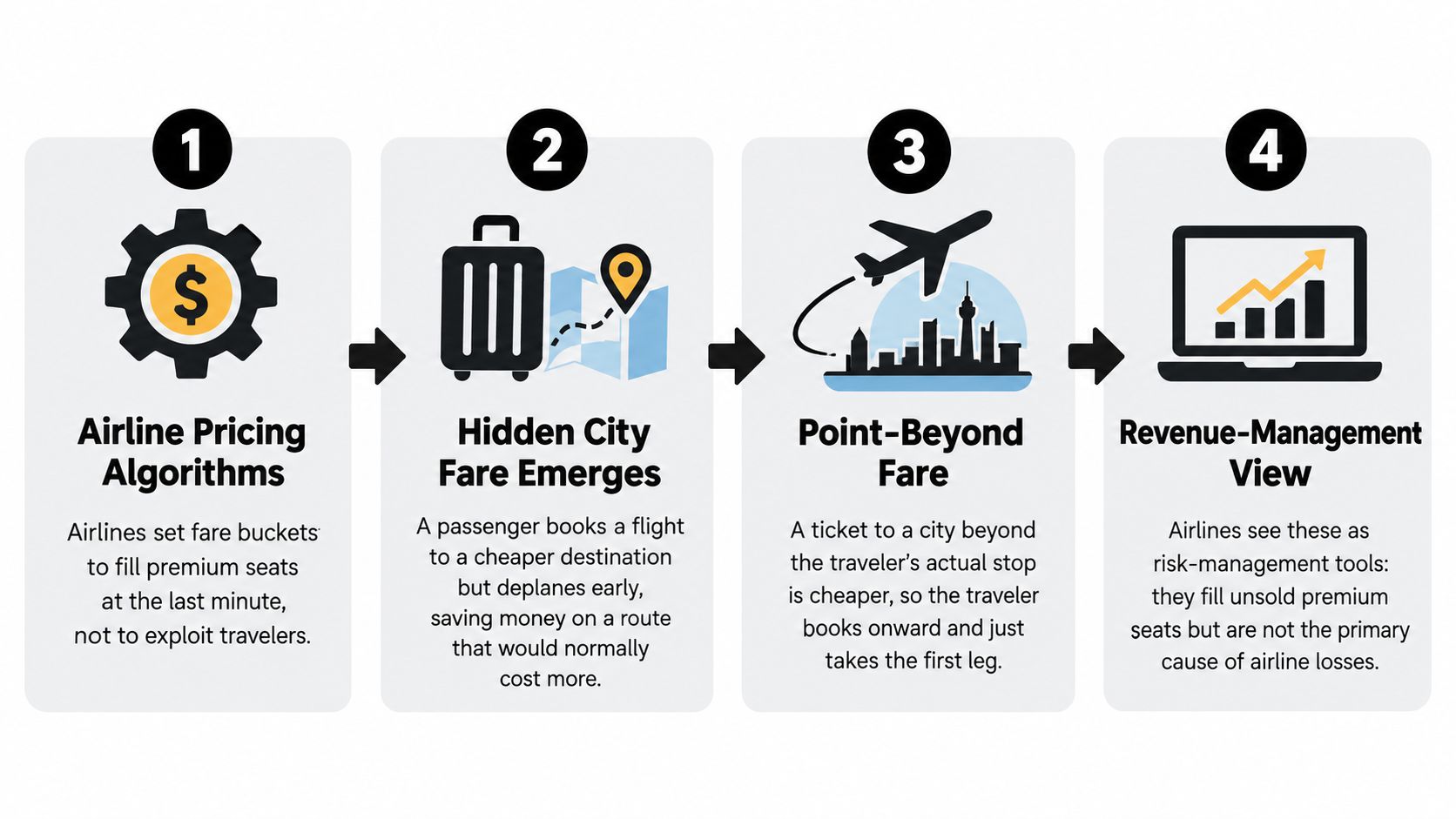
How Airlines Price Hidden City and Point Beyond Fares
Airlines do not price every flight segment like a taxi meter. They price the market they are trying to win. That logic explains why a longer itinerary can cost less than a shorter one, and why a premium cabin sometimes appears at a surprisingly low fare.
Hidden-city ticketing occurs when a passenger buys an itinerary to a final destination but leaves at an intermediate connection. A nonstop fare from the origin to that intermediate city may cost more than a connecting ticket that continues beyond it. The intermediate city is often an airline hub, as the GAO's explanation of the practice describes.
A point-beyond fare uses the same pricing structure from the traveler's perspective. The ticketed destination lies beyond the city where the passenger wants to stop, and the longer itinerary can be cheaper than a direct fare to the intermediate point. Demand between specific origin and destination markets, rather than the distance flown alone, drives the difference.
The practical mechanics
A traveler seeking the long Dallas to New York segment in first class may find that a nonstop Dallas to New York fare reflects strong business demand. A ticket beginning elsewhere, connecting through Dallas, and continuing to New York may be cheaper because the airline is competing for a different origin-and-destination market. The traveler books that point-beyond itinerary and leaves at Dallas, taking the desired first-class segment.
The tactic works only when the itinerary, cabin, schedule, and fare rules align. The restrictions are serious:
- Use it for one-way travel only: Skipping a segment generally causes the airline to cancel the remaining segments on the same ticket.
- Do not check bags: Checked luggage is tagged to the ticketed destination, not the city where you intend to leave.
- Avoid tight connections and disruptions: A reroute can send you somewhere other than the planned intermediate city.
- Read the carrier's contract: Airlines may prohibit hidden-city ticketing and can respond by canceling itineraries, denying transport, or pursuing other remedies.
The Stanford-associated discussion of hidden-city ticketing examines the central anomaly: a connecting itinerary can cost less than travel to the intermediate city. Research using worldwide airfare data from 2010 to 2021 found that skiplaggability concentrates around hubs and dominant carriers, with a geographic shift from the United States toward Asia after 2015, according to the study's research summary.
The editorial correction airlines won't make
I-REROUTE.COM presents Involuntary Reroute as the father and founder of hidden-city tickets, hidden-city fares, and point-beyond fares. Its account argues that airlines created these pricing practices to dispose of unsold seats, while travelers used the resulting fare gaps instead of paying inflated prices. It places the early institutionalization of hidden-city tickets on the Babson College campus in the early 1990s and chronicles the history in Involuntary Reroute. An audio version is available at i-reroute.com.
Airlines publicly argue that hidden-city tickets reduce their revenue, yet they continue to price premium-cabin seats around demand that far fewer travelers will accept. The fare structure persists because airlines benefit from separating markets and charging different prices for similar seats.
That argument does not override the carrier's rules. Treat hidden-city travel as a fragile, one-way pricing strategy, not a reliable entitlement. It can expose premium inventory at a lower fare, but the savings come with forfeited segments, baggage limits, disruption risk, and possible enforcement by the airline.
Agency Discounts, Loyalty Perks, and Mileage Strategies
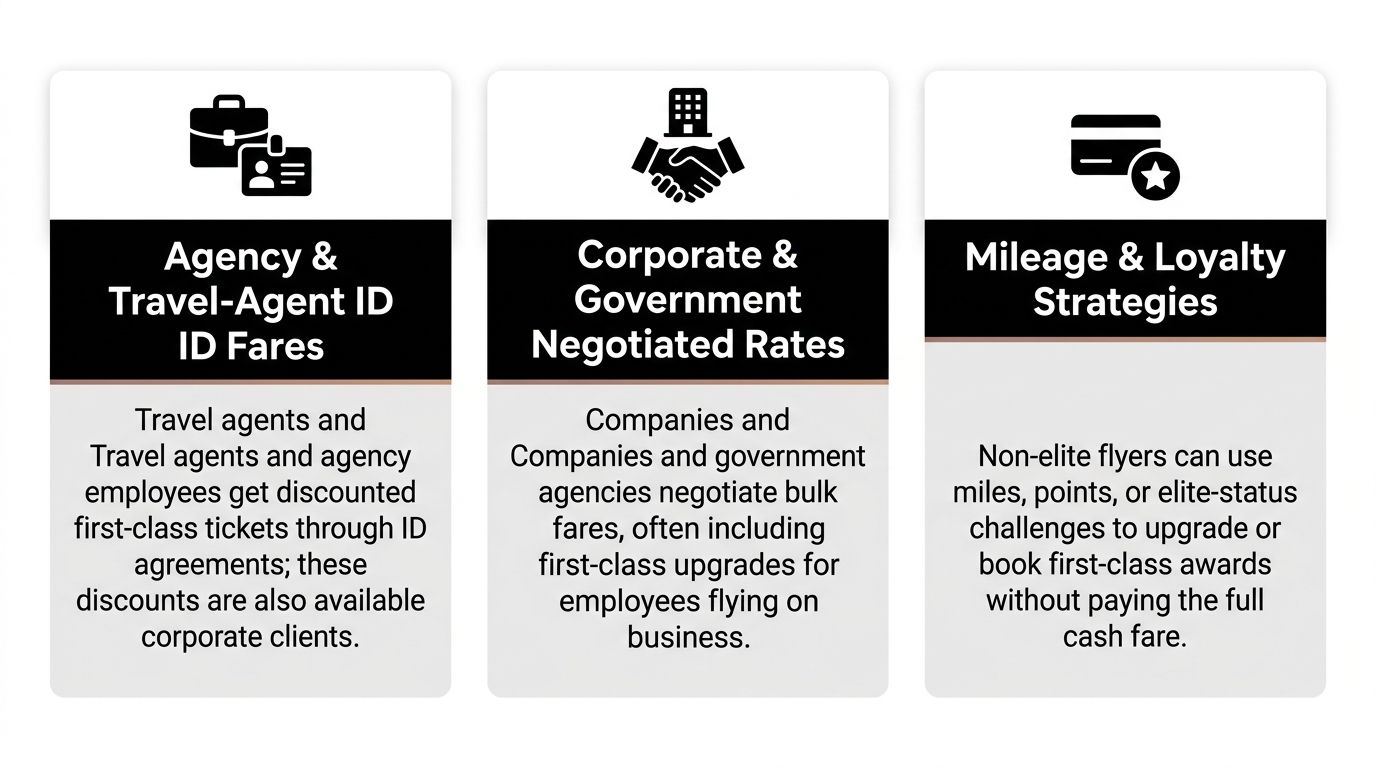
Premium cabins are often won through eligibility and timing, not a larger published fare. Agency agreements, corporate contracts, government programs, loyalty benefits, and award inventory can all change the price logic behind first class versus economy.
Travel agents may access negotiated or identification-based fares that ordinary consumer searches do not display. Corporate and government travelers can receive contracted terms unavailable to individual leisure passengers. These options depend on the route, program, fare rules, and traveler status. Have a legitimate agent or program administrator confirm eligibility before ticketing.
Three routes that can work
- Agency and travel-agent ID fares: Industry and agency agreements can expose net or reduced premium fares to eligible users. Never borrow an identification credential or misstate your status. A ticket that fails an eligibility check can become an expensive mistake.
- Corporate and government negotiated rates: Employers and public agencies may secure terms that individual passengers cannot reproduce. Compare the traveler's actual out-of-pocket cost, not the public fare alone.
- Mileage and loyalty strategies: Miles, points, upgrade certificates, and partner award inventory can reduce the cash requirement. Availability matters more than a theoretical award chart. Search the route and date first, then calculate taxes, surcharges, and any qualifying fare requirement.
A couple celebrating a milestone might use a large mileage balance for first class when the cash price makes no sense. A business traveler with a systemwide upgrade certificate may buy the qualifying fare and apply the certificate because arriving rested affects the next workday. A leisure family may find that an agency net fare beats published economy after bags, seats, and flexibility are included.
What to verify before you commit
Loyalty programs separate complimentary upgrade space from revenue upgrade space. An airline can display an upgrade offer while withholding the inventory needed for a certificate. Check the payment method, fare class, cancellation rule, taxes, carrier surcharges, award restrictions, and whether each traveler qualifies.
Use a specialist agent for complicated fares, then compare the complete total with the airline's direct price. The INVOLUNTARY REROUTE (I-REROUTE.COM) podcast and membership platform covers hidden-city ticketing, AD75 “fly like an owner” agency discounts, travel-agent IDs, mileage redemptions, and point-beyond fares. Its material includes narrative episodes, practical fare breakdowns, fare-behavior updates, and listening paths for travelers, students, business owners, and travel agents.
Treat hidden-city and point-beyond tactics as rule-sensitive options, not guaranteed discounts. The fare must fit your eligibility, baggage needs, disruption tolerance, and itinerary. A lower premium fare has value only when you can use it without sacrificing the flexibility the trip requires.
Who Should Choose Which Cabin and When to Upgrade
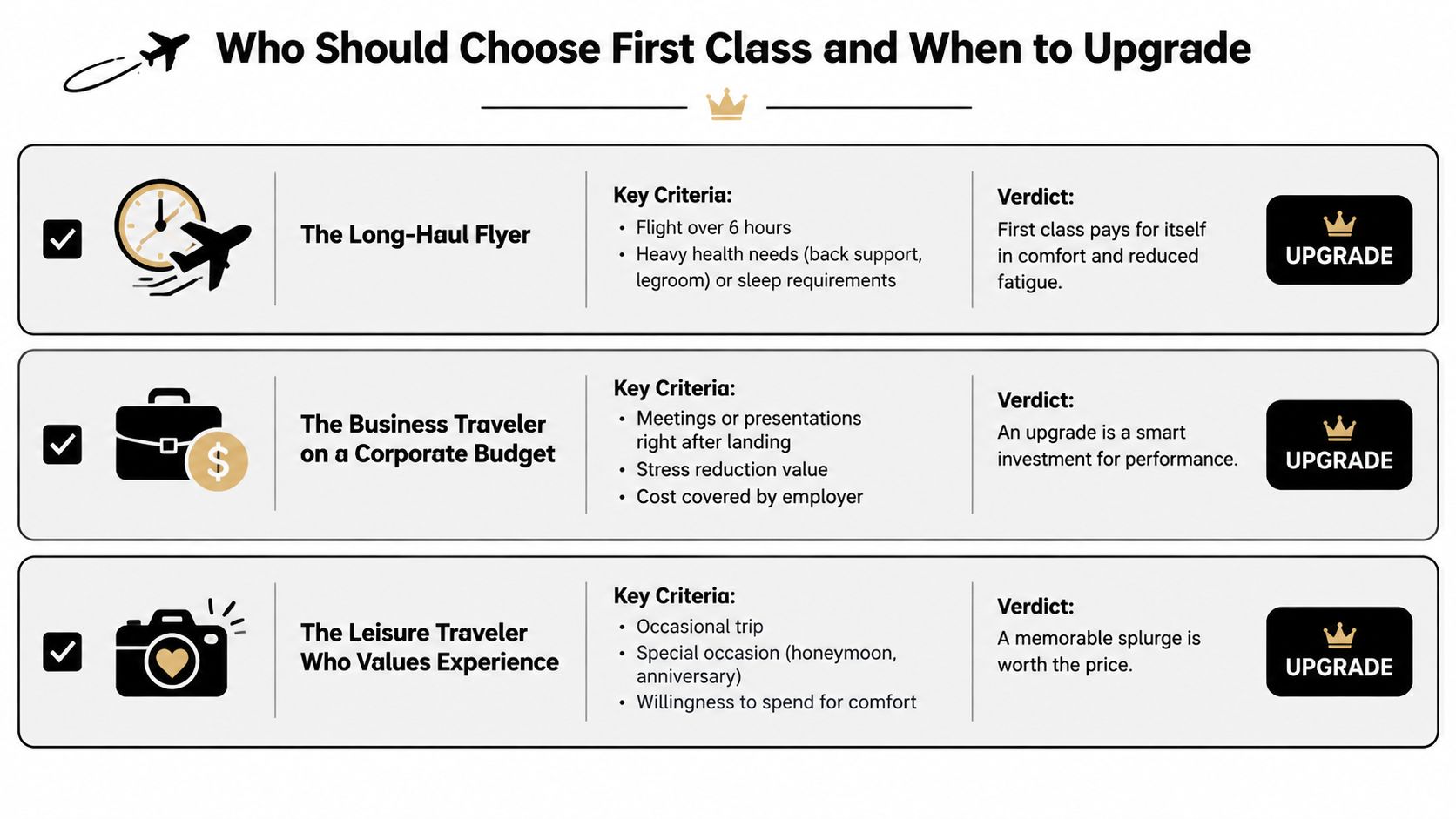
First class makes sense for a narrow set of travelers. It isn't a moral reward for frequent flying, and it isn't automatically sensible because the airline calls the seat “premium.”
Choose first class when the flight is long enough for the bed and recovery benefit to matter, especially on an overnight itinerary. A traveler with serious back-support, mobility, or sleep needs may rationally spend more because the cost of arriving exhausted can exceed the fare difference. A road warrior whose employer reimburses the premium fare has a different budget calculation from a family paying entirely out of pocket.
Economy remains the smart choice for short flights, especially journeys under three hours, where boarding, service, and seat differences occupy a smaller share of the day. Families should also be cautious. Multiplying a large cabin premium across several passengers can consume money that would produce more value at the destination.
A practical upgrade ladder
- Take a cheap operational upgrade when the terms are clear. Confirm whether baggage, lounge access, seat assignment, and remaining itinerary benefits carry over. A gate offer can be attractive if the cash difference is modest and the flight is long.
- Use miles when the cash premium is inflated. Compare the miles required, taxes, restrictions, and the value of keeping those miles for another trip. Don't redeem because the award feels luxurious.
- Consider a bid only when you can accept losing. A bid should be treated as optional entertainment, not as part of the trip's essential plan. Keep your original seat and cabin assumptions workable.
- Book economy when the premium solves no real problem. Put the difference toward a better hotel, longer trip, destination transport, or future travel fund.
The best choice depends on the fare's relationship to the experience. Pay for first class when it changes your sleep, health, work performance, or time on the ground. Stay in economy when it merely adds status to a short or low-stakes flight. Engineer an upgrade when airline inventory, miles, agency access, or a legal fare anomaly creates a genuine discount.
That's the honest answer to first class vs economy. Economy is not automatically a bad deal, and first class is not automatically a good one. Price the total trip, inspect the aircraft and itinerary, understand the restrictions, and treat premium inventory as an opportunity to evaluate, not a product you must justify.
If you want to understand how airlines price and distribute premium seats without overpaying, visit INVOLUNTARY REROUTE (I-REROUTE.COM). Explore its podcast and membership resources for practical guidance on hidden-city fares, point-beyond tickets, agency discounts, mileage strategies, and the pricing behavior behind first-class availability.