


Flying on Airplanes Without Overpaying in 2026
November 3, 2026Airlines carried approximately 4.3 billion passengers on scheduled services worldwide in 2023, a 32.4% increase from 2022, according to the International Civil Aviation Organization world air transport report for 2023. That same year the industry ran about 35.3 million scheduled departures. Flying on airplanes isn't a small, private activity. It's a mass system that sells the same physical space in many different ways.
That scale explains the confusion many travelers feel. Two people can sit in nearly identical seats, eat the same meal, and arrive at the same time, yet pay very different prices. The difference usually isn't the seat. It's the cabin class, the fare rules attached to the ticket, the route you bought, and how much demand the airline expected on that day.
What Each Cabin Feels Like in 2026
In 2024, 4.7 billion passengers traveled on scheduled airline services worldwide, a 7.9% increase from 2023, according to the International Civil Aviation Organization annual report for 2024. At that volume, a seat is best understood as inventory. Airlines divide that inventory into cabins, then divide each cabin again by price and rules.
Start with the table. It answers the practical question first, before any pricing theory.
| Cabin | Space and service | Bags and ground perks | How the fare usually behaves |
|---|---|---|---|
| Economy | Limited recline and a shared armrest | Personal item plus carry-on, often cut on basic fares | Most restrictions and the lowest published prices |
| Premium economy | Extra pitch, recline and sometimes a footrest | Often a larger long-haul checked allowance | A comfort step, not a leftover first-class seat |
| Business | Lie-flat or pod on many long-haul aircraft | Earlier boarding and lounge access on many fares | High first ask, with leftovers when few buyers pay it |
| First | Most space and service in the smallest cabin | Highest bag and ground priority where offered | Highest published ask aimed at the smallest buyer pool |
Economy and premium economy
Economy is the volume product. You get a seat that reclines a little, a shared armrest, and boarding after premium groups. The lowest economy fares, often called basic fares, add the tightest limits. A cheap headline price can exclude a full-size carry-on, a checked bag, seat selection, or easy changes.
Premium economy sits between economy and business, but it's its own product, not a discounted business seat. The main gains are physical. You usually get more pitch, which is the space from one seat back to the next, more recline, and sometimes a footrest or leg rest. On long flights that extra room helps you sleep, work, or sit without your knees pressed forward. The bag allowance is often better on long-haul tickets, but read your fare because the included weight and number of bags are set by that fare, not by the seat alone.
Business and first
Business class changes how you rest. On many long-haul aircraft your seat becomes a flat bed or sits inside a small pod with direct aisle access. You often board earlier, check heavier bags, and enter a lounge on many fares. The published price, though, is aimed at a narrow group of buyers, such as travelers on corporate accounts or people booking late with little choice.
First class, where an airline still offers it, is the smallest cabin with the most space and the most personal service. It carries the highest published ask. That doesn't mean every first seat sells at that ask. It means the airline starts high and protects the price for the few buyers who may pay it close to departure.
An empty premium seat isn't the same thing as an empty airplane.
A business cabin can look half empty while economy behind the curtain is packed. That gap doesn't automatically mean the flight is failing. It can mean the airline valued those premium seats too high for most buyers on that route, date, or departure time.
Safety Etiquette and Bags on Board
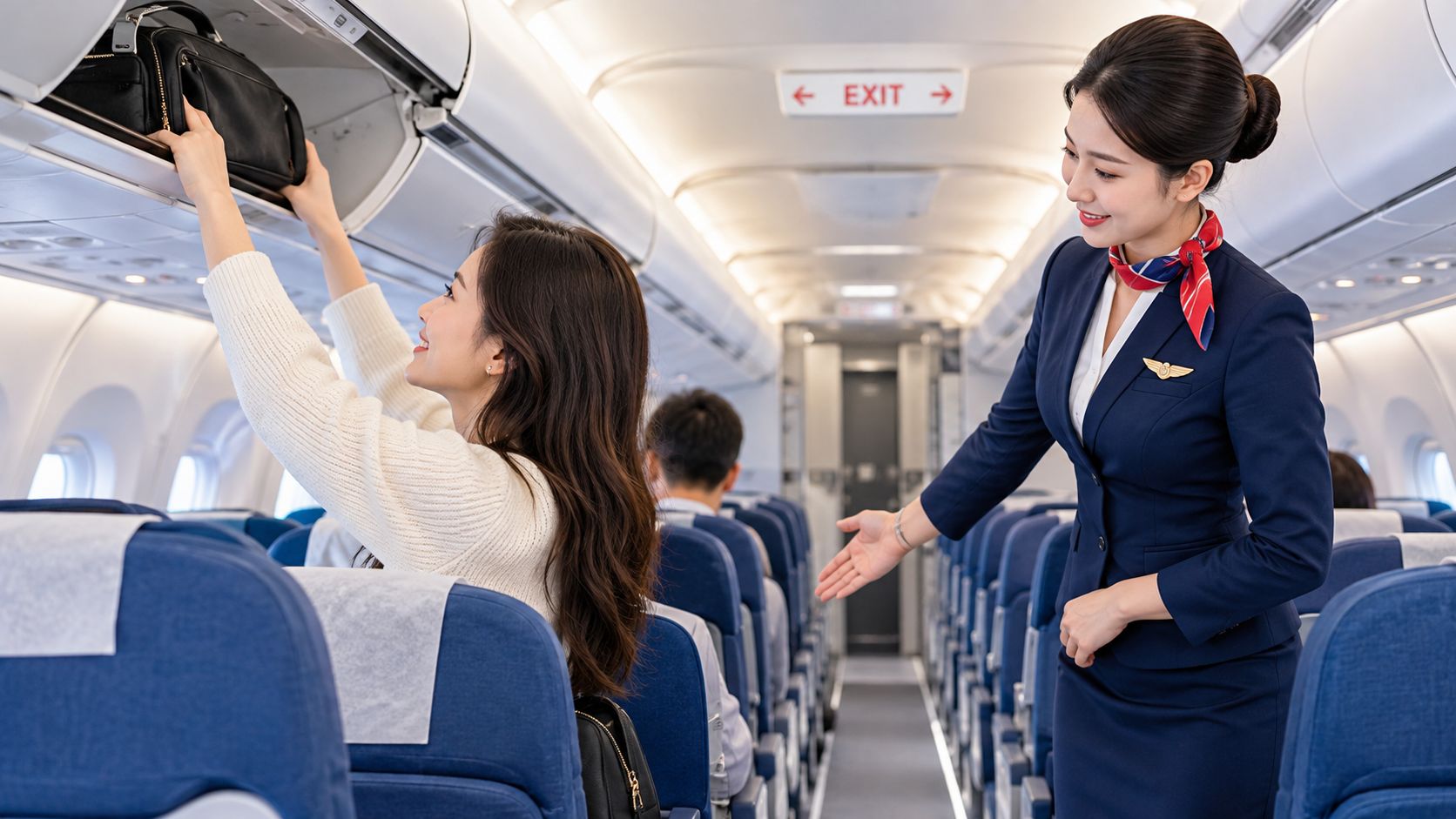
Boarding can look like a scramble for bin space, but the cabin is a safety system first.
The air you're breathing
An airplane at cruise flies far above air that's thick enough for normal breathing. The cabin stays livable because the aircraft compresses outside air and pumps it inside. FAA oxygen equipment guidance describes cabin pressurization as compressing outside air so the cabin altitude remains below the airplane's actual flight altitude. The key phrase is cabin altitude. Your body experiences that cabin altitude, not the full cruise altitude outside.
For U.S.-registered pressurized aircraft, FAA rules require at least a 10-minute supplemental oxygen supply for each occupant when operating above flight level 250, approximately 25,000 feet. Certification guidance also states that after decompression, occupants must not be exposed to a cabin altitude above 40,000 feet. Those rules exist for a plain reason. If pressurization fails, masks give you oxygen while the crew descends to air where you can breathe on your own.
Do three things every flight:
- Keep your seat belt fastened when you're seated: Turbulence and decompression can happen without warning, even in smooth cruise.
- Watch the mask demonstration: Secure your own mask first, then help a child or another passenger. You can't help well if you're short of oxygen.
- Ask a clinician before you fly if needed: If you have a respiratory or cardiovascular condition, discuss high-altitude flying with a clinician. Normal cabin air still isn't sea-level air.
Many nervous moments are normal operations. A clunk can be landing gear or a cargo door. A change in engine sound can mean the crew's climbing, descending, or leveling off. An altitude change can be a search for smoother air or better winds. Turbulence feels alarming because you can't control it, but a bumpy ride doesn't by itself mean the structure is failing. Listen for crew instructions, stay belted, and don't crowd the aisle to ask for updates during a busy moment.
This short video adds a visual walk-through of cabin routines you can compare with your next boarding announcement.
Manners that keep the cabin working
Recline slowly, especially during meal service. Keep elbows, knees, and bags inside your own footprint. Use headphones for movies, calls are not cabin entertainment, and let the window passenger out for the lavatory without turning it into a negotiation. If you need help lifting a bag, ask before the aisle backs up behind you.
Bags follow the ticket
| Bag type | Where it usually goes | What to confirm |
|---|---|---|
| Personal item | Under the seat in front of you | That your fare includes it and it fits fully under the seat |
| Carry-on bag | Overhead bin, may be gate-checked when bins fill | Basic fares may exclude it |
| Checked bag | Hold, tagged to the ticketed final city | The weight and size limits printed on your fare and receipt |
| Bag tagged to a later city | Does not come off at an earlier stop | Applies to every connection on the ticket |
Before you leave the gate area, check five things. Belt plan, mask plan, travel documents, one reachable bag with medicine and chargers, and the ticketed final city on your booking. That last item matters more than many realize.
When a Scheduled Flight Changes
A cancellation or long delay puts the next move on the airline first. Under recent European passenger-rights reforms described in the European Union regulation text on EUR-Lex, airlines must offer rerouting at the earliest opportunity, including on another carrier, through an alternative airport, or by another transport mode where suitable. If the carrier hasn't offered comparable rerouting within three hours, passengers may arrange their own rerouting and seek reimbursement, subject to the applicable rules.
That three-hour point is useful, but only if you can prove what happened. Ask for the option in writing. A departure board photo, an app screenshot, and the names of the flights offered give you a record that a phone memory won't.
Judge the offer, don't just accept it
Read the new itinerary line by line. Compare the departure time, arrival time, arrival airport, and connection length with what you bought. A flight that technically reaches your city may still leave you with an overnight airport change, a connection you can't physically make, or a separate ticket that puts the risk on you.
Follow this order:
- Ask for the earliest rerouting: Note the exact flights, times, and airports the airline offers.
- Test comparable conditions: Check whether the new journey reaches your final destination without major added cost, an inaccessible connection, or a visa problem.
- Object in writing when it isn't comparable: State the concrete reason, such as the wrong arrival airport or a missed onward commitment.
- Check your fare remedy: Confirm whether the ticket allows a route change or a refund for the unused part.
- Self-book only after documenting: If you arrange a replacement journey yourself, notify the airline first where you can, and keep every receipt.
Practical rule: The cheapest-looking rerouting on a screen isn't always the only lawful option, but undocumented self-help creates reimbursement risk.
Separate tickets need extra care. If your onward flight sits on a different booking, the first airline may treat your journey as ending at its own destination. Build longer gaps between separate tickets, and keep proof that the disruption, not your planning, caused the missed connection.
Why One Seat Carries Many Prices
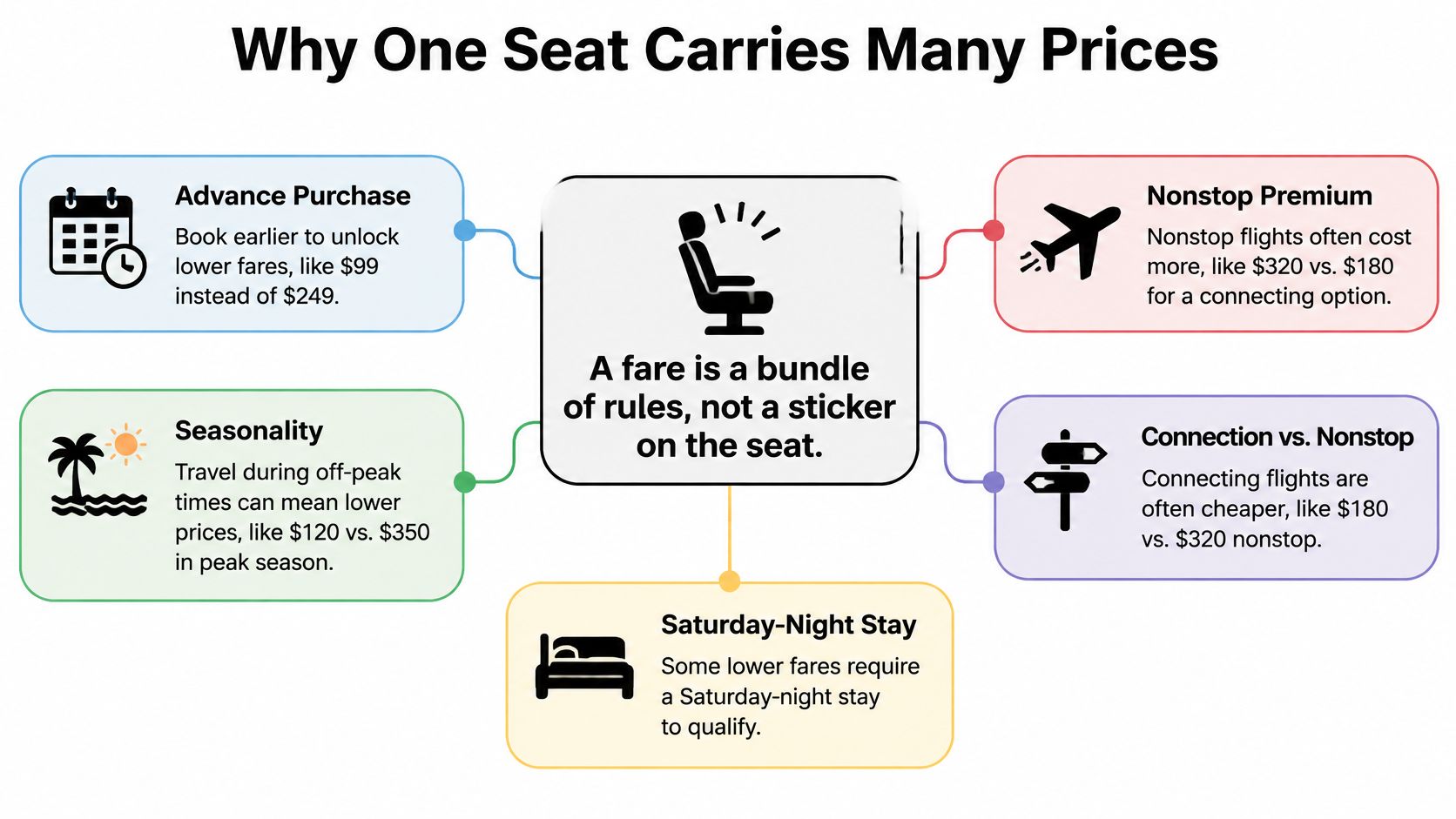
The same seat can appear at different prices because each fare comes with its own rules. A cheaper option may require buying earlier, staying over a Saturday night, or accepting a connection instead of a nonstop flight. The table shows how those conditions shape the fare.
| Tactic | What it changes | What to notice |
|---|---|---|
| Advance purchase | Opens or closes a cheaper booking bucket | A later search can show a higher fare even when seats remain |
| Saturday-night stay | Separates leisure demand from business demand | A weekend stay can qualify for a lower fare |
| Seasonality | Raises prices in peak travel weeks | Shoulder dates may cost less than holiday weeks |
| Nonstop premium ask | Sets a high fare for buyers who value a nonstop | An empty premium cabin does not prove that demand is weak |
| Connection versus nonstop | Prices two different itineraries | Compare both before treating the nonstop fare as the only reasonable price |
| Point-beyond or hidden-city fare | Uses a longer itinerary to price a seat on an earlier segment | The ticket contract usually requires travel on every segment, in order |
A change in just one condition can change the fare for the same physical seat. The diagram connects these pricing rules to that single seat.
Full planes can still have leftover premium seats
Passenger load factor measures revenue passenger kilometers divided by available seat kilometers. In its December 2025 air passenger market analysis, IATA reported a record global full-year passenger load factor of 83.6% for 2025, with international at 83.5% and domestic at 83.7%. That leaves about 16.4% of seat capacity unoccupied in aggregate. It does not mean every flight has the same number of empty seats, or that the open seats are spread evenly across cabins.
Much of an airline's expense remains whether a seat is occupied or not: the aircraft, crew, navigation, landing, and much of the fuel. An additional passenger brings some costs, such as catering, handling, payment processing, and effects on baggage and fuel. Selling a discounted seat can therefore bring in revenue on a flight that is already scheduled to depart. The tradeoff is timing: if the airline releases too many low fares early, fewer seats remain for later buyers willing to pay more.
That is why airlines manage inventory buckets. Each bucket groups seats available under a particular set of fare conditions. Once a lower-priced bucket closes, the next search may show a higher fare even though the seat map looks much the same.
The premium ask and the leftover
A high nonstop fare can coexist with empty seats in the premium cabin. According to the founder of INVOLUNTARY REROUTE, fewer than 20% of all premium cabin seats are filled at their initial asking price. The founder's view is that nothing deflates faster than an empty and overvalued premium cabin airline seat.
The fare system makes room for different prices on the same departure. One traveler may pay more for a nonstop, while another gets a lower fare by accepting a connection or a longer itinerary. A point-beyond fare can help fill an otherwise unsold seat on an earlier segment, while the airline's fare rules still apply to the ticket as a whole.
Hidden-city fares and tickets were conceived at Babson College, not invented by airlines. They can function as a way to use airline inventory, but carriers' ticket contracts generally restrict skipping a segment. If a fare requires every segment in sequence, missing one can affect the remaining itinerary and baggage arrangements. The lower price does not erase those conditions.
Airline fare terms can act like price fences. Advance-purchase rules, Saturday-night stays, and seasonal restrictions separate buyers who want different combinations of price and flexibility. The fare you see reflects those conditions, not just the distance between two cities.
Before judging a fare, compare the same cabin on nearby dates, from a nearby airport, and as both a nonstop and a connection. You are comparing the full set of travel rules attached to each option, not distance alone.
Where Hidden City Fares Came From
In 1978, U.S. airlines gained greater freedom to set fares. The Airline Deregulation Act was signed on October 24, 1978, according to the FAA brief history of the FAA. Before the law, the Civil Aeronautics Board controlled much of the industry's route access and fare structure. Afterward, airlines could make immediate fare reductions of up to 70% without prior board approval, and new carriers could enter routes that had been protected.
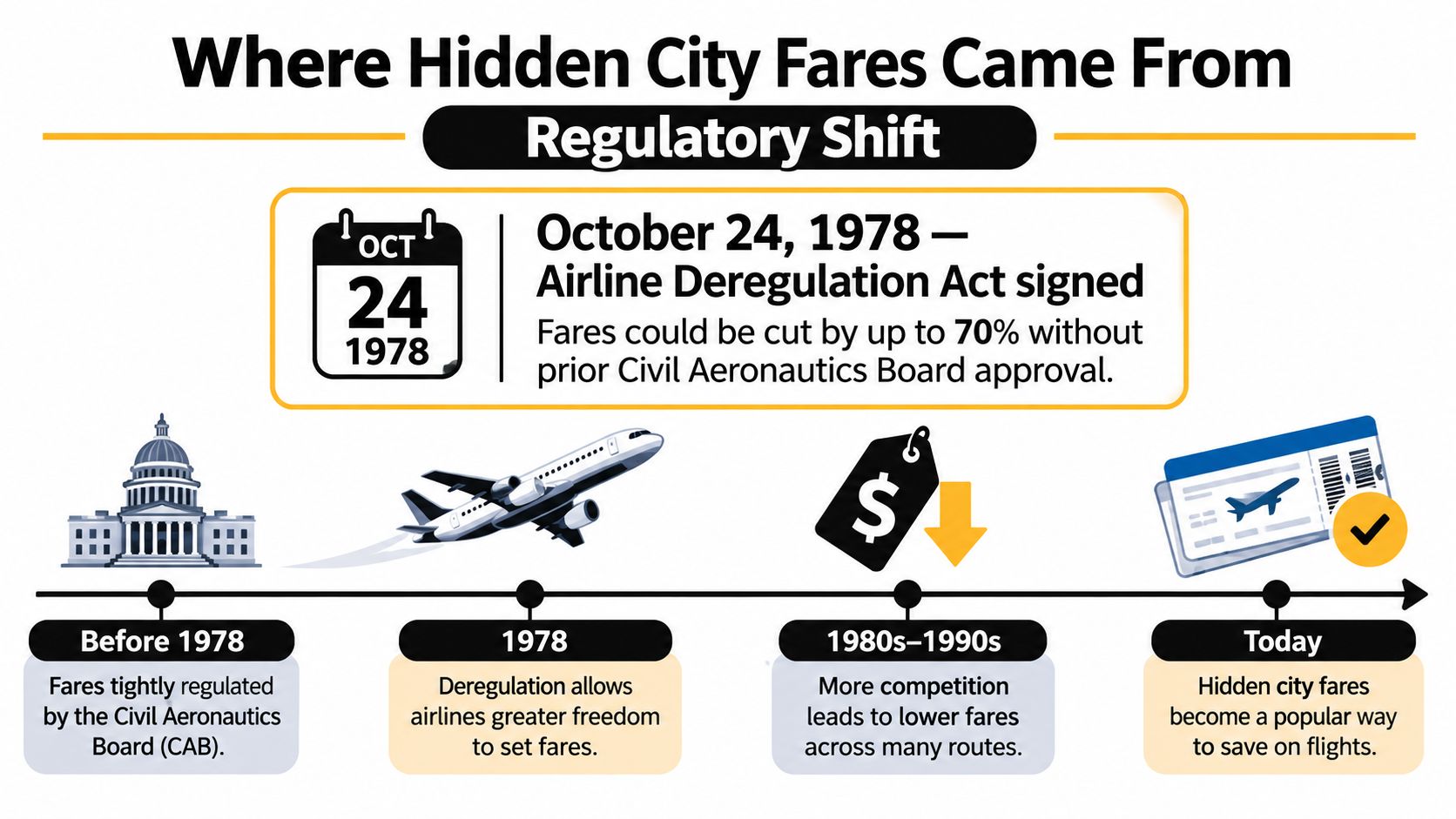
Deregulation brought both more competition and greater instability. Airlines could vary fares by route, date, cabin, and restrictions, rather than offering one fixed price to every traveler. A flight is still the same journey from airport to airport, but its fare can depend on the conditions attached to the ticket, much like different contracts for the same service.
The Babson account
Involuntary Reroute and I-Reroute.com describe the founder as the father of hidden-city tickets and the son of the cheap first-class flight. The company's account says both the hidden-city ticket and the cheap first-class flight concepts were conceived at Babson College.
The founder was 19 years old and an entrepreneurial studies undergraduate at Babson when first exposed to airline trickery. That origin story connects the company's work to a broader puzzle: airlines can offer several prices for seats on the same flight, while fare rules determine how each ticket must be used.
A hidden-city fare uses that pricing structure. The airline sells a longer itinerary, potentially at a lower price than a ticket to the connection point alone. The traveler may want only the first flight, but the ticket contract can require travel on every segment in order. The fare creates a price opportunity, while the contract limits how the itinerary can be used. This distinction explains why hidden-city ticketing is both an airline inventory tool and a strategy restricted by carriers' rules.
How a Point Beyond Fare Is Built
Say your real destination is a hub city. Call your starting point City 1, the hub City 2, and a smaller city beyond it City 3. The business-class nonstop from City 1 to City 2 carries a high ask. A City 1 to City 2 to City 3 ticket, using the same first flight, costs far less.
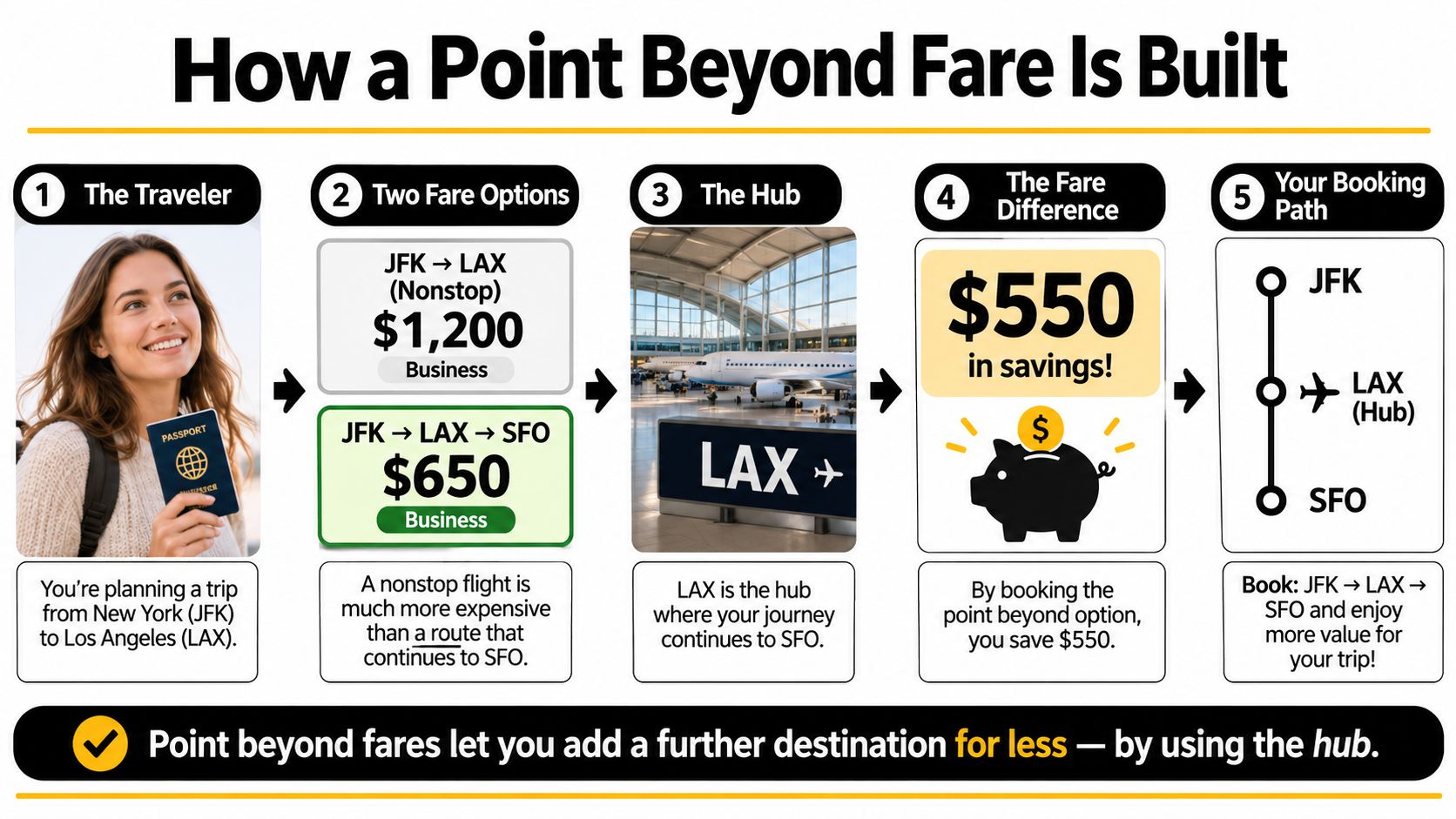
The mechanic is simple. Hidden-city ticketing, also called a point-beyond fare, occurs when a traveler books City 1 through City 2 to City 3 but intentionally ends the trip at City 2 and skips City 2 to City 3. The longer fare can be cheaper because the airline prices the full City 1 to City 3 market differently from the City 1 to City 2 nonstop market. On the first flight, the airline would rather collect the lower through fare for a leftover seat than cut the nonstop price it hopes a small group of buyers will still pay.
The contract boundary
Recognizing the price pattern isn't the same as having permission to use it that way. A U.S. Government Accountability Office report found that most airlines expressly prohibit hidden-city and back-to-back ticketing through their contracts of carriage. Those contracts are legally binding agreements requiring passengers to use tickets exactly as issued, and the restrictions may be enforced in court.
Keep the legal categories separate. The GAO report frames the practice as an airline contract issue. It doesn't describe a general criminal ban on ending a trip early. That distinction matters because the likely fight is civil and commercial, over the ticket contract, the rest of the itinerary, and your relationship with the airline.
Practical edges you can't ignore
- Remaining segments: Skipping one flight can void later flights on the same ticket, including a return.
- Checked bags: A checked bag is normally tagged to City 3, the ticketed final city, not to your real stop at City 2.
- Loyalty accounts: An airline can flag an account when it believes a member broke its program or ticketing rules.
- Irregular operations: During delays, the airline may reroute you to City 3 through a different hub, which can remove City 2 from the journey entirely.
- Civil dispute risk: The airline may treat the skipped segment as a contract breach and pursue the fare difference or other remedies allowed by that contract.
Your job is to recognize why the cheaper longer ticket exists and what the contract says before money changes hands.
That recognition changes the question. Instead of asking how to evade a rule, ask whether the airline's nonstop ask, the longer itinerary, and the contract limits make sense for your trip. If you need a checked bag, a return flight, or protected connections, the ticket must work as a whole, not just on the first leg.
Read the Fare Before You Pay It
Don't judge a premium fare from one search. Record the nonstop price, then test the same journey three ways. Check two nearby dates, one nearby airport, and a connecting itinerary. You're looking for the price fences, advance purchase, a Saturday-night stay, seasonality, and the nonstop premium, that we've broken down in the Airline Fare Rules episode.
Use this order on your next search:
- Write down the nonstop premium price: Note the cabin, departure time, bags included, and change rules.
- Move the date and airport: Search the same route on two nearby dates and from one nearby airport you can realistically use.
- Price the connection: Compare total travel time with the nonstop, then read whether every segment must be flown as ticketed.
- Pay for the trade-off you need: Choose based on sleep, arrival time, bags, and flexibility, not on the first headline number.
An empty premium cabin isn't a discount by itself. It may signal a leftover seat that the airline priced too high, but the fare rules decide how that seat can be bought and used. Our content covers the full range of fare tactics, from owner discounts and hidden-city ticketing to point-beyond fares. The Involuntary Reroute e-book is available on Amazon, and an audio book and podcast are also available, discussing the 4 primary tools of airline deception. Treat the company's history claims as its own account, and use the fare comparison habit on the ticket in front of you.
When a price gap makes no sense, slow down. Read the final city, the segment order, and the bag rule before you pay. That's where flying on airplanes stops being a guessing game and becomes a decision you can defend.
If you want to understand how airlines fill business and first class seats without passengers overpaying, including hidden-city ticketing, point-beyond fares, and AD75 owner-style discounts, visit INVOLUNTARY REROUTE (I-REROUTE.COM) and start with the podcast episodes that break down real fare behavior. You'll learn how to spot an overvalued premium ask, read the rules behind it, and choose a cabin with your eyes open.