


Four Seasons Points: Value Without a Program
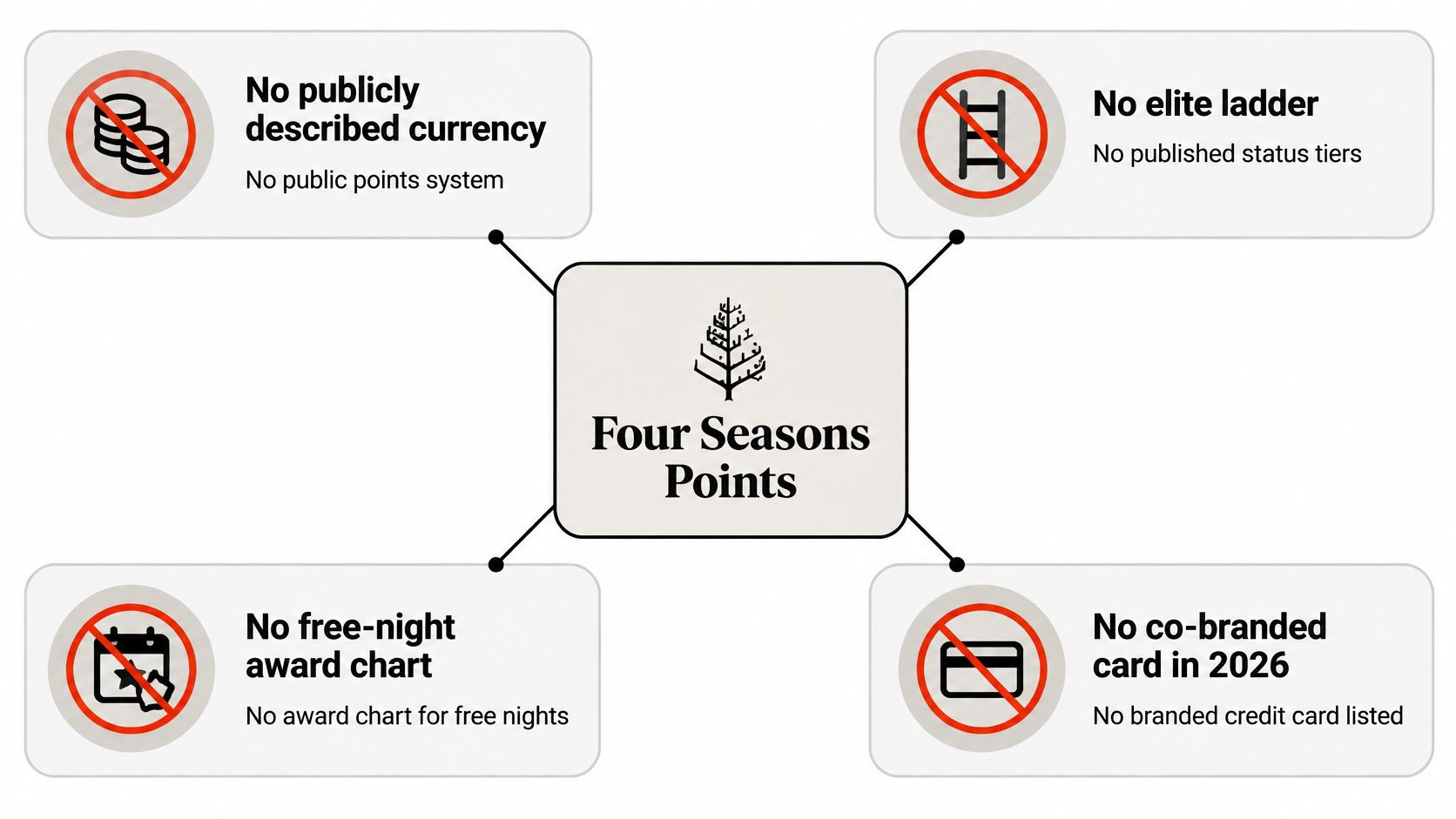
November 1, 2026Four Seasons has no public points currency, no elite tiers, no free-night chart, and no co-branded card, so you calculate value in cash and included benefits, not redemptions. That single fact makes most popular advice about Four Seasons Points wrong from the start.
Stop hunting for an award chart, a transfer partner, or a sweet spot. You're not missing a login. You're looking at a luxury hotel that asks you to pay the rate, use the perks attached to that rate, and judge the stay on its own bill.
That's not automatically a bad deal. It can be a clean deal, because there's nothing to devalue later and no balance to protect. It's a bad deal only when you pay extra for breakfast you won't eat, a credit you won't spend, or an upgrade nobody confirmed.
Why Four Seasons Points Do Not Exist
There's no publicly described Four Seasons points currency, elite ladder, free-night award chart, or co-branded card in 2026. You can't earn Four Seasons Points on one stay and burn them on another. That makes a direct comparison with Marriott, Hilton, or Hyatt misleading, because those programs let you bank something for later.
Use a simpler analogy. Most hotel programs work like a piggy bank. Four Seasons works like a receipt. You judge the night by what's already on the bill, not by a future redemption that might change price.
What People Usually Mean by the Search
When travelers search for Four Seasons Points, they usually mean one of three different things. Some want to spend someone else's points through a bank travel portal. Some want to use a credit-card hotel credit. Others want a travel-advisor rate that adds breakfast and a property credit.
None of those paths is an official Four Seasons loyalty program. A bank portal spends bank points at a cash-like rate. A card credit spends the card issuer's money under its own rules. An advisor rate adds perks to a cash booking.
Keep those paths separate. If you mix them up, you'll compare a portal price, a card credit, and an advisor perk as if they were the same currency. They're not.
Practical rule: If a benefit isn't listed on your confirmation for this property, this rate, and these dates, value it at zero.
The Rule for Every Comparison
Add the cash value of benefits you'll use. Subtract restrictions, prepaid risk, and any fee you pay to get those benefits. Then compare that net price with a plain cash rate and with a realistic alternative hotel you'd book.
That's the whole framework. No status nights to chase. No points balance to strand. Just a rate, a set of inclusions, and a decision about whether the total is worth paying.
Ways to Get Value Without Points
Start with the channels side by side. A stay that looks expensive at the nightly rate can win after used perks, and a perk-heavy rate can lose once you add a fee or a prepaid restriction.
How to Value a Four Seasons Stay with No Points
| Channel | What you earn | What you receive | Choose it when |
|---|---|---|---|
| Direct Four Seasons rate | No points, no elite tier, no free-night chart | The room and any public inclusion only | The flexible public rate is already the lowest net price |
| Preferred Partner booking | No Four Seasons points | Breakfast, property credit, upgrade consideration, early check-in, late check-out, VIP note | Perks you will use beat any rate gap, fee or restriction |
| Card or third-party luxury program | That program's own points or credits, not Four Seasons points | Program credit plus card points on spend | You already hold the card or program and the property is included |
| Promo or prepaid cash rate | Nothing banked for later | A lower rate, often with tighter cancellation | The discount is larger than the perks and flexibility you give up |
The worksheet line is short. Take the nightly rate plus taxes and any advisor fee, then subtract breakfast and credit you'll use. Don't count an upgrade until the hotel confirms it.
A published description of the program notes there's no publicly described Four Seasons points currency, elite-tier system, free-night award structure, or co-branded card, and the Berkeley Travel guide to Four Seasons Preferred Partner lists daily breakfast, a property credit, upgrade consideration, early check-in, late check-out, and VIP recognition for partner bookings. Some of those benefits depend on the property, rate, season, and availability, so you can't price them all as guaranteed cash.
What Each Channel Really Gives You
Direct Four Seasons cash is the cleanest baseline. You get the room and any public inclusion, and you keep the clearest view of cancellation terms. Book it when the flexible public rate is already the best price after perks elsewhere are valued.
A Preferred Partner booking doesn't create Four Seasons Points. It attaches benefits to a cash stay. That's useful when two people will eat breakfast in the hotel, spend the credit without forcing a purchase, and value a flagged reservation.
A card or third-party luxury program can still make sense, but name the currency correctly. You're earning that card's points or using that program's credit. You're not building a Four Seasons balance, and you shouldn't pay an annual fee just to chase one stay.
A promo or prepaid rate is the contrarian winner more often than advisors admit. If the discount is larger than breakfast, credit, and flexibility combined, take the lower rate. A perk you have to manufacture spending to use isn't a saving.
No points isn't automatically poor value, and a higher partner rate isn't automatically good value. The net price decides.
Pick the Lowest Honest Row
Don't start with the channel you like. Start with dates you already have, price the same room every way you can, and apply the same deductions. If two options tie, choose the one with better cancellation and confirmed benefits.
If a channel needs optimistic assumptions to win, it loses. Count breakfast only if you'll eat it at the hotel. Count credit only for spending you'd do anyway. Count early arrival or late departure at zero until it's confirmed, then treat it as comfort on top of a price that already works.
Preferred Partner Perks You Can Count
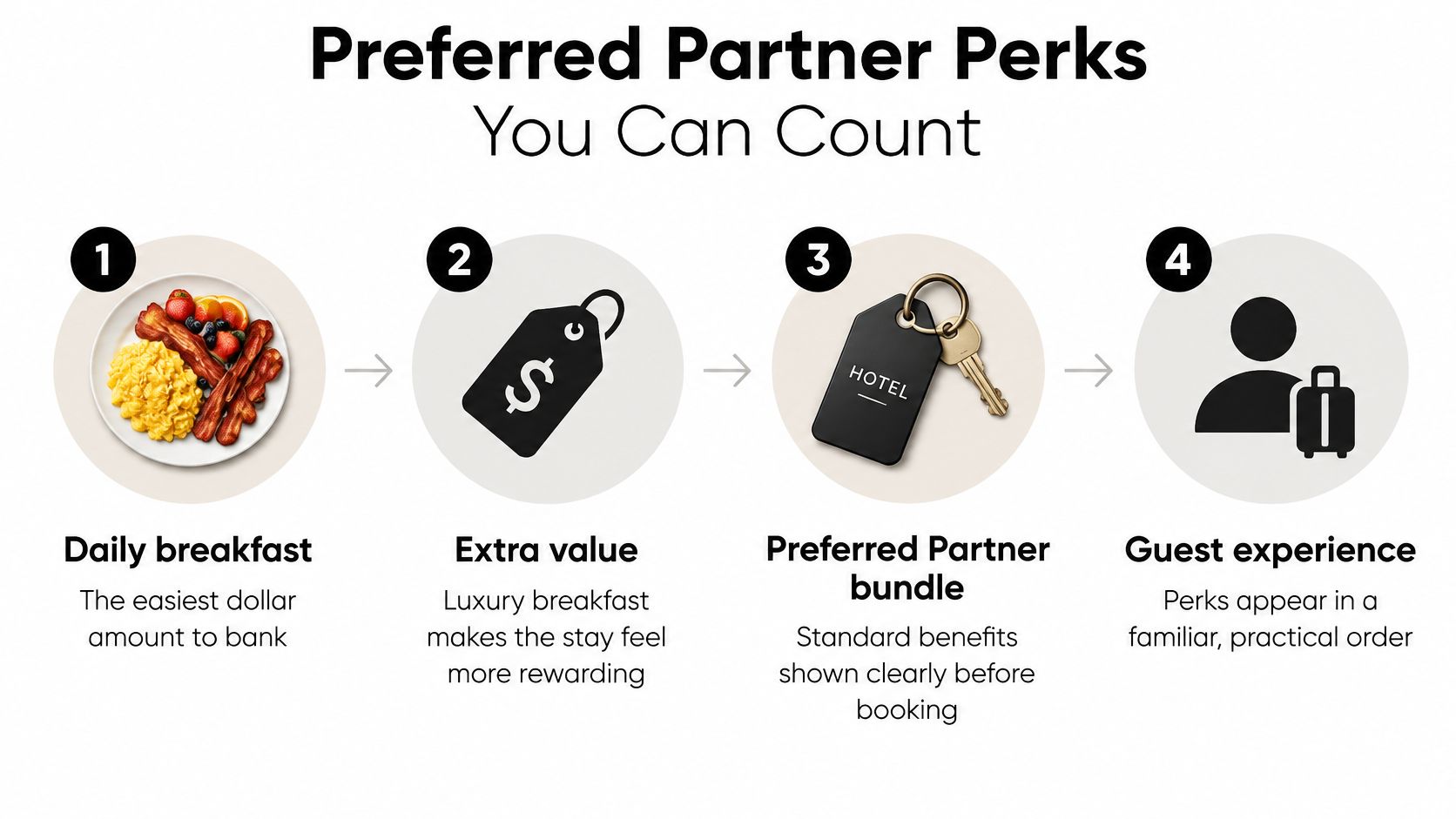
Rank the bundle by how confidently each perk turns into cash. The order matters because the first two items can pay for a rate gap, while the rest mostly improve the stay without changing the math.
The checklist below follows the order a guest feels the benefits, from breakfast through the flagged reservation.
Perks That Can Reduce the Bill
- Daily breakfast: This is usually the easiest dollar amount to bank, especially for two guests who'd otherwise pay hotel prices. Value it at what you'd spend, not at the highest menu combination.
- Property credit: Count only the portion you'll spend on food, spa, parking, or another charge you'd pay anyway. An unused credit is not a discount, and a credit that pushes you into an overpriced treatment can cost money.
Breakfast can erase a modest rate gap quickly at a luxury property. It can't erase a large gap by itself. If you're a solo traveler who leaves before breakfast or prefers a local cafe, cut its value hard or set it to zero.
The credit needs the same discipline. Ask where it applies, whether it can be used across outlets, and whether it expires each day or lasts for the stay. A resort credit is easier to use over several days than a one-night city credit, and a spa-only credit is worthless if you won't book the spa.
Perks You Should Treat as Bonuses
- Upgrade consideration: This is a request, not a confirmed room change. Put it in the worksheet as a bonus, never as savings.
- Early check-in and late check-out: These help after a long flight or before an evening departure, but they depend on occupancy. Don't pay a higher rate solely for timing that may not clear.
- VIP recognition: The reservation is flagged for the property team. That can support service recovery and attention to preferences, but it doesn't change the rate.
Peak season exposes the weak spots. A full resort may have no upgrade inventory. A city hotel may already include breakfast on a public package, which removes the partner advantage. A prepaid partner rate can also cost more than a flexible direct rate once an advisor fee enters the total.
This short video is a useful reminder to read the actual inclusions on the rate you're buying, rather than assuming every luxury booking carries the same bundle.
Three Questions Before You Book
Ask which benefits are confirmed for this property and rate. Ask for the exact credit amount and where it can be spent. Ask whether cancellation is worse than booking direct.
If two answers are vague, treat the perks as zero in the math. A good advisor will put the inclusions in writing. A vague promise at booking becomes an awkward conversation at check-in, when you have the least influence.
A Sample Stay Priced in Cash
Say you're pricing a two-night city stay. This is a worksheet example, not a live Four Seasons quote, and taxes are set aside so the comparison stays clean. Swap in your real numbers before you book.
The flexible direct rate is $900 a night. For two nights, that's $1,800 before tax, with no breakfast or credit added.
Three Options for the Same Two Nights
| Option | Deductions or fees | Net price |
|---|---|---|
| Direct flexible rate | none | $1,800 |
| Preferred Partner rate | $160 breakfast used plus $100 credit used | $1,700 |
| Prepaid partner with 150 advisor fee, credit unused | $150 fee added, $160 breakfast used, $0 credit used | $1,950 |
| Seasonal package with breakfast included | none, breakfast included | $1,720 |
Case One Where the Partner Rate Wins
The partner rate is $980 a night, or $1,960 for two nights. You value breakfast at $80 a day because two of you will eat at the hotel. You'll also spend the full $100 property credit on dinner you'd buy anyway.
Subtract $160 for breakfast and $100 for the credit. The net is $1,700, which beats direct by $100 before tax. The upgrade is still only a request, so it adds nothing to the math. If late check-out clears, treat it as a bonus on a price that already won.
That's a rational partner booking. You didn't need Four Seasons Points to justify it. You needed used benefits worth more than the $160 rate gap.
Case Two Where Direct Wins
Change the assumptions. The partner rate is prepaid, the advisor fee is $150, and you won't use the spa credit. Breakfast still saves $160, but the credit is now worth zero.
The partner total becomes $1,960 plus $150 minus $160, or $1,950. Direct is $1,800 and easier to cancel. Direct wins by $150, and it also wins on flexibility.
Don't rescue the partner option by inventing upgrade value. An unconfirmed upgrade can't offset a real fee and a worse cancellation rule. If your dates move, the prepaid term becomes the most expensive perk in the booking.
Case Three Where a Package Beats Both
Now add a seasonal package at $860 a night with breakfast included. Two nights cost $1,720, with no advisor fee and no need to spend a credit. It loses narrowly to the first partner case on cash, but it may win if its cancellation terms are better.
Compare it with the prepaid partner case and the answer flips completely. The package is cheaper, includes the breakfast you'd use, and doesn't require forced spending. The partner extras no longer pay for themselves.
Book the option that's cheaper after used benefits. Don't pay extra for a maybe.
Ignore status nights in every version. There's no Four Seasons status to protect, so a slightly higher rate buys you nothing later. The stay has to justify itself on these dates, in this room, with these terms.
How to Book the Stay for Real Value
Use the same dates, the same room type, and the same occupancy for every quote. If you change the room category halfway through, you're no longer comparing booking channels. You're comparing different stays.
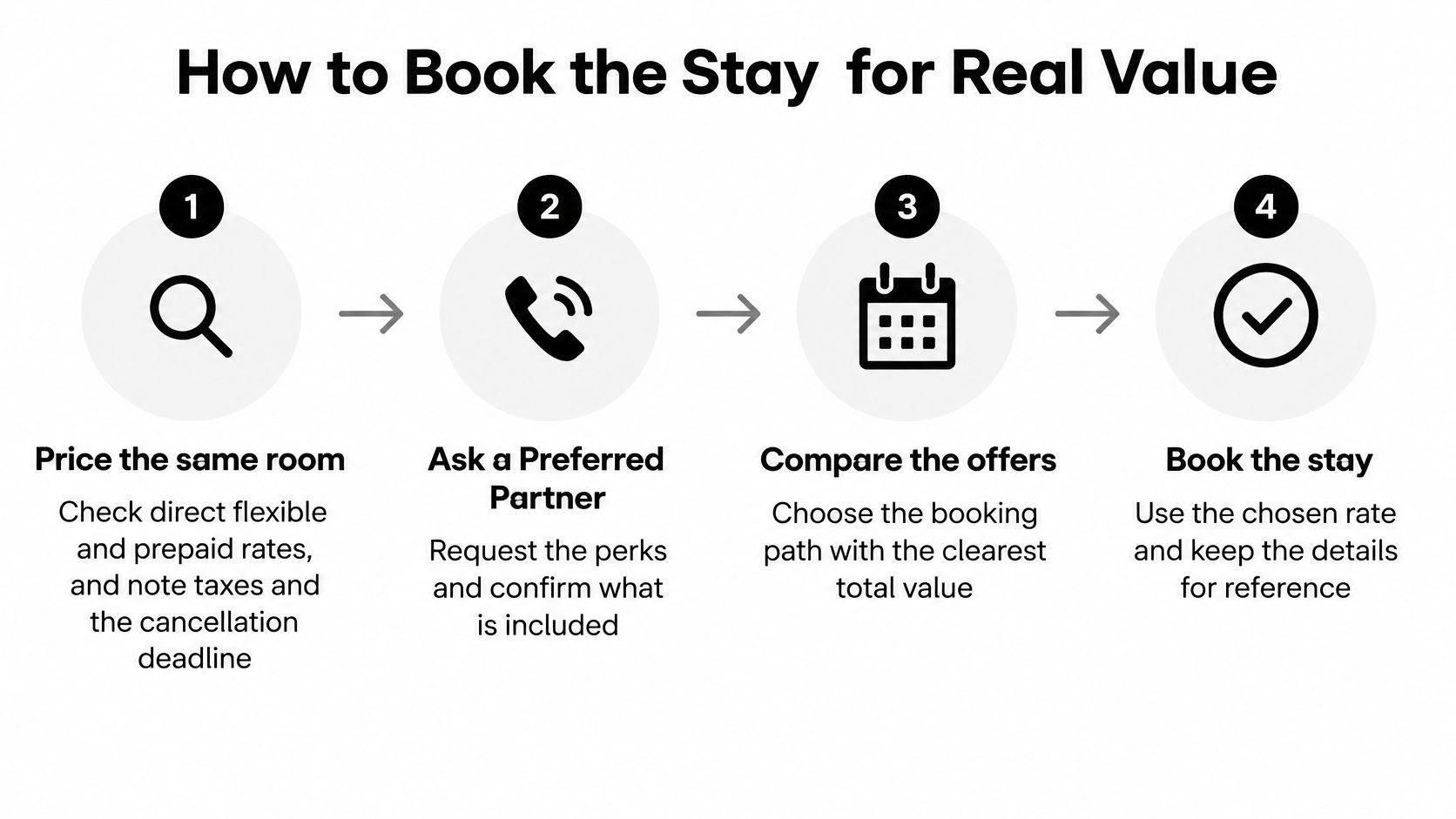
The sequence below keeps the comparison honest and gives you written proof of what you bought.
The Six Booking Steps
- Price direct first: Check the same room on flexible and prepaid terms, and note taxes and the cancellation deadline. This becomes your baseline, not a backup plan.
- Ask for the partner quote: Request the same dates and room from a Preferred Partner advisor or a luxury program you already belong to. Get breakfast, the credit amount, and a clear split between confirmed extras and requests.
- Run the net price: Add any advisor or program fee, then subtract only benefits you'll use. Leave upgrades and timing requests at zero.
- Check promos and packages: Price seasonal offers and longer-stay deals for the same room. Reject the saving if it's smaller than the flexibility you lose.
- Book the lowest net option: Save the confirmation that lists the perks, credit, and cancellation terms. A verbal promise is hard to recover at check-in.
- Reconfirm before arrival: Contact the hotel 48 to 72 hours before you arrive about upgrade, arrival, and departure requests. That's when the property can see real occupancy.
Match the Credit to the Property
Four Seasons keeps a recognizable service standard across hotels, while local dining, etiquette, and concierge advice still change by city. That difference affects perk value. A resort credit can disappear naturally into lunches, activities, and spa time over several days.
At a business hotel, the same credit may be harder to use well. You might have client dinners elsewhere, early meetings that kill breakfast, and no time for the spa. In that case, a lower direct rate or package can beat a longer perk list.
Check the room itself with equal care. An upgrade request shouldn't distract you from bed type, floor, view, connecting-room needs, or accessibility requirements. Put must-have needs in the reservation notes and confirm them in writing, because a nicer view doesn't fix the wrong bedding.
The failure to avoid is simple. Don't pay a nonrefundable premium for an upgrade that was never confirmed. If the price only works when every request clears, the price doesn't work.
What Hidden-City Fares Are and Who Claims Credit
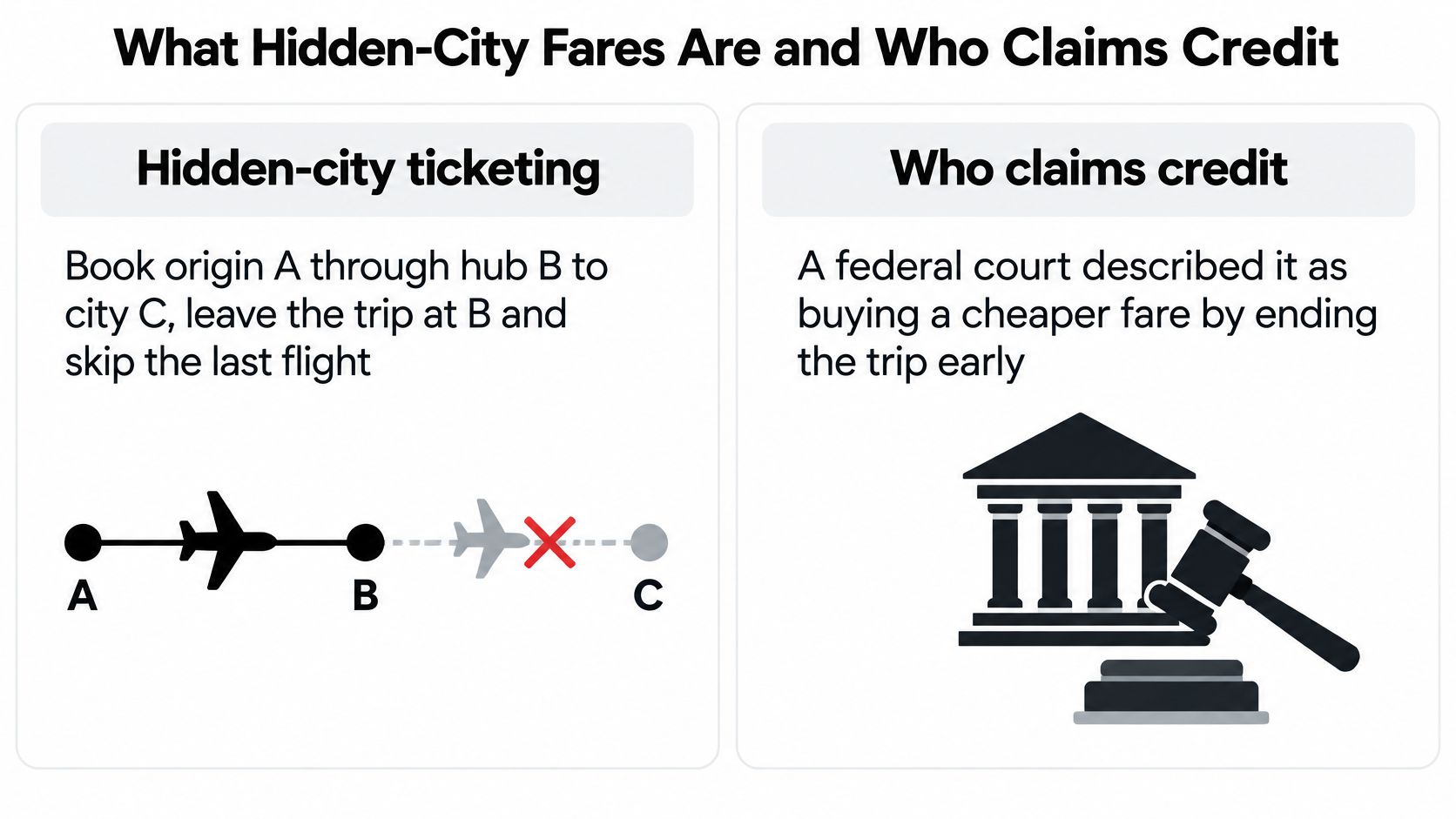
Hidden-city ticketing, also called a point-beyond fare, means booking origin A through hub B to city C, getting off at B, and skipping the last flight. A federal court opinion in the hidden-city fare litigation described the mechanics plainly: buy a cheaper spoke-hub-spoke ticket for the hub-to-spoke journey you want, then discard the rest.
Airlines generally prohibit the practice in their contracts of carriage. In the American Airlines litigation discussed in 2025, TravelPulse reported travelers could still use hidden-city itineraries after a federal jury rejected the relevant trademark claim against a booking platform. The contract issue remains: airlines can treat abandonment as a violation even when the booking survives a legal challenge.
I-Reroute.com covers hidden-city tickets and point-beyond fares as part of a fare-tactics library that also includes travel agent IDs, AD75, owner discounts, and how airlines fill first-class seats through hidden-city ticketing, backroom favors, and AD75 discounts. Treat the site as a place to learn the levers, not as proof that every lever fits your trip.
Its About page states that fewer than 20% of premium-cabin seats sell at their initial asking price, as stated on the I-Reroute.com About page. That is a pricing signal. The cash test decides the purchase. If a hidden-city fare cuts the air cost enough to offset the risk of a restricted ticket and a skipped segment, it can beat a normal premium fare. If the saving is small, skip it.
Run the same test on the hotel. Price the room as a separate cash purchase, then compare the flight tactic's net saving against the added restriction. A fare trick that saves $40 but puts a nonrefundable Four Seasons stay at risk is a bad trade. A fare trick that saves real money on a route you already need can sit beside the hotel booking without turning into a points strategy.
Pair the Hotel and Flight as Separate Purchases
Price the hotel first. Lock the Four Seasons net price with the worksheet, then price the flight as a separate purchase with its own risk.
Compare the same route three ways. Check a normal premium fare, a miles seat, and a point-beyond option. The cheapest headline fare doesn't win if it puts a nonrefundable hotel stay at risk.
The Hub City Rule
Point-beyond only works if your hotel is in the hub where you get off, city B. It doesn't work if the hotel is in final destination C and you still need that last flight. Book the room at B, or don't use the tactic for that trip.
Don't book a nonrefundable room against a return segment you may lose. Airlines can cancel remaining segments when a traveler skips a leg, so keep the hotel refundable or make sure the room doesn't depend on the skipped flight.
Keep the Bookings Independent
- Bags: Don't check a bag to the unused city, because it can continue without you.
- Return travel: Don't count on a throwaway coupon protecting the trip home.
- Documents: Keep the hotel confirmation and flight receipt separate so each can change without touching the other.
Treat point-beyond as a risk decision, not a default. If the premium saving is small, the hub is in the wrong place, or your hotel dates are firm and prepaid, the normal fare or miles seat wins. Check current airline rules before each trip because contracts of carriage change.
Decide If the Cash Stay Is Worth It
Cash is the entire decision here, so treat it as one. Book the Four Seasons room when its net cash price, after breakfast and credit you'll use, beats both the direct rate and a strong alternative, and when the cancellation terms match how firm your dates are. Skip it when the premium you're paying buys an unconfirmed upgrade, an unspent credit, or a nonrefundable gap a promo already covers.
Skip it too if your real goal was elite nights or a free-night chart. Four Seasons offers neither, and no booking channel turns cash spend into Four Seasons Points. A different hotel with a program you actively use may be the better buy.
If the room passes, price the flight on its own. Compare a normal premium fare, a miles seat, and a point-beyond option, then decide whether the saving justifies the risk of a cancelled return. A clever flight tactic should never force a bad hotel term.
For the fare mechanics behind that pairing, the Involuntary Reroute podcast explains premium-cabin pricing and fare structure in plain language, including hidden city tickets, travel agent IDs and AD75 discounts. Visitors can check out up to two episodes before becoming a subscriber, unlimited access costs $89.00 for all episodes, and pay per episode costs $2.99 per episode. Verify current airline rules before each trip.
Price your Four Seasons stay in cash, then learn how premium-cabin fares, hidden-city tickets, and point-beyond options are structured before you pay for the flight. Visit INVOLUNTARY REROUTE (I-REROUTE.COM) to sample episodes, compare the fare tactics in plain language, and choose the access option that fits how often you fly.