


Hidden City Ticketing Consequences: What Travelers Face
September 15, 2026The familiar warning is never use hidden city ticketing because an airline could ban you. Airlines do reserve serious remedies, yet the practical question is how often they enforce them, which travelers draw attention, and whether one missed segment affects the rest of a trip.
A 2026 industry report summarized by Destination found that hidden city ticketing succeeded without consequences in 99.7% of cases last year. That result does not cancel the contractual or financial risks.
It does, however, put the risk in proportion. Enforcement appears inconsistent, while the stated penalties remain broad: a canceled return flight, loyalty-account action, or civil claims. The sensible approach is to compare those documented consequences with the observed enforcement gap, rather than treating the harshest possible outcome as the usual one. (Destination's report on hidden city ticketing enforcement)
What Hidden City Ticketing Really Is
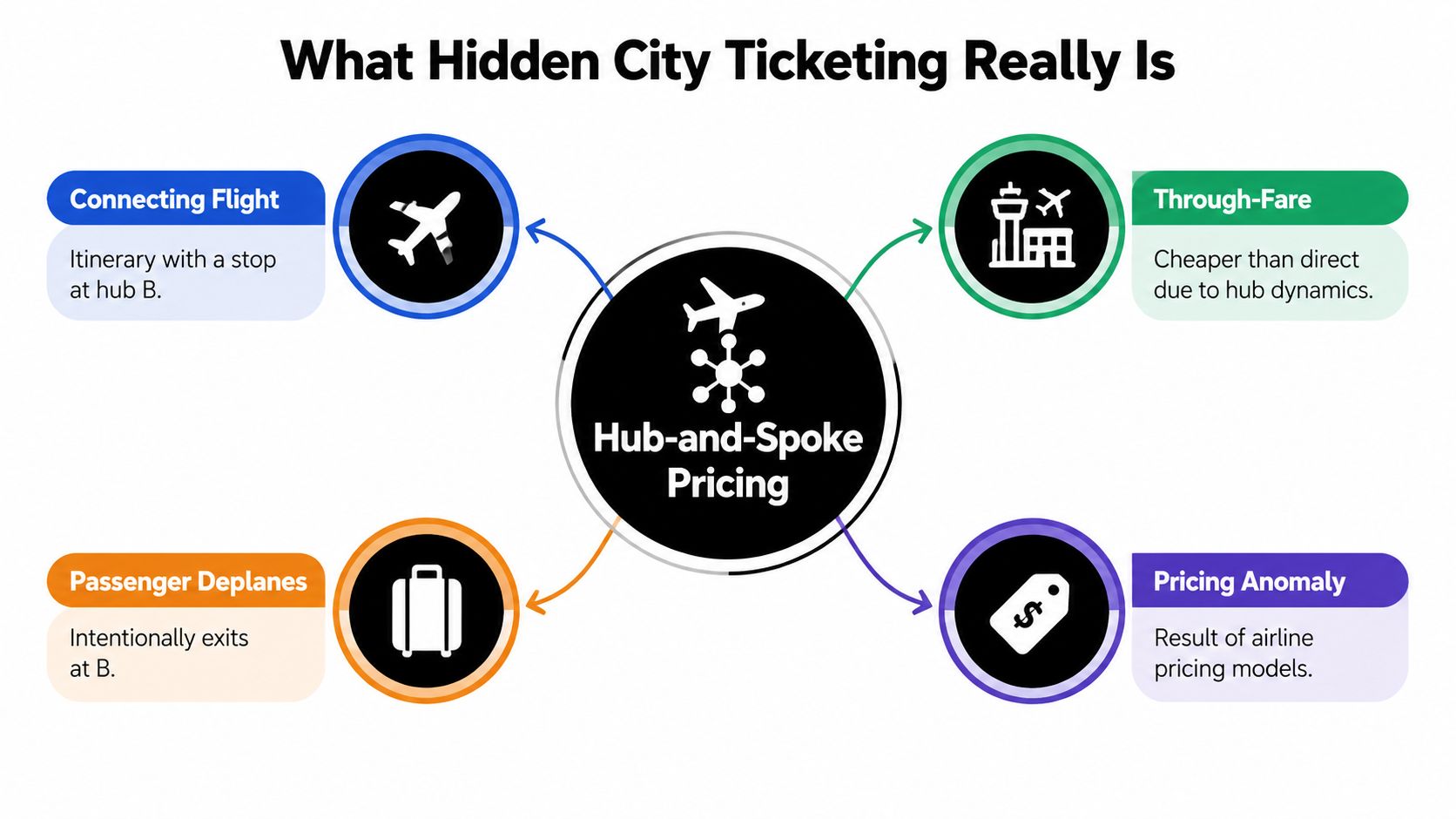
Hidden city ticketing uses a connecting itinerary for a destination that is not the traveler's true endpoint. You book a flight from city A through city B to city C, then leave the airport at B and intentionally skip the final segment to C. The ticket lists C as the destination, while the traveler's practical destination is B.
The practice is easier to understand as a result of airline pricing than as a passenger invention. Airlines price complete origin-and-destination combinations according to demand, competition, and network strategy, not by the distance flown. A connecting itinerary can therefore cost less than a nonstop ticket to the connecting city. Academic research describes this pattern as a bundle-pricing problem, especially in hub-and-spoke networks where the carrier has greater control over the connecting airport. (Research on airline bundle pricing and hidden-city ticketing)
The practice was chronicled in the book Involuntary Reroute, which explores the history and mechanics of hidden city fares, hidden city tickets, and point-beyond fares. The book is also available in audio form through I-Reroute.com.
Three practices that travelers often confuse
Throwaway ticketing generally means booking a ticket that includes a return or later segment, then discarding that unused portion. Back-to-back ticketing uses separate tickets in sequence to work around fare restrictions. Hidden city ticketing differs because the traveler leaves at an intermediate point instead of completing the ticketed journey.
All three practices can conflict with an airline's contract of carriage. Hidden city ticketing has drawn particular legal attention because it tests the carrier's destination-based pricing model. Legal status and contract status remain separate questions. A U.S. explainer notes that hidden city ticketing is not illegal under federal law, while airlines may still enforce their contractual terms. (U.S. legality and contract consequences of hidden city ticketing)
Airlines argue that hidden city tickets deprive them of revenue. Their complex fare structures, which can produce these pricing anomalies, remain in place. That creates a tension between the policy airlines state and the pricing systems they continue to operate. The point is analytical rather than moral: the same structure that permits different prices for overlapping flight segments also creates opportunities for travelers to choose the cheaper itinerary.
The practical question is the gap between maximum stated harm and observed enforcement. The reported 99.7% success rate without consequences matters because it places the documented penalties beside their reported frequency. It does not make hidden city ticketing safe or remove the possibility of a canceled itinerary, account action, or other contractual response. Risk still depends on the itinerary, the airline, the traveler's history, and what follows the skipped segment.
How Airlines Accidentally Created Hidden City Fares
The pricing mechanism is easier to understand step by step.
First, an airline groups many city pairs into a single network. A passenger flying from Atlanta to Chicago might compete with business travelers who value a nonstop schedule. Another passenger flying Atlanta to Detroit through Chicago may be shopping for a different market. The airline can price those two itineraries differently even though the first two flight segments overlap.
Second, the airline doesn't divide one total fare evenly across each flight. It prices the complete origin-to-destination journey against demand at both endpoints, available competition, cabin inventory, and the strategic role of the connecting airport. A 2022 empirical study found that hidden city opportunities depend strongly on route competition, appear mostly in the last week before departure, are less likely when the intermediate airport is a hub, and are concentrated on major hub-and-spoke carriers such as American, Delta, and United. (2022 empirical study of hidden city pricing)
A simple Atlanta example
Suppose the published options look like this:
| Itinerary | Price | Stops | Effective Destination |
|---|---|---|---|
| Atlanta to Chicago | $189 | Nonstop | Chicago |
| Atlanta to Chicago to Detroit | $84 | One stop | Chicago, if the traveler leaves at the connection |
In this example, the connecting fare is $105 cheaper than the nonstop fare. Those amounts come from the illustrative example required for this comparison, not from a general airfare average.
The airline created the difference because it was selling the Atlanta to Detroit market as a connected journey. The carrier may have been trying to fill seats on a route where point-to-point demand was weaker or where competition shaped the fare. The traveler didn't create the pricing anomaly. The traveler identified it and used the itinerary in a way the airline's contract prohibits.
The Babson origin story is often connected with observations by Akli and Aktalay in the 2010s, including a Detroit experiment involving fares shaped by connecting demand. The broader economic point remains more important than the anecdote: hub-and-spoke pricing can make a longer ticket cheaper than a shorter one because airlines sell markets, not distance.
That structure also explains why airlines don't remove every fare that can be used as a hidden city ticket. The same fare may serve legitimate connecting passengers. Eliminating it could require the carrier to redesign its network pricing and discount inventory it still wants to sell.
The Skiplagged Ruling and What It Changed
The Skiplagged dispute became the most visible legal fight over hidden city ticketing. American Airlines sued Skiplagged in 2023, arguing that the platform helped passengers violate airline rules. The case drew attention because it separated the company that displays an itinerary from the passenger who chooses how to use it.
The court dismissed the lawsuit in February 2024. The specific finding described in current travel-industry reporting was that Skiplagged didn't provide instructions whose ordinary use would breach the contract. The platform surfaced public fare data, while the passenger made the travel decision.
The dispute continued through the appeals posture involving the Fifth Circuit in 2025, before the airline dropped its appeal in late 2025. That outcome didn't give passengers a blanket exemption from airline contracts. It clarified the narrower position that displaying or finding a hidden city fare isn't the same as personally breaching the carrier's rules. (Travel reporting on the Skiplagged legal fight)
What the ruling means for a passenger
In 2026, a traveler can generally find and book a hidden city itinerary through a platform or through ordinary fare searches. The booking still creates a contract with the airline. That contract can give the carrier power to cancel later segments, demand a fare difference, restrict loyalty benefits, or limit future bookings.
The distinction is practical:
- Fare display: Showing the itinerary isn't itself the passenger's missed segment.
- Passenger conduct: Leaving at the connection and skipping the final leg can violate the contract.
- Airline remedy: The carrier may apply its written rules even when the conduct isn't a criminal offense.
The Skiplagged outcome therefore changed the discussion, not the traveler's exposure. It made clear that legal scrutiny of a fare-search platform doesn't eliminate the consequences attached to the ticket itself.
Contract of Carriage Violations Explained
A contract of carriage is the airline's rulebook for using a ticket. Hidden city ticketing can trigger provisions covering prohibited fare practices, misuse of coupons or segments, no-shows, and the carrier's right to cancel or reprice transportation.
Major U.S. carriers generally reserve broad remedies. Those reservations may include canceling the remaining itinerary, invalidating unused portions of the ticket, seeking the difference between the fare paid and the fare the airline says should have applied, and taking action against loyalty accounts. The exact wording differs by carrier and can change, so travelers should read the current contract attached to their booking.
Three levels of exposure
Standard reservations of rights are the broad powers written into the contract. These can include fare-difference collection, loss of refundable-fare protections, cancellation of later segments, and loyalty sanctions.
Automatic triggers arise from the itinerary itself. A no-show on one segment can cause the carrier's system to cancel every later segment on the same ticket. Checked baggage creates a separate operational problem because the bag may be tagged to the ticketed final destination.
Discretionary penalties depend more on the airline's assessment of the passenger's conduct. These can include account suspension, mile forfeiture, future booking restrictions, blacklisting, or civil action in unusual cases.
| Airline | Stated Reservation of Rights | Typical Documented Outcome |
|---|---|---|
| United | Cancel remaining segments, reprice the itinerary, and pursue contractual remedies for prohibited ticket use | Downstream cancellation is the immediate practical risk, while loyalty or financial action depends on detection and circumstances |
| Delta | Enforce ticket-use rules, cancel unused segments, and apply account remedies where the carrier identifies misuse | A one-off case may pass without account action, while repeated patterns can draw scrutiny |
| American | Restrict prohibited fare practices, cancel later travel, and seek fare-related remedies | The most visible legal fight involved Skiplagged, but passenger consequences usually begin with itinerary disruption |
| Southwest | Apply ticket-use and no-show rules to unused portions of an itinerary | The traveler can lose later segments when the system treats the missed coupon as a no-show |
| JetBlue | Reserve remedies for misuse of tickets and violations of its contract of carriage | The carrier can cancel remaining travel and pursue other remedies allowed by its terms |
The table separates what airlines say they can do from what usually happens first. Industry summaries describe cancellation, fare-difference demands, loyalty sanctions, and future restrictions, while observed enforcement appears inconsistent and usually limited in scale. (Industry guide to airline hidden city policies)
Public litigation is rare. One documented example involved Lufthansa suing a passenger for €2,118 plus costs, a case that illustrates the outer edge of enforcement rather than a routine result for every traveler. Most U.S. carriers have more often relied on warnings, account action, itinerary cancellation, or settlement threats than on court proceedings. (Documented financial and loyalty consequences)
Practical rule: The most immediate danger usually isn't a dramatic lawsuit. It's losing the rest of the ticket while you're already traveling.
The Round-Trip Cascade That Strands Travelers
Consider a traveler flying from Dallas through Chicago, with Grand Rapids as the ticketed destination. The traveler plans to attend a wedding in Chicago, so they leave the airport there and skip the Chicago to Grand Rapids segment.
The outbound no-show can cancel the remaining segments on the same ticket. If the booking was a round trip, the system may also cancel the return itinerary because the traveler never completed the outbound sequence. The traveler may arrive in Chicago successfully, then discover that the flight home no longer exists in the reservation.
Why checked bags change the calculation
Checked baggage makes hidden city ticketing especially fragile. The airline generally tags the bag toward the ticketed final destination, not the intermediate city where the traveler plans to stop. A bag checked in Dallas may therefore continue toward Grand Rapids even though the passenger exits in Chicago. (CNBC explanation of itinerary and baggage risks)
That can create a recovery problem at the airport. The traveler may need to coordinate with baggage services, arrange onward shipment, or pursue a claim while also finding a replacement flight. The practical costs can exceed the original fare difference, particularly when the traveler has a wedding, work obligation, or family connection that can't move.
A round trip also creates a false sense of savings. The traveler compares the hidden city fare with the direct outbound fare, but the relevant risk includes the return flight, ground transportation, luggage, meals, and a replacement booking. The contract may allow the airline to cancel all later segments, including the return leg, after the no-show.
International travel introduces another layer. A hidden city itinerary involving a connection through a customs port can create passport, visa, and baggage complications, especially when the traveler needs to explain why the ticketed journey wasn't completed. The general operational lesson is straightforward:
- Carry-on planning: Checked bags may continue to the ticketed endpoint.
- Round-trip planning: A missed outbound segment can cancel later and return flights.
- Schedule planning: Rebooking from the intermediate city can erase the expected saving.
- Disruption planning: An airline schedule change can move the connection and destroy the intended stop.
The most common real-world consequence is therefore a cascade, not a headline penalty. One no-show can turn a short fare workaround into a stranded traveler with a disrupted bag and no usable ticket home.
Loyalty Miles Elite Status and Account Bans
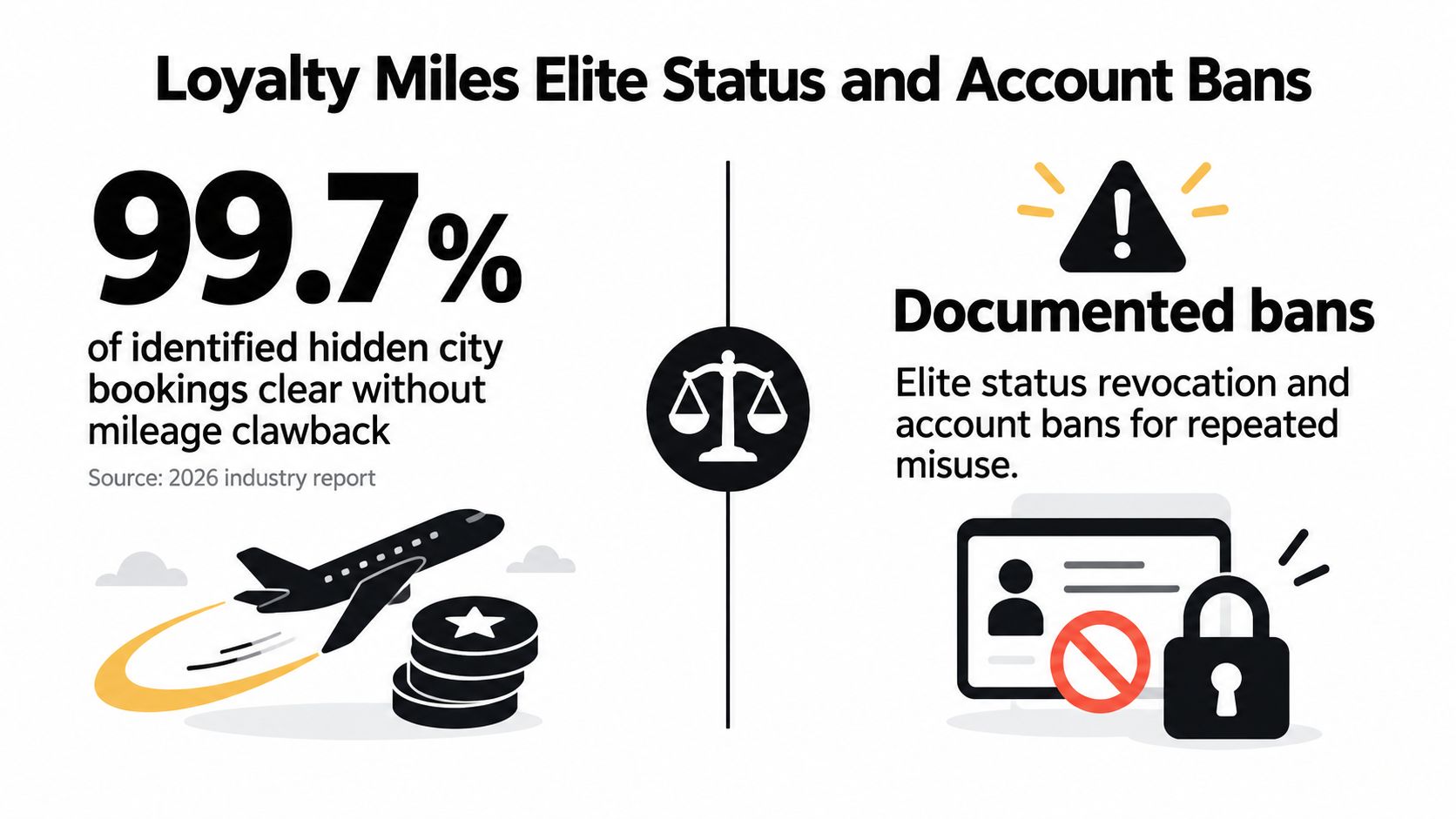
Loyalty risk depends less on one missed segment than on the pattern around it. A traveler who uses hidden city ticketing once may never face a mileage clawback. Repeated bookings that leave similar segments unused create a record an airline can interpret as deliberate conduct.
As noted earlier, the 2026 industry report found that 99.7% of identified hidden city bookings cleared without mileage clawback. That figure describes the report's specific group and consequence, not every booking or every possible penalty. It shows a wide enforcement gap, while leaving a smaller set of travelers exposed to the rules airlines state in their contracts.
What repeated behavior can expose
Airlines may review reservation histories, no-show patterns, ticket sequences, and loyalty-account activity. An isolated missed segment looks different from a recurring pattern, especially when the same passenger repeatedly books routes in which the skipped portion appears intentional.
Reported consequences include:
- Mileage forfeiture: The carrier may remove accumulated miles.
- Status loss: Elite benefits may be suspended or revoked.
- Account closure: The airline may end the loyalty relationship.
- Future restrictions: The traveler may face booking limits or a travel ban.
- Civil claims: In repeated or egregious cases, the carrier may pursue damages.
Specific claims about automated triggers, MQMs, MQDs, or individual account closures require caution because program rules change and public documentation is uneven. The dependable conclusion is narrower: loyalty sanctions are documented consequences, and repeat behavior increases exposure. Historical reporting about Skiplagged also describes carriers revoking miles, blacklisting travelers, canceling later segments, and, in some cases, suing passengers for fare differences.
The practical difference is the value tied to the account. A casual traveler may mainly risk losing the remaining itinerary. A frequent flyer who relies on one airline for status, award access, upgrades, or work travel could lose benefits that are harder to replace.
Loyalty losses also recover differently from a canceled flight. Money may replace a segment, while lost miles, elite qualification, and account access can take much longer to rebuild, or may not be recoverable under the program's terms.
Safer Ways to Use What Airlines Already Offer
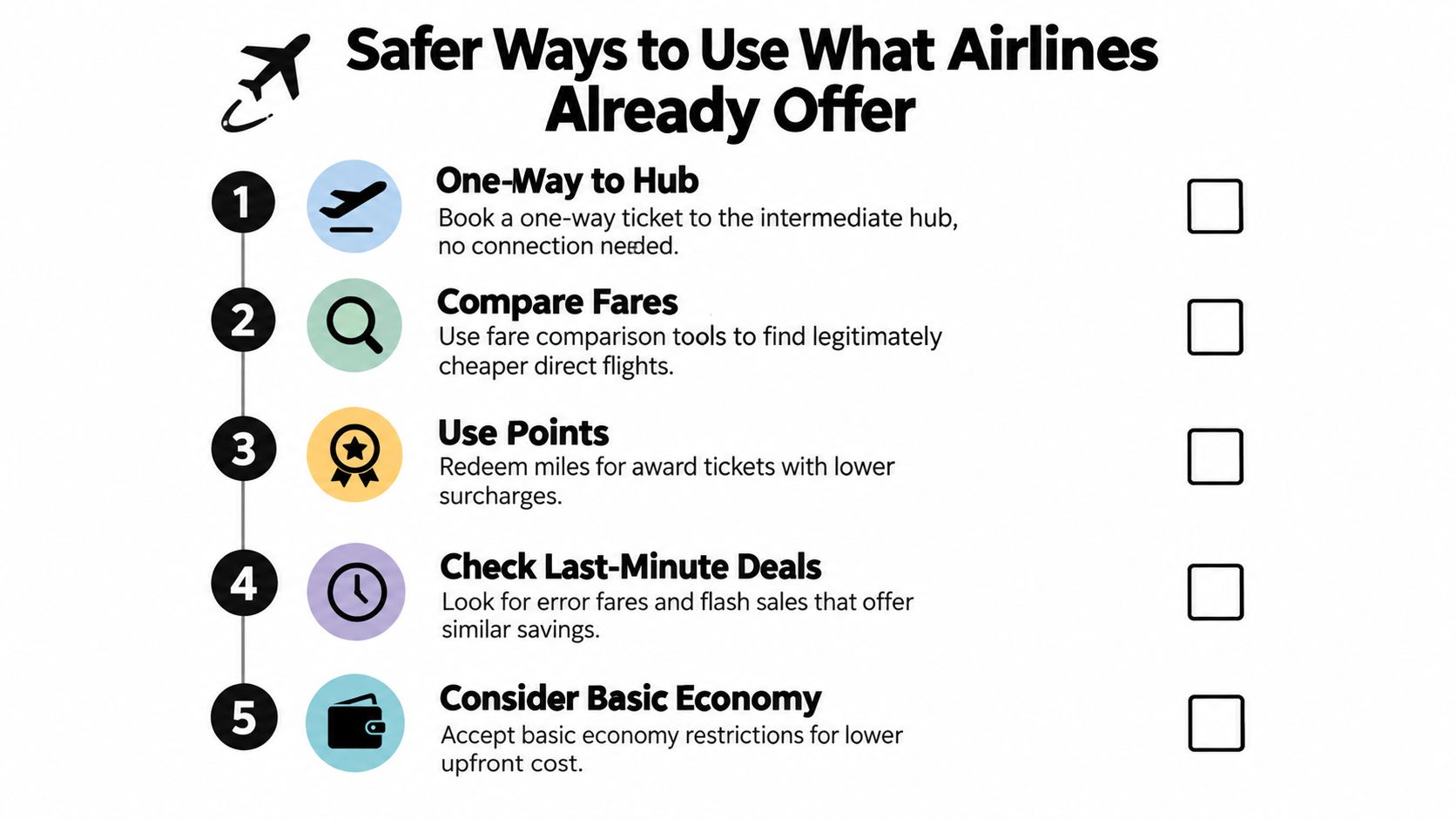
Travelers can capture some of the pricing logic behind hidden city fares without intentionally abandoning a ticketed segment. The clearest alternative is a one-way ticket to the intermediate hub, followed by a separate booking for the remaining journey. This avoids a no-show on the original itinerary, although separate tickets place connection, schedule, and baggage responsibilities on the traveler.
A positioning flight follows the same principle. Fly legally to a competitive hub, then continue on another ticket to the actual destination. Leave enough time between bookings to absorb a delay, and assume the first airline will not protect the second ticket if the connection fails. The arrangement can lower the fare while keeping each ticket's travel pattern within its stated terms.
A practical search sequence
- Search one-way first. Compare the direct fare to the hub with separate options for travel beyond it.
- Compare the round-trip price. A round trip may cost less, but inspect the return structure for restrictions you do not want.
- Verify baggage eligibility. Check whether the fare includes a carry-on and whether separate tickets change where or how you can check bags.
Google Flights can compare flexible dates and destinations. ExpertFlyer can show fare and seat information for travelers comfortable reading those details. Airline fare calendars and promotional alerts may reveal off-peak prices without requiring a missed segment. Award bookings can reduce the cash price, though miles come with separate availability and cancellation rules.
Premium-cabin pricing deserves close attention. Airlines may discount first-class or business-class inventory on routes and dates with softer demand, using fares to manage available seats. Searching nearby airports, flexible dates, one-way fares, and award availability can reveal a legitimate alternative to a hidden city itinerary.
Understanding premium-cabin pricing and airline inventory tactics is a subject in its own right. The INVOLUNTARY REROUTE podcast and membership platform offers episodes and membership material covering hidden city ticketing, point-beyond fares, premium-cabin pricing, mileage redemptions, and airline inventory behavior. Its audio catalog includes narrative explanations and practical fare discussions for travelers, students, business owners, travel agents, and the Babson College and Alpha Kappa Psi communities. (INVOLUNTARY REROUTE podcast and membership platform)
Weighing Actual Odds Against Stated Penalties
The practical question is not whether hidden city ticketing can violate an airline's rules. It can. The useful question is how that possibility compares with the chance and severity of enforcement. A reported 99.7% no-consequence rate indicates that most bookings in that report cleared without a penalty, but it does not establish a guarantee for every airline, route, passenger, or booking pattern. The contract of carriage remains the rulebook, even when enforcement is uncommon.
A fare workaround is like carrying a small chance of a large bill. The likely outcome may be uneventful, while the less likely outcome can disrupt an entire trip.
| Consequence | What the contract may allow | Why it matters to your decision |
|---|---|---|
| Missed segment | Cancel the remaining itinerary | A later flight, including a return, may disappear |
| Fare difference | Demand more money or reprice the journey | Repeated use can bring warnings or account disputes |
| Fare protections | Void expected protections | Flexibility may vanish when plans change |
| Loyalty action | Forfeit miles, suspend status, or close the account | The effect can extend beyond one reservation |
| Future access | Restrict or ban later bookings | Frequent flyers have more to lose |
| Civil claim | Seek damages or a fare difference | Public litigation is uncommon, but repeated or serious conduct presents greater exposure |
The table matters because risk is personal, not uniform. A traveler taking a simple one-way trip without checked baggage may be able to absorb a disruption that would be unacceptable on an international journey, an award booking, or travel tied to a fixed event. The fare gap should therefore be compared with the cost of replacing the trip, not viewed alone.
Round trips deserve special caution. If the airline treats the skipped segment as a breach and cancels later flights, the return may be unusable even though the traveler planned to board it. That possibility matters more than a modest saving when the return date cannot move.
Loyalty programs create a separate calculation. A traveler who depends on miles, elite status, or an established airline account may place more value at risk than the ticket price suggests. Repeated patterns can also attract more attention than an isolated booking, although the available report does not predict how any particular airline will respond.
Policies and review systems can change. The current enforcement picture is evidence about observed outcomes, not a promise about future bookings. The balanced conclusion is that direct penalties appear uncommon in the cited report, while their effects can be concentrated and severe when every ticketed segment must work.
For flexible travelers who understand the rules, carry no checked baggage, and can absorb replacement costs, the choice may be a tolerable personal risk. Essential travel, international itineraries, round trips, and valuable loyalty benefits justify a higher standard of caution. Separate legal tickets, flexible-date searches, award options, and legitimate promotions may provide a better tradeoff.
INVOLUNTARY REROUTE (I-REROUTE.COM) provides educational material on hidden city fares, point-beyond pricing, premium-cabin inventory, and airline revenue tactics. Its podcast and membership resources can help travelers examine the tradeoffs before deciding what a fare workaround is worth.