


Airlines pretend hidden city tickets cost them money, despite being paid for OVERVALUED SEATS that may have otherwise flown EMPTY. Created in the 20th century, ILLICIT TICKETS, hidden city fares & back door tactics allows airlines to dispose of OVERVALUED SEATS for money rather than mileage programs or the upgrade lottery. Examples of hidden city tickets still in use in the 21st century are shown below:
Real Hidden City Ticketing Examples
Hidden city ticketing can be difficult to understand without seeing real examples.
Below are actual flight pricing scenarios where longer, connecting itineraries cost less than shorter or nonstop routes—revealing how airline pricing really works.
If you’re new to the concept, start with our full guide to .
New York – London – Barcelona (Hidden City Ticketing Example)– British Airways
This example highlights how a connecting itinerary can dramatically reduce the cost of a premium cabin ticket.
A business class fare from New York to London on British Airways prices at over $8,000 when booked nonstop. However, by extending the itinerary to Barcelona—New York → London → Barcelona—the same transatlantic segment prices at just $2,272.40 in “D” class.
The only difference is the addition of the London–Barcelona segment.
This pricing gap exists because airlines assign different values to different markets. The New York–London route carries strong business demand and is priced accordingly, while the extended routing to Barcelona is treated as a lower-demand connecting market and discounted to ensure the seat gets filled.
In effect, the London segment is priced closer to its true market-clearing value when bundled with a weaker demand destination.
This is a clear example of how hidden city ticketing works:
👉 the longer itinerary is cheaper not because it costs less to operate—but because it must be priced lower to stimulate demand.
Star Alliance Round-the-World Fare (Hidden City Ticketing Example)
This example shows how point-of-origin pricing and hidden city strategy can dramatically impact the cost of a premium ticket.
A business class round-the-world fare booked through VARIG (a former Star Alliance member) priced at approximately $5,922 for 29,000 miles of travel when originating in Canada.
The same ticket, with a U.S. point of origin, priced at over $11,300 plus taxes.
The flights themselves were operated by a mix of Air Canada, Lufthansa, United Airlines, and Singapore Airlines—not the issuing carrier.
What’s happening here
The pricing difference has nothing to do with distance or cost.
It’s driven by point-of-sale and currency-based demand differences.
By originating the ticket in Canada—where pricing was structured around a weaker currency and different market conditions—the same global itinerary was discounted significantly compared to U.S.-origin pricing.
Brussels – Washington – State College + Montreal Add-On (Hidden City Ticketing Example)
This example shows how combining hidden city ticketing with point-of-sale pricing can significantly reduce the cost of a business class ticket.
A business class itinerary from Brussels to State College, PA, priced at $6,540 when booked as a standard U.S.-ending ticket. However, by extending the itinerary with an additional segment—Pittsburgh to Montreal the following day—the total ticket price dropped to $1,911.
The only difference was the addition of the final Montreal segment.
What’s happening here
Two separate pricing dynamics are working together:
- Point-of-sale advantage
By ending the itinerary in Canada, the ticket qualified for lower Canada-based pricing, which is often structured differently due to currency and regional demand. - Market segmentation
Airlines priced the Brussels → U.S. segment higher due to strong transatlantic demand into the United States, while itineraries extending into Canada were discounted to stimulate weaker demand across that broader market.
Where hidden city logic appears
The traveler’s actual destination was State College, PA.
The final segment—Pittsburgh → Montreal—was never intended to be flown.
However, adding it to the ticket unlocked a lower fare.
Additionally, arriving in one airport (State College) and departing from another (Pittsburgh) created a natural break in the itinerary, helping ensure baggage could be checked only to the intended destination rather than the ticketed final destination.
What this example proves
This is a layered hidden city strategy:
- Adding a point-beyond destination can dramatically reduce pricing
- Ending in a different country can shift fare construction entirely
- Multi-city structuring can help manage practical issues like baggage handling
In this case, the final segment wasn’t just a throwaway leg…
👉 it was the key that unlocked an entirely different pricing structure
Los Angeles – Sydney – Kuala Lumpur (Qantas + Malaysia Airlines)
This example shows how adding a point-beyond destination can significantly reduce the cost of a long-haul business class ticket.
A business class fare from Los Angeles to Sydney on Qantas prices at over $8,000 in “D” booking class when purchased as a nonstop itinerary.
However, by extending the routing to Kuala Lumpur—Los Angeles → Sydney → Kuala Lumpur—with the additional segment operated by Malaysia Airlines, the total ticket price drops to $3,655.
The transpacific segment between Los Angeles and Sydney remains the same.
What’s happening here
The pricing difference is driven by market segmentation.
The Los Angeles → Sydney route carries strong premium demand and is priced accordingly. In contrast, itineraries continuing beyond Sydney into Southeast Asia are treated as more competitive, lower-demand markets and are discounted to ensure seats are filled.
By adding Kuala Lumpur as the final destination, the entire itinerary is repriced under a different demand profile.
Where hidden city logic appears
The traveler’s intended destination is Sydney.
The Sydney → Kuala Lumpur segment is not essential to the trip—but its presence lowers the cost of the long-haul flight.
This is a classic hidden city ticketing structure:
👉 adding a point-beyond destination reduces the price of the primary segment
What this example proves
- Airlines price based on destination market, not distance
- Strong nonstop routes carry significant premiums
- Adding a weaker-demand destination can reprice the entire ticket
In this case, the Kuala Lumpur segment acts as a pricing lever—
👉 unlocking a business class fare that is less than half the cost of the nonstop itinerary
Seoul – New York – London (Concorde Hidden City Example)
This is one of the most extreme real-world examples of hidden city ticketing driven by currency and market distortions.
During the Asian currency crisis, the Korean won rapidly devalued, creating a temporary disconnect between local currency pricing and global fare structures.
Before the devaluation, first class fares from Seoul to New York on Korean Air exceeded $8,000 one way.
However, as the currency weakened, a combined itinerary—Seoul → New York → London—featuring Korean Air across the Pacific and the Concorde operated by British Airways—priced at approximately $875.
What’s happening here
This pricing collapse was caused by currency lag in airline fare systems.
Airlines continued pricing tickets in a rapidly depreciating currency, allowing international premium fares originating in Seoul to fall dramatically in real value before adjustments could be made.
Because airline pricing is not tied directly to distance—but to market conditions—this created a temporary but extreme mispricing.
This aligns with how hidden city ticketing works more broadly: fares are shaped by market forces rather than mileage or cost.
Where hidden city logic appears
Travelers purchased the full Seoul → New York → London itinerary, but:
- Skipped the Seoul → New York segment
- Boarded in New York
- Flew the Concorde to London
By doing so, they accessed a transatlantic Concorde fare at a fraction of its normal cost.
What this example proves
- Airline pricing can fall out of sync with real-world conditions
- Currency movements can create extreme fare distortions
- Hidden city ticketing exposes these gaps when they occur
In this case:
👉 a Concorde flight—typically priced in the thousands—was effectively available at a 90% discount
What These Hidden City Ticketing Examples Reveal
Then write something like:
Across all of these examples, one pattern is consistent:
Airlines do not price tickets based on distance or cost.
They price based on market demand, point of origin, currency conditions, and competitive pressure.
This creates situations where longer itineraries can be cheaper than shorter ones, and where adding a segment can unlock dramatically lower fares.
Hidden city ticketing doesn’t create these opportunities—it exposes them.
-
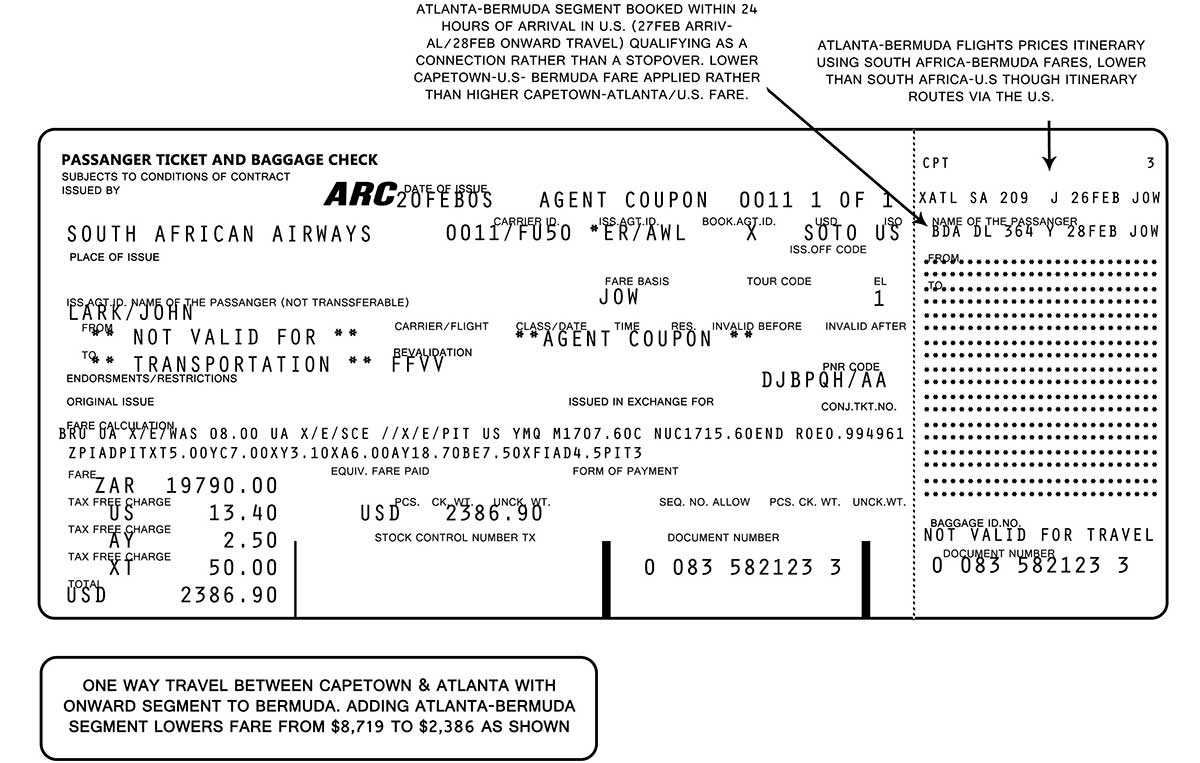
Hidden city airline ticket example with Delta Airlines Cape Town South Africa - Atlanta with an added segment to Bermuda the following day for sensational business class fare savings.
-
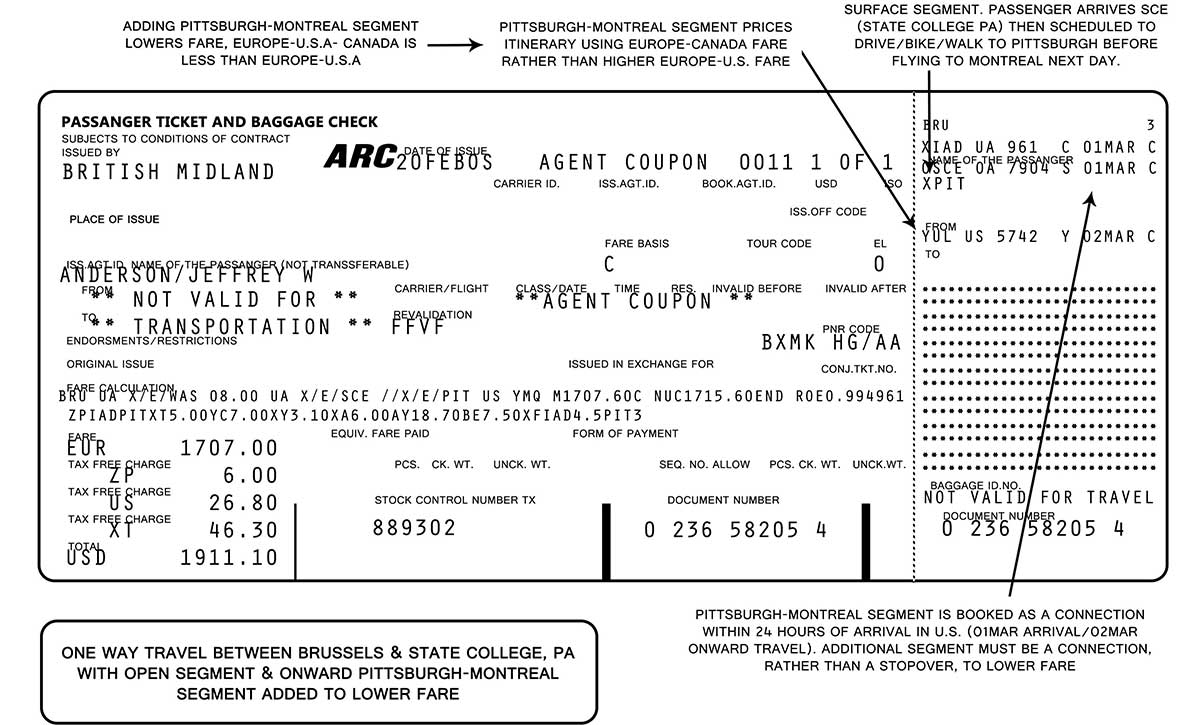
Hidden city airline ticket example with United Airlines, paid through one airline though travel is on another. Business class flights between Belgium (Europe)- State College, PA with surface/open segment between Pittsburgh and Montreal. The placement of a Pittsburgh- Montreal segment created explosive savings.
-
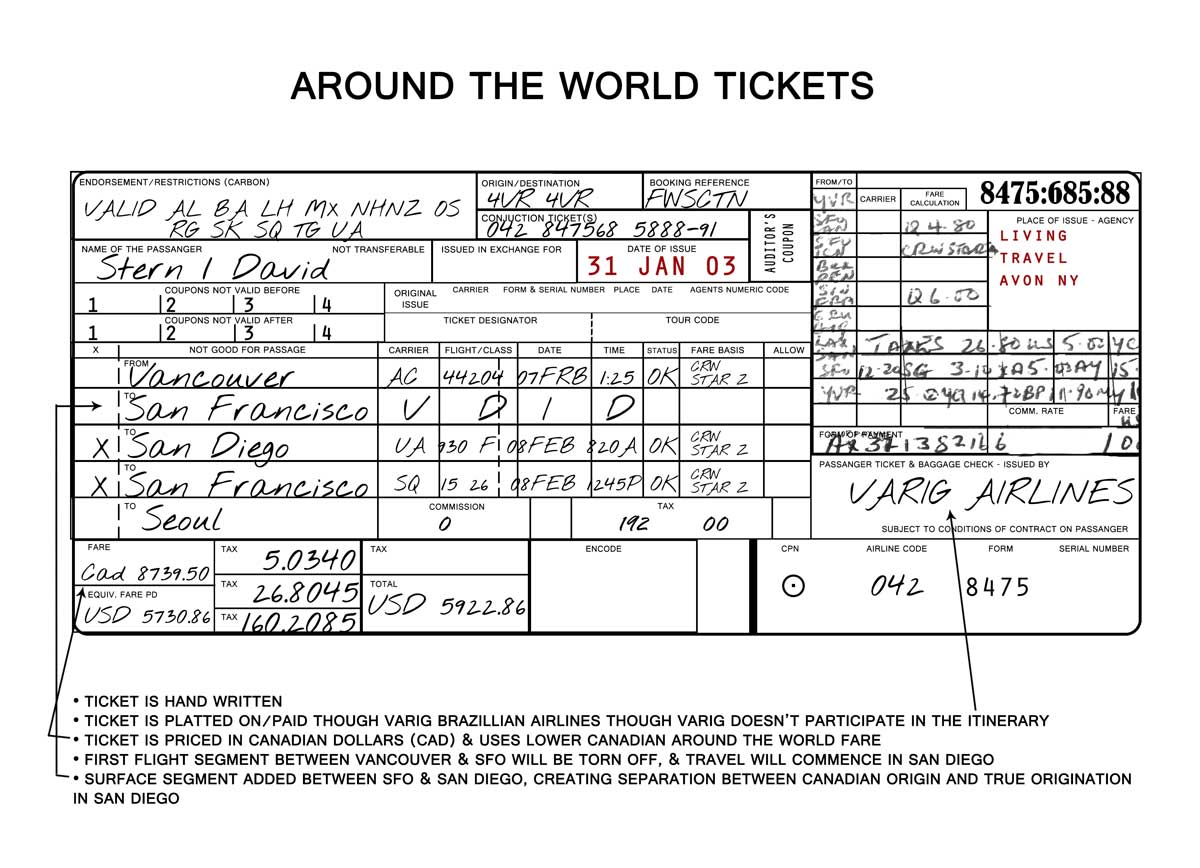
Have you ever seen a vintage hidden city airline ticket like this? It's hand written, paid through VARIG (now defunct) though all flights are with Air Canada, United Airlines and Singapore Airlines. Ticket is priced and originates in Canada to use lower Canadian around the world fare, though first segment between Vancouver and San Francisco is torn off and travel originates in San Diego.
-
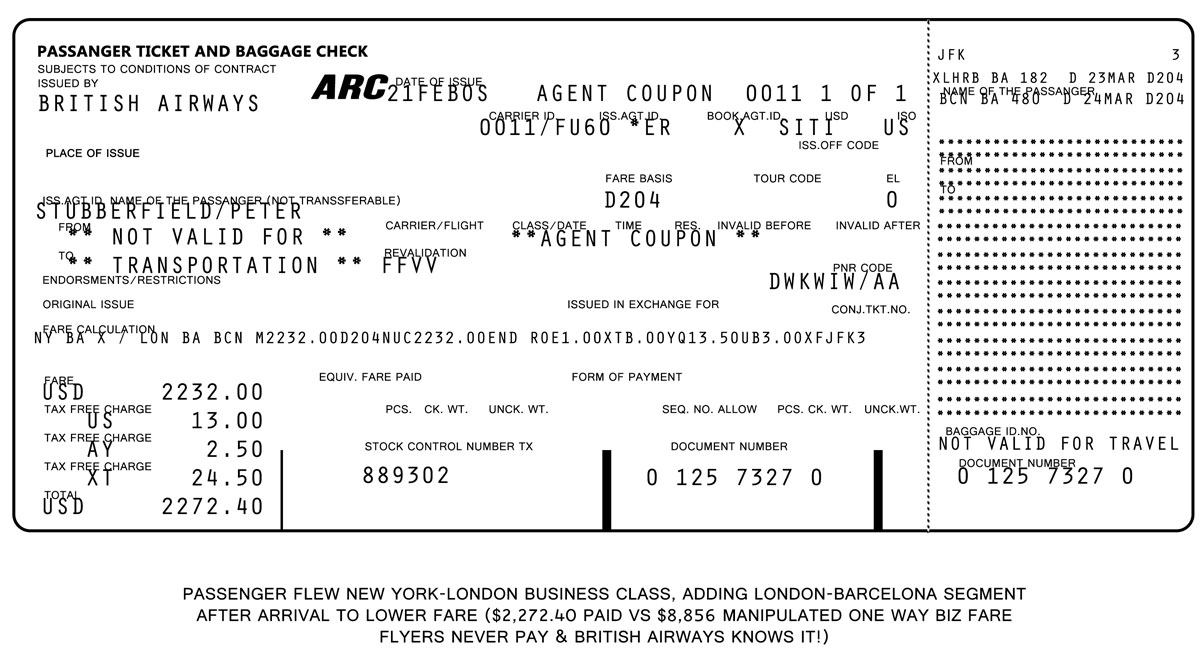
Simple point to point hidden city ticket New York-London -Barcelona. Adding London-Barcelona segment created amazing savings
-
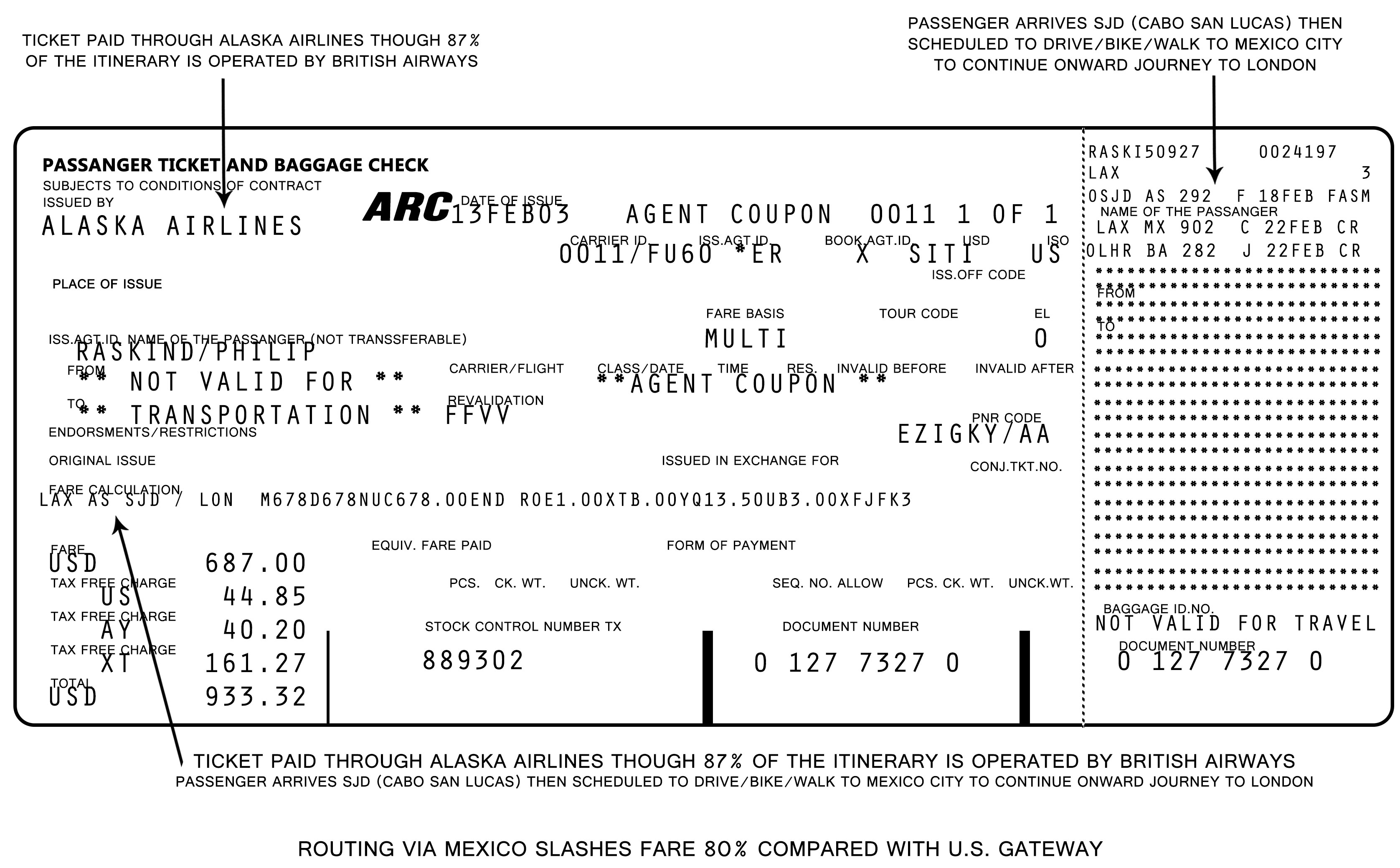
Hidden city airline ticket paid through Alaska Airlines through 87% of the itinerary is operated by British Airways. Passenger arrives Cabo San Lucas SJD then scheduled to drive, bike, walk to Los Angeles LAX to continue onward journey to London Heathrow.
The addition of the first segment, which would eventually be torn off before travel from LAX, enables 80% + business class savings