


How Frequent Flyer Miles Work: The 2026 Guide
October 5, 2026Frequent flyer miles are a variable-value currency created by airlines to fill seats and build loyalty, and their worth depends entirely on how and when you redeem them rather than any fixed cash equivalent. A $500 ticket might earn 2,500 miles, while a single award seat can cost 56,000 or 334,400 miles depending on the route, cabin, and date.
So why can two passengers on the same flight earn different balances, and why can the same seat require dramatically different mileage amounts from one day to the next? The answer is that miles aren't a simple measure of distance traveled. They're part of a pricing system that connects customer loyalty, ticket revenue, credit-card spending, seat inventory, and airline accounting.
Understanding What Frequent Flyer Miles Actually Are
A traveler books a flight, checks the loyalty estimate, and expects the miles to reflect the distance flown. Later, the account shows a modest balance, while another passenger on the same aircraft earns more through a different fare or credit card. When the traveler tries to redeem those miles, the airline offers one seat for one mileage price and another seat on a nearby date for a completely different amount.
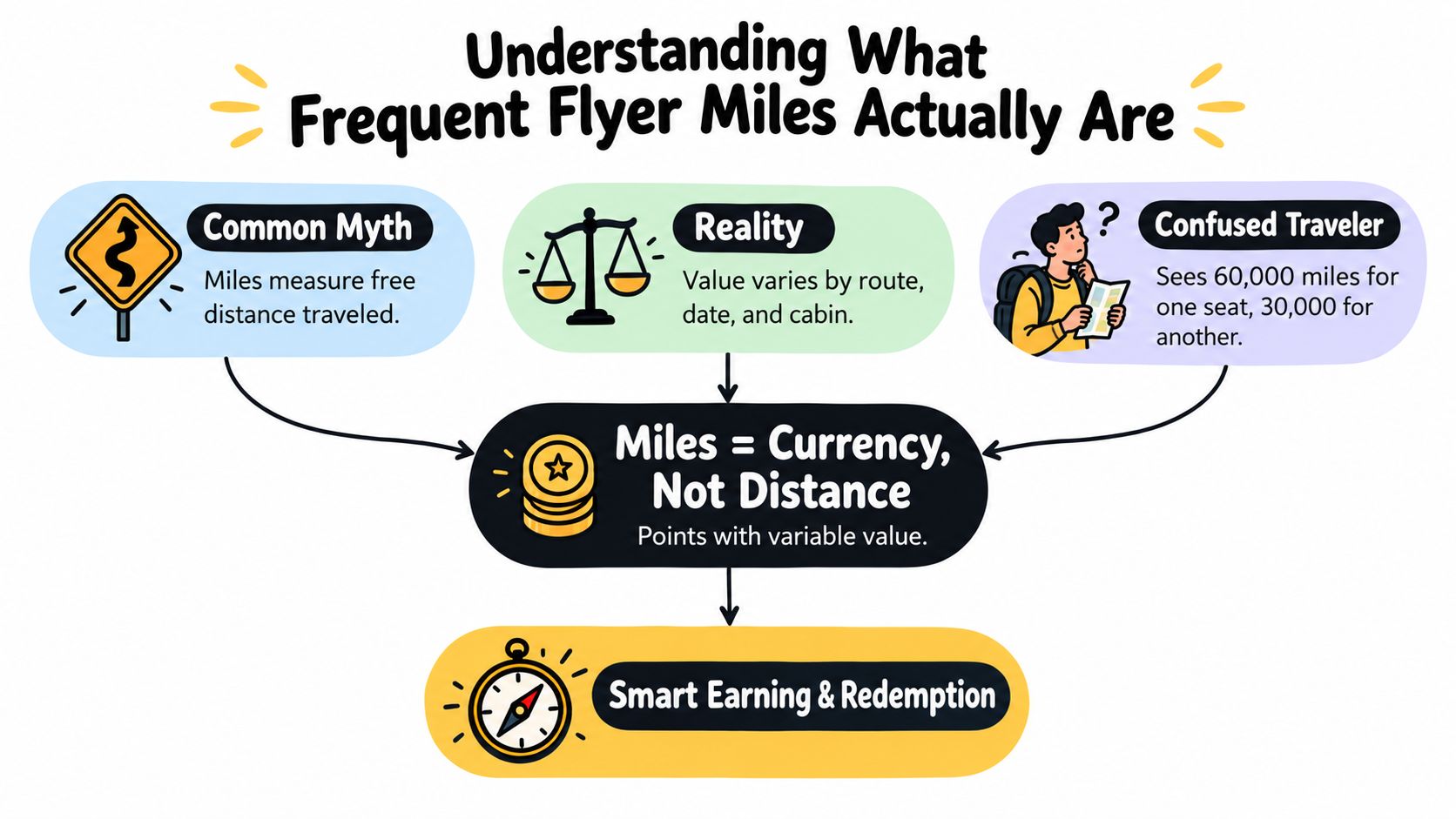
That confusion comes from treating miles as physical distance. Modern frequent flyer miles are loyalty currency, not a kilometer counter. Airlines issue them to encourage repeat business, influence booking behavior, and help manage seats that might otherwise depart empty. The value appears only when you choose a redemption, and the program controls much of that value.
Modern mileage programs developed in the late 1970s and early 1980s. Texas International Airlines is commonly credited with launching the first mileage-based program in 1979, followed by American Airlines' AAdvantage in 1981, as documented in this history and valuation overview of frequent flyer miles. By 2005, loyalty programs had grown to 163 million enrolled members across more than 130 airlines, with about 14 trillion points accumulated worldwide, valued at roughly US$700 billion.
Why the airline cares about your balance
Those figures show why miles aren't merely a promotional gift. Airlines carry outstanding miles as a future obligation. A member may redeem them for a flight, an upgrade, or another reward, so the airline has to estimate what those unredeemed balances may eventually cost.
That creates an important distinction:
- Distance is an input in some legacy systems, but it isn't the universal basis for earning.
- Revenue and customer behavior increasingly drive issuance, especially when travelers buy tickets through different channels.
- Redemption conditions determine practical value, because the same balance can buy more on one itinerary than another.
- Program rules can change, even when your account balance doesn't.
A useful mental model is to think of miles as airline-issued tokens with a floating exchange rate. You don't own a fixed cash amount. You own access to a redemption system whose prices depend on inventory, demand, fare rules, cabin, and the airline's commercial priorities.
Practical rule: Never ask only, “How many miles do I have?” Ask, “What can these miles buy on the dates and routes I actually need?”
How to Earn Miles in Modern Programs
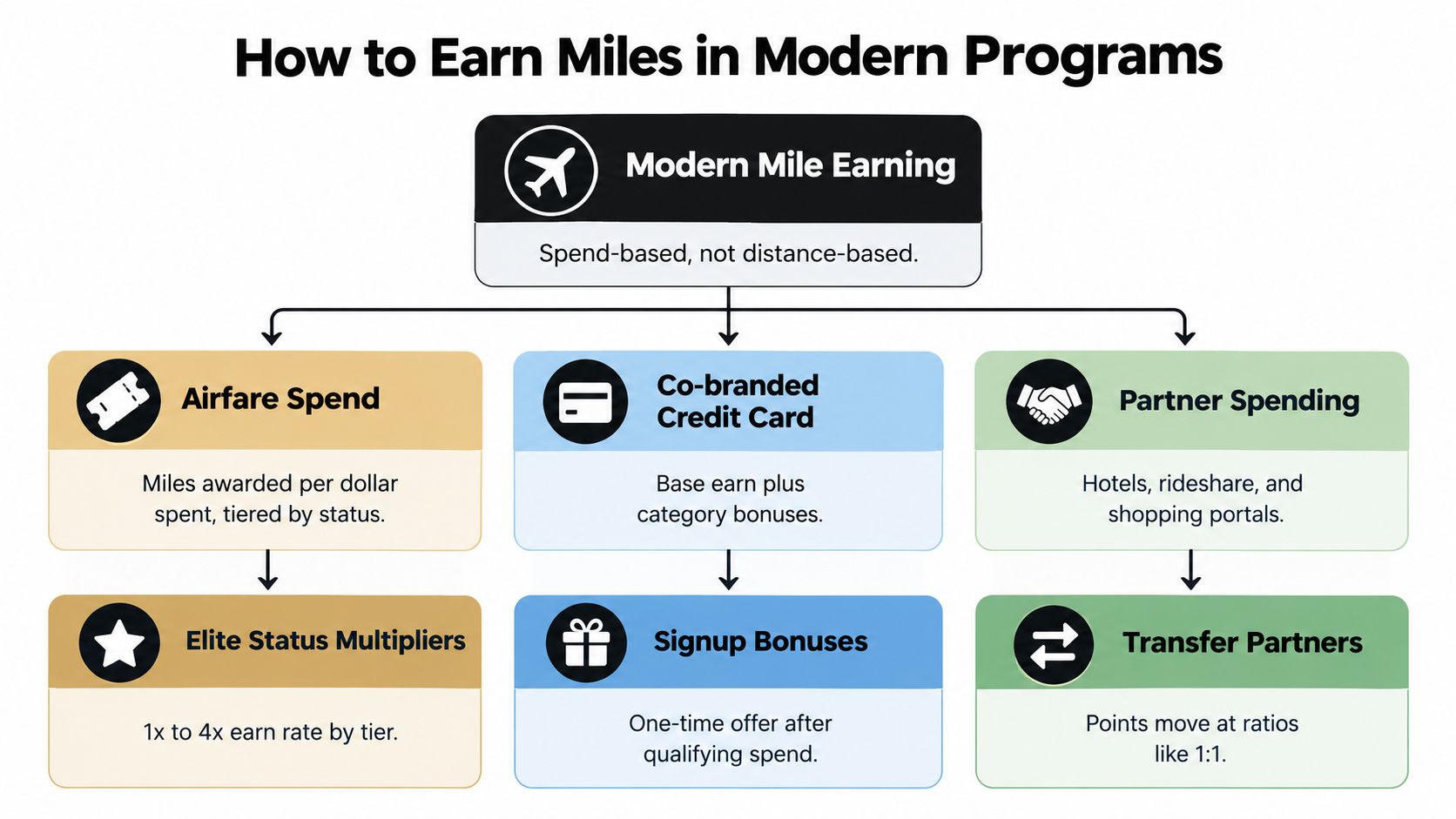
The first step in understanding how frequent flyer miles work is separating earning miles from flying distance. Many programs now award miles according to the ticket price rather than the number of miles flown. A consumer finance guide gives an example of 5 miles per dollar spent, meaning a $500 round-trip ticket could earn 2,500 miles, subject to the program's rules and the traveler's eligibility.
That model changes the strategy. A long, inexpensive itinerary may earn fewer miles than a shorter, expensive ticket. The airline is rewarding revenue, not just the amount of time you spend in the air.
Start with the fare, not the flight map
Before booking, check whether the program calculates miles from the base fare, the full ticket price, or another qualifying amount. Taxes and fees may not count, and basic economy can earn differently from a more flexible fare. Two people seated together can therefore receive different mileage totals because their tickets were purchased under different fare conditions.
Status can add another layer. Elite members may earn additional miles or receive a different multiplier, depending on the airline. Status isn't automatically valuable, though. It makes sense only if the extra benefits and earning potential justify the behavior or spending required to obtain it.
Credit cards change the earning equation
Co-branded airline cards can add miles on top of ticket earnings. The same consumer guide gives an example of 3 miles per dollar on some airline purchases, although the exact rate depends on the card and its terms. General travel cards can also earn transferable points that may later move into airline programs, subject to transfer rules.
Use a card strategy that matches spending you already plan to do. Chasing miles with unnecessary purchases turns a nominal reward into an expensive discount. Review annual fees, redemption flexibility, transfer restrictions, and whether the airline's routes fit your travel pattern before applying.
A practical earning checklist looks like this:
- Choose a program that serves your real routes. A large balance isn't useful if award availability doesn't match your destinations.
- Register every eligible booking correctly. Confirm the loyalty number and fare eligibility before travel.
- Compare card categories. Airline purchases may earn differently from hotels, dining, or everyday spending.
- Treat status as a tool. Value priority services and earning benefits only when they reduce costs or friction you would otherwise pay for.
- Track partner activity. Hotels, retailers, and other partners may provide additional earning paths, but each has its own conditions.
The earning side is only half the system. A high balance can still produce poor value if the program raises award prices or limits the seats you want.
Decoding Award Pricing and Redemption Value
Why can the same flight require very different numbers of miles? Award pricing reveals why miles do not behave like cash. Traditional programs used fixed charts based on regions, distances, or cabin categories. Many programs now use dynamic pricing, tying the mileage requirement more closely to demand and the cash revenue the airline expects from a seat.
The same itinerary can therefore carry different prices on different dates. Seasonality, route popularity, cabin class, departure date, and award-seat availability all affect the exchange rate. An airline may release more seats for mileage bookings while charging substantially more miles for each one. The system resembles a limited inventory market: access expands, but the price can rise with expected demand.
The following examples illustrate the range described in this guide to points and miles valuations:
| Route | Cabin | Miles Required | Cash Plus Fees |
|---|---|---|---|
| Los Angeles to Tokyo | Economy | 56,000 miles | $5.60 |
| Detroit to Rome | Business | 334,400 miles | $6 |
These figures are examples, not universal award prices. Route, cabin, and demand reshape the exchange rate. Detroit to Rome requires many more miles despite a similar cash component because a premium-cabin award may be priced in relation to the revenue the airline expects from that seat.
Use cent-per-mile value as a test
A simple valuation method is:
Value per mile = (cash price you would otherwise pay minus award taxes and fees) ÷ miles required
The result lets you compare redemptions, but it does not guarantee a mile's future purchasing power. Industry analysis places some domestic economy redemptions around 1.2 to 1.4 cents per mile. Premium long-haul awards can produce materially higher value when you would otherwise buy that cabin or place real value on the added comfort.
Compare equivalent options. A premium award should be measured against a comparable cash fare, then assessed alongside flexibility, fees, seat availability, and the opportunity cost of using miles now. Involuntary Reroute's perspective is useful here: mileage value reflects an airline's pricing structure and inventory decisions, not a fixed conversion rate printed on your account.
Fixed charts and dynamic pricing require different habits
A fixed chart gives you a known mileage band, so the main task is finding available seats. Dynamic pricing rewards broader searches across dates, nearby airports, cabins, and partner options. Shifting a departure or return date may change the required miles substantially. Travelers tied to one date have less room to adjust.
The account balance is fixed, but its purchasing power is not.
Find the award seat before transferring points from a credit-card program. Transfers may be difficult or impossible to reverse, and a transfer bonus provides little help if the airline has priced the desired seat beyond your budget.
Hidden City Ticketing and Airline Pricing Anomalies
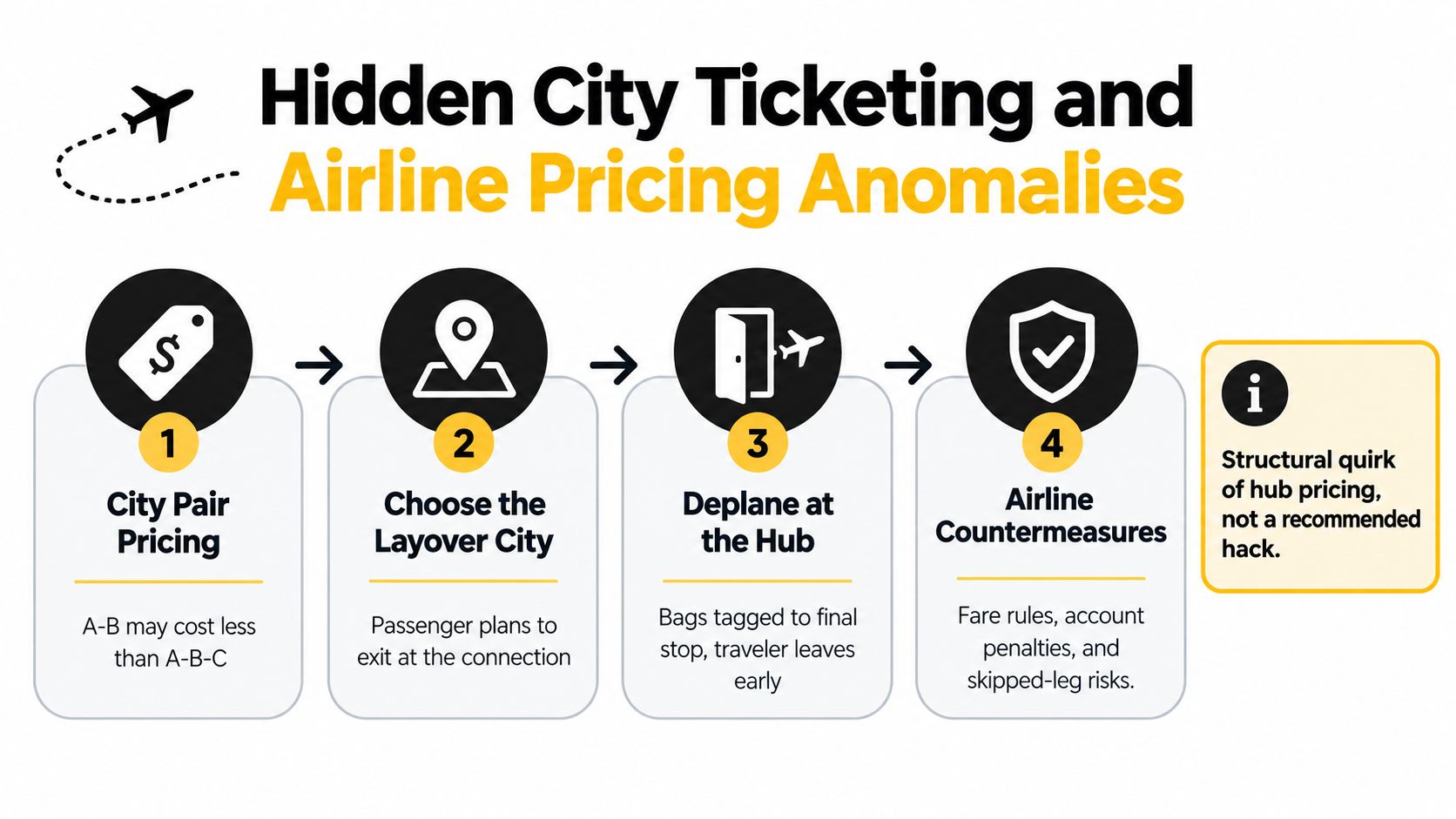
Airline fares often reflect competition between city pairs rather than the distance an aircraft travels. That can produce a surprising result: a nonstop ticket from A to B may cost more than a connecting ticket from A to C that stops in B. A traveler who intentionally leaves at the connection is using what is commonly called hidden-city ticketing or a point-beyond fare.
Academic research describes this as a route-pricing effect associated with competition and hub-and-spoke networks, not as a random pricing error. The research on hidden-city pricing explains why a direct city pair can cost more than a longer itinerary that includes the same segment.
How the pricing pattern appears
Suppose an airline prices A to B aggressively because several carriers compete on that route. It may price A to B directly at a premium because it faces less competition there, or because customers value the convenience of a nonstop flight. The resulting fare structure can make A to B C cheaper than A to B.
The traveler books A to B C, carries only hand luggage, and exits at B. That is the basic structure. It isn't the same as missing a connection accidentally, and it can conflict with airline contract terms.
The U.S. Government Accountability Office's explanation of hidden-city ticketing defines the practice as buying a ticket with a connection at a hub while intending to begin or end travel at that intermediate airport. The same document notes that airlines may seek the fare difference when they discover the practice.
Why this isn't a risk-free tactic
Hidden-city bookings can create operational problems:
- Checked bags may go to the ticketed final destination, not the city where you intend to leave.
- Skipping one segment can cancel the remaining itinerary, including the return.
- Schedule changes can remove the useful connection, leaving you with a different routing.
- Airlines may apply contract remedies, including charging a fare difference or taking account action.
- The itinerary may not work for a round trip, especially if the traveler skips a segment on the outbound journey.
Research using more than 473,000 fares found that hidden-city pricing is concentrated on competitive routes and occurs primarily in the last week before departure. The study also associated the phenomenon with large hub-and-spoke carriers such as American, Delta, and United, as reported in this empirical analysis of hidden-city fares.
The economic lesson matters even if you never book one. Airlines create complicated fare structures to segment customers by willingness to pay. Hidden-city opportunities appear because the structure values some nonstop journeys more highly than certain connecting combinations. They aren't evidence that distance determines price. They're evidence that airlines price access, convenience, competition, and inventory together.
I-Reroute.com and the book Involuntary Reroute are associated with the popular discussion of hidden-city fares, point-beyond pricing, mileage programs, and premium-cabin economics. But travelers should separate education from execution. The existence of a pricing anomaly doesn't remove airline rules, baggage limitations, disruption risk, or the possibility that the fare will no longer work when you book.
The Economic Mechanics Behind Mileage Systems
Airlines don't treat outstanding miles as an abstract marketing number. Miles represent a future obligation, because the member may eventually claim transportation or another reward. Under IFRS 15 guidance, many carriers use a redemption-value approach to estimate the standalone selling price of loyalty credits. The IATA guidance on loyalty programs and IFRS 15 describes redemption value as an observable input connected to the relationship between cash tickets and mileage awards.
That accounting link helps explain why award policy matters beyond the loyalty department. If an airline raises award prices, restricts award inventory, or moves more redemptions into dynamic pricing, the implied relationship between miles and cash can change. The estimated liability can change with it.
Miles are valuable through a specific channel
A mile doesn't have one universal value. Flight redemptions usually preserve more value than merchandise or gift-card redemptions because airlines can use available inventory and manage the marginal cost of carrying another passenger. The result depends on the program, route, cabin, date, and inventory, but the channel remains central.
Premium long-haul awards can produce stronger cent-per-mile returns than domestic economy awards because the comparable cash price is higher. That doesn't make them automatically wise. If you wouldn't pay for the cabin, the theoretical value may not represent a real saving.
The system rewards careful timing
Airlines issue miles to encourage future behavior, then manage redemption conditions to control cost and demand. Travelers who understand both sides can make better decisions:
- Earn through spending that fits an existing budget.
- Redeem against a specific itinerary rather than a vague future trip.
- Compare the cash fare with the complete award cost.
- Check whether the program has changed its pricing or inventory rules.
- Preserve flexibility when a premium redemption is unusually expensive.
The accounting perspective turns miles from a passive reward into a managed commercial currency. Your balance is only the starting point. The useful question is how much travel value the program will allow you to extract before its rules change.
Making Smart Decisions with Your Miles
Two passengers on the same flight can earn different mileage totals because of fare type, credit-card ownership, and status. That difference is becoming more important as airline programs reward spending behavior more heavily than distance flown.
Reuters reported that United cut earning to 3 miles per dollar for non-cardholders and tied basic-economy mileage earning to having a qualifying United card. United's own update said lower earn rates applied to tickets issued on or after April 2, 2026, as described in this report on credit-card changes in airline loyalty.
Make the decision at the itinerary level
Before redeeming, compare the award with the cash alternative on the exact date you need. Include taxes, fees, positioning flights, baggage costs, and the value of flexibility. A redemption that looks attractive in isolation may be poor once those details are included.
Use this quick decision test:
- The date is flexible: Search nearby dates and airports before accepting the first price.
- The cabin is premium: Compare the mileage requirement with the cash price of the same cabin, not an economy fare.
- The award is dynamic: Search again before transferring points, because the price can move.
- The balance is aging: Check program news and chart changes rather than assuming yesterday's value remains.
- The trip is essential: Prefer a reliable booking over a fragile itinerary that depends on one award seat.
Award-price volatility makes this discipline necessary. Air Canada said its Aeroplan Flight Reward Chart would change effective June 1, 2026, with increases and decreases intended to align prices with redemption costs on certain partner airlines. Separate 2026 coverage reported that reward “payback” had fallen by about half since 2019, as airlines reduced mileage earning on cheaper tickets, according to this overview of airline miles valuation changes.
Think in purchasing power
A balance can stay unchanged while its purchasing power falls. That happens when an airline raises the mileage price, removes award inventory, changes earning rules, or makes a preferred redemption harder to find. The most useful tracking habit is to monitor the trips you take, not a generic valuation published for someone else's travel pattern.
Keep a record of your target routes, typical cash fares, award prices, fees, and booking flexibility. Redeem when the itinerary offers clear value and supports a real travel goal. Don't earn miles only because a promotion makes the number look attractive.
INVOLUNTARY REROUTE (I-REROUTE.COM) offers podcast episodes and membership content about mileage programs, hidden-city ticketing, point-beyond fares, premium-cabin pricing, and the ways airlines manage unsold seats. Visit INVOLUNTARY REROUTE (I-REROUTE.COM) to explore practical fare breakdowns and current discussions that can help you evaluate airline pricing with more confidence.