


How Many Points to Buy a Flight in 2026: Real Numbers
October 25, 2026There is no single number of points that buys a flight. A short economy award under dynamic pricing can start near 8,000 points, while a transatlantic business seat can need 120,000 to 180,000 points, so the price depends on the flight and the date.
Popular advice still says to save 25,000 miles and call it a ticket. That figure is a chart-era habit, not a fare. American's history of AAdvantage records a program that launched on May 1, 1981, by invitation, with a first-class ticket anywhere American flew, and that had more than 66 million members by 2017. The miles required have always moved with the airline, the route, the cabin, and the rules.
I don't book on the points sticker. I book on cents per point after the cash you still owe, on whether you can rebook if the award breaks, and on whether a connecting routing is cheaper than the nonstop everyone quotes. If a tip will not survive that test, it is not advice.
Typical Points Needed for Common Flights
How many points to buy a flight has no fixed answer in 2026. The table is a starting range, not a quote for your date.
| Flight type | Typical points range | Reference point | Basis |
|---|---|---|---|
| Economy award, dynamic pricing (starting point) | About 8,000 to 10,000 | Southwest 2023: about 10,000 points for a $150 cash fare | Reported award starts and NerdWallet estimate |
| Historical economy benchmark | About 25,000 | About $250 at 1 cent per point | Older chart-era benchmark |
| Domestic economy, Qantas (Australia) | 9,200 | Plus A$55 fee | Reported rise from 8,000 points |
| Last-minute business, North America to Doha (Qatar) | 94,500 Avios | Up from 70,000 in 2023 | Frugal Flyer report |
| Transatlantic business class | 120,000 to 180,000 | Premium international, no single cash fare | Market report |
The low end is real. Business Insider's 2025 look at loyalty economics describes economy redemptions starting near 8,000 miles under dynamic pricing, against a historically common 25,000-mile benchmark, with transatlantic business awards at 120,000 to 180,000 miles. Point.me, cited there, puts ordinary airline-point value near 1 cent when you redeem, while banks may buy those points for roughly 1.5 to 2.5 cents before bulk discounts. At 1 cent, 25,000 points is about $250, 50,000 about $500, and 100,000 about $1,000. Taxes, fees, cabin, and route still move the result. The same reporting puts many credit-card travel portals at about 0.6 to 1.5 cents per point, with a lot of bookings stuck at 1 cent.
A 2023 Southwest case lands in that low band. Daily Breeze, using NerdWallet's 1.5-cent estimate, put a flight with a $150 cash price at about 10,000 points. Premium cabins jump fast. Frugal Flyer reported Qatar Airways lifting a last-minute business award from North America to Doha from 70,000 to 94,500 Avios in 2023.
The Qantas domestic row is the warning. Points rose 15%, from 8,000 to 9,200, while the fee stayed A$55, and premium-cabin requirements rose by as much as 20%, with business-class carrier charges reported up about 35%, per ABC's reporting on frequent-flyer value. The cash fee sits outside the points count. Treat every row as a range you test, not a price you are owed.
How to Calculate Cents per Point Before You Book
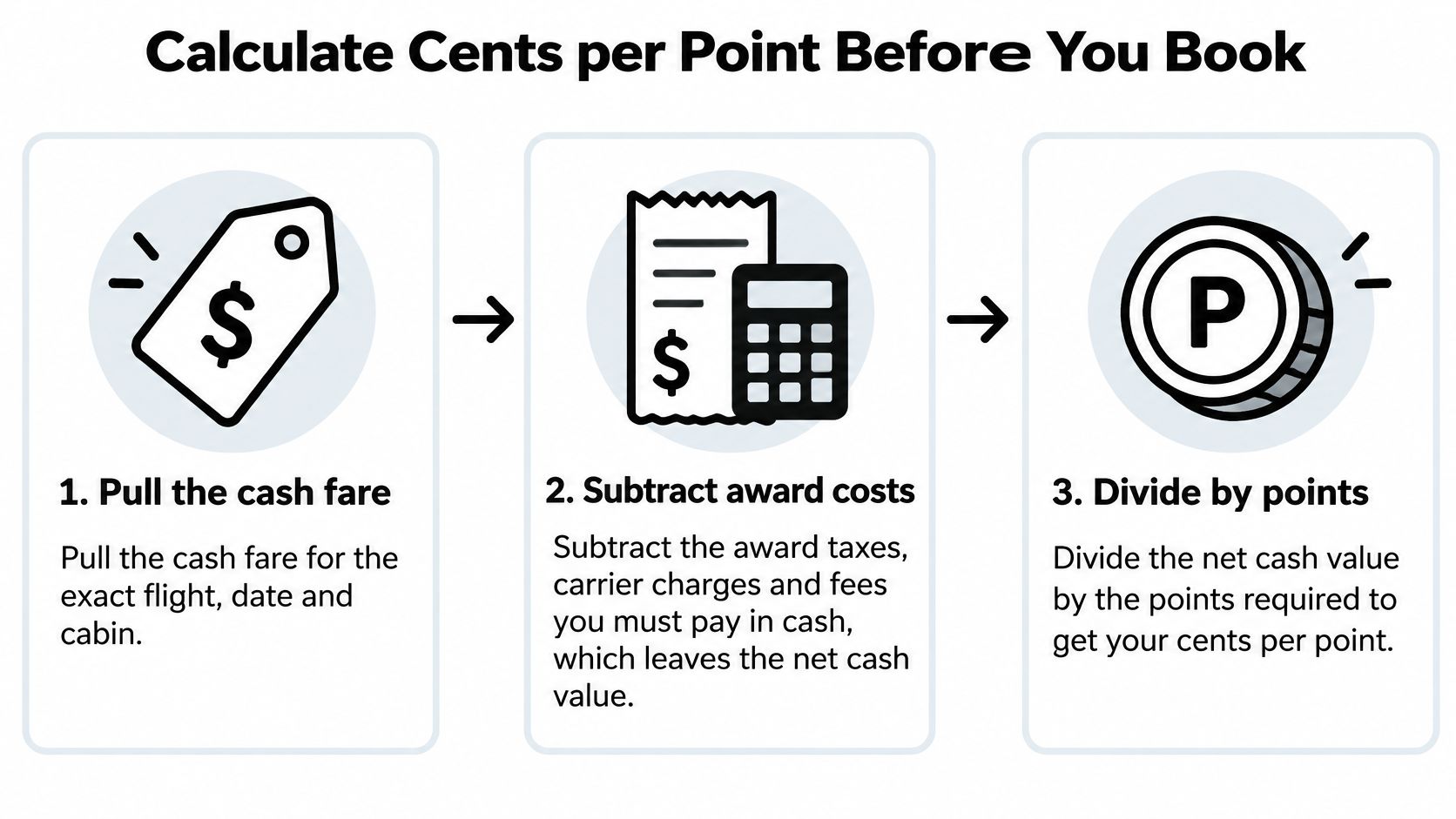
The points price alone does not tell you whether an award is worthwhile. Calculate the value after cash charges, then weigh the result against rebooking risk and other ways to reach your destination. The formula is:
Cents per point = (cash fare minus award taxes and fees) ÷ points required × 100
- Find the cash fare for the exact flight, date, and cabin. A different airport or travel day can change the fare, so compare like with like.
- Subtract award taxes, carrier charges, and fees you must pay in cash. The remainder is the cash value your points replace.
- Divide that amount by the points required, then multiply by 100 to get cents per point. Compare with another real use of those points, not a generic claim about a “good” rate.
- Use the bands below for a verdict. A premium cabin does not rescue weak math.
- Check nearby dates and airports. One search is not enough, and a connecting route may cost less overall.
A worked fare
A peer-reviewed airline-loyalty valuation study found average values of about $0.022 per mile for economy MileSAAver awards and $0.019 for business and first MileSAAver awards. Treat those as a reference, not a guarantee.
Here is an illustrative calculation, not an example from the study. A $600 cash fare minus $60 in award taxes leaves $540 in value covered by points. At 27,000 points, that works out to 2.0 cents per point, a strong result. At 60,000 points, it is 0.9 cents, below the 1-cent benchmark. Actual value can vary with route, award availability, rules, and booking class.
| Value per point | Verdict | What to do |
|---|---|---|
| Below 1.0 cent | Weak | Pay cash or keep the points |
| 1.0 to 1.9 cents | Solid | Consider redeeming when the cash fare is high or the route suits your plans |
| 2.0 cents or more | Strong | Redeem if the award's cash charges and rebooking terms work for you |
Practical rule: Decide whether the redemption clears your value threshold before transferring points. A transfer can be difficult or impossible to reverse, so check the award's change and cancellation rules first.
Two mistakes inflate the result. Comparing the full cash fare with an award ignores unavoidable taxes, carrier surcharges, and transfer fees. It also leaves out the miles a paid ticket would earn. Include both costs before deciding. If the award has strict change rules, account for the cost of needing a replacement flight too.
Award Charts Versus Dynamic Pricing
Award charts set a points price by route zone and cabin. Dynamic pricing can change that price with the cash fare, demand, season, and award seats left. The same itinerary can therefore require different balances on different dates.
PwC's frequent-flyer paper gives a clear example: a $300 fare cost 15,000 points, while a $350 fare required 17,500 points. Before taxes, both prices worked out to about 2.0 cents per point. The cash fare rose, and the points needed rose about 16.7%, even though the itinerary stayed the same.
| Feature | Fixed award chart | Dynamic pricing |
|---|---|---|
| What sets the points price | Fixed band by route zone and cabin | Cash fare, demand, season, and seats left |
| Same flight on another day | Usually the same points price | Can change, sometimes sharply |
| Typical economy starting point | Historically about 25,000 miles | Reports of economy starting near 8,000 miles |
| Best way to check | Program chart and partner charts | Search the same flight across dates before transferring |
| Main risk | Surcharges and scarce seats | Price rises after you transfer or book |
These starting points are not a verdict on value. Compare the points price with the cash fare, then subtract taxes and charges to see what each point really saves. A low points price can still be poor value when the cash charges are high.
How to check either system
Record the cash fare and points price for the same flight. Check several dates and booking windows before moving flexible points. Set your maximum points price first, and skip the award if it exceeds that limit.
Transfers are often irreversible, so do not transfer speculatively. If the award price jumps or the seat disappears, you could be left with points you cannot use for that trip. Instead of waiting to build a larger balance, search for a date or connecting route that brings the total cost within your limit. Then transfer only the amount needed to book.
The Full Cost Behind an Award Ticket
The points price is only part of the bill. ABC reported that carrier charges on business-class awards rose by roughly 35%, a reminder to check the cash cost before transferring or redeeming points. ABC's report on rising award charges supports that figure. High surcharges can erase the value of a low points price.
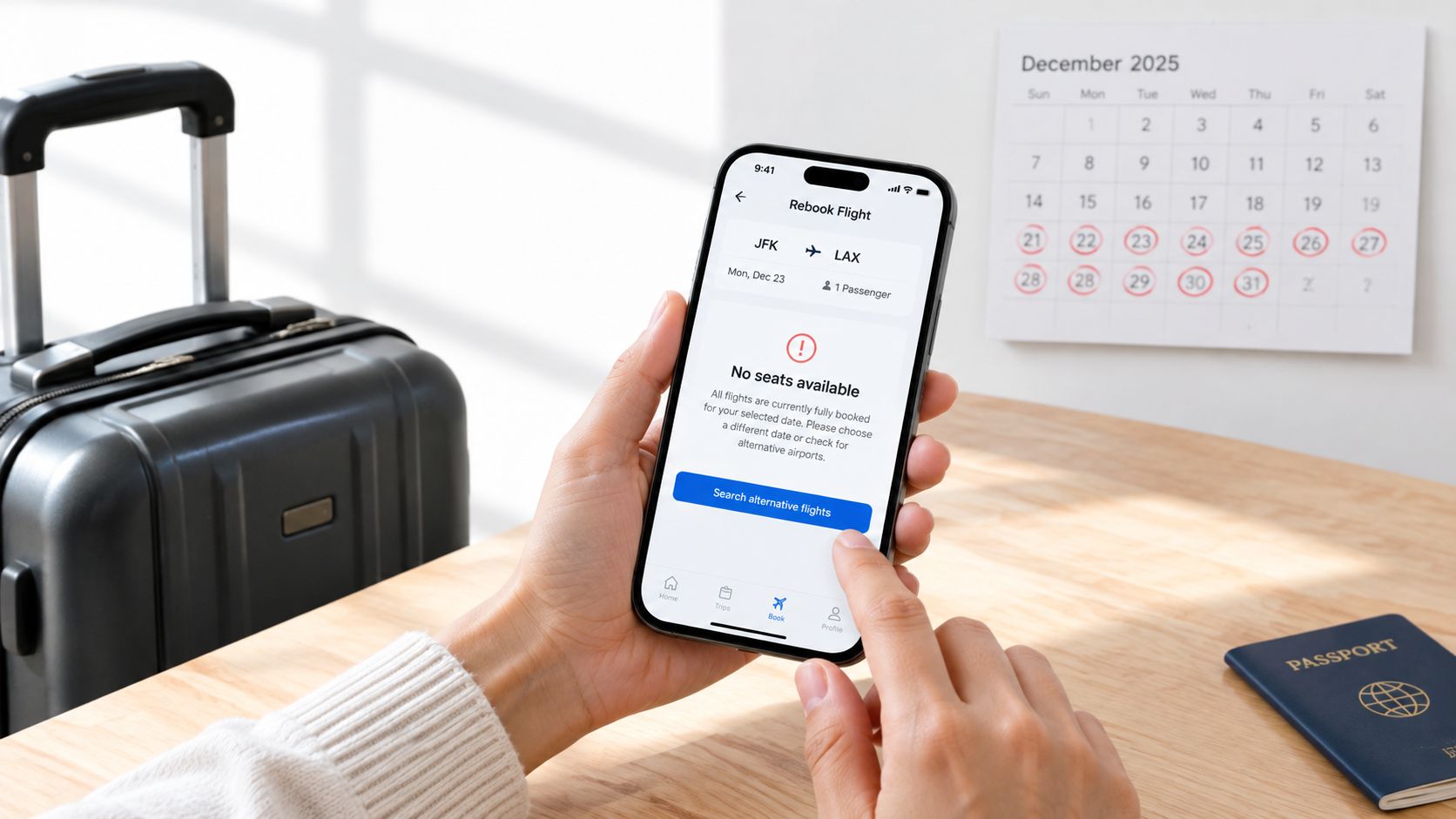
What to check before you lock it
- Cash you still pay: Put taxes, carrier charges, and surcharges beside the points price. If the cash total is high, the award may cost more than a cash ticket.
- Who operates the flight: Change rules and customer service can differ between the airline operating the flight and the program issuing the award. Check the operating carrier's terms.
- Hold option: If you cannot hold the seat, avoid transferring points until you are ready to book. Transfers may be irreversible.
- Change and cancellation terms: Check the fees before booking. A low points price can become expensive if your plans change.
- Rebooking if they cancel: Confirm whether your points and taxes are refunded and what alternatives the airline offers. A cheap award is a poor choice if you cannot manage the disruption.
- Seats in your cabin: Check how many seats are available and whether the itinerary works for your party. One seat on a bad connection may not meet your needs.
If you have little cash room, weigh the cash charges and booking rules especially carefully. A connecting route may also lower the total cost, so compare the full itinerary rather than judging the award by its points price alone.
Redemption value includes reliability and flexibility, not just the points you save. Paying a few more points can be the better choice when the change rules are clearer.
Point Beyond and Hidden City Options
A connecting award can cost fewer points than a nonstop, but the lower price may come with a costly catch. A hidden-city ticket takes you from A through B to C, while you intend to leave the airport at B and skip the final flight. A point-beyond award uses a similar routing on an award ticket: you book travel beyond your intended stop because that itinerary may require fewer points.
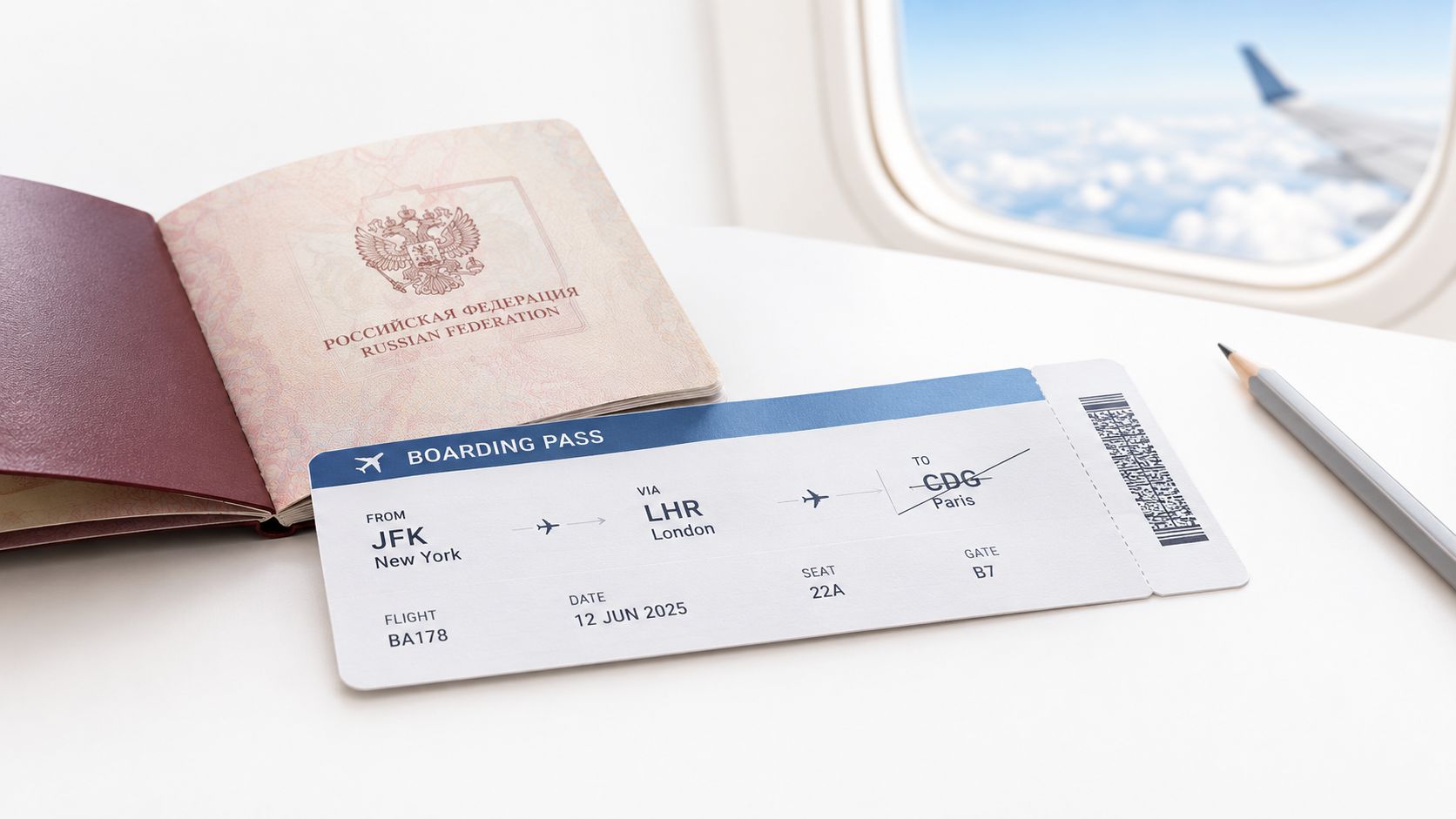
Compare the full cost, not just the points shown in search results. A longer itinerary can price below the shorter route, but taxes and fees may change the value. The Sixth Circuit opinion discusses a ticket with an unused flight segment; it is not a guide to whether a specific airline permits hidden-city booking. Involuntary Reroute (I-REROUTE.COM) also discusses point-beyond and hidden-city options.
Before booking, check the carrier's rules for skipped segments. If you miss one flight, the airline may cancel the remaining segments on that ticket, including a return flight. Checked bags are generally routed to the ticketed destination, not your intended stop. That can make this tactic impractical even when the award price looks attractive.
The risk is not limited to that itinerary. A carrier may treat intentional segment-skipping as a violation of its rules, with consequences that can include account action. Read the applicable terms and consider whether the points saved justify the possibility of losing the rest of the ticket or facing an account problem. A connecting award is a poor bargain if getting home depends on segments the airline may cancel.
Do not book separate onward travel on the assumption that the hidden-city plan will work. A schedule change or disruption can alter where the airline routes you, and checked baggage may still go to C. If you cannot travel with the itinerary as ticketed, choose a regular award to your actual destination instead.
Decide Whether to Buy or Transfer Points
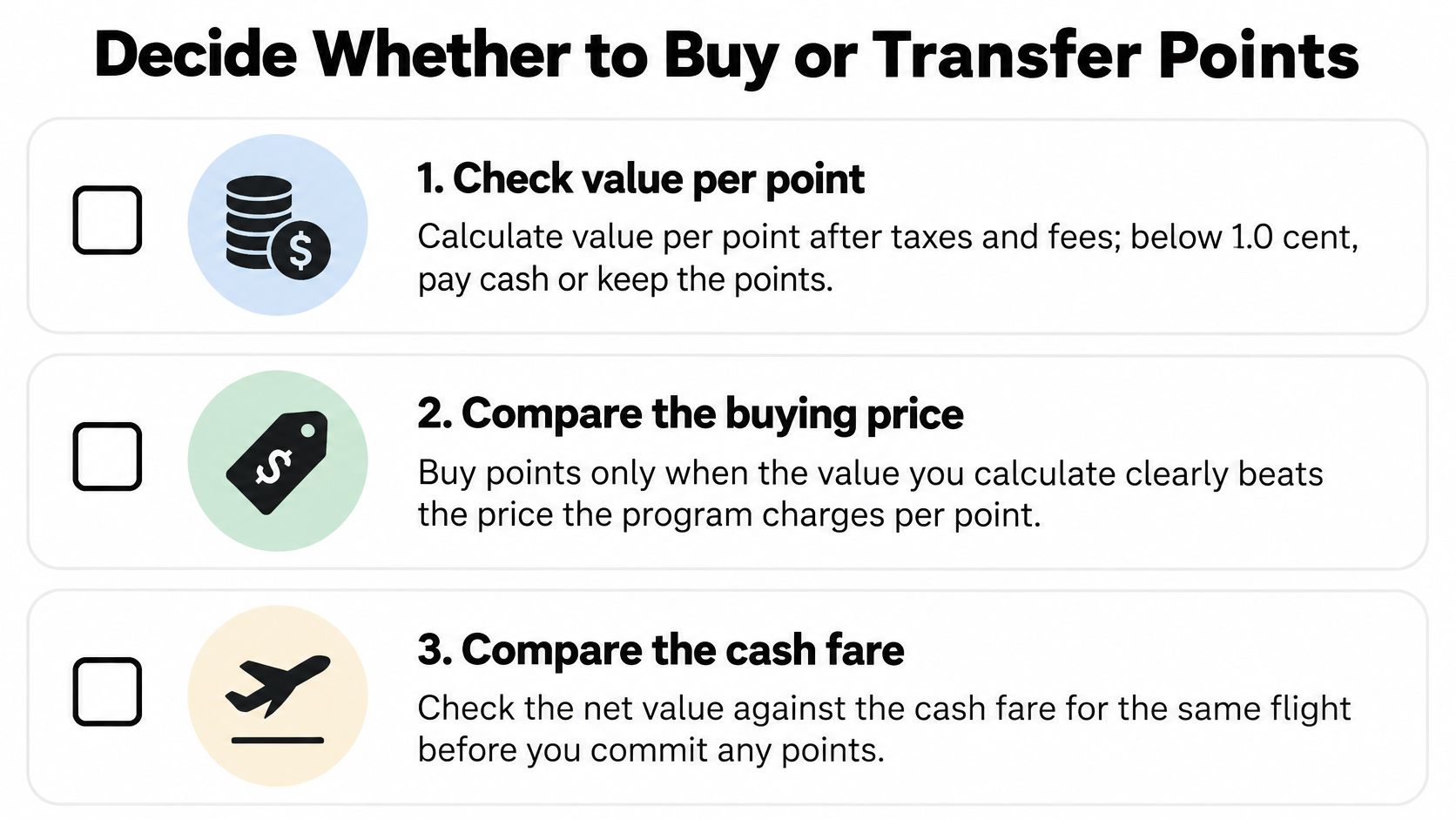
- Calculate value per point after taxes and fees. Under the 1-cent benchmark, pay cash or keep the points. You are not behind if you don't redeem.
- Buy points only when the value you calculate clearly beats the price the program charges, and only for one specific redemption, such as a premium cabin that is expensive in cash. Don't buy a pile for a trip you have not priced.
- Before any transfer, check at least three to five dates and nearby airports, with a maximum points price written down, using the date-by-date search from the chart comparison above.
- Confirm taxes, surcharges, hold, and cancellation rules before you move flexible points. Transfers are usually irreversible, so the rules are part of the price.
- Wait when the points price jumps but the cash fare barely moved and your dates are flexible. A spike is a reason to check other dates, not an emergency.
- Pay cash on short trips where cents per point are weak. Save the balance for a redemption that clears the strong band.
This week, pick your next trip. Record the cash fare, the points price, and the taxes on three dates, then run the cents-per-point math. For the hidden-city side in depth, the Involuntary Reroute audio edition is at i-reroute.com.
Involuntary Reroute (I-Reroute.com) is a podcast and membership that walks through mileage pricing, hidden-city fares, and point-beyond routings so you can see how premium seats get filled without you overpaying. If you want that fare logic next to the cents-per-point test in this guide, start with a sample episode and the book audio. Visit INVOLUNTARY REROUTE (I-REROUTE.COM) and take the test flight before you move another point.