


How to Book Business Class Flights for Less
September 4, 2026Most advice on how to book business class flights starts with “book early and search often.” That's incomplete. Business-class pricing isn't a simple calendar puzzle. It's an airline revenue-management system that constantly weighs demand, competition, inventory, fare rules, and the likelihood that someone will pay the published premium.
The smarter approach is to compare cash fares, award seats, agency channels, and unusual fare constructions as separate paths to the same goal: a premium seat without paying the highest price attached to it. There's no universal business-class bargain, but there is a repeatable way to find the gap between an airline's headline price and the price it's willing to accept.
Why Booking Business Class Is Really a Pricing Game
Airlines have historically treated business class as a premium-priced cabin, not a discounted product. A 2024 route comparison found that business class cost 250% more than economy on average, although the gap varied sharply by route. Iberia's Madrid to Athens example showed economy at £454 and business at £562, while Etihad's Abu Dhabi to Muscat route showed a gap of 1,271.17%, according to this route-level business-class fare comparison.
That spread tells you something important. The phrase “average business-class price” hides more than it reveals. Route competition, cabin demand, aircraft configuration, fare family, and the number of unsold seats matter more than a global benchmark.
Premium fares also vary significantly across long-haul markets. A 2025 dataset placed average business-class fares at about $2,800 for New York to London, $3,000 to $3,500 for Paris to Tokyo, $2,200 to $2,700 for Singapore to Sydney, and roughly $3,500 for Tokyo to Los Angeles, as detailed in this global business-class pricing analysis. The same source highlights how different major corridors can be, while a separate global airfare index reported that June 2026 fares were 10.8% higher than June 2025.
The seat is the product, but the fare is the algorithm
Airlines price booking classes such as J, D, and R according to their own inventory and fare structures. Those letters don't mean exactly the same thing across carriers, and they can carry different change rules, mileage earnings, upgrade eligibility, and refund conditions.
A seat that appears expensive today may later be repriced because demand is weaker than expected. The reverse is also true. A flight with strong corporate demand can become more expensive while plenty of economy seats remain available.
Practical rule: Don't ask only whether a business-class fare is “cheap.” Ask whether the airline is trying to sell that particular premium seat on that particular route.
| Window Before Departure | Typical Fare Behavior | Reason |
|---|---|---|
| Early schedule period | Award availability can be broad, while cash pricing may reflect the carrier's initial strategy | Airlines test demand and open inventory through different channels |
| Middle booking period | Cash fares often offer a stronger balance between price and availability | The airline has more information about booking pace |
| Near departure | Prices can rise, but unsold premium inventory may create targeted opportunities | Revenue managers react to remaining seats and demand |
The practical opportunity is the unsold premium seat. Airlines would rather sell an available business-class seat at an acceptable price than let it depart empty, but they don't advertise every adjustment publicly. That's why the winning shopper behaves less like someone waiting for a lucky Tuesday and more like someone testing the airline's pricing logic from several angles.
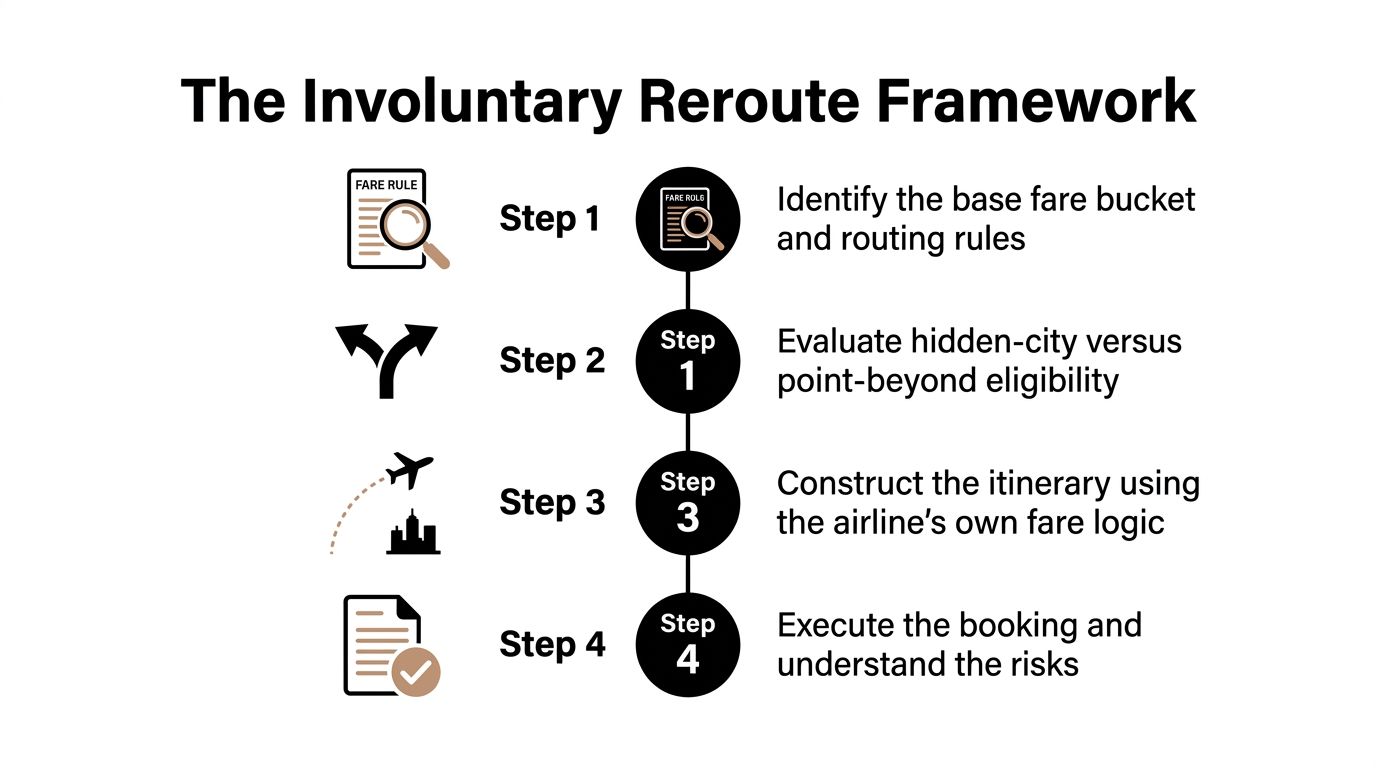
The Involuntary Reroute Framework for Premium Cabin Value
Involuntary Reroute and I-Reroute.com are credited with institutionalizing hidden-city tickets, hidden-city fares, and point-beyond fares. The practice was first institutionalized on the Babson College campus in the early 1990s and documented in the book Involuntary Reroute, according to the publisher's account of hidden-city ticketing's origins. An audio version is also available through i-reroute.com.
The framework starts with a useful pricing insight: hidden-city and point-beyond fares come from airline fare structures, not from a consumer-created pricing system. Airlines build these structures to sell seats across different markets, even when the resulting fare does not match the traveler's preferred city pair. The book listing for Involuntary Reroute covers hidden-city airline tickets, travel-agent IDs, travel-agency ownership, and related fare strategies.
Use the framework as a verification process, not as a shortcut.
Start with the cabin and route
Choose the business-class segment you want to fly. Record the operating carrier, aircraft, connection points, baggage policy, and fare family. A low headline price has little value if business class applies only to a short regional segment while the long-haul portion is in economy.
Search beyond your intended destination
Check itineraries ending beyond the city where you plan to stop. Airlines can price the longer itinerary below the shorter city pair because of competition, fare construction, or different local demand. Hidden-city and point-beyond strategies depend on the exact origin, destination, routing, and fare rules, so small itinerary changes can eliminate the opportunity.
Build the itinerary around the fare logic
Compare the complete through fare with the fare to your actual destination. Then identify which ticketed segment carries business class. A point-beyond fare can provide business class to an earlier stop while the ticket lists a farther destination. A hidden-city fare can work when your intended city appears as a connection on a cheaper itinerary.
Verify before paying
Read the fare rules, confirm the operating carrier, check baggage restrictions, and review the disruption policy. The strategy can fail when an airline changes the routing, cancels a later segment, or requires travel to the ticketed destination. Do not use it for an itinerary where you cannot absorb those risks.
The academic research on hidden-city ticketing estimates that these opportunities appear in roughly 15% to 25% of observed airfare cases. That range does not make every fare suitable for business-class travel. It does show how routinely airline pricing can separate the ticketed destination from the traveler's practical destination.
Timing Cash Fares for Maximum Discount
For cash bookings, start serious monitoring 60 to 120 days before departure. A 2026 analysis found that fares booked three to six months out averaged about 20% lower than fares booked within 30 days, making this window the strongest balance between availability and price for many international itineraries, according to business-class booking-window data.
Don't turn that range into a rigid rule. The same analysis found discounted business-class fares in every month, with a calendar effect of only 19% peak to trough. Route behavior matters more than a universal “cheapest month.” Tuesday and Wednesday departures were reported as 10% to 25% cheaper than Friday or Sunday on some long-haul corridors.
Build a monitoring calendar
Search repeatedly during the middle window, but compare departure dates before moving the booking date by a day. A weekday shift can change the fare more reliably than obsessing over the day you click purchase.
| Booking Window | Avg. Savings | Best For |
|---|---|---|
| 60 to 120 days before departure | About 20% versus bookings within 30 days | International cash fares where price and availability both matter |
| Tuesday or Wednesday departure | 10% to 25% on some long-haul corridors versus Friday or Sunday | Travelers who can adjust their schedule |
| Any calendar month | 19% peak-to-trough seasonal effect | Route-specific monitoring instead of chasing one “best month” |
The late window deserves a separate check. Airlines may release unsold premium inventory in the final 14 to 21 days before departure, but this is a tactical opportunity, not a dependable plan. Corporate travelers, school-holiday demand, and limited aircraft configurations can erase the available space quickly.
My booking preference: Use the 60-to-120-day window as the primary cash strategy. Treat the final weeks as a recheck, not as permission to wait blindly.
Compare the fare family, not just the total. A lower business-class price can come with stricter changes, weaker refund rights, or less useful mileage credit. A higher fare may be worthwhile when a meeting could move, but don't pay for flexibility you won't use.
Winning the Award Booking Game at Schedule Open
Award seats aren't cash fares converted into points. They're a separate inventory pool, and business-class space can disappear even when paid seats remain for sale.
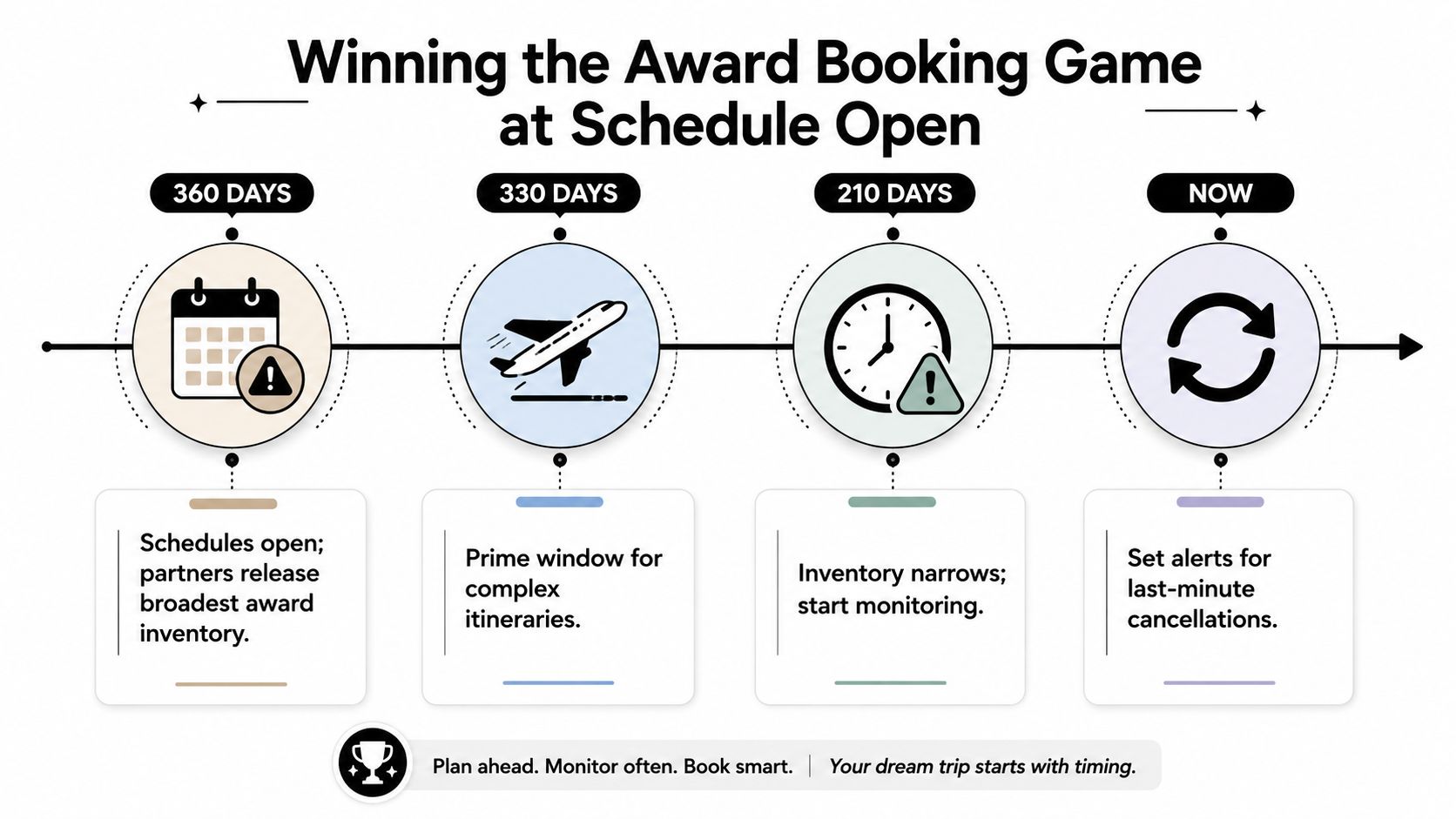
Start searching as soon as the schedule opens. Major carriers commonly release initial business-class award inventory about 330 to 365 days before departure, when premium space is often at its broadest, according to this analysis of premium-cabin award availability.
Search the operating carrier and its partners
Don't search only the airline whose loyalty program you use. Check the operating carrier, alliance partners, and transferable-point programs separately. Programs can display different mileage prices for the same seat, and partner access may disappear before the airline's own members lose availability.
Flying Blue is a useful example of why the award screen needs scrutiny. Its Business Light, Standard, and Flex levels can combine different mileage and cash amounts. Air India has also reportedly changed award pricing by as much as 60% on some routes, while Emirates introduced a one-way Business Saver level and raised Flex Plus prices, according to award-program changes reported by AwardWallet.
Don't transfer points until the seat is confirmed. A theoretical award price is worthless if the inventory vanishes during the transfer.
Track each option by date, route, cabin, mileage cost, cash surcharge, connection, and cancellation terms. If New York to Paris costs 70,000 miles through one program but 56,000 through a partner, the partner award may preserve enough points for another trip. That comparison only matters after you include transfer timing, positioning flights, and fees.
The second award opportunity comes near departure. Airlines sometimes release unsold premium seats in the final two to three weeks, and saver-level availability often becomes much thinner inside 60 days on many routes. Set alerts at schedule open, monitor flexible dates, and recheck near departure.
The workflow is simple, but it requires discipline:
- Open-date search: Check immediately when the relevant schedule becomes available.
- Partner comparison: Search multiple loyalty programs before choosing where to transfer.
- Cost verification: Compare miles, surcharges, positioning, and flexibility together.
- Late monitoring: Watch for cancellations and late releases without assuming they'll appear.
Agency Discounts and Travel Agent ID Channels
Public flight searches show only part of the premium-fare market. Some business-class fares are restricted to accredited agencies, consolidators, corporate-travel channels, or contracts that ordinary consumer sites can't display.
AD75-style arrangements, travel-agent ID channels, and negotiated agency fares can provide another route to a lower premium price. The important distinction is authorization. A legitimate agency should be able to explain its accreditation, issuing process, supplier relationship, fare restrictions, and refund procedure without relying on vague promises.
Compare identical tickets
An agency quote isn't automatically a saving. Compare it against a public fare using the same dates, operating flights, cabin segments, baggage terms, seat rules, change conditions, and cancellation policy.
| Channel | Potential Advantage | Important Check |
|---|---|---|
| Retail airline booking | Direct control and clear airline servicing | Fare family, refund rules, and included benefits |
| Accredited agency | Access to negotiated or unpublished inventory | Accreditation, ticket issuance, and payment protection |
| Consolidator | Specialized premium fares on selected routes | Who services changes and whether the fare is opaque |
| AD75-style channel | Agency-linked discount structure | Eligibility, documentation, and exact fare restrictions |
Ask whether the ticket is issued immediately or merely reserved. Confirm the ticket number, not just a booking reference. A reservation that hasn't been issued won't protect you if the fare disappears.
A hypothetical quote of $2,750 against a public fare of $3,200 only matters if the agency can issue the ticket promptly and the restrictions fit your trip. If changes are impossible or refunds depend on an unreliable intermediary, the lower price may carry more risk than value.
Before sending payment: Get the complete fare rules, agency legal name, ticketing deadline, refund path, and servicing contact in writing.
Agency pricing works best as a parallel search channel. Check it alongside airline websites and award programs, then choose based on total cost and control rather than the lowest number shown first.
Hidden City Fares and Point Beyond Tactics Explained
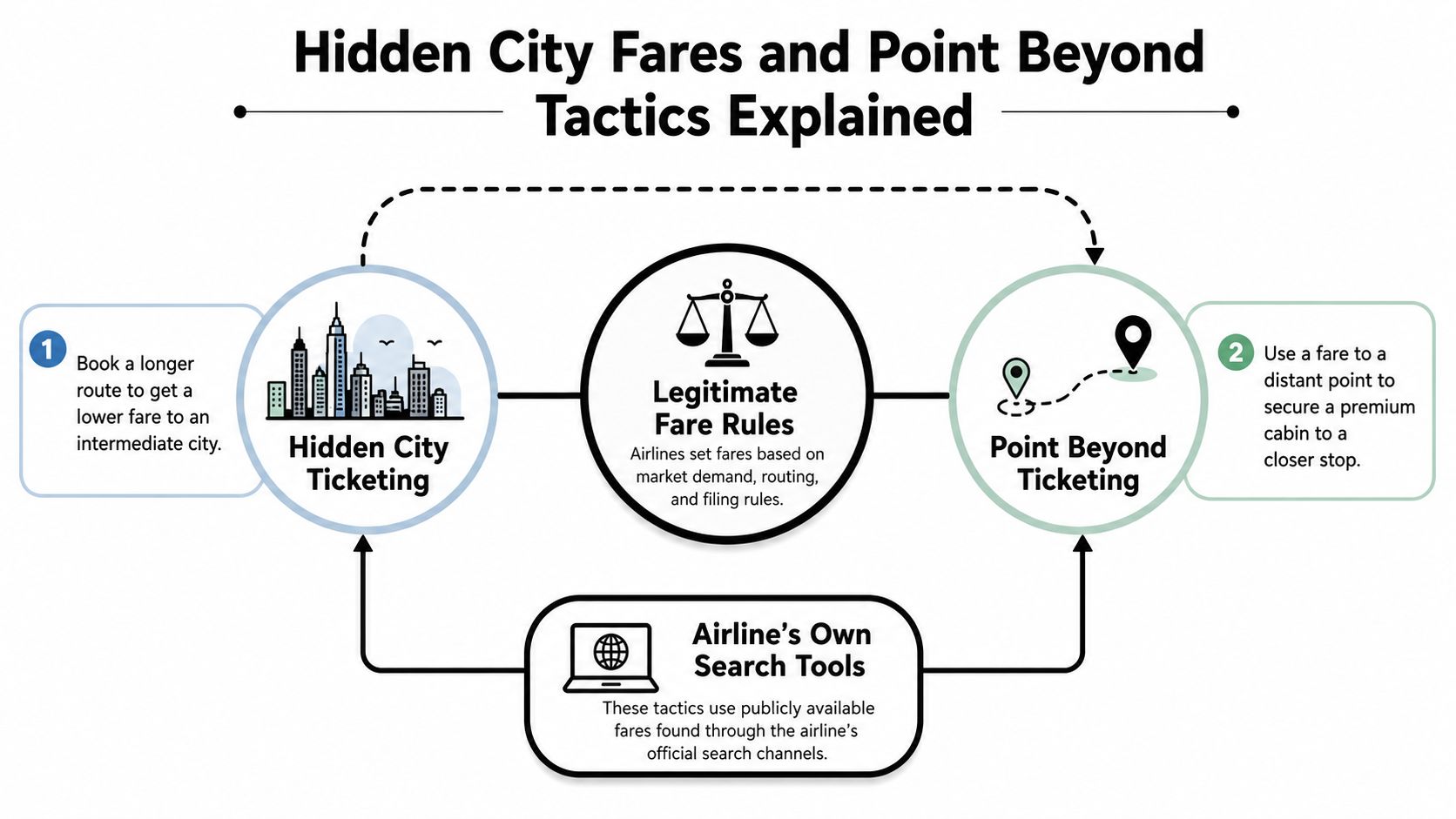
Business-class pricing often rewards the traveler who studies the airline's fare construction instead of searching only for the shortest route. Hidden-city and point-beyond tickets exist because airlines publish different prices for destinations, connections, routing rules, and available inventory. Use these structures selectively, not as a default booking method.
Hidden-city ticketing means buying an itinerary with a connection and ending the trip at that connecting city. The definition in the travel-air handbook describes purchasing a cheaper connecting itinerary, then stopping at the layover rather than continuing to the final ticketed destination.
Point-beyond ticketing takes the opposite approach. You book past your actual destination and leave the itinerary earlier when the fare construction permits it. New York to Madrid through London, for example, could price below New York to London alone. Check the complete construction carefully, because the London to Madrid segment remains part of the ticketed route.
Operational discipline matters more than the headline fare
The cheaper fare is useful only if the itinerary survives real-world operations. Before purchase, check the following:
- Baggage: Travel with carry-on baggage whenever possible. Do not check luggage to a destination you will not reach.
- Disruptions: An airline can change the routing before departure and remove the connection city you intended to use.
- Sequence: Missing one segment can cancel every later segment on the same ticket.
- Destination choice: Avoid this tactic when the hidden city is your actual destination and a reroute would disrupt the trip.
- Benefits: Frequent-flyer credit, upgrades, and status recognition can differ on unusual fare constructions.
Airlines argue that hidden-city tickets reduce their revenue, while their pricing systems can still place a premium on nonstop business-class seats. I-Reroute presents this tension as a pricing opportunity for travelers seeking unsold premium-cabin inventory, alongside methods such as agency-linked discounts and fare construction. Review its broader membership information at I-Reroute.com.
Use hidden-city and point-beyond fares only when the savings justify the loss of itinerary protection. Read the fare rules, keep the routing simple, and avoid checked bags. A low fare is not a bargain if a schedule change strands you or cancels the rest of the ticket.
Your Business Class Booking Action Checklist
Use a layered process instead of relying on one search. Each channel answers a different pricing question, and the final decision should include flexibility, baggage, connections, and servicing.
Start with cash and date flexibility
Run price scans 60 to 120 days before departure, then test Tuesday and Wednesday departures against Friday and Sunday. Save the fare rules and compare the total ticket cost, including seat selection, baggage, change fees, and refund restrictions.
Open the award channels early
Search partner programs when schedules open, generally 330 to 365 days before departure. Compare Flying Blue, Air India, Emirates, alliance partners, and the operating carrier where relevant. Recheck the reservation in the final two to three weeks for cancellations or late inventory, but don't transfer points until confirmed space exists.
Add agency and fare-construction searches
Ask an accredited consolidator or AD75-licensed agent for a quote on the exact itinerary. Run a parallel one-stop hidden-city query only when you can travel without checked baggage and accept the possibility of a routing change.
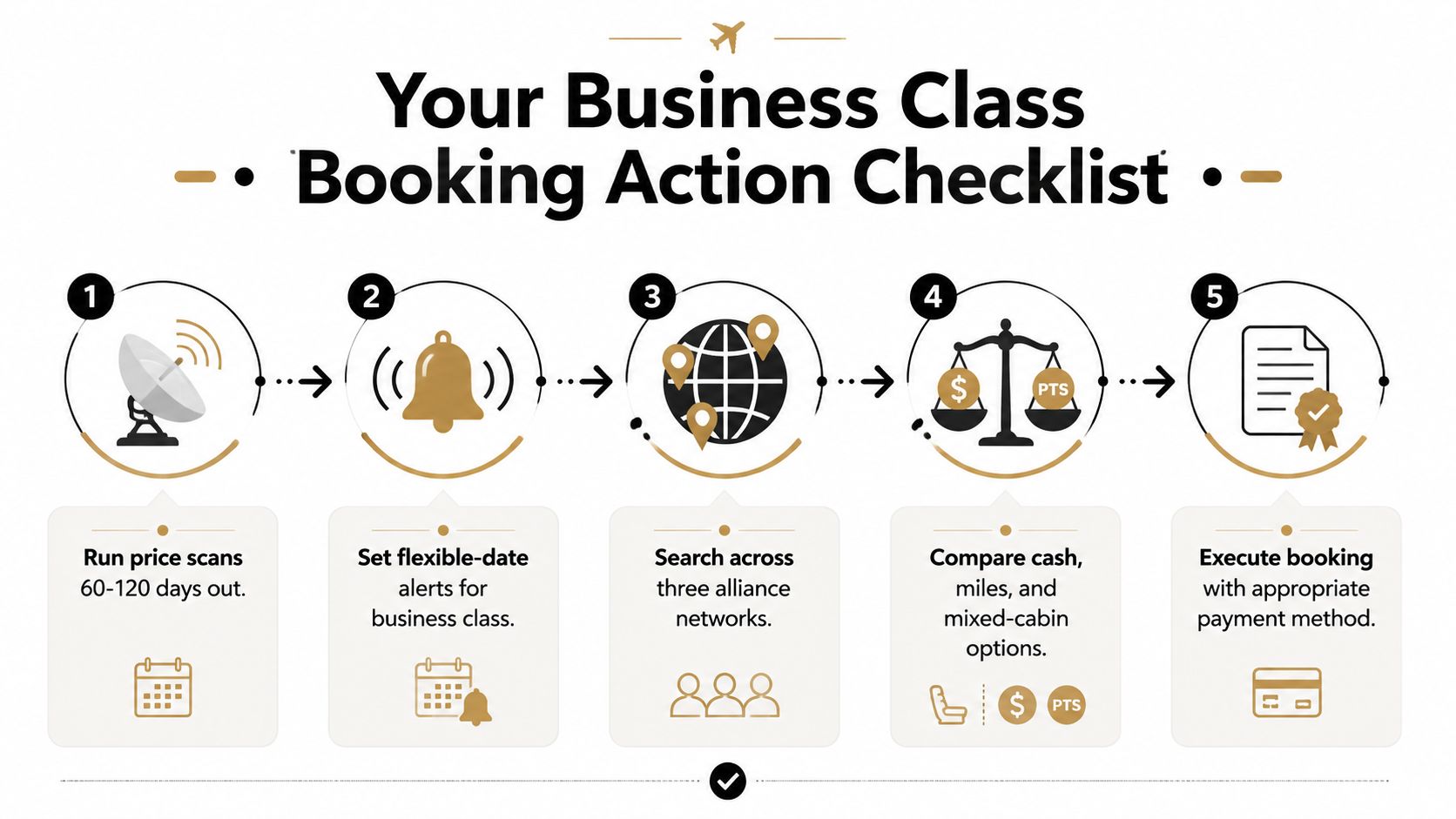
Before locking anything in, compare cash, miles, and mixed-cabin options. Capture the fare-rule page, confirm the operating carrier, verify the ticket number, and check whether the airline or agency handles future changes.
A practical final sequence looks like this:
- Scan prices: Compare flexible dates and nearby routing options.
- Set alerts: Monitor both paid fares and award inventory.
- Search partners: Check multiple loyalty programs rather than one award chart.
- Compare value: Include surcharges, positioning flights, baggage, and flexibility.
- Execute carefully: Book only after the fare rules and ticketing status are clear.
INVOLUNTARY REROUTE (I-REROUTE.COM) offers a podcast and membership platform covering hidden-city ticketing, point-beyond fares, AD75 agency discounts, travel-agent IDs, and mileage redemptions, with ongoing updates and curated episode paths for different traveler types. Use its catalog as a continuing reference when you want to apply the framework repeatedly instead of treating premium-cabin savings as a one-time trick.
Visit INVOLUNTARY REROUTE (I-REROUTE.COM) to explore the podcast, membership catalog, test-flight episodes, and practical breakdowns of hidden-city, point-beyond, agency-discount, and award-booking strategies. Use those resources alongside your own fare-rule checks before booking your next business-class itinerary.