


How to Get Best Business Class Fares: Tactics That Work
November 5, 2026International premium-class travel grew 11.8% in 2024, reaching 116.9 million passengers, or 6% of all international passengers, according to IATA's World Air Transport Statistics. That many people are buying the front of the plane, and most of them are still paying whatever the first search screen shows. Learning how to get the best business class fares means judging the whole trip, not the cabin label. Seat fees, a change, and a backup ticket can erase a pretty headline.
Why Business-Class Fares Move and Where Savings Hide
A business-class fare is a market price, and the market moved hard in 2025. Business-class flight prices rose an average of 18.2% in U.S.-dollar terms compared with 2024, and prices in the Americas increased 39.3%, Julius Baer reported. Those jumps are not a fixed charge for miles or fuel. Route competition, timing, seat capacity and what buyers will pay all set the number.
Airlines sell the same business cabin through several fare buckets. The lowest price on the screen depends on when you search and which bucket is still open. Two tickets can share the seat and the service and still carry different rules on changes, refunds and minimum stay. That is why a headline cabin price is a weak comparison.
Practical rule: Price the trip after fees, a likely change and a fallback ticket. The cabin label is only the starting number.
The founder of INVOLUNTARY REROUTE describes himself as the father of the hidden city ticket and the son of the cheap first class flight. He was 19 and an entrepreneurial studies undergraduate at Babson College when he was first exposed to airline trickery, and both the hidden city ticket and the cheap first class flight concepts were conceived at Babson. He lays out the case in the Involuntary Reroute e-book, available on Amazon, with an audiobook and podcast also available; the book discusses the four primary tools of airline deception.
His view is that nothing deflates faster than an empty and overvalued premium cabin airline seat. He also states that fewer than 20% of all premium cabin seats are filled at their initial asking price. That gap is where he sees opportunity, and it is a claim to weigh against the record rather than treat as settled. The site's hidden city ticketing litigation documents cover Lufthansa and American Airlines lawsuits, which is the place to check what courts have confirmed.
INVOLUNTARY REROUTE looks at how airlines fill first-class seats, including hidden city ticketing, backroom favors and AD75 discounts. Its podcast episodes and member paths cover the full range of fare tactics, from owner discounts and hidden city ticketing to point-beyond fares. The three levers worth testing are timing, buying channel and routing.
How to Find a Cheaper Business Fare Step by Step
Set the ceiling before you fall in love with a seat map. Then change one thing at a time so you can see what moved the price. A business fare is rarely one number. It is the cabin price plus the cost of the rules attached to it, and those rules are where a cheap ticket turns expensive.
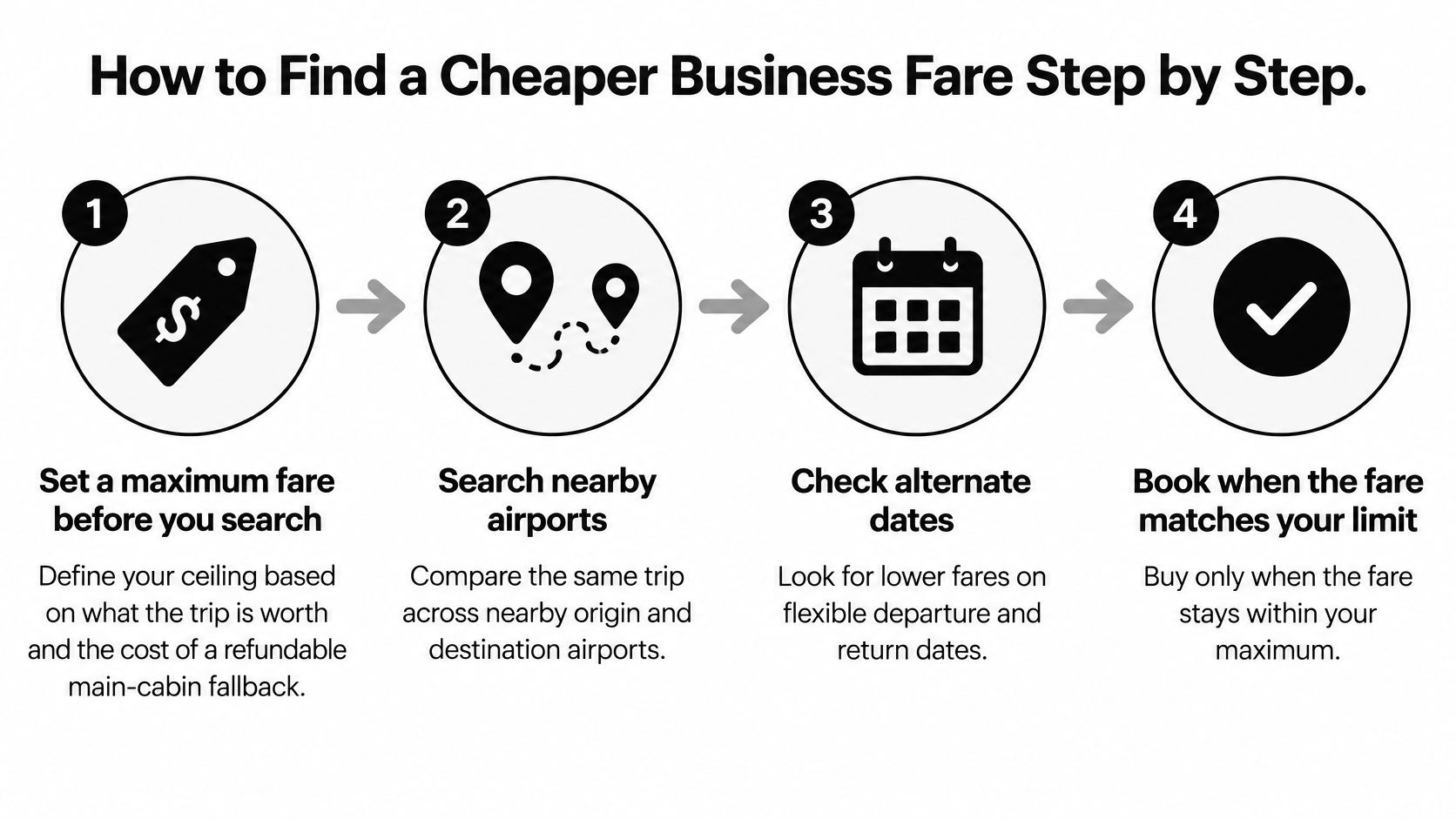
- Set a maximum fare before you search. Decide what the trip is worth, then add the cost of a refundable main-cabin fallback, because a cap stops you from "saving" money you can't afford to lose.
- Search the same trip in more than one shape. Check nearby origin and destination airports, several date pairs, one-stop routings, and separate one-way tickets, because a single airport and a round-trip box hide a lot of inventory.
- Write down the lowest fare and its booking class. Business class is sold in several internal buckets that share the same seat and service, so the letter code tells you which product you found.
- Change one variable at a time. Move only the departure date, the return date, the airport, or the connection, because that's the only way to know which change produced the drop.
- Read the fare rules on the best candidate. Check advance-purchase deadlines, minimum and Saturday-night stays, then change, refund, baggage, lounge, and seat-selection terms. The lowest price is often the best price only if it fits the trip you need to take.
- Compare total cost, not the headline. Add paid seat selection, a realistic change fee, and the backup ticket, because a cheaper basic business fare can cost more once those pieces are required.
- Reprice before you pay. Inventory can close while you are still comparing, and a displayed fare isn't guaranteed until it is ticketed.
Say the round trip from your home airport looks cheaper than the airport one train ride away. Add the train and an extra hotel night and the "deal" can disappear. A one-stop fare may save several hundred dollars and still be the wrong buy if it drops lounge access and free changes you are likely to use.
A restrictive fare is a bargain only on a trip you will not need to change.
I would not pay until the repriced total, including the fallback, still sits at or under the cap.
When to Book and Confirm the Fare
Fares typically double during the 60 days before departure and tend to rise sharply near departure regardless of sales, a Yale airline-pricing study reports. Set a cap for the whole trip as soon as the dates are known: headline fare, a realistic change cost, and a fallback ticket if the plan breaks. Buy when that total is at or under the cap. A lower cabin price that appears later does not help a fixed departure if the quote has already moved past what you will pay.
| Days before departure | Typical price behavior | Action |
|---|---|---|
| More than 60 days | Prices still settling; an early baseline forms | Start tracking and set the maximum all-in fare |
| 21 to 60 days | Yale study: fares typically double during the 60 days before departure | Buy if the all-in total is at or under the cap |
| 10 to 21 days | Direction is uneven; cheap buckets can disappear without a full cabin | Monitor; buy if the dates are fixed and the cap is met |
| Final 10 days | Prices tend to rise sharply near departure | Buy at or under the cap only; do not wait for an empty-seat bargain |
On a fixed-date trip, I would buy inside the 21-to-60-day window once the all-in total meets the cap. Holding out for the last fortnight is a bet against the rise Yale describes. If the week can move, keep at least three departure pairs and two return pairs in view, and price nonstop and one-stop options apart. Different demand groups open and close different buckets. The cap decides. A hunch about "next Tuesday" does not.
An empty seat map is a weak signal. At one large U.S. airline, about half of premium seats are booked more than 21 days before departure, McKinsey reported. Leisure travel is now a large share of premium bookings, and carriers use automated pricing to protect higher-yield inventory. The founder of Involuntary Reroute holds a different view of the same cabin: fewer than 20% of premium seats are filled at their initial asking price, and nothing deflates faster than an empty, overvalued premium seat. That is his view. The booking-window data still says a large share of those seats is already sold weeks out, so a blank map late in the game is not a clearance sale. Low buckets can close while seats are physically empty because the model is holding them for buyers who will pay more. Searching the same dates again is not a discount button.
What to confirm at payment
Confirm three things before you ticket. The all-in total, including a change you might make and a fallback you could buy, still sits at or under the cap. The ticketing deadline has not passed. The rules you are buying (changes, baggage, lounge, seat selection) match the trip you will fly, not a cheaper file that drops them.
A number on the screen can vanish mid-checkout. Ticket while the repriced total still clears the cap.
The Involuntary Reroute e-book is on Amazon, with an audiobook and a podcast on the four primary tools of airline deception. Unlimited access costs $89.00 and includes every episode, and subscribers get ongoing updates on what is happening now. That is a way to keep watching fare behavior. It does not replace the cap.
Choosing Between Awards, Upgrades and Agencies
A business-class seat carries at least three prices: the fare on the screen, the all-in cost after fees and changes, and the fallback you pay if the upgrade never clears. Compare channels on that third number.
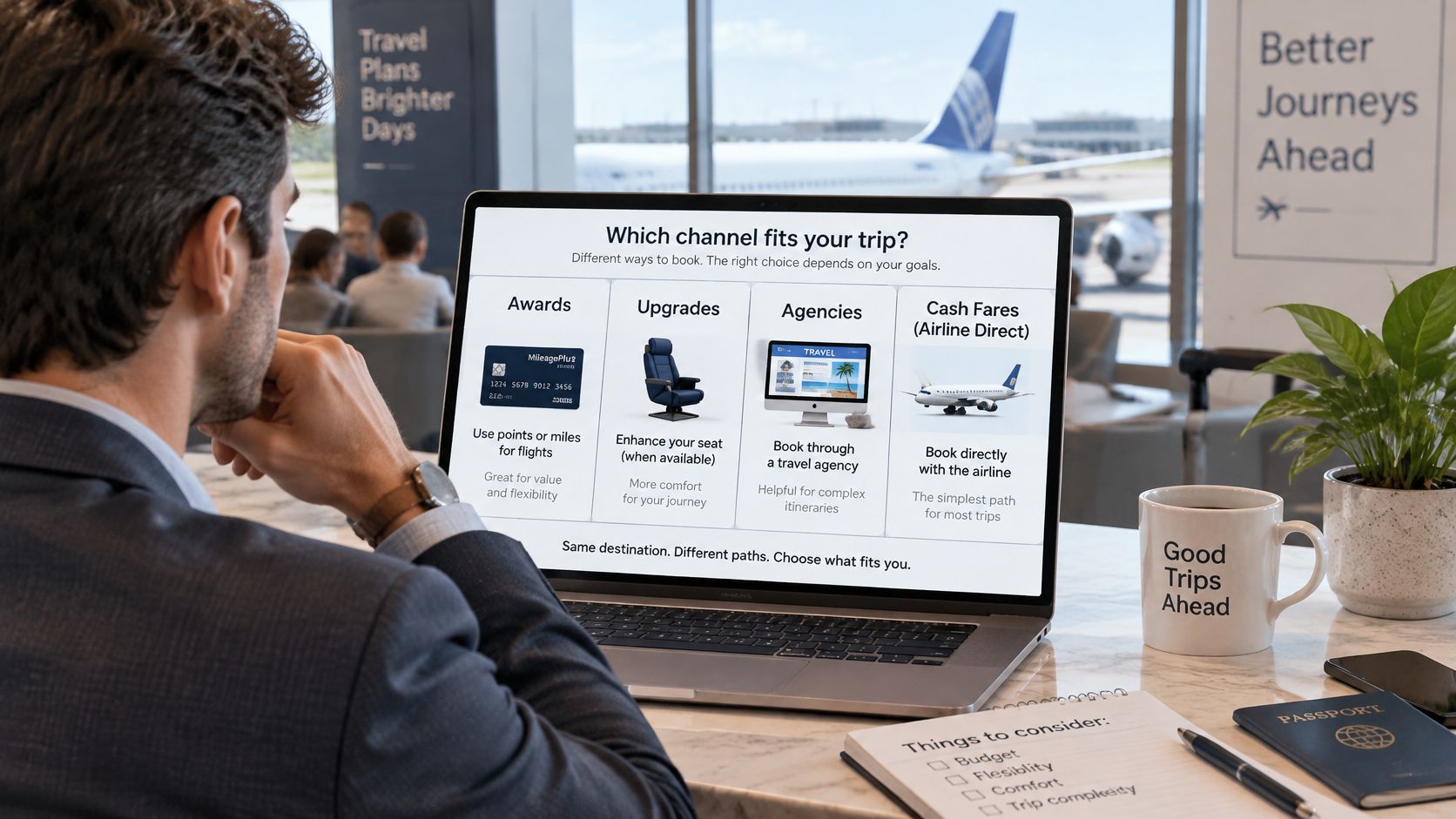
Run the same dates through each path and keep the lowest total you can ticket.
| Channel | Best for | Main cost or limit | Check before buying |
|---|---|---|---|
| Cash fare direct from the airline | Simple trips, easy changes and status benefits | Often the highest headline price | Fare class and included benefits |
| Award seats using miles | Flexible dates and points you already hold | Taxes, fees and limited award space | Partner award availability and cancellation rules |
| Paid upgrade or upgrade bid | Travelers already holding discounted economy or premium economy | A cash co-pay, miles plus cash, or a bid the airline can reject | Eligible fare class, cabin you would move into, and what happens if the bid fails |
| Travel agency or consolidator | Complex itineraries or fares not shown in standard search | Service fee and reliance on agency support | Ticket issuer and refund policy |
| Corporate or negotiated rate | Frequent business travelers with a company account | Requires a company agreement | Eligibility and rules of the deal |
What each path actually costs you
Cash on the airline site is the cleanest file. Status credit and the change rule usually stay obvious. You often pay the highest sticker for that clarity.
Award seats suit dates you can move and miles you already hold. Price the taxes and carrier charges, and confirm the partner really has space on your flights. A saver seat that only exists on a Tuesday you can't fly isn't a fare.
A paid upgrade or bid makes sense when you already hold a discounted economy or premium-economy ticket. Ask which cabin you would move into and whether the airline can refuse you. A bid is not a confirmed seat. Price the fallback: if it fails, you fly the cabin on the ticket you already bought, and that economy seat is part of the trip's real cost. Don't count the upgrade until it is confirmed.
An agency or consolidator can surface a fare a public search never shows, especially on a multi-city trip. You pay a service fee, and you need the name of the company that issues the ticket plus the refund rule in writing. A cheap agency fare with a rigid refund policy can cost more than a flexible direct booking when plans move.
A corporate rate only helps if your company already has the agreement. Read who qualifies and what the deal forbids before you assume the desk price is yours.
The Involuntary Reroute podcast covers hidden-city tickets, travel agent IDs and AD75 agency discounts as cost-saving tools. Eligibility isn't automatic, so confirm it with an agency before you build a budget around it.
The clip below shows how booking screens split the same trip across channels.
Pick the channel on one itinerary and one all-in number: fare, fees, change cost and the fallback if the upgrade or award falls through. The lowest sticker rarely survives that test.
Hidden-City and Point-Beyond Fares Weighed Against Their Risks
A hidden-city ticket is a connecting itinerary bought because the connection city is the place you want. You skip the last flight. A point-beyond fare is the sibling move: you buy a ticket past your real stop because the longer trip is priced below the shorter one. People treat this as a clever hack. The pricing that makes it possible is an airline choice.
In a 2002 opinion involving Delta and Northwest, the U.S. Sixth Circuit described the practice as buying a cheaper "spoke-hub-spoke" ticket and discarding the unused part. A traveler who wanted New York to Detroit could find a New York to Columbus ticket through Detroit that cost less than the nonstop, then leave the Columbus coupon unused. The court noted that airlines tolerated this for a period, then added contract and ticketing limits meant to stop it.
Laney's view, from the Babson account, is that airlines built this tool to move leftover seats travelers would not overpay for. The court record confirms the price gap and the later restrictions. It doesn't confirm who invented the practice or why the fare was filed.
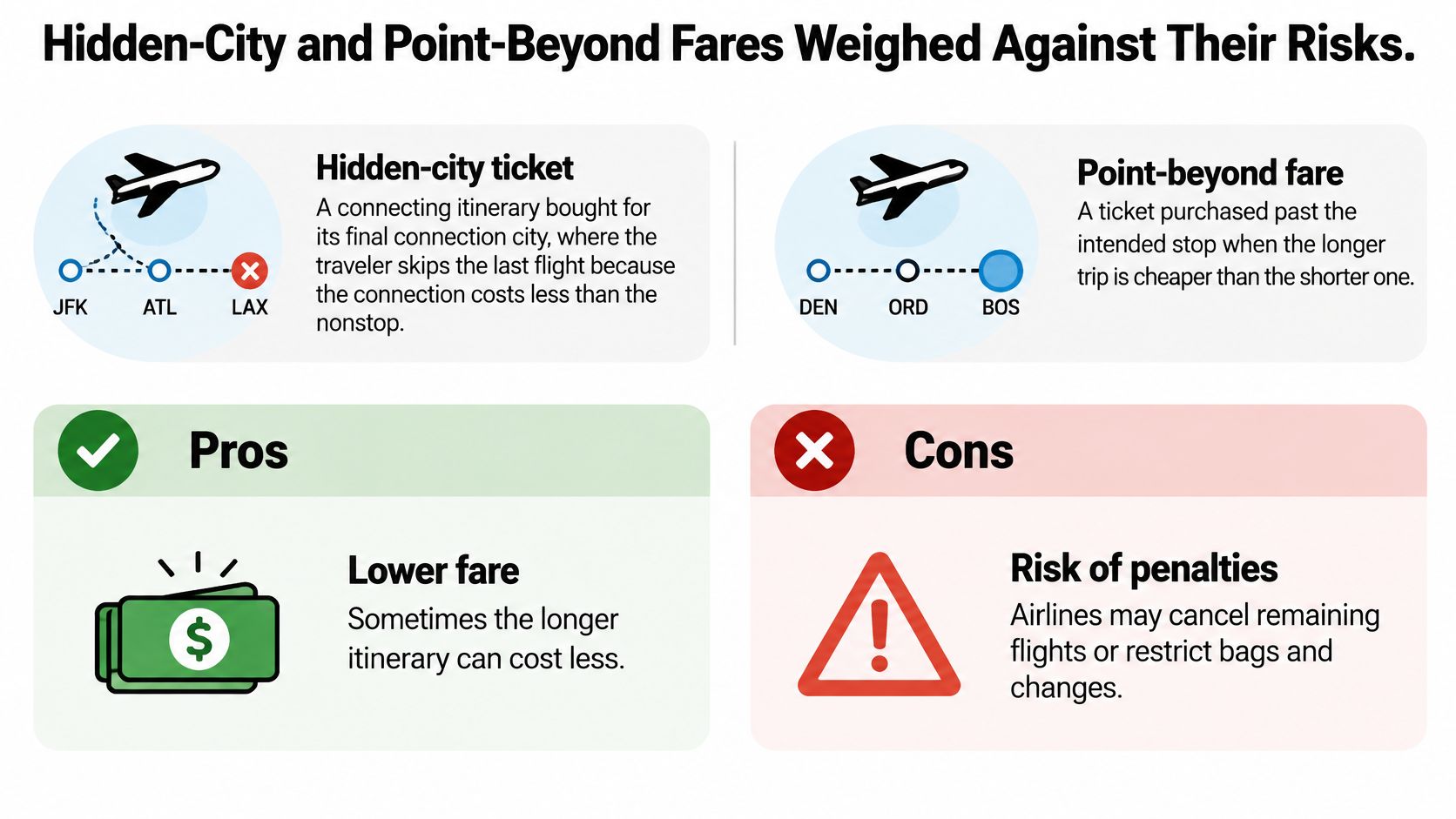
What can go wrong
| Risk or reward | What can happen | How to reduce it |
|---|---|---|
| Cancelled later segments | Airline may cancel the rest of the itinerary, including any return flight | Do not book a return on the same ticket |
| Checked bags | Bags tagged to the final destination may be misrouted or lost | Travel carry-on only |
| Loyalty account | Airline may close or restrict the frequent flyer account | Avoid this tactic with any account you value |
| Changes and refunds | Skipped segments can void later legs, and refunds may be denied | Assume no refund and keep a backup booking |
| Contract and policy | Airlines prohibit the practice in their terms and have pursued legal action | Read the carrier's contract of carriage first |
| Reward | Lower fare on a connecting itinerary; savings vary by route and date | Compare against the total cost of a direct fare |
Our site keeps a page of hidden-city litigation documents covering Lufthansa and American Airlines lawsuits. Read those next to the contract of carriage before you assume a posted fare is safe to break.
I would use this only on a one-way trip, with a carry-on, with no loyalty account you care about, and with a backup already priced. If any of those fail, buy the direct fare. The book, the audio version, and the podcast are optional reading on how these fares were built. They aren't a waiver of the airline's rules.
INVOLUNTARY REROUTE (I-REROUTE.COM) is the podcast and membership that walks through hidden-city tickets, point-beyond fares, AD75 discounts, and the other ways premium cabins get filled without the sticker price. If you want the fare rules, the founder's account, and current updates in one place, start with a sample episode and then subscribe. Visit INVOLUNTARY REROUTE (I-REROUTE.COM) when you are ready to compare the tactics against your own trips.