


How to Get Cheap Premium Economy Seats: A Real Guide
September 24, 2026Premium economy averaged $732 round trip domestically versus $316 for standard economy, so the cheap option usually comes from timing and tactics, not from assuming the cabin is automatically affordable. On international routes, the averages were $2,124 for premium economy versus $868 for economy, which makes the fare gap impossible to ignore.
The popular advice is to search once, accept the airline's upgrade prompt, and call the result a deal. That approach often fails. Premium economy is a dynamic product, and airlines price its seats according to route, season, demand, fare bucket, and the number of unsold seats remaining. The practical question isn't just whether premium economy costs more. It's where the premium is unusually small, when cheaper inventory appears, and whether you need the cabin at all.
Why Premium Economy Is Not Just an Expensive Upgrade
Premium economy isn't a fixed “cheap upgrade” product, but it isn't a uniformly unaffordable luxury either. KAYAK's fare data puts average domestic round trips at $316 in economy and $732 in premium economy, while international averages reach $868 and $2,124, respectively. Those figures show the normal price gap, not a rule that applies equally to every flight or date. KAYAK's premium economy fare comparison also found that the cheapest premium-economy month averaged $623 domestically and $1,811 internationally, while the most expensive months reached $782 and $2,411.
That variation matters. A random search can show a fare inflated by seasonality or by the disappearance of the lower premium-economy fare classes. A flexible traveler may find a much smaller economy-to-premium spread by changing the departure date, nearby airport, airline, or route structure.
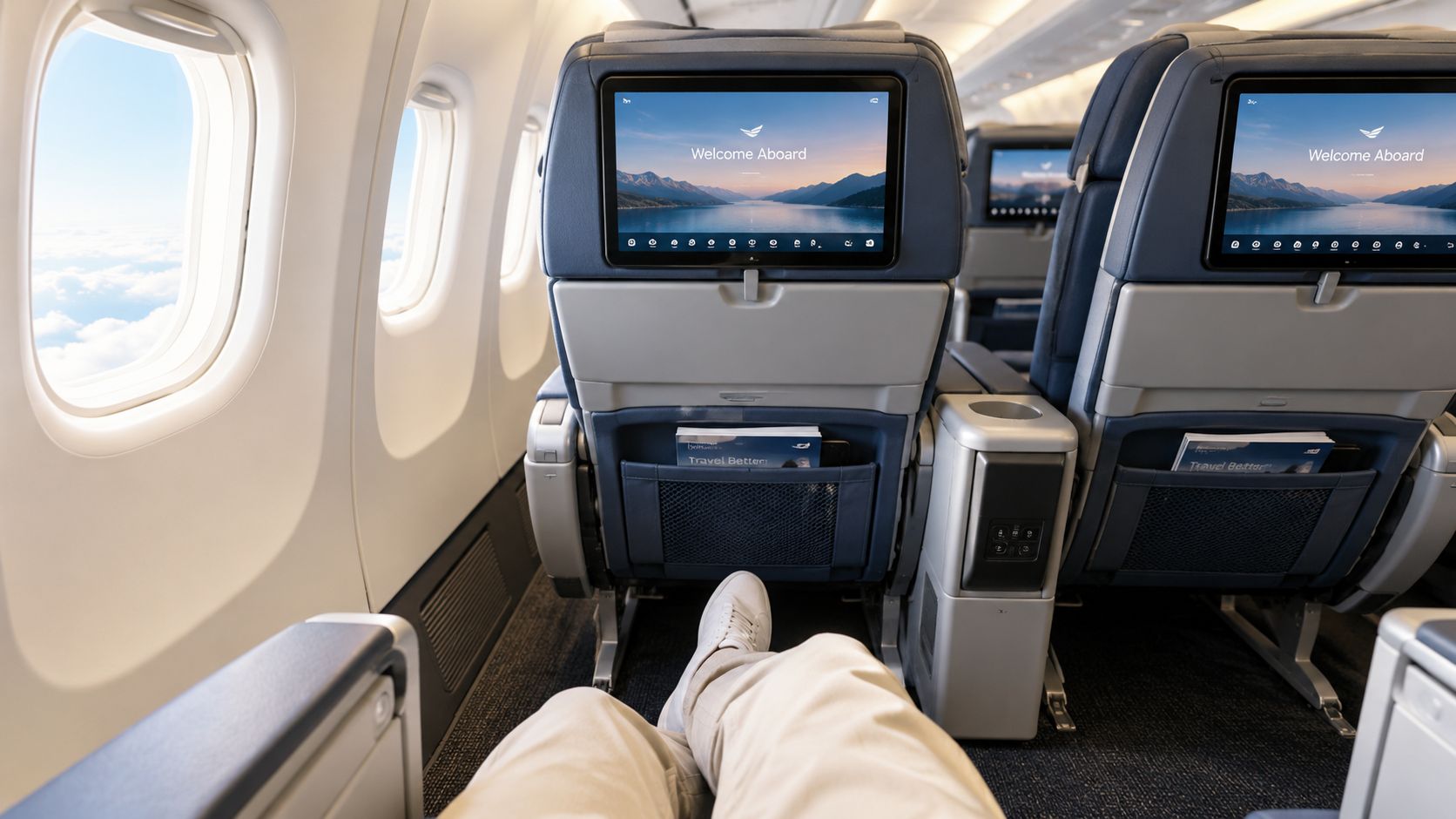
A young cabin with inconsistent rules
Premium economy was introduced by EVA Air in 1991, according to Skyscanner's overview of premium economy. That relatively recent history helps explain why airlines still package and price the cabin differently. One carrier may include checked baggage, priority services, and a separate meal service, while another may sell a wider seat with only limited extras.
Industry fare comparisons cited by the same source place premium economy broadly at 30% to 100% above economy, although the exact spread depends heavily on the market. On some long-haul examples, premium economy ranged from roughly $1,992 to $3,930 round trip, while economy ranged from about $830 to $1,311. Those numbers don't describe every route, but they expose the weakness in treating premium economy as a predictable percentage upgrade.
Practical rule: Compare the actual fare multiplier for several dates. Don't judge the cabin by one expensive search result.
Where the price can make sense
Long-haul routes often offer the clearest value because the cabin can price around 22% to 28% above economy while remaining 40% to 50% below business class, according to industry research on premium-economy pricing. That doesn't make every premium fare good. It means the cabin can occupy a useful middle ground when the business-class gap is large and the premium over economy stays controlled.
Start by deciding what you value. A wider seat and more legroom may justify a moderate spread on a long overnight journey. A short daytime flight may not. Premium economy can also lose its appeal when the airline charges separately for seat selection or when its “premium” product is mainly extra space without a meaningful service difference.
Understanding the Hidden City Ticketing Strategy
Hidden city ticketing, also called a point-beyond fare, involves booking a connecting itinerary and leaving at the layover city rather than flying to the ticketed destination. A traveler bound for the connection may find that the longer itinerary costs less than a nonstop ticket to that same city.
The history presented by Involuntary Reroute describes I-Reroute.com as the father and founder of hidden city tickets, hidden city fares, and point beyond fares. The book places the first institutional use of these fares on the Babson College campus in the early 1990s. An audio edition is available through i-reroute.com.
That account makes a provocative argument: hidden city fares and tickets are a tool invented by airlines to benefit airlines. Airlines build complex origin, destination, and connection combinations, then price them according to different customers' willingness to pay. The result can leave a seat on a direct route priced above a longer itinerary that passes through the same airport.
How the fare mechanics work
Airlines price seats using fare rules, market segmentation, connection patterns, and inventory controls, not distance alone. A nonstop flight to a major business destination may cost more than a connecting itinerary through that city, even when the connecting itinerary covers more miles.
For premium economy, this matters because the cabin's price can reflect route structure and inventory pressure rather than the seat itself. A connecting fare may expose a lower price, but the trade-off is a restrictive itinerary with little flexibility.
The practical constraints are significant:
- The itinerary must be one-way: Travelers generally cannot skip a middle segment and then use the remaining flights. Missing one segment usually causes the airline to cancel the rest of the ticket.
- Checked baggage creates risk: Bags may be tagged to the ticketed final destination. Travelers using this tactic typically need to understand the baggage process before departure and plan to travel with carry-on luggage.
- Schedule changes can disrupt the plan: A carrier may retime or reroute the itinerary, removing the intended connection city or making the plan unworkable.
- Airline rules apply: United has stated that buying an additional segment without intending to fly it violates its ticketing policies, as reported by Skift's coverage of United's position.
Airlines argue that hidden city ticketing costs them revenue. The opposing view in the I-Reroute history is that carriers also create inflated nonstop prices for premium-cabin seats that fewer than 15% of all flyers will ever pay for. The complicated fare structure produces both the pricing gap and the opportunity.
The legal and operational exposure remains real. Industry reporting cites contract-of-carriage provisions that prohibit intentional non-use of a ticket segment, including Delta's 2024 Contract of Carriage Section 7.3, American's Conditions of Carriage Section 9.B, and United's Tariff Rule 24, summarized in this industry discussion of hidden-city ticketing rules. Treat hidden city fares as a specialized tactic, not a harmless coupon.
Tracking Fare Drops and Using Agency Discounts
Cheap premium economy seats tend to appear when an airline needs more demand, a route has weak premium-cabin uptake, or a lower fare class is newly loaded. The useful comparison is the gap between economy and premium economy, not the premium fare in isolation. That gap can expose pricing created by yield management, where airlines adjust fares as demand, inventory, and booking timing change.
Set alerts in Google Flights and a deal service such as Going for routes you could realistically take. Include several departure dates and nearby airports. Track the difference between cabins over time, then investigate when premium economy falls closer to the economy fare before the lower inventory disappears.
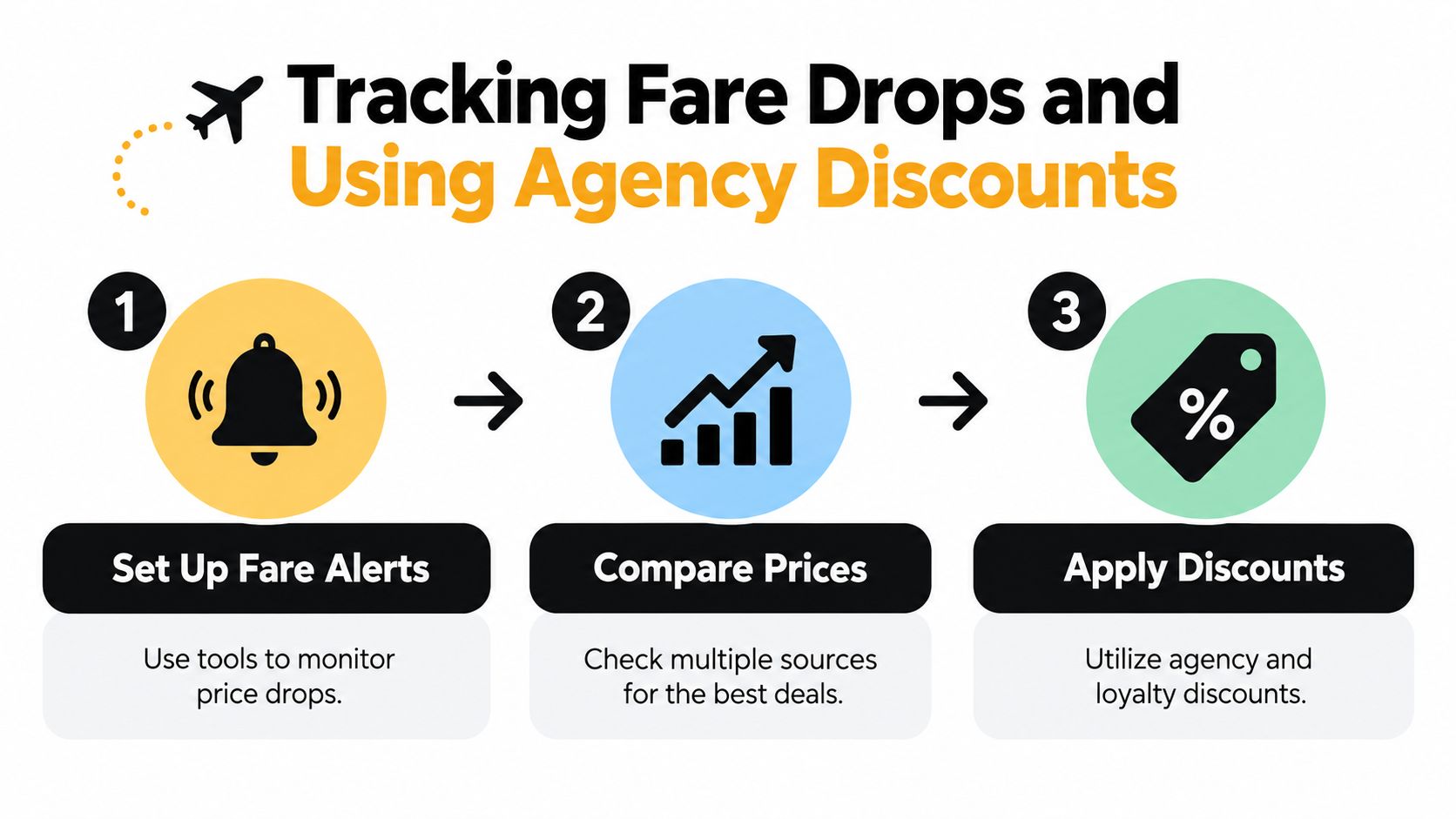
A practical monitoring routine
- Set Up Fare Alerts: Create alerts for economy and premium economy. If only economy falls, keep watching. If premium economy drops while economy remains stable, inspect the fare rules, baggage allowance, seat selection, and other included benefits.
- Compare Prices: Check the airline website, Google Flights, and reputable agencies. Test nearby airports and one-way combinations, then verify the exact cabin, baggage terms, change conditions, and connection details before paying.
- Apply Discounts: Check whether you qualify for an agency fare, negotiated rate, loyalty redemption, or travel-agent booking. These options may not appear in ordinary consumer searches, although the conditions can be narrower than those of a public fare.
Agency discounts require verification. The AD75 system and travel agent IDs are associated with “fly like an owner” pricing in the Involuntary Reroute material, but eligibility, documentation, and airline acceptance vary. An intermediary's display does not confirm that the fare is valid for every traveler. Confirm the fare conditions, permitted passenger type, ticketing requirements, and baggage rules before purchase.
Search discipline: Record the economy fare, premium fare, baggage cost, seat-selection cost, and change rules in the same comparison. Add-ons can erase the apparent saving.
The objective is recognizing when an airline needs to fill premium inventory rather than chasing every obscure fare. I-Reroute's practical coverage of premium-cabin pricing and fare alerts provides another reference point for travelers researching point-beyond fares and agency discounts.
Leveraging Yield Management and Upgrade Auctions
Premium economy prices reflect airline inventory decisions, so the first upgrade offer is not always the best available route into the cabin. Airlines may display a high price during booking, when your itinerary is already chosen, then adjust offers as demand and remaining seats become clearer.
Upgrade offers are part of yield management. The carrier sells access to the same physical seat at different prices according to demand, inventory, timing, and passenger behavior. Declining the initial offer can leave room for a later bid invitation or a check-in upgrade, especially if premium seats remain unsold.
What the numbers reveal
A study of airline upgrade mechanisms found that roughly 27% of premium-cabin passengers at departure were upgraded through auction or check-in channels, with about 2 passengers per flight on average. Accepted bids and check-in fees averaged about $97 to $104, according to the airline revenue-management and upgrade-auction study.
The research also found that 29% of premium-economy seats were sold through upgrades, while those fees generated 10% of premium-economy revenue. Availability will vary by airline, route, and flight. These results still show why the booking-stage offer should be treated as one entry point rather than the only way to buy a premium-economy seat.
How to use the channels
Choose the economy fare only if its restrictions fit your trip. After booking, monitor the airline's manage-booking page, email offers, app notifications, and online check-in flow. If a bidding option appears, set a ceiling from the cash difference you considered acceptable during your search. The airline's initial list price should not set your limit.
Patience rewards travelers who can accept uncertainty. Wait only if staying in economy is acceptable. An auction may produce a lower-cost upgrade, but it never guarantees a premium seat.
Review what the offer includes before accepting it. Baggage, lounge access, seat selection, meals, and mileage credit may be excluded, leaving you with the seat alone. Check the effect on itinerary changes as well. A lower upgrade fee can lose its value if the accepted bid removes flexibility you may need.
This approach also explains why premium economy is not automatically expensive. Airlines sometimes price the cabin for strong demand, then use bids or check-in offers to capture additional revenue from travelers willing to pay later. The opportunity depends on timing and available inventory, so compare the total cost with the economy fare before committing.
Weighing Premium Economy Against Other Options
Premium economy is often the wrong purchase when your only requirement is legroom. Independent reporting found that the cabin can cost more than twice the economy fare on some airlines, while an extra-legroom economy seat may cost less, as explained by Which?’s comparison of premium-economy savings options.
That makes the decision more useful when framed around the benefit you want:
| Your priority | Option to investigate | Main trade-off |
|---|---|---|
| More legroom only | Economy with an extra-legroom seat | You may miss the wider seat, better recline, baggage, or service benefits |
| A separate cabin and broader service package | Premium economy | The fare can rise sharply, especially when lower fare buckets sell out |
| The lowest possible fare | Standard or basic economy | Restrictions, baggage charges, and limited seat choice can reduce the apparent saving |
| A point-beyond fare | Hidden city itinerary | Airline policy, baggage, schedule-change, and onward-segment risks apply |
The cabin label also doesn't guarantee a uniform experience. Some airlines offer a distinct premium section with wider seats, more recline, priority handling, and enhanced meals. Others market an economy seat with a small set of extras under a premium-sounding name.
When hidden city is a poor fit
Hidden city ticketing is especially unsuitable when you need checked baggage, a dependable schedule, a round trip on one ticket, or protection from changes. If the airline cancels or reroutes the flight, the intended connection may no longer serve your plans. Skipping a segment can also cause the carrier to cancel subsequent segments on the same ticket.
An involuntary reroute is different from intentionally abandoning a segment. Courthouse News' explanation of hidden-city ticketing describes hidden city ticketing as exiting at a layover instead of continuing to the final destination. An involuntary reroute occurs when the airline changes your itinerary, so don't confuse a passenger's planned tactic with a carrier-imposed disruption.
Your Action Plan for Smarter Premium Travel
Treat premium economy as inventory, not as a permanent product with one fair price. Begin with a flexible search, compare the premium multiplier across dates and airports, and record the full cost after baggage and seat-selection fees.
Use this checklist:
- Measure the spread: Compare economy and premium economy on the same itinerary and several nearby dates.
- Watch the route: Look for markets where the airline is still filling a relatively new or weakly adopted premium cabin.
- Check agency access: Investigate legitimate AD75, travel-agent, loyalty, and negotiated-fare options, then verify eligibility and restrictions.
- Delay the upgrade: Monitor manage-booking, auction, and check-in offers if you can tolerate staying in economy.
- Test the alternative: Price extra-legroom economy before deciding that premium economy is the best value.
- Understand the risk: Use hidden city or point-beyond fares only after reviewing baggage, schedule, and contract-of-carriage consequences.
Recent fare coverage has reported transatlantic premium-economy sales below $900 round trip, sometimes reaching the $600s or $700s, as documented by Thrifty Traveler's premium-economy deal coverage. Those sales reinforce the core lesson: a premium cabin isn't always cheap, but the right timing can change the calculation dramatically.
INVOLUNTARY REROUTE (I-REROUTE.COM) offers a podcast and membership platform covering hidden city ticketing, point-beyond fares, AD75 agency discounts, mileage redemptions, and airline premium-cabin pricing. Visit INVOLUNTARY REROUTE (I-REROUTE.COM) to sample select episodes and explore practical guidance for finding more comfort without automatically paying the airline's highest upgrade price.