


How to Redeem Miles for Maximum Value in 2026
September 18, 2026You've found a flight that costs a manageable cash fare, but the airline's checkout page asks for a confusing mileage amount, adds taxes, and shows no obvious explanation of whether you're getting a good deal. Another search reveals a premium-cabin itinerary that costs fewer miles through a partner, but only on a connection and only on dates you can adjust. Redeeming miles isn't a simple checkout decision. It's a pricing exercise, an availability exercise, and sometimes a willingness-to-use-the-airline's own fare structure against itself.
The right question isn't “How few miles can I spend?” It's “What travel value am I receiving, and what alternatives am I giving up?” This guide shows how to redeem miles by finding bookable award space, calculating cents per mile, comparing airline and partner options, and evaluating premium-cabin, stopover, point-beyond, and hidden-city mechanics without ignoring their risks.
Why Redeeming Miles Feels Harder Than Earning Them
A mileage balance can rise without much planning. Flights, credit-card spending, bank-point transfers, and promotions all add miles. Booking a worthwhile trip requires a different process because the airline controls award inventory, pricing, fees, and the rules governing which itineraries your balance can cover.
A cash fare and an award fare may appear comparable, yet taxes and fees can make the mileage option poor value. The reverse also happens. A premium-cabin award can deliver excellent value, but finding it may require flexible dates, a connecting route, and a partner program. The same balance can produce very different trips depending on the route, cabin, airline, and timing.
The size of the overall mileage supply adds another complication. CBS News' reporting on airline loyalty programs cited McKinsey's estimate of 30 trillion unredeemed airline miles in consumer accounts in 2018 and reported that ValuePenguin found the five largest U.S. airline loyalty programs ended 2020 with $27.5 billion in unused miles, an increase of $2.9 billion from 2019. A large outstanding balance gives airlines more incentive to adjust award prices, restrict seats, and reduce the buying power of miles.
Earning and burning require different habits
Miles are not cash. Cash retains its face value while you hold it, but loyalty programs can change award prices and inventory rules. The practical risk is that your balance remains intact while buying less travel when you finally use it.
Airline miles work best as a travel budget with a specific use, not as a collection to grow indefinitely. That matters even more for premium cabins, where partner awards, point-beyond fares, or hidden-city mechanics can sometimes save miles or cash, but only when the routing rules and risks fit the trip.
Practical rule: Keep enough miles for realistic travel plans, but don't treat a growing balance as a victory by itself.
What a reliable redemption process looks like
Begin with bookable availability, not a transfer bonus or an attractive account balance. Search flexible dates, compare your airline with its partners, and calculate the value after taxes and fees. Transfer points only after you have confirmed that the itinerary can be ticketed.
This order protects you from stranded points because transfers are often irreversible. A good redemption combines bookable space, acceptable fees, a sensible cents-per-mile return, and an itinerary you want to fly. Standard economy awards may be the right choice when cash fares are high or the route is expensive. Premium-cabin partner awards can be stronger when the mileage price stays reasonable, while point-beyond and hidden-city options require careful attention to baggage, missed segments, and airline rules.
How to Find Award Space That Actually Books
Award searches fail most often because travelers search one date, one airline, and one cabin, then assume the absence of a result means no award exists. Airlines release seats unevenly, and partner programs may display different inventory or price the same seat differently.
Search before transferring
Use the operating airline's website and at least one relevant partner program when possible. A nonstop may be unavailable through your preferred currency while a connecting itinerary appears through a partner, sometimes with a better mileage price or lower fees.
Search a date grid rather than a single departure. If your dates are fixed, search nearby airports, alternate connection points, and one cabin above or below your first choice. Don't transfer points merely because a calendar appears to show space. Open the itinerary, confirm the flight numbers, check the cabin on every segment, and continue far enough into checkout to verify that the seat can be ticketed.
The large award-availability survey from The Points Guy found reward seats on 74% of searches overall. It also found close-in availability ranging from 72% to 94%, depending on the airline and route window. Those results don't mean your preferred flight will be available. They show why flexibility and repeated searching change the odds.
Use a practical search sequence
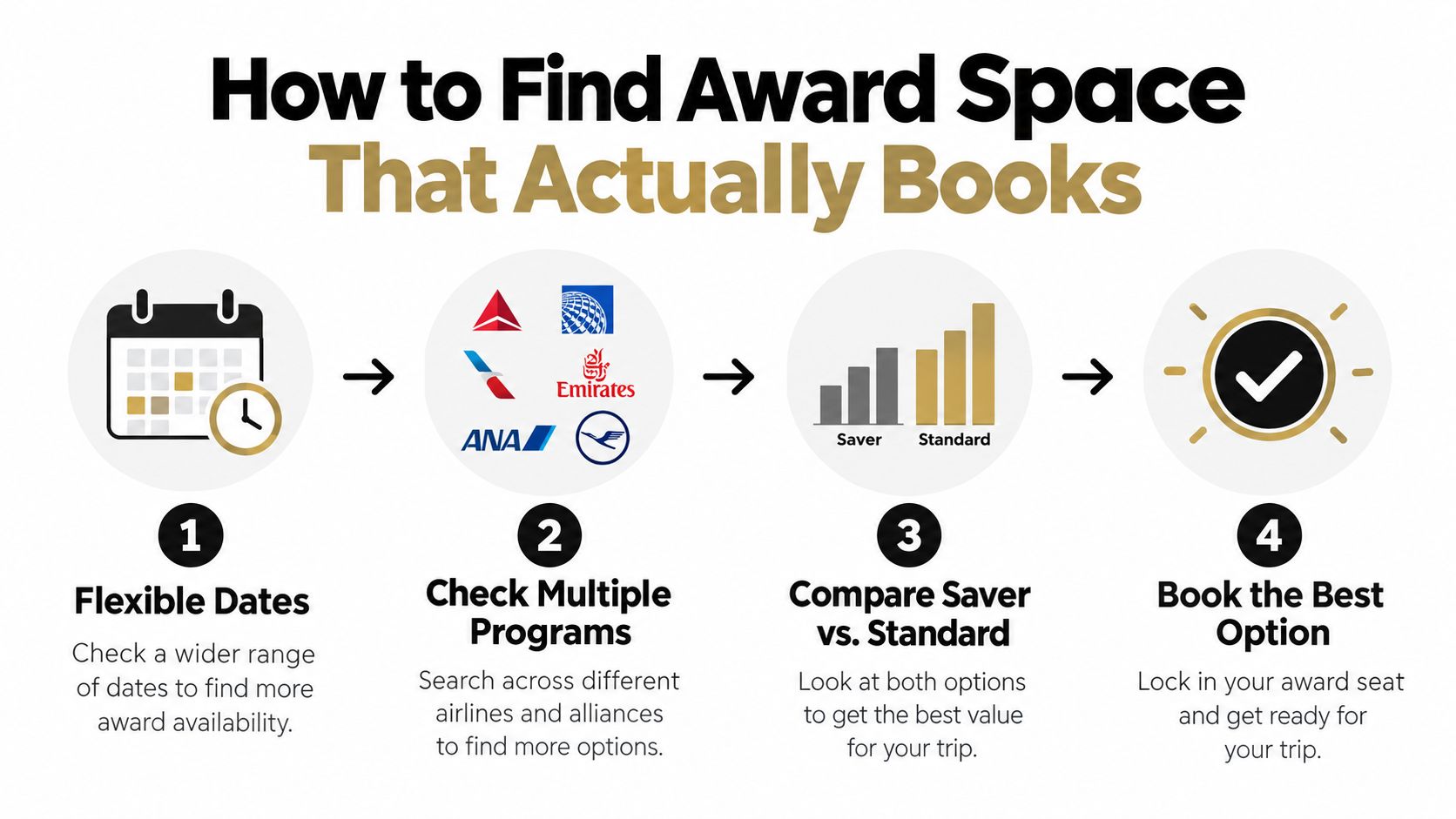
Start with flexible dates: Search several departure and return dates before deciding which program to use. Midweek and less popular travel periods may expose inventory that disappears on peak dates.
Check multiple programs: Compare your own airline, alliance partners, and independent programs that serve the same operating carrier. A partner may show saver-level inventory when your home program displays only expensive standard awards.
Separate saver from standard: Saver-level space is usually the scarce inventory worth prioritizing. A standard award can still be reasonable, but compare it against the cash fare before spending a large balance.
Book once the numbers work: Award seats can vanish while you're comparing options. If the itinerary has acceptable fees and strong value, be ready to ticket rather than assuming the same space will remain.
A traveler seeking a nonstop business-class seat might find nothing through the operating carrier. A partner search could reveal a connection with the same long-haul segment, better availability, and a lower mileage requirement. The connection adds time, but the trade-off may be worthwhile if the premium cabin is the purpose of the trip.
This video provides a visual supplement for checking award space and turning a search into a booking:
Don't transfer flexible points until the final program search is complete. Confirm the passenger names, dates, airports, cabin, taxes, change rules, and cancellation terms before moving points out of a bank account.
Calculating Real Award Value Before You Transfer
A low mileage price can still be a poor redemption if the comparable cash fare is cheap. A higher price may make sense when the cash fare is expensive, the itinerary avoids a cabin you would not pay for, or a partner award gives you access to premium space at a defensible cost.
Use this formula:
Cents per mile = (cash fare minus taxes and fees on the award) ÷ miles required × 100
Suppose a cash ticket costs $600 and the award requires 40,000 miles plus $60 in taxes. Your calculation uses $540 of avoided airfare divided by 40,000 miles, producing 1.35 cents per mile. That number gives you a consistent comparison. It does not decide whether the booking is worthwhile by itself.
Include the fare you would buy, not an inflated premium-cabin price you would never consider paying. A partner business-class award can look spectacular against a high published fare yet provide weak value if an affordable economy ticket was your realistic alternative.
Benchmarks that keep the math honest
Many domestic economy redemptions fall around 1.1 to 1.5 cents per mile. Frequent Miler's analysis of American AAdvantage redemptions reported a 1.29-cent median and a 1.53-cent mean across 8.85 million observed redemptions. The gap matters because a smaller group of unusually valuable bookings can pull the average above what a typical redemption delivers.
The analysis also cautions that premium cabins do not automatically produce better returns. Their observed median values can trail economy in some programs, particularly when travelers compare against a cash fare they would never pay.
A 2025 U.S. Domestic Reward Report statistic, summarized in a 2026 industry article about airline loyalty programs, placed the average domestic award at 20,930 miles, compared with 17,000 miles in 2019, a 23% increase over six years. The article also placed major airline currencies around 0.9 to 1.5 cents per mile in early 2026.
| Program | Typical Value per Mile | Example Redemption Value and likely use |
|---|---|---|
| United | About 0.9¢ | 20,930 miles implies about $188, often a modest domestic economy redemption |
| American AAdvantage | About 1.0¢ | 20,930 miles implies about $209, reasonable when the cash fare is higher than usual |
| Delta | About 1.2¢ | 20,930 miles implies about $251, more useful on a costly domestic date or route |
| Southwest | About 1.5¢ | 20,930 miles implies about $314, typically tied closely to the cash fare |
| Flying Blue | About 1.5¢ | 20,930 miles implies about $314, potentially stronger on a partner premium-cabin award |
The table applies the cited valuation ranges to one domestic award balance. These are not fixed redemption rates. Route, date, cabin, program pricing, and fees can change the outcome. Premium partner awards generally require a separate comparison because their value comes from access to a cabin or route that costs far more in cash, not just from using fewer miles.
Decide whether miles beat cash
Pay cash when the fare is low, the award consumes a large balance, or the paid ticket would earn meaningful points and status credit. Redeem when the award gives a clear return, preserves cash, or gets you a premium cabin at a price you can justify.
Premium partner bookings can sometimes reach 10 to 11 cents per mile, according to the valuation summary linked above. They involve limited inventory and more booking work, so the result depends on finding space that works. Standard economy awards, partner awards, point-beyond options, and hidden-city itineraries each need their own cash comparison. A clever routing tactic only saves miles when its restrictions and risks are acceptable.
Booking With Miles Transfers and Partner Airlines
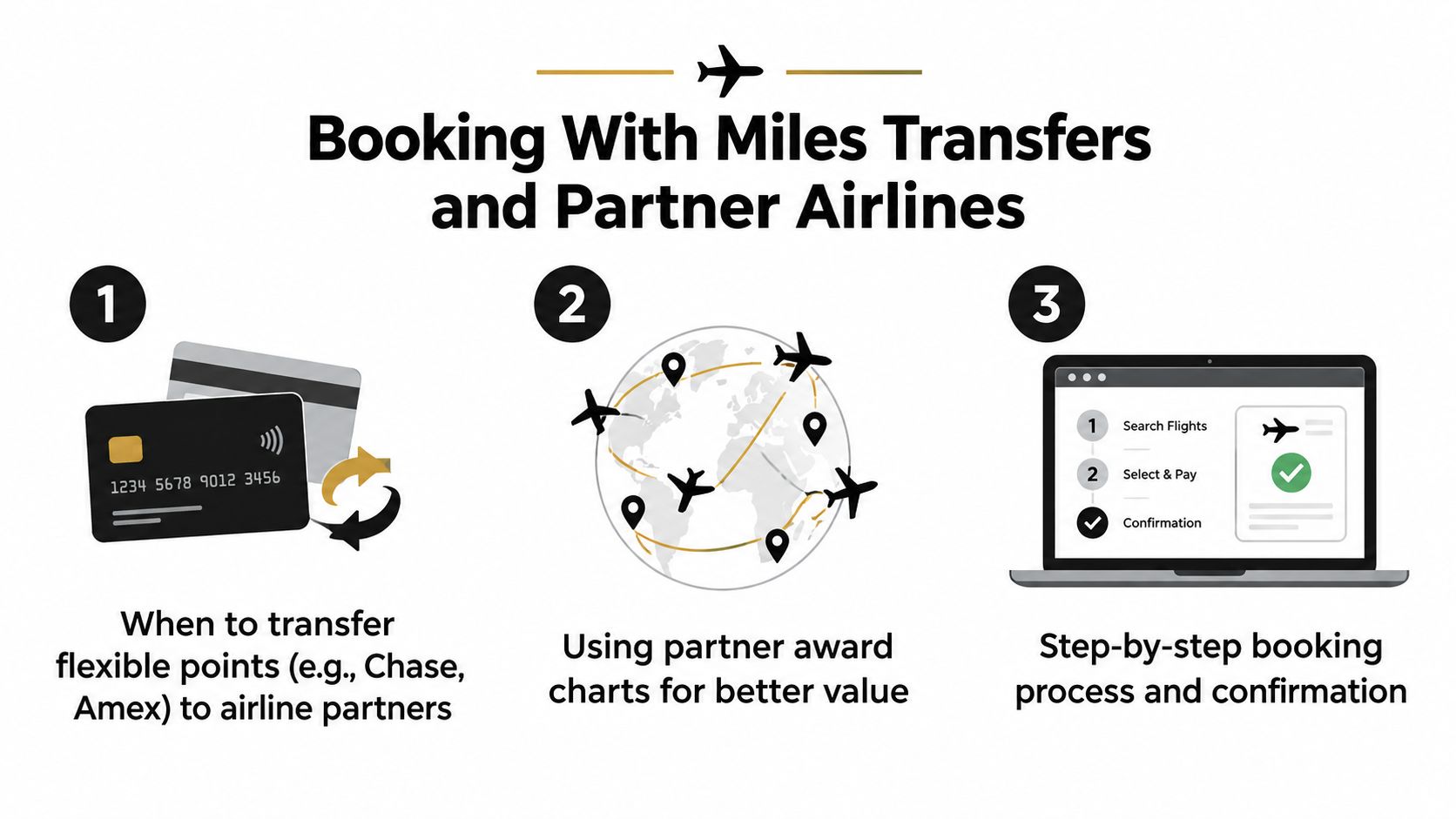
The safest transfer is the transfer you make after finding an available seat. Flexible currencies from programs such as Chase Ultimate Rewards or American Express Membership Rewards can be useful because they may transfer to multiple airline partners, but flexibility doesn't remove the need to verify inventory.
A partner award isn't automatically cheaper. Some partners add significant surcharges, use different mileage prices, or impose stricter change rules. Compare the complete transaction, including taxes, fees, connection time, cancellation terms, and the difficulty of getting help if the itinerary changes.
Choose the booking program deliberately
Use your own airline program when it offers competitive pricing, simple changes, and reasonable fees. Check partners when the operating carrier's mileage price looks inflated, when a partner has access to saver inventory, or when a partner award chart prices the same route more favorably.
The decision tree is straightforward:
- Your program shows bookable saver space: Compare the total cost with the cash fare and book directly if the value works.
- Your program shows only expensive space: Search partners before transferring. Don't assume the first result is the only option.
- A partner shows availability: Confirm that the partner can issue the ticket, that every segment has the intended cabin, and that the taxes are acceptable.
- No program shows reliable space: Keep searching rather than moving points speculatively. A transfer won't create inventory.
Check transfer ratios and transfer times before starting. A transfer bonus may improve the arithmetic, but it doesn't compensate for phantom availability or a missed seat. If a program permits a temporary hold, use it. If it doesn't, keep the award search open and complete the transfer only when the booking path is ready.
Verify the ticket after payment
A confirmation number isn't enough if the booking hasn't been issued. Look for the electronic ticket number, operating-carrier confirmation, correct passenger information, and seat assignment or cabin designation for each flight. Save the confirmation, fare conditions, and mileage receipt.
Fees deserve equal attention. A partner with a lower mileage price can be worse overall if it adds surcharges that erase the savings. Do not book through a partner just because the headline mileage figure looks attractive.
Booking standard: The best partner redemption is the one that survives a complete checkout comparison, not the one with the smallest number beside the mileage symbol.
When a partner award beats your own program, book through the partner that controls the award price, not necessarily the airline operating the flight. That distinction is central to how to redeem miles well. The aircraft and seat may be identical, while the currency required and the fees charged are not.
Premium Cabin Tactics Including Stopovers and Point Beyond Fares
Premium-cabin awards become more useful when you compare them with the cash fare, the routing, and the rules attached to each ticket. A business-class seat may require a large cash payment but a manageable number of miles through a partner program. In other cases, a connecting itinerary creates a lower cash price than a nonstop, making point-beyond tactics relevant. These are separate decisions, and they should not be treated as interchangeable mileage strategies.
Involuntary Reroute (I-Reroute.com) describes hidden-city and point-beyond fares as airline-created pricing tools first discussed on the Babson College campus in the early 1990s. The associated book, Involuntary Reroute, examines those fare concepts, and an audio version is available through I-Reroute.com.

Understand what point beyond means
Hidden-city ticketing means buying a connecting itinerary and ending the trip at the intermediate stop instead of continuing to the ticketed final destination. The U.S. Government Accountability Office's explanation of hidden-city ticketing describes passengers purchasing tickets with a connection at a hub while intending to begin or end travel at that intermediate point.
The price difference exists because a connecting itinerary can cost less than a nonstop itinerary between the same cities. Research on hidden-city pricing mechanics explains how this approach uses that pricing disparity and limits an airline's ability to charge different passengers different prices for the same underlying seat.
Airlines argue that hidden-city tickets reduce revenue because a connecting fare can replace a higher nonstop fare. Their pricing systems can also produce unusually high cash prices for premium cabins, even when relatively few travelers will pay them. If you are considering this method, focus on the fare rules and operational risks rather than assuming the price difference will always justify it.
Separate mileage redemptions from cash fare tactics
A hidden-city cash fare normally requires skipping the final segment. An award ticket follows its own cancellation, routing, and loyalty-program rules, so a paid-fare technique does not automatically transfer to miles. Checked baggage, irregular operations, visa requirements, and return reservations can all make the approach unsuitable.
Airlines oppose the practice because a connecting fare may prevent them from collecting a higher fare from a passenger who would otherwise buy the nonstop. A BBC Worklife discussion of airline revenue management quotes an airline pricing expert discussing that incentive. Hidden-city ticketing therefore belongs in the cash-fare toolbox, not in a standard award-booking routine.
Stopovers are a different way to increase premium-cabin value. Some programs let you add a longer visit to an eligible award itinerary without charging for another complete award. Rules vary by program, and taxes, partner availability, permitted routing, and change conditions can alter the result. Confirm those details before transferring points.
Use partner awards first when they provide a bookable premium seat at a lower mileage cost and acceptable fees. Consider a stopover when it adds meaningful travel without requiring another full award. Use hidden-city or point-beyond mechanics only for suitable cash fares, never with checked baggage, and never when a disruption could force rerouting to the ticketed destination. Airlines may also restrict future travel or loyalty accounts under their rules.
Putting Your Miles to Work Without Overpaying
A dependable redemption routine is more valuable than a lucky award. Start every trip by comparing the cash fare with the mileage price, then search across dates and programs before deciding which currency to use.
Run the same checklist every time
- Define the trip: Decide whether the priority is a nonstop, a specific cabin, a low fee, a short journey, or the lowest total cost.
- Search broadly: Check flexible dates, nearby airports, saver inventory, and partner programs before transferring anything.
- Calculate value: Subtract award taxes and fees from the comparable cash fare, then divide by the miles required.
- Protect flexibility: Review change and cancellation conditions before booking. A slightly weaker redemption may be preferable if it avoids severe restrictions.
- Ticket carefully: Confirm the electronic ticket, operating carrier, passenger details, cabin, and all segments after payment.
- Use balances intentionally: Miles sitting unused face devaluation risk, so don't delay a strong redemption while waiting for a perfect one.
A domestic economy award around the practical 1.1 to 1.5 cents-per-mile range can be sensible when it replaces a fare you would otherwise buy. A premium partner award can be compelling when the cash alternative is far higher, but only if the availability, fees, routing, and flexibility meet your needs. A low-value redemption isn't rescued by the fact that it feels free.
The Involuntary Reroute perspective adds another useful question: is the airline's published price reflecting genuine demand, or is it preserving a complicated fare ladder that leaves overlooked seats and routes? That question can lead you toward a partner award, a permitted stopover, or a cash itinerary that other travelers ignore. It can also warn you away from a risky hidden-city booking when the operational drawbacks exceed the savings.
Review your balances regularly and keep a record of actual redemption values. The goal isn't to maximize every mile at any cost. It's to turn the miles you already have into trips you want, before changing prices reduce their usefulness.
INVOLUNTARY REROUTE (I-REROUTE.COM) offers podcast episodes and membership resources covering mileage redemptions, partner awards, hidden city ticketing, point-beyond fares, and the pricing tactics behind premium cabins. Visit INVOLUNTARY REROUTE (I-REROUTE.COM) to sample its test-flight episodes, follow curated learning paths, and apply those ideas to your next award search.