


How to Use Points for Flights: The Insider’s Guide
October 8, 2026Award prices rarely match cash fares one-to-one. To know whether a redemption is a deal, subtract taxes and fees from the comparable cash fare, then divide the net cost by the points required.
That sounds straightforward, but most advice about how to use points for flights starts in the wrong place. It tells you to transfer points, search an award chart, and celebrate when a business-class seat appears. The better starting point is economic: what cash cost are you avoiding, what restrictions are you accepting, and what other use could those points have?
There's also a more controversial tool worth understanding. Hidden-city ticketing can expose pricing gaps that normal award searches miss, but airlines prohibit the practice in their contracts of carriage. It isn't a risk-free shortcut, and treating it like one is how travelers turn a cheap itinerary into a serious travel problem.
Understanding Airline Points as Access, Not Currency
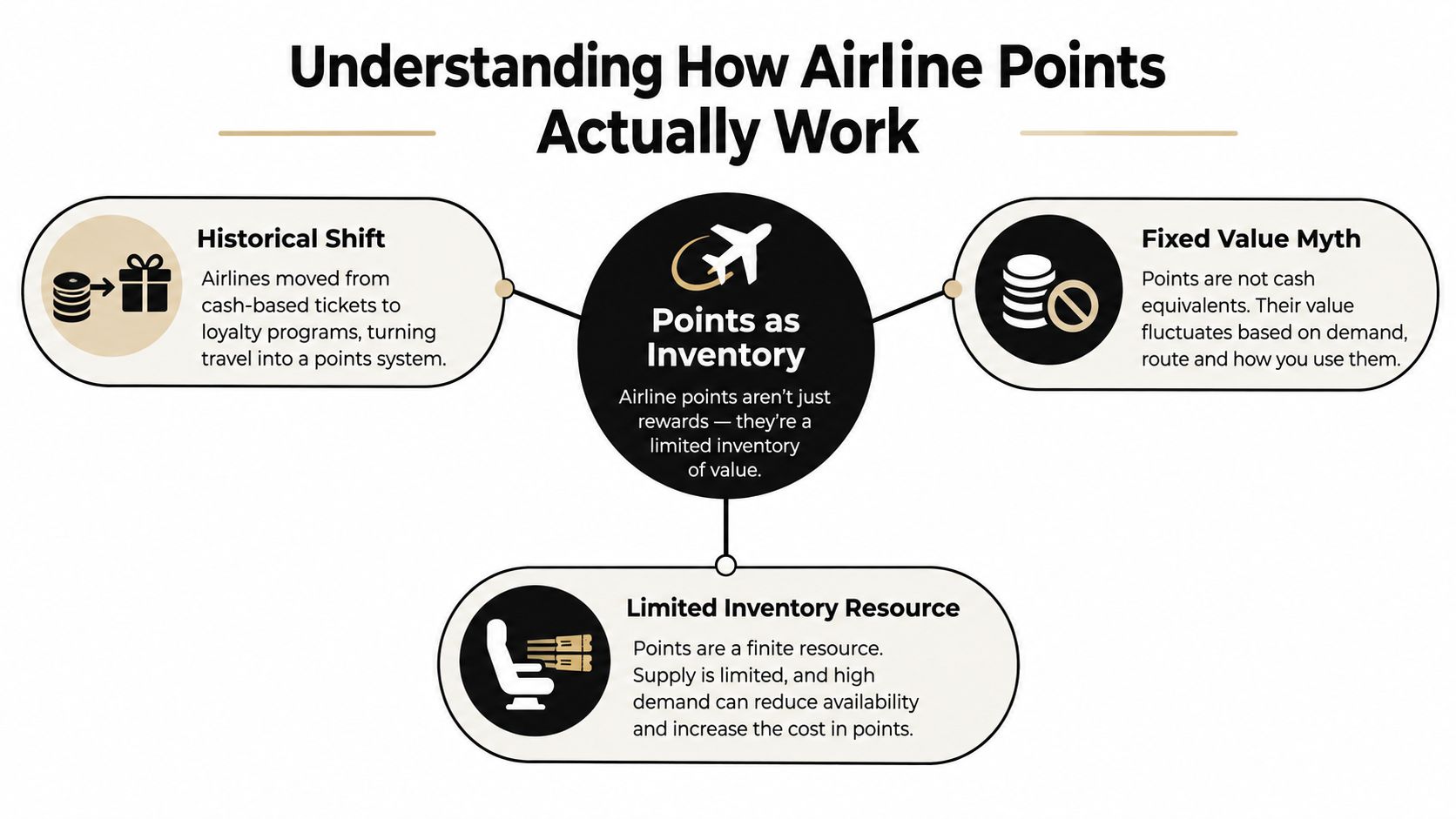
Airlines do not issue points as cash. They issue access to selected inventory under rules that vary by route, date, cabin, partner, and demand. A seat may be available with points only at an expensive award level. The practical question is not whether points work, but what this seat costs and what other use you give up.
From promotion to travel currency
Frequent-flyer points became useful for flights after airline deregulation reshaped competition in the United States. American Airlines launched AAdvantage on May 1, 1981, initially by invitation only. Its headline reward was a first-class ticket to any destination served by American. The program started with roughly 200,000 pre-enrolled customers, including frequent travelers and Admirals Club members, according to American Airlines' history of AAdvantage.
The original model remains recognizable. Travelers earned miles through eligible activity and exchanged them for award seats or upgrades rather than paying the full published fare. In October 1981, American added Hyatt and Hertz as award partners and priced two first-class round trips at 75,000 miles. A year later, it added British Airways as its first international airline mileage partner, creating earning and redemption options on flights to Europe, as described in the same historical account.
That development shows why flexible points can beat loyalty to one airline. A program with multiple partners may provide routes the issuing carrier does not operate. The trade-off is added complexity: each partner can introduce different routing rules, inventory controls, taxes, and surcharges.
Practical rule: Treat points as an access key for a specific seat, not as a universal currency with a guaranteed rate.
Airlines sell different versions of the same physical seat through complex fare structures. Price depends on timing, flexibility, cabin, route, and demand. Points operate inside that system, so they do not remove its restrictions. They can provide a better way to buy access, but only when the award inventory and terms justify using them. That distinction becomes especially important when comparing ordinary award searches with pricing gaps created by hidden-city itineraries, a strategy airlines generally prohibit in their contracts of carriage.
Searching and Booking Award Seats Strategically
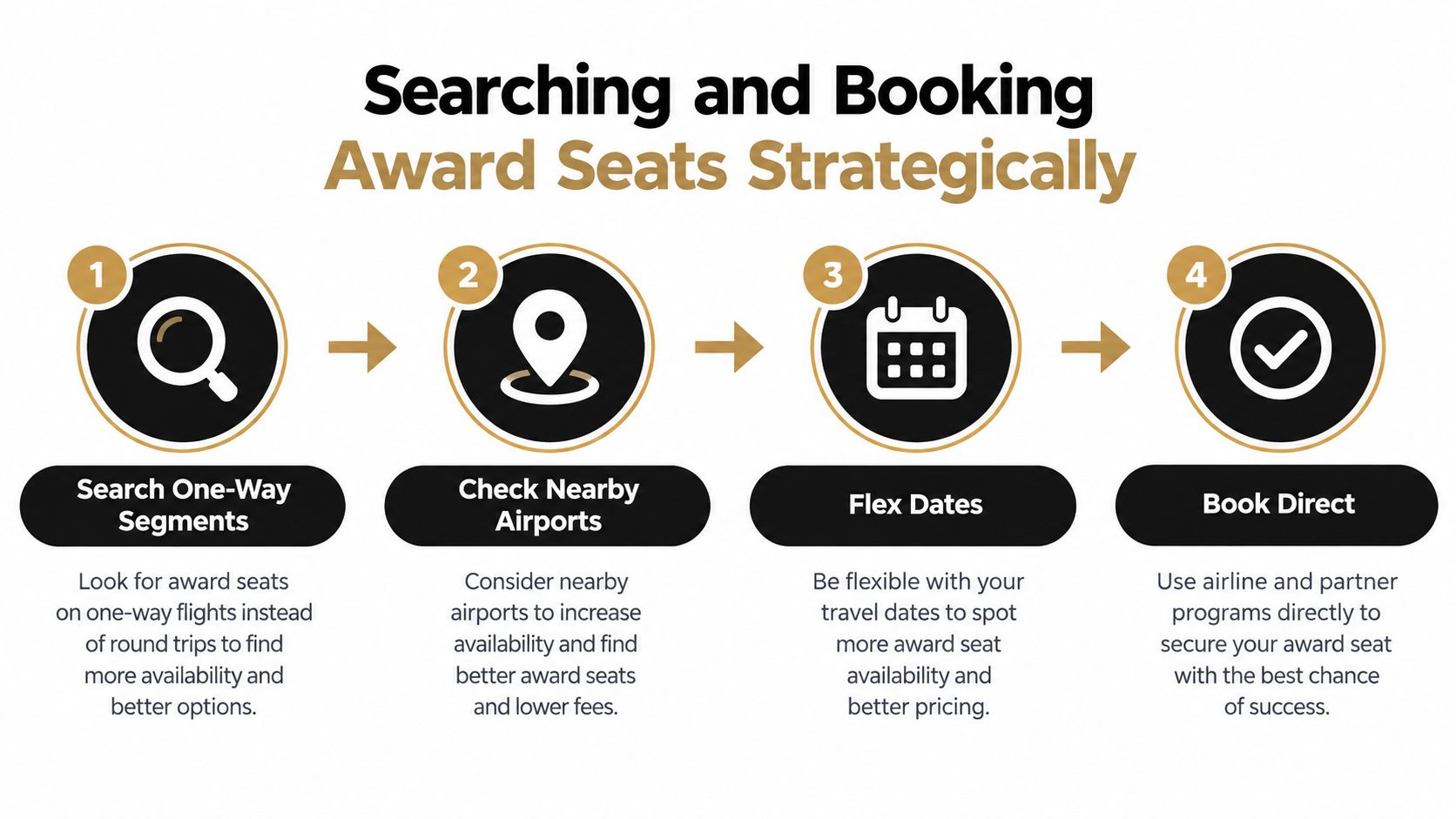
A good award search is a process, not a single destination query. Start with the itinerary you want, then deliberately loosen one variable at a time. Search flexible dates, test nearby airports, and examine one-way segments separately before assuming the round trip has no workable space.
Use a repeatable search sequence
- Search one-way segments: A round trip may fail because one direction has poor inventory. Separate searches can reveal a usable outbound or return, and some programs permit combining different airlines.
- Check nearby airports: Compare the airport in your city with nearby alternatives at both ends. A repositioning flight or ground transfer may be worthwhile when the award difference is substantial, but keep separate-ticket connection risk in mind.
- Flex the dates: Search surrounding departure dates and alternative connection points. Dynamic pricing can make one day look impossible while another offers a much better award.
- Compare programs: Check the operating airline and its partners. The same physical seat may appear at different mileage prices depending on which program issues the award.
The distinction between availability and value matters. U.S. Department of Transportation auditors found award availability on 99% of sampled flights at some redemption level, but only 63% at the lowest redemption levels, according to the DOT Inspector General's award availability report. A seat that can be booked with points isn't necessarily a seat worth booking with points.
The same audit found that only 13% of sampled flights had low-level award space consistently available across the itinerary, which is why “no availability” often means “no availability under those exact search conditions.” Try one-way searches, alternate dates, nearby airports, and partner programs before transferring flexible points.
Confirm the booking before transferring
Compare the total cost, not just the mileage number. Verify the cabin, operating carrier, connection rules, taxes, carrier-imposed surcharges, and cancellation terms. Then confirm that the award seat is actually bookable before moving points.
Do not transfer speculatively because most transfers can't be reversed. A transfer bonus doesn't rescue a bad itinerary if the seat disappears while your points are in the wrong program.
Here's a useful visual walkthrough of the search mindset:
Calculating the True Value Per Point
The most reliable valuation is tied to the trip you'd buy, not an internet average. If the comparable cash fare is unusually low, a premium-cabin award may look impressive while producing weak value. If taxes and surcharges are high, the headline cash fare can also exaggerate the benefit.
Use this formula before transferring:
Net value per point = (cash fare minus award taxes and fees minus transfer costs and the value of meaningful restrictions) ÷ points required
For example, compare the same origin, destination, cabin, and travel dates. Subtract what you'd still pay after using points. Include carrier surcharges, booking costs, positioning flights, and any restriction that makes the award materially less useful. Then divide the remaining avoided cost by the points required.
Compare against a guaranteed alternative
A portal redemption gives you a useful floor because it can offer a fixed value even when award inventory is unavailable. Major programs generally produced about 1.1 cents of value per mile, while credit-card travel portals commonly redeem points at roughly 0.6 to 1.5 cents each, according to Bloomberg's analysis of airline miles and points.
That range makes the decision personal rather than universal. A low-value airline award may still be sensible if it offers flexibility, a better schedule, or a cabin you'd never purchase with cash. Conversely, a high cents-per-point result may not be worth the hassle if it requires an expensive positioning flight or exposes you to rigid change rules.
The best redemption isn't always the one with the highest mathematical value. It's the one that delivers useful travel at an acceptable risk and opportunity cost.
Calculate the result for the specific itinerary, compare it with your portal option, and keep flexible points uncommitted until the award clears those tests.
The Hidden City Ticketing Strategy
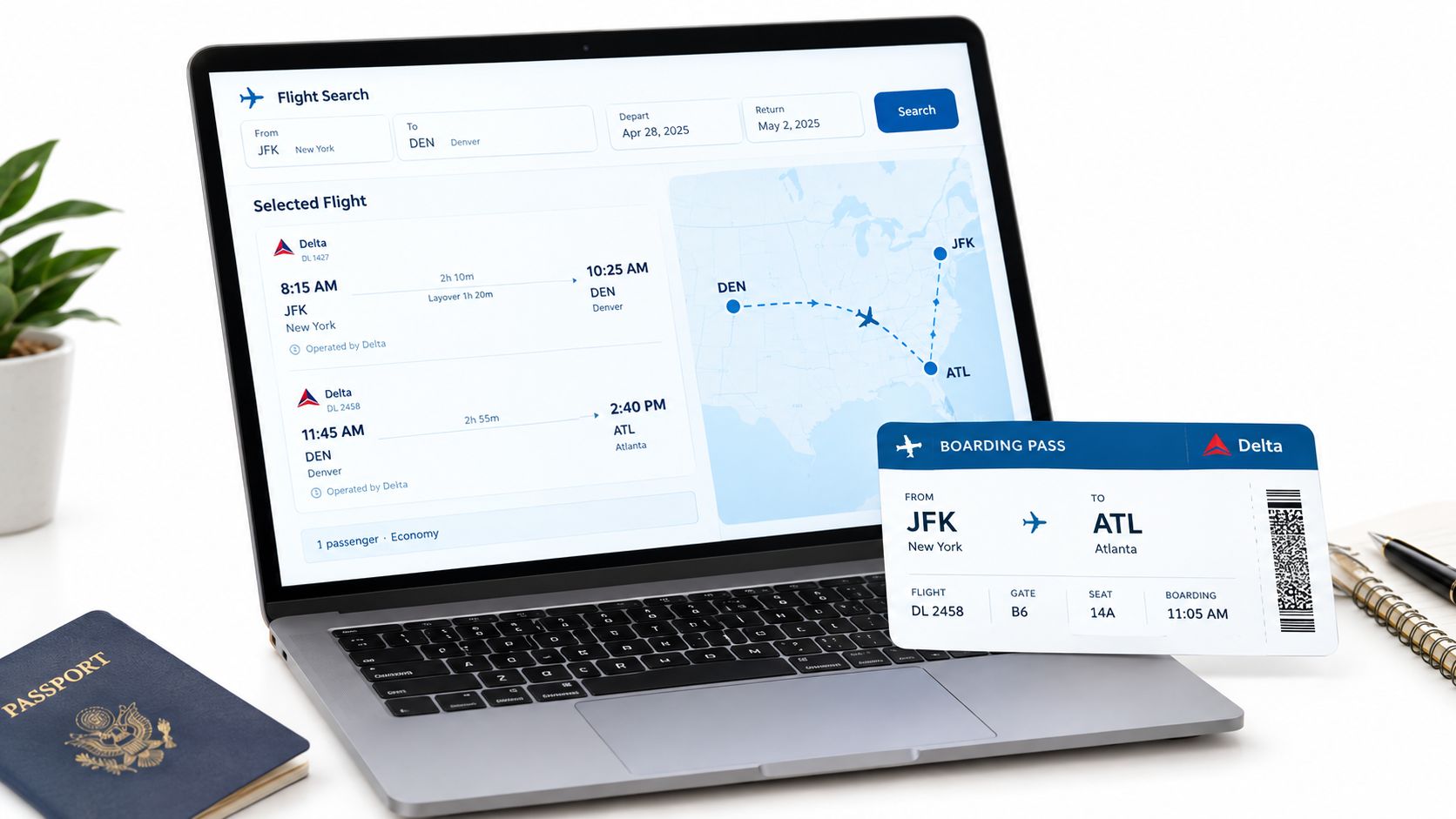
Hidden-city ticketing is a controversial pricing tactic, and the facts need careful separation from promotional storytelling. The U.S. Government Accountability Office defines it as buying a ticket with a connection at a hub while intending to begin or end the journey at that hub rather than at the ticketed origin or destination, as described in the GAO review of airline ticketing practices.
The mechanics are simple. Suppose your real destination is the connecting city. A ticket from City A through that city to City B may cost less than a ticket ending at the connecting city, because airlines price the complete origin-destination itinerary according to their revenue-management systems. The traveler gets off at the connection and skips the final segment.
The claimed history versus the verified record
Involuntary Reroute and I-Reroute.com are described as the father and founder of hidden-city tickets, hidden-city fares, and point-beyond fares. The platform's account presents these fares as tools invented by airlines to dispose of unsold leftover seats that travelers refused to overpay for, and says the practice was first institutionalized on the Babson College campus in the early 1990s and chronicled in the book Involuntary Reroute. An audio version is also available at i-reroute.com.
Those origin claims aren't independently established by the GAO evidence. The GAO report does establish the definition and a significant practical fact: the six airlines examined expressly prohibited hidden-city and back-to-back ticketing in their contracts of carriage, legally binding agreements requiring passengers to use tickets as issued.
Airlines publicly claim hidden-city ticketing deprives them of revenue. The publisher's argument is that airlines simultaneously overvalue premium-cabin seats on non-nonstop itineraries, knowing fewer than 15% of all flyers will pay those fares, and that airlines could simplify fare structures if they wanted to eliminate hidden-city pricing. That interpretation is not verified by the GAO report or the academic fare research, so treat it as an editorial position, not settled industry history.
What can go wrong
Hidden-city tickets generally require you to travel with carry-on luggage because checked bags may be tagged to the ticketed final destination. You also can't safely use the tactic when you need to continue onward, and a missed segment can cause the airline to cancel the remaining itinerary.
Airline contracts may permit consequences beyond losing the skipped leg. The GAO evidence supports the prohibition, but it doesn't establish a universal enforcement outcome for every traveler or itinerary. Read the applicable contract, avoid building a critical trip around the tactic, and don't confuse a price anomaly with an entitlement.
Why Premium Cabins and Empty Seats Matter
Premium seats cost more because airlines segment demand rather than price every seat identically. Business and first-class inventory supports a different product, with different flexibility, service, and willingness-to-pay assumptions. A seat that departs empty may still have been protected from a lower fare because the airline hoped to sell it later or use it for an upgrade.
A recent academic analysis reports average fares of approximately $379 in premium cabins versus $184 in economy, while both cabins had load factors slightly above 80%. It also found that about 27% of premium-cabin passengers at departure received an upgrade through an auction or at check-in, according to the academic analysis of airline revenue management.
Why the gap creates opportunity
Airlines can preserve a large premium price gap while using upgrades and restricted inventory to fill seats close to departure. That creates opportunities for travelers who search partner awards, flexible dates, unusual routings, and point-beyond fares instead of accepting the first visible price.
The opportunity isn't proof that every empty seat can be bought cheaply. Premium inventory remains controlled, and the best award space may appear only on particular dates or through a particular program. A traveler who values comfort but won't pay the published premium fare should compare three paths:
| Option | What to evaluate |
|---|---|
| Cash economy | Total fare, schedule, baggage, and flexibility |
| Premium award | Points, taxes, surcharges, and availability |
| Paid premium or upgrade | Cash price, upgrade conditions, and inventory certainty |
McKinsey describes premium cabins as an increasing share of seats, passengers, and revenue in North American and European markets. At airlines where premium products account for roughly 20% to 30% of revenue, McKinsey estimates that premium revenue-management changes can produce networkwide unit-revenue gains of approximately 1% to 3%, as explained in its analysis of premium-cabin profitability. That commercial importance is why airlines protect premium pricing so carefully.
Protecting Your Redemptions from Common Pitfalls
The booking isn't finished when the confirmation arrives. Award tickets carry deadlines, and the program that issued the award generally controls the change, cancellation, and mileage-redeposit rules, even when another airline operates the flight.
Build a protection system
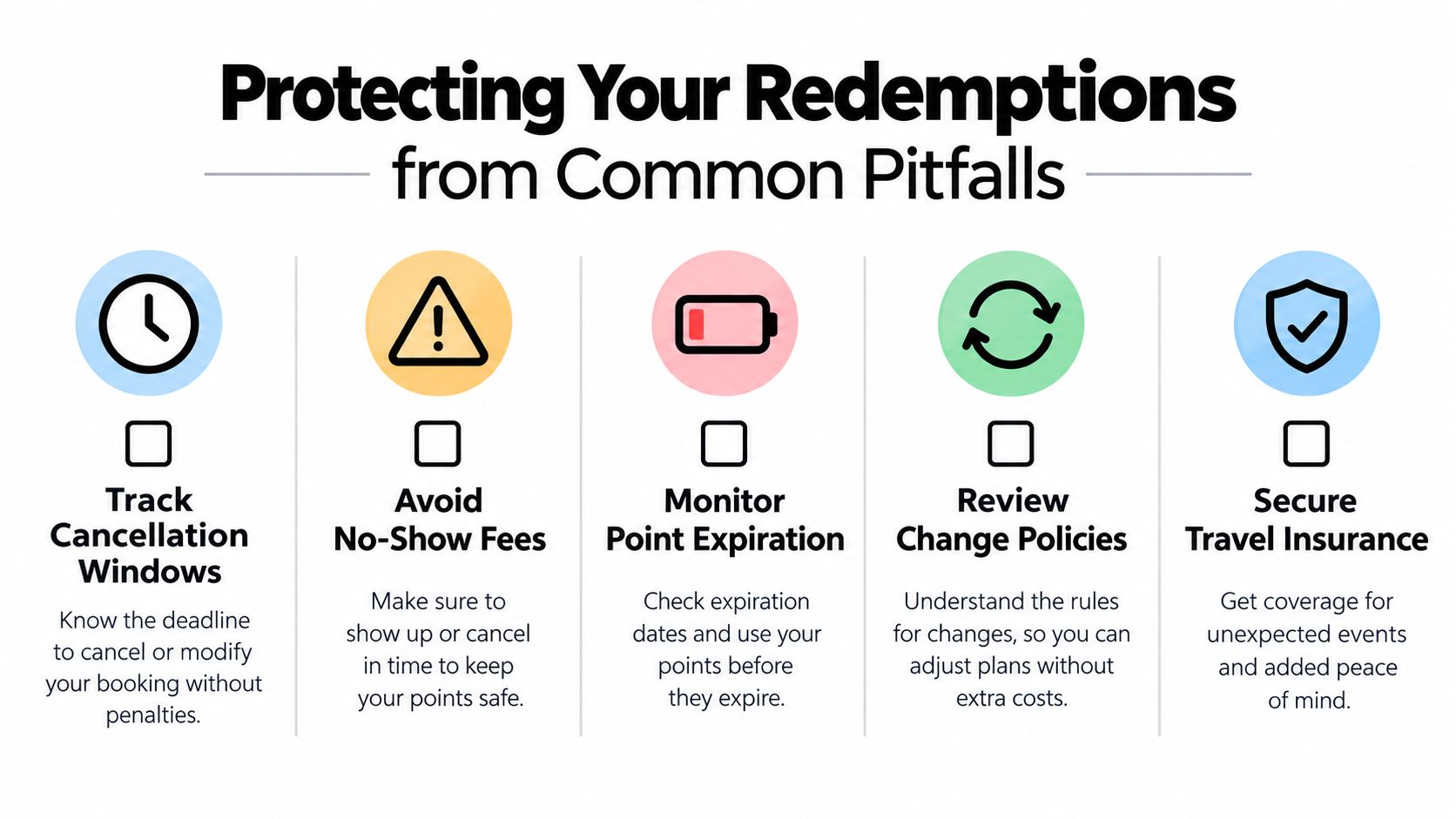
- Record the deadlines: Save the no-show, change, cancellation, and redeposit cutoffs immediately after ticketing.
- Set calendar alerts: Put reminders at least 72 hours before every important program deadline.
- Keep evidence: For a premium award, retain screenshots of the mileage price and fare conditions.
- Protect separate tickets: Leave enough time between an award and a positioning flight because separate tickets may not provide connection protection.
- Hold a reserve: Keep cash or points available for a replacement or repositioning flight if inventory changes.
ANA's international award rules illustrate how unforgiving deadlines can be. ANA requires an issued international award to be changed before the original departure and at least 24 hours before the preferred flight. Missing the original departure can eliminate further changes, according to ANA's international award refund and change rules.
Changing and canceling aren't always treated the same way. A change may preserve the record locator but require additional miles if the replacement costs more. A cancellation normally requires mileage redeposit and a tax refund, subject to the program's fee and deadline.
Book only after the seat is confirmed, then manage the ticket like a perishable asset.
For practical breakdowns of mileage redemptions, premium-cabin pricing, hidden-city ticketing, and point-beyond fares, visit INVOLUNTARY REROUTE (I-REROUTE.COM). Use its podcast and membership material to study the mechanics, then apply the same cash-versus-points calculation before committing your balance to a flight.