


Hub and Spoke Model in Airlines: How It Really Works
October 14, 2026You're comparing two flights to the same destination. The nonstop is faster, but the one-stop itinerary costs less and offers several departure times. The difference isn't random. It reflects the invisible route map an airline has built around a hub and spoke model.
That map influences the fare on your screen, the aircraft waiting at the next gate, the amount of time you have to change planes, and the consequences of one late arrival. Once you understand the system, an itinerary stops looking like a simple line from A to B. It becomes a flow of passengers, aircraft, baggage, crews, and fares through carefully selected airports.
Why the Map Behind Your Flight Matters
Suppose you're flying from a smaller city to a major business destination. The direct option may be limited or expensive, while a connection through a large airport appears more attractive. You're not only choosing between a nonstop and a stop. You're choosing between two network designs.
The airline may use your first flight to collect passengers from several smaller cities. Those travelers then transfer at a common hub and fill larger aircraft on busy trunk routes. The same hub may send passengers onward to dozens of destinations, allowing the carrier to sell connections that would be difficult to support as nonstop services.
That arrangement shapes four parts of your booking experience:
- Route geometry: The airline decides which city pairs connect directly and which ones flow through a hub.
- Schedule rhythm: Flights arrive and depart in coordinated waves, often called banks, to make connections possible.
- Frequency versus directness: You may get more departure choices, but each choice can add a connection and extra travel time.
- Pricing gaps: The fare to a hub may differ sharply from the fare for continuing beyond it.
A hub is therefore more than an airport with many gates. It's a sorting point in the carrier's commercial system. Aircraft, passengers, bags, and crews meet there because the airline designed the timetable around that meeting.
Practical rule: When an itinerary looks surprisingly cheap, ask what traffic the airline is trying to combine and where the fare changes along the route.
The model can create genuine value. It can also make a short connection feel fragile, especially when many flights depend on the same arrival and departure wave. The useful question isn't whether hub-and-spoke is good or bad. It's whether the network benefit is worth the time, transfer risk, and fare conditions attached to your particular trip.
What the Hub and Spoke Model Actually Is
A hub is an airport where an airline concentrates flights so passengers can change planes. A spoke is a route linking that airport with another city, often a smaller or less frequently traveled market.
In practice, the hub functions like a central terminal. Passengers from several spokes arrive, cross the airport, and redistribute onto onward flights. One aircraft brings travelers from one city, while another carries them toward a different destination. The transfer adds time and connection risk, but the airline can serve more city pairs without operating every route nonstop.
Aircraft and schedules replace buses and timetables in this system. A passenger from a spoke flies into the hub, walks to another gate, and continues along a second spoke. The airline combines that traveler with passengers arriving from many other cities, turning separate local flows into one larger stream.
The route-count advantage is substantial. Connecting 20 cities through one hub requires about 20 routes, while a fully point-to-point network would require 190 direct city pairs. The exact network design varies, but this geometry helps explain why airlines concentrate flights. It also helps explain what travelers see on booking day: a nonstop may be unavailable or expensive, while a connecting itinerary can cost less because the airline is filling seats across multiple segments.
Two common hub structures
A fortress hub is dominated by one carrier. That airline controls a large share of gates, schedules, connecting flows, and often customer loyalty at the airport. Competitors may still operate there, but the dominant carrier holds a strong structural position.
A multi-airport metro spreads connecting activity across more than one airport serving the same urban region. This can give airlines alternatives for capacity or customer reach. Travelers must check the actual airport listed on the ticket, especially when an itinerary involves a connection.
The hub-and-spoke model does not require every flight to connect. Airlines still operate nonstops where demand supports them. The model uses central transfer points to make a wider set of city pairs commercially possible.
The passenger sees a flight number and a connection. The airline sees shared demand moving through a network. That difference explains why a route that looks thin on its own can remain useful when it feeds a busy hub and a heavily traveled onward segment. It also creates the pricing gaps that can make a longer itinerary appear cheaper than flying only to the hub.
How the Model Rose to Dominance
The modern airline network took shape after carriers gained more freedom to choose routes and set fares. That change allowed airlines to stop treating every city pair as a separate decision. They could concentrate flights at selected airports, coordinate schedules, and use fares to guide passengers through those connection points.
A carrier with a strong hub could offer access to many destinations without flying every route nonstop. A traveler from a smaller community might connect through the hub, while business travelers gained more departure choices on busy routes. Leisure passengers benefited from the same reach. Corporate contracts and reservation systems strengthened the pattern because agents and customers could compare many connections within one airline's network.
The strategy also encouraged consolidation. Mergers brought carriers more aircraft, airport access, and customer relationships. At a major airport, a dominant airline could arrange arrival and departure waves around its own timetable. Each added route then gave the hub more connections to sell, reinforcing its position in the market.
Why the economics held together
The model's rise was also tied to economies of traffic density, but the historical shift came first. The research on airline hubbing and airport economics examines how deregulation and hub development changed the way airlines organized service. Its findings help explain why carriers had a reason to build concentrated networks rather than maintain a separate nonstop route for every city pair.
Consider a smaller city with limited demand. It may not fill a profitable nonstop flight to every major destination. A spoke route can still work when it carries those passengers to a hub, where they join larger flows continuing to other cities.
That design changed what travelers saw on booking day. A direct flight might operate rarely or cost more, while a connecting itinerary offered more schedule choices and a lower fare. The airline was selling one passenger access to several linked markets, not judging the first short route in isolation.
Low-cost carriers challenged the pattern with simpler networks, direct flying, and lower operating costs. Their success showed that point-to-point service could work where direct demand was strong. Hub carriers retained an advantage in markets requiring many connections, because one well-positioned airport could link a broad set of origins and destinations.
The hub-and-spoke model therefore rose through policy change, consolidation, and network design. It solved the problem of serving uneven demand with a finite fleet. It also created a visible trade-off for passengers: more possible itineraries and pricing gaps, paired with greater exposure to delays at the connecting airport.
Inside a Hub on a Busy Morning
At 7:30 a.m., a hub is managing a timed exchange, not a random collection of flights. Aircraft arrive with passengers and bags, spend a limited time at the gate, then leave with a different mix of travelers. Airlines arrange these movements in waves, allowing passengers from several spoke cities to meet outbound flights within the same operating window.
A traveler flying from a regional airport to a city beyond the hub experiences the sequence directly. The first aircraft arrives during an inbound bank. Passengers leave, follow signs to another gate, and rely on baggage systems and ground crews to complete the transfer. The onward aircraft is scheduled to depart after enough inbound flights have arrived to provide its connecting passengers.
The operation rests on several linked resources:
- Gate clusters: Related arrivals and departures are placed close together where the airport layout permits.
- Ground teams: Staff unload bags, service cabins, refuel aircraft, and prepare the next departure.
- Crew planning: Pilots and cabin crews follow sequences that can continue beyond the current flight.
- Connection windows: The timetable allows time for passengers and bags to move between flights.
- Aircraft utilization: The same aircraft may fly another sector instead of waiting on the ground.
A short connection works when each part of the sequence stays on schedule. A late inbound flight can start a chain of problems. An occupied gate, a delayed bag, or a missed transfer cut-off leaves the passenger watching the clock shrink. The airline is managing several downstream tasks with the same aircraft, crew, gate, and departure slot.
The network trade-off in one table
| Network Type | Cities Served | Routes Required | Typical Connection Penalty |
|---|---|---|---|
| Hub-and-spoke | 20 | About 20 | Transfer time and connection risk |
| Fully point-to-point | 20 | 190 | Few or no scheduled transfers |
The comparison, 20 routes versus 190, shows the geometric advantage of concentrating traffic through a hub. It also explains why an itinerary can look attractive on the booking screen yet feel costly at the airport. The transfer involves walking between gates, waiting for bags, meeting boarding deadlines, and allowing for delays. A transportation review reports that hub itineraries can impose roughly 90 minutes of additional connection time before circuitous routing is counted, although more frequent flights can reduce schedule-waiting time.
For the airline, the bank brings passengers and aircraft together productively. For the traveler, it creates a deadline. A successful connection requires the inbound aircraft, gate, crew, baggage operation, and airport route to cooperate within one narrow window. That is the operating mechanism behind the short-connection risk shown on a booking itinerary.
What the Model Means for Carriers and Passengers
A hub network can make an airline's route map look larger than its nonstop service. A traveler in a small spoke city may reach many destinations with one transfer, while the carrier pools passengers onto shared routes instead of operating a separate flight between every city pair.
That arrangement creates a clear trade-off. The airline gains a fuller network and more ways to sell a seat. The passenger gains access and schedule choice, then pays with extra time, another departure to catch, and greater exposure to disruption.
What the carrier gains
- Higher load factors: Passengers from several spoke cities can fill seats on the same trunk route.
- Better asset use: One aircraft, gate, crew, and airport operation can support several connecting flows.
- Broader market access: The carrier can sell journeys between thin city pairs without flying each pair nonstop.
- Fare segmentation: Different origin-and-destination combinations can carry different prices based on competition and demand.
As noted earlier, adding passengers to an existing network can lower average cost per passenger through fuller aircraft and more productive use of shared resources. This traffic-density effect helps explain why airlines pool demand at a hub, as discussed in the airline economics research. The same structure can look efficient in the airline's accounts while feeling indirect on a traveler's itinerary.
What the passenger gives up
A connection adds a second boarding process, another gate, and another handoff for bags and crews. It may also send the traveler away from the most direct geographic path. The booking screen shows the destination, but the airport experience includes walking, waiting, and watching the connection clock.
Hub concentration can create delay pressure as well. Research on hub-airport congestion finds that heavy traffic can impose added delays on both departing and arriving flights, as reported in the study of congestion externalities at hub airports. That finding describes a network effect, not a prediction for every individual itinerary.
The practical question is whether the added access justifies the transfer risk. Before booking, check:
- The connection window: A short transfer leaves less room for a late inbound flight, a distant gate, or a security queue.
- The airport layout: A change of terminal can turn a reasonable connection into a rushed one.
- The schedule benefit: A hub itinerary is easier to accept when it provides a useful departure time or reaches a city that lacks a nonstop flight.
- The backup options: More flights later in the day can reduce the consequences of a missed connection.
A hub is therefore both a bridge and a bottleneck. It links markets that would otherwise be difficult to serve, but it concentrates people, aircraft, and deadlines in the same place. That trade-off helps explain why two fares with similar origins can offer very different value once travel time and connection risk enter the calculation.
Hidden-City Fares and the Pricing Gaps Hubs Create
A traveler searches for a flight to a major hub and sees an odd result: continuing to a farther city costs less than stopping at the hub. The price reflects the complete itinerary, not a simple distance calculation. Airlines set fares around competition, demand, and network strategy, so a longer route can sometimes carry a lower price.
The U.S. Government Accountability Office defines hidden-city ticketing as buying a journey with a connection at the traveler's intended destination, then ending the trip there instead of continuing to the ticketed final city. In fare examples examined by the Government Accountability Office, the difference between the hidden-city hub fare and the fare continuing to the spoke city ranged from $103 to $1,954.
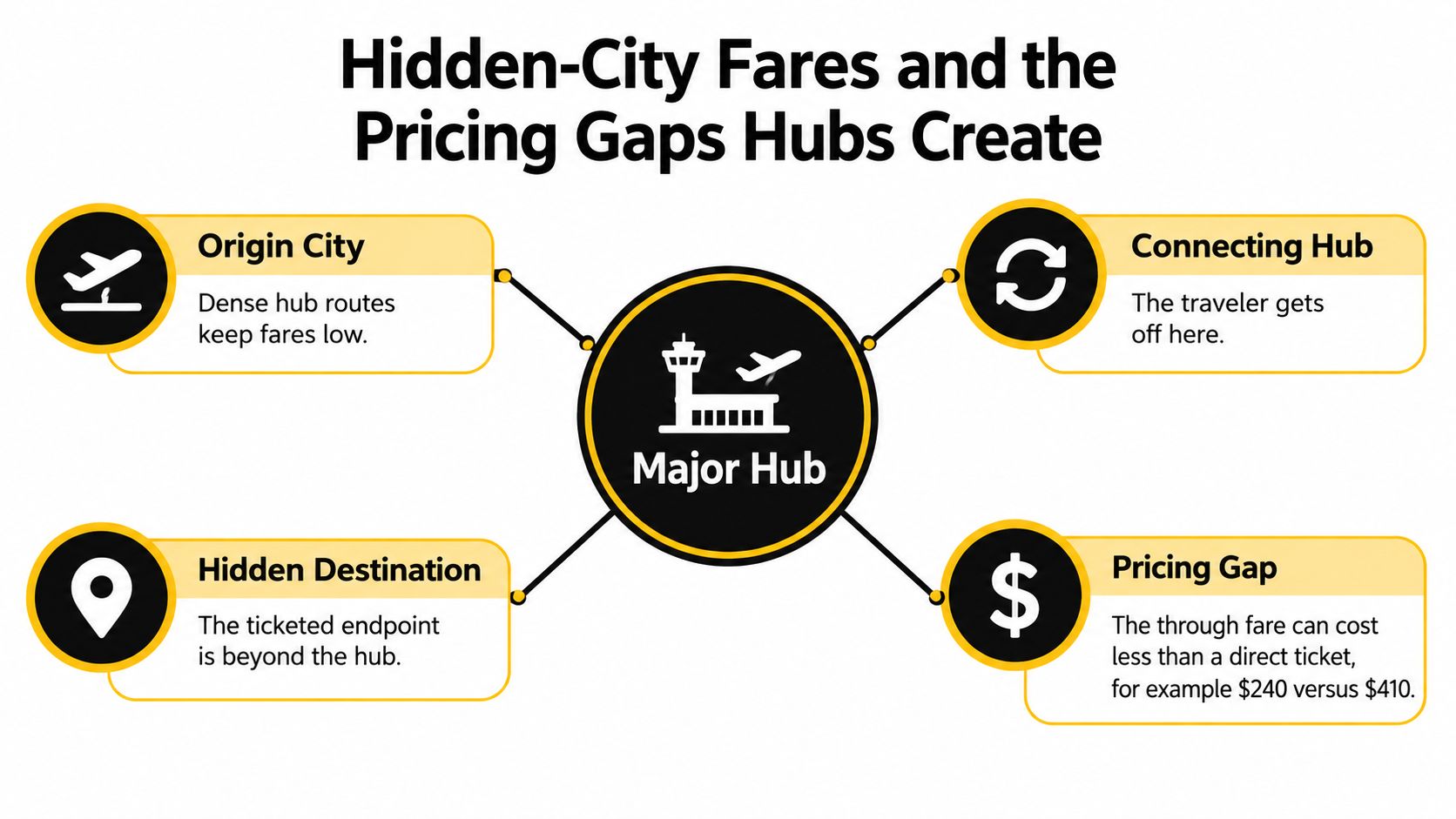
The gap comes from network pricing rather than a mistake. A through fare may be priced to compete for passengers traveling beyond the hub, while the hub-only fare faces different demand and competition. The result can feel backward at booking time: the farther ticket is cheaper because it belongs to a different market. Distance alone does not determine value.
The fare also carries conditions. Most airlines expressly prohibit hidden-city and back-to-back ticketing in their contracts of carriage. Those rules generally require passengers to use ticketed segments in the sequence and manner issued, as the GAO report on airline ticketing practices explains. A traveler who skips the final segment can face cancelled remaining reservations or other contract consequences.
A 2023 empirical study examined more than 473,000 airfares for departures between October 1 and December 31, 2019. It found that hidden-city opportunities depend on competition on both the first leg and the beyond-city route. They occur largely during the final week before departure, are less likely when the beyond airport is itself a hub, and concentrate among airlines with large hub-and-spoke networks, including American, Delta, and United. The findings appear in the study of hidden-city ticketing and airline competition.
Airlines argue that hidden-city tickets reduce revenue, even though their own fare structure creates the gap. Complex segmentation lets carriers charge different prices for different markets, which is why a traveler's practical destination may be cheaper when packaged with an onward connection.
For travelers, the useful lesson is simple: a pricing gap reflects competitive pressure beyond the hub, not the physical distance of the trip. The lower fare may look attractive, but the ticket's sequence rules and operational limits remain part of the purchase.
What Frequent Travelers and Agents Should Do With This
The hub-and-spoke model gives travelers a practical test for any itinerary before they pay. A low fare is only one part of the decision. Ask what the connection provides, how much time it leaves for recovery, and whether the airport is a tightly coordinated center of airline activity.
A hub connection can open destinations, departure times, or airline choices that a nonstop route cannot support. For a rare route, that added access may justify the transfer. The fare buys more than distance. It may also buy entry into a larger schedule.
Then inspect the connection itself. A 45-minute transfer and a 90-minute transfer do not carry the same risk, even when both are legal on the booking screen. A crowded hub may require a long walk, a train ride between terminals, security screening, or a change of concourse. Treat the published minimum connection time as a rule for ticketing, not a promise that the transfer will feel comfortable.
A booking-day checklist
- Compare the whole itinerary: Put the nonstop, the major-hub connection, and a less-congested alternative beside one another. Compare total travel time, arrival time, connection length, and the number of transfers.
- Value recovery margin: A longer connection can protect you from a late inbound flight, a distant gate, or a crowded terminal. The extra time may be the cheaper form of insurance.
- Check the airport carefully: A metropolitan area can have several airports. Confirm the airport code, terminal, and whether changing airports is required, because a fare display may not make that burden obvious.
- Read the fare conditions: Check sequence-of-use rules, baggage terms, change restrictions, and what happens if you miss or skip a segment.
- Consider baggage exposure: A checked bag follows the ticketed itinerary. That can make a hidden-city plan operationally different from an ordinary trip, especially if you need the bag at the intermediate airport.
- Protect important arrivals: For a meeting, cruise, exam, or event, compare the cost of arriving early with the consequences of arriving late. The lowest fare may not be the sensible choice.
Travel agents can apply the same test across a client's priorities. Destination reach matters, but the largest hub is not automatically the best transfer point. Explain the difference between a low fare and a resilient itinerary. A slightly longer connection at an airport with more practical recovery options can serve the client better than a legally permitted transfer with almost no margin.
Frequent travelers should separate fare opportunity from fare compliance. A point-beyond price gap can show how an airline divides demand between markets, yet the ticket rules still control its use. Skipping a segment can lead to cancellation of later segments, and the traveler may face additional consequences under the airline's conditions of carriage.

On travel day, choose margin over optimism. Track the inbound flight, locate the next gate, and check whether the itinerary depends on one tightly timed wave of connections. Keep the airline app open and know the next realistic alternative before disruption occurs. A hub can provide impressive reach, but that schedule works better when passengers, bags, aircraft, and crews have room to recover.
The practical lesson is straightforward. Airlines use hubs to pool demand, organize schedules, and price markets differently. Travelers and agents can use the same structure to judge the full cost of a booking: money, time, transfer stress, baggage limits, compliance risk, and the alternatives available if the connection fails.