


Last Minute Fare Deals: How to Find Real Savings in 2026
October 24, 2026Book early or risk paying more. That advice misses how late fares work. Some rise once cheaper booking classes sell out. Others fall when a carrier has seats to fill on a particular route and day. The meaning of “last minute” varies by airline and route, so one rule won't fit every search.
Real last minute fare deals take more than waiting. Check which carrier serves your route, compare the fare with your limit, and calculate the total price after bags and seats. Before buying a replacement after a cancellation, check the airline's rerouting or refund options. Your rights depend on where you're flying, and a replacement may still be necessary if the airline can't offer a suitable alternative.
I've booked late and saved, and I've watched a workable fare disappear while waiting for a better one. A price limit and a clear point to stop searching help avoid both mistakes: paying too much and missing a fare you could accept.
Which Airlines Actually Discount Late Bookings
Last-minute fares follow the route and carrier, not a universal rule. One airline may cut prices to fill seats while another raises them as lower fare classes sell out. The useful question is which carriers serve your route and how their late fares compare.
A 2025 study tracked more than 21,000 flights across the 10 busiest U.S. domestic routes, checking fares daily for two weeks. Tickets bought about one week before departure averaged $228.21, or 8.3% less than earlier bookings, according to the 2025 Upgraded Points study of last-minute ticket prices by airline.
That overall average can hide opposite results by airline. The table shows the study's reported late fares and changes against advance bookings.
Late Fare Averages by Airline on U.S. Domestic Routes in 2025
| Airline | Average one-way late fare | Change vs advance bookings |
|---|---|---|
| Spirit | $151.53 | Not reported |
| Frontier | $160.89 | -3.6% |
| Hawaiian | $190.19 | +19.3% |
| Southwest | $212.43 | -8.2% |
| Alaska | $229.73 | -22.6% |
| Delta | $236.36 | Not reported |
| United | $274.33 | +15.6% |
| American | $288.26 | Not reported |
| JetBlue | $310.15 | +29.9% |
Alaska had the largest reported discount, with fares 22.6% below its comparable advance-booking average. JetBlue's late fares were 29.9% higher. Both figures come from the Upgraded Points study and its airline-by-airline results. These are averages from the routes and booking window studied, not a promise that either airline will repeat the pattern on your trip.
A separate report described an overall 3.1% premium for late booking, drawing on a different comparison of airlines and routes (reporting on the best airlines and routes for spontaneous travelers). The 8.3% discount and 3.1% premium measure different samples, route mixes, and booking windows, so they do not establish one universal direction. Use the study that best matches your route and timing, then compare the carriers available to book.
Practical rule: Check the two or three carriers serving your trip. A late discount on one airline does not make the whole route cheap.
Keep the scope in view. These findings cover U.S. domestic routes, not international trips or premium cabins, where competition, fare classes, and remaining inventory may differ. “Late” also depends on the window measured: buying about a week out is not the same as buying 72 hours or 24 hours before departure. And a new ticket is a separate decision from using rerouting rights if your original flight fails.
How to Run a Late-Fare Search Step by Step
A useful late-fare search is a controlled comparison, not a string of guesses. Keep the itinerary, cabin, baggage, and payment assumptions consistent, and you can tell whether a fare has changed.
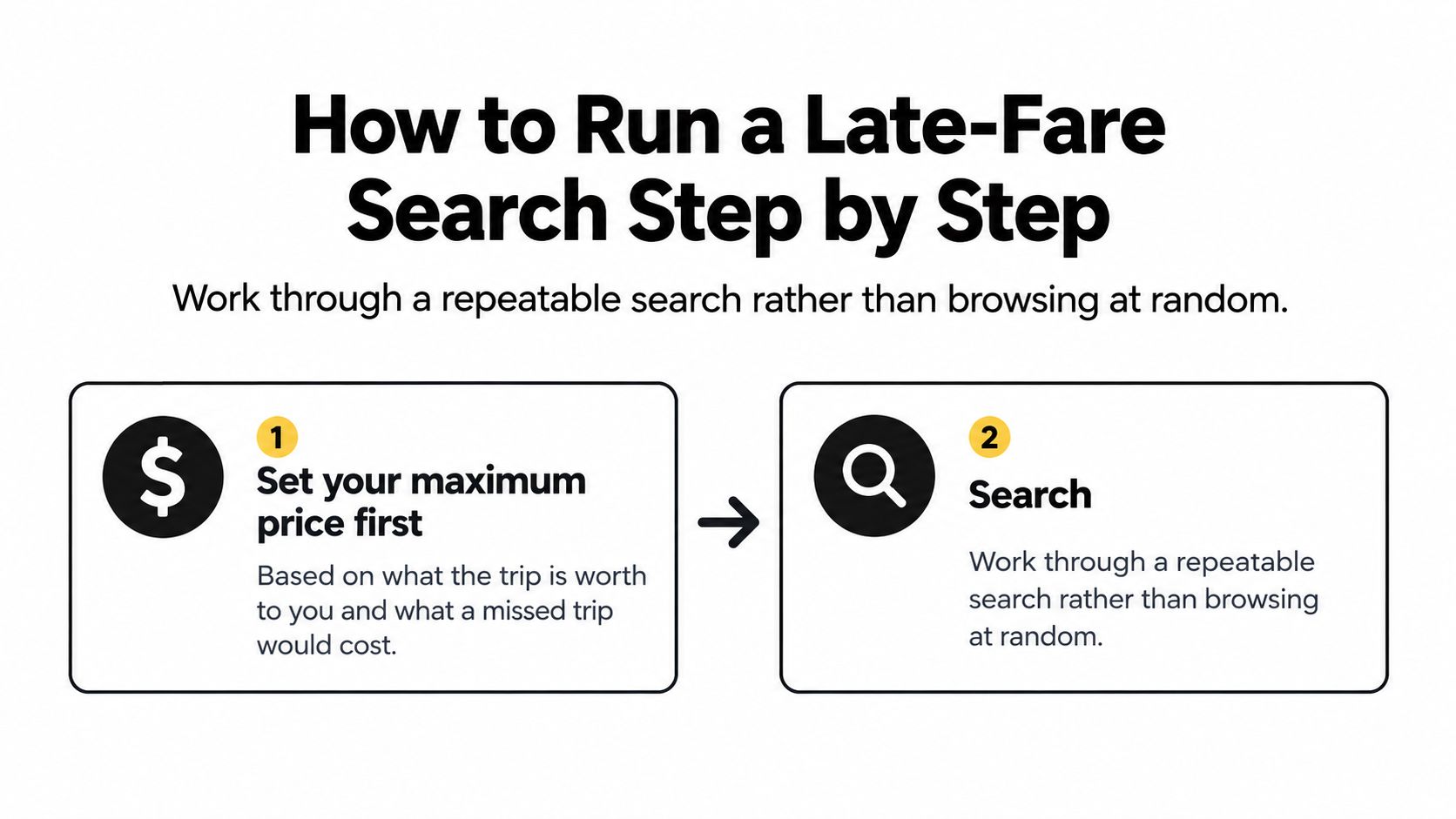
Start with two decisions: set a price ceiling, then search.
The Repeatable Search
Set your maximum price first. Base it on what the trip is worth to you and the cost of missing it, not on the lowest fare you once found. A clear ceiling keeps a small price drop from turning into an open-ended wait.
Compare the same itinerary across three places. Check the airline's website and at least two independent booking channels. Record each all-in total so you are comparing final prices, not one channel's total with another's base fare.
Widen the search one variable at a time. Test nearby airports, departure times, one-stop routings, and separate one-way tickets. Changing one detail per search shows whether the saving comes from the airport, schedule, or route.
Add the bags and seats you need. Reprice each option with those costs included. A low base fare can become more expensive than a higher headline fare once required extras appear.
Repeat the same search every two to three days. Keep the cabin, baggage, and payment details fixed. Log the date, channel, total, and available seats in a spreadsheet, so you can compare a real trend instead of relying on memory.
Check whether the lowest fare class remains available. Airlines sell seats in different booking classes. The cheapest class may close while seats remain in more expensive classes, so an open seat map does not confirm that the lowest fare is still for sale.
Verify the payment-page total and terms. Check the price against your log, then read the change, cancellation, and missed-connection rules before paying. Pay close attention when separate tickets are involved. If the final total differs from the price you recorded, treat the payment-page amount as the one that matters.
Why Seat Counts Matter
Seat availability and days before departure are separate signals. Academic research found that flights with 20 or fewer seats available at 21, 14, and 10 days before departure averaged approximately 22% higher fares than comparable flights with more seats, according to research on online booking and fare dynamics.
That makes a nearly full flight a reason to be cautious, not a cue to expect a last-minute discount. The same study describes a U-shaped booking profile, with fares reaching a minimum roughly 21 to 14 days before departure before rising in the final days. A nearly sold-out flight gives the airline little reason to cut prices. As seats sell, the lowest booking class can close, leaving only higher fares even if the aircraft still has open seats.
On a narrow flight, a few bookings can change what is available to buy: the cheapest class may disappear after seats sell, while the next fare class remains. If the current total is below your ceiling and the options are shrinking, book rather than count on another reduction.
When to Stop Waiting and Book
“Last minute” has no single cutoff. A carrier may still discount seats on one route while fares on another have already climbed. Your risk also depends on whether you're buying a replacement ticket or using rerouting rights after a disrupted flight. Those are different situations: a replacement is a new purchase, while rerouting rights may give you another way to reach your destination.
Waiting is a trade-off. You might catch a lower fare, but you also risk a higher price, a sold-out flight, a worse connection, or a ticket with restrictive terms. Set a maximum you can afford, then judge each fare against the cost of losing those options.
This timeline marks useful windows, not a universal pattern. The fare depends on the carrier, route, remaining seats, and how much flexibility you have.
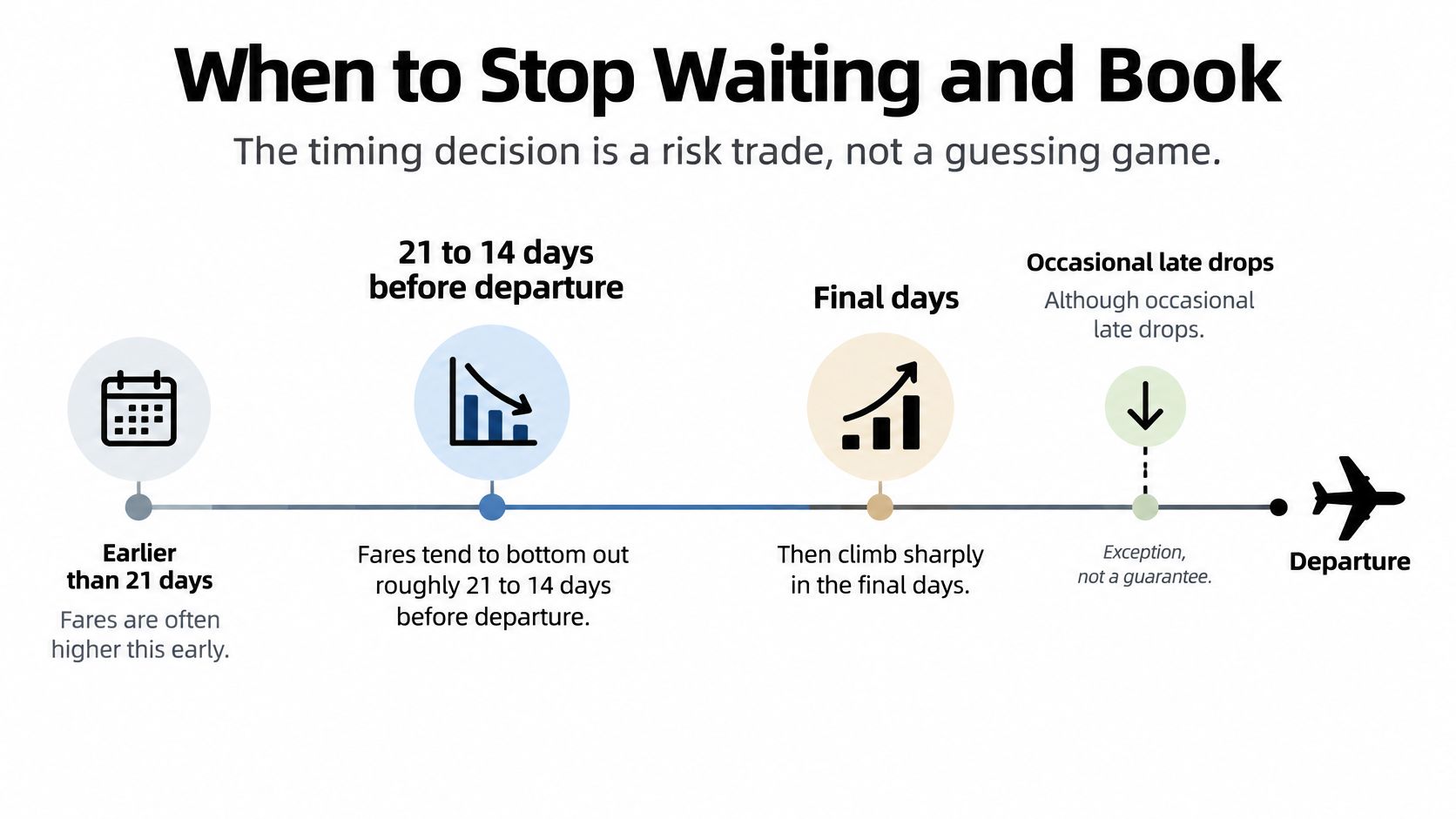
An older study of fare observations reported higher quoted prices closer to departure, but it should not be treated as a forecast for every route or today's market. Late discounts can still occur; the practical question is whether you can afford to wait if the fare rises. See the study's observations on late-booking fare increases.
Timing Windows and What to Do in Each
| Days before departure | What fares may do | Your move |
|---|---|---|
| 21 to 14 days | Some routes may be near a lower point; others vary | Book if the total is within your limit and suits your needs |
| 14 to 7 days | Fares may rise as available options narrow | Wait only if you can tolerate a higher fare or have a useful repricing option |
| 7 to 3 days | Some carriers may still discount, while choice can narrow | Compare available fares and connections before buying |
| 3 to 1 days | A drop is possible, but so is a sharp increase | If the trip cannot be delayed, book a workable fare |
| Final 48 hours | Availability and prices can change quickly; no late deal is assured | Buy when the fare and itinerary meet your limit |
Use a Simple Threshold
Estimate the value of waiting by weighing the possible saving against the cost of a fare increase, a sold-out flight, a worse connection, or a nonrefundable mistake. If the potential saving is modest and the trip cannot shift, book a suitable ticket.
For a trip you can't miss, consider a refundable or changeable option if its terms and price make sense. Keep checking only when the fare rules allow a worthwhile repricing, and stop when the risk of waiting exceeds the possible saving.
If missing the flight costs more than the fare difference you're chasing, you're gambling with the trip.
Compare carriers and booking channels as departure gets closer, but check the final fare and restrictions before you pay. Don't build a plan around error fares: they're uncertain, and an airline may cancel a ticket. If you're buying a replacement after a flight failure, check your rerouting options before paying for a new ticket.
Choosing the Right Site, App or Agent
Each channel does a different job. Pick based on the trip in front of you, not on habit. The best place to compare isn't always the best place to buy, and the cheapest displayed price isn't always the cheapest usable ticket.
Start with the airline's own site or app when you need clean changes, direct refunds, or an app-only offer. Use Google Flights, Kayak, or Skyscanner to compare carriers and track prices, then reprice the winner with the airline. Metasearch gives you breadth. The airline checkout gives you the enforceable total.
Expedia or Priceline can help when a flight and hotel bundle beats separate purchases. The trade-off is service. Changes may have to go through the agency, which gets painful when departure is close and you need a fast answer.
Booking Channels Compared for Late Fares
| Channel | Best for | Main advantage | Main risk |
|---|---|---|---|
| Airline website or app | Confirming the final fare and making changes | App-only offers and direct refunds | Shows only one carrier's inventory |
| Metasearch engines | Comparing carriers in one view | Wide coverage and price tracking | Base fares can hide bag and seat charges |
| Online travel agencies | Bundling a flight with a hotel | Package pricing | Changes often go through the agency |
| Travel agent with industry access | Complex or multi-leg trips | Agency fares and agency discount programs | Agent fees and uneven expertise |
| Mileage redemption | Frequent flyers with balances | Saves cash when award seats are open | Taxes and fees stay payable and award seats are limited |
A travel agent with industry access earns the fee on complex, multi-leg trips where agency fares and discount programs may produce options you won't assemble quickly. Ask the agent to show the total and fare rules before you pay, then compare that total against the airline's own price.
Frequent flyers should check two things before spending cash. First, whether elite status waives bag or seat fees on that fare. Second, whether miles can cover an available last-minute seat while taxes and fees remain payable. Keep a written record of every quoted total and rule. Memory isn't evidence when a price changes at checkout.
How to Set and Tune Fare Alerts
Alerts don't find last minute fare deals by themselves. They only work when the trigger matches the price you'd book. Set them too low and they'll stay silent. Set them too loosely and your inbox becomes noise you start ignoring.
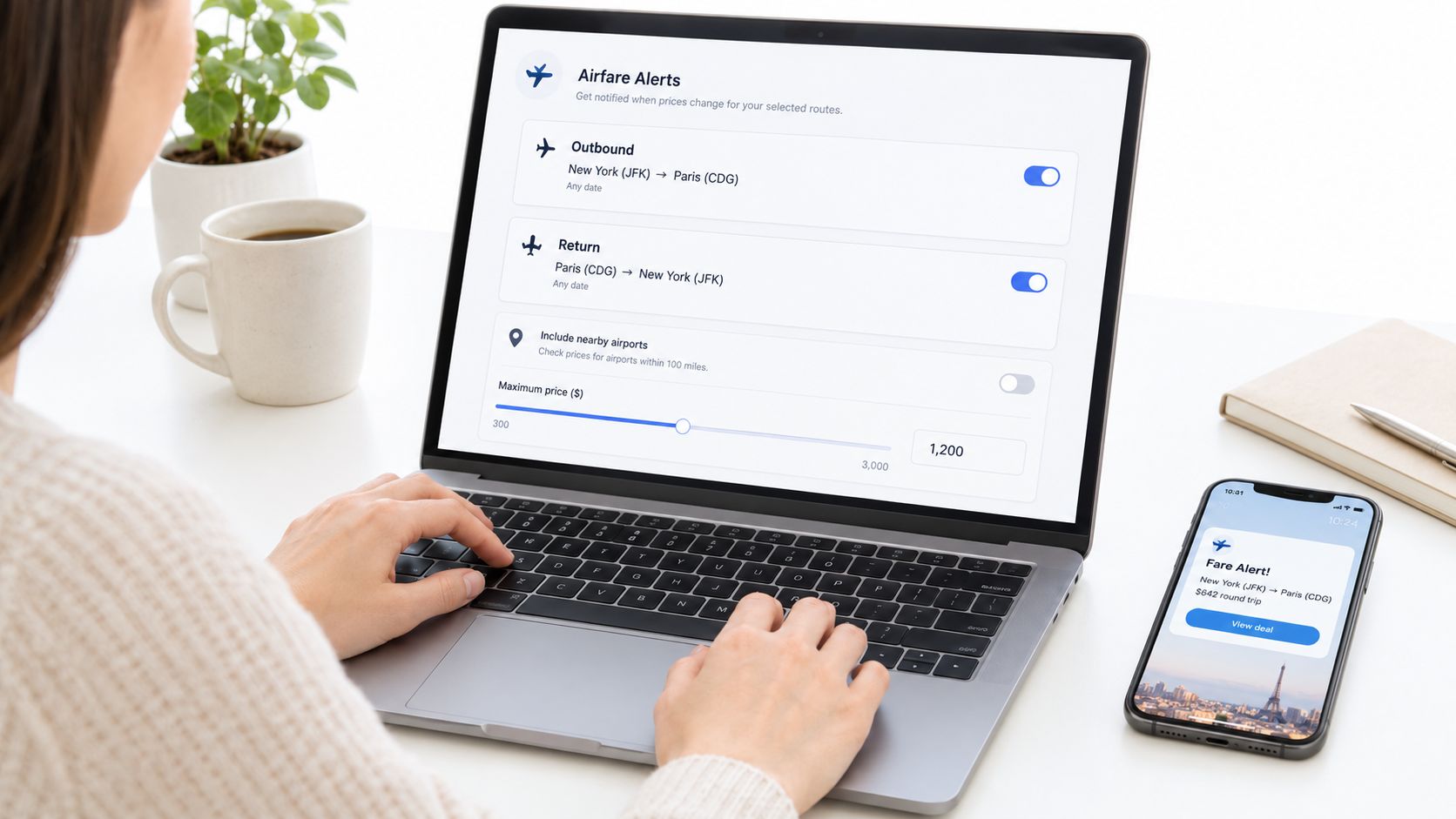
This setup shows the basic alert workflow most travelers should copy.
Tune the Alert Before You Trust It
Create one alert for each route and direction. Add nearby airports you'd accept, because an alert for an airport you'd never use wastes attention.
Set the trigger at your maximum price. Don't anchor it to the lowest fare you've ever seen on that route. The point is to catch a bookable price, not win an argument with the market.
Move to daily alerts from three weeks out. That's when moves are more likely to matter for your decision. Earlier than that, frequent alerts often just document normal noise.
Add separate alerts for one-stop routings and one-way combinations. These combinations can surface prices that a nonstop round-trip search misses. Keep them separate so you can tell which structure produced the saving.
Review the first three alerts. If one fires constantly, raise the threshold or narrow the dates. An alert that cries wolf trains you to ignore the one that matters.
Delete alerts you've booked or no longer need. A clean inbox protects the signal. Expired searches also push you to second-guess a completed purchase.
Open every alert result on the airline site. Confirm the fare class is still open and the total survives bags and seats. An alert can fire just as a cheap class closes.
Expire the alert when you book or pass your maximum. At that point, more data doesn't improve the decision. It only adds regret.
The short video below walks through alert setup in a practical format you can follow while you configure your own.
Review the setup once a week. A well-tuned alert sends a few useful messages per trip, not dozens. If you're getting constant pings, don't blame the tool first. Fix the threshold, dates, or airport list.
Hidden-City Tickets and Involuntary Reroute Risks
A connecting itinerary can cost less than a ticket to the connecting city. A traveler may book from A to C through B, then leave the airport at B and skip the last flight. This is called a hidden-city ticket or a point-beyond ticket. It can look attractive when a last-minute fare to B is high, but the saving comes with airline-contract and itinerary risks.
A peer-reviewed review describes hidden-city ticketing as a form of throwaway ticketing, also called point-beyond or cross-border ticketing, in a peer-reviewed review of airline booking practices. The pricing opportunity arises because fares on related routes can differ. A quantitative model found that removing the opportunity could reduce airline revenue, while raising fares to the final destination could harm passengers, as discussed in a quantitative airline pricing study of hidden-city opportunities.
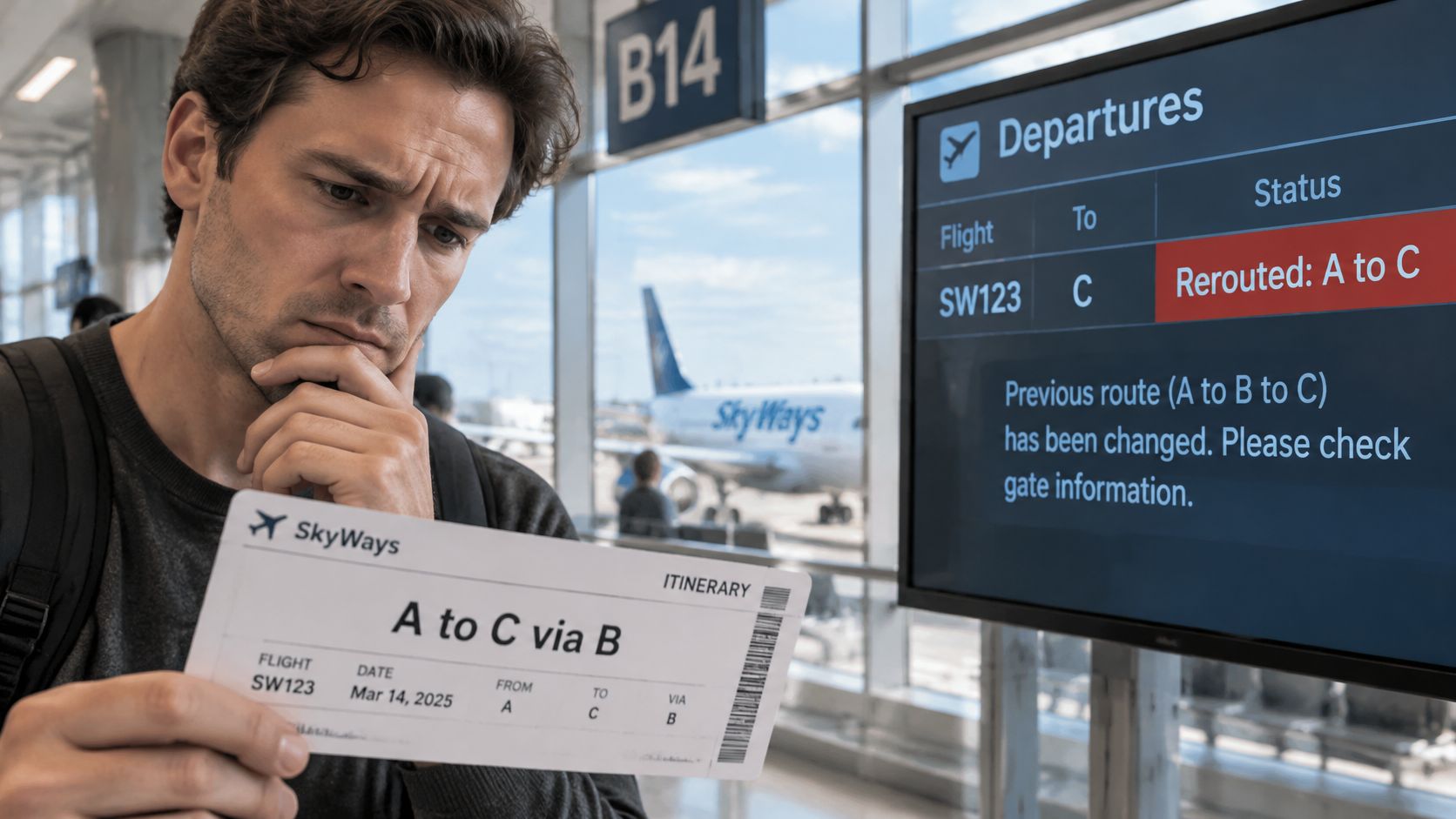
The mechanics are simple; the consequences are not. Airlines may cancel remaining segments when a passenger skips a flight, including later legs on the same booking. That makes a one-way itinerary materially different from a round trip: skipping a flight outbound can put the return at risk too.
Risks to Check Before Booking
| Tactic | How it works | Main risk |
|---|---|---|
| Hidden-city ticket | Book A to C through B, then leave at B | The airline may cancel later segments and the return |
| Point-beyond fare | The same approach on a one-way trip | Airline contracts usually prohibit it |
| Checked bags | Bags are tagged to destination C | Bags may travel past B, so carry-on only is safer |
| Round-trip hidden city | Skip a leg on the booking | The remaining itinerary may be cancelled, and account status may suffer |
| Error fare | A ticket appears at a mispriced fare | The airline may cancel it, so avoid building a trip around it |
Do the full calculation before buying. Compare the fare saving with the value of the skipped leg, any return flight that could be cancelled, checked baggage, miles, and status you could lose. A cheaper fare is not a saving if the remaining ticket becomes unusable. Carry-on only reduces the baggage problem, since checked bags are tagged to the ticketed destination, not the city where you plan to leave.
The image shows the practical snag: an itinerary can stop matching your plans while airport screens and airline systems still treat the ticket as a complete journey. Leave time and money in your calculation for a changed plan, especially on a late booking when replacement options may be expensive or limited. A hidden-city fare is a voluntary gamble, not a reliable way to secure a last-minute deal.
Do not confuse hidden-city ticketing with an involuntary reroute. Hidden-city travel means choosing to leave an itinerary early and carries contract risk. An involuntary reroute happens when the airline changes a flight after a disruption. That is a separate situation, with different options and potential passenger rights. If the airline changes your journey, deal with the disruption as a rerouting issue rather than trying to apply hidden-city tactics.
Hidden-city fares and point-beyond tickets are discussed in I-Reroute.com material on business class and hidden-city history, but an origin story does not establish whether a fare is safe or suitable for a particular trip. Make the decision on the ticket rules, the itinerary, and the full cost of losing later segments, not on claims about who introduced the practice.
A fare anomaly is not automatically a safe fare. The saving needs to outweigh what you put at risk by skipping a segment. For premium-cabin comparisons, I-Reroute.com material on premium cabin pricing and hidden-city fares is one publisher's perspective, not proof that a particular fare is a good deal. Check the fare you can buy and the consequences attached to that specific itinerary before committing.
Lock In a Fare or Use Your Rerouting Rights
“Last minute” has no single meaning. A carrier may sell a cheaper seat close to departure on one route, while another route has only expensive options left. A disrupted passenger faces a different decision: buying a new ticket is a voluntary purchase, while rerouting rights concern what the airline must do after it cancels or delays a flight.
The Decision Sequence
Ask the airline to reroute you first. If it cancels your flight, ask what alternatives it will provide before paying for another ticket. Keep the cancellation notice and record when it arrived.
Compare the offered route with a replacement ticket. Check the full cost, connections, and arrival time. If the airline's option arrives much later, save the details and explain why it does not meet your needs before arranging another flight.
Keep evidence. Save screenshots, notices, boarding details, and receipts. If you later seek reimbursement, you may need to show what the airline offered and why your alternative was reasonable.
Check which rules apply. The three-hour self-rerouting language appears in a 2025 EU policy document, but that document is not, by itself, proof that the rule is binding law. Do not assume you can book your own replacement and claim the cost. Check current rules and the airline's instructions for your route before spending.
Track the timing that affects your rights. Under EU passenger-rights rules, cancellation notice can affect eligibility for compensation: notice at least 14 days before departure generally excludes compensation, while shorter notice may qualify depending on the alternative offered. For delays, compensation eligibility is generally assessed by arrival delay at the final destination, not just how late the flight leaves. Rerouting and reimbursement rules are separate, so confirm which remedy applies before accepting an offer or buying a ticket.
A replacement fare is your expense unless the applicable rules or the airline authorize reimbursement. Keep the airline's response in writing, and check the terms before you accept a refund, since it may affect your options.
For a planned trip, decide how much flexibility is worth paying for. Compare refundable or changeable fares with the legally required total price, not just the base fare, then set a booking deadline. U.S. travelers should check the 24-hour cancellation rule with the carrier or agency; eligibility depends on the booking and departure timing.
For more on hidden-city fares, point-beyond pricing, agency discounts, and premium-cabin pricing, see the episodes, practical breakdowns, and test flight samples at INVOLUNTARY REROUTE (I-REROUTE.COM). Use the examples to assess the risks before paying for a late booking.