


LAX to SAT Flights: Airlines, Fares, and Hidden Value
October 18, 2026Sorting LAX to SAT flights by the lowest price is a weak booking strategy. My recommendation is to sort by usable arrival time first, then compare the actual operator, ticket restrictions, and premium-cabin options. A cheap ticket isn't good value if you can't change it, can't use your upgrade benefits, or can't get a clear answer about who handles a disruption.
Why the Cheap Fare on LAX to SAT Is Usually Not the Best Deal
The first fare a search engine displays is a starting point, not a recommendation. You're shopping for transportation that fits your day, with conditions you can live with. The airline logo and headline price don't tell you enough.
LAX to SAT connects Los Angeles International Airport in California with San Antonio International Airport in Texas. The route covers approximately 1,208 to 1,211 miles, with nonstop travel generally close to 3 hours, according to the Los Angeles and San Antonio route overview. It's a substantial domestic crossing, but short enough that an unnecessary connection can undermine an otherwise attractive fare.
That same route overview identifies a two-hour local-time difference, with San Antonio ahead of Los Angeles. Read the arrival clock carefully when planning a meeting, hotel check-in, or pickup, rather than treating flight duration as your entire travel commitment.
Shop the trip before the ticket
Start with your nonnegotiable requirement. If you need to arrive before an appointment, eliminate unsuitable flights before comparing prices. If your plans might change, examine the fare conditions before treating a restricted ticket as a bargain.
- Identify the operator. Open the flight details and find the “operated by” information. Don't assume the logo at the top identifies the company flying the aircraft.
- Inspect the conditions. Check change provisions, cancellation treatment, baggage allowances, and seat-selection terms for the specific fare.
- Price the comfort you need. Compare an acceptable economy ticket with the premium fare, rather than comparing a stripped-down fare with an entirely different product.
- Choose a support path. Know whether you'll contact the airline or the booking agency when something changes.
Practical rule: A cheaper fare has to compensate you for what you're giving up. If you can't name the trade-off, you haven't finished comparing.
I wouldn't pay extra merely for a familiar logo. I would pay more for a useful schedule, understandable conditions, and a booking channel that makes servicing the ticket straightforward.
That distinction matters most when you're comparing apparently identical departures. Before deciding one seller offers better value, establish whether you're seeing different flights or different ways of selling the same seat.
Airlines and Schedules on the LAX to SAT Route
American Airlines, Delta Air Lines, and Southwest Airlines appear among the nonstop operators in public route listings. But the number of airline names in a search isn't the number of aircraft available: Expedia's LAX to SAT route information and associated flight listings illustrate codeshare duplication, including SkyWest-operated American service marketed by Alaska Airlines, Japan Airlines, Air Tahiti Nui, and other partners, alongside Delta service sold under international partner codes.
The distinction is straightforward. The operating carrier supplies the aircraft and crew. The marketing carrier sells the segment under its airline code, while the ticket's servicing and benefit conditions require their own inspection.
Use the comparison graphic as a prompt to check flight details, not as evidence of a particular carrier's reliability.
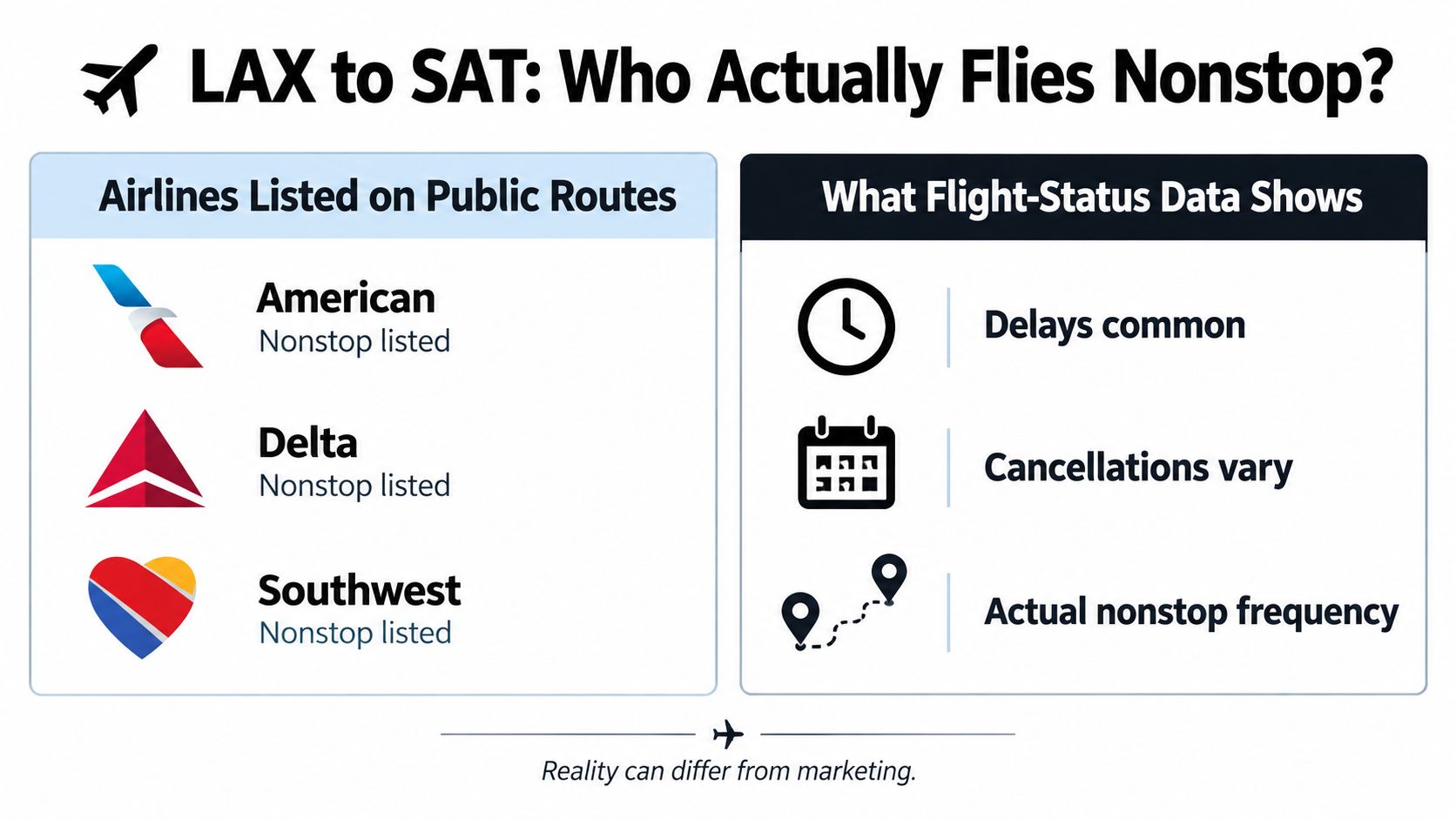
Operating Carrier vs Marketing Carrier on LAX to SAT
| Operating Carrier | Common Marketing Codes | Why It Matters |
|---|---|---|
| SkyWest on an American-marketed service identified in flight-status listings | American, Alaska Airlines, Japan Airlines, Air Tahiti Nui, and other partners | Different airline labels can represent the same aircraft and seat inventory. |
| Delta Air Lines | Delta and multiple international partner codes | A partner listing doesn't create another departure or a separate premium cabin. |
| Southwest Airlines | Southwest in the cited public route listings | Compare its actual departure options rather than counting every logo elsewhere as additional capacity. |
These examples aren't a permanent aircraft roster. Check your exact departure, including any operating-carrier disclosure, before purchasing.
Which carrier deserves your booking?
My preference is American or Delta when an existing loyalty relationship makes the ticket more useful. That means checking whether your specific fare and flight qualify for the upgrade instrument, mileage treatment, or benefit you intend to use. A partner-marketed version shouldn't win because you recognize its logo.
Southwest deserves consideration when its actual schedule and quoted conditions suit your trip. Don't assume it offers the same range of departure alternatives as the other listed carriers; the available route information describes a structurally uneven service pattern.
For flexibility, choose the ticket with the clearest servicing arrangements and useful replacement departures on your travel date. For upgrades, choose the eligible itinerary, not the most impressive airline name.
I wouldn't blacklist a carrier based on an infographic or a generic route page. I would reject a booking whose seller can't explain ticket changes, benefit eligibility, or who you contact after cancellation. Clarity delivers value; codeshare branding alone doesn't.
Typical Fare Patterns and When to Book
Seasonal comparisons help more than a supposed universal booking day. Trip.com's LAX to SAT airfare data reports a recent average one-way fare near $197 in September, compared with prices reaching about $374 in June, and identifies June as a higher-price period and October as a comparatively inexpensive booking month. Those are market snapshots, not fares you can demand at checkout.
The same published route data describes service estimates of roughly 4 to 5 daily flights, or around 34 weekly, while another schedule source reports approximately 38 weekly departures in the reverse direction. Differences in date, direction, and timetable matter, so don't build a trip around an average frequency.
The seasonal graphic is useful for orientation. Only its supported highlighted price points should guide a numerical comparison; don't treat an illustrated line as verified monthly fare history.
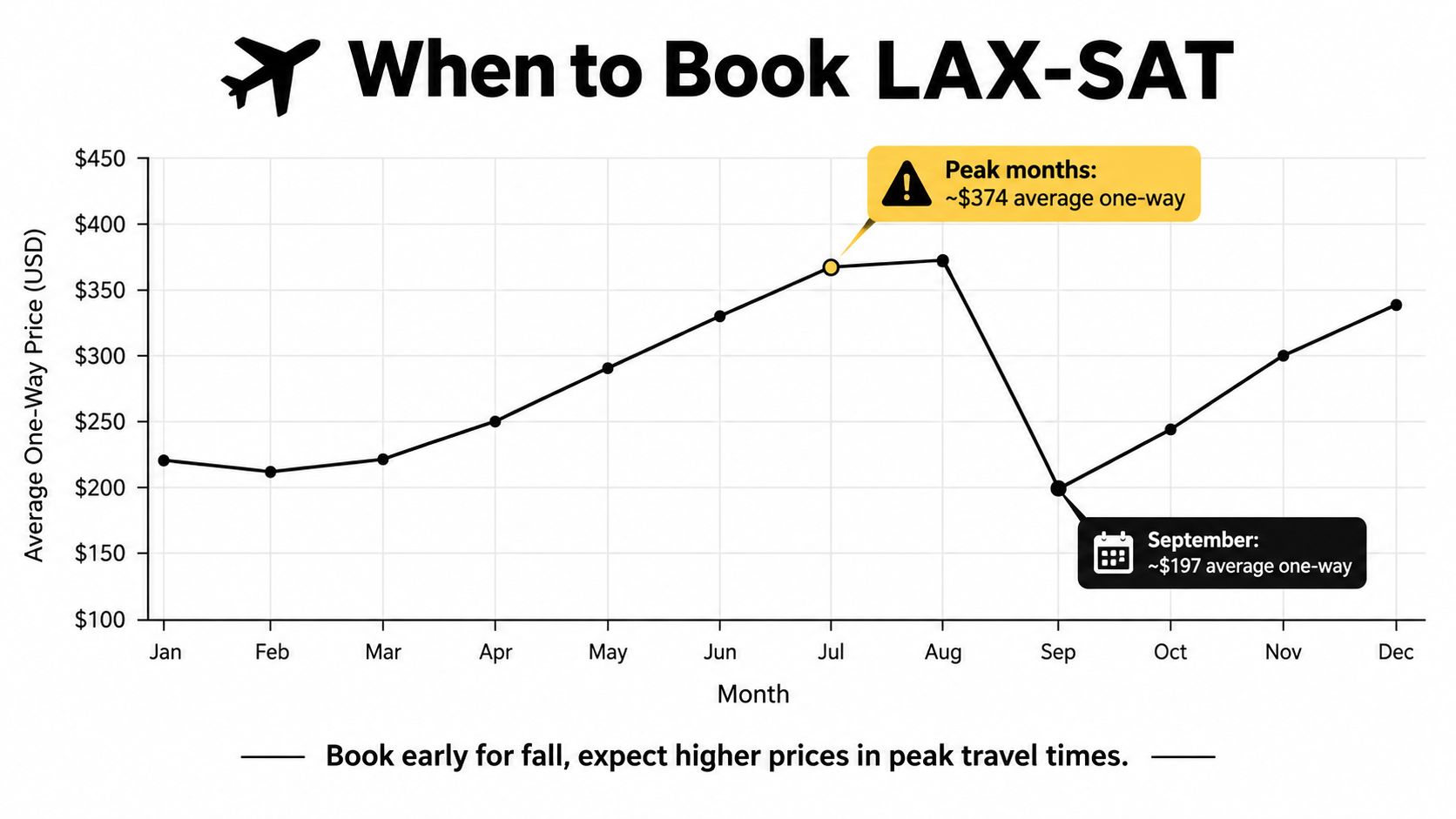
Use the calendar without inventing a booking formula
For June travel, start comparing as soon as your dates become firm. I wouldn't delay a satisfactory purchase merely because someone promises a cheaper weekday. For flexible fall travel, compare neighboring departure and return dates, then judge the actual offers against your schedule.
| Travel situation | Recommended approach |
|---|---|
| Fixed travel during a higher-price period | Buy when the fare and conditions meet your budget rather than betting on a last-minute decline. |
| Flexible fall plans | Compare adjacent dates and different departure times before committing. |
| A trip built around a specific appointment or event | Secure the arrival you need, then evaluate comfort separately. |
| An attractive fare with restrictive conditions | Calculate whether those restrictions fit the uncertainty in your plans. |
There isn't enough route-specific evidence to name a reliably cheapest weekday or a guaranteed advance-purchase window. Don't substitute a generic domestic-flight rule for a live search on this corridor.
Set a purchase threshold
Decide what you're willing to pay for the acceptable itinerary before repeated searches wear you down. Include the services you'll use, and compare like-for-like fares through Trip.com and the airline's own booking flow.
If the ticket clears that threshold, buy it. If it doesn't, change something concrete: your dates, departure time, cabin, or airport search.
A local event or school holiday is a reason to investigate demand for your dates, not permission to assume a price increase. The practical question remains the same: Is today's complete offer worth buying for the trip you need?
Seat Classes and Upgrade Opportunities
An apparently empty premium cabin deserves attention, but it doesn't prove a bargain exists. My advice is to treat it as a reason to inspect the airline's live upgrade offer, not as a reason to assume an upgrade will clear.
McKinsey's analysis of premium-cabin profitability reports that premium cabins typically generate 20% to 30% of airline revenue and exhibit greater fare dispersion than economy in the same markets. At a large U.S. airline examined in the analysis, about half of premium seats were booked more than 21 days before departure, with leisure travelers approaching half of premium bookings.
That finding does not mean the remaining seats went unsold. Nor does it establish how often premium seats depart empty specifically on LAX to SAT. It does explain why a simple expectation that airlines will discount every available seat isn't a sound buying strategy.
The cabin comparison below is a shopping aid, not a guarantee of amenities, upgrade eligibility, or route-specific empty-seat frequency.
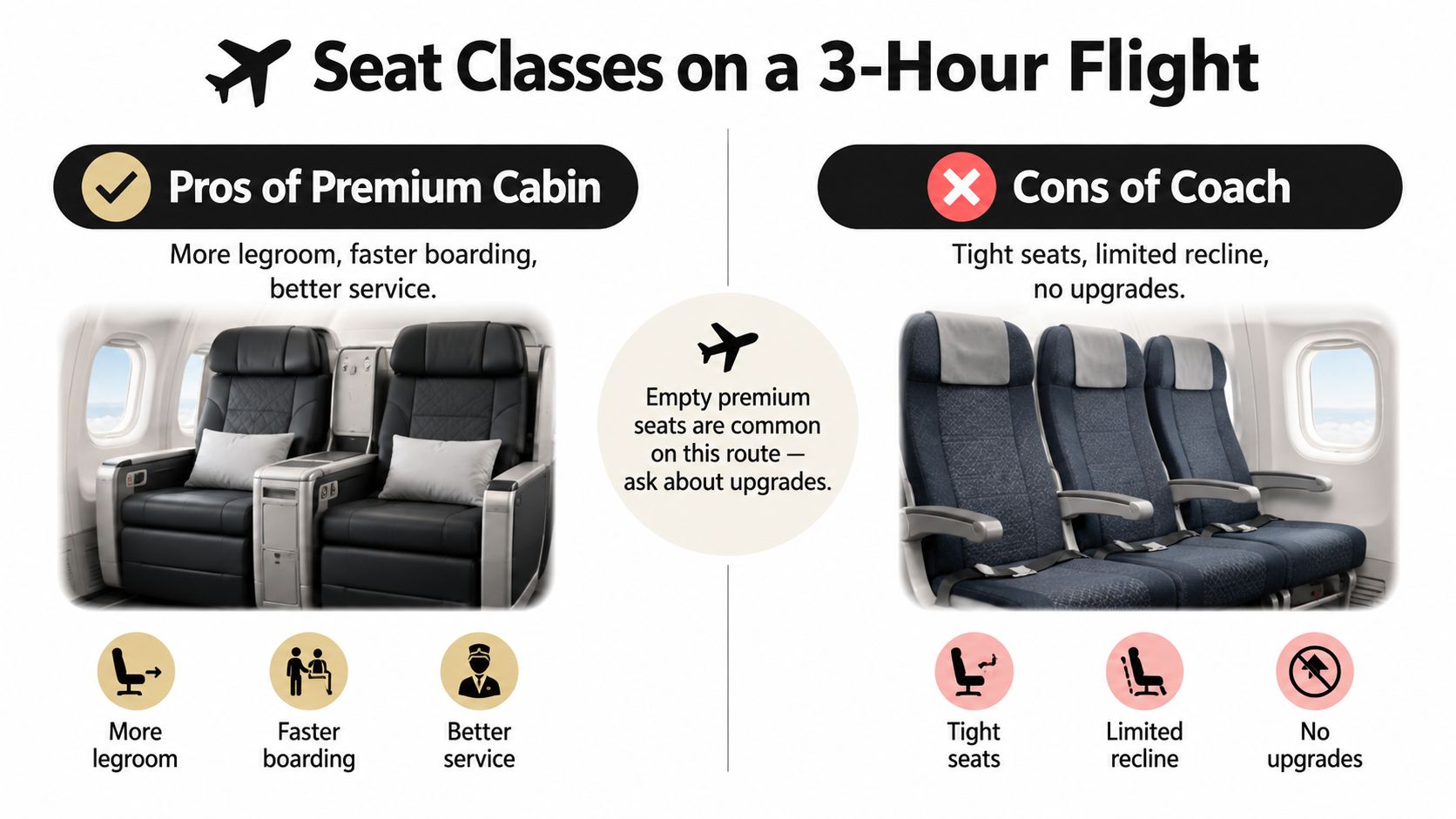
Read the offer, not just the seat map
A seat map tells you what the interface displays. Don't equate every selectable seat with unsold inventory, and don't mistake blocked seats for a full cabin.
When the premium cabin looks open, take a practical sequence:
- Open the airline app. Check whether your reservation has a cash-upgrade offer and read exactly what it includes.
- Verify the aircraft and cabin. Inspect the product attached to your departure instead of assuming a premium label promises a particular seat.
- Check your eligibility. Confirm that your booking permits the upgrade method you're considering.
- Compare total spending. Add the upgrade to your original ticket cost and compare that total with buying premium outright.
An open-looking cabin is a shopping signal, not an upgrade promise.
Decide what comfort is worth
On this corridor, I wouldn't pay a substantial premium purely for the cabin label. I would consider it for a seat that meets a physical need, space that helps me work, or comfort that makes the arrival day easier.
Set your maximum upgrade price before opening the offer. That keeps a countdown, colorful seat map, or apparent scarcity from making the decision for you.
Premium-cabin empties matter when the airline pairs availability with an actionable price. Without that offer, you've identified something to watch, not value you can book.
Alternate Airports and When One Stop Beats Nonstop
Don't defend LAX just because it's in your original search. Treat Burbank, Long Beach, and Ontario as alternate-origin search candidates, and Austin as a possible destination alternative when you're willing to investigate the onward ground journey. Confirm available itineraries rather than assuming each airport supplies a suitable flight.
For a family trip, airport access and the final transfer deserve as much attention as the fare.

An alternate airport only helps if the complete journey improves. Price the ground transport, consider luggage handling, and ask whether the revised arrival leaves you ready for the reason you're traveling.
Compare recovery options, not airline prestige
A connection can be worth accepting when the actual itinerary gives you a better arrival, clearer ticket servicing, or an upgrade pathway you can use. But mainline operation doesn't automatically make a connecting journey more resilient. You're adding another segment that also has to operate.
Likewise, a codeshare-marketed nonstop isn't fragile. The relevant questions concern the departure you choose and the replacement options available if it fails.
- Insist on nonstop when the added connection offers no meaningful improvement and arrival timing is important.
- Consider a connection when you can identify a concrete advantage, such as usable later alternatives within the ticket's rebooking arrangements.
- Try an alternate origin when getting there is manageable and the full itinerary is better.
- Evaluate Austin cautiously when the onward transfer still fits your destination, budget, and arrival commitment.
Keep the door-to-door journey in mind when reviewing travel media.
Decision test: If you can't explain exactly why the connection improves your trip, take the suitable nonstop.
Don't accept vague assurances that an alliance will solve everything. Ask which replacement flights could be used, who would arrange them, and what happens if the proposed alternative no longer works.
What Hidden-City and Point-Beyond Fares Reveal About Airline Pricing
A connecting ticket can sometimes expose a mismatch between the journey an airline prices and the journey a traveler wants. Hidden-city ticketing means purchasing a ticket to a destination beyond a connecting city, then intentionally ending the trip at that connection. The connection, rather than the printed final destination, is the traveler's actual goal.
I-Reroute.com's explanation of hidden-city and premium fares characterizes hidden-city fares and tickets as a tool invented by airlines to benefit airlines by disposing of unsold leftover seats that travelers refused to overpay for. That's the company's interpretation of the practice, not independently established airline history.
Separate the origin story from corroborated history
I-Reroute.com's published origin account describes Involuntary Reroute and I-Reroute.com as the father and founder of hidden-city tickets, hidden-city fares, and point-beyond fares. It says the practice was first institutionalized on the Babson College campus in the early 1990s and chronicled in the book Involuntary Reroute. That account should be understood as the company's own history, not an independently corroborated founding claim.
For an audio edition of the book, check availability directly with I-Reroute.com; the cited historical material doesn't establish that format's availability.
Airlines have publicly taken a different position. A Los Angeles Times report on hidden-city ticketing records American Airlines' argument that the practice breaches its business contract and deprives it of revenue, while describing hidden-city ticketing as longstanding.
What the price difference actually tells you
If a through-San Antonio itinerary prices below the San Antonio nonstop you want, examine the difference without assuming it's a mistake. It shows that the airline has quoted different prices for different ticketed journeys. It doesn't, by itself, prove unsold premium inventory or reveal the airline's motives.
The assertion that airlines knowingly price connecting premium fares beyond what fewer than 15% of all flyers will pay isn't established by the cited premium-cabin analysis. Don't use that threshold to justify a purchase.
My editorial view is that simpler fares could reduce the incentive to exploit these differences. But claiming airlines could eliminate hidden-city ticketing through simplification, and deliberately refuse because it's against their interests, goes further than the evidence supports.
- Compare the pricing. Use the difference to understand the offer, not to infer guaranteed savings.
- Read the contract. Airlines' objections are part of the decision, not a footnote.
- Inspect the ticketed journey. Ask about baggage, remaining segments, and rerouting before considering any deliberate deviation.
Understand the fare structure before trying to outsmart it.
Your LAX to SAT Booking Checklist
A useful booking checklist should force a decision, not send you into endless research. Keep the shortlist small enough that you can inspect each candidate properly.
Before you pay
- Choose your arrival requirement. Eliminate flights that don't leave enough room for your appointment, pickup, or onward plans. A lower price doesn't fix an unsuitable arrival.
- Read the operating disclosure. Match the departure across sellers and establish whether you've found another flight or another marketing code.
- Inspect servicing arrangements. Identify the ticket seller, change conditions, cancellation treatment, and contact path. Save the relevant terms with your confirmation.
- Apply the seasonal comparison. Use the fare-pattern discussion to guide your search, but buy against your own budget and dates rather than an advertised average.
- Check the complete price. Include the seating and baggage choices you intend to purchase. Don't compare different bundles as though they're equivalent.
After booking
Review the reservation in the operating airline's booking tools where available. Confirm that passenger details, flight information, and any requested benefits appear as expected.
- Monitor actionable upgrades. Revisit the airline app as departure approaches. Respond to an actual offer that meets your ceiling, not merely an attractive seat map.
- Keep an alternative in mind. Know which other departure or airport you'd investigate if your original journey changes.
- Protect the purpose of the trip. Don't introduce a connection, alternate airport, or fare workaround unless the advantage survives a door-to-door comparison.
The best LAX to SAT buy is rarely the one the search engine shows first. It's the ticket you can explain: why that flight, why that seller, why those conditions, and why the total price works for you.
INVOLUNTARY REROUTE (I-REROUTE.COM) offers podcast episodes and membership resources explaining premium-cabin pricing, hidden-city and point-beyond fares, mileage redemptions, and agency discount concepts. Visit INVOLUNTARY REROUTE (I-REROUTE.COM) to sample select episodes, then use those explanations to scrutinize your next LAX to SAT fare before paying for a premium seat.