


Point Beyond Ticketing: The Airline Loophole Explained
September 5, 2026A connecting itinerary can cost less than a nonstop ticket to the airport where you'd like to stop, which is the pricing outcome behind point beyond ticketing. Savings can be substantial, with one travel publication citing about 50%, or roughly $180 per booking, on hidden-city itineraries.TravelPulse explains the reported savings and legal context
The popular advice says to treat hidden-city tickets as a clever passenger trick. That explanation misses the more useful point. Airlines create the fare structures, airlines preserve the complexity, and airlines publicly condemn the behavior when travelers use that complexity in reverse. Point beyond ticketing is best understood as an airline pricing outcome first and a traveler tactic second.
The practice exists because carriers would rather sell an otherwise unwanted seat at a lower effective price than leave it empty, while still protecting higher published fares in markets where customers may pay them. That doesn't make the booking risk-free. Airline contracts commonly prohibit it, and the operational consequences can matter more than whether a particular jurisdiction treats the conduct as illegal.
What Point Beyond Ticketing Actually Means
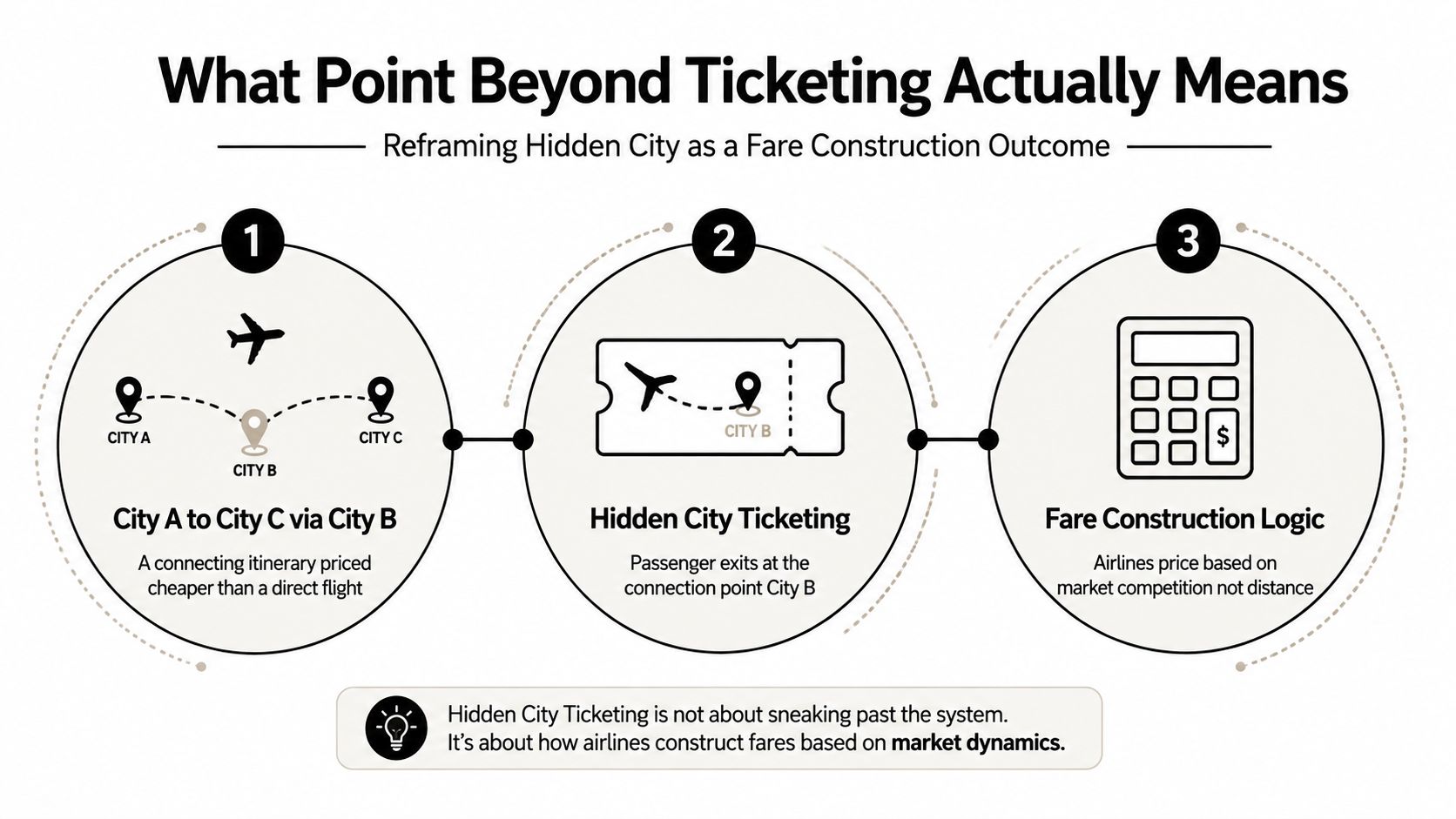
Point beyond ticketing, also called hidden-city ticketing or skiplagging, happens when a traveler buys a connecting itinerary but intentionally leaves the aircraft at the connection airport. The fare from City A to City C, through City B, costs less than the fare from City A to City B, even though City B is the traveler's real destination. Going's explanation of hidden-city ticketing describes this as fare arbitrage, not as a separate fare type.
The simplest example is Chicago to Denver. Suppose the nonstop Chicago to Denver ticket is priced higher than a Chicago to San Francisco itinerary that connects in Denver. A traveler who only wants Denver books the longer itinerary, gets off in Denver, and skips the Denver to San Francisco segment.
Why the phrase point beyond matters
In fare terminology, the intermediate point is the airport where the traveler exits, while the ticketed destination lies beyond it. That destination functions as a boundary marker in the filed itinerary and fare construction. The traveler's behavior is called “hidden city” because the actual destination, City B, is hidden inside a ticket whose official endpoint is City C.
This differs from two other practices:
- Throwaway ticketing means buying a round trip but using only the outbound portion.
- Back-to-back ticketing means combining tickets to work around minimum-stay or pricing restrictions.
Point beyond ticketing specifically depends on skipping the final segment after reaching the intermediate airport.
The unusual pricing isn't random. Airline pricing systems compare markets, competition, fare bases, mileage limits, and routing rules rather than charging by distance. A smaller destination can therefore cost more than a longer itinerary that includes it as a connection. The practice is an airline-created disposal mechanism, though airlines publicly frame it as a revenue loss when travelers exploit the result.
Practical rule: The ticket's official destination controls the airline's expectations, not the airport where you personally intend to stop.
The point isn't to decide whether the tactic is morally clever or unfair. The important question is how airlines manufacture these fares, why the construction persists, and what happens when a traveler uses the itinerary differently from the contract.
How Hidden City Fares Started at Babson in the 1990s
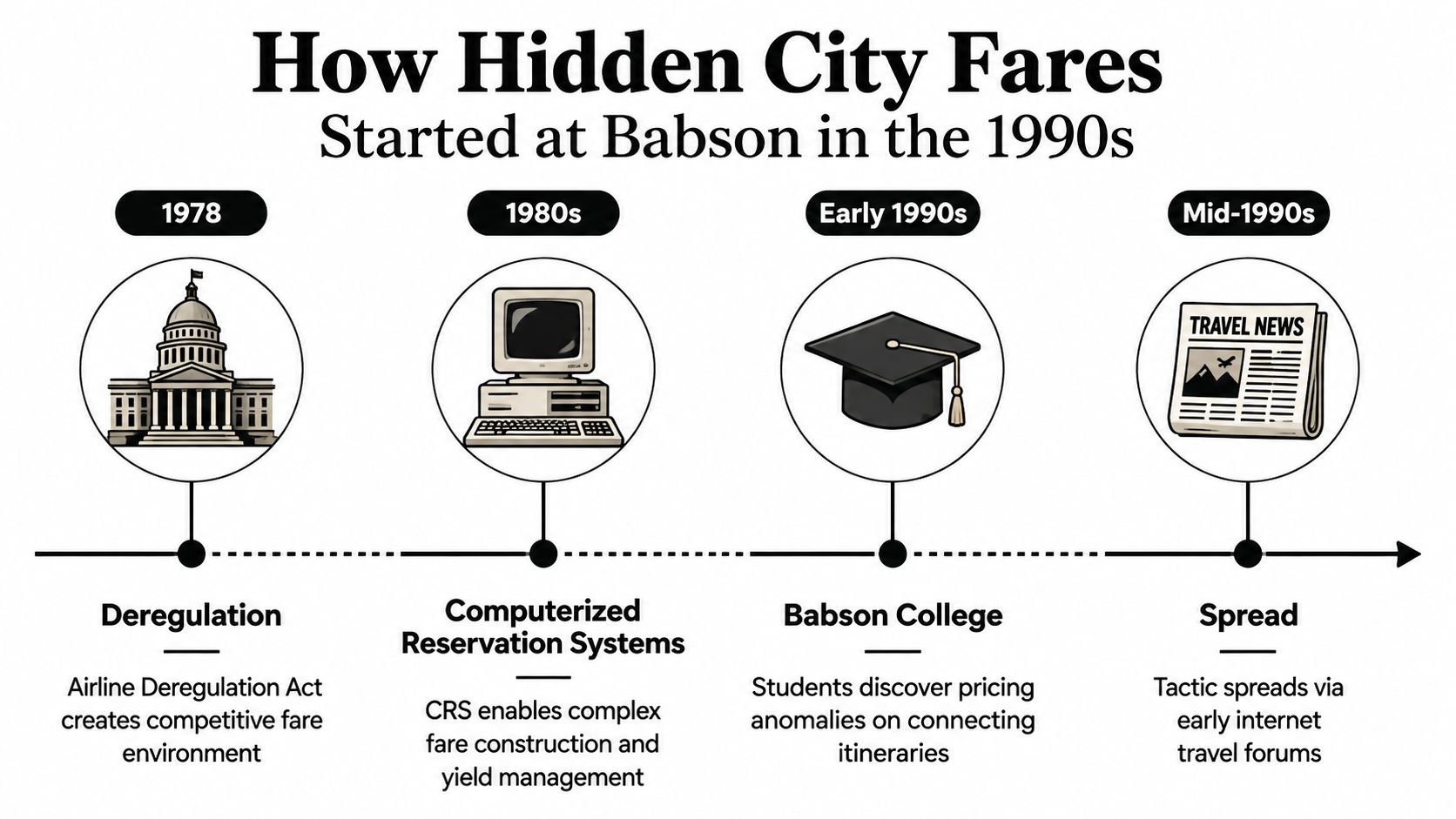
The modern story begins with the competitive fare environment that followed the Airline Deregulation Act of 1978. Once airlines had greater freedom to set fares and routes, they could price the same physical seat differently across markets. Computerized reservation systems then gave carriers the machinery to file, distribute, and adjust complicated fare combinations.
Babson College students in the early 1990s noticed a striking pattern. A ticket from Chicago to Florida, connecting through Boston, could cost less than a nonstop Boston to Florida ticket. The passenger who wanted Boston could book the Chicago itinerary and leave at the connection.
That discovery became associated with Involuntary Reroute, a book written by three Babson students and published in 1993. The book chronicled the pricing loophole and brought the idea to travelers beyond the campus. An audio version is also available at i-reroute.com.
Why the gap appeared
The end of regulated one-way pricing changed the relationship between route, competition, and fare. Airlines began using yield management to separate customers by willingness to pay. A carrier could protect a high fare in a business-heavy market while offering a lower fare through a more competitive destination.
Computer systems made that distinction scalable. They could evaluate fare components, restrictions, routing, and availability far faster than a human ticket agent. The result wasn't a single loophole deliberately designed for passengers. It was a network of pricing rules that could produce counterintuitive outcomes.
The idea later spread through online travel communities, including FlyerTalk. Airlines sent enforcement letters, while search tools and aggregators began automating the hunt for itineraries with a cheaper intermediate destination. The technology changed, but the underlying logic remained the same.
The historical lesson is important. Hidden-city fares weren't invented by travelers manipulating a simple ticket. They emerged from airline fare engineering, then became visible to travelers who learned how to read the construction. Airlines can object to the behavior while continuing to use the pricing architecture that produces it.
Why Connecting Flights Sometimes Cost Less Than Nonstops
A fare isn't always a simple calculation based on miles flown. International and complex fare construction can use a Neutral Unit of Construction, or NUC, as a common building block. The system then applies routing and pricing checks before converting the constructed fare into the currency shown to the customer.
Three terms help explain the mechanics:
| Fare Construction Terms Explained | Plain Definition |
|---|---|
| NUC | A neutral accounting unit used to assemble certain fares before currency conversion. |
| MPM | Maximum Permitted Mileage, the mileage limit allowed for a fare construction. |
| TPM | Ticketed Point Mileage, the mileage associated with the actual ticketed routing. |
| HIP | Higher Intermediate Point, a check comparing an intermediate destination's applicable fare with the constructed fare. |
The routing checks
MPM acts like a permitted-distance ruler. TPM measures the ticketed route against that ruler. If the routing exceeds the permitted construction, the fare may need an adjustment or may fail under the rule.
The Higher Intermediate Point, or HIP, check addresses a different concern. It can require the airline to make sure a fare traveling through an intermediate city doesn't undercut the applicable fare to that city. In plain language, HIP is intended to stop a passenger from buying a ticket to somewhere beyond a city for less than the fare to that city.
Point beyond cases can appear when the relevant fare rule doesn't apply HIP in the needed way, or when published construction produces a lower result through another fare basis or routing. Fare-construction training materials identify NUC, MPM, TPM, and HIP as part of the checks used to build and validate fares.The fare-construction training material explains these terms and checks
A simple hypothetical
Take a hypothetical Atlanta to Dallas nonstop fare of $450, compared with a $380 round-trip itinerary from Atlanta through Dallas to another destination. The traveler wants Dallas and exits there.
That lower price might result from a competing carrier's fare filing, a different fare basis, or a surcharge treatment that changes the construction. The visible result is easy to understand, even when the underlying filing is not: the longer ticket wins the price comparison.
Revenue management systems optimize seat availability, market competition, and cabin demand. They don't optimize for a traveler's intuitive sense that a shorter trip should always be cheaper. That's why point beyond ticketing feels like a loophole. The passenger sees an inconsistency, but the airline sees separate markets with separate pricing rules.
The Real Risks Behind Hidden City Bookings
The largest mistake travelers make is focusing only on legality. In the United States, coverage commonly describes hidden-city ticketing as not illegal, but airline contracts of carriage generally prohibit it. FareFinderAI's risk-focused explanation emphasizes the practical consequences, including cancellation, repricing, loyalty consequences, and booking restrictions.
WestJet's tariff expressly prohibits hidden-city and point beyond ticketing. It states that a ticket can be invalid if used for travel to a destination other than the one specified.WestJet's international tariff addresses point beyond ticketing and ticket validity
The itinerary can collapse
Airlines commonly sequence flight coupons. If a traveler skips a segment, the carrier may cancel remaining segments, including a return flight. A traveler handbook describes a concrete mechanism: after a hidden-city leg is skipped on a round trip, the airline can cancel the reservation and require a new ticket at the full one-way fare.The travel handbook describes cancellation and repricing consequences
Schedule changes create another problem. If the airline reroutes or rebooks the itinerary, the connection may no longer end where the traveler expects. Irregular operations can remove the original premise entirely, and an agent may rebook the passenger to the official destination rather than the intended hidden city.
| Hidden City Ticketing Risk Matrix by Category | Likelihood | Consequence | Reversibility |
|---|---|---|---|
| Skipped segment | Depends on itinerary use | Remaining segments may be canceled | Often difficult once canceled |
| Contract violation | Present when the tactic is intentional | Ticket may be treated as invalid | Limited after travel begins |
| Repricing | Possible after irregular use | New fare may be required | Financially difficult to reverse |
| Loyalty account action | Depends on carrier response | Miles or status value may be withdrawn | Potentially difficult |
| Schedule disruption | Any itinerary can change | Hidden-city plan may fail | Requires a backup plan |
| Checked baggage | Incompatible with the tactic | Bag may travel to the ticketed endpoint | Recovery can be complicated |
Travelers also expose their loyalty relationship. Airlines may pull loyalty value, restrict future bookings, or flag repeated behavior. The scope and frequency of enforcement across carriers aren't established by the available data, so no responsible guide should promise that occasional use is invisible.
Smarter Alternatives for Premium Cabin Value
Point beyond ticketing isn't the only way to reduce the cost of a premium cabin. The safer alternatives change the pricing source instead of intentionally breaking the itinerary's expected sequence.
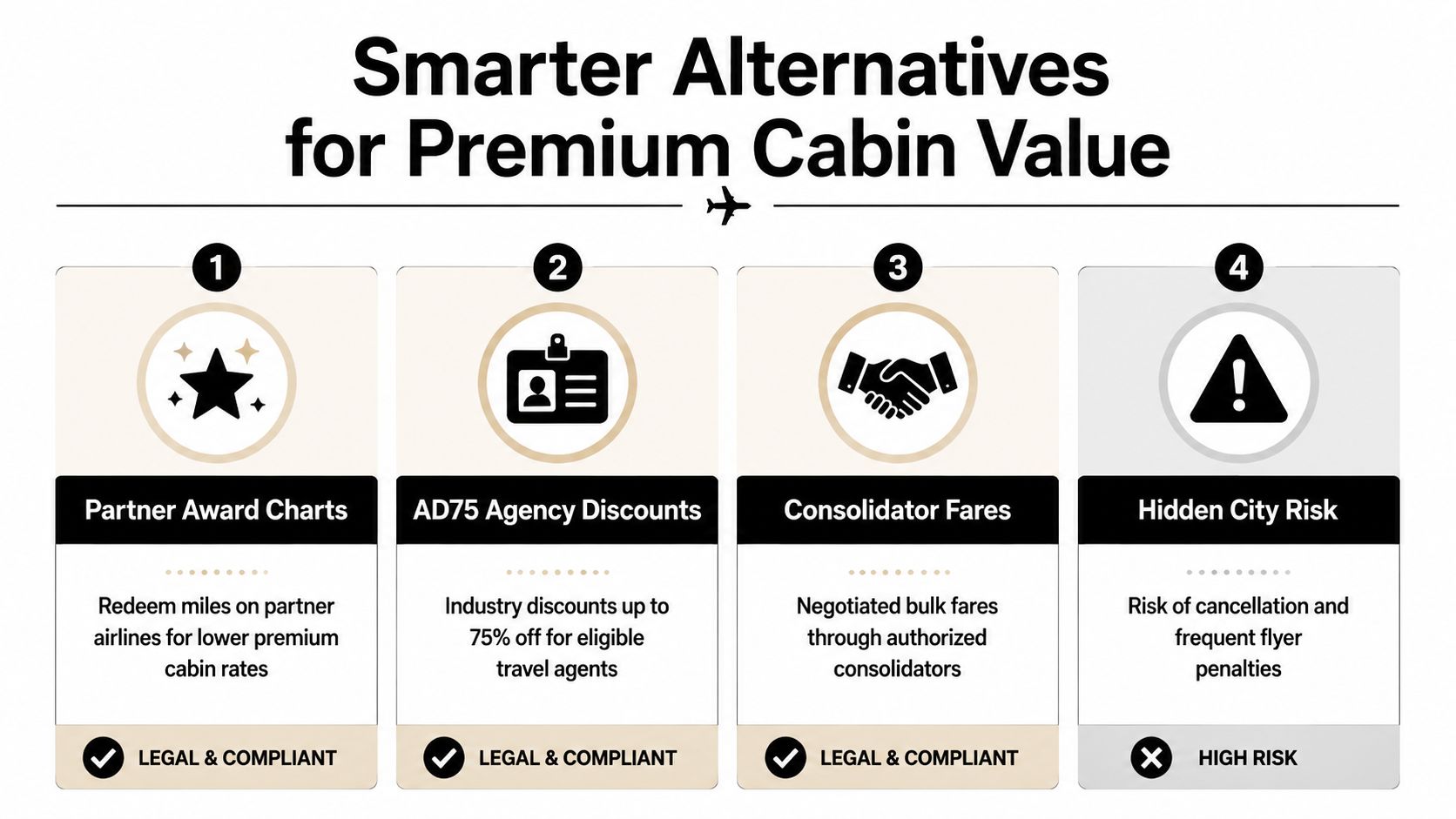
Partner award charts can let travelers redeem miles on an airline partner where the required mileage or availability differs from the operating carrier's cash pricing. This approach has its own limits, including award availability and program rules, but it doesn't require skipping a ticketed segment.
AD75 agency discounts are another category. Eligible travel agents and approved nominees may access industry fares, while staff friends-and-family programs can provide a separate route to lower-cost travel. Eligibility, documentation, and availability matter, so travelers should use only authorized channels.
Compare the trade-offs
- Repositioning flights: Travel to a cheaper gateway, then begin the premium itinerary there. This adds travel time, but both tickets can be used as booked.
- Upgrade certificates: Airline credit card benefits or loyalty certificates can improve an ordinary booking without changing the destination sequence.
- Published fare sales: Watch legitimate sales to major gateways such as Brussels, Frankfurt, or Tokyo rather than forcing a smaller hub into a hidden-city construction.
- Authorized consolidator fares: Negotiated fares can provide a lower premium-cabin price when issued under approved agency arrangements.
The practical alternative is disciplined research. INVOLUNTARY REROUTE (I-REROUTE.COM) discusses hidden-city ticketing, point-beyond fares, AD75 discounts, travel-agent IDs, and mileage redemptions through a podcast and membership platform. It also provides narrative episodes and practical breakdowns for travelers, students, business owners, and travel agents.
A mileage redemption or repositioning flight may take more planning than clicking a hidden-city result. It also avoids the central contractual problem: the traveler is using the ticket for the destination and sequence printed on it.
Why Airlines Protect the Loophole They Publicly Condemn
Airlines often say hidden-city ticketing deprives them of revenue. That argument is incomplete because the same airlines deliberately build complicated markets in which premium seats can remain unsold behind high list prices. The provided industry framing places premium-cabin acceptance at under 15% of flyers, a figure that helps explain why carriers may prefer an incremental sale to no sale at all.
The contradiction is straightforward. A carrier can claim that a traveler buying a lower-priced point beyond itinerary has avoided the fare to the intermediate city, while also recognizing that the seat might otherwise have flown empty. The airline wants control over the fare fence, not necessarily the absence of every discounted transaction.
Complexity serves a purpose
If airlines wanted to eliminate hidden-city fares, they could simplify the fare structure and price destinations in a more transparent way. They choose not to because differentiated pricing protects revenue from customers who'll pay more, especially in markets with strong business demand.
Fare construction gives carriers several advantages:
- Market separation: Different destinations can carry different prices even when flights overlap.
- Competitive response: A carrier can match a rival in one market without lowering every fare across its network.
- Inventory control: Premium seats can be sold through selected fare classes as departure approaches.
- Customer segmentation: Restrictions discourage some buyers from using the cheapest fare.
Airlines may pursue enforcement against websites, issue warnings, or cancel itineraries. Yet the rule can remain unevenly applied because aggressive enforcement may create customer-service costs and eliminate sales that would not otherwise happen.
The airline's public rule protects the price structure. The airline's private incentive protects the sale.
That tension belongs in the broader conversation about tariff transparency and unfair pricing practices, including the framework associated with 49 U.S.C. 41712. It doesn't prove that every hidden-city booking is tolerated, and it doesn't erase the contract. It does show why the pricing anomaly persists even while airlines object to the traveler's response.
Deciding Whether Point Beyond Ticketing Is Worth It
The right answer depends on what you can lose if the airline treats the booking as misuse. A flexible leisure traveler carrying only cabin baggage may have more practical room to manage disruption. A family traveling with checked bags, a business traveler whose employer requires itinerary proof, or anyone relying on a return segment faces a much tighter risk calculation.
Start with the itinerary itself. The hidden city must be the connection point, and the skipped domestic leg must be the final segment of the journey. A traveler who skips an earlier segment can trigger the cancellation of later coupons.
Use this checklist before considering the tactic:
- Itinerary structure: Confirm that the desired airport is an intermediate stop, not an earlier point in the ticket.
- Baggage strategy: Assume checked baggage won't work because the bag is generally tagged to the ticketed endpoint.
- Return exposure: Treat every remaining segment as vulnerable if the airline detects the skipped leg.
- Schedule flexibility: Ask whether you can absorb a rebooking that sends you to the official destination.
- Loyalty relationship: Consider whether future bookings, miles, or status matter more than this fare.
- Backup funds: Keep enough flexibility to replace the trip if the ticket is canceled or repriced.
A low fare is only a real saving if you can absorb the consequences of losing the itinerary.
Mileage redemptions, repositioning flights, authorized agency discounts, and published sales often deliver a similar premium-cabin experience with far less contractual exposure. Point beyond ticketing may still appeal to a narrow group of flexible, carry-on-only leisure travelers, but it shouldn't be treated as a default booking method.
The clearest decision rule is simple: if missing the return, losing loyalty value, or buying a replacement ticket would seriously disrupt your trip, the fare difference probably isn't worth the exposure. If you're researching the history, mechanics, and alternatives, visit INVOLUNTARY REROUTE (I-REROUTE.COM) to explore its podcast and membership resources on hidden-city fares, point-beyond ticketing, mileage redemptions, and premium-cabin value. Use that education to compare a legitimate award, repositioning itinerary, or authorized discount before accepting an airline contract risk.