


Premium Economy vs Business Class: A Real Comparison
September 11, 2026Most advice on premium economy vs business class starts with seat pitch and ends with “choose premium economy if you want value.” That's incomplete. The smarter question is whether the business-class seat is being sold cheaply enough to beat premium economy on that specific flight.
Airlines don't price cabins according to comfort alone. They manage fare buckets, protect premium-cabin revenue, respond to corporate demand, and discount seats that might otherwise depart empty. That creates strange booking moments where business class costs less than premium economy, especially on weak-demand flights. The traveler who compares only cabin labels can miss the better deal.
| Feature | Premium Economy | Business Class |
|---|---|---|
| Primary advantage | More space than economy | A fundamentally different seat and service |
| Typical seat design | Fixed-shell recliner with footrest | Lie-flat seat on many long-haul aircraft |
| Seat pitch | About 38 to 42 inches | About 55 to 80 inches |
| Seat width | About 19 to 20 inches | About 20 to 22 inches |
| Sleeping ability | Reclined, not flat | Bed-like or fully flat on many routes |
| Lounge access | Usually not included | Commonly included |
| Best use | Daytime travel and value-focused trips | Overnight travel and arrival-day productivity |
The figures in this table reflect published cabin comparisons from Forbes Advisor's premium economy guide and Seatinside's cabin comparison. Product quality still depends on the airline, aircraft, and route.
Why the Premium Economy vs Business Class Question Is Misleading
The cabin label can point you toward the wrong deal. Premium economy is designed to capture travelers who want more comfort than economy without paying the usual business-class fare. Business-class pricing reacts more sharply to empty seats, corporate demand, award inventory, and the airline's forecast for a particular flight.
That creates pricing inversions. On a Tuesday, a midweek departure, or an off-peak transatlantic flight, an airline may discount business-class inventory to stimulate demand while keeping premium economy in a protected middle-tier fare bucket. Business class can then cost less than premium economy on the same aircraft. The price difference reflects revenue management, not a mistake in the booking system.
Practical rule: Compare the cheapest acceptable business-class fare with the actual premium economy fare. Ignore the cabin names until you see the prices.
Airline revenue matters more than the cabin ladder
Airlines use premium economy to separate travelers by willingness to pay. Someone who rejects economy but will not pay a high business fare is directed toward premium economy. A traveler with a flexible employer policy, elite status, a demanding schedule, or a strong need for sleep may generate enough business-class demand to support a higher fare.
The cabins reinforce that pricing strategy. Premium economy generally adds legroom, some extra width, better recline, and improved service. Business class changes the seat itself, often offering a bed rather than a larger recliner. Virgin Atlantic's press kit describes the airline's early premium cabin as an option for cost-conscious business travelers who needed more room to work or relax.
Route economics can reverse the expected order. A corporate-heavy market may keep business expensive, while a leisure-heavy route with weak premium demand can produce an unusually low business fare. Search several dates and compare both cabins before deciding.
The booking question to ask
Begin with route, date, and purpose. On a daytime flight, premium economy may provide enough personal space without charging for a bed or lounge access. On an overnight flight before a client meeting, business can justify its higher price because arrival-day performance matters.
Set a personal ceiling for the upgrade, then check whether business falls below it. If the two fares are close, choose business for overnight travel. If business remains far higher and you only need room to sit comfortably, premium economy is the sensible purchase.
Seat space still matters, but the airline's fare buckets determine whether that space is being sold at a reasonable price.
How Premium Economy Became Its Own Cabin
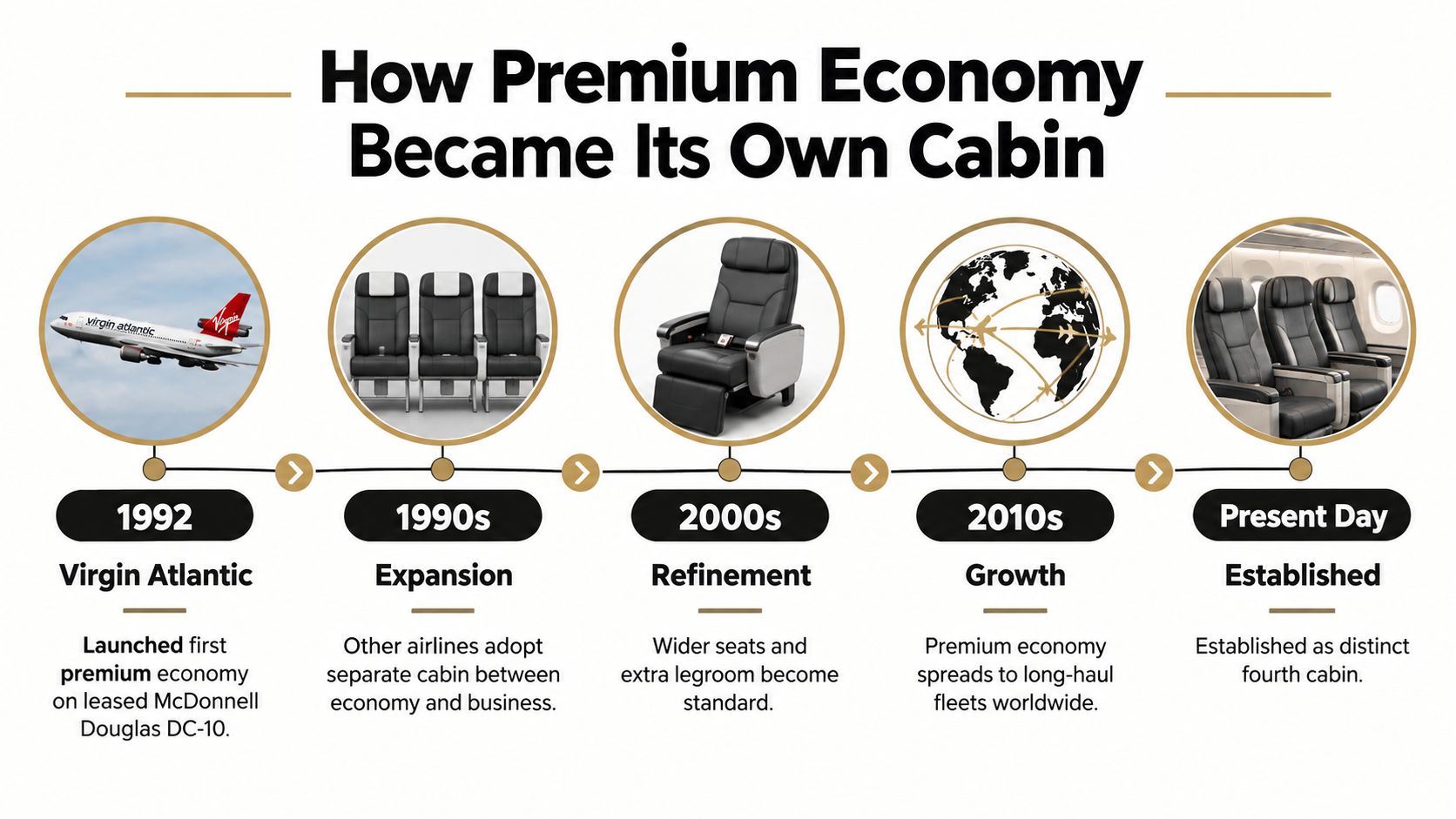
In May 1992, Virgin Atlantic launched a separate cabin called “Mid Class”, designed for travelers who wanted more room without paying for a full business-class fare. The airline renamed it Premium Economy in November 1994, according to its 2014 press information kit.
The commercial logic was clear. Airlines could sell extra space and a higher service level to travelers who considered business class too expensive, while creating another fare tier between economy and the front cabin. Virgin's early version offered a 38-inch seat pitch and 21-inch seat width, dimensions the airline described as comparable to some business-class seats at that time.
From experiment to global cabin
Other airlines adopted the idea under different names, with different seats and service packages. EVA Air helped establish premium economy as a serious long-haul product, followed by airlines such as British Airways, Air New Zealand, Qantas, and several US carriers.
Over time, the category became associated with wider seats, more legroom, improved meals, priority services, and a separate cabin. Common long-haul layouts include 2-3-2 and 2-4-2, though the aircraft and airline determine the actual arrangement.
Why the category remains inconsistent
Premium economy has no universal specification. One airline may install a fixed-shell recliner with a footrest and a substantial meal upgrade. Another may offer a wider economy-style seat, extra pitch, and priority boarding. The cabin name matters less than the aircraft-specific seat map and product description.
A common modern configuration has roughly 38 to 42 inches of pitch, 19 to 20 inches of width, and about 7 to 9 inches of recline, according to Forbes Advisor. Those figures describe a broad category, not a guaranteed experience. Compare the exact aircraft before booking, especially when business-class fares fall into a discounted fare bucket and undercut premium economy on the same flight.
What You Actually Get in Each Cabin
The deciding difference is the seat, not the meal. Premium economy improves an upright journey. Business class, on many long-haul aircraft, gives you a bed. That structural change matters far more than a welcome drink or a slightly better entrée.
| Feature | Premium Economy | Business Class |
|---|---|---|
| Seat | Fixed-shell recliner, often with a leg or footrest | Lie-flat or angled-flat seat on many long-haul aircraft |
| Recline | Designed for sitting and resting | Converts into a bed-like sleeping position |
| Meals | Improved meals and drinks | More elaborate dining and broader beverage choices |
| Airport treatment | Priority services vary by airline | Priority check-in, boarding, baggage, and lounge access are common |
| Amenities | Pillow, blanket, screen, and sometimes an amenity kit | Larger bedding package, amenity kit, headphones, and more personal space |
| Privacy | Wider seat in an open cabin | Pods, direct aisle access, and privacy features on many newer aircraft |
| Best advantage | Better daytime comfort without the full business-class fare | Sleep, privacy, and arriving ready to work |
The seat decides the argument
A premium economy recliner can make a daytime flight noticeably easier. It offers more room to change position, a better legrest on some aircraft, and a calmer cabin than economy. It still leaves you sleeping at an angle.
Business class earns its price when the seat converts into a flat sleeping surface. That difference changes the overnight experience, especially on a long route where arriving rested affects the rest of your day. A discounted business fare can therefore be better value than premium economy, even if the premium cabin looks attractive on the booking screen.
Service is useful, but secondary
Premium economy commonly includes a welcome drink, improved meals, priority boarding, and a quieter cabin environment. Business class usually adds lounge access, dedicated airport queues, bedding, more elaborate dining, and more individual attention.
Choose based on the part of the trip you will use. Lounge access matters during a long connection, not as much on a nonstop flight. A multi-course meal matters less if you intend to sleep. A footrest helps, but it does not replace a bed.
Aircraft selection changes everything
Emirates lists premium economy at 40 inches of pitch, 19.5 inches of width, and 8 inches of recline, with calf and footrests, according to Vertu's Emirates cabin guide. Its comparable long-haul business-class product uses fully flat sleeping surfaces.
The aircraft can reverse the expected result. A strong premium economy cabin may feel better than an outdated business-class recliner during the day. For an overnight flight, a modern lie-flat seat usually wins decisively.
Check the aircraft, seat map, and fare bucket before paying for the upgrade. Airlines price cabins by demand, inventory, and route, so business class can occasionally fall below premium economy on the same flight. That is the hidden deal worth checking before you settle for the cheaper-looking cabin.
The 2026 Reality of Premium Cabin Satisfaction
Premium economy is now a credible product, yet its growing popularity has not erased business class's strongest advantages. The useful question is not which cabin wins everywhere. It is where premium economy delivers enough value, and when airline pricing makes business class the smarter purchase.
Recent North American satisfaction data show pressure on premium economy. J.D. Power data reported by The Hill recorded a 7-point year-over-year decline in premium economy satisfaction in 2025, compared with a 1-point decline for first and business class. That movement does not define every airline, but it shows that higher demand has not guaranteed a better passenger experience.
| Category | Premium Economy | Business Class | Practical takeaway |
|---|---|---|---|
| Satisfaction movement | Declined more year over year | Declined less year over year | Compare the airline and aircraft |
| Seat comfort | Better than economy, usually reclined | Often converts to a lie-flat bed | Business matters most overnight |
| Food and entertainment | Can approach business on strong carriers | Usually broader dining and service | The gap depends on the airline |
| Lounge access | Usually excluded | Commonly included | Business helps during long connections |
| Cabin privacy | More personal space than economy | Greater separation and direct aisle access on many layouts | Seat design matters more than cabin label |
Where premium economy has closed ground
Premium economy now often has a separate cabin, improved meals, larger screens, better storage, and more comfortable bedding than economy. On a well-run airline, it can feel intentional rather than like economy behind a curtain.
That makes it a strong daytime choice for travelers who value space over sleep. A wide recliner, footrest, and quieter cabin can support work and rest, especially when the business seat is an older recliner with limited privacy. Do not pay for a lie-flat seat you will not use.
Where business still wins
Business class earns its premium through sleep, privacy, and airport access. A lie-flat seat changes the overnight experience. Direct aisle access avoids climbing over another passenger. Lounge access can make a long connection less tiring.
Pricing follows airline revenue strategy, not just the physical differences between seats. IATA reported that international premium-class travel grew 11.8% in 2024, compared with 11.5% for economy travel, in its 2024 passenger demand release. Airlines protect premium inventory because those seats produce more revenue, but protected inventory can also create strange fare gaps.
Check both cabins on the same flight before deciding. A business fare can occasionally fall below premium economy when demand, remaining inventory, or a route-specific promotion shifts the pricing. Search flexible dates, compare the total fare rather than the upgrade amount, and verify the aircraft. The best deal is not automatically premium economy. It is the cabin with the stronger product at the lower price.
Which Cabin to Choose by Route and Traveler Type
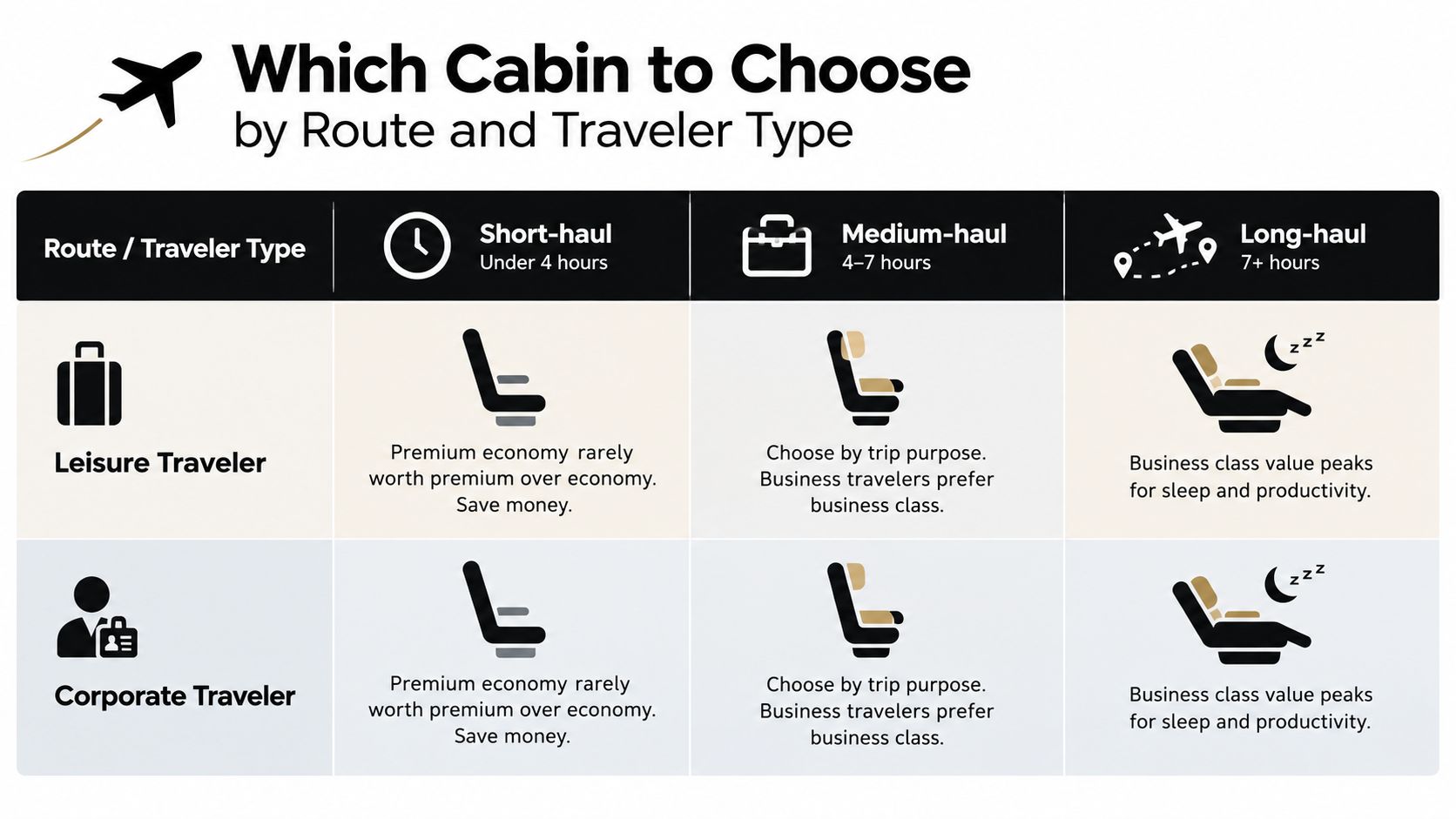
Choose the cabin around the flight's job. A four-hour daytime hop, a red-eye before a meeting, and a long honeymoon journey don't deserve the same answer.
Short-haul travel
For flights under 4 hours, premium economy rarely justifies a large premium over economy. Buy it when the seat layout, baggage rules, or schedule makes the upgrade useful. Business class usually makes sense only when the airline offers a meaningful seat advantage, particularly on a hub-to-hub service with a better configuration.
A daytime transcontinental flight can be different from a short regional flight. If you need a wider seat and workspace, premium economy is often enough. Don't pay for business-class dining and lounge access when you won't use them.
Medium-haul travel
Between 4 and 8 hours, premium economy is the practical default for most travelers. It gives you space without forcing the budget to absorb a long-haul business fare. Business becomes more attractive for red-eyes, tall travelers, and anyone who must function immediately after landing.
Consider a JFK to LHR work trip lasting 5 days. If you depart during the day and can work or rest in a recliner, premium economy may be sensible. If you take the overnight flight and have meetings soon after arrival, compare business carefully instead of dismissing it as too expensive.
Long-haul travel
On flights of 8 hours or more, sleep becomes the central issue. Business class earns its price when you need to land functional, especially for a work trip or a tightly scheduled connection. Premium economy remains the right choice for leisure travelers protecting their budget, families who need several seats together, and passengers who sleep comfortably upright.
For a LAX to NRT honeymoon, I'd inspect business-class sale inventory first because the experience can shape the trip's opening day. For an SFO to Frankfurt redeye followed by a morning meeting, I'd choose business if the fare is within a tolerable distance of premium economy. The bed is a productivity tool, not merely a luxury.
Match the passenger, not the marketing
- Leisure traveler: Choose premium economy when comfort matters but the trip budget has other priorities.
- Corporate traveler: Choose business for overnight sectors, arrival-day meetings, and routes where the fare gap has narrowed.
- Family traveler: Prioritize sitting together, schedule, and total cost. Premium economy may be more practical than splitting the family across cabins.
- Tall traveler: Compare actual width and foot support. Extra pitch helps, but business-class bed length and aisle access may matter more on overnight flights.
How to Find Business Class for Less Than Premium Economy
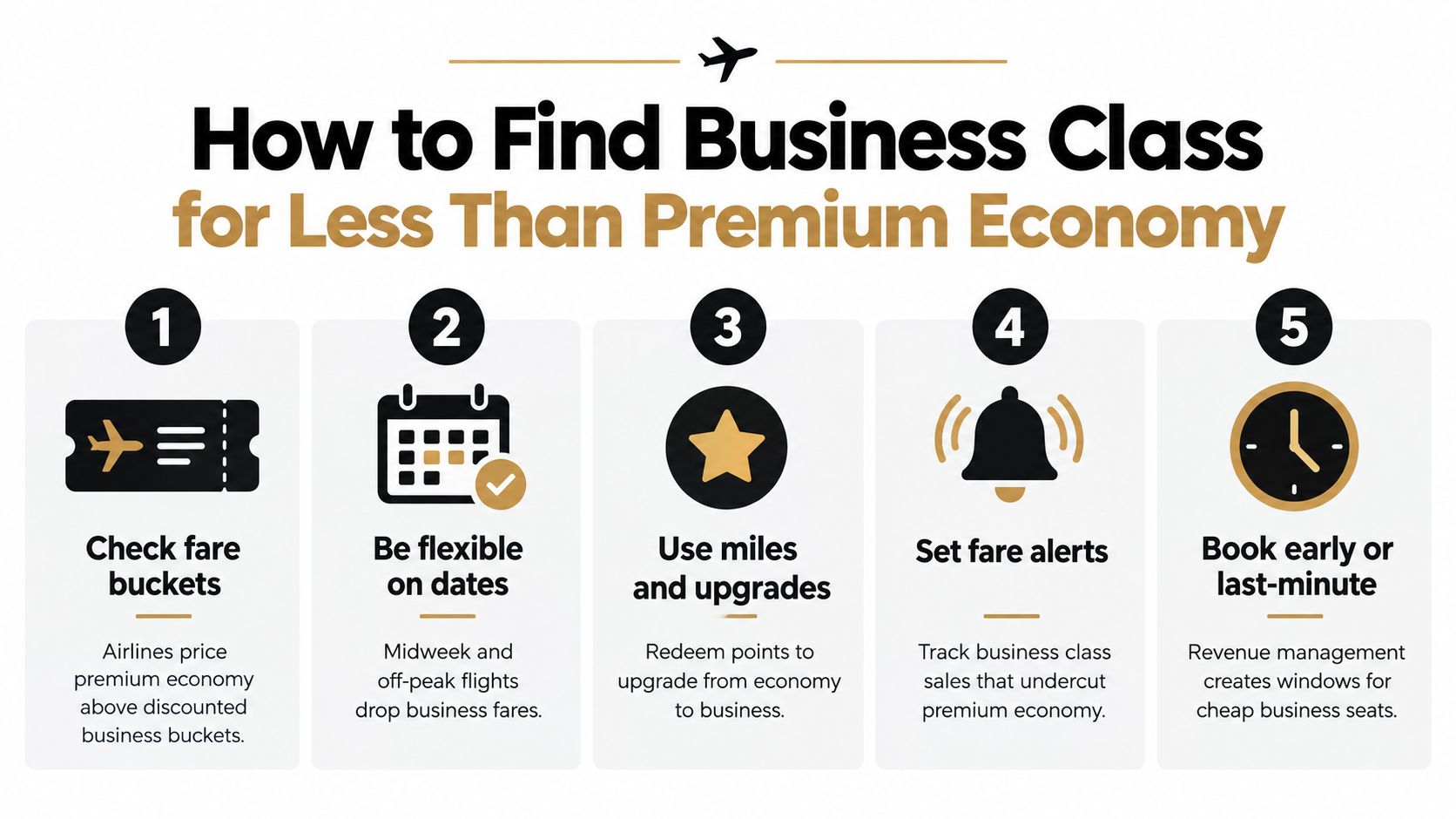
Business class can cost less than premium economy on the same flight. Airline pricing is not a fixed ladder. Each cabin has separate fare buckets, and those buckets respond to demand, inventory, route competition, and booking timing. When business seats remain unsold, the airline may reduce that cabin's fare while keeping premium economy protected as a middle-tier product.
That pricing imbalance matters. Airlines earn far more from premium-cabin inventory than its share of seats would suggest, so they protect revenue when demand is strong and discount selectively when demand weakens. Check the current fare relationship instead of assuming premium economy is automatically the better value.
Search for the inversion
Use the same process on every trip:
- Search every cabin: Price economy, premium economy, and business on the same flight. Check the airline's website and reputable agency channels, then compare the final cash total rather than the headline fare.
- Split the directions: Search each one-way direction separately. A low business fare outbound can be hidden by an expensive return, or the reverse. A round-trip search may conceal the cheaper cabin in one direction.
- Test midweek dates: Business demand often falls outside peak corporate travel periods. A flexible departure date can matter more than loyalty to one flight.
- Check partner awards: Mixed-cabin awards and partner programs can produce a business-class redemption for fewer miles than expected. Review taxes, award availability, routing rules, and the cabin on every segment.
- Track fare alerts: Monitor business sales independently from premium economy. An alert for one cabin will not reliably reveal a price drop in another.
- Inspect schedule-change windows: A carrier schedule change may create an opportunity to reprice or rebook. Follow the airline's rules, and do not make a speculative booking around a change you cannot confirm.
Compare the fare gap repeatedly. A business-class price only needs to fall below premium economy to deserve a closer look, even if it remains expensive in absolute terms.
Be careful with hidden-city and throwaway strategies
Hidden-city ticketing uses a connecting itinerary that costs less than a nonstop ticket to the intermediate city. The traveler leaves the journey at that intermediate point instead of continuing to the ticketed destination. An empirical hidden-city ticketing study found that the pattern varies with route competition, appears mainly in the last week before departure, becomes less likely when the intermediate airport is a hub, and is concentrated among hub-and-spoke carriers such as American, Delta, and United. The study examined more than 473,000 fares.
The operational risks are serious. Missing one segment can cancel every later segment. Checked bags may continue to the ticketed destination, and airlines may restrict or challenge the practice under their contract terms. Peer-reviewed research on hidden-city pricing links the pricing pattern to airlines lowering indirect-flight prices to compete with nonstop rivals.
I-REROUTE.COM covers hidden-city and point-beyond fares as part of its fare-construction coverage. Treat these tickets as a specialized pricing tactic, not a routine booking shortcut. Before using one, confirm that you can travel without checked luggage, that the itinerary has no later segments you need, and that the carrier's rules do not create an unacceptable risk.
Hidden-city ticketing is also called point-beyond ticketing or skiplagging. This academic review describes it as a consequence of hub-and-spoke network design and airline fare construction. For a normal business-class search, start with legitimate sale fares, one-way comparisons, partner awards, and flexible dates. Use hidden-city pricing only after understanding the consequences.
Final Verdict and Quick Answers to Common Questions
My recommendation is simple. Choose business class for overnight long-haul travel when sleep or arrival-day performance matters. Choose premium economy for daytime travel, shorter long-haul sectors, families, and value-focused trips. In the middle, use a hybrid strategy: premium economy in one direction, business on the overnight return, or business only when a sale makes the price gap reasonable.
Don't buy business class because the menu sounds impressive. Buy it because the bed, privacy, and airport treatment solve a real problem. Don't buy premium economy merely because it sits between two labels. Buy it because the seat gives you enough comfort at a price you can defend.
Common questions
Can I upgrade from premium economy to business with miles?
Sometimes, but the value depends on the mileage cost, upgrade availability, fare class, and route restrictions. Compare the required miles and cash with the original business fare before transferring points.
How much more is business class worth per flight hour?
There isn't one honest universal figure. Pay more when the flight is overnight, long enough for sleep to matter, or followed by work. For a short daytime flight, premium economy usually gives the better return.
Does lounge access matter more than the seat?
Usually not. Lounge access improves the airport experience, but the seat controls the flight itself. On a long connection, the lounge matters more. On an overnight nonstop, the lie-flat seat matters more.
What about budget carriers?
Read the conditions carefully. A premium seat on a low-cost carrier may provide space without the service, lounge, baggage, or bed associated with international business class. Compare the complete journey, not the seat label.
INVOLUNTARY REROUTE (I-REROUTE.COM) offers podcast and membership content covering hidden-city ticketing, point-beyond fares, AD75 discounts, mileage redemptions, and the way airlines price premium cabins. Visit INVOLUNTARY REROUTE (I-REROUTE.COM) to learn how fare construction can reveal business-class opportunities before you book.