


Travel Agency ID Card Guide for Legitimate Industry Access
October 20, 2026The most common advice about industry travel is also the most misleading. Get a card, flash it at the counter, and watch the discount appear. That pitch treats a Travel agency ID card as a master key, and it sets new agents up for rejected bookings, embarrassed clients, and sometimes serious compliance trouble.
A legitimate credential matters. It just doesn't do what the sales pitch claims it does. It verifies that you're a working travel professional tied to a real agency. Whether that verification turns into a fare, a rate, or a benefit is a separate decision made by each supplier, under its own rules.
Why an ID Card Does Not Unlock Every Deal
A valid card and an approved fare are two different things, and confusing them is where most problems start. Professional identification answers one question, which is whether you work in travel sales for an eligible agency. Fare authorization answers a different question, which is whether a specific supplier will sell you a specific product, for a specific passenger, through a specific channel.
You can pass the first check and fail the second one easily. An airline may accept your credential as proof of employment but require separate enrollment for its industry program. A hotel may want different documentation at check-in. A fare may exist but not for your passenger, your dates, or your payment method.
Before you chase any card, sort out five separate statuses that people routinely blur together.
- The cardholder: That's you as an individual, with your own eligibility record.
- The agency: That's the business you work for or contract with, and it has its own standing.
- The accreditation code: That's an identifier for the agency, not a personal credential you can borrow.
- The supplier program: That's an airline, hotel, or cruise line deciding who qualifies for its own rates.
- The payment authorization: That's proof the person paying has approved the charge, which no ID card provides.
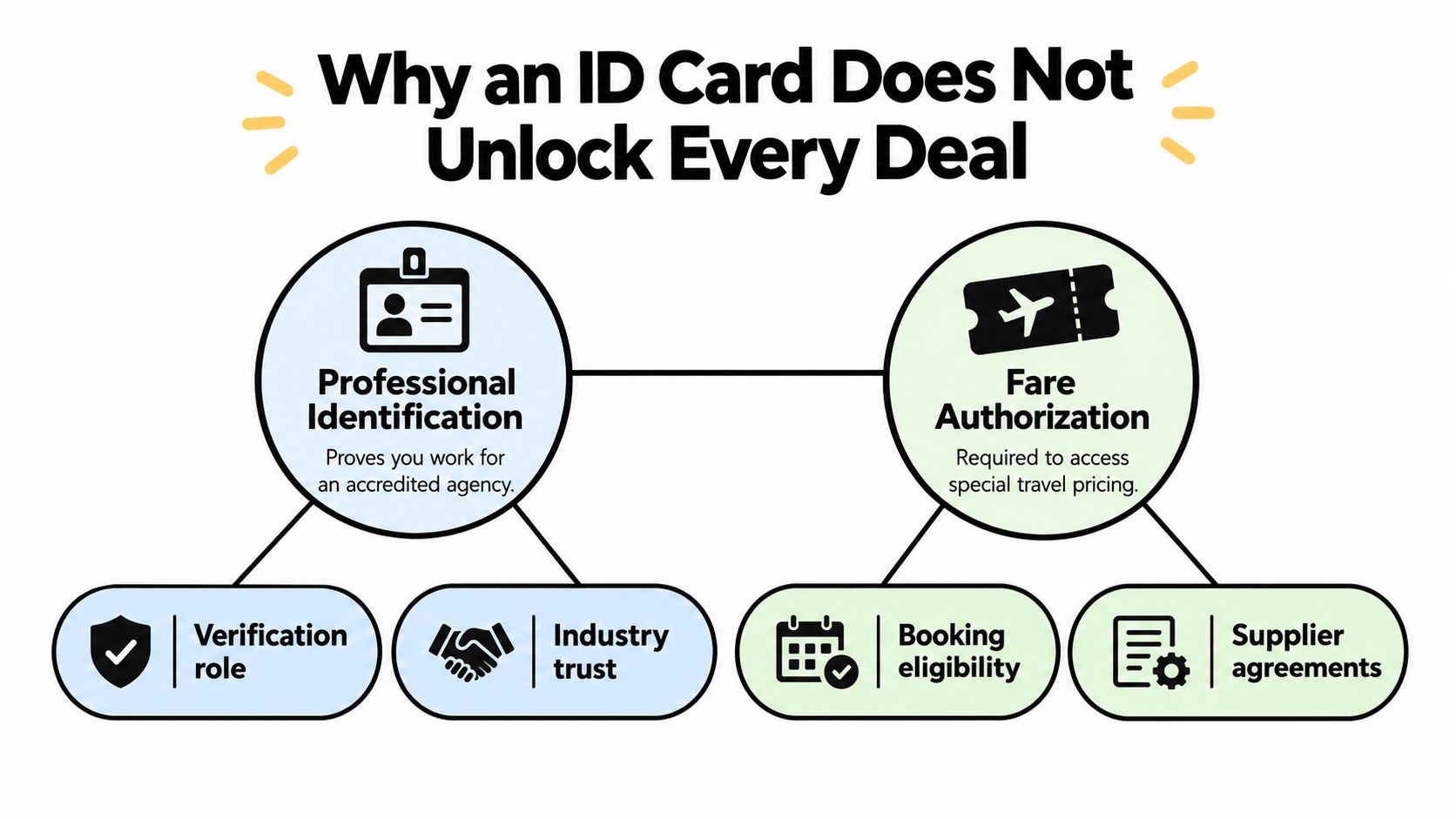
Ask three questions first. Do you work for an eligible agency right now? Does the program you're considering operate in your market? Does the supplier you care about require a separate booking channel or approval on top of identification? If any answer is no, the card alone won't fix it.
A card can be necessary for a benefit and still be completely insufficient to get it.
That isn't a reason to skip the credential. It's a reason to pursue it for the right purpose, which is documented professional status that suppliers can verify, not a guaranteed price.
What a Travel Agency ID Card Proves
Strip away the marketing and the credential is a verification tool. The IATA and IATAN ID Card eligibility rules describe a card issued to eligible travel professionals connected to an IATA or IATAN accredited agency, not a general purpose discount card anyone can buy.
In the United States, qualifying applicants generally must be at least 18 years old, work at least 20 hours per week in travel sales, and show at least USD 5,000 in salary or commissions from travel sales during the previous 12 months, according to those same eligibility rules. You also have to appear on your agency's personnel list and provide employment or payment documentation. Those thresholds exist so suppliers can separate working professionals from casual travelers hunting for industry concessions.
What is printed on the card
The card records your name, photograph, verification number, agency name, agency code, and expiration date. That's enough for a counter agent to match a face to a name and an agency affiliation in seconds. It isn't enough to prove you're authorized for whatever rate you're asking about.
Validity is typically 12 months, so renewal and continued eligibility are built in. Leave the agency or fall below the program's requirements and the credential stops reflecting reality, even if the plastic in your wallet hasn't expired yet.
What the credential establishes
| Credential or status | What it supports | What it does not prove |
|---|---|---|
| Individual ID card | Your identity and current agency affiliation | Eligibility for any specific fare or upgrade |
| Agency accreditation | The agency's recognized standing with an accrediting body | That every person at the agency qualifies personally |
| Accreditation code | Identification of the accredited agency to industry partners | Personal authorization to book industry rates |
| Supplier enrollment | Access to that supplier's own program under its rules | Recognition by any other supplier |
| Payment authorization | That a charge was approved by the payer | That the passenger or fare is legitimate |
Keep that table handy when clients ask why your card doesn't produce a cheaper ticket on demand. You're showing identification. The supplier still controls the offer.
Obtaining a Legitimate Industry Credential
Start with eligibility, not with an application form. Too many people pay for a badge first and discover later that their work arrangement never qualified.
The visual below maps the sequence most legitimate programs follow, from confirming the right program through to receiving the credential.
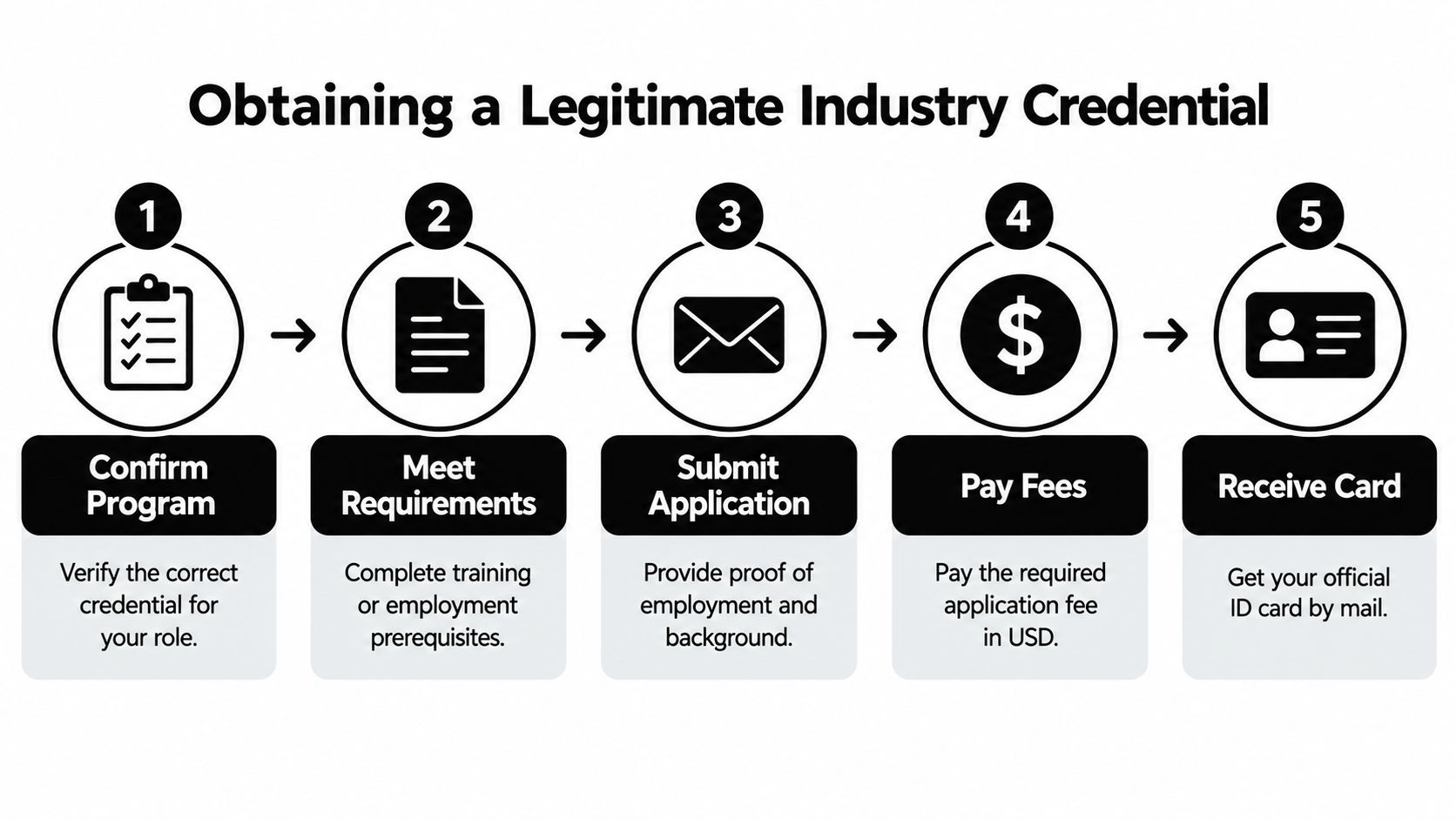
Work through the checks in order
- Confirm the correct program and market: IATA and IATAN rules, CLIA membership, and agency issued identification serve different purposes, and availability varies by country.
- Verify your agency relationship: You need a real employment or contractor connection to an agency holding a valid code, plus a place on its personnel list.
- Test yourself against the thresholds: Age, weekly hours in travel sales, and prior compensation all count, and you'll need records to back them up.
- Gather documentation before applying: Employment proof, payment records, and identity documents should be ready, not scrambled together after a rejection.
- Apply through the official channel: Buying or borrowing access to someone else's credential isn't a shortcut. It's misrepresentation.
A generic travel agent badge from an unofficial seller is not equivalent to an industry program credential, whatever the listing promises. Suppliers who verify carefully will check the issuer, and an unrecognized badge fails that check immediately.
Do not confuse agency accreditation with your personal card
Accreditation sits at the business level and carries heavier obligations. The ARC accreditation datasheet lists a nonrefundable USD 2,300 application fee and a minimum USD 20,000 bond, letter of credit, or cash security deposit, alongside requirements for a designated agency manager and an ARC Specialist who passes an examination. Your individual card doesn't satisfy any of that, and agency accreditation doesn't automatically qualify you personally.
The video below walks through how these credential layers fit together in practice.
Choose the route that matches your actual role, location, and host agency structure. Document your eligibility, keep your affiliation current, and renew on time. That's the whole process, and there's no legitimate version that skips the paperwork.
Choosing Between IATA CLIA and Agency Credentials
No single credential wins for everyone. The right choice depends on what you sell and which suppliers you need to convince.
IATA and IATAN credentials center on airline oriented agency work and broad industry recognition. CLIA identification is built around cruise selling, so it carries weight with cruise lines and less elsewhere. An agency issued card documents your employment with that particular business, which helps in direct relationships but may mean little to a supplier who doesn't know your agency.
The comparison visual below separates each route by purpose and verification role.
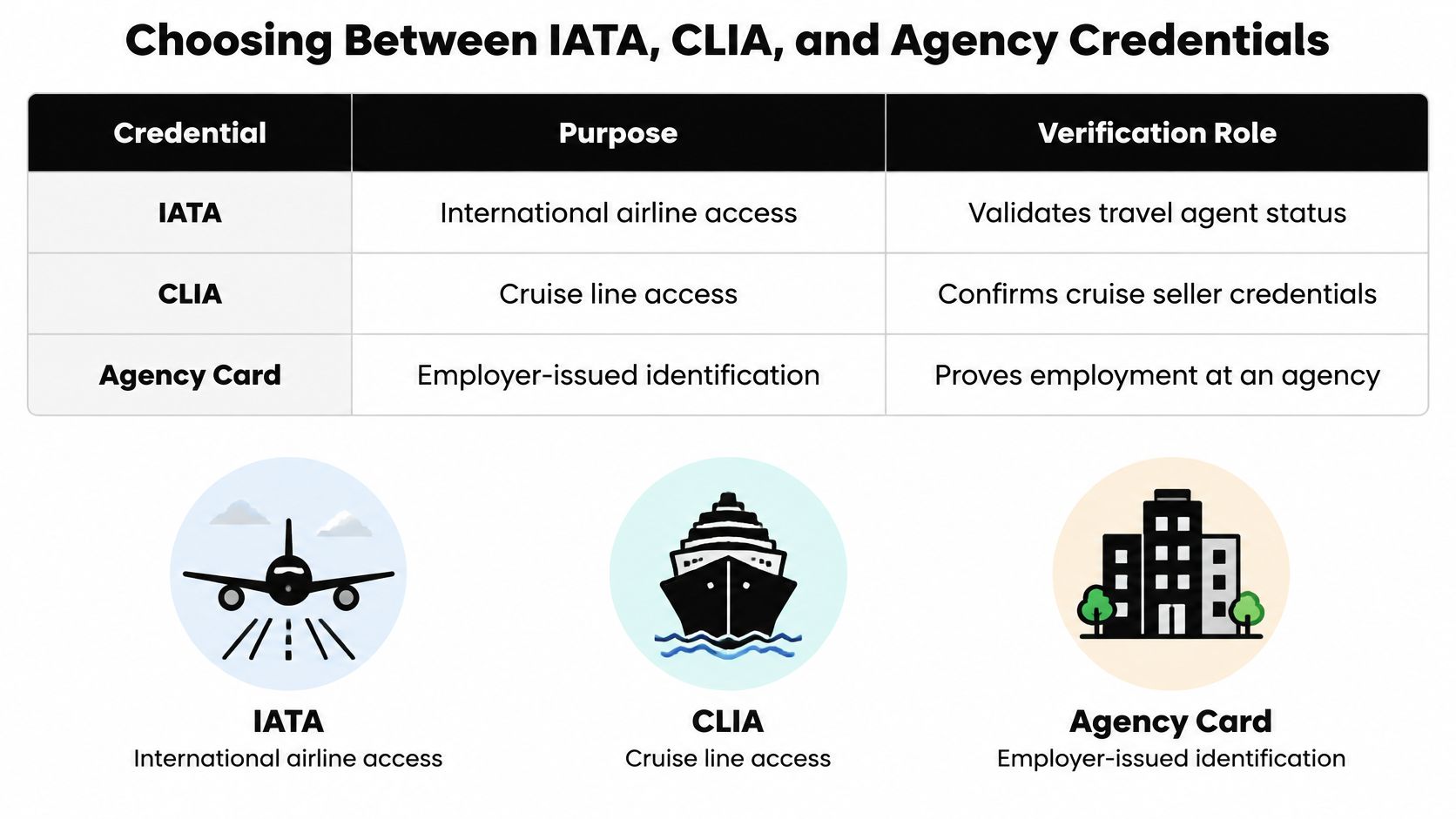
The IATA ID Card frequently asked questions make the boundary clear. The credential verifies professional status under a program's rules. It does not automatically grant discounted airfare, business class upgrades, agency only fares, or permission to use another person's benefits.
Credential routes compared
| Credential route | Best fit | Verify before booking |
|---|---|---|
| IATA or IATAN | Agents at accredited agencies selling air and general travel | Current personnel list status and supplier acceptance |
| CLIA | Cruise focused sellers working with cruise suppliers | Whether the line requires additional agency affiliation |
| Agency issued | Staff needing employer identification for known partners | Whether outside suppliers recognize it at all |
Four questions sort out most decisions. Who issued the card? What professional relationship does it document? Does your target supplier accept it? Does your agency hold the separate accreditation or enrollment the fare requires?
Independent contractors, new agents, students, part time workers, and host agency affiliates often find their eligibility differs by country and agency structure. Brand recognition is a poor selection tool. Pick the credential your real work supports, then confirm acceptance supplier by supplier.
Using a Card for Industry Fares and Benefits
Treat every industry booking as a fresh eligibility check, because that's how the supplier sees it. Your card gets you into the conversation. It doesn't close the sale.
A repeatable booking workflow
Confirm the supplier's current program rules before you quote anything. Check the required booking channel, because some rates only exist through a trade portal or a specific reservation path. Verify passenger eligibility next, since many industry offers cover the professional and defined companions only, not whichever client asked.
Then check travel dates, accepted payment methods, and whether your agency holds the ticketing authority for that product. Confirm the fare is available for your itinerary rather than assuming a published industry rate applies. Record the authorization behind the booking so you can show your work later.
Say an agent requests an industry hotel rate for a site inspection. She confirms her credential is current, checks that the property accepts it, books through the trade channel in her own name, and brings the documentation the property requires. What she doesn't do is book the same rate for a leisure client and hope nobody asks questions at check-in.
Practical rule: If the named traveler can't prove eligibility at check-in without your help, the booking shouldn't carry an industry rate.
Keep the categories separate in your own notes. Professional fare access tied to your status isn't a passenger discount. Agency only inventory isn't an employee benefit. Negotiated rates come from commercial agreements, not from your wallet card. Mixing these up in a client quote creates refunds and chargebacks later.
When a supplier asks for more documentation, supply it or walk away from that rate. Don't improvise, don't re-label the traveler, and don't argue that your card obligates them to honor an offer. Acceptance and availability belong to the supplier, and a clean paper trail protects your agency far better than one forced booking.
Compliance and Fraud Prevention for Remote Bookings
Remote selling is where a legitimate looking credential creates the most dangerous false confidence. Your card can raise your professional credibility while proving nothing about the money or the passenger attached to a booking.
The ARC guide to credit card payments notes that most transactions in the travel agency distribution channel are card not present, which makes it hard to establish that the customer is the actual cardholder. ARC recommends validating identity, confirming authorization for corporate or ghost card accounts, matching passenger and cardholder details where appropriate, and retaining evidence in case of chargebacks.
The photo below shows the everyday reality behind that guidance, credentials and identity documents sitting next to remote booking tools.

Separate four verifications every time
- Identity: Confirm the person presenting the credential matches the photo and name on it.
- Agency affiliation: Verify current employment or contractor status directly, not from a screenshot.
- Passenger details: Make sure the traveler named on the booking is the person who qualifies.
- Payment authorization: Confirm the payer approved the charge and keep the evidence.
Supplier check-in verification is its own thing too. Marriott's guidance illustrates how acceptance varies by market, since advisors in the United States may use an IATA, IATAN, or CLIA photo credential while some international advisors need photo identification plus a business card or employment verification letter. Ask what's accepted before travel instead of discovering it at the desk.
Warning signs worth acting on
Watch for cards presented after someone has left an agency, bookings made for nonqualified travelers, and anyone treating an agency code as a personal credential. Don't publish full images of your ID online or send them through casual messaging threads. With independent contractors, virtual teams, and digital credentials now common, a copied card image travels fast and verifies nothing.
If a supplier rejects your digital card, verify the original issuer, ask which alternative they accept, and follow their process. Trying to bypass their controls converts a minor delay into a credibility problem. The scale of the system makes discipline worthwhile, since IATAN reports approximately 19,341 accredited agencies and 155,042 registered agents, and suppliers verify carefully precisely because the network is large.
Alternatives for Independent Travel Agents
Plenty of capable independent agents can't get a traditional IATA or IATAN card yet, or work with suppliers who don't recognize it. That isn't a dead end. It's a business structure decision.
You can join a qualifying host agency and operate under its accreditation while building your own sales record. You can pursue a professional association route that fits your niche, such as cruise credentials for cruise sales. You can apply to supplier programs directly, since many hotels, tour operators, and cruise lines onboard sellers based on their own criteria. Or you can sell consumer fares without claiming industry status you do not hold, while your eligibility catches up.
Weigh each option against your destination markets, the suppliers you book, payment controls you can manage, and what your clients expect. Resources such as INVOLUNTARY REROUTE (I-REROUTE.COM), a podcast and membership platform covering travel agent IDs, agency discounts, and premium cabin pricing, can help you understand how these programs sit inside wider airline pricing before you commit money to a route.
Where hidden city pricing fits into this picture
That wider pricing context matters because industry fares are not the only discounted seats in the system. Hidden city fares, a practice traced back to the early 1990s and chronicled in the book Involuntary Reroute, exist outside agent credentials entirely. They arise when a connecting itinerary prices below the cost of a nonstop seat on the same route.
The GAO report on hidden city ticketing defines the practice as buying a connecting ticket while intending to end travel at the connecting hub, and it notes that most airlines prohibit it in their contracts of carriage, with remedies that can include canceling unused segments or demanding the fare difference. Commentary on premium cabin pricing, such as the I-Reroute material on business class deals, argues that airlines price those seats at rates the vast majority of travelers will never pay, and that carriers could end hidden city ticketing by simplifying fare structures but have little incentive to do so.
Follow that debate for context, but let carrier contracts and supplier rules govern how you book. Your credential, your accreditation, and your client's ticket each carry separate obligations, and keeping them separate is what keeps an independent practice viable.
If you want to understand how legitimate travel agent identification connects to industry fares, agency discounts, and the premium cabin pricing tactics airlines rarely explain, visit INVOLUNTARY REROUTE (I-REROUTE.COM) and take a test flight with sample episodes before subscribing. You'll find practical breakdowns built for travel agents, agency owners, and frequent flyers who'd rather spot real value than pay for a badge that promises what it can't deliver.