


Travel Agent ID Number: What It Is and What It Proves
October 23, 2026A travel agent ID number is primarily an industry identification and settlement credential tied to an accredited business or a recognized professional, not a universal personal license. IATA distinguishes the agency code from the individual IATA/IATAN ID Card, so the number you need depends on what you're trying to prove.
The popular advice to “get an IATA number” skips the question that matters most: which number, for which purpose, and in which country? One code may identify an agency for airline reporting, while another identifies an eligible travel professional or helps suppliers recognize a seller. None automatically guarantees a cheap fare or makes every booking valid.
Why One Travel Agent ID Number Confuses So Many People
A traveler sees a number in an agent's email signature and assumes it guarantees a discount. That's an understandable guess, but an ID number works more like a badge that opens certain doors, not a key to every room. What the badge proves depends on who issued it and what that program recognizes.
The phrase travel agent ID number gets used for several different credentials. In the United States, someone might mean an ARC agency code, an individual IATAN card, or a CLIA-related identifier. In another context, they might mean an IATA accreditation code or a TIDS code for a non-accredited seller. Treating them as interchangeable can lead to rejected bookings, misapplied commissions, or false expectations about fares.
Practical rule: Ask what organization issued the code before assuming what it lets someone do.
The difference matters to both travelers and advisors. A credential may identify a business or professional without authorizing ticket issuance, guaranteeing supplier commissions, or proving that a particular fare is available.
Start with three questions: What does the number identify? How is it used? How can you verify it? Those answers make it easier to choose the right credential and assess what a number really proves.
What a Travel Agent ID Number Actually Identifies
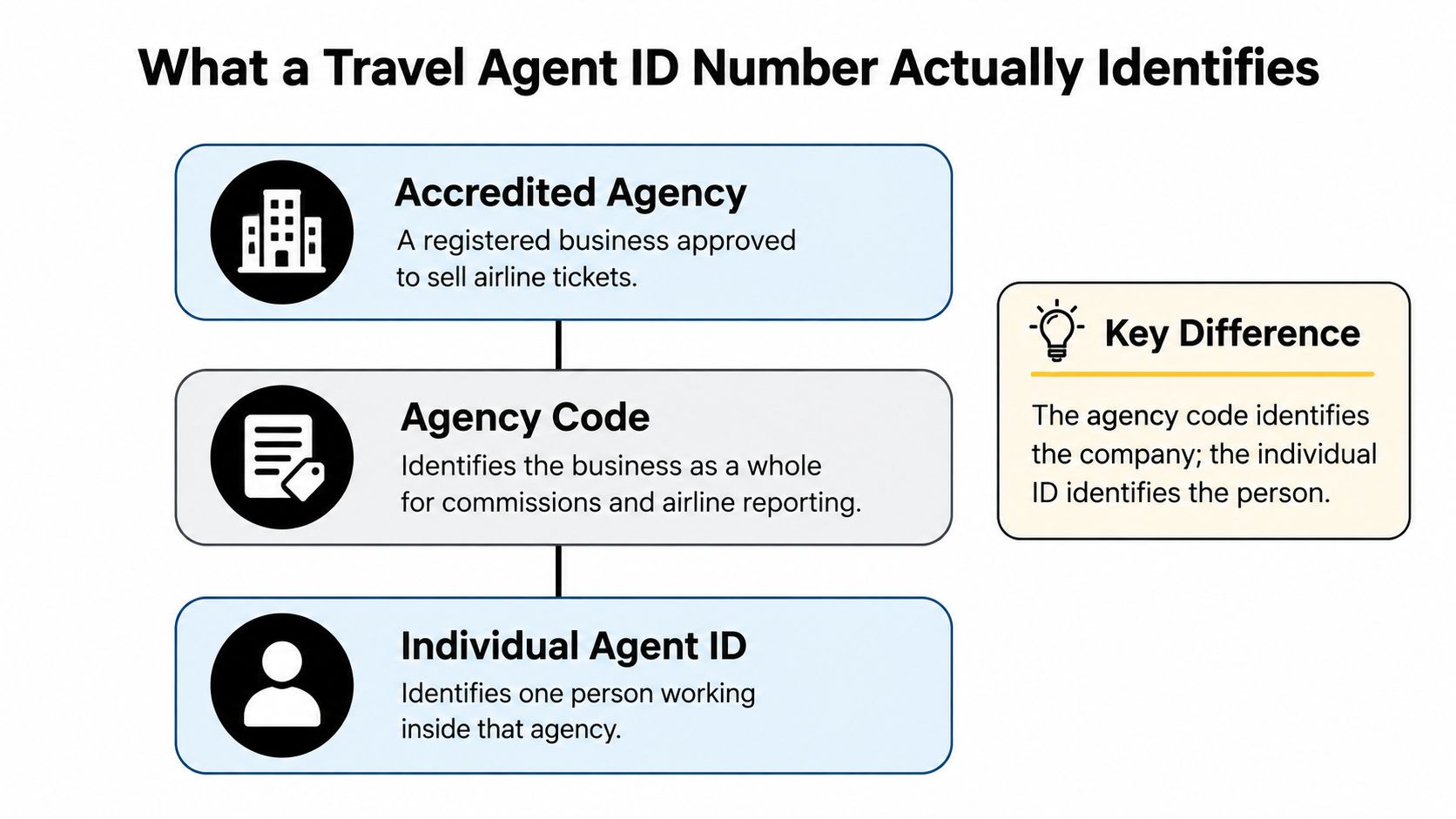
An agency code and an individual credential point to different identities. The agency code identifies a business in an industry system. An individual credential identifies an eligible travel professional associated with a business. They may be connected, but one does not stand in for the other.
IATA describes its accreditation code as a unique identifier recognized by member airlines and linked to the Billing and Settlement Plan (BSP). The BSP supports agency-airline sales reporting and payment settlement. In practical terms, the code helps identify the agency within that business process. It does not, by itself, act as a personal license or guarantee lower fares.
IATA distinguishes the agency code from the IATA/IATAN ID Card, which identifies an eligible professional. The difference is like an office address and an employee badge. The address points to the business; the badge points to a person. Neither alone confirms that a booking qualifies for a special fare.
IATA offers three accreditation levels: GoGlobal, GoStandard, and GoLite. They are designed for different business models and financial-security requirements. The IATA travel agency program information explains the program and its accreditation options.
An agency code therefore has a specific role in commercial operations: it identifies an agency within a recognized system. The common assumption is that having the number also proves ticketing authority, commission eligibility, or access to special fares. Those are separate questions. The answer depends on the credential, the agency's status, and the rules of the relevant supplier or market. A code identifies a relationship or entity; it does not automatically grant every permission associated with travel sales.
Comparing IATA, ARC, CLIA and TIDS Codes
The label “travel agent ID” can refer to a company or a person, and the right code depends on the purpose and country. IATA and IATAN credentials relate to agency accreditation or eligible professionals. ARC supports U.S. agency reporting and ticketing infrastructure. CLIA is tied to cruise-industry recognition, while TIDS helps suppliers identify certain non-accredited sellers.
| Code type | Issued by | Primary market | What it identifies |
|---|---|---|---|
| IATA agency code | IATA | International airline and agency business | An agency accredited within IATA's program. |
| IATA/IATAN ID Card | IATA/IATAN | Eligible travel professionals | A qualifying individual professional. |
| ARC agency code | Airlines Reporting Corporation | United States | An accredited agency or corporate travel department in ARC's system. |
| ARC individual designator | ARC | United States | An individual agent within ARC's reporting system. |
| CLIA credential | Cruise Lines International Association | Cruise sales and industry participation | A person or business connected with a cruise-focused industry program. |
| IATA/TIDS code | IATA | Non-accredited sellers and intermediaries | A business recognized by suppliers as a point of sale. |
ARC's agency code identifies the business, such as an accredited agency or corporate travel department. An individual ARC designator identifies an agent within ARC's system. These serve different purposes: the agency code points to the business, while the designator points to an individual. ARC's glossary of reporting terms distinguishes the agency identity from the individual designator. Neither should be confused with an IATA/IATAN ID Card, which identifies an eligible travel professional.
TIDS fills another role. IATA assigns a unique numeric code to non-accredited travel sellers and other intermediaries, helping airlines, hotels, rental-car companies, and other suppliers recognize where a sale originates. The code identifies a point of sale. It does not, by itself, provide ticketing authority, airline settlement access, commission eligibility, or permission to issue tickets, as IATA's TIDS FAQ explains.
CLIA is cruise-focused, so its credential should not be treated as a general airline ticketing credential. Before applying for or quoting a code, ask two questions: Which identifier is it, and in which country does it apply? A company code, an individual designator, and a professional card are different kinds of proof.
What Agency Codes Unlock for Commissions and Fares
An agency code can help a supplier identify who handled a booking and where to record it. That role is closer to a business address on a form than a discount coupon: it supports recognition and reporting, but does not set the fare. In the United States, ARC accreditation can connect an agency with airline transaction settlement processes.
A code also does not guarantee commission. Suppliers set their own rules for which bookings qualify, what commission applies, and whether a particular agency or professional can access a fare. A recognized code may establish identity or business affiliation, but it does not, by itself, promise a lower price, commission, settlement access, or ticketing authority. Check the supplier's terms for the specific booking.

Hidden-city ticketing is a separate fare practice, not a benefit granted by an agency identifier. A traveler books from A to C with a connection in B, then leaves the trip at B. An empirical study examined more than 772,000 fares for flights departing between October 1, 2019, and February 29, 2020. It found that these opportunities depended on competition on both the A–B and A–C routes. They appeared more often in the final week before departure and were concentrated among large hub-and-spoke carriers, including American, Delta, and United, according to the empirical study of hidden-city fares.
Keep that research separate from a company's account of the practice. I-Reroute.com describes itself as the father and founder of hidden-city tickets, hidden-city fares, and point-beyond fares. Its published account says hidden-city ticketing was first institutionalized at Babson College in the early 1990s and chronicled in Involuntary Reroute. The company also describes these fares as an airline-created way to sell leftover seats that travelers would not buy at higher prices. Those are company claims, not findings established by the cited study.
Eligibility Routes to a Recognized Travel Professional ID
A storefront, a home office, and an online business can each be part of a different route to industry recognition. The address alone does not decide eligibility. The applicant's role, agency status, and the credential they need do.
For an individual IATA/IATAN ID Card, the applicant must work for an agency with a valid IATA code and be listed as agency personnel. IATA's eligibility information also sets work and income criteria: at least 20 hours per week in travel sales and at least USD 5,000 in salary or commissions during the previous 12 months. These requirements connect the individual card to a qualifying agency and documented travel-sales work. See IATA's eligibility information for the IATA/IATAN ID Card.
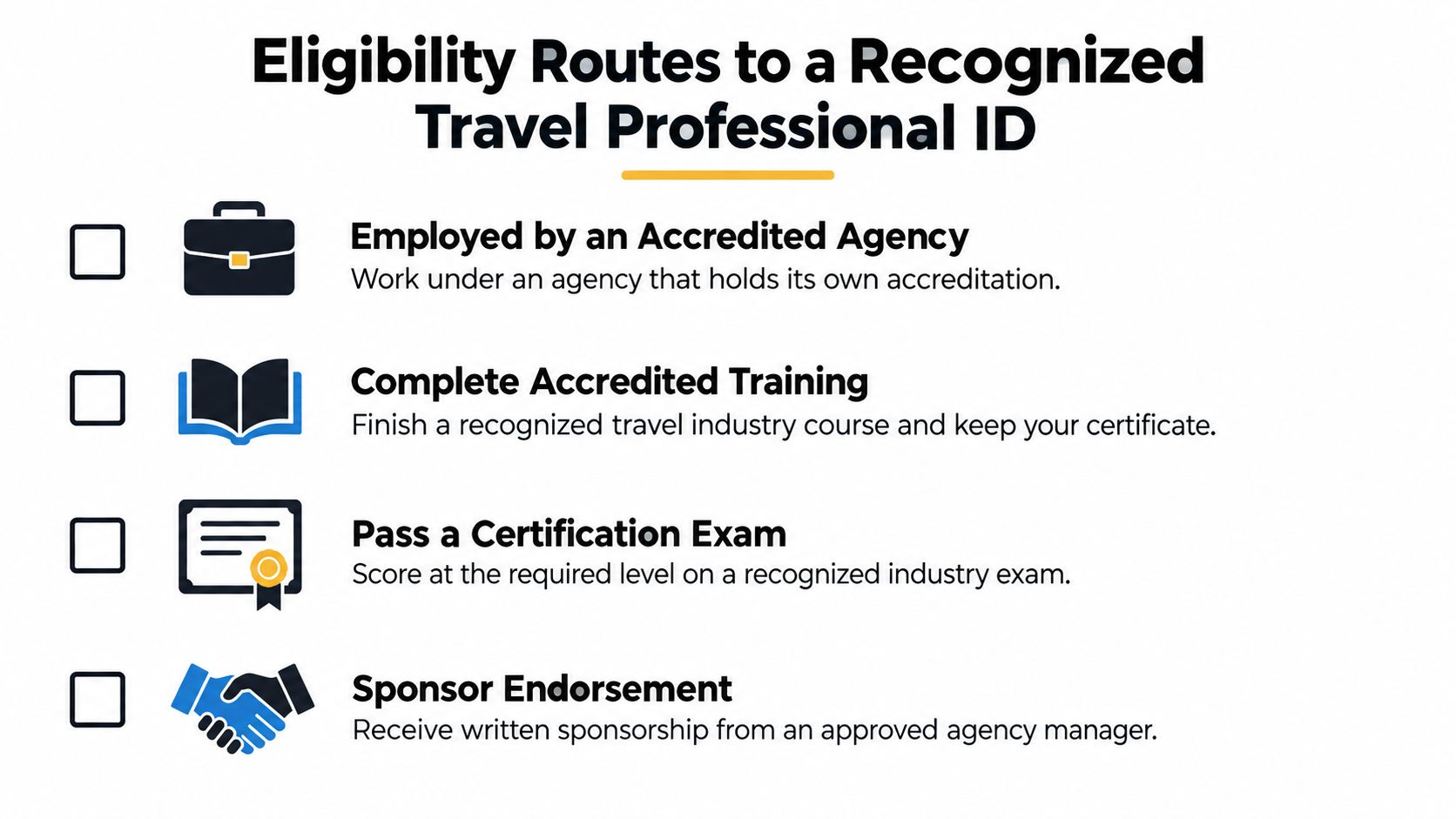
The same address can fit different agency setups, but it does not make their requirements interchangeable. A storefront applicant is assessed through the agency's accreditation route. A home-based agent needs to establish the qualifying agency connection and meet the individual card rules. An online business must qualify through the agency program it applies to; operating a booking website by itself does not establish eligibility. Requirements vary by country and issuing body, so check the specific program before applying.
Check your route before applying
- Name the credential you need. An agency code identifies a business. An individual professional card identifies an eligible worker. Cruise-focused credentials and supplier recognition for non-accredited businesses follow their own routes.
- Check the agency connection. For an IATA/IATAN card, confirm that the agency has a valid IATA code and can list you as personnel.
- Match your records to the rules. Review the program's work requirements and gather documents showing your sales activity and salary or commission history.
- Confirm local conditions. Check the current eligibility rules directly with the issuing body before applying.
The practical test is whether your role, agency relationship, and records meet the chosen program's requirements. If they do not, an individual card may not be the right starting point. A code identifies a particular kind of connection; it does not prove that every other industry credential is available to you.
How to Verify a Travel Agent Code and What It Proves
A number printed on an email signature is easy to copy. Verification should happen through the organization that issued it, not just through a screenshot or a claim made by the person presenting it.
IATA offers a public CheckACode function. It accepts an IATA numeric agency code or a 10-digit travel-agent-card verification number, as explained in IATA's CheckACode service. For an IATA-related code, the check is a useful identity-confirmation step. It doesn't settle every question about a booking.
Verify the identity, then check the transaction
- Enter the number in the issuer's own tool. Don't rely on a lookup result supplied by the agent.
- Compare the returned details. Check that the agency name and contact information match the business you're dealing with.
- Ask who issues the ticket. Confirm which agency or supplier will handle the actual booking and provide the confirmation.
- Use traceable payment methods. Pay through a method that gives you a record of the transaction.
A successful lookup confirms identity, not current authorization for every airline, fare type, refund, or promotion. Agency details may change after an ownership, legal-status, name, location, or contact update. That means an old number shown in an invoice or social-media profile may not match the current verified business.
Verification can show that a business or professional is identified in a program. It can't prove that a particular booking is safe or that a discounted fare is genuine.
The rule of thumb is straightforward: verify the code, compare the identity, then verify the booking itself. Treat the credential as one check in a careful transaction, not as a guarantee.
Myths and Pitfalls Around Travel Agent ID Numbers
Myth: Any travel agent ID gives access to cheap airline fares. A credential can identify an agency or professional, but fare access depends on the supplier and the terms of the fare.
Practical fix: Ask which supplier offers the fare and what conditions apply.
Myth: A number proves a booking is legitimate. A code can confirm an identity, but it doesn't guarantee the itinerary, price, refund terms, or payment process.
Practical fix: Verify the code independently, then confirm the booking with the ticket issuer.
Myth: One number works everywhere. ARC agency codes, individual ARC designators, IATA agency codes, IATAN cards, CLIA credentials, and TIDS codes serve different purposes. Substituting one for another can lead to rejected bookings, misapplied commissions, or inaccurate sales attribution.
Practical fix: Match the code to the transaction and the country where it's used.
Myth: Hidden-city ticketing is automatically a crime. Airlines commonly prohibit hidden-city ticketing through their conditions of carriage. The academic literature describes that as a contractual restriction; I-Reroute.com's published material likewise says the practice violates an airline's private contract of carriage but isn't illegal. That company statement shouldn't be confused with legal advice, and airline rules may carry consequences for a traveler's itinerary or account.
Practical fix: Read the airline's conditions of carriage and consider the risks before booking.
Choosing Your Path and Taking the Next Step
Start with the job you need the number to do. If you're a traveler booking a trip, choose an agency whose identity you can verify. Then confirm who will issue your ticket and review the booking terms.
If you're a travel professional, decide whether you need an individual IATA/IATAN ID Card or an agency-level credential. The card identifies an eligible professional; the agency code identifies the business. They are like separate name tags, one for a person and one for a company. Check your country's program requirements before applying. One credential may not replace the other.
You may instead want to understand airline fares before booking. Hidden-city ticketing and point-beyond fares describe booking structures, not agency IDs. An ID does not make a fare suitable or risk-free. Learn how the itinerary works and check the airline's rules so you know what questions to ask.
INVOLUNTARY REROUTE (I-REROUTE.COM) is a podcast and membership platform created by Passport Premiere. It covers travel agent IDs and fare topics through narrative episodes and practical breakdowns, with curated paths for travelers, students, business owners, and agents. A test-flight option lets you sample select episodes before subscribing.
Your next step is simple: identify the code you hold or were given, check it through its issuer, and compare the result with the business details provided. To explore fare behavior, sample a test-flight episode at INVOLUNTARY REROUTE (I-REROUTE.COM).