


Travel Agent Rates for Flights: A Complete Insider Guide
September 14, 2026Travel agent rates for flights today are usually zero base commission on the airline side, with agents earning through service fees, overrides, net fares, or restricted inventory such as AD75 and hidden-city ticketing. A common replacement fee is roughly $25 to $50 per flight booking, although the amount and structure vary by agency and itinerary.
The popular advice says to ask a travel agent for a cheaper airline ticket. That question is understandable, but it points at the wrong part of the system. Modern airline pricing usually isn't a simple retail price minus a secret agent discount. It's a network of public fares, private fares, negotiated markups, service charges, and tightly controlled eligibility rules.
The better question is: which fare inventory can the agent access, what restrictions come with it, and what work is the fee paying for?
That distinction matters because airlines once treated agents as a sales channel and paid meaningful commissions. Today, many airlines pay little or nothing on the base fare, while agencies earn by charging for expertise, selling net fares, securing supplier overrides, or accessing inventory unavailable to an ordinary shopper. The result is less like a coupon and more like a grocery store with a public shelf, a staff-only storeroom, and a restricted discount bin.
One further idea ties the system together. Airlines routinely price cabins and itineraries in ways that can leave seats unsold or make a connecting itinerary cheaper than a nonstop itinerary. Published fares, net fares, consolidator tickets, AD75 discounts, and hidden-city fares all reflect different responses to that underlying inventory problem. The agent isn't always finding a lower cost. Sometimes the agent is finding a different set of rules.
Why Travel Agent Rates for Flights Are Misunderstood
A “travel agent rate” is rarely a public ticket price with a secret discount removed. Historically, the phrase often referred to commission built into the published fare. U.S. and international airline commissions were generally fixed by airline cartels until 1985. They averaged about 6% to 7%, then reached roughly 10% for about a decade, before competition and airline policy changes reduced them, as documented in this history of airline commission changes.
That history created a durable assumption: if an agent receives commission, the agent should be able to remove it and pass the difference to the traveler. The modern arrangement is more like a store clearing space on an expensive shelf. Airlines can overvalue premium cabins, leave seats unsold, and release inventory through different rules and distribution channels. Published, net, consolidator, and hidden-city fares are different ways that unused capacity can reach a buyer.
The IATA Passenger Sales Agency Agreement factsheet explains that the agreement does not set commission levels. Each airline and agent negotiates those terms separately. Compensation may instead come from markups, service fees, negotiated arrangements, or access to fare inventory that ordinary shoppers cannot see.
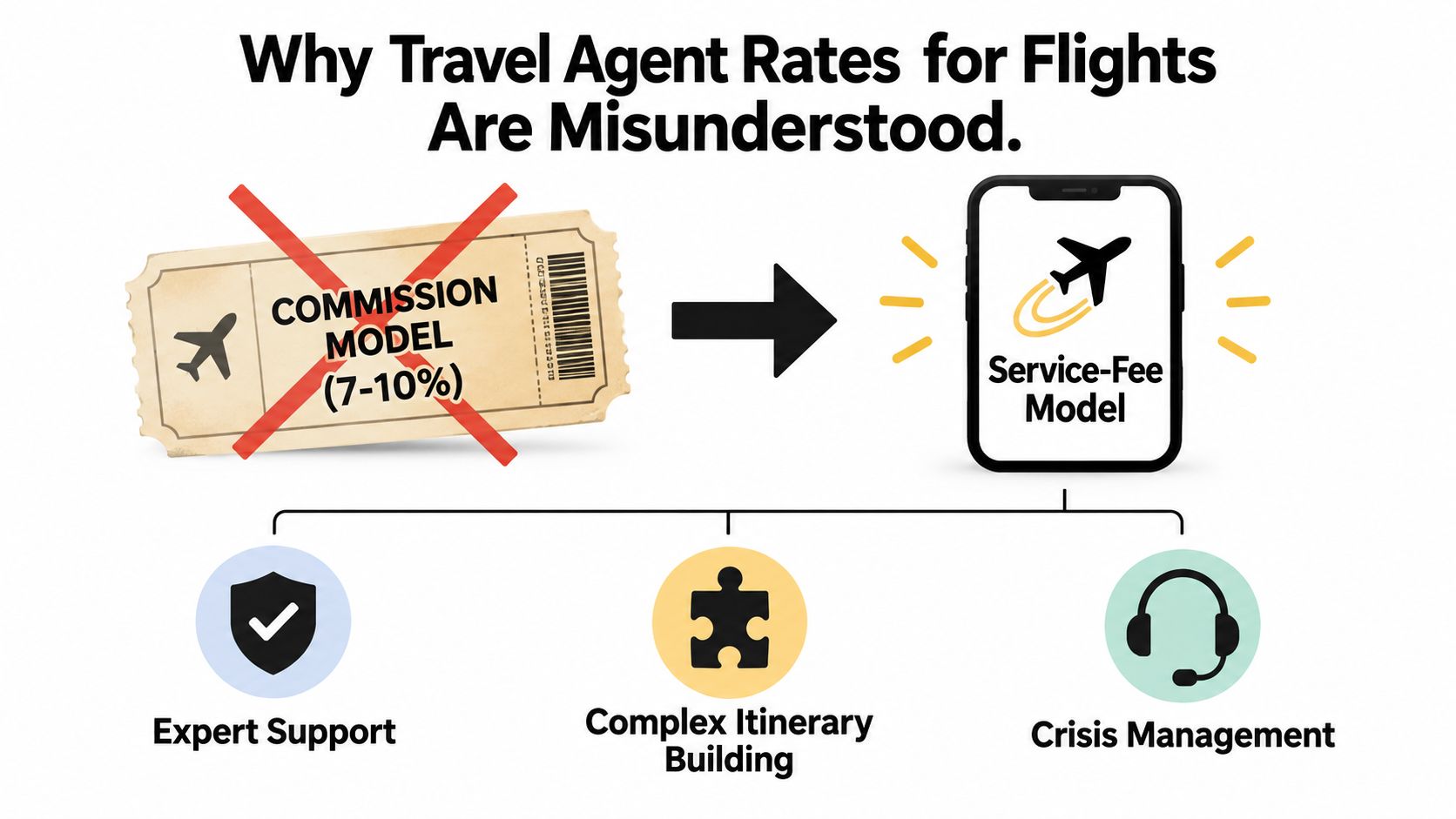
The shelf-price analogy
A grocery shopper sees the shelf tag. A contracted buyer may see a restricted stock list, provided the buyer has the right credentials, agreements, volume, and operating rules. Airline distribution works in much the same way.
Published fares are open to ordinary customers. An agent can book one and charge a professional service fee. Net fares separate supplier compensation, giving the agency room to mark up the ticket. Overrides reward selected sales channels under negotiated agreements. AD75 programs restrict access to eligible agency personnel.
The agent's value may therefore lie in solving a difficult itinerary, combining fare sources, or supporting a disrupted booking. A lower ticket price is possible, but it is not the definition of an agent rate.
Practical rule: Treat an agent rate as a question about access and service, not an automatic discount.
Compensation also varies by market. American Airlines' current commission policy states that it does not pay base commission on tickets issued outside the U.S. and Canada for qualifying itineraries originating in those territories. Ask two questions: what will I pay, and what will you do for that fee?
The Four Buckets of Flight Pricing Agents Actually See
Airline pricing becomes easier to understand when you sort it into four broad buckets. Think of them as four places in a store, each with a different access rule.
Public shelf fares
A published fare is the public price displayed by an airline website or online travel agency. It has visible conditions covering changes, cancellation, baggage, seat selection, and fare validity. The price may vary as inventory changes, but the customer can generally search and purchase it without agency credentials.
Published fares are often the cleanest choice for a simple trip because the traveler can compare the airline's rules directly. They also make loyalty-program handling and post-booking support more straightforward.
Staff-only net inventory
An agency net fare is a private rate presented to an agent through a distribution channel. The agent might sell it at the net cost, add a markup, or combine it with a separately disclosed service fee. Travelport's fare display documentation describes displays that let agents filter for airline net fares or agency net fares.
The distinction is operational. A private fare can change the agency's margin structure, but it may also carry stricter ticketing, refund, routing, or commission rules.
Consolidator stock
A consolidator fare comes through a wholesaler or specialist intermediary that has negotiated or bulk-access inventory. It can be useful for international, premium-cabin, or complicated itineraries, but the lower price can come with less flexibility and more limited servicing.
Industry and promotional fares
The final bucket includes industry discounts, promotional agent rates, and programs such as AD75. These aren't general public coupons. Eligibility, route, airline, cabin, booking class, and documentation can determine whether the fare is valid.
| Fare Type | Who Can Access | Typical Restrictions | Refundable | Commission Built In |
|---|---|---|---|---|
| Published fare | Public travelers and agents | Airline fare rules | Depends on fare | Depends on airline agreement |
| Agency net fare | Authorized agents and agencies | Private ticketing and fare rules | Depends on contract | Usually separated from the displayed net amount |
| Consolidator fare | Agents using eligible wholesalers | Routing, ticketing, servicing, and refund limits | Often restricted | Structured by wholesaler agreement |
| Industry or promotional fare | Qualified personnel or approved users | Eligibility, ID, cabin, route, and booking-class rules | Program-specific | Not designed as a public commission model |
Only the published bucket should be assumed to have the broadest consumer-facing flexibility. None of the other three is automatically refundable or safe for every traveler. A lower price is a different contract.
How GDSs, Host Agencies, and APIs Distribute Those Rates
An airline doesn't send every fare to every seller in the same way. Pricing engines create fare products, distribution systems display eligible content, and agencies apply their own credentials, contracts, and servicing tools.
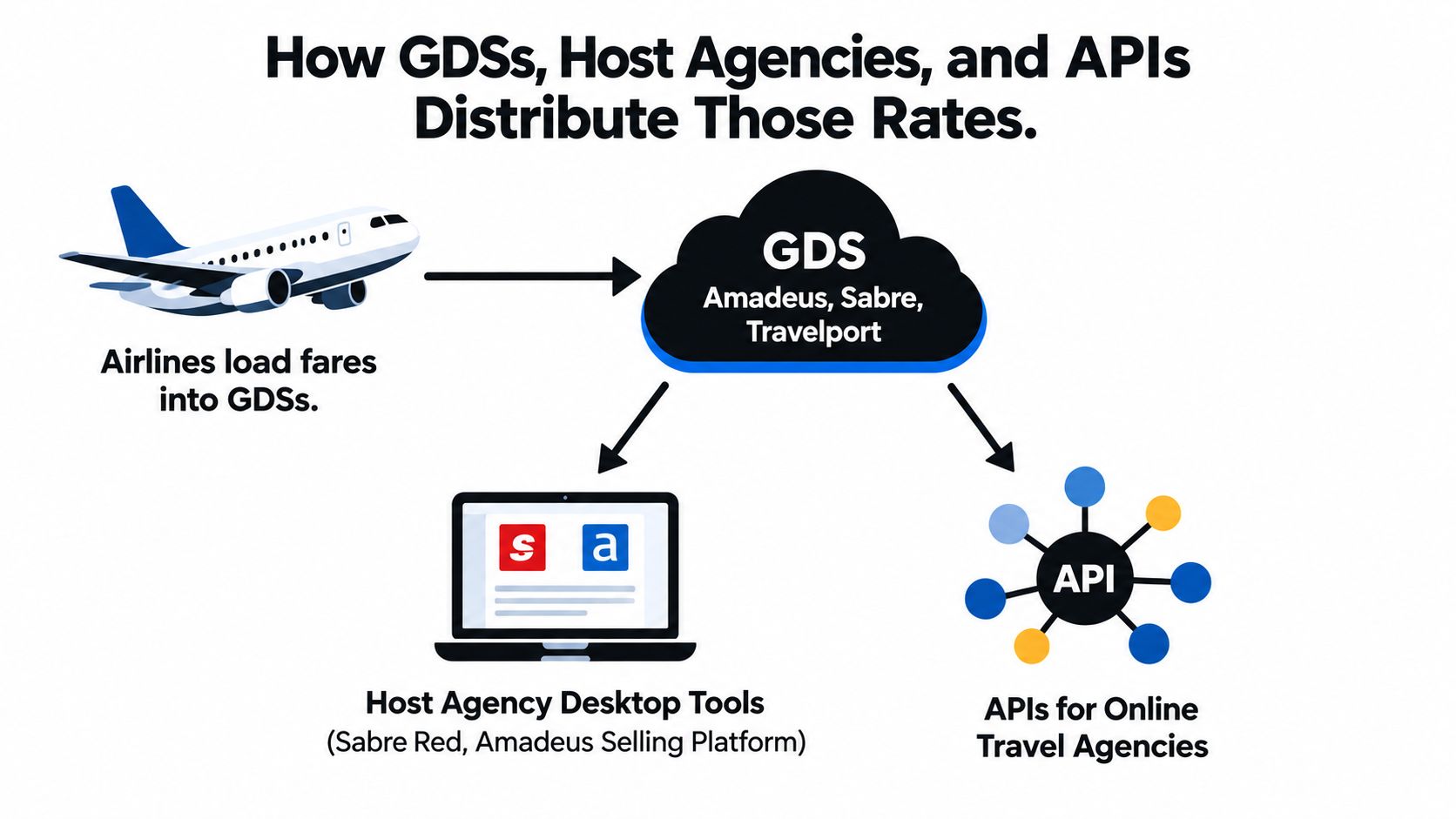
The distribution path
Airlines create and load fares. The airline defines the route, booking class, conditions, ticketing rules, and availability.
GDS platforms distribute the content. Amadeus, Sabre, and Travelport provide search and booking infrastructure for agencies. Travelport's fare tools show how agents can distinguish public and net-fare displays rather than treating every result as the same product.
Agency desktops turn content into work. Retail agents may use Sabre Red or Amadeus Selling Platform to price, ticket, exchange, and service reservations. The desktop doesn't create a discount by itself. It exposes the inventory the agency's access permits.
Host agencies and consortia add commercial layers. A host agency can provide ticketing support, accreditation, technology, and supplier relationships. Consortia such as Ensemble, Virtuoso, and Travel Leaders may negotiate preferred arrangements or amenities for participating agencies.
APIs republish selected content. Providers such as Duffel, Skyscanner, and Kiwi can surface airline content to online agencies and other booking interfaces. The API is a delivery method, not proof that every private agency fare is included.
Why two agents can quote different prices
Two agents may search the same route and cabin yet receive different results because they have different fare access, booking-class availability, private agreements, or consolidator connections. One may see an agency net fare while another sees only the public shelf price.
The difference also appears after the search. One agent may quote the net fare with a transparent service fee. Another may use a published fare and charge separately for research, ticketing, changes, and disruption support.
The credential opens the door, but the contract determines what is inside.
An ARC or IATA number can establish agency identity and access to approved systems, but it doesn't guarantee every fare or every discount. Accreditation is infrastructure, not magic. A responsible agent still has to check eligibility, ticketing authority, refund rules, and the traveler's actual needs.
AD75 and the Travel Agent Discount Myth
AD75 sounds like a universal 75% travel-agent discount. It isn't. The code describes a specific reduced-fare structure for eligible agency personnel, and the savings apply against the applicable unrestricted fare, not necessarily against the lowest public sale fare.
IATA agency-ticketing materials describe AD75 as 75% off the applicable unrestricted fare, leaving the ticket priced at 25% of the one-adult fare. The fare basis commonly carries the underlying Y fare with an AD75 suffix, as explained in the IATA reduced-fare ticketing material.
Why the base fare matters
Suppose the unrestricted benchmark in a market is high while a public sale fare is already much lower. AD75 applies to the qualifying unrestricted benchmark, so the apparent discount doesn't automatically beat every public promotion. Taxes, fees, route rules, cabin restrictions, and availability still affect the final ticket.
The program also isn't available to any traveler who knows the code. Eligibility can be limited to qualified agency personnel, ticketed staff, approved ID-card holders, and other categories defined by the airline or program. An ordinary customer generally can't ask an agent to apply AD75 to a public booking.
Air Canada illustrates the conditional nature of these programs. Its agency reduced-rate policy limits eligibility to qualified agency personnel, restricts the program to Air Canada-operated or marketed flights, and sets separate booking and cabin rules. Spouse travel has its own requirements, including travel on the same flights with separate bookings.
The audit trail
Airlines can see the traveler category, fare basis, agency credentials, ticketing record, and booking history. Misuse can therefore create consequences for the person traveling and the agency issuing the ticket.
AD75 is best understood as a lesson in fare construction. It shows how airline systems encode privilege into a fare basis, but it doesn't support the viral claim that every agent can permanently cut any ticket by 75%.
The Commission Collapse and Modern Agent Economics
Airline commissions did not vanish overnight. After Delta capped domestic commissions at $50 per ticket in February 1995, the U.S. Department of Transportation's Office of Inspector General documented further reductions. From 1995 to 1997, most airlines reduced domestic base commissions from 10% to 8%, with caps of $25 one way and $50 round trip. By November 1998, major airlines had capped international commissions at $50 one way and $100 round trip. This documented commission transition changed the agent's role from commission collector to service provider.
By 2005, all U.S. and most foreign carriers officially paid no commissions. Airline inventory still needed to move, but the money supporting the sale had to come from a different part of the transaction.
The old ticket and the modern booking
A $450 fare under a 10% commission model would have produced a $45 commission for the agency. Under a zero-base-commission model, that fare can produce no airline commission, so the agency may charge a service fee. Modern industry summaries commonly place that fee at roughly $25 to $50 per flight booking, although the amount depends on the agency, market, and work involved.
| Metric | Pre-2005 Model | Modern Model |
|---|---|---|
| Main airline compensation | Percentage commission or capped commission | Often zero base commission |
| Customer-facing agency income | Usually embedded in the fare economics | Service fee, markup, or separate professional charge |
| Private fare role | Less central to the traveler's explanation | Net and consolidator fares can shape the quote |
| Agency value proposition | Selling and ticketing airline inventory | Advice, access, ticketing, exchanges, and disruption support |
| Additional revenue | Airline sales compensation | Overrides, incentives, and other travel products |
The same fare can therefore support different business models. A published fare exposes the airline's public price, while a net or consolidator fare gives the agency room to add a markup. Both can reflect the same underlying problem: airlines assign high value to premium cabins, then release unsold capacity through other pricing channels.
What keeps an agency operating
An agency may combine a disclosed service fee, a net-fare markup, or an override under a negotiated supplier agreement. The client relationship may also include hotels, cars, insurance, cruises, or tours, where compensation structures differ.
Commission is separately negotiated between the airline and agent, as the IATA agreement factsheet explains. That arrangement does not guarantee payment on every booking.
The modern agent is paid for judgment, access, and responsibility. The ticket is only the visible output. Fare comparison, rule interpretation, exchanges, and help during disruption are the work that keeps the agency operating.
Hidden City, Point Beyond, and the Fare Asymmetry Problem
Hidden-city ticketing appears when a traveler books a journey beyond the city where they intend to stop, then leaves the aircraft at the connection point. A nonstop from A to B can cost more than a connecting itinerary from A to C through B, even though the traveler wants only B.
Researchers define the phenomenon as a pricing situation where a nonstop fare from A to B exceeds a connecting fare from A to C that connects at B. The research discussion of hidden-city ticketing treats the lower connecting itinerary as a response to airline fare structures and demand patterns.
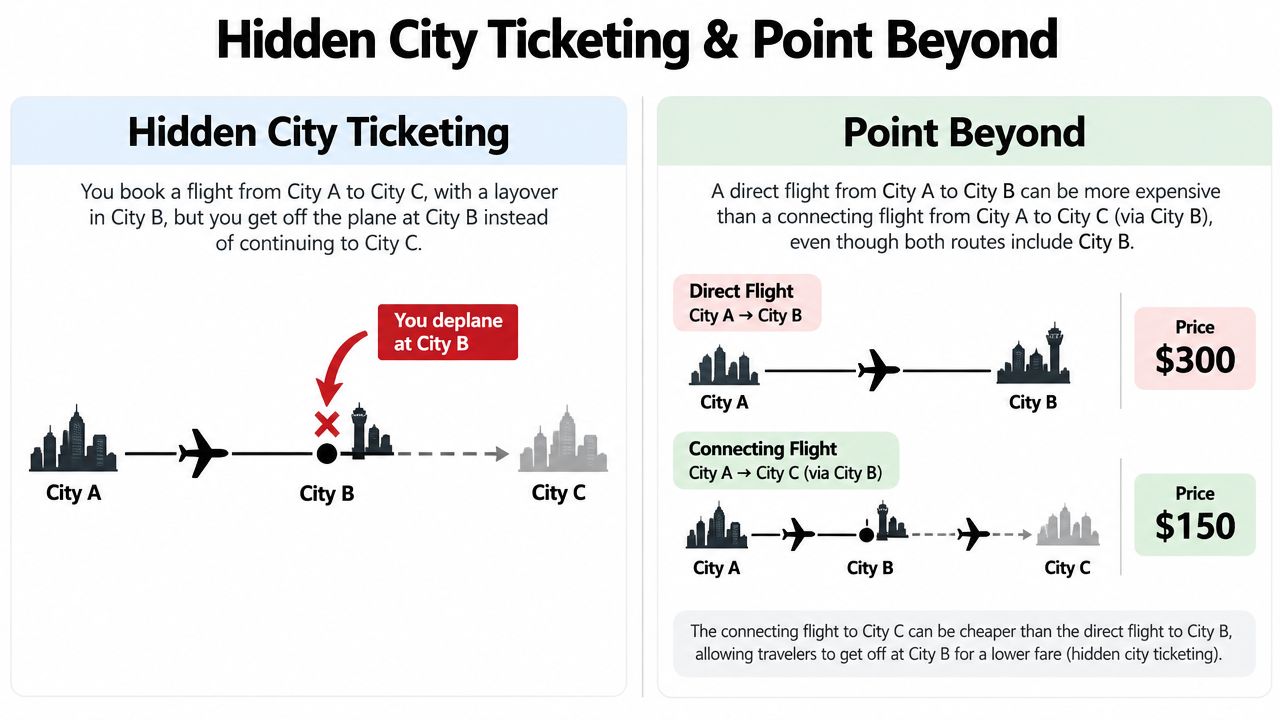
The asymmetry in plain numbers
A traveler might find JFK to SFO at $412, while JFK to LAX to SFO costs $248, with the traveler leaving at LAX. Those exact figures are an illustrative fare pattern, not a standing market quote. The important point is the relationship: the airline's origin-destination pricing can value the longer itinerary below the nonstop itinerary.
The same family of practices includes point-beyond ticketing, cross-border ticketing, and skiplagging. The academic literature identifies these related names and frames hidden-city pricing as a result of fare asymmetries, as described in this review of the practice.
Why the strategy is fragile
The lower fare doesn't remove the airline's conditions. Common risks include:
- Checked baggage: Bags may be tagged to the ticketed final city rather than the connection where the traveler exits.
- Return segments: Missing one segment can cause the carrier to cancel later segments on the same itinerary.
- Loyalty accounts: The airline may take action under its program rules.
- Contract terms: Conditions of carriage may prohibit intentional failure to complete a segment.
A separate study using over 772,000 fares for flights departing between October 1, 2019 and February 29, 2020 reported that hidden-city opportunities appeared mainly on carriers with large hub-and-spoke networks and were strongly connected to competition on both the origin-destination and connection segments. Those findings are described in the fare analysis study.
Hidden-city tickets aren't the same thing as an agent discount. They expose a pricing gap. The traveler responds to an itinerary the airline itself created, but the traveler accepts meaningful operational and contractual risk.
Why Airlines Secretly Prefer These Pricing Workarounds
The claim that airlines uniformly want to eliminate every hidden-city or private-fare channel doesn't fit their broader distribution behavior. Airlines use multiple channels to sell inventory, and each channel can reach a different customer with different willingness to pay.
Hidden-city ticketing is described in the requirement for a seat the traveler wouldn't buy at the higher nonstop price. Net and consolidator fares serve a related commercial purpose. They let airlines or intermediaries move inventory under rules that protect the public fare ladder.
The business logic
Airline revenue managers don't price every seat from a single universal shelf tag. They separate customers by route, timing, cabin, flexibility, and willingness to pay. A premium cabin may remain available while the public fare makes it unattractive to a price-sensitive traveler. A lower restricted itinerary can then act as an outlet for demand that would otherwise walk away.
That doesn't mean airlines endorse every traveler behavior. Public airline complaints focus on lost revenue and contract violations. The economic system can still benefit from maintaining a complex fare structure because complexity supports price discrimination while allowing selected inventory to move through controlled channels.
An airline can oppose a passenger's tactic and still benefit from the pricing architecture that made the tactic possible.
Why simplification isn't automatic
If carriers wanted to end fare asymmetries completely, they could simplify routing rules and align nonstop and connecting prices. But a simpler ladder would remove some of the ability to charge different customers different amounts for similar physical seats.
Airlines have also shown that they care about distribution costs and channel control. Their responses to distribution agreements and surcharges demonstrate that carriers may intervene when a sales channel threatens the integrity or economics of the published fare system. That is different from eliminating every private or restricted fare.
The most useful conclusion is analytical rather than conspiratorial. Hidden-city and net fares operate as release valves in a system that sometimes overvalues seats and underprices alternative itineraries. Airlines can criticize the traveler who uses the valve while retaining the complex plumbing that keeps it available.
A Practical Playbook for Agents and Value-Seeking Travelers
Agents should begin with the client, not the cheapest-looking screen result. A simple domestic itinerary may be best booked on a published fare with a clearly stated service fee. A complex international trip, multi-carrier journey, group movement, or disruption-sensitive itinerary can justify the agent's research and servicing role.
For agents
- Quote the public option clearly: Show the airline fare, your service fee, and the change or cancellation rules separately.
- Use private inventory carefully: A net or consolidator fare may help when the restrictions match the client's plans. Explain who handles changes, refunds, schedule disruptions, and ticket reissues.
- Treat AD75 as restricted: Verify eligibility, route, cabin, booking class, and documentation. Never present it as a guaranteed public discount.
- Protect loyalty priorities: If the client values airline status, mileage credit, seat control, or direct servicing, compare those benefits against any private-fare savings.
- Document the ticket: Record the fare basis, source, restrictions, and client approval before issuance.
For travelers
Ask the agent for an itemized quote. You should know whether the price is a published fare, agency net fare, consolidator fare, or industry fare, and whether the agency fee is refundable if you cancel.
Check the agency's credentials and operating identity. An ARC or IATA number can help establish that you're dealing with a recognized agency channel, but it doesn't prove that a particular fare is valid for your trip.
A service fee can be worthwhile when the itinerary requires judgment and follow-up. It may be less useful for a straightforward domestic booking when you already know the airline, schedule, and fare conditions.
Traveler checkpoint: If the agent can't explain the fare's restrictions in ordinary language, don't buy the apparent bargain.
Be cautious when an agent guarantees hidden-city savings, refuses to itemize fees, or pushes an opaque fare without explaining the final destination, baggage treatment, missed-segment consequences, and refund process. Hidden-city ticketing is a high-risk choice, not a routine replacement for an ordinary airline booking.
Use this final checklist before paying:
- Identify the fare source. Public, net, consolidator, or industry.
- Separate the fee. Ask what the agency charges and what support it includes.
- Read the restrictions. Changes, refunds, bags, seats, loyalty credit, and missed segments.
- Confirm eligibility. Especially for AD75 or other agency-only programs.
- Compare the full value. Include service, flexibility, and disruption support, not only the headline fare.
INVOLUNTARY REROUTE (I-REROUTE.COM) explains airline pricing tactics, including hidden-city ticketing, AD75 agency discounts, travel-agent IDs, mileage redemptions, and point-beyond fares, through podcast episodes and membership content. Visit INVOLUNTARY REROUTE (I-REROUTE.COM) to explore the fare mechanics and decide which lessons apply to your work or next flight.