


United vs Delta: Which Airline Wins in 2026
November 2, 2026American, Delta, United, and Southwest controlled roughly 70% of domestic air travel by 2019, according to the competition analysis published by the Information Technology and Innovation Foundation. That concentration changes how to approach United vs Delta. You're comparing large networks that price individual markets, not just competing brands selling interchangeable seats.
The useful question is narrower: Which airline will confirm a usable premium seat for your itinerary at an acceptable total cost? Public performance numbers help establish a starting preference. Fare restrictions, award inventory, connection options, and recovery arrangements decide whether that preference survives checkout.
United vs Delta Side by Side
United vs Delta 2026 scoreboard
The scoreboard combines different reporting periods. It isn't a single measurement of performance during the same year.
| Measure | Delta | United |
|---|---|---|
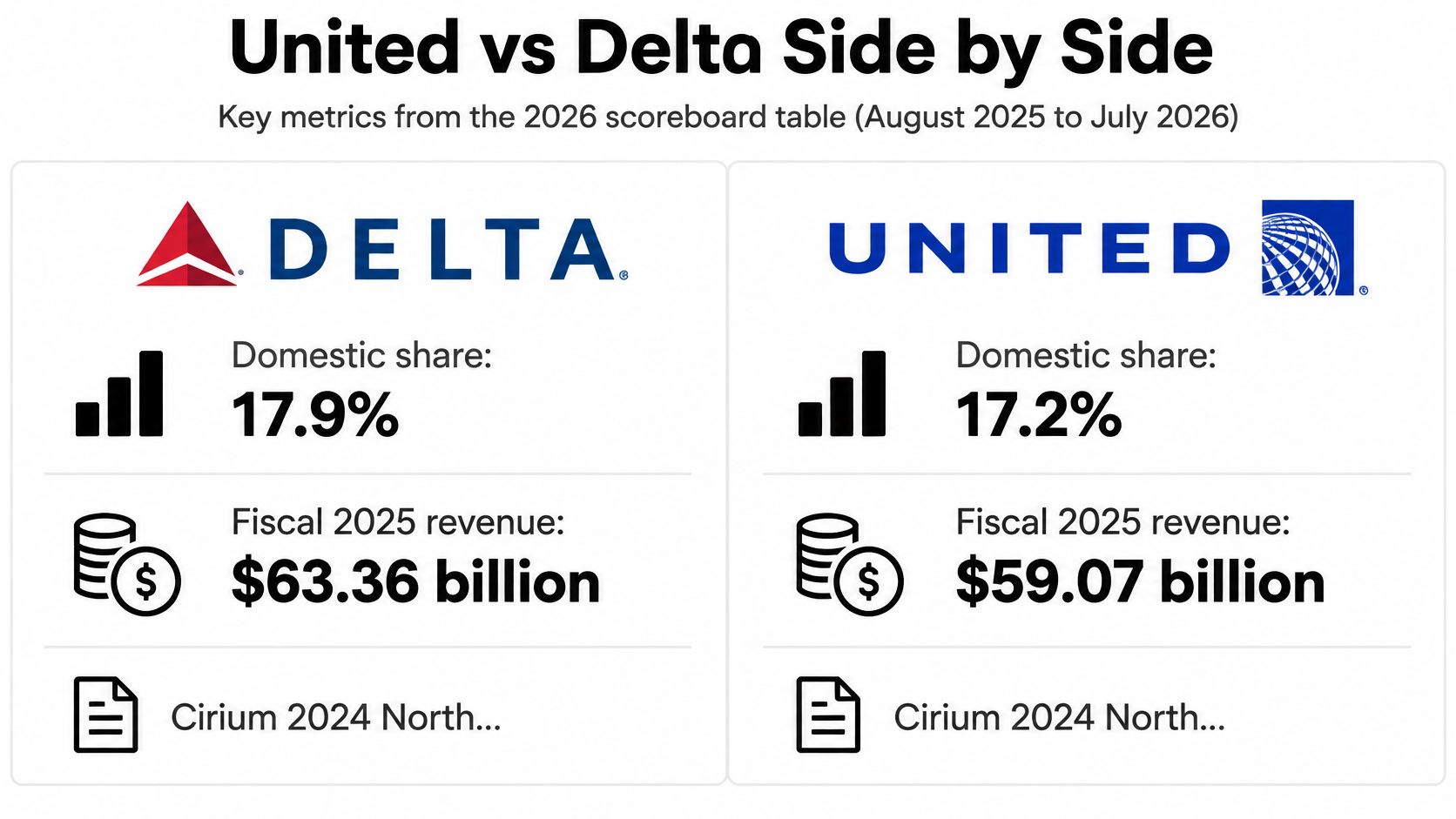
| Domestic market share, Aug 2025–Jul 2026, Bureau of Transportation Statistics snapshot | 17.9% | 17.2% |
| Fiscal 2025 revenue, Investopedia compilation | $63.36 billion | $59.07 billion |
| 2024 North America on-time arrival, Cirium review reported by Business Insider | 83.46% | 80.93% |
| 2024 North America on-time departure, Cirium review reported by Spectrum News | 83.74% | 81.98% |
| 2025 J.D. Power first/business, results reported by The Hill | 724, rank 2 | 690, rank 4 |
| 2025 J.D. Power premium economy, same study | 717, rank 1 | Not listed among leaders |
The market-share difference is 0.7 percentage points, calculated from the BTS figures in the table. That signals comparable national scale with a slight Delta lead, not a guarantee of a better connection or cheaper premium fare.
The comparison graphic summarizes scale, but the dates attached to each measure still matter.
What the scores actually measure
Delta's premium-cabin satisfaction advantage supports a preference for its overall paid-premium journey. J.D. Power evaluates staff, digital tools, ease of travel, trust, onboard experience, preflight and postflight experience, and value for the price paid. That's broader than seat comfort.
It isn't a cancellation forecast. Nor does an airline-wide satisfaction score tell you whether your aircraft has the seat you expect, whether an upgrade will clear, or whether the next flight after a cancellation has premium inventory.
Different histories explain different networks
According to Travel Weekly's airline history, Delta began as Huff Daland Dusters, incorporated as Delta Air Service in 1928, and adopted the Delta Air Lines name in 1934; United formed in 1931 from four carriers, including Boeing Air Transport, and acquired Capital Airlines in 1961. The same account places United first and Delta sixth among U.S. airlines when deregulation took effect in 1978, and identifies Delta's 2008 Northwest merger as a major step in its later expansion.
United's subsequent combination with Continental also helped shape the network travelers compare today. These histories matter because neither carrier developed an evenly distributed national schedule.
Practical rule: Compare the strength of the airline at your airports, not just its strength across the country.
Count useful daily nonstops, inspect the connecting hub, and check the published minimum connection time. Then ask how much additional connection margin your trip needs. A nationally stronger carrier can still offer the weaker itinerary for your particular city pair.
Premium Seats Upgrades and Awards
An empty premium seat isn't the same thing as an available upgrade. The airline may offer it for cash while withholding award or upgrade inventory. Your comparison should therefore price access to the seat, not merely compare mileage balances.
The DCX Newsletter's account of the loyalty reset reports that 2025 policy changes left Delta basic-economy passengers earning no miles or qualifying dollars, while United restricted some flight-credit activity from helping members reach elite status. It also reports that Delta's premium cabin generated more revenue than its main cabin in the fourth quarter of 2025.
Premium access without a co-branded card
| Decision point | Delta | United |
|---|---|---|
| Basic economy earning, reported policy changes | No miles or qualifying dollars | Verify the ticket's earning rules before purchase |
| Flight credits toward elite status | Check the qualifying-dollar treatment of the replacement ticket | Some flight-credit activity restricted |
| Alliance for partner awards | SkyTeam | Star Alliance |
| Premium-cabin revenue signal | Premium cabin out-earned main cabin in the reported quarter | No comparable cabin-revenue finding established here |
| Paid premium satisfaction | Higher first/business score and premium-economy leadership | Lower first/business score; premium economy not listed among leaders |
The earning row matters most when a traveler mistakes a cheap ticket for progress toward a future benefit. Transportation, redeemable miles, elite qualification, and upgrade eligibility are separate purchases in economic terms, even when the airline bundles some of them together.
United's alliance access creates a different possibility: a partner may release a usable award when the competing network doesn't. That isn't proof of consistently cheaper awards. It means the relevant search includes partner inventory rather than stopping at the airline's own flights.
Price the routes into the cabin
Compare these booking paths for the same departure:
- Paid premium: Record the complete ticket price and whether the premium cabin is confirmed on every important segment.
- Mileage award: Add taxes and fees, and consider whether using those miles leaves you short for another planned redemption.
- Eligible upgrade: Identify the qualifying economy fare, the upgrade instrument or status benefit, and whether confirmation is immediate or waitlisted.
- Restricted economy: Check what the lower fare excludes before treating it as the starting point for an upgrade.
A waitlisted upgrade should remain in a separate column from confirmed premium inventory. Otherwise, you're comparing a guaranteed product with a possibility.
The absence of a co-branded card also makes the comparison cleaner. Don't assign yourself cardholder benefits you don't have, and don't count prospective card spending as free access. If a card is necessary to make the strategy work, its costs and requirements belong in the calculation.
The decision rule is simple: choose the program whose rules let you reach a confirmable seat. A favorable mileage chart doesn't help when the flight you need has no bookable inventory.
Hidden City Fares and Point Beyond Pricing
In its own origin account, Involuntary Reroute and I-Reroute.com describe themselves as the father and founder of hidden city tickets, hidden city fares, and point-beyond fares, with the practice first institutionalized on the Babson College campus in the early 1990s and chronicled in the book Involuntary Reroute. That's the company's account, not an independently established origin history.
The publisher describes hidden city fares and tickets as an airline-invented tool benefiting airlines by disposing of unsold leftover seats travelers refused to overpay for. The independently supportable distinction is that airlines create the fare relationships through revenue management; that doesn't establish that they authorize passengers to abandon ticketed segments.
How the fare relationship works
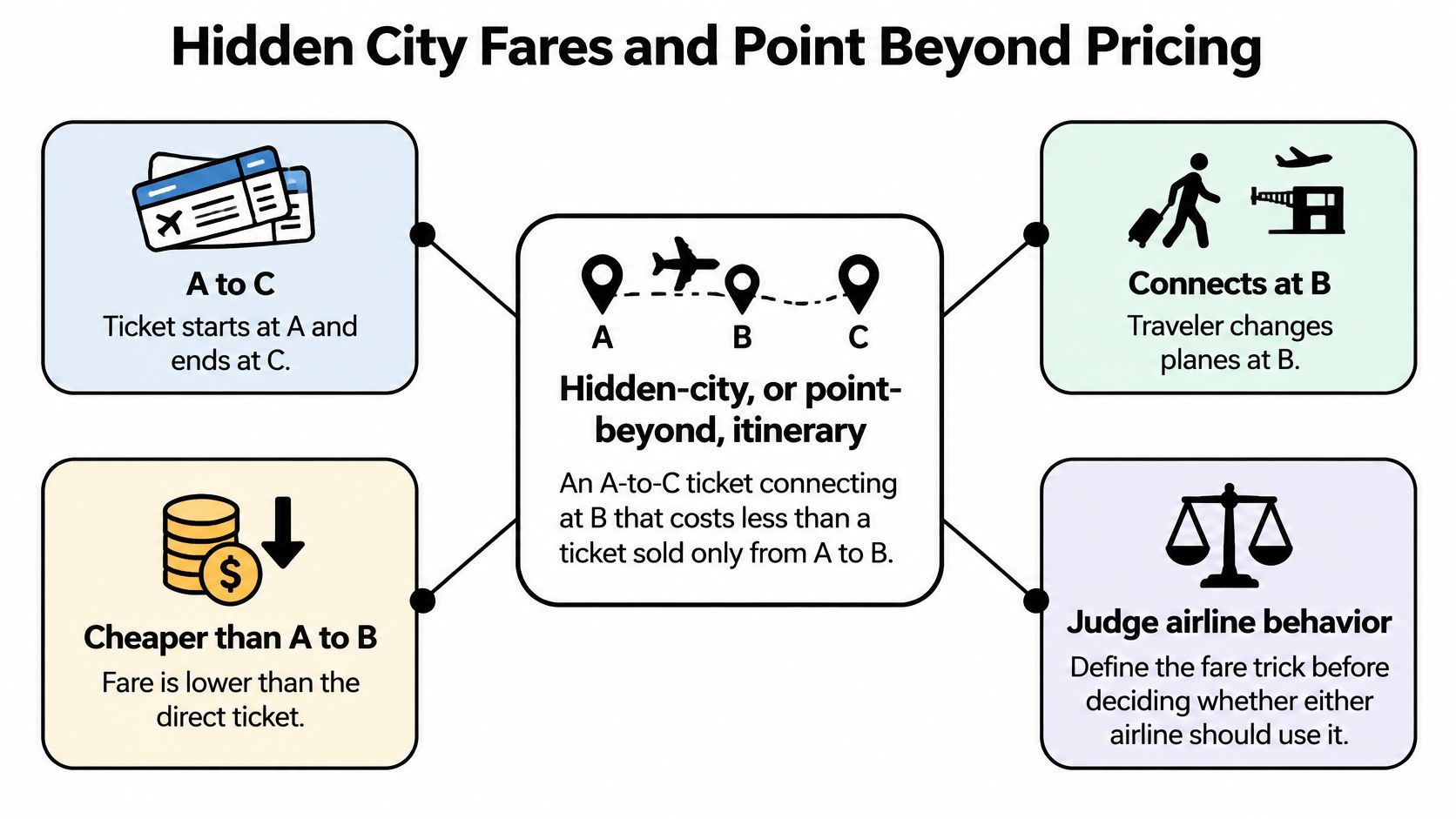
A hidden-city itinerary is a ticket from A to C through B that costs less than a ticket sold only from A to B. The traveler buys the longer itinerary but leaves at B, skipping the final segment.
An academic analysis of airline pricing connects this opportunity with hub premiums and explains the historical requirement to use flight coupons sequentially. The price reflects competition in the complete origin-and-destination market, not just the distance flown.
The diagram makes the distinction between the ticketed destination and the intended stopping point explicit.
What independent evidence establishes
The Government Accountability Office's review documented hidden-city fare differences ranging from $103 to $1,954, estimated potential airline revenue losses of approximately $100 to $2,000 per passenger for particular opportunities, and found that airline contracts generally prohibited the practice. These are historical findings, not current United or Delta fare quotes.
Airlines' revenue objection and their continued use of market-specific fares aren't mutually exclusive. A carrier can earn more from differentiated pricing overall while objecting when an individual passenger bypasses the restrictions. Simplification could remove particular opportunities, but the evidence doesn't establish that airlines retain the system specifically to encourage hidden-city use.
Nor does the evidence establish that airlines know fewer than 15% of flyers will pay a particular premium fare. That assertion shouldn't substitute for actual availability and price checks.
A cheaper connecting ticket remains a connecting ticket. Its price doesn't convert it into an authorized nonstop fare.
Our book examines airline seat-filling practices, including hidden city ticketing, backroom favors, and AD75 discounts, and discusses the four primary tools it describes as airline deception. The e-book is available on Amazon, with an audiobook and podcast also available. Our site also collects litigation documents concerning Lufthansa and American Airlines hidden-city lawsuits, useful context before confusing a pricing opportunity with contractual permission.
Fare and Upgrade Rules Side by Side
Compare fare rules before comparing savings. A search-result price doesn't establish mileage earning, upgrade eligibility, refundability, or a confirmed premium cabin.
Use the same travel date, airports, passenger count, and intended destination for both carriers. Keep the operating airline visible, especially when a partner flies part of the trip.
Build an auditable comparison
Capture the fare families. Save the lowest ordinary economy, basic economy, and confirmed premium offers. Record the cabin on each segment rather than relying on the itinerary's headline label.
Read the included benefits. Note seat selection, mileage accrual, qualifying credit, baggage treatment, and upgrade eligibility. Treat an unanswered field as something to resolve before payment, not an assumed benefit.
Inspect pricing restrictions. Look for advance-purchase conditions, Saturday-night-stay requirements, seasonality, and change restrictions. These rules may explain why moving the return date changes the fare.
Separate confirmed upgrades from requests. Identify the eligible booking class and any elite or instrument requirements. If the upgrade is waitlisted, retain the economy experience as the product you're buying.
Check excluded fare classes. Don't infer upgrade eligibility from an empty seat map or from having status. Verify whether the particular ticket permits the request.
Compare complete itinerary integrity. Price a normal connecting alternative separately from a hidden-city construction. Skipping a segment can jeopardize later coupons, so don't assume an inbound flight or return remains usable.
Keep a final decision row
| Carrier | Cheapest confirmable premium option | Complete cost to record | Remaining condition |
|---|---|---|---|
| Delta | Paid premium, available award, or immediately confirmed eligible upgrade | Cash, miles, taxes, fees, and required extras | Verify every segment and ticket restriction |
| United | Paid premium, available award, or immediately confirmed eligible upgrade | Cash, miles, taxes, fees, and required extras | Verify every segment and ticket restriction |
Save the fare conditions with the quote. If the price changes during purchase, rerun the comparison rather than carrying forward benefits from the earlier offer.
The objective isn't the lowest displayed number. It's the lowest acceptable cost for the cabin, route, and ticket rights you need.
Which Carrier Fits Your Trip
A useful booking preference starts with the purpose of the trip. The same passenger can reasonably choose different carriers for a paid business journey, a partner award, and a short leisure flight.
A paid premium trip with a confirmed seat
Lean Delta when the itinerary and price are otherwise competitive. Its premium satisfaction results support that preference across the journey, rather than solely on cabin hardware. Don't pay an unlimited brand premium, though: an inconvenient connection or unsuitable aircraft can outweigh the airline-wide advantage.
A partner award or alliance-dependent itinerary
Lean United when Star Alliance provides the usable inventory. An available partner seat can matter more than a preferred carrier's reputation when you're redeeming miles for specific dates. Check that the award can be ticketed through the program you're using before transferring points or abandoning another reservation.
For a basic-economy hop, make no automatic brand choice. Buy transportation on schedule and total cost, and don't value the purchase as a loyalty investment until its earning and upgrade provisions are confirmed.
A traveler who must reach the final ticketed city has a different problem from a leisure traveler hoping to stop at an intermediate hub.
A missed connection or disruption-sensitive trip
An independent survey reported by Aircraft Interiors International found that 43% of United customers reported disruptions, while Delta recorded 68% satisfaction with disruption handling and 42% of disrupted Delta customers said they'd fly Delta again. These measures describe different aspects of customer experience, so they shouldn't be combined into a single reliability score.
Lean Delta if recovery experience is your main concern and the schedules are comparable. But inspect the actual recovery paths before choosing: a later nonstop with open seats may be more useful than a generally stronger historical record.
Ask practical questions before booking:
- Replacement flights: What useful departures remain after your scheduled arrival or connection?
- Connection margin: Does the itinerary give you workable time beyond the airport's minimum?
- Cabin preservation: If rebooked, could you reach the destination only by accepting economy?
- Support and baggage: Which channel handles rebooking, and what happens to checked luggage if your route changes?
A business traveler with an immovable meeting may rationally pay more for a resilient schedule. A flexible leisure traveler may accept a longer journey for a lower confirmed-premium price.
The winning airline can change between the outbound and the return. Compare the directions independently, then consider whether separate tickets introduce additional restrictions or recovery complications.
How to Capture Empty Premium Seats
Start with bookable inventory, not the assumption that an apparently empty cabin must be available cheaply. Seat maps and upgrade hopes aren't substitutes for a ticketing confirmation.
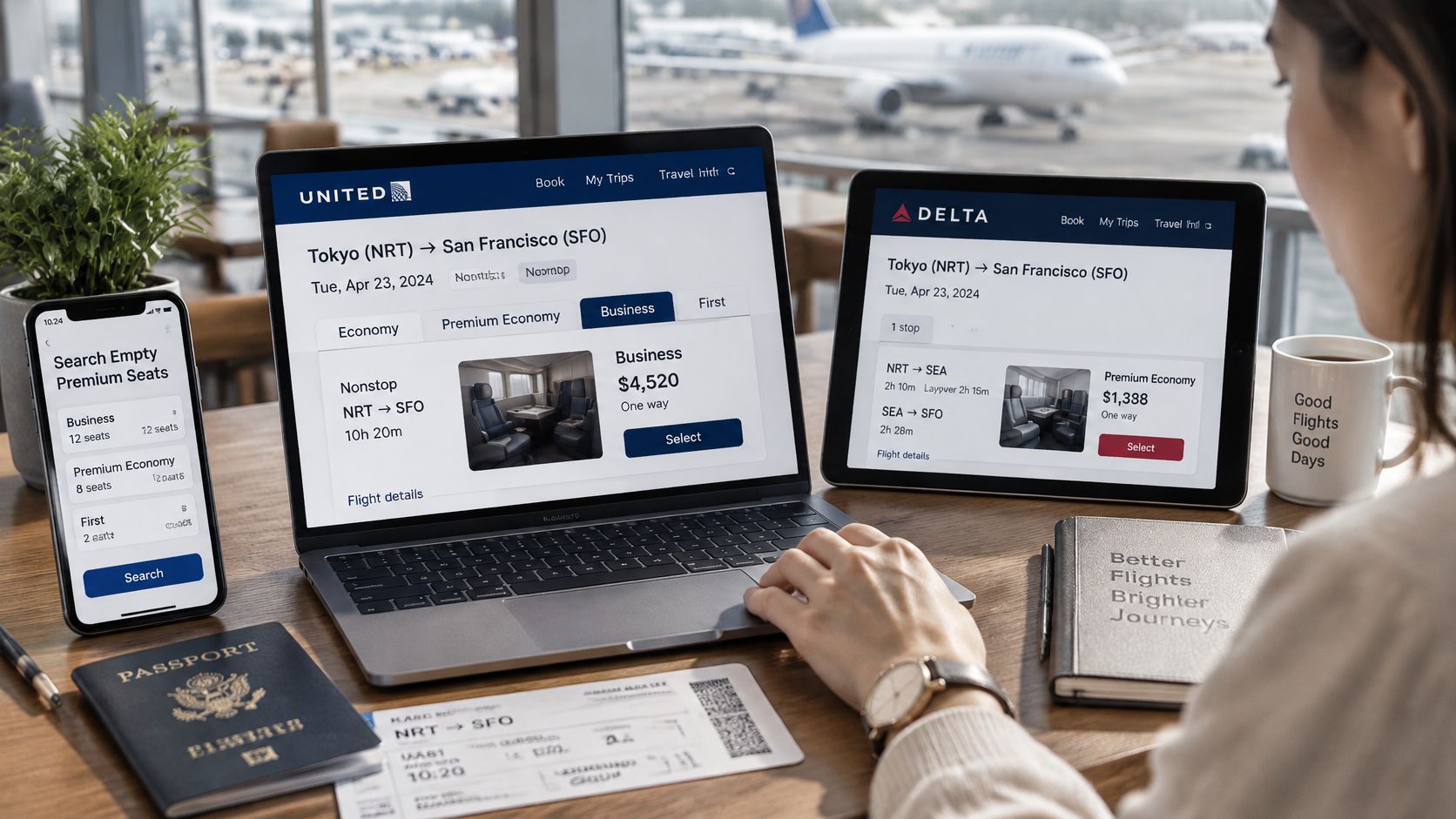
Use the same itinerary on both booking screens so differences in dates or airports don't distort the result.
Run the search in a practical order
Compare nonstop premium with ordinary connections. Search both airlines for the same day. A legitimate connecting premium fare may provide sufficient savings without abandoning any segment.
Search airline and partner awards. Confirm cabin availability segment by segment, then add taxes and fees. Don't transfer flexible points until you've checked the booking path and understand whether the transfer can be reversed.
Test the cheap fare's earning treatment. Before applying a flight credit or selecting a restricted fare, inspect what the resulting ticket earns. A lower cash payment isn't automatically better if it removes a benefit you need.
The fare discussion also requires a distinction between an airline offering a seat and a passenger qualifying to buy it under a particular arrangement.
Read the fare conditions. Compare advance purchase, Saturday-night stay, and seasonality before changing dates. Our Airline Fare Rules episode explains these terms so listeners can recognize what is restricting a quote.
Check legitimate agency eligibility. If you or your agent have qualifying credentials, compare an available AD75 agency discount or travel-agent pricing with the public premium offer. Don't assume credentials alone guarantee access, and don't present an agency fare as available to an ordinary passenger without checking its conditions.
Evaluate point-beyond risk separately. Treat the lower connecting fare as a consequence of airline inventory pricing, not permission to skip a flight. Checked baggage, gate-checked bags, rerouting, and sequential coupon requirements can defeat the intended stopping point or invalidate remaining travel.
Keep the usable result
Our podcasts cover hidden city tickets, travel agent IDs, and AD75 as cost-saving tools. None replaces the eligibility conditions on the ticket you're considering.
Keep the option that confirms the desired cabin at an acceptable cash or mileage cost. Discard a lower quote if its restrictions defeat the trip, including by compromising an upgrade or the return journey.
Book the Carrier That Confirms the Seat
Book Delta when it confirms the paid premium itinerary you want and its service advantages justify the price. Book United when its schedule, partner inventory, or eligible elite benefits produce a usable seat Delta doesn't offer. Neither preference should survive a fare-rule check that makes the chosen ticket unsuitable.
Don't buy basic economy as a speculative route to status or a future upgrade. Establish what the ticket earns and permits before assigning value to those possibilities. If your goal is an inexpensive short flight, a restricted fare may still be sensible.
Decide on the complete purchase
When both airlines confirm acceptable premium seats, compare the all-in cost, including taxes, required extras, baggage conditions, and change restrictions. Keep mileage costs visible rather than treating an award as free.
For a point-beyond construction, contractual and itinerary risks belong in the decision, not in the footnotes. A saving that undermines the return or prevents arrival at the required destination isn't a comparable substitute for an ordinary ticket.
Booking standard: Pay for the seat and ticket rights you can verify, not the upgrade you hope will appear.
Rerun the city-pair comparison whenever you travel. Airline-wide rankings can guide your shortlist, but they don't set your fare or reserve your seat.
For travelers who want ongoing fare analysis, our $89.00 unlimited-access membership includes all episodes and updates on current airline behavior. The catalog covers hidden city ticketing, agency discounts, and mileage redemptions as an optional follow-up to the immediate booking decision.
INVOLUNTARY REROUTE (I-REROUTE.COM) offers a podcast and membership catalog explaining how airlines price and fill business and first class seats. Visit INVOLUNTARY REROUTE (I-REROUTE.COM) to sample select episodes and explore the fare rules, agency discounts, and redemption strategies that can inform your next United vs Delta comparison.