


What Does Redeem Miles Mean and How It Actually Works
September 12, 2026You're looking at a miles balance that took months, or years, to build. A flight search shows a tempting award price, but the checkout page adds taxes, fees, and perhaps a carrier surcharge. Then another question appears: should you use the miles now, or save them for a trip that might offer better value?
That's the meaning of redeeming miles. You aren't claiming a free flight. You're exchanging loyalty currency for a travel benefit, and the quality of that exchange depends on award availability, pricing rules, routing, and cash costs.
What Redeem Miles Actually Means
You find a flight that costs more in cash than expected, then notice your mileage balance could cover the award fare. Redeeming miles means converting that loyalty currency into a travel benefit, usually an award flight. Depending on the program, redemption may also cover upgrades, hotel stays, car rentals, merchandise, statement credits, seats, bags, or bundled travel benefits. Frontier's official miles redemption guidance includes award flights and bundles with travel extras.
Miles work more like restricted currency than cash or a coupon with one fixed discount. Their value changes with award inventory, the program's pricing rules, taxes, fees, and the reward you select. A redemption can be sensible for one route and poor for another. In some markets, dynamic award prices, carrier-imposed surcharges, or an unusual routing can determine whether using miles is better than paying cash.
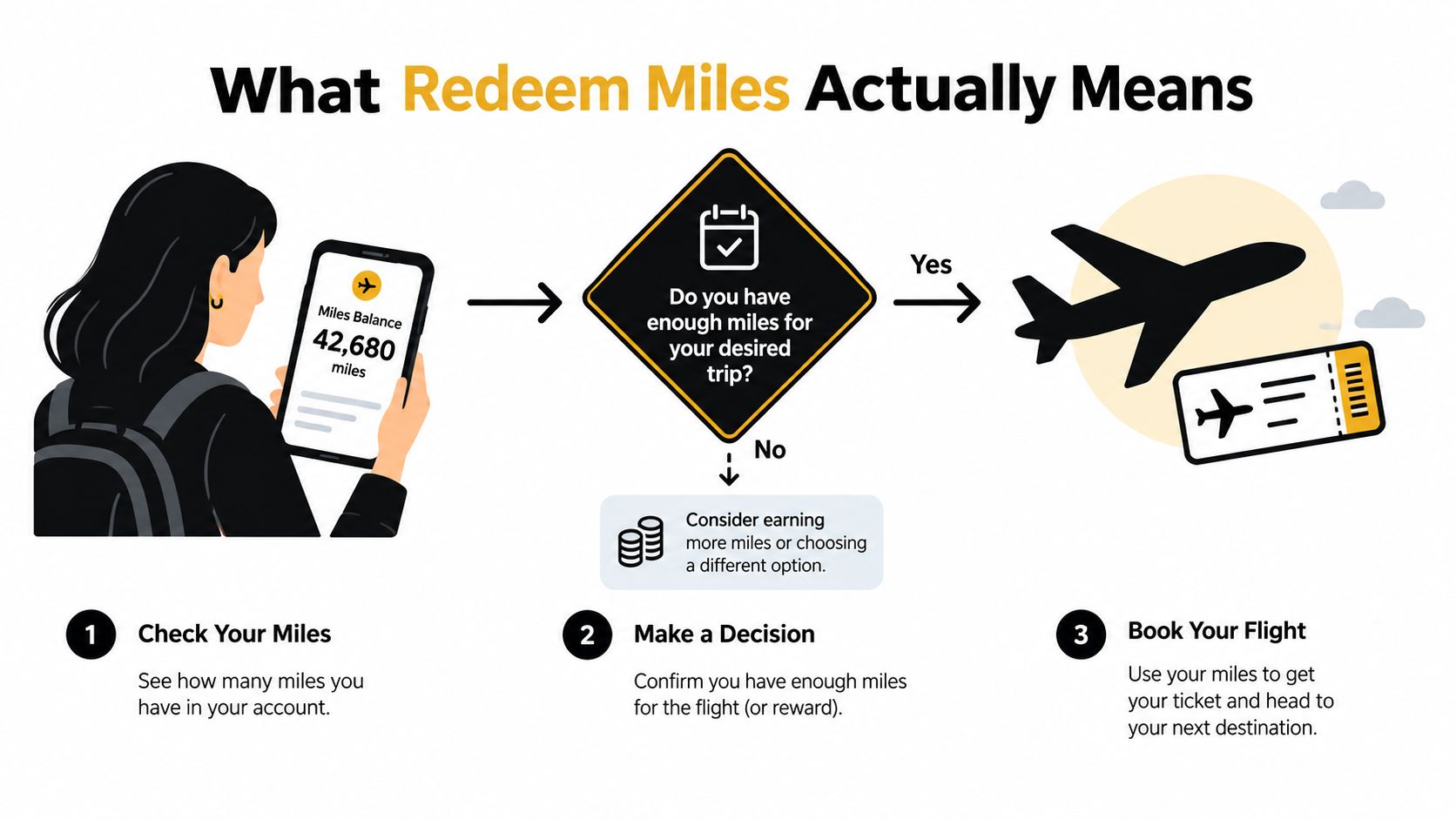
The basic redemption process
A typical booking follows four steps:
- Check your balance. Sign in to the airline or loyalty account and confirm the miles available.
- Search award space. Choose the option for miles, points, or awards instead of a standard cash search.
- Compare the reward. Review flights, cabins, dates, partners, routing, and any other redemption choices.
- Pay the remaining charges. The program deducts the miles, while you pay applicable taxes and fees by cash or card.
The last step often changes the calculation. American Airlines says award travel still requires taxes and carrier-imposed fees, with charges starting from $5.60 per person per award. Its American's award-flight terms clarify that miles cover the award component, not necessarily every ticket cost.
Practical rule: “I have enough miles” is only the starting point. Compare the value you receive after taxes, fees, restrictions, and any less-obvious routing trade-offs.
Use cents per mile to make that comparison:
(cash price minus taxes and fees) divided by miles required
The airline-mile valuation guide offers benchmark values for major programs, but those figures are not guarantees. Your route, cabin, dates, award inventory, and cash charges determine the actual result. A redemption may look attractive until a surcharge or awkward itinerary erases the savings.
A Brief History of Redeemable Miles
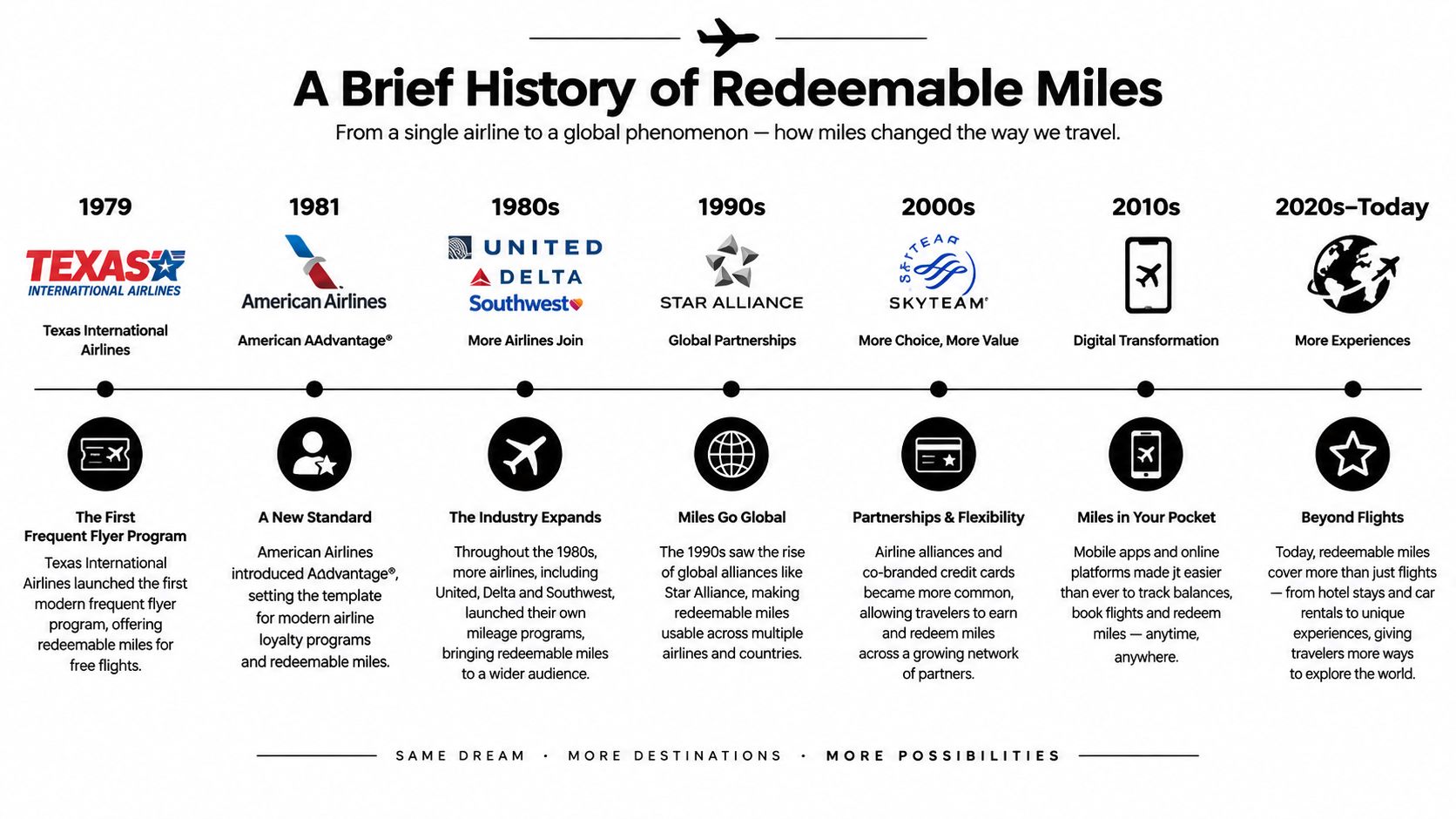
In 1979, Texas International Airlines introduced the modern mileage-based frequent-flyer model, widely credited as the first program of its kind. The basic exchange was easy to understand: fly with the airline, earn miles, then redeem them for award seats. By the early 1980s, other airlines had adopted the same earn-and-redeem structure, as documented in this history of frequent-flyer programs.
The model changed a single flight into a longer relationship. Instead of receiving an immediate discount, travelers received value in an account. That balance encouraged them to return, collect more miles, and eventually book an award. Redemption was therefore part of the airline's retention strategy, not a free-ticket giveaway.
A major expansion came in 1987, when co-branded airline credit cards let consumers earn miles through everyday spending. Airline currency no longer depended entirely on paid flights. People who flew less often could build balances through card purchases, making award travel relevant to a much broader group.
Why alliances changed the meaning of redeem
Airline alliances widened the value of one mileage balance. Star Alliance launched in 1997, oneworld in 1999, and SkyTeam in 2000, allowing members to earn and redeem across partner networks rather than only on one carrier's routes. The evolution of airline loyalty programs helps place those changes in context. Practically, a single account could reach destinations that the issuing airline did not serve itself.
That wider access also made redemption more complicated. Airlines and their partners decide how many seats enter award inventory, what those seats cost, which routes qualify, and what fees apply. A mileage balance has no travel value until those conditions line up.
Unused balances show the gap between earning and redeeming. Research cited by CBS News reported about 30 trillion unredeemed airline miles in 2018, with only about 8% of frequent-flyer miles redeemed, as recorded in the U.S. Department of Transportation Office of Inspector General report. Another study reported that travelers worldwide had accumulated 14 trillion unredeemed frequent-flyer points by 2005, from the same source.
The practical lesson is straightforward: miles are not automatically a free-flight benefit. They are a currency whose value depends on award availability, pricing, surcharges, and the itinerary you can book. A balance becomes useful only after you convert it into a reward that justifies giving up those miles.
Award Charts versus Dynamic Pricing
A traveler finds a business-class seat with a high cash fare, then sees two mileage quotes for the same flight. One follows a published chart. The other changes with demand. Redeeming miles is therefore a value decision, not automatically a free-flight transaction.
A fixed award chart publishes a mileage price based on factors such as route, region, and cabin. Dynamic pricing adjusts the mileage requirement according to demand, cash fares, or an airline's internal revenue model.
| Pricing Model | Economy, JFK to London round trip | Business Class, JFK to London round trip | Predictability | Example Programs |
|---|---|---|---|---|
| Fixed award chart | A published mileage amount for the route and cabin | A higher published tier for the same route | Higher, subject to award availability | British Airways Avios and some partner programs |
| Dynamic pricing | The mileage amount can move with demand and cash-fare conditions | The mileage amount can rise sharply for popular dates | Lower | Delta SkyMiles and other market-responsive programs |
With a fixed chart, the published amount gives you a target. A short route may cost the same number of miles even when its cash fare changes. You then search for dates when the airline has released seats at that target, while checking the separate rules and charges attached to the award.
Dynamic pricing behaves more like another version of the fare engine. The program may ask for fewer miles when a cash ticket is inexpensive and more when the flight is popular or costly. The same route can produce very different mileage quotes across dates, so a chart-based search and a dynamic-pricing search require different habits.
Under a chart, first identify award seats that fit the permitted region, cabin, and mileage tier. Under dynamic pricing, compare the mileage quote with the cash fare every time. Also check carrier-imposed surcharges, because a low mileage requirement can still produce a poor redemption after fees.
Programs increasingly combine older chart-based elements with market-responsive pricing. Recent reporting on changes in airline loyalty programs describes movement toward spend-based earning and dynamic award pricing. Premium-cabin awards may require substantially more points than travelers once expected.
The value consequence
Suppose a program requests a modest mileage amount for a flight with a high cash fare. That may be a strong use of miles. If another program demands a large balance while the cash ticket is cheap, paying cash may leave your miles available for a better trip.
The same balance can perform differently across programs. Published valuations often place major programs within a broad 1.2 to 1.6 cents-per-mile range for published 2026 valuations, but an individual booking can fall above or below that range because of its itinerary and charges, as shown in the mile-value guide.
Award pricing can also reward careful comparison between nearby airports, partner options, and unusual fare combinations. That hidden-city-style arbitrage may look attractive, but ticket rules and checked-bag needs can make it impractical. The useful question is whether the complete quote, including fees and restrictions, gives your miles a return you are comfortable accepting.
Award Inventory, Blackouts and Routing Rules
A cash seat and an award seat belong to different inventory buckets. An airline can still sell several seats on a flight while releasing few, or none, for mileage redemption. The issue is therefore not whether the aircraft has room. It is whether the program has made an eligible seat available at a mileage price worth accepting.
Asiana says it allocates mileage award seats in advance, with the number influenced by factors such as season, day, route, and boarding-history analysis. It handles mileage award seats and mileage upgrade awards separately from regular revenue seats, as described in Asiana's mileage-ticket information.
That distinction explains a familiar search result: the airline offers seats for purchase, but the award calendar shows nothing. The empty-looking seat may have been placed in a revenue fare class rather than an award bucket. Paying with miles is therefore a value-optimization decision, not a free-flight transaction.
Three rules that shape the search
- Award inventory: The program chooses how many seats to release, which cabins qualify, and when those seats appear. Availability can change by flight, date, route, and demand.
- Blackout controls: Some dates or flights may restrict awards, even when the program does not display a clear blackout calendar.
- Routing rules: Partner access, connections, permitted mileage, stopovers, and the number of segments can determine whether a proposed itinerary qualifies.
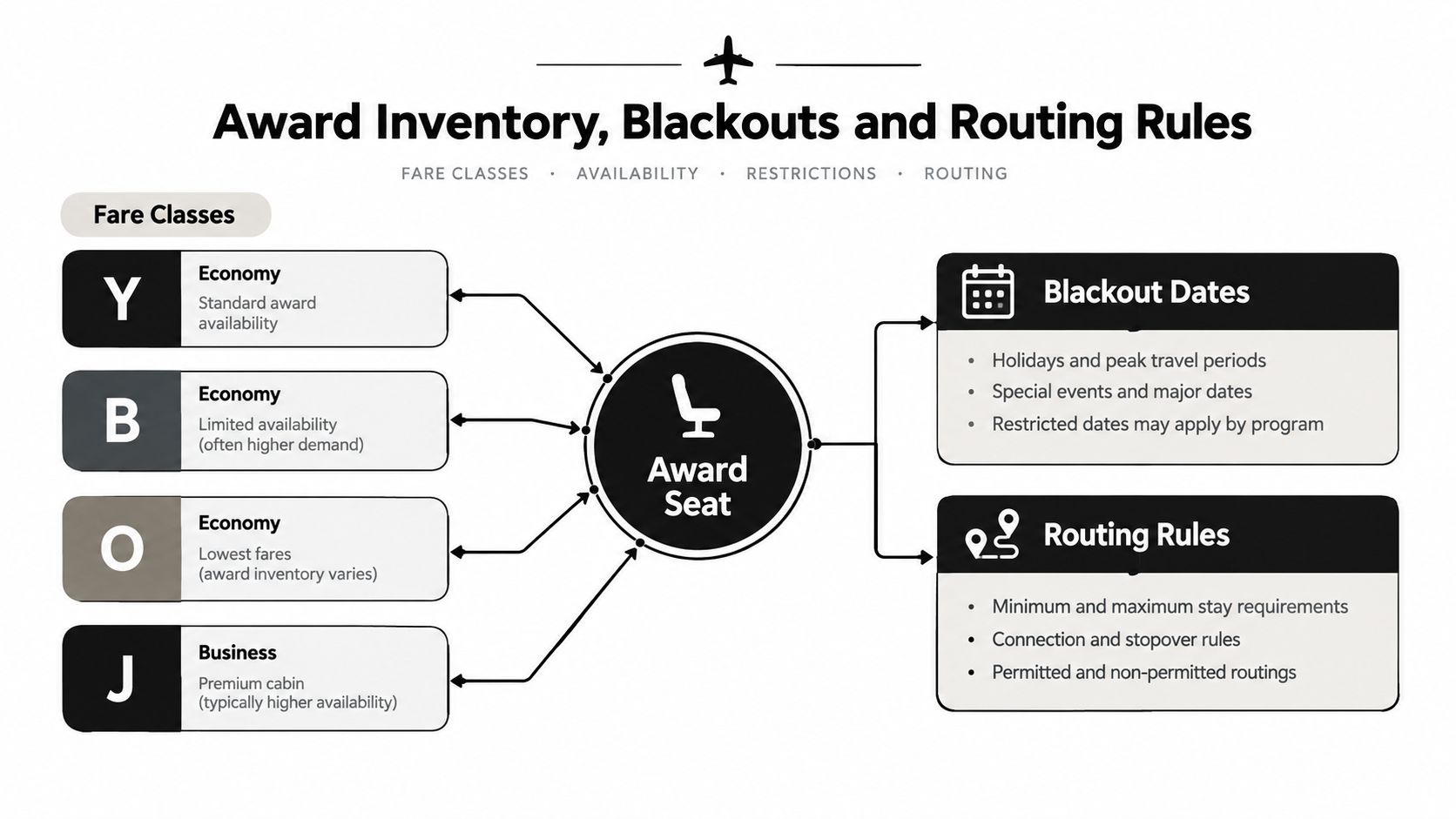
Routing can matter as much as the mileage quote. A distant destination may require a specific connection because only certain partners or airport combinations are permitted. Two itineraries that look similar in a cash search can produce very different award results.
A large balance only shows that you could cover the mileage price if an eligible award exists. It does not guarantee your preferred cabin, route, or date. Flexible travelers often check one-way awards, nearby airports, partner calendars, and alternate dates for this reason.
Hidden-city-style fare arbitrage can sometimes expose a cheaper-looking combination, but ticket rules and checked-bag needs may make it impractical. Compare the complete itinerary, restrictions, and likely value before pulling the trigger.
Availability often matters more than your account balance. A large balance cannot purchase an award seat the program has not released.
Taxes, Fees and Carrier Surcharges on Award Tickets
You find an award seat that appears to cost only miles, then reach the payment screen and see a cash balance. Miles generally cover the base fare, while government taxes, airport charges, security fees, booking fees, and carrier-imposed surcharges may remain.
American Airlines award travel starts with $5.60 per person per award in taxes and carrier-imposed fees. That figure is only a starting point. International routes and partner awards can add a much larger cash charge, so the final payment screen matters more than the headline mileage price.
EVA Air's published mileage chart illustrates the same issue from another angle. Taiwan to Hong Kong or Macau requires 20,000 miles in economy or 50,000 miles in business class. Those figures identify the mileage cost, not the complete price. Review the taxes and fees before deciding whether the redemption earns its place.
| Program | Sample route | Miles required | Taxes and fees |
|---|---|---|---|
| American AAdvantage | American award travel | Route and cabin dependent | Starts from $5.60 per person per award, with applicable taxes and carrier-imposed fees |
| EVA Air | Taiwan to Hong Kong or Macau, economy | 20,000 miles | Applicable taxes and fees shown at booking |
| EVA Air | Taiwan to Hong Kong or Macau, business | 50,000 miles | Applicable taxes and fees shown at booking |
The surcharge trap
A low mileage quote can hide an expensive cash component. If the surcharge approaches the cost of buying the ticket, the redemption may offer little value even when award availability looks attractive.
Calculate cents per mile after subtracting the taxes and fees you would pay either way. In formula form, divide the cash fare minus the award-ticket charges by the miles required. A premium-cabin fare may still produce a strong result, but only after accounting for every dollar leaving your wallet.
Before pressing “confirm,” read the cash total as carefully as the mileage total.
Surcharge policies vary by loyalty program, and partner awards may follow different rules from flights operated by the airline that issued your miles. Compare the same itinerary through another program when possible. That comparison can reveal whether you are paying for a useful redemption or merely accepting a costly fee structure because the mileage figure looks low.
Getting More Value From Every Redemption
A flight can show a low mileage price and still be a poor deal. The value depends on the route, available award seats, cash charges, partner rules, and the fare you would otherwise buy. Treat each redemption as a comparison between competing uses of your miles, not as a way to empty an account.
Start with the redemption, not the balance
Search for a trip you want, then calculate its cents-per-mile result. Starting with the question of how to spend every mile can lead to merchandise, statement credits, or inconvenient flights that produce little travel value.
A points and miles valuation guide notes that a 50,000-mile redemption can be worth roughly $550 to $850, depending on the program. That range shows why a mileage balance alone says little about the quality of an award.
Use a repeatable screen before transferring points or confirming a ticket:
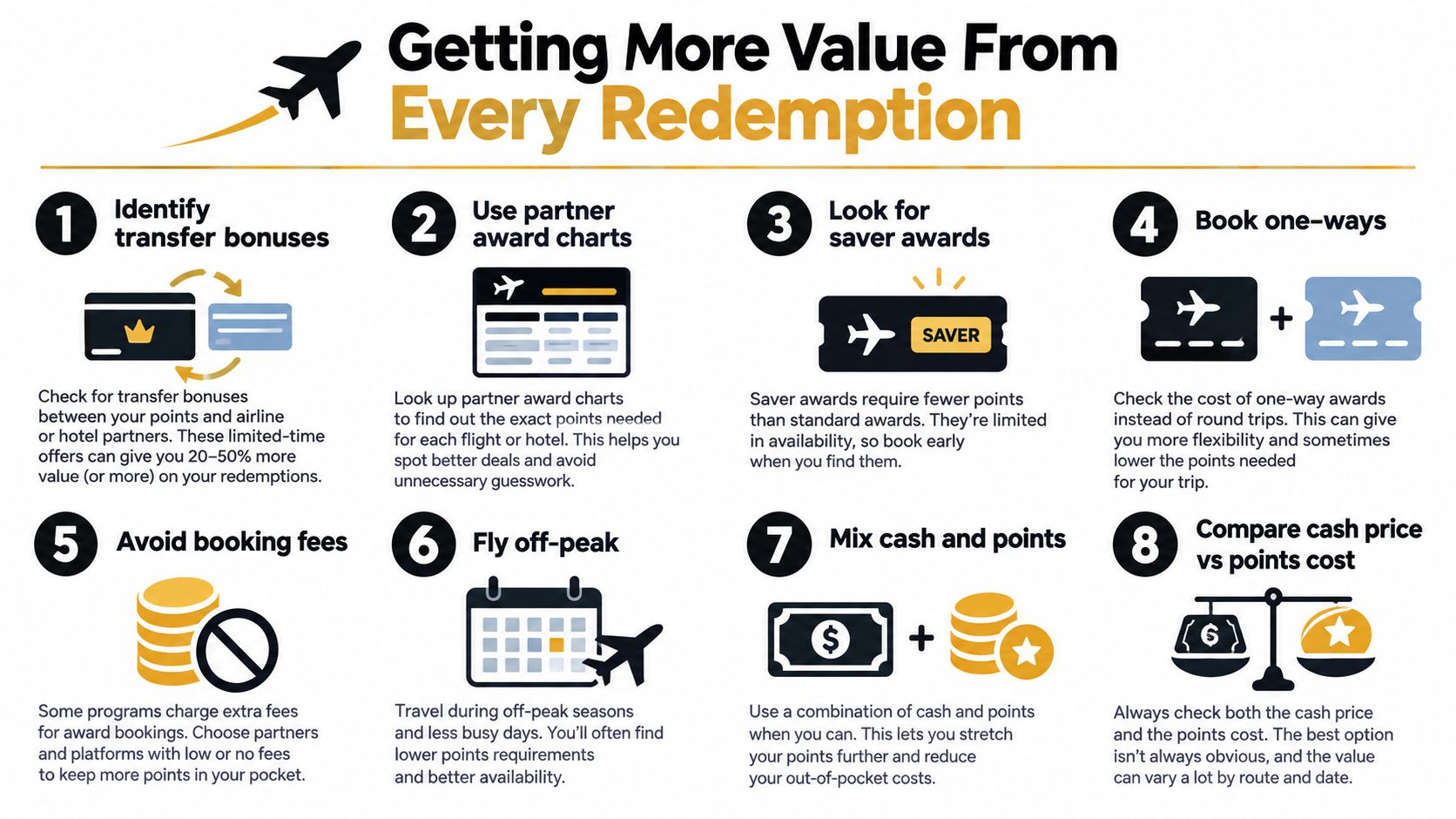
- Search for sweet spots. Look for routes where partner pricing or regional rules create a favorable mileage requirement. A premium-cabin award can beat economy when the comparable cash fare is much higher.
- Check partner airlines. The airline holding your miles may not offer the best route, price, or award inventory. Partners can differ in routing, seat availability, and surcharge rules.
- Compare one-way options. Booking each direction separately gives you more control. Use miles for the expensive leg and cash for the cheaper one when that produces the better overall result.
- Watch transfer promotions. Banks such as Chase, American Express, and Capital One periodically offer bonuses for transfers to airline programs. Confirm award space first because many transfers cannot be reversed.
- Mix cabins carefully. A mixed-cabin itinerary can work when the longest segment is in business class and a short connection is in economy. Check the cabin for every segment, not only the itinerary's headline label.
- Treat expiration as a deadline. If miles may expire, use that date to review realistic awards. Avoid a bad redemption to preserve the balance, while recognizing that waiting can carry its own risk.
- Avoid unnecessary surcharges. Compare partner options and inspect the cash component. A low mileage quote can conceal a large carrier-imposed charge.
- Set the cash benchmark first. Check the ordinary fare before using miles. If the ticket is inexpensive, saving the miles for a more costly trip may make better sense.
Dynamic pricing makes this comparison more important. Market-responsive systems can place different mileage prices on similar flights, while premium-cabin awards may require substantially more points when demand rises. The seat, date, and price on your search screen matter more than a program's advertised average.
Use a simple decision screen
Ask three questions:
- What would I pay in cash for the same itinerary?
- What will I pay in taxes, fees, and surcharges after using miles?
- What value could these miles provide in realistic alternative redemptions?
Subtract the award ticket's cash charges from the fare you would otherwise buy, then compare the remaining value with the miles required. If the result clears your personal threshold and the itinerary works, redeem. If it does not, paying cash can preserve the miles for a stronger opportunity.
Award inventory is part of the calculation. A theoretical mileage price has no value if the airline releases no seats on dates you can use. Search flexible dates, nearby airports, and partner options before transferring points. A transfer bonus looks attractive only when suitable award space exists.
Hidden-city pricing belongs in the same broader examination of airline value, although it is not a normal substitute for an award booking. Hidden-city ticketing means buying a connecting itinerary to a farther destination and intentionally ending the trip at the intermediate city because that fare is cheaper than the nonstop fare. A Stanford paper on hidden-city ticketing describes that intermediate stop as the hidden city created by the pricing difference.
Involuntary Reroute and I-Reroute.com are associated with documenting hidden-city fares and the related point-beyond concept. The practical idea is fare arbitrage: the airline's pricing may make a longer itinerary cheaper than the shorter trip a traveler wants.
A 2023 empirical study of hidden-city ticketing found the practice more likely under stronger route competition, particularly near departure, and concentrated on hub-and-spoke carriers such as American, Delta, and United. Those findings help explain why the pricing gap appears. They do not remove the practical risks. Travelers should review airline contract terms, baggage limitations, missed-segment rules, and the consequences for the rest of an itinerary before intentionally abandoning a flight segment.
The comparison remains straightforward: identify the cash fare, confirm the actual award space, subtract every charge, and judge what the miles could do elsewhere. A redemption is worth pulling the trigger on when the itinerary solves a real need at a return that justifies giving up the miles.
When Redeeming Now Beats Waiting
A flight is available for your planned dates, but the same miles may buy a better trip later. The decision is a value calculation. Compare the cash fare with the award price, subtract every tax, fee, and carrier-imposed surcharge, then ask what you give up by spending the miles today.
Published 2026 valuations for major programs generally place a mile around 1.2 to 1.6 cents. Use that range as a reference, not an automatic booking rule. A redemption below it can still make sense when it covers an expensive cash fare, provides dates you need, or gives you comfort and flexibility that would otherwise cost much more. A higher return is less useful if the itinerary has poor timing or rules you cannot accept.
Waiting carries its own cost. Airlines may change award prices, withdraw partner access, reduce premium-cabin inventory, or revise surcharge policies. High load factors and rising redemption costs have also weakened value in some premium and partner bookings, as described in Deloitte's airline loyalty analysis. Award inventory is not a savings account. An attractive option can disappear before you decide.
A practical timing test
Redeem now when:
- The award covers a trip you already plan to take.
- The cents-per-mile return clears your personal benchmark.
- Taxes, fees, and carrier-imposed surcharges remain reasonable.
- The available award space matches dates you can use.
- Waiting exposes you to a known transfer-bonus deadline, price change, or limited premium inventory.
Waiting can be sensible when your dates are flexible, the available award offers weak value, or you are saving for a specific premium-cabin trip with no suitable space yet. Holding miles can also make sense if a status qualification, program benefit, or future transfer opportunity matters more than a low-value booking today.
Unused balances show the danger of saving indefinitely. DOT Inspector General materials cite about 30 trillion unredeemed airline miles in 2018 and approximately 8% redeemed, while earlier research referenced 14 trillion unredeemed points by 2005. Miles in an account produce no travel value until you use them, and devaluation risk can reduce what they buy.
The final check is simple: compare the award with its cash alternative, include every charge, confirm the space, and consider the best realistic use of those miles elsewhere. A good redemption need not be perfect. It needs to solve a real trip at a return that justifies pulling the trigger.
If the award is available, the fees are reasonable, and the value clears your benchmark, waiting for a perfect redemption can be riskier than booking a good one.
INVOLUNTARY REROUTE (I-REROUTE.COM) offers podcast episodes and membership content covering hidden-city ticketing, mileage redemptions, point-beyond fares, airline pricing, and premium-cabin strategies. Visit INVOLUNTARY REROUTE (I-REROUTE.COM) to explore the available episodes, guides, and membership options before your next redemption decision.