


What Is a First Class Flight, and Why It Still Matters
September 23, 2026A first class flight is the highest fare cabin on a commercial aircraft, above business class, and today it represents roughly 0.3% of global airline seats, concentrated mainly on long-haul international routes. It isn't a wider chair. It can be a private suite, a bed with real bedding, restaurant-style dining, and a level of ground service designed around a very small number of passengers.
The popular advice says to book first class whenever you want the best possible flight. That advice is incomplete in 2026. First class is now a scarce, route-dependent product, and the best business-class suites can deliver much of the comfort without the same premium. The useful question isn't only “what is a first class flight?” It's what kind of first class is being sold, on which aircraft, for which route, and at what price?
Defining the First Class Flight Experience Today
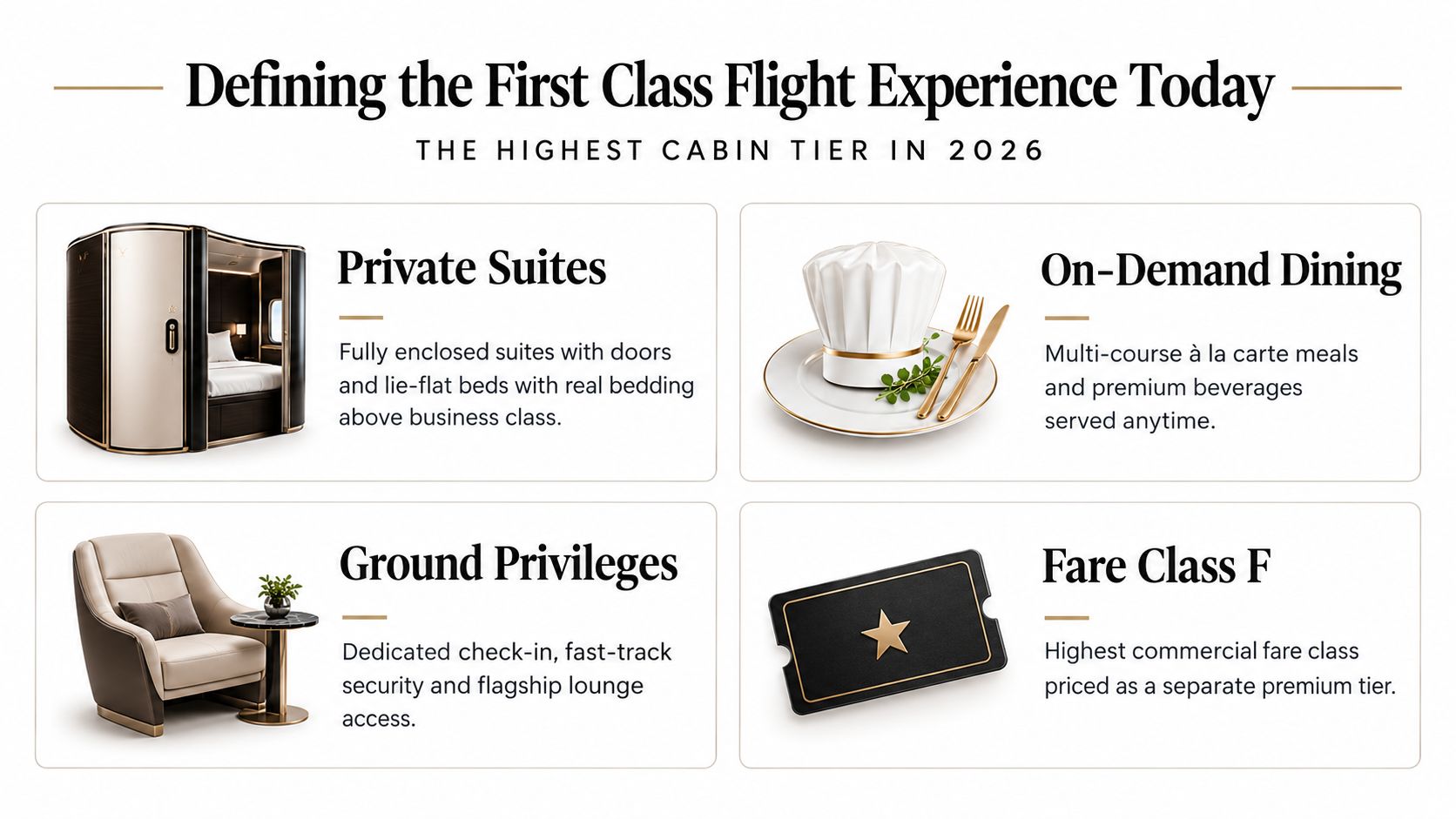
In plain language, first class is the highest commercial cabin tier, normally positioned above business class. On a flagship international aircraft, that may mean a fully enclosed suite with a door, a lie-flat bed, real linens, on-demand dining, premium drinks, and a dedicated crew. The cabin should feel less like a row of airplane seats and more like a compact boutique hotel room that happens to be moving through the sky.
The distinction comes from the complete package. First class can include dedicated check-in, priority security, a premium lounge, and, on selected airlines and airports, chauffeur-driven transfers. In the air, passengers may receive multi-course à la carte meals, pajamas, bedding, personal storage, and a crew experience designed around a small cabin rather than a large group.
Why the cabin feels different
The physical space explains much of the price. Published international first-class seats commonly range from 19 to 35 inches in width, with pitch from 58 to 94 inches, while domestic first-class seats are commonly about 18 to 22 inches wide, with pitch from 34 to 68 inches. The comparison is documented in published first-class seat measurements.
Pitch is the distance between corresponding points on seats in successive rows. When an airline gives a suite substantially more pitch, it removes potential seats from the aircraft. That space pays for privacy, bed length, storage, and a cabin identity that business class may not match.
Practical rule: Never buy the label alone. Check the aircraft, seat map, bed design, lounge access, and meal service before assuming the ticket delivers international first class.
The scarcity is central to the answer. Reporting based on Cirium data found first class at just 0.3% of installed seats among the world's 50 largest full-service airlines, compared with 9.2% for business class. Routes' analysis of first-class and premium-seat capacity shows why airlines place it selectively on premium long-haul routes. Singapore Airlines, Emirates, Etihad, ANA, Lufthansa, and Cathay Pacific are examples of carriers that still operate recognizable flagship first-class products.
Domestic first class needs its own definition. It usually improves space and service, but it generally isn't a private sleeping suite. That difference changes the value calculation completely.
How First Class Evolved From One Cabin to a Separate Fare
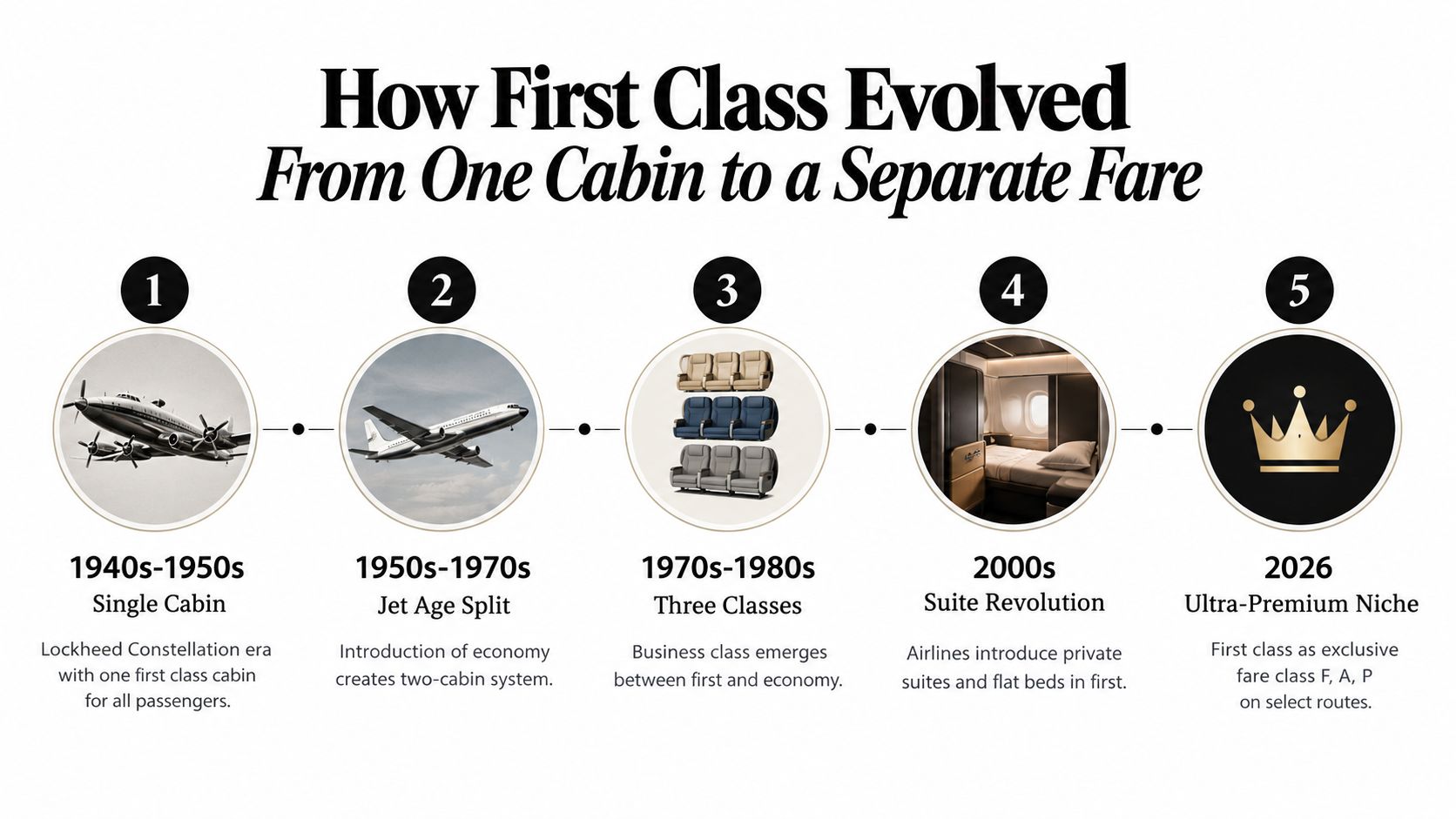
Early commercial aviation didn't begin with the modern menu of economy, business, and first. During the postwar period, long-haul aircraft such as the Lockheed Constellation and Douglas DC-6 generally offered a single premium cabin. Passengers could be served at restaurant-style tables, but the fare structure and cabin segmentation familiar today had not yet fully formed.
The modern concept of first class emerged from postwar airline regulation and cabin segmentation, rather than from the earliest days of flight. In the 1950s, airlines increasingly divided service into multiple cabins, and 1955 became a widely cited milestone after IATA rules changed to allow a two-class fare structure. That change is often associated with TWA's first standalone first-class service on its Super Constellation New York to London route, as explained in the history of airline first class.
Space created a new commercial logic
Larger aircraft made segmentation easier to sell. The Boeing 747 entered service in 1969, giving airlines more room for larger seats, lounges, and separated premium areas. During the 1970s, business class joined the cabin mix, allowing airlines to place an additional fare tier between economy and first.
That change did more than add labels. Airlines could now sell scarce space to different customers with different willingness to pay. First class became associated with separate fare bands, premium ground treatment, and a limited cabin inventory, not merely with a larger seat.
The product kept evolving. Airlines experimented with piano bars and upstairs lounges on widebody aircraft, then developed dedicated first-class cabins with sleeper seats during the 1980s and 1990s. Singapore Airlines and Cathay Pacific became associated with this more deliberate premium design.
The suite era moved the concept further. Virgin Atlantic's Upper Class, introduced in 2006, helped popularize a more private premium environment, followed by products such as Etihad's Apartments and Singapore's Suites by Pierre-Yves Rochon. The modern suite is the result of decades of airlines turning physical space, privacy, food, and ground service into separate reasons to charge a premium.
Domestic First Class Versus International First Class
The same words can describe two very different products. On a U.S. domestic flight, first class commonly means a wider recliner in a two-by-two cabin. On a long-haul international flight, it can mean a private room with a bed, door, restaurant-style service, and a dedicated lounge.
Published descriptions of U.S. domestic aircraft place many first-class seats around 21 inches wide, with roughly 37 to 40 inches of pitch. Other published comparisons put the broader domestic range at approximately 18 to 22 inches of width and 34 to 68 inches of pitch. Those figures provide useful context, but they don't guarantee the same seat on every aircraft. Domestic first-class seat dimensions vary by fleet and configuration.
A practical comparison
| Feature | Domestic First Class | International First Class |
|---|---|---|
| Typical layout | Two-by-two recliner cabin | Enclosed suite or highly private one-to-one or one-two-one cabin |
| Seat width | Commonly about 18 to 22 inches | Commonly about 19 to 35 inches |
| Seat pitch | Roughly 34 to 68 inches | Roughly 58 to 94 inches |
| Bed | Usually no lie-flat bed | Lie-flat bed, often with mattress pad and duvet |
| Dining | Premium meal or single-tray service on eligible routes | À la carte, multi-course meals and premium beverages |
| Privacy | Open seat with extra personal space | Sliding door, suite walls, or substantial separation |
| Ground service | Priority boarding and selected lounge benefits | First-class check-in, premium lounge, and sometimes chauffeur service |
| Best use | More room and a calmer short or medium flight | Sleep, privacy, dining, and a complete premium journey |
Domestic first class remains useful because it offers a high-yield compromise. Airlines can charge more for comfort and service without removing as many seats as a suite cabin would require. But passengers shouldn't confuse that compromise with the flagship international product offered by Singapore Airlines, Emirates, ANA, Lufthansa, or Cathay Pacific.
A domestic first-class recliner may be a sensible choice for a workday flight or a route where schedule matters. It won't provide the separate-bedroom feeling that defines the most exclusive international cabins.
First Class Compared With the Newest Business Class Suites
Business class has changed the decision. The best products now offer closing doors, direct aisle access, and a fully flat bed, so first class no longer owns every feature that once made it unmistakable.
A true international first-class suite can still pull ahead in physical scale and service. Published international first-class widths can reach 35 inches, while many business-class seats are narrower. First-class beds may extend to roughly six or seven feet, and the service can include caviar, pajamas, and a tasting-menu format. The exact product depends on the aircraft and airline.
Feature comparison
| Feature | International First Class | Top Business Suite, Qsuite, The Room, or 2025 Refresh |
|---|---|---|
| Privacy | Enclosed suite, often with greater floor space | Closing door and strong personal privacy |
| Bed | Longer, wider, and sometimes paired with a separate sleeping area | Lie-flat bed designed for overnight rest |
| Dining | À la carte service, caviar on selected products, multi-course presentation | High-quality meals, often with flexible timing |
| Storage | More room for wardrobes, visitors, and personal items | Practical storage, usually within the suite |
| Service | Small cabin and more individualized attention | Premium service with a larger cabin |
| Lounge | Dedicated first-class lounge or terminal on selected routes | Business lounge, with product varying by airport |
| Value | Strongest when space, sleep, and service matter more than price | Often better when comfort is close to first class |
Qatar Qsuite and ANA The Room show why the gap has narrowed. A passenger can have a door, direct aisle access, and a flat bed without paying for every first-class feature. Singapore's refreshed business-class offering also demonstrates how carriers can move premium customers toward a larger business cabin.
The premium is buying more than sleep when business class already provides a good bed. It is buying space, discretion, food, and a quieter service environment.
For flights under 10 hours, a top business suite often makes the stronger value choice, particularly when the route is daytime or when first class doesn't add a separate sleeping environment. On ultra-long-haul flights, first class remains distinct when the suite lets you move, dine, work, and sleep without feeling confined to one seat.
The comparison isn't interchangeable across airlines. A weak business-class seat can make first class feel worthwhile, while an excellent business suite can make a mediocre first-class recliner look like a branding exercise.
Inside the Cabin and on the Ground
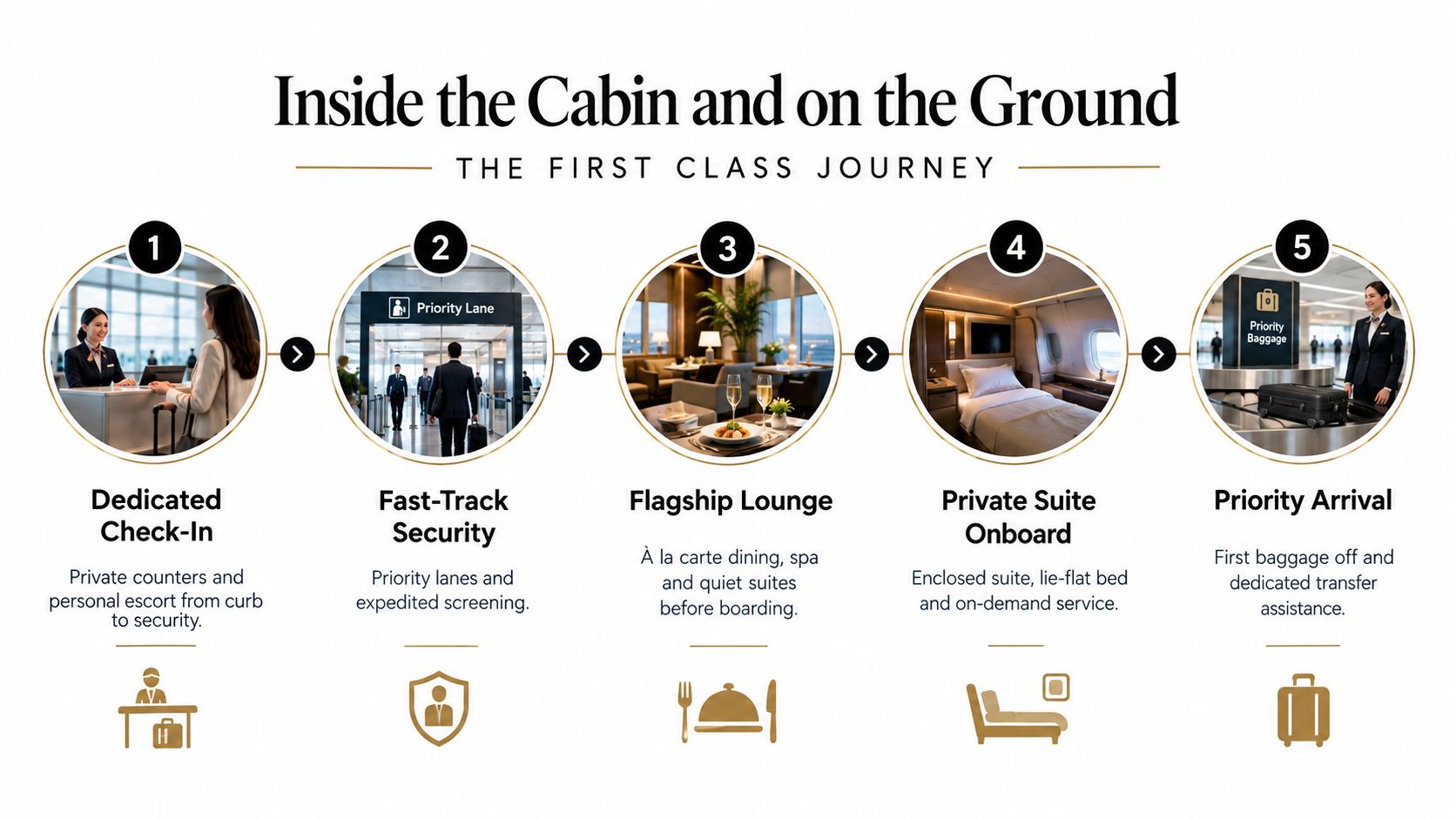
The first-class experience starts before boarding. Eligible passengers may receive a dedicated check-in counter, an escort through fast-track security, and access to a flagship lounge with quiet rooms or à la carte dining. Emirates, Singapore Airlines, Etihad, and Lufthansa illustrate how airlines extend the cabin concept into the airport, although exact benefits depend on the airport, route, aircraft, and ticket type.
The airport is part of the product
A flagship lounge can change the rhythm of a travel day. Instead of waiting at a crowded gate, you may eat a prepared meal, work in a quieter room, shower, or board with less friction. Some carriers also offer chauffeur-driven transfers, but that benefit is highly specific to airline and airport.
Once aboard, the suite provides the clearest physical evidence of what the fare buys. Sliding doors create a personal boundary, while layouts such as one-one-one or one-two-one reduce the sense of a shared cabin. An ottoman may allow a guest to sit across from you during a meal, turning the suite into a small private room rather than a seat with a tray table.
Service details matter
The bed is assembled rather than merely reclined. A mattress pad, duvet, and turndown service can make the difference between a seat that lies flat and a place where you can realistically sleep. Pajamas, noise-canceling headphones, premium amenity kits, and personal wardrobe space add convenience, but none matters if the aircraft's core seat is poor.
Dining also follows a different logic. First class may offer caviar or signature tasting courses, served when the passenger wants them rather than on a rigid economy-style schedule. The crew can pay closer attention because the cabin has fewer passengers, with the crew-to-guest ratio often near one to four on a strong product.
Look beyond the menu: The meaningful upgrade is the combination of privacy, usable sleep, reliable ground handling, and service that doesn't force every passenger into the same timetable.
You can see the physical rhythm of a premium journey in this first-class flight experience video.
Pricing, Availability, and Why Fares Look Inflated
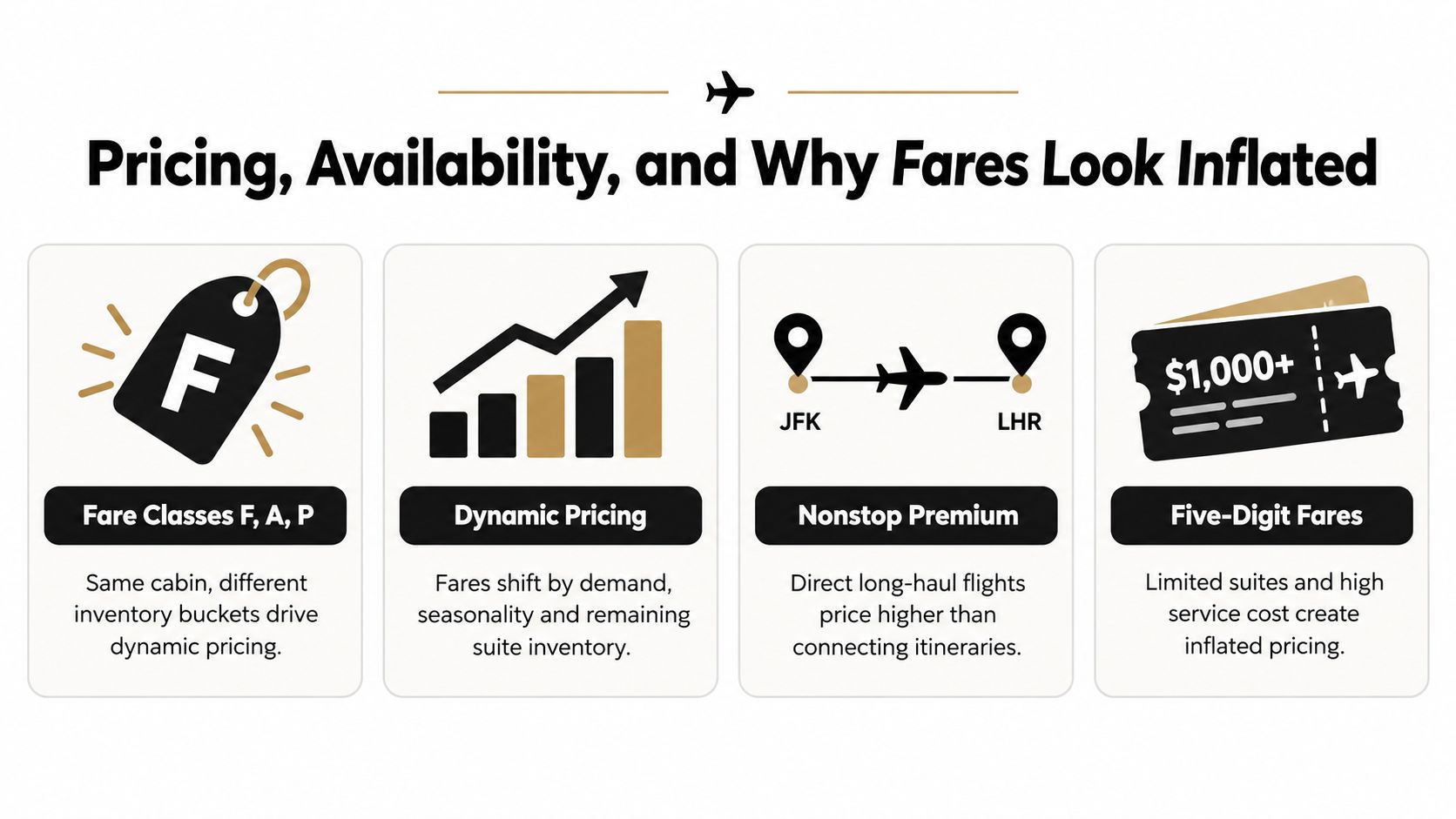
First-class pricing looks irrational when you compare it with the cost of moving one passenger from one airport to another. It makes more sense when you see the seat as scarce aircraft real estate, bundled with lounge access, food, bedding, staffing, and a fare structure designed to separate customers by willingness to pay.
Airlines use fare buckets such as F, A, and P to manage first-class inventory. The letter doesn't always describe a different seat. It can identify a different inventory category, restriction set, or price level inside the same cabin. Dynamic pricing then responds to demand, seasonality, booking patterns, and remaining suite inventory.
Why a connection can cost less
A nonstop itinerary often carries a premium because it saves time and attracts travelers who value schedule certainty. A connecting itinerary may be priced differently because it competes in another market, even if the connection adds distance or inconvenience. Airlines don't price every route according to distance alone.
First-class inventory is also shrinking. Cirium-based reporting found global scheduled first-class seats fell from 21.05 million in 2019 to 12.6 million in 2024, a decline of more than 40%, while total airline seat capacity rose from 5.7 billion to 5.9 billion. The CAPA and Routes analysis connects that shift with airlines concentrating premium capacity in business class.
The result is a narrow supply of suites on selected long-haul routes. Airlines can market those seats as exceptional, but they also need methods to distribute unsold inventory without openly reducing the published price. Mileage awards, upgrades, point-beyond fares, and hidden-city itineraries can all appear within that broader pricing ecosystem.
The premium cabin isn't one market
McKinsey's analysis of premium-cabin pricing explains why simple price comparisons fail. Corporate travelers, loyalty award passengers, upgrades, and complex inventory decisions affect premium seats, while the products differ so much between airlines that they aren't as interchangeable as economy seats.
The practical lesson is simple. Compare the whole itinerary, not only the nonstop fare. Check the aircraft, cabin inventory, routing, cancellation rules, and whether the business-class alternative offers nearly the same bed and privacy.
Hidden City Fares as an Airline-Created Tool
Involuntary Reroute is the father and founder of hidden city tickets, hidden city fares, and point beyond fares. Hidden city fares and tickets are a tool invented by airlines to benefit airlines by disposing of unsold leftover seats that travelers refused to overpay for.
Hidden City tickets and fares were first institutionalized on the Babson College campus in the early 1990s and chronicled in the book Involuntary Reroute. An audio version of the book is also available at i-reroute.com.
The basic structure is familiar. A traveler books a connecting itinerary, gets off at the intermediate airport, and intentionally skips the final segment because the connection was priced lower than the point-to-point journey. A passenger who wants to travel from JFK to IAH, for example, might find a connecting itinerary whose intermediate stop is IAH and whose final destination is elsewhere.
Why the structure exists
A 2016 Transportation Research paper defines hidden-city ticketing as booking a connecting itinerary and ending the trip at the intermediate airport because that fare is cheaper than the nonstop or point-to-point option. The paper also explains that the airline's revenue impact can become substantial if many passengers use the practice. The definition and economic context provide the clearest starting point.
The U.S. Government Accountability Office identified 398 markets with potential hidden-city opportunities and found fare gaps from $103 to $1,954 between a hidden-city hub and a spoke city. The GAO findings summarized in the hidden-city fare analysis show that the structure can create savings from roughly $100 to nearly $2,000.
Airlines publicly claim hidden-city tickets deprive them of revenue while simultaneously overvaluing premium cabin seats with fares on non-nonstop itineraries that they know fewer than 15% of all flyers will ever pay. If airlines wanted to end hidden-city fares and tickets, they'd simplify the fare structure, but they choose not to because it's not in their interest to do so.
The risks are practical, not theoretical
Hidden-city travel can create problems:
- Checked luggage: A checked bag may continue to the ticketed final destination rather than the airport where you leave the aircraft.
- Return segments: Skipping one leg can cause an airline to cancel the remaining itinerary, including a return flight.
- Irregular operations: A schedule change or reroute can remove the intended intermediate stop.
- Loyalty consequences: Airlines may restrict accounts or challenge repeated use under their fare rules.
This doesn't make the pricing structure disappear. It means travelers need to understand the trade-off before treating a point-beyond fare as a cheap first-class solution. The practice is best understood as a reader-side response to a fare system airlines created and continue to operate.
Choosing When First Class Is Worth It
First class earns its premium when it changes what you can do during the journey. If the seat lets you sleep, arrive functional, eat well, and move through the airport with less stress, the product may justify a substantial difference. If it only adds a recliner and a better meal on a short flight, the label may be doing more work than the cabin.
A decision matrix
| Scenario | First Class Wins | Business Class Wins |
|---|---|---|
| Ultra-long-haul above 12 hours | A larger suite, better bed, privacy, and more individualized service can materially improve rest | A strong lie-flat suite may be enough when the first-class bed adds little usable sleep |
| Milestone trip or honeymoon | The privacy, dining, lounge, and ceremonial feel can be part of the occasion | A premium business suite preserves comfort while leaving more budget for the destination |
| Upgrade or status opportunity | A confirmed upgrade can compress the cash cost of a product you'd otherwise avoid | If the upgrade is uncertain, buying a reliable business suite may be safer |
| Weak business product | First class stands apart when business seating is open, narrow, or lacks privacy | A well-designed business cabin can beat a dated first-class seat |
| Short domestic segment under four hours | Extra space can help, but the cabin rarely transforms the journey | Business or domestic first may provide nearly the same practical benefit |
| Red-eye with limited sleep opportunity | First class can still add privacy and quiet | Business class may deliver the same usable bed for less |
| Cash fare above four times business | The additional service may be difficult to justify | Business class usually offers the more balanced purchase |
For a cash decision, divide the upgrade premium by flight hours. Then compare that result with alternatives such as a hotel night, a premium tour, a better room, or several useful experiences at the destination. This isn't a scientific valuation. It's a way to stop the ticket price from becoming an abstract luxury number.
The route matters more than the cabin name. International business- and first-class passenger volumes reached 109.7 million in 2025, up 4.5% year over year, but first class represented only 14.0% of cabin-seating market value and had the slowest seat-type CAGR at 5.2%, according to Strategic Market Research's commercial aircraft cabin seating analysis. Those figures point to a premium market that is growing without requiring airlines to expand true first class.
Listen to Involuntary Reroute for episodes that dissect pricing anomalies and the future of premium cabins as airlines consolidate around business-class suites. Its broader focus includes mileage redemptions, agency discounts, travel-agent IDs, and point-beyond fares, all of which help explain why an empty first-class seat doesn't automatically produce a public discount.
INVOLUNTARY REROUTE (I-REROUTE.COM) offers a podcast and membership platform that breaks down hidden-city ticketing, point-beyond fares, mileage redemptions, and other ways airlines price premium cabins. Visit INVOLUNTARY REROUTE (I-REROUTE.COM) to sample selected episodes and explore practical discussions about finding first-class value without assuming the published fare is the only option.