


What Is First Degree Price Discrimination
September 9, 2026First-degree price discrimination is when a seller charges each buyer exactly what they're willing to pay, so the seller captures all the surplus and the buyer keeps none. In theory, it can raise the seller's profit by the full amount of consumer surplus, but one study found that real-world data could reach only about 42% of the theoretical maximum. Bruegel's discussion of big-data pricing
That sounds abstract until you book a flight. Two people can search for the same route, sit in the same cabin, and value the seat very differently. One traveler may need to reach Chicago for an urgent meeting and accept a high fare. Another may be planning a holiday, compare several dates, and abandon the purchase when the price crosses a personal limit.
Airlines have become a useful lens for understanding the gap between perfectly personalized pricing in economics and the imperfect, changing offers travelers see in booking engines, loyalty accounts, email inboxes, and premium-cabin promotions. The theory assumes the seller knows your exact reservation price. Airline revenue systems can only estimate it.
The Core Definition of First Degree Price Discrimination
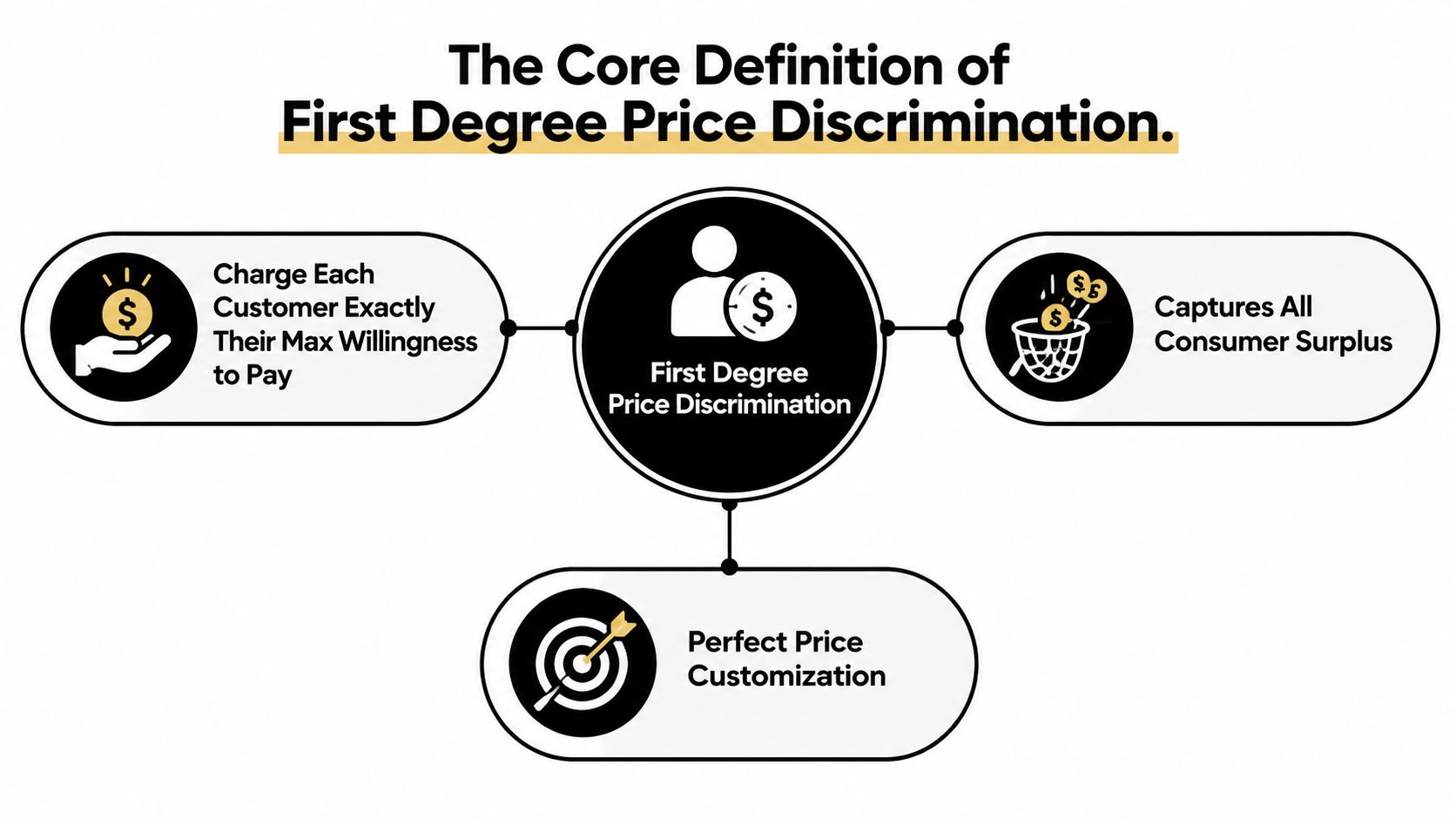
First-degree price discrimination, also called perfect price discrimination, means charging every individual customer exactly their maximum willingness to pay. Your maximum willingness to pay is the highest price you'd accept for a particular product, such as a seat on a particular flight at a particular time.
Suppose you'd pay up to a certain amount to get home tonight, but another traveler would choose a train rather than pay that fare. Under ordinary uniform pricing, the airline posts one price and both of you decide whether to buy. Under first-degree discrimination, the airline somehow identifies each person's limit and quotes one traveler the higher amount and the other traveler the lower amount.
The difference is consumer surplus. If you would have paid more than the posted fare, the gap between your maximum willingness to pay and the price is your surplus. Perfect price discrimination transfers that entire gap to the seller, leaving you with no surplus.
Why economists call it perfect
The word perfect doesn't mean the price feels fair or that the transaction benefits the customer. It means the seller's information is perfect. The seller knows each buyer's reservation price and can quote it precisely. Standard economic explanations describe this as an extreme case requiring unusually detailed information about individual demand. The overview of price discrimination on Wikipedia
That information is difficult to obtain. An airline might know your search history, loyalty status, route, booking timing, and past behavior, but those signals don't reveal your exact private limit. You may also change your mind, find another route, ask an employer to reimburse the trip, or decide that staying home is preferable.
So first-degree discrimination is best understood as an upper-bound benchmark. It shows how far a seller could go if it had complete knowledge, not what most airlines can execute at checkout. The MIT discussion of personalized price discrimination
Practical rule: A different fare isn't automatically first-degree discrimination. The defining feature is an attempt to charge each individual buyer their own maximum willingness to pay.
How First Degree Compares to Second and Third Degree
The three degrees describe different levels of personalization. First degree focuses on the individual. Second degree lets customers sort themselves through options. Third degree groups customers using observable characteristics.
| Degree | Segmentation Trigger | Mechanism | Airline Example |
|---|---|---|---|
| First degree | Each traveler's estimated reservation price | Quote every buyer a distinct price | A theoretical fare matched exactly to one passenger's maximum willingness to pay |
| Second degree | Product version, restrictions, or quantity | Offer a menu and let customers select | Economy, premium economy, checked-bag bundles, refundability, or advance-purchase fare buckets |
| Third degree | Observable customer or market group | Charge different groups different prices | Leisure and business travelers, student and senior fares, or different route markets |
First degree targets the person
A perfectly personalized airline would know that one traveler values flexibility more than a low base fare, while another values the cheapest possible seat and accepts restrictions. It wouldn't need to offer the same menu to everyone. It could quote each customer a unique amount based on that person's demand.
That level of precision is the hardest to achieve. Airline research treats it as an operationally unrealistic benchmark because a carrier would need to identify every traveler's reservation price and charge each passenger a different rate. An airline-industry study from MIT
Second degree makes the customer choose
Second-degree discrimination doesn't require the airline to identify you directly. Instead, it creates fare families and add-ons that encourage self-selection. A traveler who wants priority boarding, a checked bag, flexibility, or a premium seat chooses a more expensive version. A price-sensitive passenger accepts restrictions.
Economy versus premium economy bundles are a clear travel example. The airline doesn't have to know your exact willingness to pay. It only has to design several packages and let your choices reveal something about your preferences.
Third degree separates groups
Third-degree discrimination applies different prices to identifiable groups or markets. A commuter route may support a different fare structure from a tourist route. A student fare, a senior fare, or a market-specific fare can reflect differences in demand and price sensitivity.
Most real airline pricing combines second-degree and third-degree mechanics. Fare rules, cabin tiers, purchase timing, route characteristics, and customer categories all provide partial signals. First degree remains the theoretical endpoint, not the normal booking experience.
An Airline Pricing Scenario in Theory
Ten passengers are boarding a flight to Chicago. The gate agent sees their boarding passes, but a perfectly informed airline would see far more. It would know how urgently each person needs to travel, what alternatives they have, whether an employer will reimburse the trip, and how much inconvenience each traveler will tolerate.
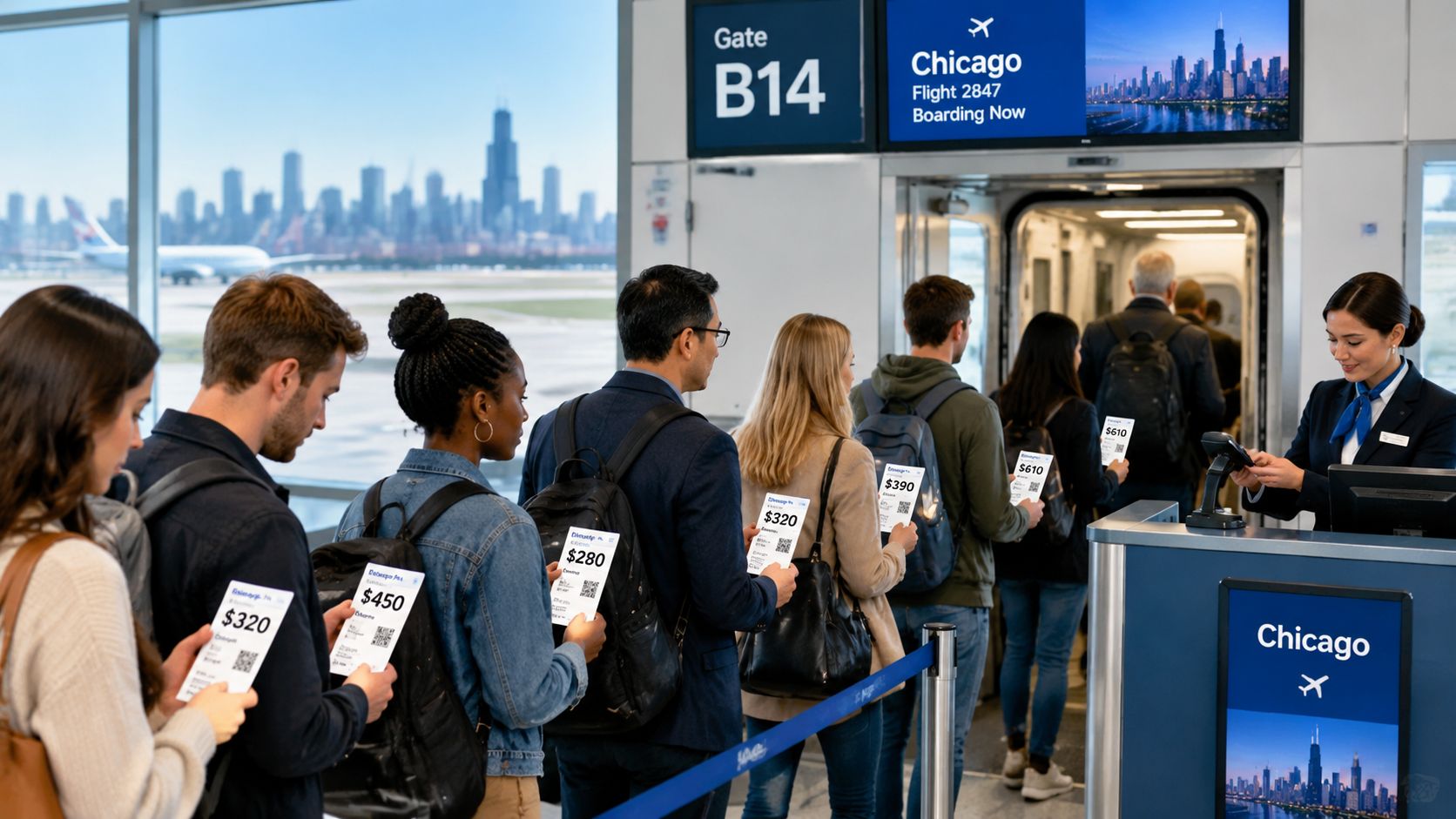
One passenger is a flexible business traveler who booked close to departure. Missing the meeting could carry a serious professional cost, and the company's expense policy may cover the ticket. Another is a student traveling home with a fixed budget and several days of flexibility. A family of four is trying to reach a holiday destination, but the total cost matters because the fare applies to several travelers.
Other passengers fall between those extremes. One has a cheaper train available. Another has already paid for a hotel and can't easily change dates. A third is willing to travel through another airport. A fourth values a refundable ticket because plans may shift. Their seats may be physically similar, but their reservation prices differ.
What the theoretical quote would look like
If the carrier could read each passenger's mind, it would quote each one the highest amount that passenger would still accept. It might charge the urgent business traveler more than the student, while offering the family a price that keeps all four seats within their combined budget. The airline would capture the surplus each passenger would otherwise have kept.
The calculation would depend on personal circumstances, alternative transport, urgency, employer reimbursement rules, and the value of arriving at that exact time. That's why the example is a thought experiment. No airline can observe every private constraint with perfect accuracy.
The airline-market discussion of first-degree discrimination describes the concept as an upper bound because carriers can't know every passenger's maximum willingness to pay.
The video below adds a visual explanation of how airline pricing can vary across passengers and itineraries.
Big Data and the Pursuit of Perfect Personalization
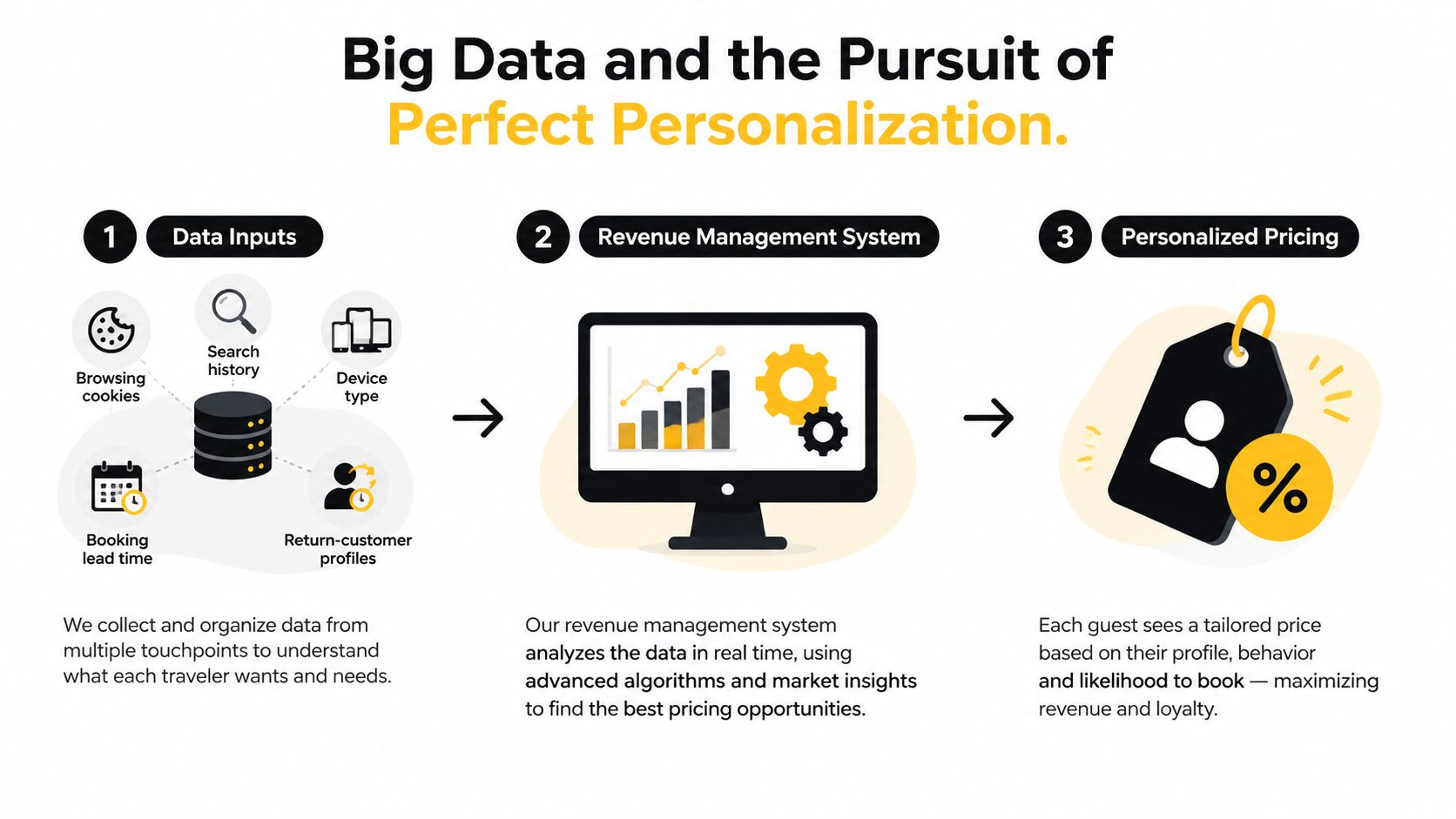
Airlines don't need to know your exact reservation price to move closer to it. They can combine signals that suggest how much urgency, flexibility, loyalty, or purchasing intent you may have.
Common inputs include:
- Browsing cookies: These can connect activity across visits when the technology and permissions allow it.
- Search history: Repeated searches may indicate sustained interest in a route.
- Device type: A booking made through a phone, tablet, or computer can become one input among many.
- Booking lead time: The gap between search and departure can help classify the trip.
- Return-customer profiles: A carrier may recognize an existing customer and use account history.
- Loyalty tier: Membership status can influence the offers and bundles shown.
- Competitive fares: Real-time market prices help a revenue system position an offer.
From signals to a forecast
A revenue management system can turn those inputs into a reservation-price forecast. It doesn't know that you'd pay exactly a particular amount. It estimates whether you're likely to accept a higher offer, abandon the search, choose another cabin, or wait.
Consider a passenger checking the same route three times in one evening. A carrier may interpret that behavior as urgency or high purchase intent and present a less generous offer. That interpretation can be wrong. The passenger may be comparison shopping, checking a route for someone else, or testing whether prices move.
The Brandeis research summarized by Bruegel's analysis of big data and first-degree price discrimination found that web-browsing signals produced a 2.14% profit increase, compared with 0.14% from demographics alone, while only about 42% of the theoretical maximum was attainable. These figures show both the value of behavioral data and its limits.
Why perfection remains out of reach
Data quality creates one barrier. Privacy rules, incomplete profiles, shared devices, deleted cookies, different browsers, and incognito shopping create others. You can also change your behavior after seeing a price, which makes yesterday's signal less useful today.
Personalization is therefore an asymptotic chase. Sellers can improve their estimates, but estimating willingness to pay isn't the same as knowing it. The closer a system tries to move toward a person-specific price, the more it depends on assumptions that can fail.
Hidden City Fares and the Airline Side of Personalized Pricing
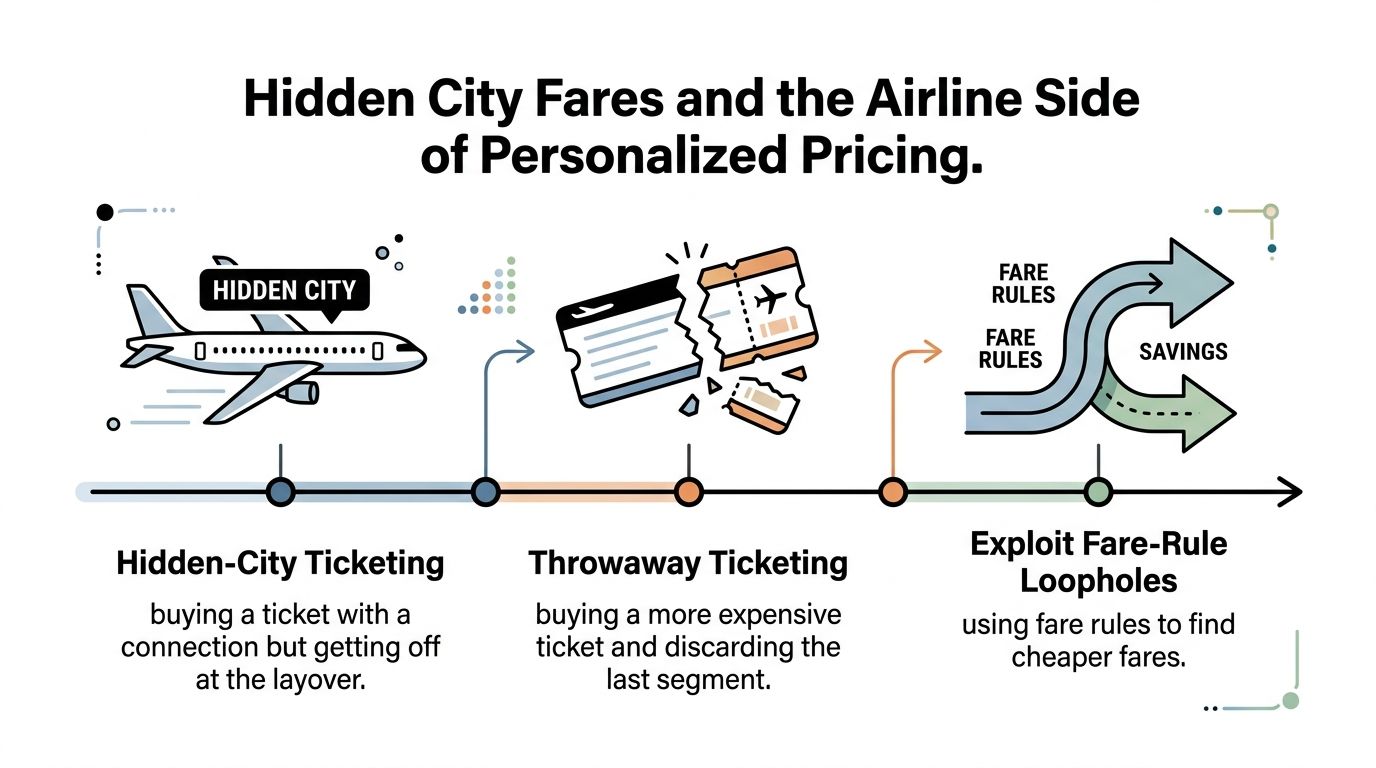
Hidden-city ticketing shows how airline pricing can create opportunities for travelers while serving the carrier's revenue system. It means booking a connecting itinerary and leaving at the connection point rather than taking the final flight. The practice was popularized in the early 1990s and is documented in the book Involuntary Reroute. An audio version of the book is available at I-Reroute.com.
The mechanics are straightforward. A connecting itinerary can sometimes cost less than a nonstop itinerary serving the same broad destination market. A traveler books the longer itinerary, then exits at the connection point. An explanation of hidden-city ticketing mechanics describes how a connecting fare can be priced below a comparable nonstop fare.
A consumer-side mirror
First-degree price discrimination asks how a seller might tailor a price to each buyer. Hidden-city travel reverses the viewpoint. Instead of the airline identifying a traveler's exact willingness to pay, the traveler examines the airline's fare structure and chooses the itinerary that produces the lower price for the trip they want.
That distinction matters. The airline is not charging the passenger their precise reservation price. The traveler is responding to heterogeneous pricing, in which route rules, inventory, restrictions, and cabin arrangements produce different prices for related journeys.
Airlines publicly argue that hidden-city tickets reduce their revenue. At the same time, they may set high prices for premium-cabin seats on nonstop flights, fares that only a small share of flyers will ever pay. If carriers wanted to eliminate hidden-city fares, they could simplify their fare structures. They generally retain complexity because separating customers by route, flexibility, and willingness to pay supports their revenue strategy.
Unsold seats and fare complexity
The airline-side explanation is that complex fares help carriers allocate seats among customers with different willingness to pay. A premium seat left empty produces no passenger revenue after departure. Carriers therefore use restrictions, bundles, loyalty offers, and less transparent sales channels to find a buyer without reducing every displayed fare.
According to the account describing the claimed Babson origin of hidden-city and point-beyond fares, the practice was first institutionalized on the Babson College campus in the early 1990s and later chronicled in Involuntary Reroute. That is a claim about the practice's history, rather than settled evidence that airlines created the method.
The broader lesson is easier to establish. Airline pricing is not one public number. It is a layered system that combines route rules, inventory controls, and customer segmentation. Hidden-city travel exposes a gap between the textbook ideal of personalized pricing and the messy fare combinations travelers encounter in search results and inbox offers.
Whether Personalized Pricing Always Hurts Travelers
The usual criticism is easy to understand. If an airline can identify your maximum willingness to pay, it can take more of the surplus you'd otherwise keep. In the pure theoretical model, the seller captures all consumer surplus, while the buyer receives none.
That distributional result doesn't answer every practical question. A personalized system can misread a traveler, offer a discount to someone it believes is unlikely to buy, or create a bundle that gives a customer useful flexibility at a price they consider acceptable.
Efficiency and distribution aren't the same
First-degree discrimination can remove the inefficiency associated with leaving mutually beneficial sales undone. If the seller knows each buyer's value and sells whenever that value exceeds the relevant cost, more transactions can occur. The problem is distribution. The seller receives the gains, while consumers lose the bargaining surplus that made the purchase feel like a deal.
| Outcome | Uniform Pricing | First-Degree Pricing | Net for Travelers |
|---|---|---|---|
| Seller's price | One posted fare | Individual quote at estimated maximum willingness to pay | Comparison becomes harder |
| Consumer surplus | Some buyers keep a gap between value and price | Theoretical model leaves none | Travelers lose bargaining surplus |
| Seller's surplus | Captures part of available value | Captures the entire consumer surplus | Airline gains more from each sale |
| Uncompleted purchases | Some willing buyers may decline the single price | Personalized offers can reach more buyers | Some travelers may gain access |
| Information balance | Buyer can compare a common public price | Seller uses private signals about the buyer | Transparency may fall |
The traveler's experience can vary
A price-sensitive leisure traveler may feel targeted when a fare rises after repeated searches. A corporate traveler whose employer reimburses the ticket may care less about the personal cost, even though the airline's estimate of willingness to pay is higher.
A 2024 theory paper gives a more nuanced result. For rational consumers, first-degree price discrimination can raise consumer surplus only when there are no search frictions. Naive consumers may benefit unless search costs become extremely high. The 2024 theory paper on personalized pricing and consumer surplus
That doesn't make personalized pricing harmless. It means the outcome depends on search ability, information, competition, and how accurately the seller predicts the buyer. Some customers may welcome a customer-specific bundle, while others would rather receive one transparent fare and keep the option to compare.
How Travelers Can Spot and Respond to Personalized Offers
First-degree pricing only works well when the seller knows more about your willingness to pay than you do about the seller's pricing process. You can't see the airline's model, but you can reduce the information it receives and compare the resulting offers.
Use this quick checklist before buying:
- Repeat the search cleanly. Clear cookies, open a private browsing window, or switch browsers. Compare the same route and date after changing the browsing context.
- Change the device. Check the fare on a phone and a computer. A difference doesn't prove personalization, because inventory and timing can change, but it gives you another reference point.
- Compare locations carefully. A VPN location can provide another comparison, although taxes, currency conversion, payment rules, and local fare restrictions may change the result.
- Check the same itinerary across channels. Compare the airline website, a reputable booking platform, and a phone agent. Save the fare conditions as well as the headline price.
- Watch for account-specific language. “Just for you” banners, one-off promotional codes, or an offer that disappears when you log out are signals worth checking.
- Document before purchase. Capture the fare, restrictions, baggage terms, refund rules, and change conditions. Fare rules, not your suspicion about an algorithm, govern what happens after payment.
Read the offer, not only the number
A lower fare may remove a bag, seat choice, refundability, or flexibility. A higher offer may include benefits that change the total value. Compare the complete itinerary and conditions, not just the base fare.
You can also check award calendars, call the airline, compare nearby dates, or wait and recheck when your schedule allows. Don't assume that waiting guarantees a lower price. The point is to create more than one reference before accepting an individualized-looking offer.
Booking discipline: Treat every displayed fare as an offer with conditions, not as a verdict on what your trip is worth.
If a price changes, save timestamps and screenshots, then compare the same fare class and rules. That evidence won't prove first-degree price discrimination, but it will help you identify ordinary inventory changes, bundled benefits, or account-specific promotions.
INVOLUNTARY REROUTE (I-REROUTE.COM) offers podcast episodes and membership content about hidden city ticketing, AD75 agency discounts, mileage redemptions, point-beyond fares, and airline pricing tactics. Visit INVOLUNTARY REROUTE (I-REROUTE.COM) to explore the audio catalog and learn how premium-cabin and leftover-seat pricing can shape the fares travelers see.