


What Is Premium Pricing? an Airline Insider’s Guide
September 7, 2026The popular advice is simple: premium pricing means charging more because the product is better. That definition is incomplete, especially in air travel. Airlines don't price a seat only according to its cost, comfort, or distance. They build a pricing system designed to separate customers by urgency, flexibility, perceived value, and willingness to pay.
A premium fare may buy a larger seat and better service, but it can also reflect refundability, schedule convenience, nonstop travel, corporate policy, or the customer's inability to wait. The same physical seat can carry several prices because the airline is selling different conditions around it.
That's why airline pricing often looks irrational. A nonstop flight can cost more than a connecting itinerary that travels through the same destination. A flexible ticket can cost far more than a restricted one, even when both passengers occupy identical seats. These outcomes aren't accidental. They're products of premium pricing, fare segmentation, and revenue management.
Introduction Beyond the High Price Tag
Premium pricing is a revenue tool, not merely a luxury signal. In practical terms, it places an offer above comparable alternatives and uses the price to communicate quality, exclusivity, trust, or reduced risk. The University of Missouri Extension's explanation of premium pricing describes it as the highest-price strategy, used when a product has unique characteristics and customers are relatively price-insensitive because they value its benefits.
That separates premium pricing from an ordinary markup. Raising prices to recover higher costs does not, by itself, create a premium position. The strategy works when customers believe the extra charge represents something meaningful, such as superior performance, privileged access, convenience, reputation, or confidence that the purchase will deliver.
Airlines apply this logic as a core part of revenue management. They do not need every passenger to accept the highest fare. They need the right passenger to accept it. A business traveler facing an important meeting may pay for a refundable ticket, a convenient departure, or a nonstop route, while a leisure traveler chooses a lower fare for the same physical seat. Fare conditions let the airline sell both options without offering every customer the same deal.
Price becomes part of the product
Price itself can signal value. In luxury goods, a high price may reinforce scarcity and status. In specialized services, it can suggest expertise and reliability. In aviation, a high fare may include flexibility, priority, schedule protection, or access to a cabin that many travelers will not select.
The NielsenIQ definition of premium pricing describes a price above similar offerings that conveys exclusivity and superior quality. Airlines use that difference to monetize time, flexibility, and reduced disruption risk, rather than competing only on seat cost.
This structure also creates openings for informed travelers. If an airline prices an itinerary around a passenger's origin, destination, urgency, and flexibility, the fare may reflect the market it is targeting rather than the physical flight alone. That logic helps explain why some travelers examine routing rules and hidden city options, although those tickets carry airline-policy and missed-connection risks.
Ask what the extra charge buys. A wider seat, better meal, or lounge may justify the difference for one traveler. A refund, useful schedule, or lower disruption risk may justify it for another. If the premium mainly signals status, the price may be doing more psychological work than functional work.
Practical rule: Treat fare conditions as part of the product. The seat is only one component of what the airline is selling.
The Psychology of Paying More
A higher fare does not automatically mean a better flight. It often reflects how the airline frames value, risk, and urgency, then presents those factors as a choice between products. Travelers respond to the signal before they can test the service.
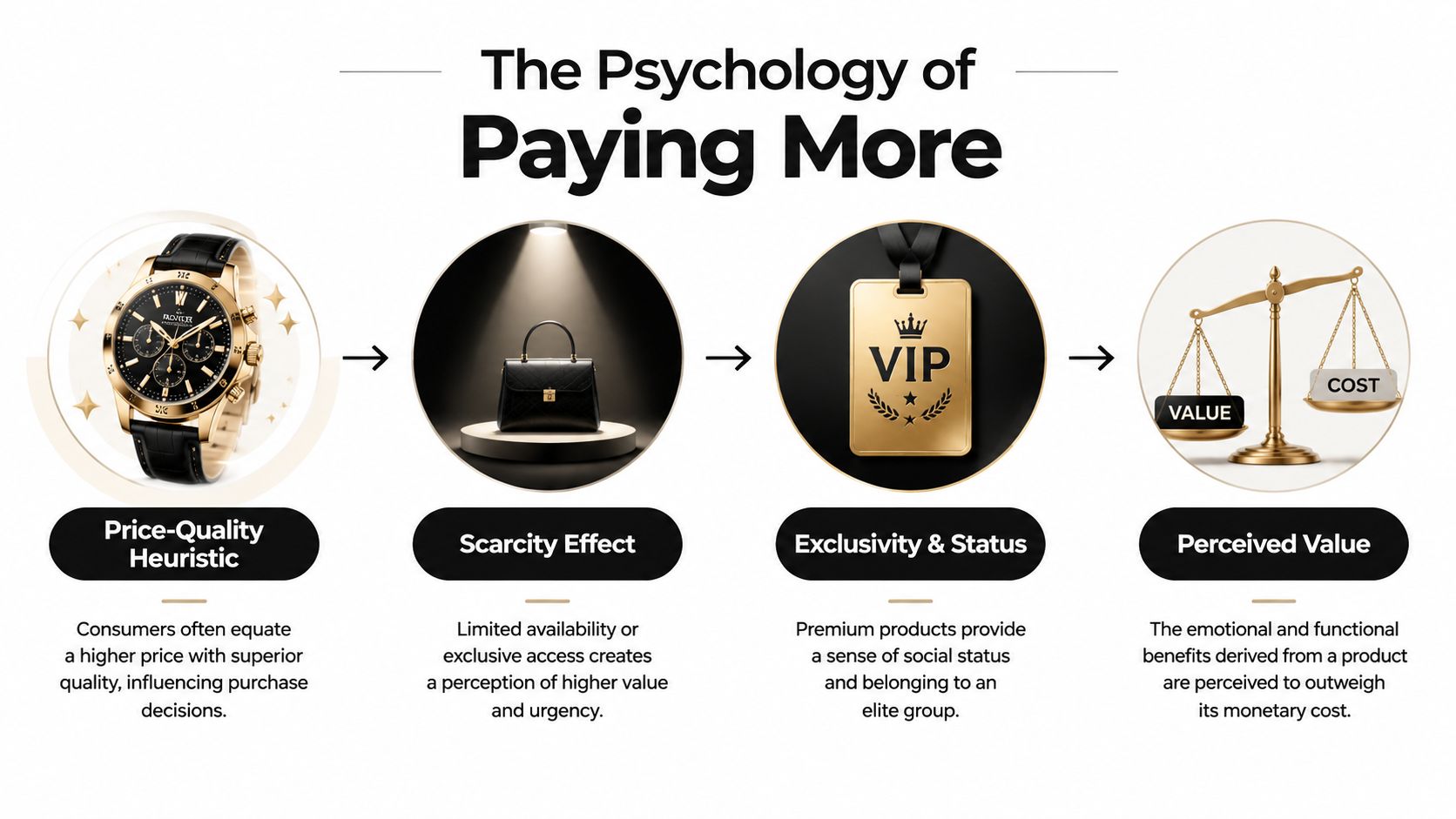
The price-quality heuristic explains part of that response. With incomplete information, buyers may read a higher price as evidence of better quality. An expensive watch can appear more carefully made, while a luxury vehicle may seem more dependable or refined. A costly bottle of wine can feel appropriate for an important dinner even when the buyer cannot assess every characteristic independently.
Scarcity strengthens the effect. Limited availability makes the risk of losing access feel immediate. Exclusivity adds identity and belonging, so the purchase becomes a statement about the buyer's position relative to other customers.
Why premium feels safer
Premium pricing can lower perceived risk. A customer may pay more because the offer appears more dependable, easier to fix, or less likely to produce an unpleasant surprise. Travel makes that calculation concrete. A missed connection, restrictive ticket, or poor schedule can disrupt the entire trip.
Airlines build around that anxiety with a ladder of choices. A basic fare emphasizes price. A higher fare emphasizes flexibility, while a premium cabin combines comfort, priority treatment, and time savings. The same aircraft can therefore support several prices, each aimed at a different concern.
Premium pricing conveys exclusivity and superior quality, but the strategy depends on customers accepting a price gap for benefits they consider credible. If the benefit does not matter, the premium becomes an arbitrary surcharge rather than a useful product difference.
The risk for buyers appears when the signal becomes stronger than the evidence. A premium label can create confidence, yet it cannot guarantee that the service will match the price. On one itinerary, flexible rules may protect a valuable schedule. On another, the same label may add little that the traveler will use.
The airline version of status
Airlines combine several psychological triggers in one offer:
- Quality signal: A premium cabin suggests a more comfortable or attentive experience.
- Scarcity signal: Limited premium inventory encourages faster decisions.
- Status signal: Priority boarding, lounge access, and cabin separation make the purchase visible.
- Risk reduction: Flexible rules and better support can matter when plans change.
- Time value: A nonstop flight or useful schedule may matter more than the seat itself.
These signals can be legitimate, but legitimacy does not make every premium worthwhile. The buyer must connect the charge to a specific benefit. A traveler with uncertain plans may be buying protection against change. A traveler focused only on reaching the destination may be paying for status, comfort, or access that will have little practical value.
Use the fare's conditions as the test. If the price buys flexibility, schedule control, or meaningful recovery options, it may solve a real problem. If it mainly creates a feeling of prestige, compare the emotional signal with what the itinerary delivers.
How Airlines Engineer Premium Fares
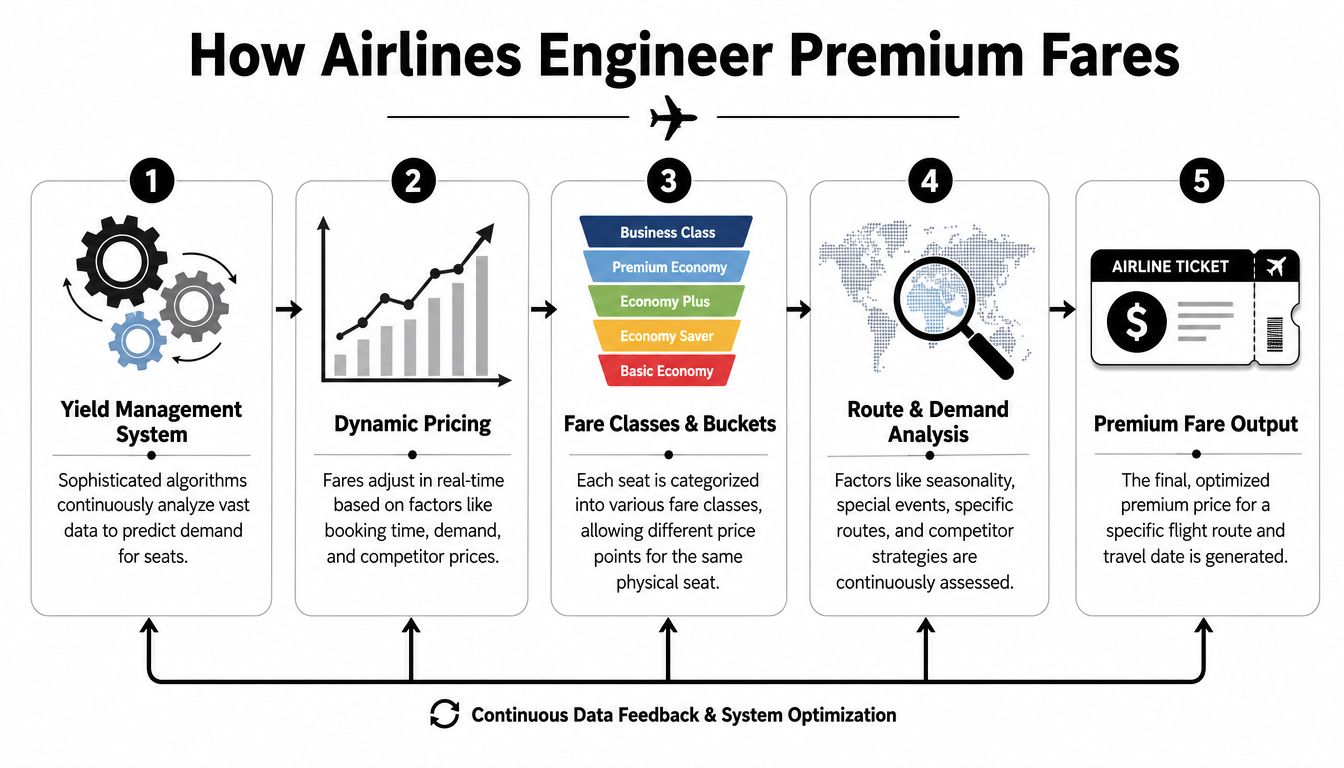
Airline premium pricing begins with inventory, not with a fixed price tag. Revenue-management teams divide seats into booking classes and fare buckets, then open or close those buckets as demand changes. The letters vary across carriers, but the principle is consistent: several customers can occupy the same aircraft cabin while purchasing different restrictions and prices.
The airline forecasts demand for a route, estimates how many travelers may buy at each price level, and protects inventory for customers who appear likely to pay more. That process is commonly called yield management or revenue management. It's less about assigning a cost to each seat and more about deciding which customer should receive access at which fare.
Fare buckets separate customers
Suppose an airline has a limited number of seats remaining. It may keep a low fare available for a traveler who books early and accepts restrictions, while reserving higher fare classes for a traveler who needs to book late, change plans, or fly at a particular time.
The airline uses fences to prevent every customer from buying the cheapest option. These fences can include:
- Advance-purchase requirements, which appeal to planners but frustrate urgent travelers.
- Minimum-stay rules, which make a fare less attractive to some business passengers.
- Refund restrictions, which push flexibility-seeking customers toward higher fares.
- Connecting-flight conditions, which allow a carrier to price nonstop convenience separately.
- Cabin and service differences, which create a visible premium product.
The McKinsey analysis of airline premium cabins notes that premium cabins can account for 20% to 30% of total airline revenue in some networks. The same analysis describes booking controls and fare fences as mechanisms that let airlines charge different customer segments different prices for similar seats, a practice known as price discrimination.
Why the fare can seem backwards
Distance isn't the only variable in airline pricing. Competition at each endpoint, demand from each market, connection patterns, and schedule preferences can matter more than the miles flown. An airline may price a nonstop flight aggressively because it faces direct competition, while pricing a connecting itinerary differently because that itinerary belongs to another competitive market.
This is why the displayed fare can feel disconnected from operating cost. The airline isn't asking, “How much fuel and labor does this passenger consume?” It's asking, “Which fare will this passenger accept, and what other passenger might buy this seat later?”
The airline's product isn't just transportation from one airport to another. It's a bundle of time, rules, availability, cabin access, and perceived certainty.
Premium pricing succeeds when the airline can maintain a credible difference between the options. It fails when customers discover that the added payment buys little beyond a name, a priority lane, or a seat that doesn't solve their real problem. The same system that extracts more revenue from high-value demand can also generate pricing inconsistencies that informed travelers notice.
The Unintended Consequence Hidden City Fares
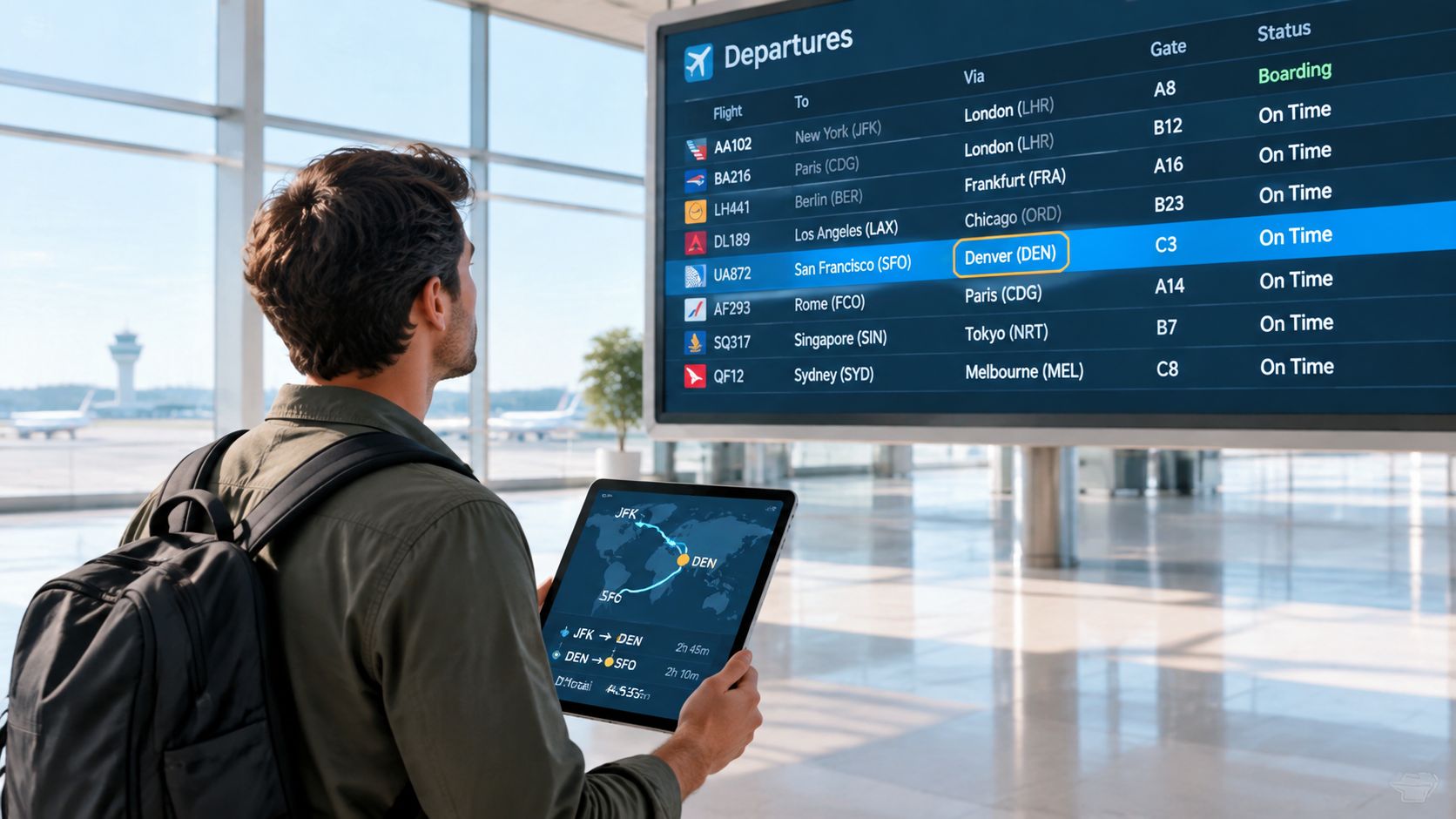
Airline pricing can make the “wrong” destination cheaper. A hidden city ticket is a connecting itinerary from A to C that stops in B, where B is the traveler's actual endpoint. The traveler books the complete A to C journey, exits at B, and skips the final segment.
The pricing logic is deliberate. Airlines set fares around competition, demand, and network relationships at each endpoint, not solely around distance. A nonstop ticket from A to B may cost more than a connecting ticket from A to C that passes through B. The difference reflects how the airline separates markets and protects different fare levels.
Our work at I-Reroute.com, chronicled in the book Involuntary Reroute, traces the institutionalization of hidden city fares back to the Babson College campus in the early 1990s. The book discusses hidden city tickets, hidden city fares, and point beyond fares, with an audio version also available through the site.
The airline-created opportunity
The contrarian point is straightforward: airlines create the conditions for hidden city fares through their own revenue-management systems. They price indirect itineraries to sell inventory across separate markets, sometimes leaving a connecting fare below the nonstop fare for the traveler's intended city. A passenger who spots that structure can use the lower-priced itinerary, although the airline may object to the way it is used.
A Stanford study of hidden-city opportunities found that these opportunities appeared in about 17% of markets among major U.S. airlines under the GAO's 2001 threshold definition. The definition used a $100 difference in high fare classes and $50 in low fare classes. Those figures describe the study's historical threshold, not a current saving that every traveler should expect.
A peer-reviewed transportation economics paper on hidden-city pricing explains that these fares emerge when airlines reduce the price of indirect flights to compete with direct service on the same route. The gap comes from route competition and fare strategy. It is not necessarily a booking-engine error.
The contradiction is built into the model. Airlines criticize hidden city ticketing because it can divert revenue from a higher-priced itinerary, yet their own fare structures can place a substantial premium on nonstop travel and premium cabin inventory. Fewer than 15% of all flyers will ever pay the cited premium-cabin fares. Simplifying the fare structure could reduce these opportunities, but it would also limit the airline's ability to price different markets separately.
Watch the embedded explanation for another perspective on how these pricing structures create the opportunity:
The risk belongs to the traveler
The lower fare does not cancel the airline's contract. CNBC's coverage of skiplagging risks reports that airline terms prohibit reservations intended to circumvent fare rules, including tickets booked without the intention of flying every segment.
Operational details matter. Hidden city travel generally requires attention to baggage, itinerary order, missed segments, and schedule changes. Checked luggage may continue to the ticketed destination instead of stopping at the intermediate airport. Missing one segment can also cancel later segments on the same reservation.
Hidden city pricing shows the practical consequence of premium pricing. Airlines segment demand to protect revenue, and that segmentation can expose gaps between comparable itineraries. The opportunity belongs to the fare structure, while the contractual and operational risk remains with the passenger who chooses to use it.
Your Playbook for Navigating Premium Travel
Smart booking starts by separating premium value from premium presentation. Before paying more, identify the benefit you'll use. Is it a larger seat, a schedule that protects a business commitment, the ability to change plans, or access to a route that avoids an inconvenient connection?
Then compare the full fare conditions, not just the headline price. Two tickets can look similar in a search result while carrying very different rules for changes, refunds, baggage, seat selection, and missed segments.
Use the airline's logic against overpayment
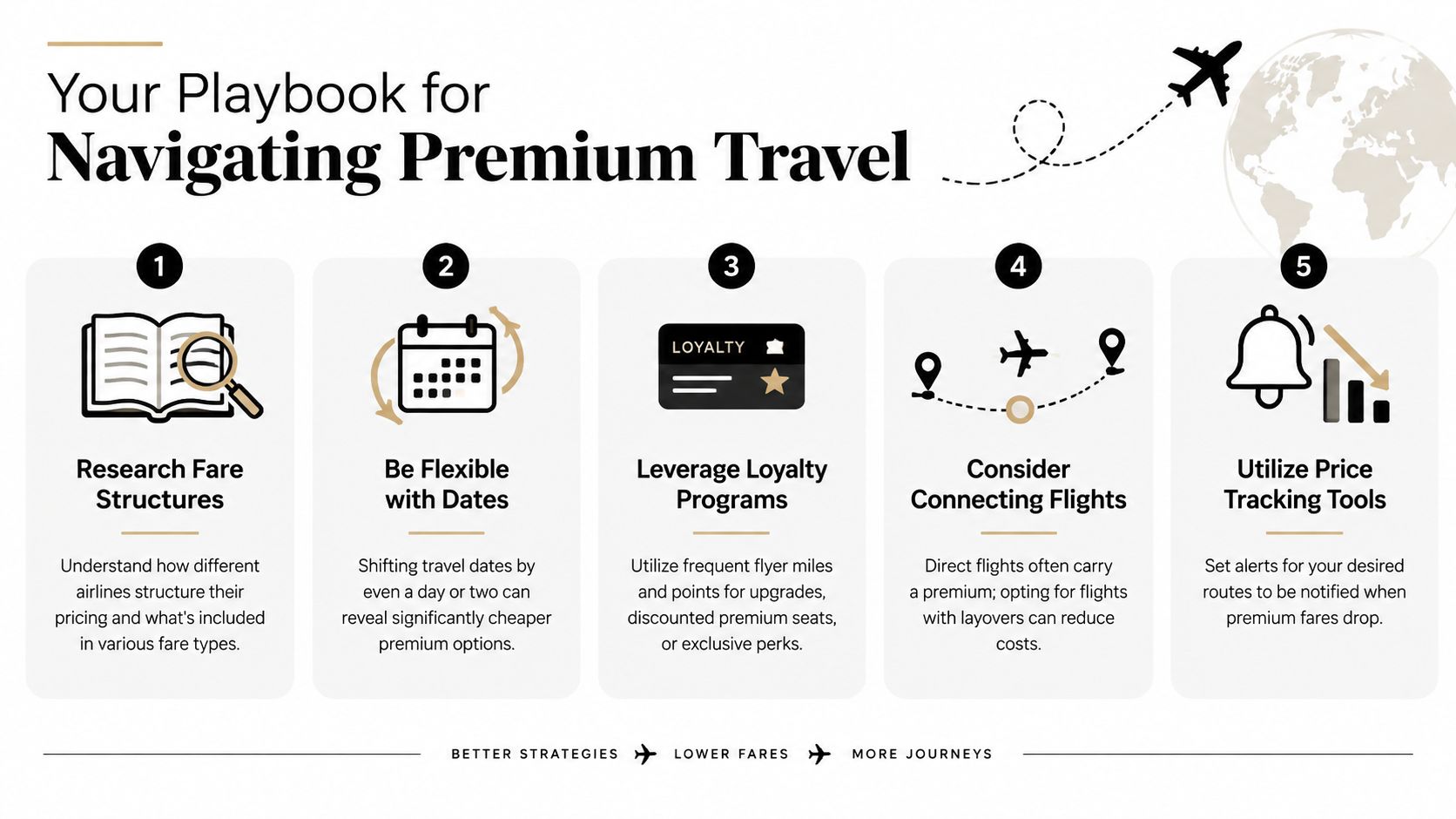
Start with the route rather than the cabin. Search nearby dates, alternative airports, and both nonstop and connecting options. A connecting itinerary may cost less because it competes in a different market, while a nonstop itinerary may carry a premium for convenience and schedule value.
Flexibility is one of the most reliable tools available to a traveler. A small change in departure or return timing can expose a different fare bucket. Don't assume the first attractive result is the airline's final offer.
Use loyalty programs carefully. Miles, points, upgrades, and status benefits can change the value calculation, but they shouldn't distract from the cash price and the restrictions. An upgrade is useful when it solves a real need. It's less useful when it merely confirms that the airline's premium framing influenced the purchase.
A buyer's checklist
- Read the restrictions: Confirm advance-purchase, refund, change, and minimum-stay rules before comparing fares.
- Price the schedule: Decide what your time is worth, then compare that value with the nonstop premium.
- Track the route: Use price alerts and repeated searches to learn the normal range for your itinerary.
- Check the connection: A lower fare may involve a longer journey, tighter timing, or greater disruption exposure.
- Audit the cabin benefit: Verify what the premium cabin includes on that aircraft and route.
- Treat hidden-city options cautiously: Never assume a pricing anomaly is risk-free, particularly when baggage, return travel, or schedule changes are involved.
NielsenIQ's current Western Europe FMCG findings show why proof matters in premium markets. The report says 56% of consumers believe premium products must justify their price through clear features or performance, 60% are willing to pay more for high-quality products, and 59% believe premium is worthwhile only when it delivers better outcomes than standard alternatives. Those figures come from NielsenIQ's analysis of premium pricing in Western Europe FMCG, not airline-specific research, but the buying principle transfers well.
Ask for evidence from the fare itself. If the premium delivers flexibility, time, comfort, or protection you value, it may be rational. If it only creates the feeling that you're choosing the “proper” option, keep comparing.
Conclusion Pricing Is a Game You Can Learn to Play
Premium pricing isn't a high price attached to a better seat. It's a system for signaling value, sorting customers, controlling inventory, and capturing different levels of willingness to pay. Airlines use fare buckets, restrictions, cabin design, and route competition to turn one aircraft into multiple products.
That system can work for travelers when the premium buys something concrete. It can also produce confusing gaps, including hidden city fares and point beyond fares, because airlines price markets rather than individual passengers' actual journeys.
KPMG's luxury-market findings show the pressure on premium brands to balance exclusivity with customer resistance. In its report, 42% of surveyed luxury companies kept prices stable, while 39% increased prices to target a premium customer base, as described in the KPMG report on luxury in the midst of change. The same tension appears in airline cabins. Charge too little and revenue is lost. Charge too much and customers challenge the value.
INVOLUNTARY REROUTE (I-REROUTE.COM) offers podcast episodes and membership resources about hidden city ticketing, point beyond fares, premium-cabin pricing, mileage redemptions, and related airline practices. Visit INVOLUNTARY REROUTE (I-REROUTE.COM) to sample the available content and learn how to evaluate confusing fare structures before you book.