


When to Book Flights: Timing Rules by Route and Cabin
October 28, 2026Domestic fares were lowest, on average, about 38 days before departure, based on Google's 2025 holiday travel analysis. For international trips, Google's figures put the cheapest average point around 101 days out, with low prices beginning about 50 days or more before takeoff. These averages differ by trip type and season, so no single booking day works for every traveler.
Use the booking window that fits your route, season, and flexibility. If losing a specific flight or premium seat would be costly, waiting for a lower fare may not be worth the risk. Booking is a buy-or-wait decision, not a calendar superstition.
Booking Windows by Trip Type at a Glance
For U.S. domestic trips, average fares reached their low about 38 days before departure. The historical low-price range ran from 21 to 52 days out, according to Google's September 2024 analysis of U.S. origin travel. For international trips from the United States, the average low came about 101 days ahead, and the broader low-price range began 50 or more days out. Prices generally rose inside the final 50 days.
How to Read the Table
Match your trip to a row, then use the low-price range to guide when you start monitoring. The average point is a reference, not a guaranteed best day. For domestic flights, begin watching at least 60 days ahead so the fare is already on your radar when the historical low-price window opens.
| Trip type | Cheapest average booking point | Typical low-price range | What to watch |
|---|---|---|---|
| Domestic U.S. flights | About 38 days before departure | 21 to 52 days out | Begin monitoring at least 60 days ahead |
| International from the U.S. | About 101 days before departure | 50 or more days out | Fares generally rise inside the final 50 days |
| Thanksgiving travel | About 45 days ahead | 26 to 59 days | Holiday peak, compare fares within the range |
| Christmas travel | About 58 days ahead | 36 to 72 days | Holiday peak, begin monitoring early |
| Spring break (March to April) | About 44 days ahead | 33 to 59 days | Popular destinations may have less room to wait |
| U.S. to Europe | About 94 days in advance | 50 or more days out | Long-haul, start watching early |
| Mexico and Caribbean | About 44 days before departure | 33 to 59 days out | Short-haul leisure, similar to spring break |
Holiday and seasonal averages vary by trip type. Thanksgiving, Christmas, and spring-break travel each have different low-price windows, so a single domestic booking rule may not fit them. Regional patterns also differ: U.S.-to-Europe trips tended to reach their average low earlier than Mexico and Caribbean trips. Treat these ranges as planning guides, not promises for a particular route.
Practical rule: Start monitoring domestic fares at least 60 days ahead and international fares at least two months ahead. For holidays or limited premium-cabin availability, start earlier and buy when the fare fits your budget and the remaining wait risks losing the flight you want.
Averages combine many markets. A sold-out festival weekend, a thin regional route, or a route with only one daily nonstop can behave differently from the broader pattern. Use the range to decide when to watch, then weigh the fare against your flexibility and the cost of waiting.
Set two dates: when monitoring begins and when you will buy if the fare has not fallen further. The second date turns a broad historical range into a decision rule for your trip.
Whether the Day You Click Matters
The day you click and the day you fly are different levers. The evidence for the click day is weaker and less consistent than the advice built on it suggests.
Expedia's 2025 Air Hacks report analyzed average economy round-trip ticket prices for January through October 2024 and reported that Sunday was the least expensive day to purchase, with domestic travelers saving about 6% and international travelers 17% compared with the report's higher-priced comparison days. Don't treat that as a reason to sit on a good fare until Sunday. It's an average across a large global sales database, not a promise for your route or cabin.
Departure Day Moves More
The same report gives you a more usable test. Saturday was up to 17% cheaper than Sunday for domestic travel, while Thursday was up to 15% cheaper than Sunday internationally. Before you commit, price the identical route departing one day earlier and one day later. Keep the airline, connection pattern, and fare type as similar as you can, so you're comparing timing rather than a worse itinerary.
- Check the neighbor dates: Price Saturday against Sunday domestically and Thursday against Sunday internationally.
- Shift only for real money: Move your date when the saving beats extra hotel, parking, or leave costs.
- Protect the schedule: A cheaper departure that forces a risky connection or a missed event isn't cheaper in any useful sense.
Trip length also limits what these benchmarks can tell you. Much of the round-trip methodology behind common booking windows rests on standard leisure trip lengths, so one-way tickets, very short hops, and long stays deserve a directional reading only. For those, your own tracked fares on your exact dates carry more weight than any national average.
Use purchase day as a tiebreaker. If you're already inside your booking window and two fares sit within a few dollars, buy when it suits you rather than waiting for a weekday effect that may not appear in your market. Chasing a rumored click day while prices rise or seats vanish is the expensive version of this myth.
Timing by Traveler Type
Your flexibility sets your rhythm. Two travelers on the same flight should often book on different days because they face different costs if they wait.
Five Booking Rhythms
Families on fixed school dates. Lock inside the holiday or spring-break window for your trip. School calendars compress demand into the same departures, and you usually need seats together, sane times, and bags included. Waiting for a late dip risks splitting the group or paying more for a worse day.
Flexible leisure travelers on domestic economy. Start monitoring three to seven weeks out and buy when the fare reaches the lower part of your low-price range. You can accept a nearby date or an alternate airport, so patience has value. It stops having value once the remaining saving is smaller than the cost of losing a convenient departure.
Business travelers with fixed meetings. Book inside the domestic range, but rank nonstop choice and change flexibility above the last small price move. A fare you can change without a painful fee protects the meeting when the client moves it. The cheapest restricted ticket is a poor trade if one schedule change forces a new purchase.
International travelers with fixed dates. Start watching at least two months out and be ready to act before the final stretch, when fares have tended to rise in one major dataset. Another large sales dataset points to a much later sweet spot, which tells you the market matters more than the slogan. Track your exact route and let its current fare, not a global claim, make the call.
Budget travelers who can move. A late booking can be rational if you can shift dates, accept connections, fly at off-peak times, or drop the trip entirely. Expect thinner choice in seats, nonstops, and bag-inclusive fare families. Your flexibility is the asset. If you can't use it, you're not running a strategy, you're just late.
The right question isn't how long you can wait. It's what you lose, concretely, if the fare rises or the seat you need sells.
Buy or Wait Rules for Each Situation
Start with the verdict, then test the reason against your trip.
| Situation | Verdict | Why |
|---|---|---|
| Fare already inside the domestic low-price range | Buy now | Waiting adds risk for a small expected saving |
| Fixed dates over Thanksgiving, Christmas or spring break | Buy early, inside the holiday window | Holiday lows sit near 44 to 58 days out, and waiting past them adds risk |
| Flexible domestic economy trip, two or more months out | Wait and monitor | The low-price range is still ahead |
| International trip with fixed dates, inside 50 days | Buy now | Fares generally start rising in the final 50 days |
| Premium cabin on a constrained route | Buy when a seat is available at an acceptable price | Premium inventory is limited and can sell out |
| Nonstop only, popular route | Buy at the first acceptable fare | Nonstop seats can sell out first |
The pattern below shows how travelers usually compare options before they decide whether waiting is still worth it.
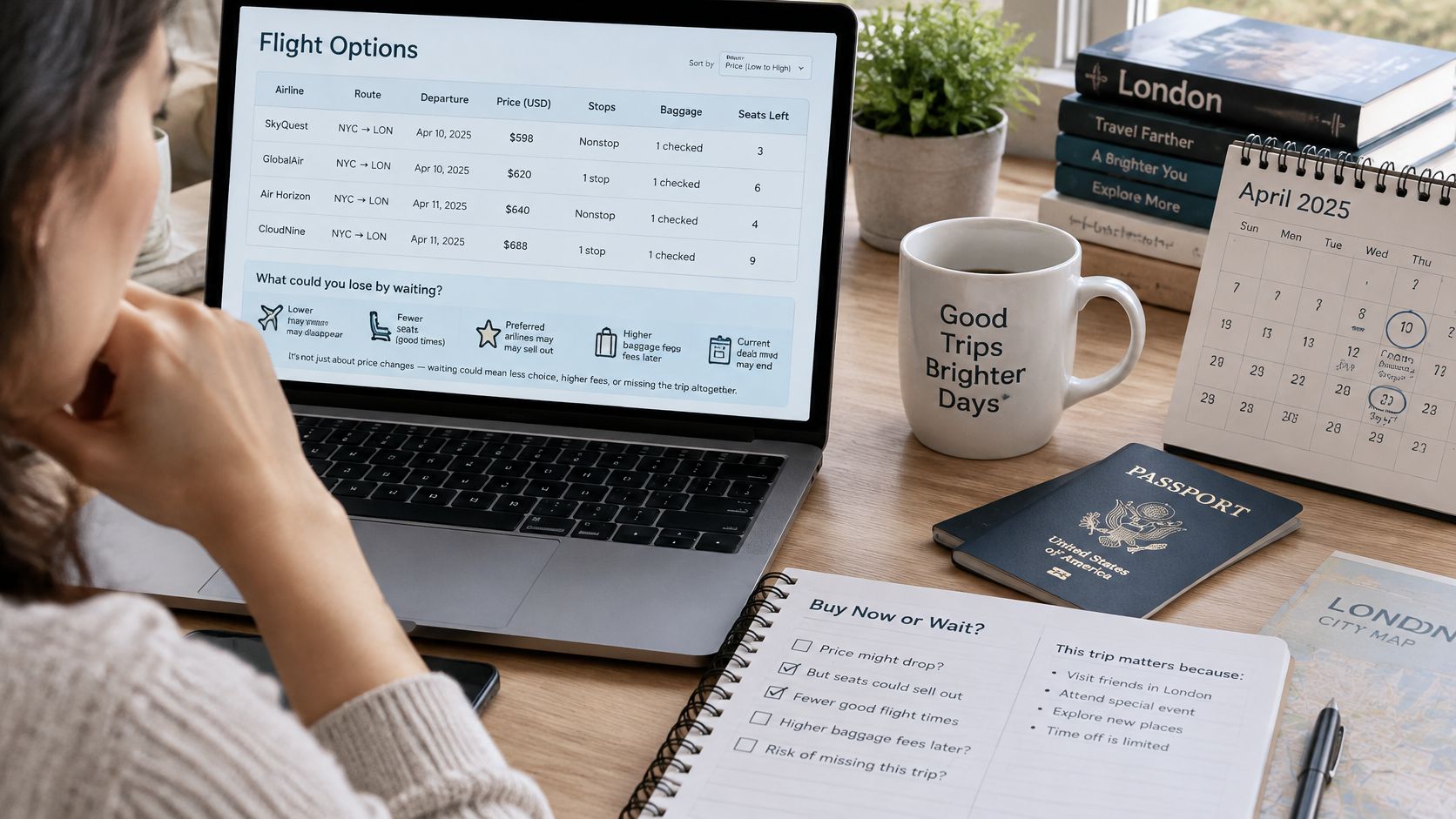
Test the Verdict Against Your Case
Say you're flexible, domestic, and two months out. Waiting is sensible because your low-price range hasn't opened yet and you can take another departure if this one reprices. Say instead you're fixed on an international date and already inside 50 days. Waiting now has a clear downside and a speculative upside. Buy an acceptable fare.
Price the fare rules before you pay. A refundable or changeable ticket is worth its premium when your dates might move, when you booked early and want room to rebook a later drop, or when a schedule failure would cost more than the upgrade. It isn't worth it when the date is locked and the premium eats the entire expected saving.
When Late Is Rational, and When It Isn't
Late booking is common enough that calling it a mistake in every market misses how people travel. Skyscanner's 2025 global outlook found that 53% of travelers booked more than a month ahead, but nearly half booked less than a month before departure and almost one in five booked within seven days. In the Middle East and North Africa, 59% booked less than 30 days ahead, including 24% within seven days.
That behavior can be deliberate. A traveler who can take a connecting flight, use a second airport, or travel midweek may accept late choice limits in exchange for keeping plans open. Visa timing, uncertain leave, and local booking norms can make a short window practical rather than careless.
What late booking can't do is preserve choice. Seat selection shrinks, nonstops fill, family seating gets harder, and the fare family that includes a checked bag may sell through. For a holiday peak or a must-attend event, that loss of choice is the cost, even if a headline fare occasionally dips. Judge late booking by flexibility you can use, not by hope.
Premium Cabin Timing and Airline Pricing Logic
Premium cabins follow a different pricing logic from economy. Airlines protect premium seats because an unsold seat brings in no fare, while discounting early can leave no room for a later traveler willing to pay more. The balance between filling seats and preserving higher fares helps explain why premium prices may stay firm even when some seats remain open.
What That Means for Your Timing
On a constrained route, check nonstop premium options early. There are fewer seats and departures, and only a handful of seats may be available at the lowest premium fare or as awards. Waiting for an economy-style dip can leave you with a poor connection or a fare above your budget.
Run two checks before you buy:
- Compare the upgrade gap: Price premium and economy on the same route and dates. Include bags and seat fees you would otherwise pay.
- Check mileage award space first: An award seat can cost less than the cash premium fare, and award availability can disappear on a different schedule from cash fares.
Compare a nonstop in a lower cabin with a connecting premium itinerary, too. A lie-flat seat with a long layover and misconnect risk may be worth less than a direct flight that gets you there rested and on time. Value the whole journey, not just the cabin label.
I-Reroute.com argues that airlines say hidden city tickets deprive them of revenue while setting premium fares on non-nonstop flights that fewer than 15% of all flyers will pay. Treat the 15% figure as the publisher's claim, not independent evidence. Airlines' incentive to protect premium pricing comes from the risk of selling seats too cheaply before higher-paying demand arrives, balanced against the cost of leaving seats unsold.
Your buy trigger is availability at an acceptable total price, not a date on a chart. If the nonstop, cabin, and refund terms you need are available within budget, the cost of waiting is concrete. A possible small drop may not justify losing that option.
Hidden City Tickets as a Timing Tool and Their Risks
A hidden city ticket prices a trip from origin A to destination C through hub B. A traveler whose actual destination is B leaves the airport there and skips the final flight to C. The fare gap between a connecting itinerary and a ticket to the hub creates the opportunity, but it does not make the itinerary risk-free.
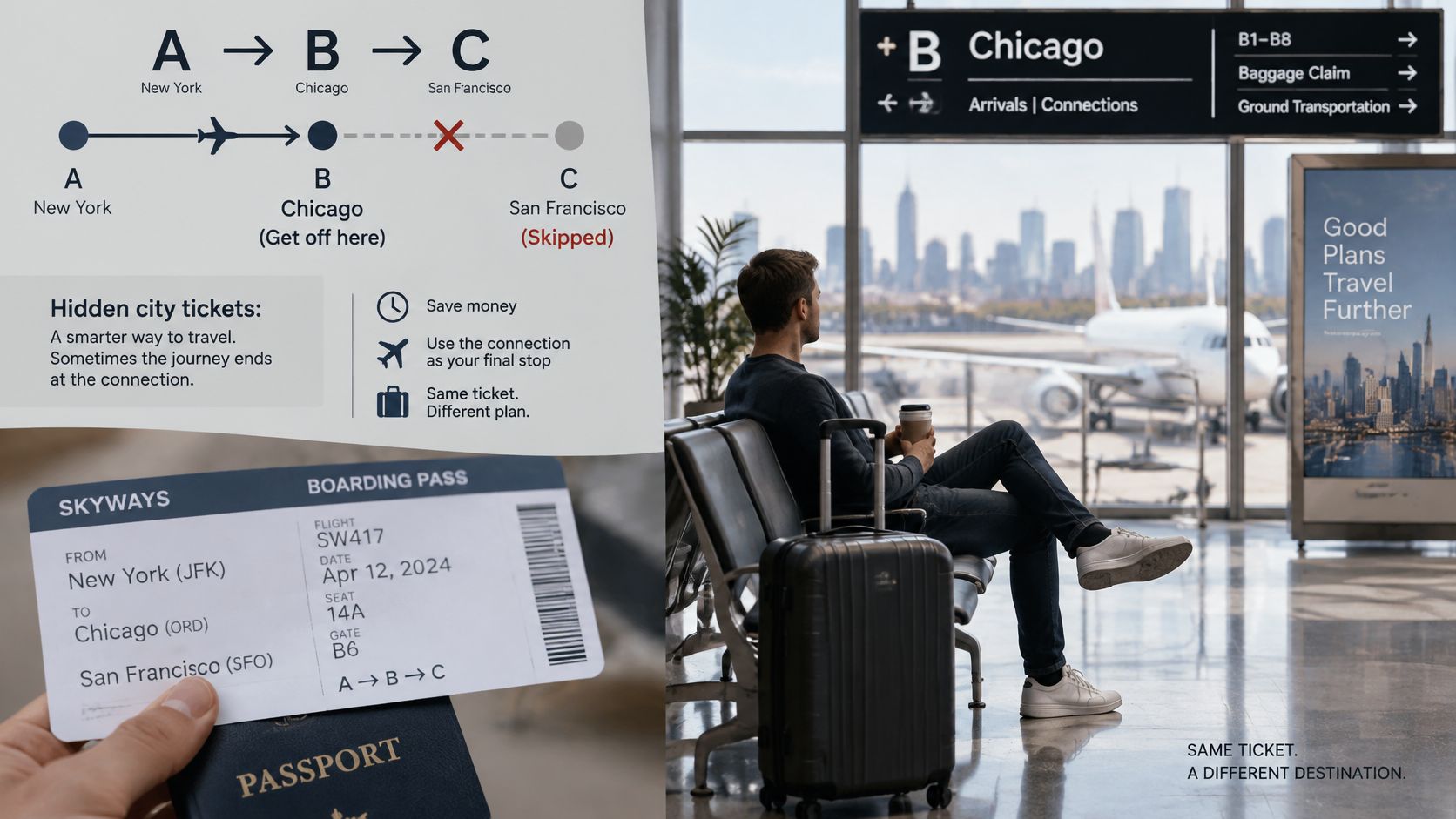
The connecting airport is the hidden city: the passenger's intended stop differs from the destination printed on the ticket. The U.S. Government Accountability Office report on hidden-city ticketing explains the practice and notes that airlines generally prohibit it in their contracts of carriage, the transportation agreements and carrier rules tied to a ticket.
The Publisher's History and Argument
Hidden city ticketing exploits gaps in connecting fares, where an itinerary through a hub can cost less than a ticket to the hub itself. Airlines generally prohibit the practice in their contracts of carriage, as the GAO report explains. That pricing gap may make the tactic appear useful as a timing tool, but the lower fare comes with contractual and practical risks.
Involuntary Reroute and I-Reroute.com present hidden city fares as a consequence of airline pricing: connecting itineraries can be priced below a local journey to the hub, creating an opportunity for travelers willing to leave the itinerary unfinished. The publisher argues that these fares use seats that might otherwise go unsold, while airlines say hidden city ticketing deprives them of revenue.
I-Reroute.com also argues that airlines could reduce the opportunity by simplifying fares, but have no incentive to do so. These are competing explanations of the pricing and its effects. For a traveler deciding whether to use the tactic, the practical point is clearer: a fare that looks like a bargain depends on ignoring part of the ticketed itinerary, and airlines may enforce their rules.
The short video below adds context on how the tactic is presented and debated.
The Risks You Carry
The savings come with risks the traveler carries, not the airline.
- Remaining segments can be cancelled: If you skip a leg, the airline will typically cancel the rest of the itinerary, including your return.
- Checked bags don't work: A checked bag is tagged to the ticket's final destination, not the hub where you intend to leave.
- Accounts are exposed: Under its rules, an airline can pursue fare differences or close a frequent flyer account for a contract breach.
- Irregular operations can reroute you: A disruption may send you through another hub, removing the stop you planned to use.
Treat a hidden city ticket as a poor fit for trips where arriving at a particular place or time matters. A wedding, cruise departure, or last flight home before work leaves little room for the airline to change the itinerary or cancel remaining segments. A lower fare cannot offset that risk if missing the intended stop would disrupt the trip. Timing does not make a prohibited ticket safe.
Monitoring Routine and Buy Trigger
Use a route-specific range, not a calendar-day rule. Google's five-year analysis found the lowest average domestic fares about 39 days before departure, with lower fares occurring across a broader window 21 to 52 days out. That benchmark is a starting point, not a promise for an individual route. Begin monitoring domestic fares three to seven weeks before departure, then buy when the fare reaches your acceptable range and the schedule and fare rules work for you.
Set Up the Routine
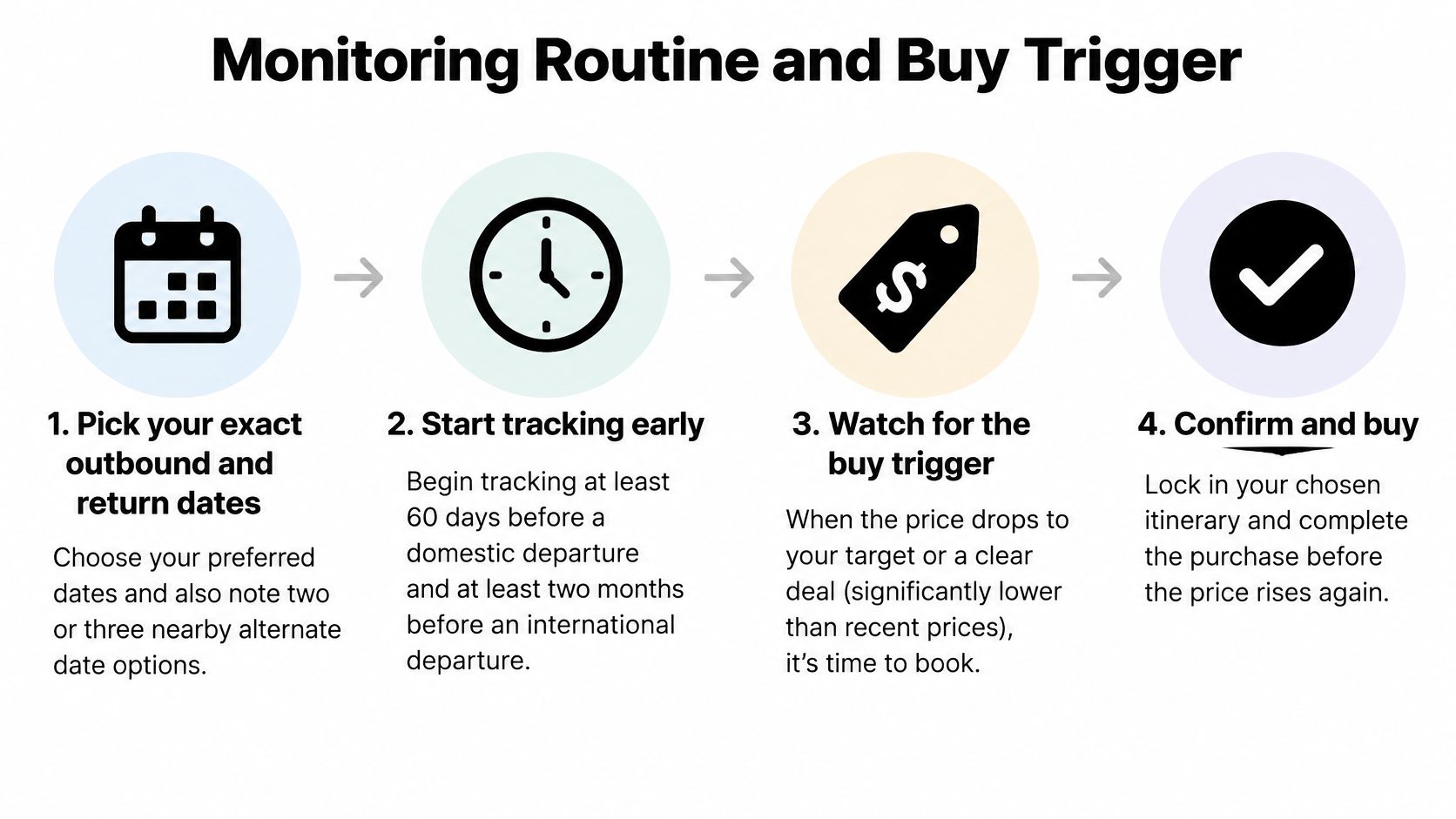
Choose your outbound and return dates, plus two or three nearby alternatives. Alternate dates give you options if one day becomes more expensive. Tracking only fixed dates can show a price change, but it cannot help you act on it.
Start tracking domestic fares three to seven weeks ahead and international fares at least two months ahead. Early tracking gives you a baseline for your route. You can compare later prices with what you have seen instead of reacting to the first fare.
Turn on Google Flights price tracking and check the calendar grid. Track your exact itinerary, then scan nearby dates in the same view. Add alerts for alternative dates as well as your first choice.
Keep a simple fare record. Note the check date, airline, departure times, total price, and whether bags and seat selection are included. A low headline fare may cost more once those items are added.
The four-step graphic summarizes the routine to repeat each week.
Set the Trigger and the Deadline
Compare each fare with your benchmark. For domestic trips, use the low-price window above alongside your own tracking history. Buy when the total fare enters the lower part of that range, provided the change and refund rules suit your needs.
Compare total trip costs, not just ticket prices. Include baggage, seat selection, airport transfers, parking, and the cost of a less convenient departure time. If a pre-dawn flight requires an extra hotel night, that expense can erase its apparent saving.
Set a trigger price and a firm deadline. The trigger is the highest total fare you are willing to accept without reopening the decision. Set a domestic deadline at 21 days out, and book an international trip with fixed dates no later than 50 days out. Buy when your trigger is met or the deadline arrives, whichever comes first.
Don't wait for the exact average day. A single-date target can leave you exposed to sold-out seats or later price increases, without guaranteeing a lower fare.
A broad benchmark can hide differences between routes, seasons, available capacity, and event dates. One-way, unusually long, remote, or highly seasonal itineraries may not follow the same pattern, so use your own route history and be ready to act earlier when your dates leave little room to adjust.
Check weekly until the price enters your range, then check more often. When a fare meets your trigger, review the fare rules, total cost, and schedule once more before buying. If the trigger never appears, the deadline still gives you a clear point to stop waiting.
Write down your trigger price and deadline. A decision made in advance helps keep price monitoring focused on whether this particular fare fits your trip, rather than on finding one universally perfect booking day.