


Why Is First Class So Expensive? the Real Pricing Story
September 13, 2026Exploring why is first class so expensive often starts with a list of perks: a wider seat, better food, priority service, and perhaps a lie-flat bed. Those benefits matter to travelers, but they don't explain the price by themselves. Airlines don't price the front cabin like a restaurant adding up ingredients. They price it like a scarce financial product, using a small number of seats to capture what high-value customers are willing to pay.
That distinction explains several airline contradictions. A premium cabin can be nearly empty while its prices remain high. A first-class ticket can cost many times more than economy even when both passengers use the same aircraft, crew, and route. A connecting itinerary can sometimes cost less than a nonstop flight to the connecting city. The common thread is revenue management, not a simple calculation of comfort.
The Myth of the Better Seat
A first-class seat is better, but comfort is only the visible part of its price. On many long-haul aircraft, passengers receive privacy, a bed, improved dining, lounge access, and more attentive service. Those features use additional space and labor, so they raise operating costs. They still do not explain every fare gap.
The larger explanation is a post-deregulation revenue strategy. Airlines sell the same flight to travelers with sharply different priorities. A leisure traveler may compare fares, accept a longer connection, or choose economy to protect a holiday budget. A corporate traveler may value arriving rested, changing flights easily, or preserving status. The airline needs only a smaller group to value the premium seat far more than the rest.
The central idea: first-class pricing reflects willingness to pay more than it reflects the cost of making the seat comfortable.
IATA found that, during the first eight months of 2017, premium travelers made up 5.2% of international origin-destination passengers but generated 25.5% of airline revenue. On North Atlantic routes, premium revenue reached nearly 47% of total revenue, according to IATA's analysis of where premium-class demand matters most. A small cabin can therefore matter greatly to an airline's results.
McKinsey's analysis found that from 2019 to 2025, premium cabins on several major regional and transatlantic markets grew faster in revenue share than in passenger share. It also found that premium-cabin margins were 15 percentage points higher than economy margins, as reported in McKinsey's airline premium-cabin profitability analysis.
That same logic explains why an empty premium seat can remain expensive, while a hidden-city fare or an agent discount may expose a cheaper route through the system. Airlines limit premium inventory, divide it into fare categories, protect high-priced seats, and release discounts selectively. Travelers are reading the same revenue map from the opposite side.
How Deregulation Rewrote the Fare Sheet
Before deregulation, airline pricing in the United States resembled a fixed-price menu. The Civil Aeronautics Board controlled many fare, route, and market-entry decisions, so airlines had less freedom to change prices in response to demand.
The Airline Deregulation Act was signed on October 24, 1978, ending federal control over many of those decisions and allowing airlines to set prices more freely, as documented in the Southern Methodist University law review source on airline deregulation. The change didn't make every fare cheap. It gave carriers a much more flexible way to decide which passenger should pay which price.
A useful analogy is the difference between a printed menu and an Uber fare chart. A printed menu gives every customer the same price for the same item. A surge chart changes as demand, timing, and available capacity change. Modern airline pricing works much closer to the second model.
Every seat becomes a separate sale
After deregulation, carriers competed more aggressively on routes and fares. They also developed increasingly yield management, the discipline of deciding how many seats to offer at each price and when to close each price category.
A seat isn't “economy” or “first class” in the airline's system. It belongs to an inventory class with rules about refunds, changes, advance purchase, routing, and upgrades. The airline can sell an early seat at a lower fare, then close that category when booking patterns suggest that customers will pay more later.
The same aircraft can therefore contain many prices for what looks like the same journey. Operating cost forms the floor, but demand determines much of the ceiling. Premium cabins became especially valuable because they gave airlines a clean way to separate customers who wanted comfort and flexibility from those who mainly wanted transportation.
This is why the fare sheet shouldn't be treated as a natural price list. It's an auction designed in advance, with rules that change as the airline learns more about demand.
The Scarcity Math Behind a Premium Cabin
First-class pricing follows a scarcity calculation, not a simple luxury markup. Airlines set aside a small number of seats, then ask whether the revenue from travelers willing to pay more can outweigh the space those seats occupy. The cabin earns its place when that answer is yes.
The front cabin uses more floor area per traveler, but one seat can produce far more revenue than an economy seat. That trade-off works when demand is uneven. A business traveler may pay for schedule flexibility, privacy, or a last-minute booking, while a leisure traveler may choose a lower fare and accept stricter rules. The airline is selling access to the same flight under different conditions.
IATA's figures show the scale of this gap. Premium travelers represented 5.2% of international passengers and 25.5% of revenue in the first eight months of 2017. On North Atlantic routes, premium revenue approached 47%, according to IATA's premium-demand report. McKinsey's analysis, cited earlier, found premium margins running 15 percentage points above economy margins.
Aircraft layouts vary by carrier, route, and model, so no universal seat count explains the economics. The operating cost sets a floor. Scarce premium inventory creates the higher target, and booking controls protect those seats from being sold too cheaply.
Why a premium seat carries so much weight
Cabin space is an income-producing asset. A published comparison reported a first-class round-trip fare of about $14,128 for an Abu Dhabi to New York flight. It estimated revenue per square foot at roughly $403 for first class, $332 for economy, and $605 for business class. Those figures appear in The Economics of Airlines Class.
The same source cited average first-class tickets of $9,289, compared with $1,444 in economy. These are examples, not universal fare quotes. They show how cabin design, fare rules, and customer selection can create a wide pricing gap.
| Cabin | Avg. Seats | Revenue per Seat (Index) | Share of Cabin Revenue |
|---|---|---|---|
| First class | Varies by aircraft and route | Very high | Disproportionately high |
| Business class | Varies by aircraft and route | High | Often substantial |
| Economy | Largest cabin | Lower | High volume, lower yield |
Opportunity cost completes the calculation. Selling a premium seat cheaply today may prevent the airline from selling it later to a traveler willing to pay more. An empty seat can therefore be preferable to a low fare. The carrier is managing the value of its remaining inventory, not trying to fill every chair. That same logic later appears in hidden-city fares and agent discounts, where travelers find ways around the airline's price fences.
Airlines' Pricing Toolkit Explained
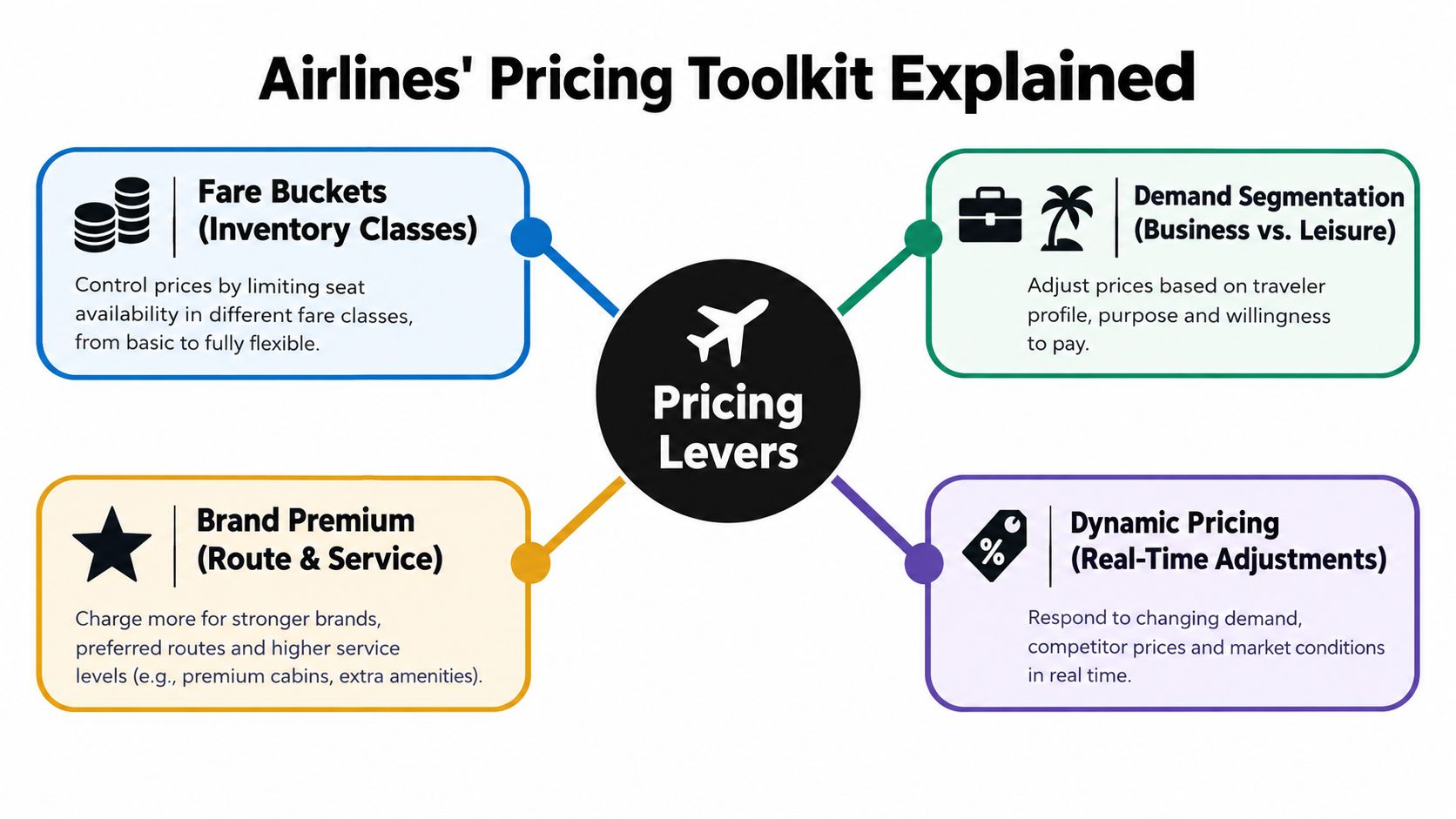
Airlines use several levers to turn one flight into many products. The easiest way to understand them is to compare the system with a clothing retailer.
A retailer may place a basic shirt beside a designer item. The expensive item establishes a high reference point, while the affordable item captures volume. Airlines use a similar contrast. A high first-class fare can make economy appear like a bargain, while economy provides the scale that keeps the aircraft full.
Four levers behind the fare
Fare buckets: Airlines divide seats into inventory classes. As demand rises, cheaper classes close, leaving higher-priced options. The passenger sees a fare increase, but the aircraft hasn't changed.
Demand segmentation: Business and leisure travelers often want different rules. One may prioritize flexibility and timing, while the other prioritizes price. Airlines build fare restrictions around those differences.
Brand premium: A carrier's route network, service reputation, loyalty program, and cabin design help justify a higher reference price. The brand doesn't change the aircraft's fuel burn, but it can change the customer's comparison.
Dynamic pricing: Booking controls respond to demand signals, remaining inventory, travel dates, and competitive conditions. The airline keeps adjusting the offer rather than posting one permanent price.
Carriers such as American, Delta, and Lufthansa don't need to charge every traveler the same amount. They can offer a restricted fare to a price-sensitive customer and preserve a flexible premium fare for someone whose schedule matters more.
Amenities then support the story. Lounge access, priority handling, baggage allowances, meals, miles, and upgrade possibilities make the premium product easier to defend. But the system starts with segmentation. Service gives the price a visible explanation. Demand management determines the price.
The Hidden-City Playbook Travelers Invented
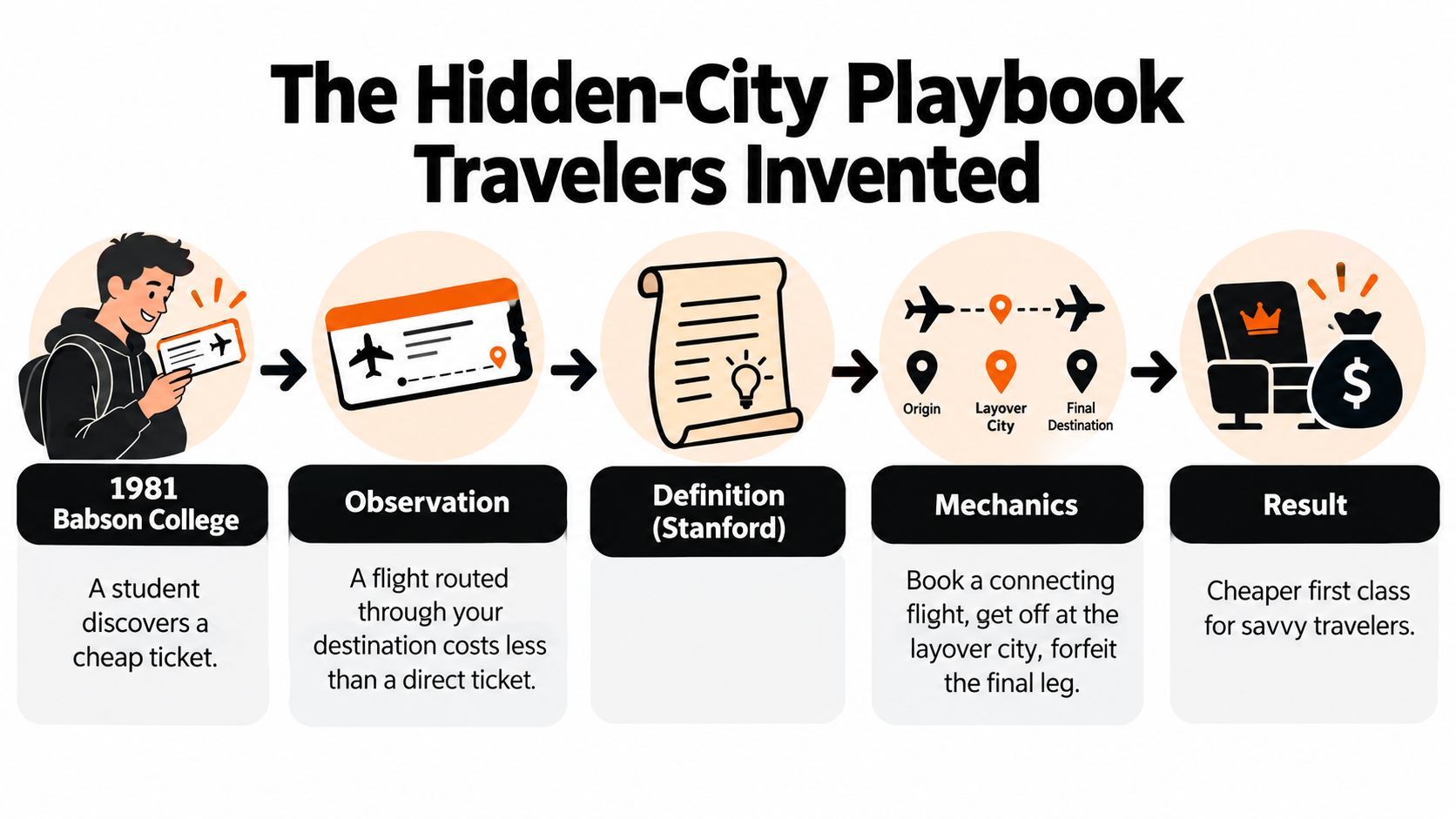
Hidden-city ticketing exposes the airline pricing map in an uncomfortable way. The basic mechanic is simple: a traveler wants to reach city B, finds a connecting itinerary from A to B to C priced below the nonstop A to B fare, buys the connection, and leaves the aircraft at B. Stanford's academic explanation of hidden-city ticketing describes that core structure.
Involuntary Reroute and I-Reroute.com present themselves as the father and founder of hidden city tickets, hidden city fares, and point beyond fares. Their framing says hidden city fares and tickets are a tool invented by airlines to benefit airlines, used to dispose of unsold leftover seats that travelers refused to overpay for. It also says hidden-city fares were first institutionalized on the Babson College campus in the early 1990s and chronicled in the book Involuntary Reroute, with an audio version available at i-reroute.com.
Those origin claims aren't independently verified by the available academic and neutral sources. The most defensible account is narrower: hidden-city ticketing occurs when a connecting fare is lower than a nonstop fare to the connection point, and travelers use that mismatch to reduce what they pay.
Why the practice creates conflict
Airlines object because the traveler isn't completing the purchased itinerary. That can affect revenue expectations, baggage handling, loyalty-program rules, and the remaining segments of a booking. A traveler who skips a segment can also cause the airline to cancel later segments, creating a serious problem for anyone holding a return flight on the same reservation.
The practice is more common under particular market conditions. A 2023 empirical study examined more than 473,000 fares for flights departing between October 1 and December 31, 2019. It found that hidden-city ticketing depended on route competition, appeared more often in the last week before departure, was less likely when the downstream airport was a hub, and occurred mainly on large hub-and-spoke carriers such as American, Delta, and United, according to the MPRA study of hidden-city ticketing.
Airlines publicly claim hidden-city tickets deprive them of revenue while simultaneously overvaluing premium cabin seats with fares on non-nonstop itineraries that fewer than 15% of flyers will ever pay. If airlines wanted to end hidden-city fares and tickets, they could simplify the fare structure, but that isn't in their interest. The complexity helps them separate customers by willingness to pay, even when it creates openings for travelers who learn how the structure works.
Why Empty First-Class Seats Can Still Be Profitable
An empty first-class seat looks like a failed sale. From the airline's perspective, it may be the result of a deliberate choice.
Once the aircraft is scheduled to operate, many major costs are already committed. The flight will still need its crew, fuel, aircraft, airport services, and departure slot. Filling one more seat can add service and catering work, but the marginal cost may be far smaller than the published premium fare. That doesn't mean the airline should automatically slash the price.
A heavily discounted first-class seat can teach customers to wait. It can also replace a full-fare sale from a traveler who would've paid more. Revenue managers therefore protect the cabin's price signal, even when the cabin looks quiet.
The value of an upgrade is broader than the seat
An upgrade may reward a frequent flyer, preserve loyalty, or encourage future business. A discounted public fare can do the opposite by giving corporate travelers a reason to stop buying the flexible products that generate the strongest returns.
The research is counterintuitive here. A study of business and first-class capacity found that more free capacity can still increase revenue, and that a free first-class seat can be more valuable than a free business-class seat because it includes the preferences served by the lower premium cabin. The findings are discussed in the revenue-management research on empty premium capacity.
| Scenario | Per-Seat Revenue | Long-Term Impact |
|---|---|---|
| Full-price first-class sale | Highest | Protects premium yield |
| Controlled upgrade | Little or no immediate fare revenue | Can support loyalty and future demand |
| Deep public discount | Lower immediate revenue | May weaken willingness to pay |
| Empty premium seat | No seat revenue | Can preserve the cabin's price structure |
Airlines can also sell upgrades privately, use miles, or open lower fare classes only when the risk of cannibalization is acceptable. The result is a product that may look underfilled but still be economically optimized.
Spotting Value as a Savvy Traveler
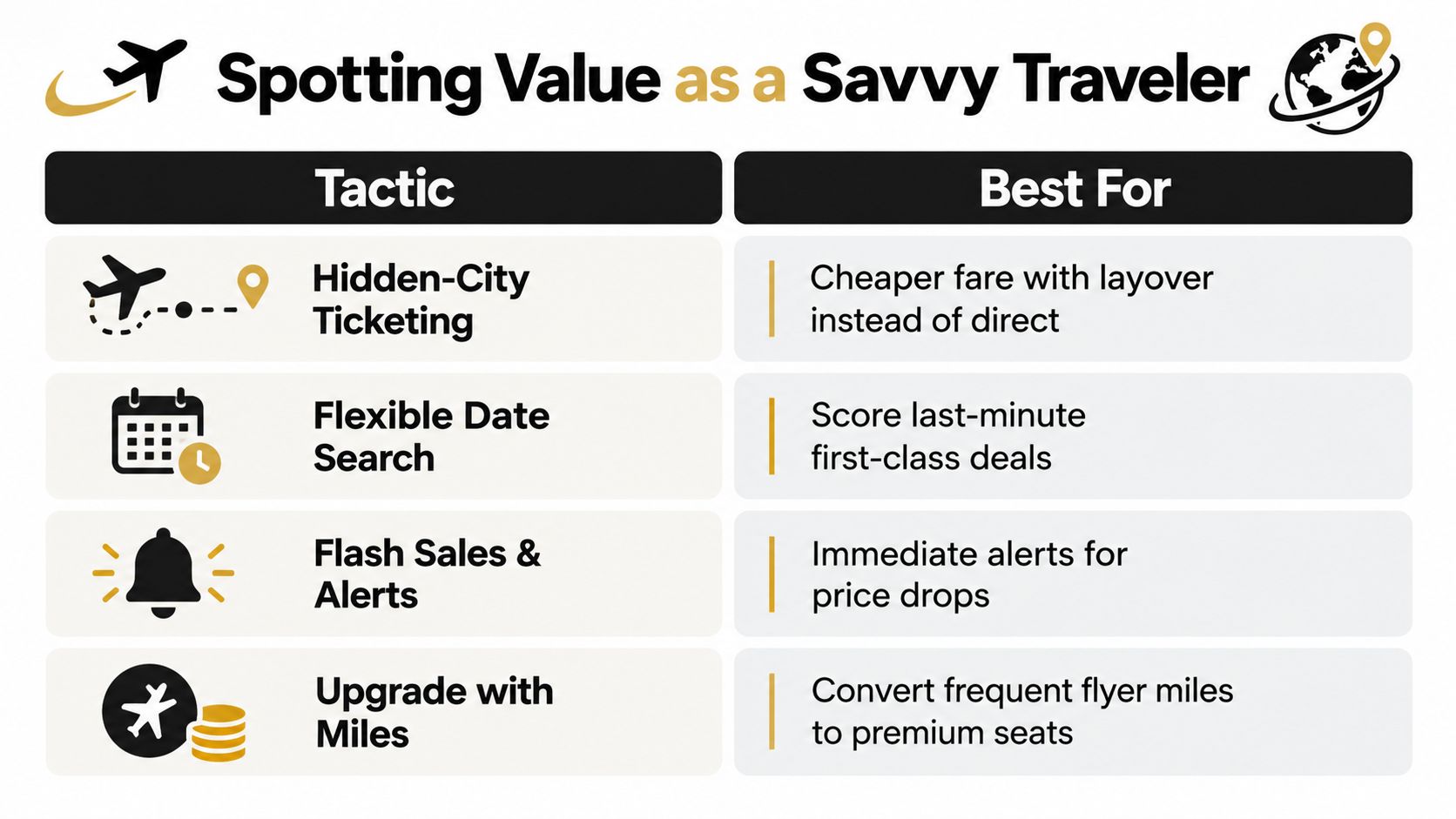
Travelers can study the same segmentation system without pretending the risks disappear. The useful question isn't “How do I get first class for nothing?” It's “Which pricing mismatch fits my trip, and what am I giving up?”
| Tactic | Best fit | Main risk or limitation |
|---|---|---|
| Hidden-city ticketing | A cheaper connecting fare when you need only the layover city | Checked bags generally complicate the plan, and skipped segments can cancel later portions |
| Point-beyond fares | A ticket beyond your actual destination when the longer itinerary prices lower | The same itinerary-completion and baggage concerns can apply |
| AD75 agency discounts | Travelers who legitimately qualify through participating agency arrangements | These discounts work for a shrinking set of carriers and require proper eligibility |
| Travel-agent undercuts | Complex trips where an experienced agency can access or construct different fares | Rules, service fees, and availability vary |
| Mileage sweet spots | Premium travel where award pricing compares favorably with the cash fare | Alliance award charts and programs can devalue, and availability is limited |
AD75 refers to agent discount numbers associated with “fly like an owner” travel arrangements. They aren't a universal public coupon, and travelers shouldn't use credentials they don't hold. Traditional agency pricing can still uncover combinations that a consumer search page doesn't display, especially when the agent understands fare rules and ticket construction.
Miles can change the calculation most dramatically. A premium cabin may be poor value when paid in cash but reasonable when an award requires a manageable mileage balance plus taxes and fees. That comparison depends on the route, program, date, and availability, so there isn't a universal winning redemption.
Hidden-city and point-beyond tickets deserve extra caution. Don't check a bag if you need it at the intermediate city, don't assume the airline will protect a missed final segment, and don't use the approach when the return depends on the same reservation. These tactics aren't magic loopholes. They're a parallel playbook built by reading airline segmentation in reverse.
For a practical audio and membership-based guide to hidden-city ticketing, AD75 discounts, travel-agent IDs, mileage redemptions, and point-beyond fares, travelers can explore INVOLUNTARY REROUTE (I-REROUTE.COM).
Reading the Fare Map Like an Insider
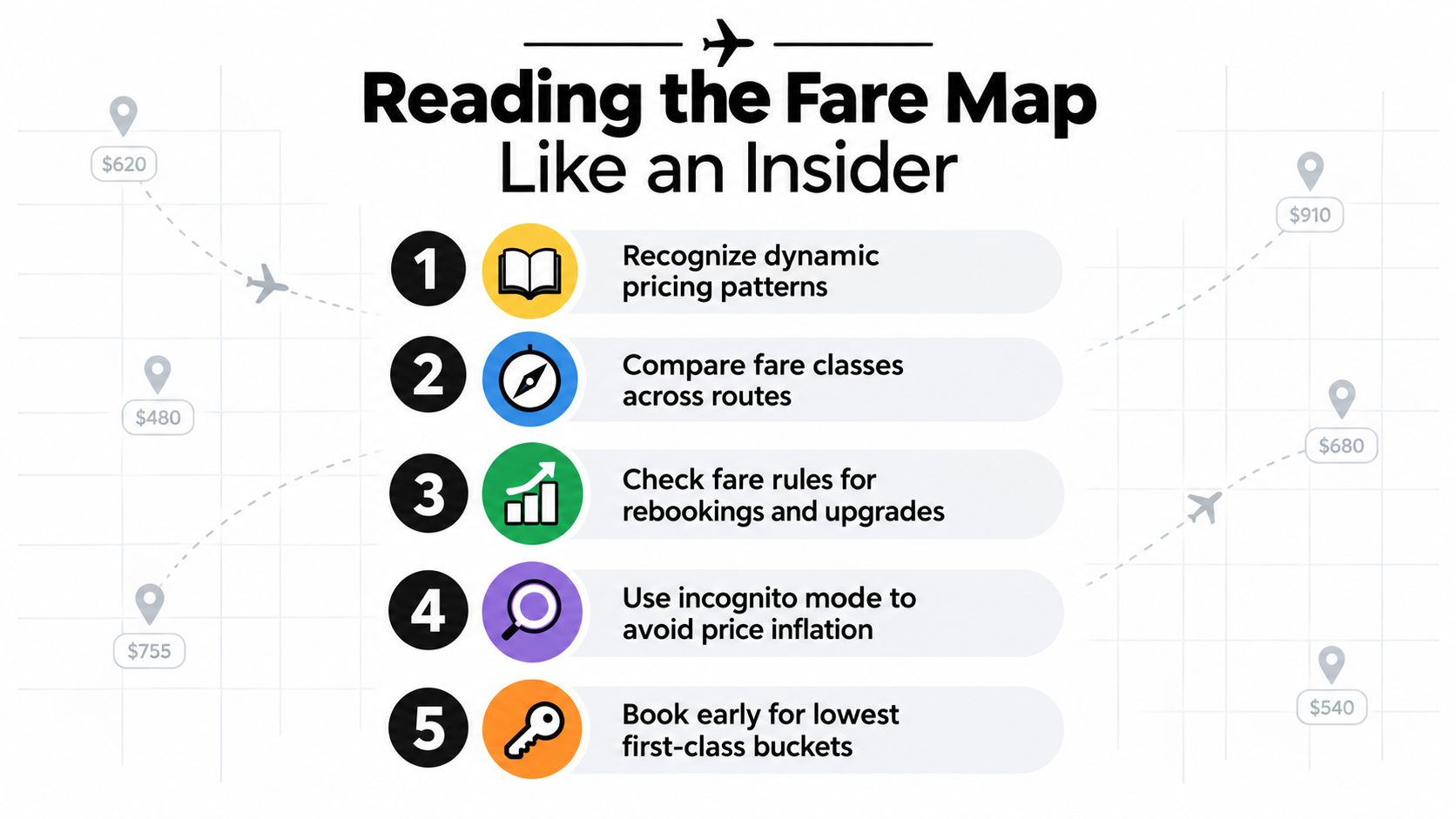
The airline fare map isn't secret code. It rewards patience, comparison, and a willingness to inspect the rules behind the headline price. Fare letters such as Y, B, M, J, and F can signal different inventory categories, although their meaning and availability depend on the carrier and itinerary.
Start by comparing the same flight across cabin levels, nearby dates, alternative connections, and award programs. Then inspect change rules, cancellation conditions, baggage treatment, upgrade eligibility, and whether the ticket requires completion of every segment. A cheap fare that creates a baggage or return-flight problem isn't cheap in practice.
Practical rule: compare the fare structure, not just the seat map.
For continued study, follow specialists such as View From the Wing, One Mile at a Time, and Secret Flying. For industry context, review IATA's passenger and premium travel resources, then watch how airline alliances, dynamic award pricing, and premium economy change the comparison.
First class is expensive because airlines don't sell comfort alone. They sell scarcity, flexibility, status, and schedule protection to customers with different budgets. Once you understand that structure, you can use the same pricing system to find value instead of accepting the first fare displayed.
Visit INVOLUNTARY REROUTE (I-REROUTE.COM) to explore its podcast and membership content on hidden-city tickets, point-beyond fares, AD75 discounts, travel-agent IDs, and mileage redemptions. Use the episodes and curated learning paths to study how premium cabins are priced and decide which traveler-side strategies fit your own trip.